5
III
March 2017
Technology (IJRASET)
Hierarchical Energy Efficient Routing Protocols in
Wireless Sensor Networks: Survey
Shruti. S. Jadhav1, Prof. Vaishali Bodade2
1,2
Computer Engineering, Bharti VidyaPeeth College of Engineering, NaviMumbai, Maharashtra, India
Abstract: Wireless sensor networks have small nodes deployed which have small batteries used for operations which consumes or dissipates more battery. As a solution for this energy efficient routing is best optimal way. An energy efficient routing protocol enhances overall performance of the nodes and there by maintains cost at minimum levels. Wireless sensor networks are very time critical some times in scenario of earthquake, volcanic eruptions as node deployed in various geographical part tend to deliver message and if some of node dies due to battery consumption can lead to heavy loss to human life’s , animals and many other biotic and a biotic factors present in that location and also nearby locations. Hierarchical routing protocols are best suitable protocols in terms of saving energy in wireless sensor networks such as leach, pegasis, teen, heed.
Keywords: hierarchical routing, leach, heed, teen, pegasis, energy residual.
I. INTRODUCTION
In Wireless sensor network there are three major task:
Wireless sensor networks devices have limited energy budget to complete large task .Energy consumptions still remain the limitations.
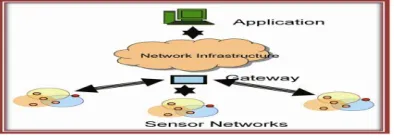
Wireless sensor networks comprise of thousands of motes which are used which are used to exchange information with the user either directly or through the external base station. Each sensor nodes send receive aggregate data from source to destination. A base station is a mobile node or may be a fixed node which has a capability of connecting the sensor network to an existing communications infrastructure or to the internet. Node performs two major task send data acting as a relay point and another is proceeding of data .[1]
Sensor nodes have many applications in weather monitoring, animal capturing in zoo, disaster management. Useful energy consumption can be due to
A. Transmit and receive data
B. Processing data
C. forward this data to base station
D.Wasteful Energy Due to
1) Idle listening
2) Duplicate packet transmission
II. LITERATURE SURVEY
A. Energy Efficient Routing
[image:2.612.215.412.628.697.2]Sensor nodes are with limited energy budget .there is need of efficient method for designing energy efficient routing in wireless sensor network where energy, bandwidths, memory are considered strictly so as to improve performance and give out the best possible outputs in time.[4].
Technology (IJRASET)
Figure 2 Classification Of Routing Protocols
III. EXISITING METHOD
A. Energy Efficient Routing protocols
1) Flat Based Routing: In this protocol data packet are send without any organization ,architecture ,schemes .every node is each other’s peers . Examples : SPIN, Direct Diffusion.
2) Location Based Routing: Most of the routing protocols require geographic ,location information’s for routing. Location information is used to calculate the distance between two sensor nodes which helps in calculating energy consumption between
two nodes. It s worth noting that there are many Ad-Hoc routing schemesExamples : GEAR , GAF [5]
3) Hierarchical Routing: It is a guarantee approach for point to point routing with small routing state .it is well knows approach in terms of scalability and efficiency. Techniques such as data aggregation are used so as to minimize data packets loads at base station. Complete wireless sensor networks are divided into clusters and hence rules are used for dividing this networks in
cluster formats. [2][3]Examples: LEACH, PEGASIS, HEED, TEEN .[7][8]
B. Hierarchical Routing
In the case study hierarchical routing is studied for energy efficient routing schemes. Because hierarchical routing provides a energy efficient routing schemes which are best in all possible environmental conditions and other factors.
1) LEACH: Low Energy Adaptive Clustering HierarchyLEACH stand for Low-Energy Adaptive Clustering Hierarchy and was one of the first hierarchical protocols. [ 11] When the node in the network fails or its battery stop working then LEACH protocol is used in the network. Leach is self-organizing, adaptive clustering protocol in which sensor nodes will organize themselves into local clusters and cluster members elect cluster head (CH) to avoid excessive energy consumption and incorporate data aggregation which reduces the amount of messages sent to the base station, to increase the life time of the network. Therefore this algorithm has an effect upon energy sa
2) Advantages of LEACH:
a) LEACH protocol performs better than conventional communication protocols in terms of network lifetime, energy efficiency and network configuration.[12 ]
b) Clustering used by LEACH protocol results in less communication between sensor nodes and base station, resulting in increase
of network lifetime
c) Clusterhead based approach enables the use of data aggregation technique and data compression techniques.
d) Allocation of TDMA schedule by CH to member nodes allows the member nodes to be turned off except for a particular time
period. This enhances the battery lifetime of sensor nodes
e) LEACH protocol gives chance to every sensor node to become cluster head at least once and to become a member node for many times. This randomized rotation of cluster head increases the network lifetime.[11][12]
3) Disadvantages of LEACH :
a) In each round cluster head is chosen randomly and the probability to become cluster heads is same for each sensor node. After
completion of some rounds, probability of sensor nodes with high energy and sensor nodes with low energy is same to become the cluster head. If the less energy sensor node is chosen as cluster head, then it dies quickly and hence lifetime of network degrades.
b) Basic LEACH does not take guarantee about the position and number of cluster heads in each round. Formation of clusters in
basic LEACH is random and leads to unequal distribution of clusters in the network. Further, there is no control over the position of CH in cluster which may result in performance degradation.
Technology (IJRASET)
Two types of protocols
1) Energy Residual Protocol: It provides concept of round there are many rounds each round contains two states.Two states are: Cluster set up
Steady state
a) In cluster formation phase, each node decides whether to turn into cluster head or not by comparing with residual energy[ 12].
b) Some nodes with more residual energy turn into cluster heads and send cluster head information to inform other nodes. The other nodes with less residual energy turn into common nodes, and send information about joining cluster to a cluster head.
c) In cluster steady phase, nodes in a cluster send data according to TDMA table, and cluster heads receive, fuse and send data to sink. After a period of time, the network reforms the cluster head selection procedure in a new round.[ 12]
2) Multi Hop Protocol:
a) Modified LEACH protocol (denoted as multi hop-LEACH protocol) which selects optimal path and adopts multi hop between
cluster head and sin
b) First, multi-hop communication is adopted among cluster heads. Then, according to the selected optimal path, these cluster heads transmit data to the corresponding cluster head which is [8] nearest to sink.
c) Finally, this cluster head sends data to sink.
Multi hop-LEACH protocol is almost the same as LEACH protocol, only makes communication mode from single hop to multi-hop between cluster heads and sink.[11 ] In this way cluster head and nodes interact which other in this protocol and routing is done.
D. PEGASIS(Power Efficient Gathering in Sensor Information Systems Working)
Working of PEGASIS protocol has two phases,
1) Chain Construction: Greedy algorithm is used to construct the chain which is formed by connecting the neighbouring nodes based on the signal strength of the node.
2) Data Gathering: A node within the chain is selected as the leader node.
Chain Based Protocol It forms a chain of the sensor nodes and the chain is formed using a greedy approach, starting from the node farthest to the sink node. The nearest node is sending the data to the neighbor node. This procedure is continued until all the nodes are included in the chain.
Approach distributes energy load evenly .on every sensor nodes. Here before passing the information to the adjacent neighbor data aggregation takes place. PEGASIS performs better than LEACH[5] by removing overhead of forming clusters dynamically. When a node fails node is reconstructed.
For gathering data in each round receives information from one neighbor aggregates with its data and transmits it to other neighbors node in chain . [15]
In this way cluster head and nodes interact which other in this protocol and routing is done.
3) Drawbacks of PEGAIS:
a) Assumes that each sensor node is able to communicate with the BS directly
b) Assumes that all sensor nodes have the same level of energy and are likely to die at the same time
c) The single leader can become a bottleneck.
d) Head chosen can have low energy level
e) Excessive data delay .[ 6]
E. Teen
1) Threshold Sensitive Energy Efficient Network Working : First protocol was designed for reactive network. Based on leach TEEN is based on hierarchical grouping which divides the sensor nodes twice for grouping clusters in order to detect sudden changes in the sensed attributes such as temperature.After the clusters are formed TEEN separates the cluster head into second level cluster head and uses hard threshold and soft threshold to detect sudden changes.
2) Hard Threshold (HT) : A member only sends data to CH only if data values are in the range of interest
3) Soft Threshold (ST) : A member only sends data if its value changes by at least the soft threshold[16] In this way cluster head and nodes interact which other in this protocol and routing is done.
4) Advantages of TEEN: Good for time critical application
Technology (IJRASET)
a) Inappropriate for users where there is requirement of data on regular basis.
b) Ambiguity between packet loss and unimportant data.
c) Transmission causes more energy consumptions than sensing.
IV. PROPOSED METHODS
A. Heed
To overcome the disadvantages of leach, pegasis, teen .heed is introduced.
Some research papers shows that heed consumes low battery in wireless sensor networks.
Heed clustering algorithm is a distributive clustering method which considers energy and communication cost simultaneously. Heed is an iterative grouping algorithm which utilizes residual energy of nodes and their communication cost to choose the best set as cluster head nodes.
During clustering procedure a sensor node might be tentative cluster head, final cluster head or covered.
At the beginning of grouping phase a node with higher energy level is more probable to be selected as tentative cluster head. [17]
On the basis of amount of energy distributed among the node, different cluster heads in a field are selected using this protocol HEED protocol [18].
B. Working of HEED
1) Heed Parameters: Parameters for electing cluster heads
a) Primary Parameter : Residual energy(Er)
b) Secondary Parameter : Communication Cost (used to break ties)
C. Maximixe Energy and Minimize Cost
1) For Load Balancing Cost proportional to node degree.
2) Average minimum reachable power
AMRP = Sum of all nodes minimum power to reach node Head M(number of nodes)
3) For dense cluster Cost is inversely proportional to node degree
V. THERE ARE THREE PHASES OF WORKING
A. Initialization
1) Discover neighbor with cluster rang
2) Compute initial cluster head probability
B. Main Processing
1) If node receives some cluster head messages choose one head with minimum cost.
2) If node does not have cluster head ,elect to become a cluster head with CHprob.
C. Finalization
1) If cluster head is found join its cluster.
2) Otherwise elect it to be a cluster head.
D. This algorithm has Four Main Goals
1) Prolonging network lifetime by distributing energy consumption
2) Terminating clustering process by constant number of iterations \
3) Minimizing control overload
4) Providing appropriate distributed cluster heads and compressed clusters. [4]
Technology (IJRASET)
location).
Since the algorithm aims to prolong network lifetime, it decides based on residual energy of each node. Network lifetime inter cluster communication cost is taken into account while designing. Usually each node has a limited number of transmission power levels.
[image:6.612.54.558.192.657.2]As the power increases the covered area is increased as well. Thus, cluster range is determined by transmitted power level used in inter cluster communication and during clustering.[15][4] In this way cluster head and nodes interact which other in this protocol and routing is done.
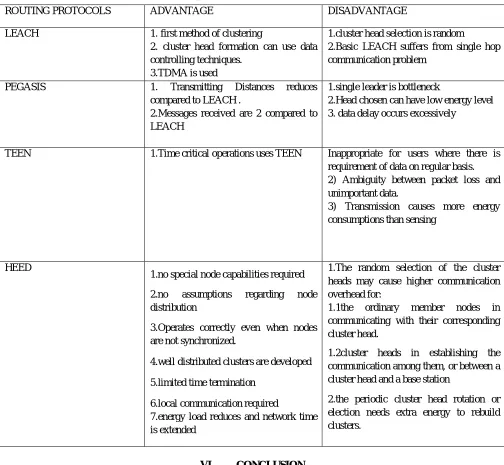
Table I Routing protocols with advantages and disadvantage
VI. CONCLUSION
In wireless sensor networks Energy efficient algorithm should be used for real time application when there are n number of sensor nodes involved in communications. So as to maximize communication and there by using minimum battery of sensor nodes. LEACH and Improved version can be used but Sensor nodes dynamically form cluster. When a cluster is formed, a sensor node in the cluster randomly selects the cluster head. All cluster head transfer the collected information to the sink node. Hence Leach consumes battery more.It is an enhancement over LEACH and it is near optimal chain based protocol. PEGASIS It will focus the
ROUTING PROTOCOLS ADVANTAGE DISADVANTAGE
LEACH 1. first method of clustering
2. cluster head formation can use data controlling techniques.
3.TDMA is used
1.cluster head selection is random
2.Basic LEACH suffers from single hop communication problem
PEGASIS 1. Transmitting Distances reduces
compared to LEACH .
2.Messages received are 2 compared to LEACH
1.single leader is bottleneck
2.Head chosen can have low energy level 3. data delay occurs excessively
TEEN 1.Time critical operations uses TEEN Inappropriate for users where there is
requirement of data on regular basis. 2) Ambiguity between packet loss and unimportant data.
3) Transmission causes more energy consumptions than sensing
HEED
1.no special node capabilities required
2.no assumptions regarding node
distribution
3.Operates correctly even when nodes are not synchronized.
4.well distributed clusters are developed
5.limited time termination
6.local communication required
7.energy load reduces and network time is extended
1.The random selection of the cluster heads may cause higher communication overhead for:
1.1the ordinary member nodes in
communicating with their corresponding cluster head.
1.2cluster heads in establishing the communication among them, or between a cluster head and a base station
Technology (IJRASET)
extend the life time of network by communicate with its closest neighbor. It will avoid cluster formation and use only one node to communicate with base station instead of with multiple nodes. While connecting it transmits more battery. TEEN Time critical data reaches the user almost instantaneously. The soft threshold can be varied, depending on the criticality of the sensed attribute and target application. It will also enhance the efficiency of wireless sensor networks. AMBIGUITY AND TRANMSIION COST ARE disadvantages. Hence HEED IS AN OPTIMAL best protocol as there are many advantages and disadvantages of various protocols HEED is more efficient in terms of all the parameters like energy, bandwith ,memory . HEED clustering algorithm is a distributive clustering method which considers energy and communication cost simultaneously. HEED is an iterative grouping algorithm which utilizes residual energy of nodes and their communication cost to choose the best set as cluster head nodes.
REFERENCES
[1] Lorenzo Bracciale, Pierpaolo Loreti, and Giuseppe Bianchi.”The Sleepy Bird Catches More Worms:Revisiting Energy Efficient Neighbor Discovery”
[2] B. Han and A. Srinivasan, “ediscovery: Energy efficient device discovery Netw. Protocols, 2012.
[3] M. Orlinski and N. Filer, “Movement speed based inter-probe times for neighbour discovery in mobile ad-hoc networks,” in Proc. 4th Int. Conf. Ad Hoc Netw., 2013, vol. 111, pp. 316–331.
[4] Jyoti Saraswat, Neha Rathi & Partha Pratim Bhattacharya” Techniques to Enhance Lifetime of Wireless Sensor Networks: A Survey 2012”
[5] Divya.P, S.Shivkumar,” study on HEED and PEGASIS Protocols 2015”
[6] Imane Boulhares and Mohammed Omari” Hybridizing PEGASIS with LEACH-1R Protocols in Wireless Sensor Networks 2016
[7] Huaiyu, Qingwei and Mandan”An Energy-Efficient Multi-Hop Routing Protocol Based on HEED 2016”
[8] Meenu M.Tech., CSE Deptt Hindu College of engg. Sonepat, Haryana Vandana A.P., CSE Deptt Hindu College of engg. Sonepat,Haryana” PEGASIS in wireless sensor netwroks2012”
[9] Ehssan Sakhaee, Naoki Wakamiya, Masayuki Murata Graduate School of Information Science and Technology Osaka University, Osaka, Japan” Self-Organized Data-Energy-Aware Clustering and Routing for Wireless Sensor Networks”
[10] Neha V. Deshmukh, Prof. A. V. Deorankar. “Minimizing Energy Consumption in Transmission Efficient Wireless Sensor Network “
[11] Amr AmwaryBenha University.Sarayut Poolsanguan, Chakchai So-In, SM, IEEE, Kanokmon Rujirakul and Kanokporn Udompongsuk Applied Network Technology“Modified LEACH Prot Dusan Maga, Tarek NahdiCzech Technical University in Prague ocol for Heterogeneous Wireless Networks”
[12] D. Li and P. Sinha”An Enhanced Cluster Head Selection Criterion ofLEACH in Wireless Sensor Networks”
[13] Shuai Gao, Hongke Zhang, and Sajal K. Das, “Efficient Data Collection in Wireless Sensor Networks with Path-Constrained Mobile Sinks”, IEEE Transactions on mobile computing,Vol. 10, NO. 5(2011),pp.592-608.
[14] Alekha Kumar Mishra Dept. of MCA, Silicon Inst. of Technol., Bhubaneswar, India Manoj Kumar Samantara Dept. of MCA, Silicon Inst. of Technol., Bhubaneswar, India“A Dynamic Energy-Efficient Chain Formation Scheme for PEGASIS in Wireless Sensor Networks 2016”
[15] Jin WangSch. of Inf. Eng., Yangzhou Univ., Yangzhou, China Jiayi CaoSch. of Inf. Eng., Yangzhou Univ., Yangzhou, China Yiquan CaoSch. of Inf. Eng., Yangzhou Univ., Yangzhou, China “An Improved Energy-Efficient Clustering Algorithm Based on MECA and PEGASIS for WSNs2015
[16] A. Manjeshwar University of Cincinnati D.P. Agrawal “TEEN: a routing protocol for enhanced efficiency in wireless sensor networks
[17] Jian Shen Jiangsu Eng. Center of Network Monitoring, Nanjing, China Anxi Wang Sch. of Comput. & Software, Nanjing Univ. of Inf. Sci. & Technol., Nanjing, China Chen Wang Sch. of Comput. & Software, Nanjing Univ. of Inf. Sci. & Technol., Nanjing, China “Performance Comparison of Typical and Improved LEACH Protocols in Wireless Sensor Networks