Technology (IJRASET)
Wireless Power Transfer Using Metamaterials and
Array of Coupled Resonators
K.Karthick1, A.Anandhakumar2
III rd Year, ECE Department
Mailam Engineering College, Mailam, Tindivanam
Abstract—In this article, we will report some recent progress on wireless power transfer (WPT) based on resonant coupling. Two major technologies will be discussed: the use of metamaterials, and array of coupled resonators. With a slab of metamaterial, the near-field coupling between two resonant coils can be enhanced; the power transfer efficiency between coils is boosted by the metamaterial. The principle of enhanced coupling with metamaterial will be discussed; the design of metamaterial slabs for near-field wireless power transfer will be shown; recent experimental results on wireless power transfer efficiency improvement with metamaterial will also be presented. By using an array of resonators, the range of efficient power transfer can be greatly extended. More importantly, this new technology can provide wireless power to both static and mobile devices dynamically. The principle of this technology will be explained; analytical and numerical models will be used to evaluate the performance of a WPT system with an array of resonators; recent experimental developments will also be presented.
Index Terms—Wireless power transfer, resonant coupling, metamaterials, array, resonators
I. INTRODUCTION
WIRELESS POWER transfer (WPT) has a long history of over 100 years that dates back to Tesla. In recent years, WPT research and product development is reemerging due to increasing demands in many applications. For example, WPT is being developed to provide charging solutions for batteries of the large number of smart cell phones and other devices, which require frequency recharging. WPT is promising in many areas with quite different power levels, from implantable medical devices (usually on the order of milliwatts) to electric vehicles (a few killowatts). Although each application has specific requirements such as transfer distance, device size, power and packaging, most of them rely on the following fundamental technologies: microwave power transmission, inductive coupling, and resonant coupling.
Microwave power transmission uses directed microwave beam to send energy from transmitter to receiver, requires accurate alignment and clear line-of-sight. The technology was primarily developed for solar power satellites [1] and is not considered suitable for consumer electronics devices charging. In short range WPT applications, inductive coupling and resonant coupling are two major technologies. Inductive coupling uses the magnetic coupling between transmitting and receiving coils to transfer power. The efficiency of such a system depends strongly on the coupling coefficient of transmitting and receiving coils. To achieve that, the two coils need to be positioned such that most of the magnetic flux generated by the transmitting coil goes through the receiving coil. Thus inductive coupling based WPT has a limited working range of a few centimeters and requires precise alignment between transmitting and receiving devices [2]–[4]. By tuning the transmitting and receiving coils to the same resonant frequency, the effective transfer distance can be greatly extended [5]–[11]. Although resonant coupling based WPT has a long history [5], [6], the
application was very limited. In 2007, Kurs et.al. demonstrated with experiment that WPT based on resonant coupling can be used
Technology (IJRASET)
using array of resonators. With a metamaterial slab, the coupling between transmitting and receiving coils can be enhanced, and the efficiency is subsequently improved [13]–[18]. We will give a brief introduction to metamaterials, their applications to WPT, and a review of recent theoretical and experimental work in this area. With an array of resonators, the range of power transfer can be greatly extended; dynamic power transfer to mobile devices can be achieved [19]–[21]. We will give an introduction to this technology and report recent experimental development on WPT with array of resonators.
Metamaterials for wireless power transfer
Metamaterials are a new class of artificial materials that are composed of engineered structures. In the last decade, unique phenomena such as negative refraction and evanescent wave amplification have been predicted and realized in metamaterials [22]– [24]. Since the first experimental demonstration of negative index of refraction [23], metamaterials have been shown to be powerful and flexible in achieving desirable electromagnetic properties from radio frequencies to optical frequencies. Numerous applications based on metamaterials have been developed, such as super-lens imaging devices [25], invisible cloaking devices [26], and novel antennas [27]. Here we report recent work on the application of metamaterials in WPT [13]–[18].
A. Metamaterial and Super-lens
[image:3.612.212.417.389.683.2]The building blocks of metamaterials are the engineered structures and typically much smaller in size than the working wavelength, so that metamaterials can be treated as effective media. The electromagnetic properties of a metamaterial are obtained from these building blocks, rather than the composition materials. Macroscopic parameters, such as permittivity ǫ, permeability µand chirality κ can be used to describe the electromagnetic properties of metamaterials. More importantly, we can design for a special set of macroscopic parameters, as these parameters are determined by the artificial structures in metamaterials. Properties, such as negative index of refraction n, that are not readily available in natural materials, have been found in metamaterials. Metamaterials have become a powerful tool that led to numerous new inventions and discoveries. In 2000, Pendry studied the wave propagation properties in a negative-index material, and showed that a negative n can be achieved by having both ǫ and µ negative in a metamaterial [22]. Negative refraction happens at the interface between a regular medium of positive n
Technology (IJRASET)
can propagate and get enhanced in a n< 0 material. Pendry showed that with a slab of material with ǫ = −1 and µ= −1, both far-field propagating waves and near-field evanescent waves of an object can be restored, such that a “super lens” can be constructed with unlimited resolution [22]. Although in reality the perfect condition of ǫ = −1 and µ = −1 does not exist, metamaterials with physical parameters and low material losses can still achieve imaging resolutions beyond diffraction limit.
B. WPT with Metamaterials
In Ref. [13], the idea of using a n< 0 metamaterial slab for WPT was proposed and studied. It was shown that the meta-material slab can couple to the near-field evanescent waves, such that the effective distance between resonators is reduced and the coupling is enhanced. With numerical simulations of a WPT system, it was shown that the power transfer efficiency of the system can also be improved significantly if a metamaterial slab is used. In Ref. [18], numerical simulations confirmed that the inductive coupling between coils can be enhanced by a metamaterial slab as “super-lens”.
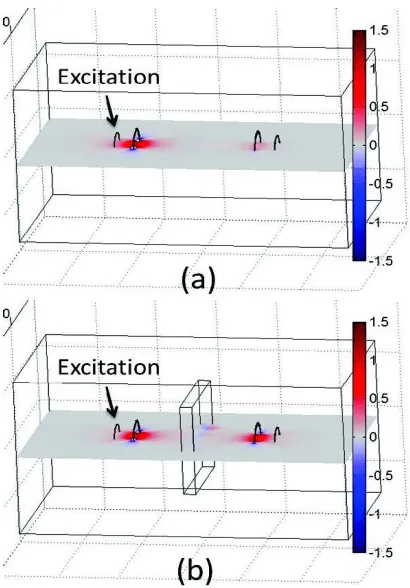
Fig. 1 shows simulated magnetic field distribution of a WPT system with two resonant coils and two non-resonant loops inductively coupled to the two coils. The transmitting port is at the left loop in both Fig. 1(a) and (b). At resonance, strong field is localized at the resonant coils. Weak field is seen between resonators, showing that the near-field is indeed decaying away from the resonators. The field is also smaller on the right side due to the fact that some energy is lost during the transfer. In Fig. 1(b), a metamaterial slab with µ = −1+0.05i and ǫ =1 is used. The near-field is seen to be enhanced at the metamaterial slab, and the field intensity at the right resonant coil is also increased.
In Ref. [14], more rigorous studies were performed based on an analytical model of the coupling between two coils and a homogeneous metamaterial slab. The coils was simplified as point magnetic dipoles, and the metamaterial slab was assumed to be infinitely large. The coupling between two coils was represented by the mutual inductance L21 , and the power transfer was characterized by a simplified circuit model. It was found that the power transfer efficiency from one dipole to the other is
proportional to |L21 |2 . The mutual inductance was calculated by taking the ratio of the magnetic flux through the second coil generated by the first current carrying coil and the current magnitude of the first coil. That magnetic flux was calculated by solving for the field in the system generated by the first coil. A large slab of metamaterial was embedded in the space between the two magnetic dipoles, with the effective and µassumed to be homogeneous and uniaxial. The presence of the metamaterial modified the field in the system, thus changed the mutual inductance between coils, as well as the self-inductance of the coils. With a metamaterial slab as a “super lens”, the mutual inductance can be increased significantly depending on the parameters. Consequently the power transfer efficiency can be improved by the metamaterial. It was shown that, with a realistic magnetic loss tangent 0.1 of the metamaterial slab, the power transfer efficiency with the slab can be an order of magnitude greater than efficiency without the slab.
C. Experiment Demonstration
The previous numerical and analytical studies showed that power transfer efficiency can be improved with metamaterial, through mutual coupling enhancement between coils. However, approximations were used in these studies. In the analytical calculation [14], the coils were assumed to be ideal magnetic dipole, and the metamaterial was considered to be infinitely large and homogeneous. In real system, the inductance and capacitance of coils are distributed and cannot be treated as magnetic dipole due to the physical size of coils; the size of metamaterial is finite and the homogeneous parameters are not precise. In the numerical simulation [13], although real coils and finite-sized metamaterial slab were used, the metamaterial parameters were still approximated. It is thus important to verify the findings with experiments.
Technology (IJRASET)
[image:5.612.184.391.120.276.2]the system is usually much smaller than wavelength, which requires the ratio λ/a > 100 at least. Plus, the required fabrication process needs to be simple and low-cost for reproduction and cost reduction. In summary, the metamaterial for WPT needs to be low-loss, low-cost, compact, and capable of handling high power.
Fig. 2. A picture of the planar metamaterial. Inset shows the details, with t the spacing between two planes
As shown in Fig. 2, the building block of the metamaterial are two-sided square spirals. The structure is designed to achieve compact size and low loss requirements. The 3turn spirals are printed on Rogers RO4003C circuit boards, with the two sides connected by wires. With size 6.5 mm by 6.5 mm, the structure gives strong response to external magnetic field around resonant frequency of 24 MHz The strong response comes from the resonance of the structure, which can be effectively considered as an LC resonator, where the inductance comes from the multi-turn metal wires, and the capacitance comes mainly from the “plate capacitor” formed by the two sides of metal structure. The effective inductance and capacitance are much larger than conventional split-ring resonators of the same size, such than much lower resonant frequency is achieved. In terms of wavelength to unit cell ratio λ/a, the current design is about 170, while conventional split-ring resonator is around 10. A µ-negative metamaterial can be constructed by assembling the spirals in cubic lattice [15]. Above the resonant frequency, the effective µ of the metamaterial is negative. At our working frequency of 27.12 MHz, this metamaterial has an effective µ very close to -1.0 and with simple fabrication, low loss, and compact size. Metamaterial with a different negative effective µ can also achieve evanescent wave amplification. However, when the absolute value of negative µ is larger, the frequency gets closer to the resonant frequency of the composing spirals, causing larger loss in the metamaterial and less power transfer efficiency improvement.
Experiments were performed to measure the power transfer efficiency of the WPT system at low power.
[image:5.612.203.399.521.669.2]Technology (IJRASET)
The overall efficiency of the system was measured by an Agilent N5230A vector network analyzer. The two loop antennas were connected to two ports of the network analyzer, and S-parameters between the two ports were measured. For each measurement, the distances between loop antennas and associated coil resonators were tuned so that the system can be properly matched to the 50 Ω ports of the network analyzer for optimal power transfer [11], [12]. When a metamaterial slab is added in the system, the optimal condition is modified. The distances between loop antennas and associated coil resonators need to be readjusted so that the optimal matching for power transfer is resettled. The reflection parameters S11 and S22 around resonance are both small (around -20 dB), and the change due to the introduction of metamaterial is negligible. Thus the power transfer efficiency of the system can be
estimated by |S21 |2 . At a distance of 50 cm between two resonant coils, the efficiency without a metamaterial is 17%, and is increased to 35% with the metamaterial slab in the system [15]. In Ref. [16], the metamaterial for WPT was further simplified. Instead of stacking the two-side square spirals in three dimensions, only two flat panels of spirals were used to construct an anisotropic metamaterial, as shown in Fig. 2. The simplification is made because the magnetic field in the WPT system is mainly in the direction along the axis of the spirals. It is sufficient to use a metamaterial having negative magnetic response in this direction, instead of an isotropic metamaterial.
The two surfaces are separated by a distance t=2cm, optimized to achieve highest power transfer efficiency of the system. With the same method, the efficiency is measured with the anisotropic metamaterial in the WPT system. As shown in Fig.3, the efficiency is increased to 47% at peak, comparing to peak efficiency of 17% without the metamaterial. The achieved efficiency is even higher than the case of isotropic metamaterial, as the loss is lower in the planar metamaterial with unnecessary structures removed. In the anisotropic metamaterial, evanescent wave amplification is achieved via the excitation of surface waves on the two surfaces. Before WPT, anisotropic metamaterials have been used for near-field imaging [30].
[image:6.612.181.389.338.647.2]Experiments at higher power level have also been
Fig. 4. WPT experiment to a 40W light bulb of system (a) without and (b) with the anisotropic metamaterial slab
Technology (IJRASET)
power is provided by a high-frequency transceiver with power amplifier through the input loop antenna.
The brightness of light bulb can thus reflect the amount of power transferred. Fig. 4(a) shows the system without metamaterial, where the light bulb barely glows. Fig. 4(b) shows the system with the anisotropic metamaterial, and the light bulb is much brighter. This indicates that the efficiency is indeed improved significantly by the metamaterial. The experiment also shows that the metamaterial is capable of handling the high power level
II. ARRAY OF RESONATORS FOR MOBILE POWER TRANSFER
As shown in Fig. 5(a), in a resonant coupling based WPT system, power is transferred between two resonant coils by the coupling of evanescent near-field. The distance between coils, as well as the
Fig. 5. (a) WPT system with one resonant coil as transmitter and one resonant coil as receiver. (b) WPT system with an array of
resonant coils as transmitter and one resonant coil as receiver
mobility of power receiving coil, is thus limited. For devices that travel with distance much larger than the physical size of wireless power transmitter, the technology is not sufficient to provide wireless power continuously.
Examples include the wireless charging for electric vehicles on the road, wireless powering for elevators, wireless powering for industrial robots that can travel a long distance. In this section, we introduce a feasible solution to the problem, and show that by using an array of resonators, mobile WPT to multiple mobile devices is achievable [19]–[21]. With this technology, mobile WPT to electric vehicles on road can be realized. By embedding a power transmitting array of resonators under surface of road or track, power can be picked up wirelessly and continuously by vehicles installed with power receivers traveling on the road.
A. Array of Resonators
[image:7.612.168.382.252.467.2]Technology (IJRASET)
from the array. Two features of the system can be observed. First, the effective power transfer range is greatly extended, as the receiver can now be anywhere along the array, which can be much larger than the physical size of one resonator. Second, the receiver can be attached to a mobile device and travels along the array with certain freedom. It is even possible to allow multiple receivers to be powered by the system at the same time, as long as each receiver is coupled to the array.
B. Analytical and Numerical Studies
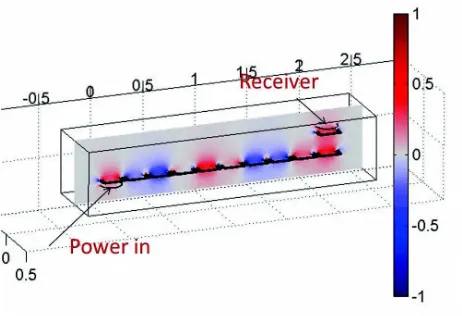
[image:8.612.180.411.271.429.2]A system similar to the one shown in Fig. 5(b) is modeled and simulated in COMSOL. In the model, the resonators are square spirals of width 20 cm, designed to have a resonant frequency around 25 MHz. A linear array is formed by 10 resonators side-by-side. A loop antenna is aligned to the first resonator in the array and inductively couple energy to the system. Another resonant coil and a non-resonant loop antenna is used as power receiver and is aligned with the 10th resonator of the array. With these settings, the magnetic field distribution of the system is calculated and plotted in Fig. 6. A strong field is excited by the non-resonant loop antenna, and localized around resonators in the array. Even the receiver is very far from the transmitting antenna, a strong field is seen as the receiver due to resonant coupling between the resonant receiver and the last resonators in the array. Thus efficient WPT can be achieved over a long distance.
Fig. 6. Simulated magnetic field distribution of a WPT system with an array of 10 resonators as transmitter.
As shown in Fig. 6, the field is not uniformly distributed along the array. The coupled mode of the resonator system forms a standing wave on the array, with the phase difference between neighboring resonators depending on the operating frequency. It is thus important to evaluate the power transfer performance of the system when the receiver is at different positions.
As numerical simulations are time consuming, a transmission line model based on circuit analysis and analytical calculations has been developed to quickly evaluate the performance of the array based system [20]. In the model, each resonator is treated as a tank circuit; capacitive coupling between resonators is neglected and inductive coupling is quantified by mutual inductances; non-resonant coils are also modeled as simple RL circuits. The inductance, capacitance, resistance and non-resonant frequency for non-resonant coils, the inductance and resistance for non-resonant coils, as well as the mutual inductance between coils are calculated analytically based on the geometry and relative positions of coils. Then the coupled circuits can be represented by a system of equations derived by Kirchhoff’s voltage and current laws.
Technology (IJRASET)
[image:9.612.205.395.162.262.2]By solving the system of equations, the current in each coil and the power transfer efficiency will be obtained. For an array with 10 resonators, the power transfer efficiency is calculated as a function of receiver position as well as excitation frequency, and plotted in Fig. 7. For a fixed excitation frequency, as the receiver moves from one end to the other end, there is highs and lows in efficiency. Different pattern is seen at different frequencies. This is due to the non-uniform field pattern of coupled modes in the array, and different coupled modes of the array are excited at different frequencies. On the other hand, at a fixed receiver position, very different efficiency can be obtained depending on the excitation frequency.
Fig. 8. Power transfer efficiency for two individual receivers and the combined efficiency, as functions of receiver position in unit of lattice size of the array. Operating frequency is fixed.
In order to improve power transfer performance, the fluctuation in efficiency as a receiver is moving along the array needs to be reduced. In a WPT system with a single resonant transmitter, it has been discovered that the more receivers in the system, the higher the overall efficiency can be achieved [12]. Similarly, the more receivers we have in the array based system, the higher efficiency can be obtained. Moreover, the overall efficiency can be more stable compared with a single receiver case. Consider the 10-resonator array system in previous simulations, we now use two resonant receivers moving simultaneously along the array, with a lateral distance of 10 cm. In this case, the power goes to each output port is calculated. The ratio of this output power to the input power is taken as the efficiency to each receiver. The overall efficiency is the sum of the two. They are plotted in Fig. 8 as functions of lateral position of the first receiver on the array in unit of the lattice size of the array. Indeed, although each receiver has significant fluctuation on the efficiency at different positions, the overall efficiency is more stable.
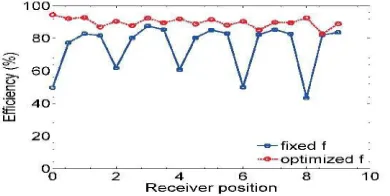
In case of one receiver, the efficiency fluctuation can be reduced by adjusting the transmitting frequency depending on the position of the receiver. As shown in Fig. 7, different efficiency can be achieved at the same position depending on the frequency. If the frequency is used such that highest efficiency is achieved at each position, the power transfer is optimized for the receiver. Fig. 9 shows an example of simulated efficiency with a fixed frequency, and optimized
Fig. 9. Power transfer efficiency for one receiver as functions of receiver position in unit of lattice size of the array, operating at a fixed frequency and optimized frequency for each position
frequency for each position, for the same 10-resonator array system used in previous simulations. To achieve the optimization in real system, a data link can be set up between receiver and transmitter. A monitor can be used on the receiver to detect and send the
power transfer status information via the data link back to the transmitter, and the transmitter can then adjust the transmitting frequency depending on the feedback.
C. Experiment Demonstration
[image:9.612.196.391.558.656.2]Technology (IJRASET)
[image:10.612.188.425.118.217.2]and dynamically from an array of resonators. The train set runs on an oval-shaped track with dimensions 183 cm by 140 cm, and total length about 5.25 m. A planar array of resonators is placed directly underneath the track, with RF power provided to the array via a square antenna inductively
Fig.10. Printed planar resonators for WPT experiment.
coupled to one of the resonators in the array. A resonant coil and a non-resonant loop antenna is placed underneath the coal tender of the train set, about 5 cm above the array. The batteries in the coal tender are removed and replaced by circuits for RF to DC conversion. The converted DC power is then send to the motor in the locomotive to run the train. Planar spirals on circuit board are used for resonator designs in this study for their simple yet reliable fabrication process. For such planar spiral structures, a
semi-analytical model has been developed by Ellstein et.al. [31] to quickly obtain their resonant frequencies. Two types of resonators are
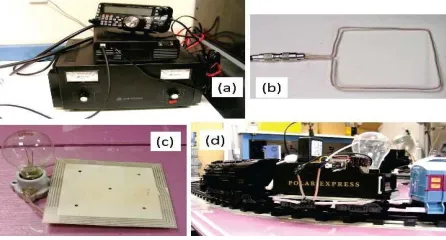
designed for the straight and curved tracks respectively. As shown in Fig. 10, both types are planar 5-turn spirals printed on 0.5 mm Rogers 4350 circuit board, with copper thickness 35 µm, copper strip width 2 mm, spacing between neighboring copper strips 1 mm. The square-shaped resonator has an outer dimension of 15 cm by 15 cm; the trapezoid-shaped resonator has a height of 12.9 cm and side lengths of 15.4 cm and 18.8 cm. A total of 6 square-shaped resonators and 24 trapezoid-shaped resonators are used to fill up the oval-shaped track. Both resonators have self-resonant frequency around 25 MHz. Fig. 11 shows the components of the demonstration system. A Kenwood TS-480 transceiver is modified and used as RF power supply [Fig. 11(a)], which is capable of putting out 200W power with frequency between 3 MHz and 30 MHz. A square antenna [Fig. 11(b)] is connected to the RF power supply and provides power to the array system via inductive coupling.
Fig. 11. Components of WPT experiment with array of resonators: (a) RF power transmitter; (b)square antenna to inductively couple power from the RF transmitter to the system; (c) a wireless power receiver composed of a resonant coil, a loop antenna and a 40W light bulb; (d) a wireless power receiver with a resonant coil and a loop antenna to pick up RF power, a rectifier and regulator to convert RF power to DC, and a motor for the toy train set and a 40W light bulb as load.
A square resonant coil, inductively coupled to a loop antenna, which is then connected to a 40 W light bulb, is used as a simple power receiver [Fig. 11(c)]. Fig. 11(d) shows the modified train set. The array of resonators under the track is visible in the picture. A resonant coil and a inductively coupled square antenna is used to pick up RF power from the array, and sends to the motor in the locomotive after going through the rectifying and regulating circuits. Another 40 W light bulb is also used as load to visually indicate the transferred power level.
III. CONCLUSION
[image:10.612.195.418.418.538.2]Technology (IJRASET)
metamaterial considered. In experiment, a metamaterial slab has been designed for a WPT system, and the efficiency with the metamaterial is almost three times as high as the system without metamaterial. Second, resonant coupling based WPT can be greatly extended with an array of coupled resonators. The distance of efficient power transfer is significantly increased by using multiple coupled resonators in the array system. Moreover, while conventional WPT technologies are mostly for static devices, the array based system can be used to transfer power dynamically to mobile devices. The advantages bring the technology new potential application areas. The array based system has been studied analytically and numerically; experiments has been done to demonstrate mobile WPT to a train on the move. Methods to improve the performance of the array system have also been discussed.
REFERENCES
[1] N. Shimokura, N. Kaya, M. Shinohara, and H. Matsumoto, “point-topoint microwave power transmission experiment” Electrical Engineering in Japan 120 (1), 33-39 (1997).
[2] J. C. Schuder, H. E. Stephenson and J. F. Townsend, “High-level electromagnetic energy transfer through a closed chest wall,” Inst. Radio Engrs. Int Conv. Record, 9, 119 (1961).
[3] Z. N. Low, R. A. Chinga, R. Tseng and J. Lin, “Design and Test of a High-Power High-Efficiency Loosely Coupled Planar Wireless Power Transfer System,” IEEE Transactions on Industrial Electronics, 56, 1801 (2009).
[4] G. A. J. Elliott, S. Raabe, G. A. Covic, and J.T. Boys, “Multiphase Pickups for Large Lateral Tolerance Contactless Power-Transfer Systems,” IEEE TRANSACTIONS ON INDUSTRIAL ELECTRONICS, 57, 1590 (2010).
[5] N. de N. Donaldson and T. A. Perlins, “Analysis of resonant coupled coils in the design of radio frequency transcutaneous links,” Med. & Biol. Eng. & Comput., 21, 612 (1983).
[6] R. Puers, K. V. Schuylenbergh, M. Catrysse and B. Hermans, “Wireless inductive transfer of power and data,” Analog Circuit Design, Springer, p395 (2006). [7] A. Kurs, A. Karalis, R. Moffatt, J. D. Joannopoulos, P. Fisher and M. Soljiacic, “Wireless power transfer via strongly coupled magnetic resonances,” Science, 317, 83 (2007).
[8] S. Valtchev, B. Borges, K. Brandisky, and J. B. Klaassens, “Resonant Contactless Energy Transfer With Improved Efficiency,” IEEE TRANSACTIONS ON POWER ELECTRONICS, VOL. 24, NO. 3, 685-699 (2009).
[9] B. L. Cannon, J.F. Hoburg, D. D. Stancil and S. C. Goldstein, “Magnetic Resonant Coupling As a Potential Means for Wireless Power Transfer to Multiple Small Receivers,” IEEE TRANSACTIONS ON POWER ELECTRONICS, 24, (2009).
[10] Q. Yuan, Q. Chen, L. Li, and K. Sawaya, “Numerical Analysis on Transmission Efficiency of Evanescent Resonant Coupling Wireless Power Transfer System,” IEEE TRANSACTIONS ON ANTENNAS AND PROPAGATION, VOL. 58, NO. 5, 1751-1758 (2010).
[11] A. P. Sample, D. T. Meyer and J. R. Smith, “Analysis, experimental results, and range adaptation of magnetically coupled resonators for wireless power transfer,” IEEE Trans.Ind. Electron. 58, 544 (2011).
[12] A. Kurs, R. Moffatt and M. Soljacic, “Simultaneous mid-range power transfer to multiple devices,” Appl. Phys. Lett. 96, 044102 (2010).
[13] B. Wang, T. Nishino and K. H. Teo, ”Wireless power transmission efficiency enhancement with metamaterials,” in Proceedings of the IEEE International Conference on Wireless Information Technology and Systems (ICWITS’10), Honululu, Hawai’i, 28. August -03. September, 2010.
[14] Y. Urzhumov and D. R. Smith, “Metamaterial-enhanced coupling between magnetic dipoles for efficient wireless power transfer,” Phys. Rev. B 83, 205114 (2011)
[15] B. Wang, K. H. Teo, T. Nishino, W. Yerazunis, J. Barnwell and J. Zhang, “Wireless Power Transfer with Metamaterials” in Proceedings of European Conference on Antennas and Propagation (EuCAP 2011) (April 11-15 2011, Rome, Italy)
[16] B. Wang, K. H. Teo, T. Nishino, W. Yerazunis, J. Barnwell and J. Zhang, “Experiments on wireless power transfer with metamaterials,” Appl. Phys. Lett. 98, 254101 (2011)
[17] B. Wang and K. H. Teo, “Metamaterials for wireless power transfer,” in Proceedings of 2012 IEEE International Workshop on Antenna Technology (iWAT), 5-7 March 2012, Tuson, Arizona
[18] D. Huang, Y. Urzhumov, D. R. Smith, K. H. Teo, and J. Zhang, “Magnetic Superlens-enhanced Inductive Coupling for Wireless Power Transfer,” J. Appl. Phys. 111, 64902 (2012)
[19] B. Wang, K. H. Teo, S. Yamaguchi, T. Takahashi, and Y. Konishi, “Flexible and Mobile Near-FieldWireless PowerTransfer using an Array of Resonators,” IEICE Technical Report, WPT2011-16 (2011)
[20] B.Wang, D. Ellstein, and K. H.Teo, “Analysis onWireless PowerTransfer to Moving Devices Based on Array of Resonators,” in Proceedings of European Conference on Antennas and Propagation (EuCAP) 2012 (Mar. 26-30, 2012, Prague, Czech Republic)
[21] W. Yerazunis, B. Wang, and K. H. Teo, “Power delivery optimization for a mobile power transfer system based on resonator arrays,” in Proceedings of International Symposium on Antennas and Propagation (ISAP) 2012, (Oct. 29 -Nov. 2, 2012, Nagoya, Japan)
[22J. B. Pendry, “Negative refraction makes a perfect lens,” Phys. Rev. Lett. 85, 3966 (2000)
[23] R. A. Shelby, D. R. Smith, and S. Schultz, “Experimental verification of a negative index of refraction,” Science, 292, 7779 (2001). [24] D. R. Smith, J. B. Pendry, and M. C. K. Wiltshire, “Metamaterials and negative refractive index,” Science, 305, 788 (2004)
[25] N. Fang, H. Lee, C. Sun, and X. Zhang, “Sub-Diffraction-Limited Optical Imaging with a Silver Superlens,” Science, 308, 534 (2005). [26] D. Schurig, J. J. Mock, B. J. Justice, S. A. Cummer, J. B. Pendry,
A. F. Starr, and D. R. Smith, “Metamaterial Electromagnetic Cloak at Microwave Frequencies,” Science, 314, 977 (2006).