Performance evaluation on vanadium transport through supported liquid
membrane by TOMAC as carrier
S. Nosrati, N.S. Jayakumar, M. A. Hashim, Soumyadeep Mukhopadhyay
Department of Chemical Engineering, University of Malaya, 50603, Kuala Lumpur, Malaysia
Abstract
Many industries use vanadium increasingly and as a consequence, the toxic effluents cause
environmental concern. Here, we study the extraction of vanadium in supported ionic liquid
membrane was studied. The effect of operational conditions on the process performance such as
initial feed phase concentration, pH of the feed solution, pore size of the membrane support, type
of ionic liquid charged on the support and stripping agent solution was investigated. Vanadium
was effectively transported from the feed phase to the stripping phase of ammonia solution using
the room temperature ionic liquid, tri-n-octyl methyl ammonium chloride (TOMAC) embedded
in the support membrane. Selective transport of vanadium from its mixture with chromium ions
was carried out applying TOMAC as the carrier. It was also observed that addition of a slight
amount of a second room temperature ionic liquid, 1-butyl-3-methylimidazolium
bis[(trifluoromethyl)sulfonyl] imide [BMIM][NTF2], improved the vanadium extraction process
considerably.
Keywords: Vanadium, Supported liquid membrane, TOMAC, [BMIM][NTF2], Ionic liquid,
Chromium
Corresponding author. Tel.: +603-79675296; Fax : +603-79675371
1. Introduction
Metal ions are one of the main water pollutants found in industrial effluent and are extremely
toxic for the environment. They can be removed by the chemical precipitation, ion exchange,
membrane filtration and carbon adsorption processes [1].
Vanadium is a hazardous metal belonging to the same class as lead, arsenic and mercury in terms
of toxicity [2]. It can be found in the flyashes generated by power stations [3], effluents from
glass, textile, metallurgy, ceramic, steel manufacturing, spent catalysts, rubber and pigments
manufacturing industries [1, 4, 5]. It is a significant component in several catalysts and steel and
iron and titanium alloys [6]. In the United States, the maximum exposure level of vanadium has
been recommended to be 35 mg m-3 by National Institute for Occupational Safety and Health[7,
8].
The oxidation state decides the toxic property of a metal species. . Vanadium appears in different
oxidation states in aqueous solution, and its speciation depends on pH of the solution,
concentration and redox potential [1, 9]. According to Naeem et al., twelve species of vanadium
can exist at the same time in a solution, and its speciation diagram reveals the dominance of
cationic forms below pH3 and anionic species between pH 4 and 11[2]. In aqueous solutions, III,
IV and V are dominant oxidized states of Vanadium [2]. Vanadium pentoxide is one of the most
toxic forms [5], and tetravalent VOSO4 has been reported to be over five times more toxic than
trivalent V2O3[7].
Several techniques have been proposed for the recovery of vanadium such as leaching or
vanadium by liquid membranes are recommended for low concentration solutions [10]. Yadav et
al. proposed an emulsion liquid membrane process as an alternative refinement method to the
conventional extraction process for enrichment of vanadium [11].
Supported liquid membrane technique is an alternative approach to other techniques such as
absorption, extraction and emulsion liquid membrane and is a proven and promising technique
for the transport of vanadium. Palet et al. designed a liquid membrane system for vanadium
transport by using Aliquat 336 dissolved in isopropylbenzene (cumene) or dodecane as a career
[10]. Lozano et al. studied the feasibility of vanadium facilitated transport through a supported
liquid membrane from diluted effluents by applying a mixture of tertiary amines, Alamine 336
and phosphine oxide Cyanex [12]. Melita et al. studied the transport of vanadium (V) and nickel
(II) through activated composite membranes based on the carrier Aliquat 336, in cyclohexane
and dodecane [7]. A combined single step process of extraction and stripping and a minimum
liquid membrane requirement provides advantages of high separation factors, low energy
requirements, possible usage of expensive carriers, easy scale-up, less capital and operating costs
[13, 14].
Ionic liquids are organic salts entirely composed of organic cations and either organic or
inorganic anions. Minimization of solvent loss, less exposure to hazardous vapors and low
toxicity makes them attractive for industrial use. Most of them have melting points around or less
temperature ionic liquids (RTIL) [19]. Interaction of either the cation or anion of ionic liquid
with the metal species may affect the chemical behavior of RTILs [15].
The room temperature ionic liquid carrier tri-n-octyl methyl ammonium chloride (TOMAC) is a
typical extractant employed as a cation exchanger at low pH, and as anion exchanger at high pH
values [19]. It was previously used for extraction of gold [16], transport of lactate ions in
membrane contactors [17] and benzimidazole separation in an emulsion liquid membrane
technique [18]. The chemical structure of TOMAC is shown in Fig. 1.
Fig. 1 Tri-n-octyl methyl ammonium chloride (TOMAC)
Industrial effluents contain different metal ions, and it is necessary to separate vanadium
selectively. Kojima et al. [20] studied the process for selective recovery of vanadium (V) from
mixture of various metal ions. They measured the selectivity of vanadium (V) over chromium
(VI) for three types of membrane systems, and their applicability to metallurgical process for
vanadium recovery.
The aim of this study is to investigate the vanadium extraction process using supported ionic
liquid membrane technique. The conditions such as initial feed phase concentration, pH of the
feed solution, pore size of the membrane support, type of ionic liquid charged on the support and
optimize the separation. The last objective of the present study is to investigate the selective
vanadium (IV) recovery from a solution containing both vanadium (IV) and chromium (VI) ions.
2. Experimental method 2.1 Reagents and membranes
The initial aqueous solutions and the feed solution of known concentration of vanadium ions
were prepared by dissolving an appropriate amount of standard vanadyl(IV) sulphate in sulphuric
acid solution procured from Merck, Malaysia. Potassium dichromate (K2Cr2O7), supplied by
R&M Chemicals, was used as the source of chromium (VI) in the feed phase. Sodium hydroxide
(NaOH) pellets and ammonia (NH3) solution were provided from R&M Chemicals, Malaysia.
The ionic liquids 1-Hexyl-3-methylimidazolium hexafluorophosphate [HMIM][PF6],
1-Hexyl-3-methylimidazolium tetrafluoroborate [HMIM][BF4], 1-Butyl-3-methylimidazolium
hydrogensulfate [BMIM][HSO4], 1-Butyl-3-methylimidazolium bis
[(trifluoromethyl)sulfonyl]imide [BMIM][NTF2] and tri-n-octyl methyl ammonium chloride
(TOMAC) were supplied by Merck, Malaysia. Deionized water was used for preparing the
chemical solutions. All the chemicals were used as received. A PTFE plain supported membrane
filter with a pore size of 0.45 and 65 µm thickness having 85% porosity was obtained from
Membrane Solutions, China.
2.2 Preparation of supported liquid membranes
Hydrophobic microporous membranes were impregnated with a 100% solution of ionic liquids,
for at least 24 hours before use. After the impregnation, the excess ionic liquid was wiped out
gently and carefully to assure that no ionic liquid was removed from the membrane pores. Then,
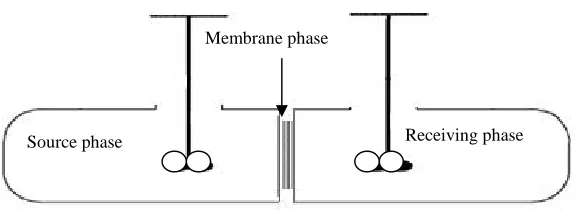
the membrane was sandwiched in between the feed and strip cells as demonstrated in Fig. 2. A
new supporting membrane was used in each experiment. The amount of ionic liquid loaded in
the supporting membrane was determined by weighing the membrane before and after
[image:6.612.74.365.246.351.2]impregnation with the ionic liquid.
Fig. 2 Schematic illustration of the glass diffusion cell set up with two independent compartments used for experiments
2.3 Experimental setup
Vanadium removal process in the supported liquid membrane was studied at the ambient
temperature using a glass diffusion cell with two separated compartments, as shown in Fig. 2.
Each compartment contained 50 ml of the process solutions. The initial concentration of
vanadium in feed solution was adjusted according to each experiment run. NH3 or NaOH was
used as the receiving phase and the concentration was varied in each experiment run according to
the requirement of each test. Both feed and receiving solutions were mechanically stirred to
reach homogeneity. The sampling of the feed solution was accomplished at particular time
intervals and in a defined period of time so as to observe concentration change of vanadium in
the feed phase.
Source phase Receiving phase
2.4 Transport studies
The change in solute concentration of the feed phase implies the process of vanadium transfer to
the stripping phase. The percentage of vanadium removal was calculated using Eq. (1):
(%) = × 100 (1)
where c0is the initial and c1is the final vanadium concentration in the feed compartment.
The kinetics of the transport process through a supported liquid membrane can be described by a
first-order reaction involving solute concentration as in Eq. (2), [21]:
= − (2)
where Ctis the metal ion concentration (mol dm-3) in the feed phase at a given time, is the initial
ion concentration in the feed solution, k is the rate constant (s-1), A is the area of membrane, V is
the volume of aqueous phase and t is the process time (s).
The value of k was gained by drawing a plot of ln (Ct/C0) versus time and calculating the steep of
the line in the graph. A high value of the determination coefficient was obtained. Afterward, the
flux (J) was determined as Eq. 3 [22]:
= (3)
2.5 Analytical methods
The concentration of each sample was measured by ICP-OES (Perkin Elmer, Optima 7000 DV).
used for stirring speed determination. Solutions were stirred mechanically by IKA Lab-Egg
Overhead Stirrer RW11.
3. Results and discussion
3.1 Selection of stripping agent
The solution of sodium hydroxide is a well-known alkaline stripping agent in metal ion
separation processes [23]. Moreover, sodium hydroxide solution was used by Abas [24] to
recover vanadium pentoxide (V2O5) from spent catalyst. On the other hand, ammonia was widely
used for stripping vanadium from its aqueous solution [10, 12, 25]. Accordingly, in the present
study sodium hydroxide and ammonia were applied in supported liquid membrane to evaluate
their stripping functionality in the vanadium removal process. TOMAC was used as the carrier.
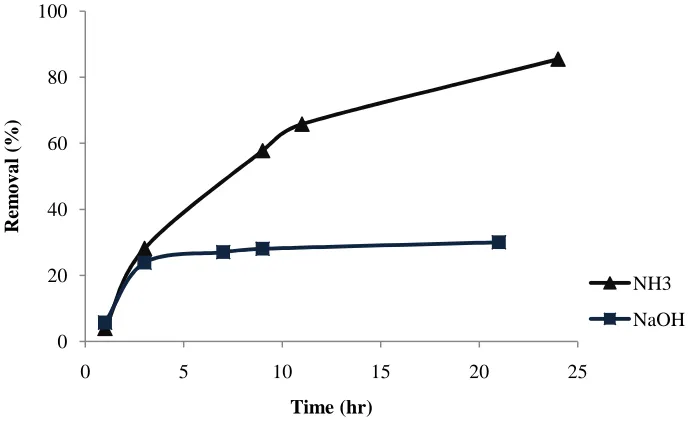
Fig. 3 displays the obtained results. Ammonia, being much more efficient in stripping vanadium
when compared to sodium hydroxide, was chosen for the rest of the experiments, and it
Fig. 3 Vanadium removal with different stripping agent
3.2 Effect of membrane support pore size
Thickness, pore size and hydrophobicity of the membrane support are among the main factors
that contributed to the efficiency and stability of supported liquid membrane [26]. In our
previous study, a PTFE membrane support with the thickness of 65 µm, having 85% porosity
demonstrated better performance and stability. A thinner membrane was found to provid less
mass transfer resistance and a membrane with high porosity provided more surface area. Smaller
pores improved the stability of a membrane support [26]. Therefore, to enhance the effectiveness
of the PTFE membrane support, another support filter with the same characteristics such as
porosity and thickness but smaller in pore size was chosen. TOMAC was used as the carrier. The
characteristics of the hydrophobic supports are summarized in Table 1. Fig. 4 demonstrates the
evaluation result of pore size effect on vanadium removal. The support with a pore size of 22 µm
accomplished better results during the initial hours of operation. However, its performance
diminished with time and fell even lower than that of the support with the pore size of 45 µm. 0
20 40 60 80 100
0 5 10 15 20 25
Re
m
o
v
a
l
(%
)
Time (hr)
NH3
This may be the result of lesser effective area of the transport caused by the blockage of small
[image:10.612.73.349.186.262.2]pores.
Table 1 Characteristics of the hydrophobic supports
Membrane type MS MS
Material PTFE PTFE
Porosity (%) 85 85
Thickness (µm) 65 65
Pore Size (µm) 0.45 0.22
Fig. 4 The effect of pore size of the membrane support on vanadium removal
3.3 Effect of pH
The solubility of vanadium oxides changes with increasing pH. Over normal acidic pH range of
wastewater, vanadium(IV) and (V) species were found to be water soluble [27]. However, highly
alkaline environment does not assure complete removal of vanadium from its aqueous solution.
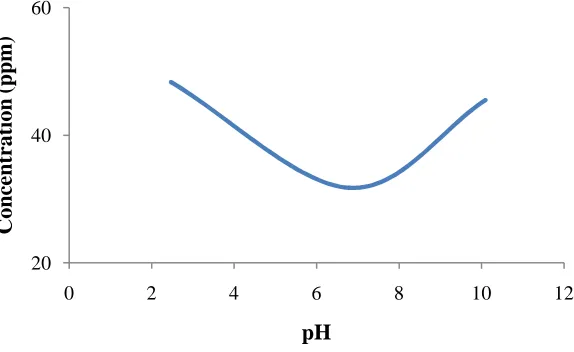
As per Fig. 5, vanadium concentration in the solution decreased when pH was increased till 7.
However, it bounced back into the solution once the pH was increased beyond 7. This signifies 0
20 40 60 80 100
0 5 10 15 20 25
R
em
oval
(
%
)
Time (hr)
45 µm
[image:10.612.86.357.304.486.2]investigate the influence of initial pH of the feed solution on the removal process, the vanadium
solution was applied in the supported liquid membrane at different pH values. The initial pH of
vanadium solution was 2.4. Two other solutions were prepared by adjusting the pH at 7 and 11.
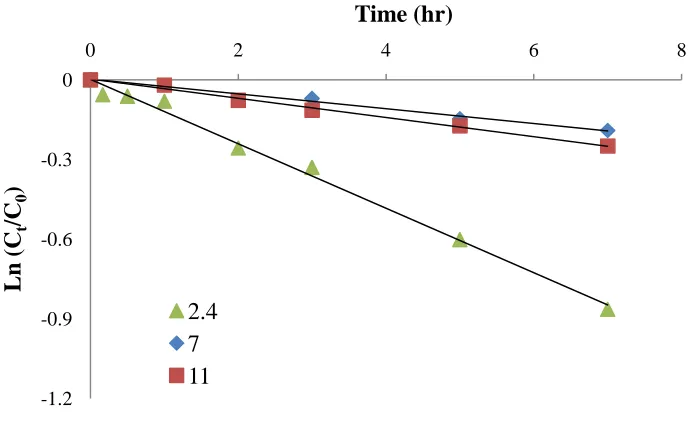
Fig. 6 shows the obtained results. The slope of ln (Ct/C0) against time indicates the rate of ion
transfer. A significant higher transfer rate of vanadium ion was observed while using a feed
solution without adjusting initial pH. This confirms the idea that vanadium transport through the
supported liquid membrane takes place on the basis of a pH gradient between feed and stripping
solutions [25]. This is also in agreement with the results obtained by Zhang et al. [28] claiming
[image:11.612.89.376.363.539.2]the maximum vanadium (IV) extraction at the optimum pH of 2.
Fig. 5 pH effect on the solubility of vanadium 20
40 60
0 2 4 6 8 10 12
C
on
ce
n
tr
at
ion
(
p
p
m
)
Fig. 6 Plot of ln (Ct/C0) vs. operation time for vanadium transport across supported liquid
membrane for observing the effect of pH at 2.4, 7 and 11.
3.4 A study on the type of ionic liquid
Fig. 7 illustrates the removal of vanadium, by using ionic liquids as the carrier in supported
liquid membrane. Two salts of 1-n-alkyl-3-methylimidazoliumviz. [CnMIM]+[BF4]- and
[CnMIM]+[ PF6]- were introduced as metal extractants [29]. However, they were not competent
enough to offer high extraction of vanadium. The acidic ionic liquid [BMIM][HSO4] also failed
to extract vanadium. As already mentioned, TOMAC has earlier extracted several metal ions
from aqueous solution. Correspondingly, the tetraalkylammonium cation exhibits higher
extraction efficiencies and this is in agreement with de los Rios et al. [30]. Although, TOMAC
carried out the vanadium extraction successfully, it was observed that adding a slight amount of
the RTIL composed of bis[(trifluoromethyl)sulfonyl] imide anion and
1-butyl-3-methylimidazolium (bmim) cation considerably improved the extraction process . It can be
inferred that owing to hydrophobic characteristics, NTF2 has a tendency to form metal ion
-1.2 -0.9 -0.6 -0.3 0
0 2 4 6 8
L
n
(
Ct
/C
0
)
Time (hr)
another pH. In fact, this behavior helped the TOMAC in forming complex. According to
Williams et al. [15], this can be attributed to the stabilized monomeric ligand-deficient
transition–metal complexes. Their findings disclosed that NTF2 anions stabilize the metal
complexes by means of four different binding modes: monodentate nitrogen or oxygen
coordination and/or bidentate oxygen–oxygen´ or nitrogen–oxygen coordination. While working
with different kinds of metals, they found out that the binding modes depended upon the
[image:13.612.85.509.304.513.2]electronic and steric demands of the metal centre [15].
Fig. 7 Vanadium removal using ionic liquids as carrier in supported liquid membrane
3.5 Effect of initial concentration of vanadium on the permeability
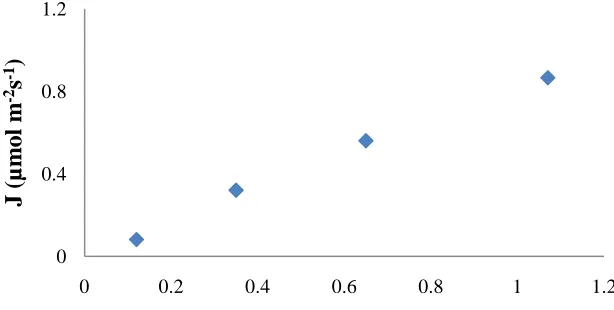
The effect of initial vanadium concentration on the flux is illustrated in Fig. 8. The vanadium
concentration varied from 0.1 to 1.1 mmol dm-3. The results revealed that the flux was dependent
on the initial vanadium concentration in the feed phase which was partly in agreement with the
anticipated trend as per Eq. (3), i.e. the flux changes proportionately with the metal
concentration. The flux tended to decline defying the trend beyond the initial concentration of 0
20 40 60 80 100
HMIM PF6 HMIM BF4 EMIM HSO4 TOMAC TOMAC+BMIM
NTF2
R
em
oval
(
%
0.8 mmol dm-3, apparently caused firstly, by membrane saturation and a lower effective
membrane area in the supported liquid membrane and secondly, due to saturation of the
membrane pores with metal carrier species and build-up of the carrier layer on the membrane
interface, enhancing the retention of the separating constituent on the entry side and thus causing
[image:14.612.88.395.252.407.2]the permeability flux to reach a constant value [31].
Fig. 8 The effect of initial vanadium concentration on the flux
3.6 The transport mechanism of vanadium across the supported liquid membrane
As already mentioned, vanadium forms different hydrolyzed species in aqueous solution and the
distribution of the vanadium (IV) species varies dependent upon the pH and total vanadium
concentration. The primary hydrolyzed vanadium (IV) species are distributed as [32]:
VO2++ 2H2OVO(OH)++ H3O+ pK1=5.67 (4)
2VO2++ 4H2O(VO)2(OH)22++ 2H3O+ pK2=6.67 (5)
According to Bhatnagar, et al. [1], vanadium forms cations below pH value of 3 and in the pH 0
0.4 0.8 1.2
0 0.2 0.4 0.6 0.8 1 1.2
J
(µ
m
ol
m
-2s -1)
contained vanadyl sulphate (VOSO4 . xH2O) and the tetravalent vanadium in the form of
oxo-complex VO2+ is the dominating cationic species. Color inspection confirms the existence of
vanadium(IV) species throughout the conducted experiments. In the feed-supported liquid
membrane interface, the vanadium that exists as VO2+ ion,forms a neutral complex VOL (L
represents the Ligand carrier). At the supported liquid membrane-receiving phase interface,
vanadium is extracted from the organic phase [33]. The mechanism of the ion pair mediated
transport is given in Fig. 9. At the interface between feed and membrane, metal ion pair forms
complex with ligand and the [VO L] complex diffuses through the membrane. At the interface
between membrane and stripping phase, i.e. in alkaline condition, the complex collapses
releasing the carrier thereby liberating the metal ion into the receiving phase. Finally, the ligand
carrier diffuses back across the membrane aqueous boundary layers to the feed
[image:15.612.83.365.436.556.2]solution-membrane interface where the cycle starts again [34, 35].
Fig. 9 Mechanism of ion-pair intervened transport through supported liquid membrane
3.7 Selectivity tests
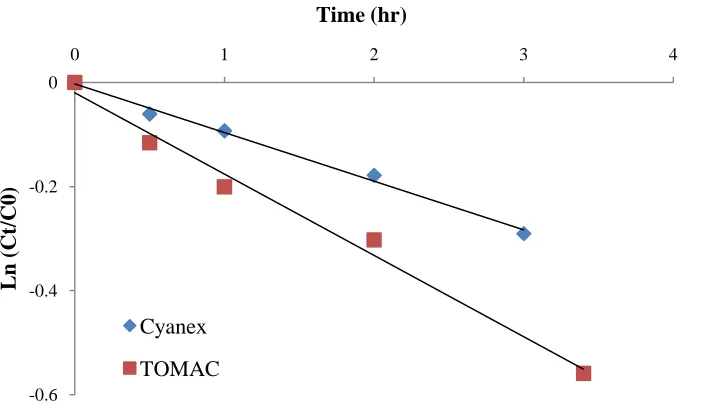
In a previous study [23], the extractant Cyanex 923 was applied as a carrier to remove chromium
from aqueous solution. In this study, its performance has been compared to TOMAC, as shown
in Fig. 10. The permeation rate for TOMAC is obviously higher than that of Cyanex 923. VO+2
[VO L]
L
Consequently, TOMAC emerged to be a prospective extractant for chromium. The selectivity of
TOMAC- based supported liquid membrane towards vanadium (IV) and chromium (VI) ions
was assessed. A solution of identical concentrations of chromium (VI) and vanadium (V) was
used in the feed compartment. The stripping cell contained sodium hydroxide solution. The
concentration change in the feed phase was measured in order to determine the selectivity. Fig.
11 shows that the selectivity of chromium over vanadium was as high as 2.6. In the next step, the
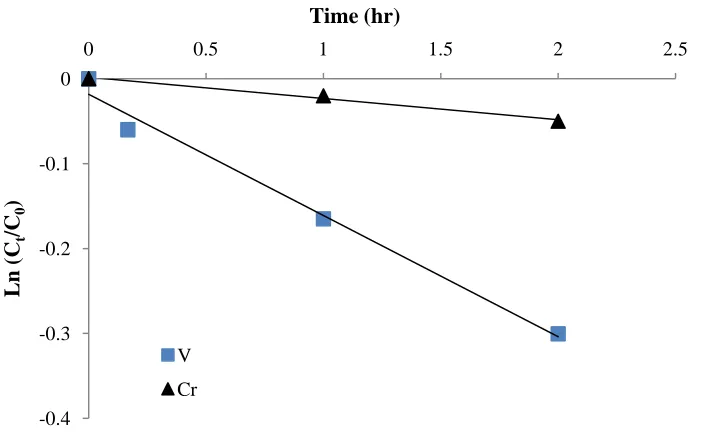
removal process was carried out using ammonia solution as the stripping agent. It is worth noting
that the selectivity dramatically changed towards the vanadium ion over chromium, as illustrated
in Fig. 12. This achievement confirms that the selectivity of vanadium (V) over chromium (VI)
depends strongly on the nature of the stripping agent.
Fig. 10 A comparison of chromium removal between the metal extractant Cyanex 923 and TOMAC.
-0.6 -0.4 -0.2 0
0 1 2 3 4
L
n
(
C
t/
C
0
)
Time (hr)
Cyanex
[image:16.612.76.427.385.593.2]Fig. 11 Plot of ln (Ct/C0) vs. operation time for vanadium and chromium transport across
supported liquid membrane using sodium hydroxide as stripping agent
Fig. 12 Plot of ln (Ct/C0) vs. operation time for vanadium and chromium transport across
supported liquid membrane using ammonia as stripping agent
4. Conclusion
Vanadium was effectively transported from the feed phase to the stripping phase of ammonia
solution using the room temperature ionic liquid, TOMAC, impregnated in the PTFE support -0.4
-0.3 -0.2 -0.1 0
0 0.5 1 1.5 2 2.5
L n ( C t/ C 0 ) Time (hr) Cr V -0.4 -0.3 -0.2 -0.1 0
0 0.5 1 1.5 2 2.5
[image:17.612.79.430.360.578.2]membrane. A significant higher transfer rate of vanadium ion was observed while using an acidic
feed solution without adjusting initial pH. Moreover, it was observed that adding a slight amount
of a second room temperature ionic liquid, [BMIM][NTF2], improves the extraction process
remarkably. Selective transport of vanadium from its mixture with chromium ions was also
carried out applying TOMAC as the carrier. The selectivity of vanadium (V) over chromium
(VI) depended strongly on the nature of the stripping agent.
Acknowledgements
The financial support from University of Malaya is gratefully acknowledged.
References
[1] A. Bhatnagar, A.K. Minocha, D. Pudasainee, H.-K. Chung, S.-H. Kim, H.-S. Kim, G. Lee, B. Min, B.-H. Jeon, Vanadium removal from water by waste metal sludge and cement immobilization, Chemical Engineering Journal, 144 (2008) 197-204.
[2] A. Naeem, P. Westerhoff, S. Mustafa, Vanadium removal by metal (hydr)oxide adsorbents, WATER RESEARCH, 41 (2007) 1596-1602.
[3] A. Okuwaki, A. Kimura, Y. Umetsu, K. Tozawa, T. Okabet, Extraction of Vanadium from Electrostatic Precipitator Ashes of Oil Power Plants, Ind. Eng. Chem. Res., 27 (1988) 1218-1222.
[4] T. Asadollahi, S. Dadfarnia, A.M.H. Shabani, Separation/preconcentration and determination of vanadium with dispersive liquid-liquid microextraction based on solidification of floating organic drop (DLLME-SFO) and electrothermal atomic absorption spectrometry, Talanta, 82 (2010) 208-212.
[5] M. Alibrahim, H. Shlewit, S. Alike, Solvent extraction of Vanadium (IV) with di(2-ethylhexyl) phosphoric acid and tributyl phosphate, periodica Polytechnica Chemical Engineering, 52 (2008) 29–33.
[6] R. Navarro, J. Guzman, I. Saucedo, J. Revilla, E. Guibal, Vanadium recovery from oil fly ash by leaching, precipitation and solvent extraction processes, Waste Management, 27 (2007) 425-438.
[7] L. Melita, F. Gumrah, Studies on Transport of Vanadium (V) and Nickel (II) from Wastewater Using Activated Composite Membranes, Waste Biomass Valor, (2010).
[10] C. Palet, M. Muñoz, M. Hidalgo, M. Valiente, Transport of vanadium(V) through a tricaprylylmethylammonium solid supported liquid membrane from aqueous acetic acid/acetate solutions, Journal of Membrane Science, 98 (1995) 241-248.
[11] S.V. Yadav, V.V. Mahajani, Liquid Emulsion Membrane (LEM) Process for Vanadium (IV) Enrichment: Process Intensification, Separation Science and Technology, 42 (2007) 1283-1303. [12] L.J. Lozano, C. Godínez, F.J. Alguacil, Facilitated transport of vanadium (V) by supported liquid membranes, Hydrometallurgy, 80 (2005) 196-202.
[13] M. Rajasimman, R. Sangeetha, Optimization of process parameters for the extraction of chromium (VI) by emulsion liquid membrane using response surface methodology, Journal of Hazardous Materials, 168 (2009) 291-297.
[14] S. Nosrati, N.S. Jayakumar, M.A. Hashim, Performance evaluation of supported ionic liquid membrane for removal of phenol, Journal of Hazardous Materials, In Press, Accepted Manuscript.
[15] D.B. Williams, M.E. Stoll, B.L. Scott, D.A. Costa, J.W.J. Oldham, Coordination chemistry of the bis(trifluoromethylsulfonyl)imide anion: molecular interactions in room temperature ionic liquids, Chemical Communications, (2005) 1438-1440.
[16] I. Villaescusa, V. Salvadó, J. de Pablo, Liquid-liquid and solid-liquid extraction of gold by trioctylmethylammonium chloride (TOMAC1) dissolved in toluene and impregnated on amberlite XAD-2 resin, Hydrometallurgy, 41 (1996) 303-311.
[17] I.M. Coelhoso, M.M. Cardoso, R.M.C. Viegas, J.P.S.G. Crespo, Transport mechanisms and modelling in liquid membrane contactors, Separation and Purification Technology, 19 (2000) 183-197.
[18] S. Venkatesan, K.M. Meera Sheriffa Begum, Emulsion liquid membrane pertraction of benzimidazole using a room temperature ionic liquid (RTIL) carrier, Chemical Engineering Journal, 148 (2009) 254-262.
[19] M. Matsumoto, T. Ohtake, M. Hirata, T. Hano, Extraction Rates of Amino Acids by an Emulsion Liquid Membrane with Tri-n-octylmethylammonium Chloride, J. Chem. T echnol. Biotechnol., 73 (1998) 237-242.
[20] T. Kojima, S. Yagi, K. Nishijima, M. Matsukata, Selective Permeation of Vanadium(V) and Chromium(V1) through Anion Exchange and Supported Liquid Membranes, Developments in Chemical Engineering and Mineral Processing, 3 (1995) 151-159.
[21] X.J. Yang, A.G. Fane, K. Soldenhoff, Comparison of Liquid Membrane Processes for Metal Separations: Permeability, Stability, and Selectivity, Ind. Eng. Chem. Res, 42 (2003) 392-403. [22] C.A. Kozlowski, W. Walkowiak, Removal of chromium(VI) from aqueous solutions by polymer inclusion membranes, WATER RESEARCH, 36 (2002) 4870-4876.
[23] S. Nosrati, N.S. Jayakumar, M.A. Hashim, Extraction performance of chromium (VI) with emulsion liquid membrane by Cyanex 923 as carrier using response surface methodology, Desalination, 266 (2011) 286-290.
[24] F.O. Abas, Vanadium Oxide Recovery from Spent Catalysts by ChemicaL Leaching, Eng.&Tech., 26 (2008 ).
[25] A. Rosell, C. Palet, M. Valiente, Selective separation and concentration of vanadium(V) by a chemical pumping hollow-fiber supported liquid membrane, Analytica Chimica Acta, 349 (1997) 171-178.
[27] R.G. Kunz, J.F. Giannelli, H.D. Stensel, Vanadium removal from industrial wastewater, Water Pollution Control Federation, 48 (1976) 762-770.
[28] P. Zhang, K. Inoue, K. Yoshizuka, H. Tsuyama, Extraction and selective stripping of molybdenum(VI) and vanadium(IV) from sulfuric acid solution containing aluminum(III), cobalt( II), nickel(II) and iron(III) by LIX 63 in Exxsol D80, Hydrometallurgy, 41 (1996) 45-53.
[29] H. Zhao, S. Xia, P. Ma, Review Use of ionic liquids as ‘green’ solvents for extractions,
Journal of Chemical Technology and Biotechnology, 80 (2005) 1089-1096.
[30] A.P. de los Rios, F.J. Hernandez-Fernandez, L.J. Lozano, S. Sanchez, J.I. Moreno, C.
Godınez, Removal of Metal Ions from Aqueous Solutions by Extraction with Ionic Liquids, J.
Chem. Eng. Data, 55 (2010) 605–608.
[31] F.J. Alguacil, C.n. Caravaca, M.I. Martin, Transport of chromium(VI) through a Cyanex 921-supported liquid membrane from HCl solutions, Journal of Chemical Technology and Biotechnology, 78 (2003) 1048-1053.
[32] D.M. Manohar, B.F. Noeline, T.S. Anirudhan, Removal of Vanadium(IV) from Aqueous Solutions by Adsorption Process with Aluminum-Pillared Bentonite, Ind. Eng. Chem. Res. , 44 (2005) 6676-6684.
[33] D. Husseinzadeh, Selective and Facilitated Transport of Vanadium (VO2+) Ion through Supported Liquid Membrane and Effects of Membrane Characteristics, World Academy of Science, Engineering and Technology 71 (2010) 228-230.
[34] P. Venkateswaran, K. Palanivelu, Studies on recovery of hexavalent chromium from plating wastewater by supported liquid membrane using tri-n-butyl phosphate as carrier, Hydrometallurgy, 78 (2005) 107-115.