BIROn - Birkbeck Institutional Research Online
Thomas, Michael S.C. (2016) Understanding delay in developmental
disorders. Child Development Perspectives 10 (2), pp. 73-80. ISSN
1750-8592.
Downloaded from:
Usage Guidelines:
Please refer to usage guidelines at or alternatively
Understanding Delay in Developmental Disorders
Michael S. C. Thomas
Birkbeck, University of London
Key words: Developmental disorders, delay, trajectories, computational modeling,
Abstract
Researchers in developmental disorders frequently refer to abilities that are in line
with mental age as simply delayed. The qualifier simply might imply an existing theory of
developmental delay that is well understood and uninteresting (perhaps because it is an
exaggerated form of individual differences, the responsibility of other researchers). In this
article, I argue that the notion of delay can be separated into descriptive and explanatory
versions. The descriptive version is often used too coarsely to be helpful. Instead, we need an
approach based on developmental trajectories to separate types of descriptive delay, which
may then have different underlying causes. The explanatory version is poorly articulated in
developmental theory. One useful way to deepen our understanding of delay is by building
computational models that simulate development in large populations of individuals and
explicitly implementing factors that cause variations in development. Finally, I suggest that
dividing research among separate investigators of typical development, individual differences,
and developmental disorders may be counterproductive if the underlying mechanisms
When researchers who investigate the causes of developmental disorders examine an
impaired cognitive ability in a given disorder, they frequently ask whether the ability is
atypical or simply delayed. Why attach the qualifier simply to the notion of delay? The
implication is twofold: Researchers already have a theory of developmental delay and find it
uninteresting. In this article, I express reservations with these implications and argue that the
concept of delay is both poorly characterized and lacking explanation at a mechanistic level.
The assumption of delayed development—that abilities will catch up eventually—is usually
wrong.
In the first part of the article, I argue that characterizing development in terms of
trajectories provides a richer vocabulary to describe delay, and I offer examples of these
methods. In the second part, I consider explanations of delay and argue that computational
modeling allows us to focus on the mechanisms that influence rates of development. I also
provide examples from language development and show how these models may provide a
basis to inform intervention. I finish with a look ahead at areas for research.
Delay as a Descriptive Term
The notion of delay, which originated in a clinical context, identifies when a child
fails to show age-appropriate developmental milestones or falls quantitatively below certain
thresholds on standardized tests of core domains, such as motor skills, speech and language,
personal-social cognition, or daily living (1). Implicit in the quantitative definition is the
recognition that in typical children, early trajectories of development vary. Variation below a
certain range is deemed problematic. The label delay may also serve as a temporary
placeholder in the dialogue between clinicians and parents, indicating that development is not
on track; a specific diagnosis may became apparent when the child is older (1). The clinical
rate of development is also associated with long-term impairment rather than resolution into
the normal range (2, 3).
The concern here is when the clinical label of delay is imported into theoretical
explanations of developmental deficits. The term is used often in describing children’s
behavioral profiles. Delay is identified when a child with a developmental disorder gets
scores or error patterns on a behavioral measure that are similar to younger typically
developing children. Sometimes, the terminology is associated with a particular form of
experimental design. A group of individuals with a given disorder is matched with two
separate typically developing control groups, with one matched on chronological age (CA)
and the other matched on mental age (MA). MA is derived from a standardized test deemed
relevant to the cognitive ability under consideration (e.g., a vocabulary test for language
ability). If children in the disorder group are impaired when compared to children in the
CA-matched group but resemble the MA-CA-matched group, individuals with the disorder are
considered delayed in this ability. In contrast, if children in the disorder group are impaired
when compared to the MA-matched control group, they are said to deviate developmentally
or be atypical for this ability (see, e.g., 4, 5).
Researchers (6) have pointed to two disadvantages to the matching design: First, age
is eliminated from the analysis at the design stage, with variations in age collapsed within the
group for both the typically developing (TD) and the disorder groups. Given that
development is intrinsically a process concerning change across age, downplaying age in this
way seems counterproductive. Second and more seriously, the notion of delay that emerges is
a blunt one. In studies of language and visuospatial skills in disorders such as autism, Down
syndrome, and Williams syndrome, researchers have argued for using developmental
trajectories that trace changes in ability over time, and comparing these trajectories between
growth-curve modeling (see, e.g., 7-9) and in the wider consideration of the shape of change
in development (10, 11).
When trajectories are constructed using even simple linear methods, abilities can be
delayed in their onset, in their rate of development, or in both. Plotting trajectories this way
also allows researchers to identify other descriptors that can differentiate TD and disorder
groups, including earlier or lower ceiling performance, differential relationships between
abilities, and the possibility of differently shaped (nonlinear) functions in the disordered
group.
Trajectory approaches have limits. Cross-sectional trajectories are frequently
constructed in the first instance, but these confound individual differences (and for disorders,
differences in severity) with developmental change. Longitudinal studies are preferable,
especially for informing causality, although practical barriers to large-scale longitudinal
studies are well-known. Researchers (6) have advocated a compromise of initially
constructing cross-sectional trajectories, which should then be validated by following up
longitudinally with the younger participants. Both cross-sectional and longitudinal methods
for investigating disorders should then be complemented by intervention studies, which are
the most direct way to test causal models.
Although building functions that link ability to chronological age can identify
different types of descriptive delay, the more theoretically informative trajectories are those
that link different abilities, which researchers term developmental relations (6). Trajectories
can be constructed that link a target ability to a child’s mental age on standardized tests, or
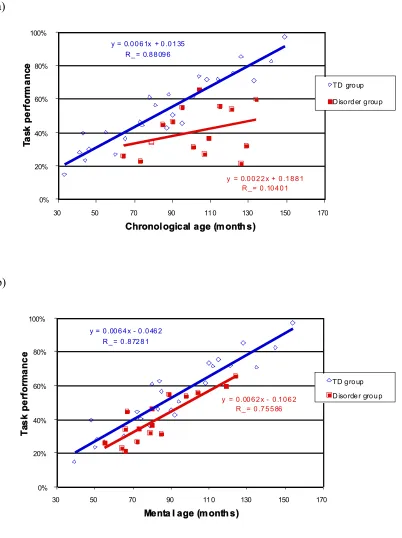
that directly link the development of different abilities. Figure 1 illustrates one heuristic used
with this method, comparing data for a TD group and a disordered group with trajectories
plotted against CA or MA on a task-relevant standardized measure. If impaired task
disorder group’s data according to each participant’s MA should normalize the atypical
trajectory— that is, move it to the top of the TD trajectory, as shown in Figure 1.
To illustrate this approach, in one study (12), toddlers with autistism spectrum
disorder (ASD) were shown pictures of faces while electrophysiological measures of neural
response were collected. The electrophysiological responses were plotted against
chronological age and social scores, revealing delayed relations with chronological age, but
normal relations with social scores. The authors inferred that slower development of the
face-processing system in ASD may be related to reduced self-directed experience with faces in
(a)
[image:8.595.80.482.73.611.2](b)
Figure 1.Illustrative data from the trajectories method comparing task performance in
typically developing (TD) and disorder groups. (a) Cross-sectional trajectories linking
performance to chronological age. (b) Trajectories linking performance to a mental age (MA)
on a task-relevant standardized test. If ability A is developing at the same rate as some other
y = 0.0061x + 0.0135 R_ = 0.88096
y = 0.0022x + 0.1881 R_ = 0.10401 0% 20% 40% 60% 80% 100%
30 50 70 90 110 130 150 170
Ta sk p e rf o rm a n ce
Chronological age (month s)
TD group
Disorder group
y = 0.0064x - 0.0462 R_ = 0.87281
y = 0.0062x - 0.1062 R_ = 0.75586
0% 20% 40% 60% 80% 100%
30 50 70 90 110 130 150 170
T as k p e rf o rm a n c e
Menta l age (month s)
TD group
(also delayed) ability B, then plotting a trajectory between performance on A and the mental
age on ability B will normalize the developmental pattern.
The study of developmental relations taps an implicit assumption researchers
frequently hold: that the cognitive system develops in integrated blocks or domains (e.g.,
verbal, nonverbal, spatial). Abilities that develop in harness are considered to be related
causally or subject to the same causal factors. The lack of an expected relation between an
ability and a given MA measure might indicate the absence of the integrated block in the
disorder; the presence of an unexpected MA predictor might indicate atypical blocks or
developmental contingencies (13). Therefore, fully understanding delay requires tracking
many abilities, not a single ability.
Delay as an Explanatory Term
Explanatory accounts of developmental delay focus on the mechanisms by which
cognitive systems change over time. However, these accounts frequently lack explicit detail
at the level of mechanism. Maturational views of delay have been formulated via the analogy
to biological growth, with variations in rate of growth reflecting differences in (putative)
genetically controlled timing mechanisms (see, e.g., 14-15, for proposals with respect to
language development). Experience-dependent views of delay are less frequent, but
presumably entail either a cognitive system that receives fewer learning experiences or a
learning system that is less malleable so more experience is needed to change behavior (e.g.,
16). These views are not mutually exclusive: A cognitive system may receive fewer or less
rich experiences because the providers of those experiences think the child’s cognitive
Computational Modeling as a Tool To Study Mechanisms of Delay
Computational modeling of development is a useful way to focus on explicit
mechanisms. Such models have been used to investigate language and cognitive development,
often using artificial neural network architectures (ANNs; 17, 18). ANNs are computational
systems based loosely on the principles of neural information processing. As such, they are
positioned at a level of description above biological neural networks, but aim to explain
behavior on the basis of the same style of computations as the brain. ANNs can learn from
data by progressively altering the strengths of the connections in their networks, and
therefore can explain the mechanisms underlying behavioral change in cognitive
development. Changes in behavior are the result of experience-dependent alterations in the
network that result from its interaction with a structured learning environment. A model has
intrinsic constraints that affect its learning ability, such as the number of artificial neurons,
the pattern of connections between units, the network’s plasticity, and the way external or
environmental inputs are encoded for processing. The richness of environmental information
can also be manipulated. However, in contrast to child development, in a model these
constraints are known precisely and can be manipulated by the modeler to observe changes to
the developmental trajectory and the learning outcome (19, 20).
Modeling Development in Populations of Children
Recently, researchers have used the computational approach to simulate
developmental processes in large populations of children, and to include intrinsic
(neurocomputational) and extrinsic (environmental) factors that interact to produce variability
in developmental trajectories (21, 22). Population models simulate a sufficiently large
contrasts with the approach of building a single model to represent typical development, and
a single altered model to represent a given disorder.
To understand why population modeling is necessary to investigate the notion of
delay, consider one reason researchers studying disorders may consider delay to be of less
theoretical interest (and so refer to it as simple). The developmental theoretical perspective
on intellectual disabilities features two causes of disability (23). First, disability can arise
from underlying organic dysfunction, producing specific deficits in cognitive functioning and
qualitatively atypical cognitive development. Second, disability may reflect individuals at the
extreme lower end of the distribution of normal functioning who show the same overall
qualitative pattern of development as nonimpaired individuals. In this view, understanding
development in disordered groups would amount to an extension of individual differences
theory, not the responsibility of researchers who study disorder. If we accept this view, then
to bring computational methods to bear on developmental disorders, we need to simulate the
normal range of variation in typical development in a population of children (the familiar bell
curve) as a backdrop against which to consider the possibility of atypical variation.
Population Modeling and Delay
Population modeling of development is illustrated in research (24) that investigated
the effects of differences in socioeconomic status (SES) on language acquisition. My
colleagues and I created an ANN to simulate children’s acquisition of inflectional
morphemes, which change a word’s grammatical function (e.g., in English, adding –ed to
form the past tense). This work sought to capture SES effects observed in a sample of
three-hundred 6-year-olds (25) with a simulated population of 1,000 children. Intrinsic variability
was built into the simulated population through small variations in a number of different
the network, the density of connectivity between neurons, and the plasticity of the network in
responding to experiences. Extrinsic variation due to SES (i.e., variation in level of cognitive
stimulation) was captured by altering the information content of the environment to which the
simulated children were exposed. Figure 2 shows the range of trajectories that the model
simulated, in this case, for acquiring the past tense of irregular English verbs. Individual
trajectories are shown in Figure 2a, the population mean in 2b, and cross-sections in 2c.
The model captured qualitative patterns within the children’s behavioral data. It also
demonstrated how gene-environment interactions, such as resilience effects, might emerge.
For example, in low-SES environments, differences in intrinsic ability were suppressed,
while differences between individuals were exaggerated in high-SES environments (26).
Moreover, the model predicted that high SES would predict reliably whether children fell in
the top 10% of the population, but low SES would not predict reliably whether children fell
in the bottom 10% of the population. This prediction was subsequently supported by
0 20 40 60 80 100 120
0.0 0.1 0.2 0.3 0.4 0.5 0.6 0.7 0.8 0.9 1.0
N u m b er o f individuals Performance level Time 1 Time 2 Time 3 0 0.2 0.4 0.6 0.8 1 Pe rfo rm an ce Development 0.0 0.2 0.4 0.6 0.8 1.0 Pe rfo rm an ce Development
(a)
(b)
(c)
Figure 2. (a) Developmental trajectories simulated by a computational model of child
development for a population of 1,000 children, with variations in the quality of learning
mechanisms and of the environment producing different trajectories. (b) A development view
of these data, considering change over time for the average child. (c) An
individual-differences view of these data, plotting the frequency distribution of performance levels for
cross-sections at different time points
We can now apply this valid model of population development to the question of
atypicality versus delay in disorders, as was done in a study of language delay (27).
Diagnosing language delay early allows intervention at a time of greater plasticity and
minimizes the impact on the child. Delay can be identified at 3 to 4 years based on
vocabulary size and parents’ reports. However, of children diagnosed with delay at this age,
between half and two-thirds fall within the normal range two years later and do not need
intervention, making intervening early inefficient in terms of cost. How do children for whom
delay resolves differ from those for whom it persists? Are those with persistent delay
qualitatively different and atypical (15, 28), or do resolving language delay and persisting
language delay fall on a continuum of severity and involve variation in the same mechanisms
(29, 30)?
In a study (27) that used the population model (24) to identify early signs of delay in
the simulated children, researchers followed the trajectories of these networks across
development. Just as with the real children, in the model, about two-thirds of the early-delay
networks later fell within the normal range, while in a third, the delay persisted. However, the
researchers had designed this simulation so that the variation in developmental mechanisms
was continuous across the population. The networks with persisting delay varied in
signal inside the networks, such as the number of units in the network or the level of
processing noise; those with resolving delay varied in parameters that primarily affected
plasticity, such as the extent to which connections changed strength following experience
with language. The two effects produced similar behavioral profiles early in development.
Again, the model generated an empirical prediction: SES should reliably predict the final
level of performance in the resolving delay group but not in the persisting delay group (the
environment being the limiting factor in the former, the processing capacity being the
limiting factor in the latter). Once more, empirical data supported this prediction (27). In
short, persisting delay appeared as a behaviorally discrete (atypical) subgroup despite a
continuum of variation in the underlying mechanisms across the population.
The population model framework above considered only a continuum of mechanistic
variation in a population of developing children. Other work has addressed the interaction of
that continuum with atypical variation, for example in cases where a subset of individuals in
the population have neurocomputational parameters that vary outside the normal range, either
due to a genetic mutation or an accumulation of common genetic variants conveying risk. In
one model (31, 32), researchers investigated whether ASD is caused by overpruning of brain
connectivity, an exaggeration of an otherwise-normal phase of brain development. These
simulations demonstrated that the effects of a pathological mechanism can interact with
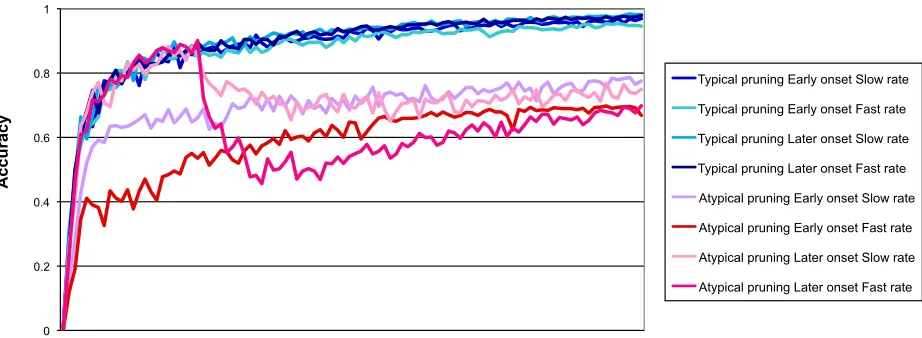
populationwide individual differences. Three parameters were included that captured
individual variation in pruning of network connectivity: its onset, its rate, and its severity. As
with other parameters, all three were allowed to vary by small amounts in the typical
population. On their own, each had little impact on developmental trajectories. However,
when the severity of pruning was increased to atypical levels, impairing the functioning and
further development of the network, the effects of the same individual differences in onset
development. These different trajectories were linked to putative early onset, late onset, and
regressive subtypes of ASD. Together, both the model of language delay and the model of
ASD (27, 31, 32) suggest that subgroups at the behavioral level are artifacts, generated by
interactions between continuous variation in many underlying mechanisms.
[image:16.595.85.546.254.423.2]
Figure 3.Simulated developmental trajectories from a computational model of autistic
spectrum disorder (ASD; 32). The model evaluated the hypothesis that ASD might be
caused by overpruning of brain connectivity. This plot demonstrates the feasibility of the idea
that apparent subgroups within ASD—early onset, late onset, and regressive subtype—might
be caused by the interaction of a single pathological mechanism (overpruning) with
pre-existing, populationwide individual differences in other neurocomputational parameters (in
this case, the onset and rate of pruning). Atypical trajectories (thick lines) show divergent
profiles. These individual differences produce otherwise-negligible effects on trajectories in
the typically developing group (thin lines).
(Reproduced with permission from 32).
0 0.2 0.4 0.6 0.8 1
Accuracy
Epochs of training
Typical pruning Early onset Slow rate
Typical pruning Early onset Fast rate
Typical pruning Later onset Slow rate
Typical pruning Later onset Fast rate
Atypical pruning Early onset Slow rate
Atypical pruning Early onset Fast rate
Atypical pruning Later onset Slow rate
From Deficit to Intervention
Population modeling provides a framework to develop and test theories about
mechanisms underlying delay and atypicality in disorders, specified in terms of influences on
developmental trajectories. Constructing models of this type provides a platform to
investigate the mechanisms by which behavioral interventions alleviate developmental
deficits. This platform allows us to address why children’s response to intervention often
varies widely. This avenue of computational modeling is relatively unexplored (see 33 for a
notable exception). Recently, my colleagues and I demonstrated that computational models of
developmental deficits (this time, in the domain of productive vocabulary development) can
be created that are tailored to the profile of individual children, which can then be used to
predict which type of behavioral intervention each child will best respond to (34). Tests of
the predictions can then be used to refine the model, harnessing intervention data to guide
mechanistic theories. This research is in the early stages, but it may help us build bridges
between a theoretical, mechanistic understanding of variations of developmental outcomes
and the practice of clinical, therapeutic interventions to remediate developmental
impairments.
Looking Ahead
We can progress further in investigating the underlying causes of developmental
delay when we think in terms of developmental trajectories and the factors that modulate
such trajectories, both across abilities and across children. We need adequate description of
those trajectories using the appropriate statistical methods and more fully articulated
mechanistic explanations of the relevant causal factors. Computational models of
Advances in understanding will be accelerated by studying individual differences, of
a typical or atypical nature, within a developmental framework. This contrasts with a frequent
division of labor among researchers into the separate fields of typical development,
individual differences, and developmental disorders. However, the underlying mechanisms
may not reflect the distinction between these three fields. To highlight this point, Figure 2a
illustrates the trajectories that can be generated in a model system where we have a full
understanding of the species-universal mechanisms of development, as well as the constraints
that cause modulations of trajectories across individuals. The development of the average
child can be characterized (as shown in Figure 2b) or explanations can be sought for the rank
order of performance in cross-sections of the population (as shown in Figure 2c). But both of
these represent restricted, partial views of the same system.
The use of population-level models is consistent with the latest methods in genetics
research. In that field, variations in cognitive development are viewed as the combination of
many small effects, detectable only with large sample sizes. Results from behavior genetics
encourage the view that, apart from cases of overt genetic mutations, the causes of atypical
variation lie on a mechanistic continuum with individual differences in the typically
developing population (35). This is in line with the computation results considered in this
article, where apparently atypical subgroups emerged from continuous variations in
developmental mechanisms across a population.
Even if causal explanations are formulated most optimally at a population level,
diagnosis and intervention ultimately concern individual children. Given the increasing
emergence of datasets at the population level, using results to connect meaningfully to
individual children—for instance, to remediate cases of developmental delay—is a challenge
Author’s Note
The research reported in this article was supported by UK ESRC grant
RES-062-23-2721, a Leverhulme Study Abroad Fellowship held at the University of Chicago, and a joint
grant from the Wellcome Trust and the Education Endowment Foundation awarded to the
University of London Centre for Educational Neuroscience.
Correspondence concerning this article should be addressed to Michael S. C. Thomas,
Department of Psychological Sciences, Birkbeck, University of London, Malet Street,
References
1. Shevell, M. I. (2010). Present conceptualization of early childhood
neurodevelopmental disabilities. Journal of Child Neurology, 25, 120-126. doi:
10.1177/0883073809336122
2. Levy, Y. (2011). Developmental delay revisited. Developmental Disabilities Research
Reviews, 17, 180-184. doi: 10.1002/ddrr.1112
3. Shevell, M. I., Majnemer, A., Platt, R. W., Webster, R., & Birnbaum, R. (2005).
Comparison of developmental and functional outcomes in pre-school children
diagnosed with either global developmental delay or developmental language
impairment. Developmental Medicine & Child Neurology, 47, 678-683. PMID:
16225809
4. Hodapp, R. M., Burack, J. A., & Zigler, E. (Eds.). (1990). Issues in the developmental
approach to mental retardation. New York, NY: Cambridge University Press.
5. Leonard, L. B. (1998). Children with specific language impairment. Cambridge, MA:
MIT Press.
6. Thomas, M. S. C., Annaz, D., Ansari, D., Serif, G., Jarrold, C., & Karmiloff-Smith, A.
(2009). Using developmental trajectories to understand developmental disorders.
Journal of Speech, Language, and Hearing Research, 52, 336-358. doi:
10.1044/1092-4388(2009/07-0144)
7. Chapman, R. S., Hesketh, L. J., & Kistler, D. J. (2002). Predicting longitudinal
change in language production and comprehension in individuals with Down
syndrome: Hierarchical linear modeling. Journal of Speech, Language, and Hearing
8. Rice, M. L. (2004). Growth models of developmental language disorders. In M. L.
Rice & S. F. Warren (Eds.), Developmental language disorders: From phenotypes to
etiologies (pp. 207-240). Mahwah, NJ: Erlbaum.
9. van Geert, P. (1991). A dynamic systems model of cognitive and language growth.
Psychological Review, 98, 3-53. http://dx.doi.org/10.1037/0033-295X.98.1.3
10.Elman, J. L., Bates, E. A., Johnson, M. H., Karmiloff- Smith, A., Parisi, D., &
Plunkett, K. (1996). Rethinking innateness: A connectionist perspective on
development. Cambridge, MA: MIT Press.
11.Karmiloff-Smith, A. (1998). Development itself is the key to understanding
developmental disorders. Trends in Cognitive Sciences, 2, 389-398.
http://dx.doi.org/10.1016/S1364-6613(98)01230-3
12.Webb, S. J., Jones, E. J. H., Merkle, K., Venema, K., Greenson, J., Murias, M., &
Dawson, G. (2011). Developmental change in the ERP responses to familiar faces in
toddlers with autism spectrum disorders versus typical development. Child
Development, 82, 1868-1886. doi: 10.1111/j.1467-8624.2011.01656.x
13.Morton, J. (2004). Understanding developmental disorders: Causal modeling. Oxford,
UK: Blackwell.
14.Rice, M. L. (2009). Language acquisition lessons from children with specific
language impairment: Revisiting the discovery of latent structures. In V. C.
Gathercole (Ed.), Routes to language (pp. 287-313). Hove, East Sussex, UK:
Psychology Press.
15.Rice, M. L. (2012). Toward epigenetic and gene regulation models of specific
language impairment: Looking for links among growth, genes, and impairments.
16.Garlick, D. (2002). Understanding the nature of the general factor of intelligence: The
role of individual differences in neural plasticity as an explanatory mechanism.
Psychological Review, 109, 116-136. doi: 10.1037//0033-295X.109.1.116
17.Mareschal, D., & Thomas, M. S. C. (2007). Computational modeling in
developmental psychology. IEEE Transactions on Evolutionary Computation
(Special Issue on Autonomous Mental Development), 11, 137-150. doi:
10.1109/TEVC.2006.890232
18.Thomas, M. S. C., & McClelland, J. L. (2008). Connectionist models of cognition. In
R. Sun (Ed.), Cambridge handbook of computational cognitive modelling (pp. 23-58).
Cambridge, UK: Cambridge University Press.
19.Thomas, M. S. C., & Karmiloff-Smith, A. (2003). Modeling language acquisition in
atypical phenotypes. Psychological Review, 110, 647-682. doi:
10.1037/0033-295X.110.4.647
20.Thomas, M. S. C., & Karmiloff-Smith, A. (2003b). Connectionist models of
development, developmental disorders and individual differences. In R. J. Sternberg, J.
Lautrey, & T. Lubart (Eds.), Models of intelligence: International perspectives, (p.
133-150). Washington, DC: American Psychological Association.
21.Thomas, M. S. C., & Baughman, F. D. (2014). Neuroconstructivisme: Pour
comprendre les trajectoires developpementales typiques et atypiques
(Neuroconstructivism: Understanding typical and atypical trajectories of
development). Enfance, 3, 205-236. doi: 10.4074/S0013754514003036
22.Thomas, M. S. C., Forrester, N. A., & Ronald, A. (2015). Multi-scale modeling of
gene-behavior associations in an artificial neural network model of cognitive
23.Bennett-Gates, D., & Zigler, E. (1998). Resolving the developmental-difference
debate: An evaluation of the triarchic and systems theory models. In J. A. Burack, R.
M. Hodapp, & E. Zigler (Eds.), Handbook of mental retardation and development (pp.
115-131). Cambridge, UK: Cambridge University Press.
24.Thomas, M. S. C., Forrester, N. A., & Ronald, A. (2013). Modeling socio-economic
status effects on language development. Developmental Psychology, 9, 2325-43. doi:
10.1037/a0032301
25.Bishop, D. V. M. (2005). DeFries-Fulker analysis of twin data with skewed
distributions: Cautions and recommendations from a study of children’s use of verb
inflections. Behavior Genetics, 35, 479-490. doi: 10.1007/s10519-004-1834-7
26.Forrester, G. S., & Thomas, M. S. C. (2015). What is universal and what differs in
language development? Language, Cognition and Neuroscience, Volume 30, Issue 8,
2015, pages 922-927. doi: 10.1080/23273798.2015.1055281
27.Thomas, M. S. C., & Knowland, V. C. P. (2014). Modeling mechanisms of persisting
and resolving delay in language development. Journal of Speech, Language, and
Hearing Research, 57, 467-483. doi: 10.1044/2013_JSLHR-L-12-0254
28.van der Lely, H. K. J., & Pinker, S. (2014). The biological basis of language: Insight
from developmental grammatical impairments. Trends in Cognitive Sciences, 18,
586-595. doi:10.1016/j.tics.2014.07.001
29.Leonard, L. B. (1987). Is specific language impairment a useful construct? In S.
Rosenberg (Ed.), Advances in applied psycholinguistics (Vol. 1, pp. 1-39). Hillsdale,
NJ: Erlbaum.
30.Rescorla, L., Dahlsgaard, K., & Roberts, J. (2000). Late-talking toddlers: MLU and
IPSyn outcomes at 3;0 and 4;0. Journal of Child Language, 27, 643-664. doi:
31.Thomas, M. S. C., Knowland, V. C. P., & Karmiloff-Smith, A. (2011). Mechanisms
of developmental regression in autism and the broader phenotype: A neural network
modeling approach. Psychological Review, 118, 637-654. doi: 10.1037/a0025234
32.Thomas, M. S. C., Davis, R., Karmiloff-Smith, A., Knowland, V. C. P., & Charman,
T. (2015). The over-pruning hypothesis of autism. Developmental Science, published
online April 6 2015 [Epub ahead of print]. doi: 10.1111/desc.12303
33.Harm, M. W., McCandliss, B. D., & Seidenberg, M. S. (2003). Modeling the
successes and failures of interventions for disabled readers. Scientific Studies of
Reading, 7, 155-182. doi: 10.1.1.126.6643
34.Best, W., Fedor, A., Hughes, L., Kapikian, A., Masterson, J., Roncoli, S., Fern-Pollak,
L., & Thomas, M. S. C. (2015). Intervening to alleviate word-finding difficulties in
children: Case series data and a computational modelling foundation. Cognitive
Neuropsychology, 32, 133-168. doi: 10.1080/02643294.2014.1003204
35.Plomin, R., & Simpson, M. A. (2013). The future of genomics for developmentalists.
Development and Psychopathology, 25, 1263-1278. doi: