PURIFICATION
METHOD OF LITHIUM
PAUWELS and K. F. LAUER
lile
1
Ç î ' l j l ·1« * ,
Joint Nuclear Research Center Geel Establishment - Belgium
Central Bureau for Nuclear Measurements - CBNM
rth ·«·>·»· TJ ΪΓ " ■
»'rtrtpít
Β
» * . Η Ι Η i
rt»1»*' ·1
fittili
rwi
imp
Γ|ί*Γ ¡fö 'ffltli
111
iff-»
: : ijtfl
iWMVWjtK'1*
i
»h>'<t
m
m
ι»:
W- WS
WS
lii
LEGAL NOTICE
This document was prepared under the sponsorship of the Commission of the European Communities.
Neither the Commission of the European Communities, its contractors nor any person acting on their behalf :
Make any warranty or representation, express or implied, with respect to the accuracy, completeness, or usefulness of the information contained in this document, or t h a t the use of any information, apparatus, method, or process disclosed in this document may not infringe privately owned rights ; or
Assume any liability with respect to the use of, or for damages
\mm
Assume any liability with respect to the use of, or for damages resulting from the use of any information, apparatus, method or process disclosed in this document.
illiiliïitt
n >>:ύ
¡a
ÙMi
ÉiPi
fer
..SMID«'liJT!ma»
BP
M W
the price of F F 4
WhTvil'îτΊ!-filt» flKwkk »rûiUJI »¡¿rtlüUCUB·'!!·'LkS*í'·7a*»iPVTι w
This report is on sale at the addresses listed on cover page 4
n.
EUR 4072 e
THE DEVELOPMENT OP A PURIFICATION METHOD OF
LITHIUM by J. PAUWELS and K.F. LAUER
European Atomic Energy Community — EURATOM
Joint Nuclear Research Center — Geel Establishment (Belgium) Central Bureau for Nuclear Measurements — CBNM
Brussels, September 1968 — 22 Pages — 3 Figures — FB 40
A purification method of lithium on a cation-exchange resin in 1 M HCl was described. To allow the preparation of lithium containing
Z. 50 ppm alkali and alkali-earth metals, a special purification of the ion-exchanger was needed. A method using batch operations with the tetra lithium salt of EDTA, with 30 % hydrochloric acid, and elution with 1 M hydrochloric acid was described.
EUR 4072 e
THE DEVELOPMENT OF A PURIFICATION METHOD OF LITHIUM by J. PAUWELS and K . F . LAUER
European Atomic Energy Community — EURATOM
Joint Nuclear Research Center — Geel Establishment (Belgium) Central Bureau for Nuclear Measurements — CBNM
Brussels, September 1968 — 22 Pages — 3 Figures — FB 40
A purification method of lithium on a cation-exchange resin in 1 M HCl was described. To allow the preparation of lithium containing ^ 50 ppm alkali and alkali-earth metals, a special purification of the ion-exchanger was needed. A method using batch operations with the tetra lithium salt of EDTA, with 30 % hydrochloric acid, and elution with 1 M hydrochloric acid was described.
EUR 4072 e
THE DEVELOPMENT OF A PURIFICATION METHOD OF LITHIUM by J. PAUWELS and K . F . LAUER
European Atomic Energy Community — EURATOM
Joint Nuclear Research Center — Geel Establishment (Belgium) Central Bureau for Nuclear Measurements — CBNM
Brussels, September 1968 — 22 Pages — 3 Figures — FB 40
A purification method of lithium on a cation-exchange resin in 1 M HCl was described. To allow the preparation of lithium containing
EUROPEAN ATOMIC ENERGY COMMUNITY - EURATOM
THE DEVELOPMENT OF A PURIFICATION
METHOD OF LITHIUM
by
J. PAUWELS and K. F. LAUER
1968
Joint Nuclear Research Center Geel Establishment - Belgium
SUMMARY
A purification method of lithium on a cation-exchange resin in 1 M HCl was described. To allow the preparation of lithium containing
¿1 50 ppm alkali and alkali-earth metals, a special purification of the ion-exchanger was needed. A method using batch operations with the tetra lithium salt of EDTA, with 30 % hydrochloric acid, and elution with 1 M hydrochloric acid was described.
KEYWORDS
REFINING IMPURITIES
SEPARATION PROCESSES LITHIUM
ION EXCHANGE MATERIALS EDTA
- 3
C o n t e n t s
page
1. Introduction 1
2. P r i n c i p l e of the method 2
3. E x p e r i m e n t a l details of the method 2 3. 1. E l e m e n t s of i n t e r e s t and their determination 2
3 . 2 . Determination of distribution coefficiente 2 3 . 3 . Determination of purification factors (PF) 4
3.4. Purification of AG 50W-XI6 5
4. R e s u l t s and conclusion 7
5
-1. I n t r o d u c t i o n
In a previous r e p o r t , four methods of determination of 0. 1 M lithium hydroxide solutions with a final a c c u r a c y of 0.02% w e r e d e s c r i b e d . As these methods, which a r e not s e l e c
-ri 7
tive, have to be applied to Li and Li solutions for the p r e paration of isotopie blends, and no chemically pure Li or 7
Li s a m p l e s were available, a purification method of lithium was needed.
The purity of the final lithium has to be such, that the r e s i dual i m p u r i t i e s do not cause any hygroscopy that might d i s t u r b g r a v i m e t r y of the formed lithium s a l t s , and that c o r r e c t i o n s for systematic e r r o r s a r e practically negligible. F u r t h e r , the lithium has to be in such a form that its t r a n s formation into a pure 0. 1 M aqueous hydroxide solution i s p o s s i b l e .
L η
The m o s t important i m p u r i t i e s found in enriched Li or Li s a m p l e s were a l k a l i - and a l k a l i - e a r t h m e t a l s (up to 0. 15% together).
Different s e p a r a t i o n s of lithium from these elements were r e p o r t e d e a r l i e r , but they were m o s t l y limited to one or two e l e m e n t s , and few authors give indications about the absolute purity of the separated lithium fraction. Most of
(2-6^
these methods a r e based on extraction , precipitation (7-12) , . . . (13-35)
x , or ion exchange chromatography
N e v e r t h e l e s s , the most recent of them all concern s e p a r a tions on cation exchange r e s i n s in the hydrogen form. An i m p o r t a n t study of the behaviour of the alkali m e t a l s in p r e s e n c e of Dowex 50 and Duolite C3 in the system HCl·
(35)
H90 - CH OH was done by Nelson v '. The described s
- 6
2. P r i n c i p l e of t h e M e t h o d
In diluted hydrochloric acid the alkali m e t a l s a r e r a t h e r strongly absorbed by cation-exchanger s like Dowex 50,
whereby lithium i s the l e a s t a b s o r b e d one. F r o m the values (35) of the distribution coefficients as d e t e r m i n e d by Nelson for Dowex-X4 it can be seen that quantitative s e p a r a t i o n s m u s t be p o s s i b l e .
To obtain still higher selectivities it i s useful to use a r e s i n with a higher DVB-content ("X16").
The described purification was p e r f o r m e d on AG 50W-X16 (50/100 m e s h ) , a Dowex 50W-X16 specially purified for a n a lytical p u r p o s e s . N e v e r t h e l e s s , further purification of this r e s i n was n e c e s s a r y .
This was made by batch operations w i t h E . D . T . A . in Li OH medium, concentrated hydrochloric acid and final elution with
1 M hydrochloric acid.
3. E x p e r i m e n t a l D e t a i l s of t h e M e t h o d
3 . 1 . E l e m e n t s of i n t e r e s t and their determination
3 . 1 . 1 . Lithium
Lithium was localized in the eluate and d e t e r m i n e d for the calculation of the distribution coefficients by t r a n s f o r m a t i o n into and calcination as sulfate.
In the case of the Κ , - d e t e r m i n a t i o n s 5 m l fractions containing 7 to 15 mg of lithium sulfate were analysed. Under these con ditions a p r e c i s i o n of 1-2% can be obtained.
45
with a Nal(Tl) Well-type scintillation counter, Ca by r e l a tive β -counting. During the separation test Li/Mg, m a g n e s i u m was determined photometrically with titan yellow.
3 . 1 . 3 . T r a c e analysis in i o n - e x c h a n g e r s and purified lithiums Ion-exchangers were calcined and purified lithiums dried as lithium chloride. The r e s i d u e s were analysed for m e t a l lic i m p u r i t i e s by the e m i s s i o n spectrographic service of the C . B . N . M .
3 . 2 . Determination of distribution coefficients (Κ ,)
Distribution coefficients for lithium, sodium, potassium, b e r y l l i u m , m a g n e s i u m and calcium were determined for c o m m e r c i a l grade D o w e x 5 0 W - X l 6 by batch equilibration t e s t s on
1-2 g r a m s oven dried r e s i n and 10 m l of hydrochloric acid. Κ ..-values were calculated from relative m e a s u r e m e n t s of α identical fractions of blanks and samples using the formula:
M -M m l Κ
d M1 g
in which:
M. = the total amount of the ion t
M, = the amount p r e s e n t in the liquid
m l = the number of m i l l i l i t e r s of hydrochloric acid. g= the number of g r a m s of oven-dried r e s i n .
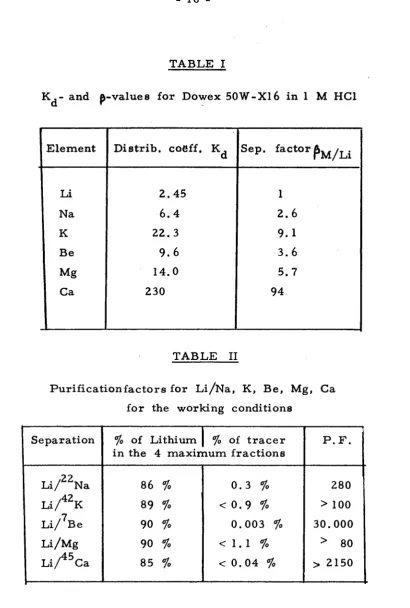
A s u m m a r y of the obtained r e s u l t s is given in figure 1. Separation factors β = Κ , /Κ a r e s u m m a r i z e d in figure 2.
M Li
F r o m this figure it can be seen that an efficient separation
- 8
large K , - v a l u e for lithium leads to broadening of the lithium peak in the effluent. 1 M hydrochloric acid was chosen as eluant. The K , - and ß-values derived from figures 1 and 2 for this medium were s u m m a r i z e d in Table I.
3. 3. Determination of purification factors (P. F . )
3 . 3 . 1 . Method of separation
Separations were p e r f o r m e d on 3 cm d i a m e t e r quartz columns filled with a quantity of r e s i n equivalent to 80 g r a m s of oven-dried Dowex 50W-X16 ( « 4 0 0 m e q . ) . Before the separation begins the r e s i n is washed with bidistilled water, until chloride ions a r e fully r e m o v e d .
On the other hand 0.5 g of lithium and 100 to 500 /Ug of a t r a c e d a l k a l i - or alkali e a r t h m e t a l a r e a b s o r b e d on 16 g r a m
oven-dried Dowex 50W-X16 ( « 8 0 m e q . ) by mixing during 30 m i n u t e s . After settling of the r e s i n and décantation of the solution, the wet r e s i n is t r a n s f e r r e d to the top of the column. The elution i s performed with (1.00 + 0.02) M hydrochloric acid.
The effluent i s collected in 50 m l polyethylene r e c i p i e n t s .
3 . 3 . 2 . Determination of purification factors
Separations of L i / Na, L i / K, L i / Be, Li/Mg and L i / Ca m i x t u r e s were made under the conditions described above. Generally 85-90% of the lithium were localized in the fractions 69 or 710, and the concentration was at a m a x i m u m in f r a c -tion 8 or 9.
3 . 4 . Purification of AG 50W-X16
3 . 4 . 1. Introduction
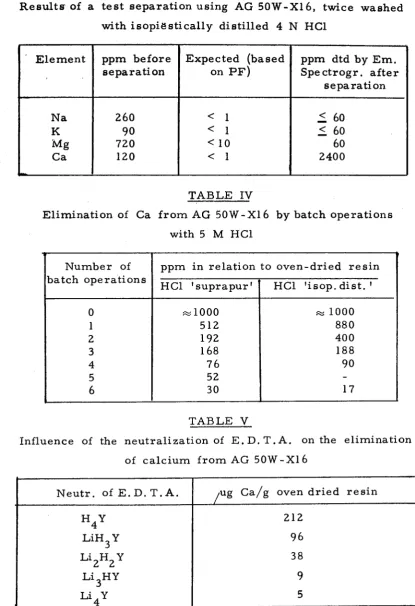
A first t e s t separation using AG 50W-X16 (50/100 m e s h ) , twice washed with isopiëstically distilled 4 N HCl, was done under the conditions described in 3 . 3 . 1 . Isopiëstically distilled 1 N HCl was used as eluant. The r e s u l t s a r e s u m m a r i z e d in Table III.
The high calcium content of the s o - c a l l e d purified product could be explained by e m m i s s i o n s p e c t r o g r a p h s analysis of the AG 50W-X16, which contained up to 1 eq. % of calcium. The r e s i d u a l i m p u r i t y level in the purified lithium is due to
two s o u r c e s (fig. 3): MT depending on the purification factor
( P . F . ) and M_ proportional to the i m p u r i t y content of the ion exchanger and i n v e r s e l y proportional to the distribution coef-ficient (K,) of this impurity. In our case - high P . F . and i m p u r i t y content of impurified lithium in the 0.1 % range -the first factor is negligible, and only -the r e s i n purity has an influence on the purity of the purified lithium. F o r this r e a s o n it was i m p o r t a n t to improve the purity of the ion-exchanger used.
Two methods were tested for this purpose:
- batch operations with hydrochloric acid of appropriated concentration
- batch operations w i t h E . D . T . A . at appropriated pH.
3 . 4 . 2 . Hydrochloric acid method
10
-used.
It was decided t o proceed with a 5 : 1 r a t i o 5 M HCl a i r dried AG 50W-X16.
T e s t purifications were c a r r i e d out with ' s u p r a p u r ' HCl (Merck A. G . / G e r m a n y ) and with i s o p i ë s t i c a l l y distilled HCl. 10 g r a m fractions of r e s i n were mixed for two h o u r s by m a g -netic s t i r r i n g with 50 m l HCl in closed teflon containers and decanted after settling. After each batch operation the r e s i n was r i n s e d with 50 m l bidistilled w a t e r . After the l a s t batch operation this rinsing was repeated t h r e e t i m e s .
The r e s i n was then t r a n s f e r r e d to a platinum crucible, dried for one night at 100°C and calcined. I m p u r i t i e s were d e t e r -mined by e m i s s i o n spectrography. The r e s u l t s s u m m a r i z e d in Table IV show that the calcium contamination i s lowered by a factor 20-40. No i m p o r t a n t lowering of the impurity content of the other alkali m e t a l s i s obtained.
3 . 4 . 3 . E . D . T . A . method
Ethylene diamine t e t r a acetic acid being sparingly soluble in water, and the stability of its calcium complex i n c r e a s i n g with i n c r e a s i n g pH, it seemed n e c e s s a r y to neutralize EDTA with a b a s e .
NH OH has the inconvenience that eventually contaminating NH . ions cannot d i r e c t l y be d e t e r m i n e d by e m i s s i o n s p e c t r o -graphy or activation a n a l y s i s .
Finally LiOH was p r e f e r r e d : it can easily be d e t e r m i n e d by e m i s s i o n spectrography, and the Li -ion is the e a s i e s t one to rinse from the ion exchange r e s i n with hydrochloric acid.
3 . 4 . 3 . 1 . Influence of the pH
11
of LiOH i n 50 m l of w a t e r . A s the d i s t r i b u t i o n coefficient
of l i t h i u m for AG 50WX16 i s v e r y high in n e u t r a l and
a l k a l i n e m e d i u m , one can c o n s i d e r that 30 m m o l of LiOH
n e u t r a l i z e s the r e s i n , and the r e s t f o r m s r e s p . H „Y, 4
LiH Y, L i2H Y, LÌ3HY and L i4Y .
After settling of the r e s i n and décantation of the solution,
the r e s i n was r i n s e d with b i d i s t i l l e d w a t e r to e l i m i n a t e
E . D . T . A . Two o t h e r batch o p e r a t i o n s with 30% HCl ' s u p r a
p u r ' w e r e m a d e to e l i m i n a t e Li, Na, K and Mg, which have
v e r y low d i s t r i b u t i o n coefficients in t h i s m e d i u m . The Κ ,
value of Ca being high, one can e a s i l y a p p r e c i a t e the i n
fluence of the E . D . T . A . t r e a t m e n t on the e l i m i n a t i o n of
c a l c i u m f r o m the r e s i n (Table V).
3 . 4 . 3 . 2 . R e s u l t s for L i . Y
Two batch o p e r a t i o n s with Li Y, followed by two o t h e r s with
3 0 % h y d r o c h l o r i c a c i d (Merck A G S u p r a p u r ) allow r a t h e r
good p u r i f i c a t i o n s of AG 50WX16.
N e v e r t h e l e s s , it was n e c e s s a r y to p e r f o r m a s u p p l e m e n t a r y
r i n s i n g of the p u r i f i e d i o n e x c h a n g e r with 1 M ' s u p r a p u r '
HCl to e l i m i n a t e c o m p l e t e l y the lithium i o n s . This s u p p l e
m e n t a r y elution leaded to a gain of a f a c t o r 10 on the sodium
e l i m i n a t i o n too.
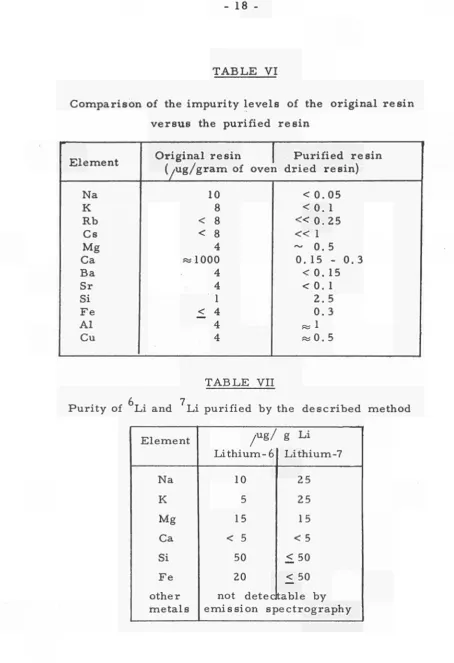
A c o m p a r i s o n of the i m p u r i t y l e v e l s of the o r i g i n a l r e s i n
v e r s u s the purified r e s i n i s given in Table VI.
4. R e s u l t s a n d C o n c l u s i o n
400 g r a m aliquote of AG 50WX16 cation e x c h a n g e r w e r e p u r i ·
fied by s u c c e s s i v e batch o p e r a t i o n s with:
1. 400 m m o l E . D. T. A. and 2800 m m o l LiOH i n a t o t a l
volume of 2 1.
2. 400 m m o l E . D . T . A . and I6OO m m o l LiOH i n a total
- 12
3. 2 1 30% 'Suprapur' hydrochloric acid. 4. 2 1 30% 'Suprapur' hydrochloric acid.
After the first t h r e e batch operations the i o n - e x c h a n g e r was washed with 1 1 bidistilled water, and after the third one t h r e e t i m e s . Then, quartz columns were filled with quanti-ties equivalent to 80 g r a m s of the o v e n - d r i e d r e s i n ,
(«400 m e q . ) and e lut e d with 3 1 1 M. hydrochloric acid and 0.5 1 bidistilled w a t e r . The whole operation was m a d e in a glove box to avoid contamination from the a t m o s p h e r e . On the other hand, quantities of 25 g a i r - d r i e d unpurified AG 50W-X16 ( « 8 0 m e q . ) were mixed for 30 minutes with approximately 75 m m o l LiOH solution in 20-25 m l .
After settling of the l i t h i u m - c h a r g e d r e s i n , the supernatant solutions were decanted, and the wet r e s i n s t r a n s f e r r e d to the top of the different columns.
Elutions were p e r f o r m e d with (1.00 + 0.02) M HCl ' s u p r a -p u r ' , and eluates collected in -polyethylene reci-pients of 50 m l . 1 m l aliquote were analysed by t r a n s f o r m a t i o n to and weighing as lithium sulfate.
Generally, 80 - 90% of the starting lithium were r e c o v e r e d in fractions 7-9 or 8-10 of the eluate, with m a x i m u m
con-centration in fractions 8 or 9. 7 6
2 g Li and 1.8 g Li were purified following this scheme, and analysed by e m i s s i o n s p e c t r o g r a p h y (Table VII).
13
a l k a l i and a l k a l i e a r t h m e t a l s , which can be u s e d for the
p r e p a r a t i o n of s p e c t r o g r a p h i c s t a n d a r d s . The s i l i c i u m
found i s p r o b a b l y due to the u t i l i z a t i o n of q u a r t z c o l u m n s .
The u s e of teflon columns will p r o b a b l y e l i m i n a t e t h i s , but
the quantity found i s u n i m p o r t a n t for v o l u m e t r i c a s well a s
for g r a v i m e t r i c a n a l y s e s with p r e c i s i o n s of 0.02 %
A c k n o w l e d g e m e n t s
The a u t h o r s a r e indebted to J . Spaepen for initiating t h i s
w o r k . T h e y thank Prof. J . H o s t e , G . H . Debus, P . J . De B i è v r e
and Y. Le Duigou for c r i t i c a l d i s c u s s i o n s .
T h e y a l s o thank Ch. B e r t h e l o t , S. H e r m a n n and T. M e n c a r e l l i
for e m i s s i o n s p e c t r o g r a p h i c a n a l y s e s .
R e f e r e n c e s
(1) P a u w e l s , J . Α . , Le Duigou, Y. and L a u e r K . F .
E U R 3 6 5 6 e (1967).
(2) P l u i s h e v and Shakhno
Z h u r . A n a l . K h i m . n° 8, 5 (1953)
(3) C a l e y E . R . and Axibrod H . D .
Ind. eng. C h e m . , a n a l . E d i t . J_6, 712 (1944)
(4) H a g i w a r a Z . and Kato T.
Bunseki to Shirjakn 2, 179 (1948)
(5) Kato T . and H a g i w a r a Ζ.
T e c h n o l . R e p t s . Tohoku Univ. 1_4 (2), 14 (1950)
(6) Guther G . A . and H a m m o n d G . S .
J . A. C . S . 78, 5166 (1956)
(7) P e c h i n a y (Compagnie de p r o d u i t s c h i m i q u e s et é l e c t r o
m é t a l l u r g i q u e s ) F r . 1 137 089 (1957)
(8) B o n n i e r E .
14
(9) Sandell E . B .
C o l o r i m e t r i e d e t e r m i n a t i o n of t r a c e m e t a l e 3 0 1 , NY (1944)
[10) C i m e r m a n C. and Wenger P .
M i k r o c h 24, 162 (1938)
[11) W i l a r d H . H . and Goodspeed E . W .
Ind. eng. C h e m . , a n a l . E d i t . 8, 414 (1936)
[12) O s t r o u m o v Ε . Α .
Ann. C h i m . A n a l . 20 (3) 9 (1953)
[13) S a m u e l s o n O. and S j ö s t r ö m E .
A n a l . C h e m . 26, 1908 (1954)
[Ϊ4) Samuelson O. and S c h r a m m K. Ζ. E l e c t r o c h e m . J57, 207 (1953)
[15) Nelson F .
J . A . C S . 77, 813 (1955)
[16) Kawabe Η . , Gualandi C. and Buna Ann. Chim. (Roma) 53_, 368 (1963)
Bosholm J.
J. C h r o m a t o g r . 21 (2), 286 (1966)
(18) Etienne Η.
Ind. Chim. Belge, Suppl. n° 1, 165 (1959)
(19) Dietrich W . C . and B a r r i n g e r R . E . Y-1254 (1959)
(20) Gorshkov V . l . , Kuznetsov, I . A . , Panchenkov G. M. and Kustova I . V .
Zh. Neórg. Khim. 8 (12), 2790 (1963)
(21) Bagbanby I. L . , Guseinov I.K. and Posadovskaya A , K . A z e r b . Khim. Zh. n° 6, 93 (1963)
15
(23) T o l m a c h e v A . M .
V e s t n . Mosk. U n i v . , S e r . II, Khim 19_ (2), 20 (1964)
(24) H e r i n g H.
A n a l . c h i m . Acta 6, 340 (1952)
(25) Maslova G . B . , Suslova Ε . Α . , and Chmutov K . V .
Z h u r . A n a l . K h i m . 1_2, 359 (1957)
(26) J e n t z s c h D. and F r o t s c h e v I.
Z . a n a l . C h e m . 144, 1 (1955)
(27) M a z z a L . , Sardo L . , F r a c h e R. and Dadone A.
G a z z . C h i m . I t a l . 95 (6), 599 (1965)
(28) V e n t u r e l l o G. , Gualandi C , and M a z z e i I.
Ann. C h i m . (Roma) 49, 149 (1959)
(29) B u r a n a , Gualandi C. , and M a z z e i I.
Ann. C h i m . (Roma) 53, 368 (1963)
(30) Okuno H. , Honda M. and I s h i m o r i T .
J a p a n A n a l y s t . 2, 428 (1953)
(31) R a t n e r R. and L u d m e r Z .
I s r a ë l J . C h e m . 2, 21 (1964)
(32) Sulcek Z . , R o s s and T h o m a
ORNL3656 (1965)
(33) N e v o r a l V.
Z . a n a l . C h e m . 195, 332 (1963)
(34) G o r s h k o v V . l . , Kuznetsov I . A . and Panchenkov G. M.
Z h . A n a l . K h i m . 14, 417 (1959)
(35) N e l s o n F . , M i c h e l s o n D. C , P h i l l i p s H. O. , and K r a u s K. A.
16
T A B L E I
K , and p v a l u e s for Dowex 50WX16 in 1 M HCl
E l e m e n t
L i N a K B e Mg C a
Di s t r i b , coëff. K , α
2 . 4 5
6 . 4
2 2 . 3
9.6
14.0
2 3 0
S e p . factor pM / L i
1 2 . 6 9 . 1 3 . 6 5 . 7 9 4
T A B L E II
P u r i f i c a t i o n f a c t o r s for L i / N a , K, B e , Mg, Ca
for the working conditions
S e p a r a t i o n
L i /2 2N a
L i /4 2K
L i /7B e
L i / M g
L i /4 5C a
% of L i t h i u m in the 4 maxin
86 %
89 %
90 %
90 %
85 %
% of t r a c e r i u m f r a c t i o n s
0 . 3 %
< 0 . 9 %
0 . 0 0 3 %
< 1. 1 %
< 0 . 0 4 %
P . F .
2 8 0
> 100
30.000
> 80
[image:20.595.111.522.49.658.2]17
T A B L E IH
R e s u l t s of a t e s t s e p a r a t i o n u s i n g AG 5 0 W - X 1 6 , t w i c e w a s h e d
with i s o p i ë s t i c a l l y d i s t i l l e d 4 N HCl
E l e m e n t
N a K Mg Ca
p p m b e f o r e s e p a r a t i o n
260 90 720 120
E x p e c t e d ( b a s e d on P F )
< 1 < 1
< 1 0
< 1
p p m dtd by E m . S p e c t r o g r . a f t e r
s e p a r a t i o n
< 60
< 60
60 2400
T A B L E IV
E l i m i n a t i o n of Ca f r o m A G 5 0 W X 1 6 b y b a t c h o p e r a t i o n s w i t h 5 M H C l
ι
N u m b e r of b a t c h o p e r a t i o n s
0 1 2 3 4 5 6
p p m H C l
i n r e l a t i o n ' s u p r a p u r ' ilOOO 512 192 168 76 52 30
t o o v e n d r i e d r e s i n H C l ' i s o p . d i s t . '
« 1000 880 400 188 90 17 T A B L E V
I n f l u e n c e of t h e n e u t r a l i z a t i o n of E . D . T . A . on t h e e l i m i n a t i o n of c a l c i u m f r o m A G 5 0 W X 1 6
N e u t r . of E . D . T . A . H4Y
L i H3Y
L i2H2Y
L i3H Y L i4Y
mg C a / g o v e n d r i e d r e s i n 212
[image:21.595.71.487.132.739.2]- 18
TABLE VI
Comparison of the impurity levels of the original resin versus the purified resin
Element Na K Rb Cs Mg Ca Ba Sr Si F e Al Cu
1
Original resin Purified resin (/Ug/gram of oven dried resin)
10 8 < 8 < 8 4 « 1 0 0 0 4 4 1 < 4 4 , 4 < 0.05 < 0 . 1 « 0.25 « 1 ~ 0.5
0. 1 5 - 0 . 3 < 0. 15 < 0. 1
2 . 5 0 . 3
f« 1
« 0 . 5
TABLE VII 6 7
P u r i t y of Li and Li purified by the d e s c r i b e d method
E l e m e n t
Na K Mg Ca Si F e other metals
103 102 10 1
Kd
-\ ^ _Li
MH C l
1 103 102 10 1
«d
Be
M
HCl10
10
IO3 102 10 I
Kd
-v_
Να
I MH C l 10 IO3 102 10 1 0
Kd
\\ t
1 5
Mg
MH C l
10 103 102 10 !
Kd
K
ι MHCI
103 IO2 10 1
Kd
- VV.
Ca
_ _ _ _ _ _ _ _
MH C l
1 J
10 10
200 100 80
60
40
20 10 8 6
1 0.8 0.6 Q4l·
02
0.1
Ρ M/Li
o o
MHCI
0 1 2 3 A 5
υ
c
o
o
TMI
ml effluent
unrørø
«&'!<·
m
l't'l
ifeì ífi¿tfn!Dt
« »
ΪΜ ·*!·'
MftWrøMitø
irïfl
i^iiiiiiaiiiiyiisiM
M
NOTICE TO THE READER
All Euratom reports are announced, as and when they are issued, in the monthly periodical EURATOM INFORMATION, edited by the Centre for Information and Documentation (CID). For subscription (1 year : US$ 15, £ 6.5) or free
specimen copies please write to :
!»
Handelsblatt GmbH "Euratom Information" Postfach 1102
D-4 Düsseldorf (Germany)
itmi
m
h^wä^aåm
T
¿m
Office central de vente des publications des Communautés européennes
2, Place de Metz
Luxembourg
WE
m
;-ȓ>ii
m
»rtK-1!*·>«
•]Ì
H
Traüttø*:
SM
ma
tffflS'.!1
«iE
»1
ìt*&knowledge is to disseminate prosperity
lüL
Ite»
rill
Rfeüi»»]
disappears the greater part of the evil which is our heritage from
"=|||ililililJlllillllllillillllllll darker times.
mean general prosperity and not individual riches — and with prosperity
*m,
Alfred Nobel
mSSSm mi
ή
SII- i # i f
■
fi«
All Euratom reports are on sale at the offices listed below, at the prices given on the back of the front cover (when ordering, specify clearly the EUR number and the title of the report, which ι shown on the front cover).
isto
OFFICE CENTRAL DE VENTE DES PUBLICATIONS DES COMMUNAUTES EUROPEENNES
2, place de Metz, Luxembourg (Compte chèque postal N° 191-90)
Τΐ·»2ΐ5ιΓ
mmm
B E L G I Q U E — B E L G I Ë M O N I T E U R B E L G E
4042, rue de Louvain Bruxelles B E L G I S C H STAATSBLAD Leuvenseweg 4042 Brussel
Ì<I4
Ü
:· !:>
D E U T S C H L A N D B U N D E S A N Z E I G E R Postfach Köln 1 F R A N C E
S E R V I C E D E V E N T E E N DES P U B L I C A T I O N S D E S COMMUNAUTES E U R O P E E N N E S 26, rue Desaix Paris 15e
UÉHafl¿ri|OUifÉM|fcitt
L U X E M B O U R G
O F F I C E C E N T R A L D E V E N T E D E S P U B L I C A T I O N S D E S COMMUNAUTES E U R O P E E N N E S 9, rue Goethe Luxembourg
Jtf!
N E D E R L A N D
S T A A T S D R U K K E R I J
Christoffel Plantijnstraat Den H a a g
I T A L I A
L I B R E R I A D E L L O STATO Piazza G. Verdi, 10 Roma
ÏN F R A N C E , j y —e
||B|
U N I T E D K I N G D O M
H . M. S T A T I O N E R Y O F F I C E P . O. Box 569 London S.E.I
;'j. ¡Hj
EURATOM — C.I.D. 5153, rue Belliard Bruxelles (Belgique)