Munich Personal RePEc Archive
Internal centralization and international
integration in the post-Soviet space
Libman, Alexander
Frankfurt School of Finance Management, Russian Academy of
Sciences and East China Normal University
March 2010
Online at
https://mpra.ub.uni-muenchen.de/21882/
1
Internal Centralization and International Integration
in the Post-Soviet Space
by
Alexander Libman
Frankfurt School of Finance & Management, Russian Academy of Sciences and East China Normal University
Abstract: An important but often neglected factor influencing the changes in power relations in Eurasia is the development of center-periphery relations in individual countries. Domestic and international politics are never clearly separated, especially in the emerging post-Soviet states, which still maintain strong economic, cultural and political links among each other. The aim of the paper is to understand how international integration and domestic policy (re)centralization influenced each other in the post-Soviet countries. It looks at four possible combinations of the development of regionalism and decentralization observed in the CIS region over the last two decades and develops a simple framework explaining the differences between these case studies.
2
1. Introduction1
The emergence of multi-level governance structures and reconfiguration of authority of traditional centralized states has been subject to studies in numerous “isles of theorizing” in public policy, political science, international relations and economics (Hooghe and Marks, 2003). What has been however a common feature of a significant bulk of research in the area is a separate discussion of multi-level structures beyond the nation-state level (usually labeled as “decentralization” or “federalism”) and above the nation-state level (labeled as “regionalism” or “regional integration”). Certainly, the literature on multi-level governance often considers both international and domestic dimensions as cases for the test of a unified framework (which is an approach particularly typical for economics, as it can be seen in Feld and Kerber, 2006) and thus developing theoretical explanations for the size and authority of jurisdictions at both subnational and supranational levels. However, a less often approached avenue of research is to look at “international” and “domestic” multi-level governance as two separate processes, which influence each other. This is exactly the perspective accepted by this paper.
If one attempts to briefly look at experience of multi-level governance structures worldwide, one would find a huge variety of combinations of domestic and international re-configurations of the centralized states. There are cases (like the European Union) where internal decentralization within member countries goes hand in hand with the international integration and creation of supranational institutions, which, in turn, actively engage in the interaction with new subnational units within the “Europe of Regions” framework. However, in other parts of the world (like North America, for instance), the emergence of multilateralism on the international level has been significantly lagging behind as opposed to decentralized organization of the US and Canada. On the other hand, the most successful area of cooperation among the members of the Organization of African Unity has always been the establishment and support of the consensus regarding unchallengeable character of the current international borders, supporting the concentration of power of current incumbents and preventing devolutionary processes or secessions. In this paper I look at one particular region of the world, where, interestingly enough, different combinations of domestic and international multi-level governance can be discovered, and hope to use this variation for the comparative analysis.
1
3
The paper looks therefore at decentralization and multilateral cooperation of the former Soviet Union (FSU) states: twelve former Soviet republics, which received their independence in the 1990s, and did not become members of the European Union. The environment of the post-Soviet space, where after the collapse of the Soviet Union different combinations of regional integration projects and approaches to decentralization have been tested by the new independent states, provides a nice background for an empirical study of the co-influence of internal decentralization and international integration, simply because one obtains the necessary variation of cases in a relatively similar economic and political environment. Indeed, as it will be shown in what follows, in the post-Soviet space one can find all four possible combinations of decentralization “within” individual jurisdictions and multilateral cooperation “between” these jurisdictions, and therefore, examine both substitution and complementarity relations between these processes and their determinants.
The paper is organized as follows: the next section surveys the key results of the literature, provides the main definitions, and also develops a theoretical framework for understanding how regionalism and decentralization can influence each other. The third section presents four case studies of this paper, which demonstrate different combinations of domestic and international movement towards multi-level governance in the post-Soviet world. The fourth section looks attempts to link the outcomes of the post-Soviet case studies to the theoretical predictions, and the last section concludes.
2. Literature and theoretical framework 2.1. Definitions
4
(Voigt, 1999). In order to describe the emergence of multi-level governance on the supranational level I use the words “regionalism” and “regional integration” interchangingly. In this case, as opposed to the “subnational” decentralization, the notion of “regionalism” is rather restricted and includes just the regional interstate cooperation, specifically resulting in the establishment of supranational institutions and treaties, thus does not covering “regionalization” emerging from the bottom-up interaction of businesses and individuals (Hurrell, 1995).
In addition, it is important to mention that the problem of “supranational” regionalism and “subnational” decentralization for individual countries can be also considered on the level of subnational units in federations: in this case the “supranational” dimension becomes their relations with the federal government and voluntarily associations, and the “subnational” dimension is the set of relations between regional governments and municipalities. In decentralized federations like the US or Switzerland the latter exhibit a huge variability, often used in comparative decentralization studies similarly to the differences in decentralization across individual countries (cf. Feld et al. 2008 as an example). Certainly, the relations between regions and the federal government differ from that between individual countries, and as it will be shown in what follows, this difference at least partly explains the differences in the empirical evidence observed in this paper. However, for the purposes of this study it is sufficient to state that one deals with two bargaining processes determining the formation of the multi-level governance on two levels, which can influence each other: and this is exactly what one requires in the context of this study. Moreover, the distinction between federal states and international alliances is in many cases not entirely straightforward: the most prominent example of the complexity is the European Union (Marks et al., 2006), but in fact the absence of a sharp distinction has been typical for many regions of the world in the past (Rector, 2009).
5
making on the national level; advanced decentralization also restricts the decision-making on the national level through delegation of authorities to subnational jurisdictions. If regionalism and / or decentralization are weak, the decisions on the national level can be made without significant restrictions.
2.2. Literature
As already mentioned, the problem of interaction of decentralization and regionalism has so far received only limited attention in the literature. There are however two related fields of research, which can provide certain insights into the matter. The first one to be mentioned is a relatively small but still growing literature on the interaction between decentralization and global or regional opening up of markets. Like this paper, these studies focus on how integration and decentralization influence each other; however, unlike this paper, the notion “integration” they refer to is economic opening up and degree of interdependence of national economies and not the re-allocation of authorities through intergovernmental cooperation, although, of course, reduction of border barriers for trade and investment between countries can follow from the advancements of cooperation of governments. Starting with Alesina et al. (2000), an important strand of this literature claims that through opening up one reduces the benefits of public goods provided by the central government and hence supports the process of decentralization (and in fact even facilitates the secessionism in large states). Stegarescu (2006) and Baskaran (2009) provide some empirical evidence for this interdependence, looking also at the European economic integration, while Garrett and Rodden (2003) show that globalization can in fact be associated with fiscal centralization because of increasing risks and cross-border shocks.
multi-6
level governance on the international level is strengthened through direct cross-border cooperation of regions (for example, Perkmann, 2003). The literature on regional aspects of the European integration is extremely large and diversified, as are the interactions between subnational, supranational and national governments and non-governmental actors in the EU. This paper can be seen as complementary to these studies, first, by focusing its attention on a different region with different institutional, social and political-economic environment (for example, predominance of non-democracies or underdeveloped market economies), and second, by looking at cases when regionalism and decentralization are substitutes rather than complementary features.
2.3. Emergence of institutions: efficiency and conflics
As it has been shown by DiMaggio (1998), the studies of emergence of institutions in different areas of social science have applied, broadly speaking, three key approaches to this problem: institutions as outcomes of efficiency considerations, institutions as by-products of struggle for rents and dominance and institutions as functions of identity and mental models. Similar point of view can be attributed to the emergence of multi-level governance structures, which can be an outcome of power struggles, efficiency considerations and shared identity. For the purpose of this paper we will focus on the first two considerations: in the context of the post-Soviet world with often very unstable political entities with a relatively short history applying shared identity as factor explaining success or failure of emergence of strong subnational players or supranational institutions can be problematic: self-identification of the population and the elites of the post-Soviet countries is often not entirely clear, as is their perception of regionalism in the former Soviet Union (cf. Filippov, 1995; Ketrman, 2005, or Blyakher, 2008) or of their sub-regional identity, which turns into a subject of manipulations of regional elites (Gel’man and Popova, 2003). In addition, it is more difficult to demonstrate the external validity of factors driven by identity or mentality specifics outside the specific “post-Soviet world”.
7
as an attempt to restrict opportunistic behavior of the countries of the regions, and centralized internal political structure is an attempt to restrict opportunistic behavior of subnational jurisdictions within the country. The situation becomes more complex, if one takes into account that centralization is simply a mechanism of aggregating individual preferences: Alesina and Perotti (1998) show that from this perspective centralization is associated with economic gains (from internalizing potential spillovers), but also with political risks (of making a collective decision contradicting the preferences of an individual participant).
Nevertheless, the allocation of authorities in the real world seems to strongly deviate from the optimal structure because of power conflicts (Hooghe and Marks, 2009). Conflicts for rents, however, allow for two different interpretations for the emergence of institutions. On the one hand, institutions can simply be designed by a “winner” reflecting her preferences regarding the distribution of assets: in this case the degree of centralization within a country simply reflects the strength of a winner, and the restrictive character of the international agreements masks the power of the hegemon. On the other hand, of course, institutions emerge as Hayekian “unintended consequences” of power struggles, and from this point of view be unpredictable for both winners and losers in the conflict (Knight, 1992). Anyway, in order to understand the design of institutions from this perspective the key ingredient is to look at the relative strengths of the participants and their preferences, which should be implemented through a conflict as a zero-sum game.
8
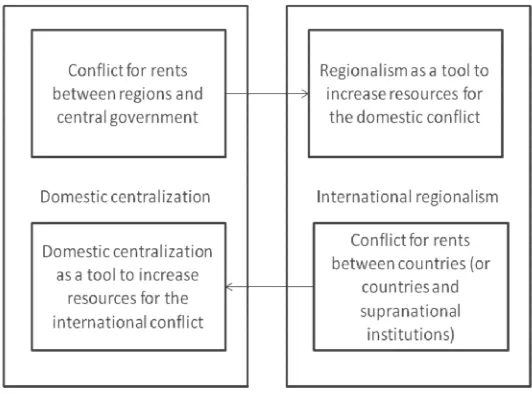
[image:9.612.189.455.162.359.2]symmetrically, the domestic centralization can also be treated as a power contest between the central and the regional governments; and from this point of view the emergence of regionalism (meaning active intergovernmental cooperation – which, as it will also be discussed in what follows, is a viable policy option also to subnational jurisdictions) can be treated from the efficiency considerations. Figure 1 represents this logic once again.
Figure 1: A simplified framework for the analysis
From this point of view one can immediately see that the degree of domestic centralization depends on two parameters: first, the power resources of both central and the regional governments, and second, the relation between efficiency gains and political risks in the relations between countries. Both of these factors should be considered individually for the central and the regional government. In the same way, for the regionalism the degree of allocation of authorities on the supranational level (or restrictions on the national decision making through intergovernmental arrangements) is depends on, on the one hand, resources of participants of the international conflict, and on the other hand, the relation between efficiency gains and political risks in the relations between the central government and the regions in each of the countries.
9
decentralization and vice versa). Of course, this is highly simplified, but on the other hand, can be helpful to focus just on the problem of this paper (and not the whole spectrum of determinants of decentralization and integration, which have been studied in the literature). The second simplifying assumption is related to the former: it claims that, say, gains in efficiency from the domestic centralization are helpful in terms of international bargaining. This is once again simplified: domestic centralization could provide some additional power resources, but they may be too small to make a difference. However, as I will show in what follows, at least in the empirical cases studied in this paper the difference mentioned has been present and relevant, as it will be shown in the following section. The final simplification is to look at the decentralization or regionalism as pure bargaining between governments, since other non-governmental agents may also be strongly involved. However, for the empirical case of this paper this focus is appropriate, since one is dealing with societies with strong deficits of democracy. This may also be an advantage, since it allows me to isolate just the “bargaining” components of the decentralization and the regional integration processes and look at their interdependence.
2.4. Vertical and horizontal conflicts
10
the “horizontal” one, although once again the distinction is not entirely clear (as the debate on supranationalism versus intergovernmentalism in the EU shows clearly).
The effects of “vertical” and “horizontal” arrangements are not identical. For the efficiency trade-off it is possible that a “horizontal” arrangement can be associated with significantly lower political risks for the dominant country, which therefore can be more likely to support a more centralized framework. On the other hand, maintaining “horizontal” dominance relations is often costly (and, in fact, the costs to be covered by the leader are over-proportionally high), as it is shown in the literature on military alliances (Sandler and Hartley, 2001). Vertical and horizontal conflicts partly “react” differently on power asymmetry between jurisdictions (Libman, 2009a): for example, in a federation with asymmetric regions decentralization is more likely, while in an international alliance, on the contrary, dominance of one country can support centralization – exactly because in this case the federation dynamics is determined by a “vertical” center-region conflict, and the development of an international alliance is a function of a “horizontal” conflict between countries. For the purpose of this paper we will treat both “vertical” and “horizontal” arrangements within the same framework, for both explaining their causes and evaluating their success: however, in each case it can be extremely important to identify the “right” shape of conflict to be able to provide a reasonable analysis.
3. Regionalism and decentralization in the post-Soviet space: four cases
3.1. Weak regionalism, strong decentralization: Russia, Ukraine and Kazakhstan in the 1990s
11
The emergence of the post-Soviet regionalism can be traced back to the collapse of the Soviet Union: in fact, the signing of the first “regionalism” agreement establishing the Commonwealth of Independent States (CIS) was indeed the act signifying the dissolution of the USSR. During the period of 1990s the CIS, which soon expanded to a regional grouping encompassing twelve of fifteen former Soviet republics (with the exception of Lithuania, Latvia and Estonia, which moved to the track towards the EU membership), remained a platform for active intergovernmental negotiations. The member countries signed a number of agreements (partly contradicting each other), suggesting the need for developed intergovernmental cooperation in economic, social and cultural sphere, but also in the area of military and security affairs. However, in spite of this immense activity, the CIS treaties remained simple “ink on paper” integration: almost none of the CIS agreements was put into practice, and the post-Soviet countries easily ignored their obligations made within the CIS framework (cf. Malfliet et al., 2007, Kubicek, 2009). It is thus not surprising that almost all countries of the CIS occasionally resolved to protectionist measures in foreign trade, directly contradicting the CIS agreements (cf. Blejer and del Castillo, 1999). The supranational bureaucracy of the CIS, although significant in number, remained very weak and in fact served as an area of “exile” of unsuccessful Russian politicians. Attempts to replace the CIS by alternative regional projects with different membership, still concentrating around Russia (like the Eurasian Economic Community) were equally unsuccessful (cf. Libman, 2007).
12
Probably, the best studied case of this de-facto devolution and its mechanisms is the Russian Federation. Regional governments obtained additional authorities through a system of post-constitutional bilateral and multilateral treaties with the federal administration, granting exclusive privileges to individual regions (Obydenkova, 2008), implementation of acts directly violating the federal law (Libman, 2009), capture of local agencies of the federal government (for example, in law enforcement and taxation) and courts, which can then be used to manipulate the implementation of federal law in favor of the federal government (Enikolopov et al., 2002, XXX). However, similar trends using almost identical mechanisms have been reported throughout the whole period of the 1990s in Kazakhstan (Jones Luong, 2004). In both countries this informal devolution did influence different regions unequally and resulted in strong asymmetries in terms of de-facto authorities accepted by the regional governors. In Ukraine in the early 1990s the decentralization was compatible to that in Russia and Kazakhstan, however, already in the mid-1990s manipulations of the central government allowed it to reduce the de-facto autonomy of regions, thus preceding the same trend to re-centralization observed in other two largest post-Soviet countries in the 2000s (Turovskiy, 1999). Nevertheless, Ukraine also experienced problems of “capture” of central agencies by the regional administration (Way, 2002). In addition, in all three countries regional governments became strong actors in the central political decision-making.
3.2. Weak regionalism, weak decentralization: Russia and the CIS in the 2000s
13
centralization has been less clear, also partly because there were no personal changes involved (Nursultan Nazarbaev remained president of the country), however, was also linked to severe measures like re-drawing regional borders and re-appointments of governors (Jones Luong, 2004). In other countries like Ukraine the described trend towards centralization was less pronounced.
However, for the purpose of this paper the most important result of the shifts described is that one obtained a certain discrepancy between the domestic and the international multi-level governance developments. While within Russia the federal government has been extremely successful in gaining control over regional administrations, its attempts to force a stronger cooperation between post-Soviet countries – either through new institutions of cooperation like the Single Economic Space initiated by Russia, Ukraine, Kazakhstan and Belarus in mid-2000s or reforms of the Eurasian Economic Community, or through direct interventions in the political decision-making in the post-Soviet world, have been almost always unsuccessful. Although Russian foreign policy attention to the CIS increased significantly (cf. Trenin, 2009:87-88), the only visible outcome of this process have been stronger tensions between Russia and its neighbors (particularly Ukraine and Georgia, but also with Belarus, which has been one of the strongest proponents of the integration before) (cf. Libman, 2009a). Hence, the weakness of the regionalism in the CIS persisted in the 2000s (also probably supporting the continuing economic disintegration of the post-Soviet space, see Libman and Vinokurov, 2010), while within individual countries the trend towards re-centralization dominated.
3.3. Strong regionalism, weak decentralization: Russian regions and municipalities in the 2000s
14
which started almost simultaneously with the development of the formal framework for the federation, has been notoriously contradictory and inconclusive: hence, while in some regions municipalities were strongly controlled by the regional administration, in others they were able to gain significant autonomy.
Nevertheless, typical trend for many regions in Russia in the second half of the 1990s became the conflict between the governors of the regions and the heads of influential municipalities (usually mayors of the largest cities) (see Turovskiy, 2003). The mayors usually received their mandate through a public election (as the governors did), and hence did not directly depend on the regional administration. The conflicts took significantly different forms ranging from highly institutionalized opposition (associated with party-building and changes in regional and municipal constitutions) to personalized conflict between two powerful politicians) and involved different degrees of collective action between municipalities within a region (Barabanov, 1999). However, in the first half of the 2000s these conflicts seem to become weaker, mostly because the governors succeeded in their confrontation and restricted the power of the mayors.
15
Kalmy kia Kha nty Man si C huk otk a
Eve nk
Tiu men Ne nets
Yamal N en ets Mo rdov ia
Toms k
Mos c ow (C ity )
Komi
Oren bur g Samara
Len ing rads kaia
No rthe rn Os s etia
Ud mur tia
Perm
Nizhn y No vg orod N ovo s ibirsk
Penz a Sver dlov sk aia
Ore l Astra kh an Bas h kor tos ta n
Altai ( R ep.) Tatar stan
Yaros lav l KalugaSak h alin
Bria nsk Ch uv a shia
U lian ov s k
Kaba rdin o-Balk aria Volgo gra d Ch eliabins k
Vladimir R iaz an
Mo sc ow (Obl.)
Kara c ha evo -Ch er ke s sia Sar atov
Kiro v Kras n oda r
Kos tr oma Kaliningra d Tve r Ma riy El
Stavr op ol Tambo v
Ivano v o Voro nez h
St. Pe ters bur g
Tula Ark ha nge ls k
Kemero v o Oms k
Kras noiarsk
Smole ns k Ro stov
D age s ta n Volog da Pr imor s k i
Kurs k
Mur ma ns k N ovg oro d Ing us h etia
Kurga n Sak ha
Khab arov sk i Irku ts k
Komi-Per m Agins k Bu riat
Psk o v Kamc h atk a
Altai ( Kra i) Belgo ro d
Ady g eia
Buriatia Lipets k
Ever eys k aia
Tyv a Kare lia Khak as s ia C hita
Us t Ord y n Buriat Amur
Taimy r Koriak
Ma gad an
.2 .4 .6 .8 1 S h a re o f t h e c e n tr a l r e g io n a l g o ve rn m e n t i n th e r e g io n a l c o n so lid a te d b u d g e t
.2 .4 .6 .8 1
[image:16.612.94.551.66.399.2]Rete ntion rate
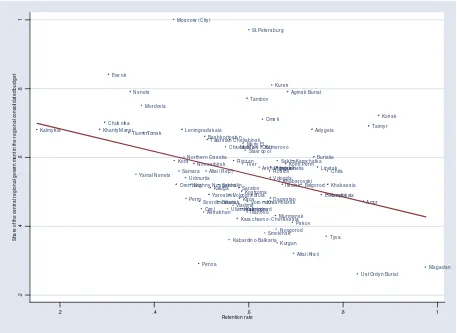
Figure 2: Decentralization within regions and in the center-region relations in Russia, 2003
16
3.4. Strong regionalism, strong decentralization: cross-border cooperation in the 1990s
Probably the most difficult case to find in the post-Soviet space is that of strong regionalism combined with strong decentralization (as it has been described before, this is exactly the scenario considered standard by the existing literature). However, under certain conditions, one could look at the skyrocketing cross-border regional cooperation of the 1990s as an example of this setting. As already mentioned, in the 1990s the intergovernmental cooperation in the post-Soviet space remained extremely weak. However, at the same time the period was marked by the emergence of strong paradiplomatic activities of Russian regions, which became active and often independent actors of international relations at least within the CIS region. Although according to the Russian federal constitutions regional administrations were not allowed to sign independent international treaties and had to implement their external economic relations though a coordinated framework set up by the central government, seventy-six of eighty-eight regional constitutions declared the region’s right to engage in international and external economic relations: of forty-two major power-sharing treaties only two did not extend the authorities of the regions on the international arena. While the paradiplomacy of Russian region was not limited to the post-Soviet space (Sharafutdinova, 2003), it has certainly had a strong impact on the CIS in particular.
17
Nemyria, 1999, Guliev, 2009). In many cases this cross-border cooperation was institutionalized through agreements and even intergovernmental organization (like border region councils) (cf. Zabello and Sobyanin, 2001; Schneider, 2002; Golunov, 2005). Therefore the interaction between regions was in many cases not influenced by the general political conflicts on the high level and thus was more successful (Makarychev, 2000).2
The increasing re-centralization in the 2000s formally did not put an end to this cross-border cooperation. On the contrary, officially the sub-regional cooperation was still endorsed and supported by the federal government. However, the federal administration specifically restricted the autonomy of regions in the international relations, putting any form of cross-border cooperation under strict control of the federal government. Therefore it is not surprising that the observers reported increasing difficulties in the area of cooperation between regions (Vardomsky, 2003, 2006) or at least increasing transaction costs through the “coordination” by the central government (Alexeev, 2000), which simply turned into part of the overall government-led regionalism strategy for the Russian involvement in the CIS – which, as noticed above, has been completely unsuccessful. Let me provide one particular example how centralization influenced the cross-border cooperation. In order to facilitate the cross-border cooperation, territorial specialization of the customs is required: in this case the imported and exported goods can be processed in a particular region without delays. On the contrary, the federal government in the 2000s actively promoted the functional organisation of the customs: in this case the customs clearing for individual types of exported goods was possible only in a limited number of branches in Russia, often located in a different region then the location of the actual transaction. Even more, the regional administrations lost their ability to influence the customs (even informally) in order to promote the cross-border cooperation (Vardomsky 2009a).
4. Distribution and efficiency: co-evolution of regionalism and decentralization
As I have shown so far, one indeed can observe different combinations of internal and international developments in multi-level governance: the main goal of the paper is however to provide explanations for these differences. For this purpose we will attempt to distinguish among the redistribution conflict and the efficiency trade-off in each of the cases and thus to clarify how these two features influenced each other, generating the results observed. Each
2
18
conflict is characterized primarily by the power asymmetry, and each efficiency trade-off by the relation between efficiency gains from cooperation and political risks.
4.1. Weak regionalism, strong decentralization
Let me consider first the case of leading FSU countries in the 1990s: when weak post-Soviet integration was combined with weak centralization. If one looks at both redistribution conflicts within and between individual countries, the results are relatively straightforward: the decentralization within countries was caused by relative weakness of the central authority vis-à-vis regional administrations. In Russia during the late 1980s - early 1990s subgroups of regions (like the so-called autonomous republics) successfully used the contradictions first between the Soviet and the Russian republican administrations, and then between the Supreme Council and the president (Sheinis, 2005) in order to obtain strong gains represented by the Federal Treaty – the predecessor of the Russian constitution. Later on this multilateral bargaining situation was replaced by bilateral bargaining, where particular regions once again forced the federation to provide stronger devolution in exchange for loyalty and electoral support and also in absence of effective tools of control – although one should mention that this power potential was accumulated just by a small group of regions with others being not particularly eager to support devolution (Crosston, 2004). Situation in other CIS countries was somewhat similar.
From the point of view of the conflict between the CIS countries, the key element is, unlike the domestic “vertical” conflicts, the “horizontal” conflict, where the key problem can be attributed to the power relations between the Russian Federation and other countries. Russia is obviously the strongest member of the CIS, and thus could theoretically be perceived as an integration leader in the Mattli’s (1999) sense. Nevertheless, during the 1990s Russia seems to combine two features preventing regional integration from being successful: on the one hand, it has been strong enough to be perceived as a threat by other countries (D’Anieri, 1997), but on the other hand obviously weak enough to really influence the domestic decisions (Libman, 2007). Other countries of the CIS (like Kazakhstan), which seemed to pursue its own integration agenda, have been significantly weaker during this period and obviously unable to support regionalism, although the situation seems to have changed slightly in the 1990s (Libman and Vinokurov, 2010a).
19
for their international political initiatives, but potentially had to suffer under significant political costs through adjusting to regional preferences in international relations. For all three largest CIS countries one can observe at least certain differences between central and regional perceptions of foreign policy. In Ukraine and Kazakhstan the key issue was the support of re-integration with Russia by the Russian-speaking territories in the East and the North respectively; for Russia the effect was smaller but, for example, was present in the Northern Caucasus, where ethnic republics were actively involved in the conflicts in Georgia and Azerbaijan. Hence, adaptation to regional preferences was relatively costly, especially for Ukraine and Kazakhstan, were it could in fact challenge the nation-building project; therefore in this particular case political risks seem to be higher than potential benefits in terms of power potential.
For the international efficiency trade-off, probably, both risks and gains were rather small. There is almost no evidence of direct support of devolutionist and separatist interests by the neighboring CIS countries. The reasons are relatively straightforward: the CIS countries, as many non- and semi-democratic regimes in emerging nations with weak and disputable borders, seem to be able to achieve consensus in terms of “not supporting” secessionism because of huge external effects of these policies for the own territorial integrity. For example, for Russia officially encouraging separatism and devolution in Ukraine or Georgia would symmetrically create problems in the Northern Caucasus (for Central Asia see this discussion in Libman, 2009b). Therefore this absolute minimum of cooperation needed to prevent the direct support of internal devolution interests seems to have been present anyway and no further cooperation was required. In fact, this fact can indeed explain the reasons for individual governments to claim to support cooperation without real actions: for example, in Kazakhstan declarations of integration support (like the project of the Eurasian Union in the early 1990s) without any real implementation was a very cheap way to reduce problems with domestic Russian minorities and thus strengthen the internal political position of the regime (Pomfret, 2009).3 Therefore complementarities between the domestic power conflict and international efficiency trade-off could probably be one of the reasons for persistence of regional cooperation projects without any implementation.
To conclude, the efficiency trade-offs seem to support the results obtained in power conflicts. On the other hand, the allocation of power also seems to be relevant for at least one
3
20
of the efficiency trade-offs (for the domestic re-centralization). Thus, in addition there seems to be an indirect link between the domestic and the international power conflicts through the shape of the efficiency trade-off for the domestic decentralization.
4.2. Weak regionalism, weak decentralization
The results of bargaining in the 2000s seem, once again, to depend first on the power allocation for both conflicts. Within Russia the changed federal administration and new active president seem to shift the balance of power towards the central government from the coalition of regions, where the strongest territories received almost no support from the majority of regional administrations interested primarily in federal transfers (Gel’man, 2006). In Kazakhstan even no shift in administration was necessary: it sufficed that the central government accumulated substantial resources from the economic growth in the country, which allowed it to re-define power relations with the regions. On the other hand, the autonomy obtained by Russian and Kazakhstani regions in the 1990s was mostly based on informal relations, which could be easily re-defined given new power constellation and new personalities; in the international relations a more significant shift of power was necessary, since the national governments of the CIS had the full formal power over their territories supported by their recognition by the international community: and this final shift did not seem to happen. Thus, Russian central government succeeded in re-centralization within, but still faced the same problem of the “weak power asymmetry” abroad (Libman, 2009a). For Kazakhstan the situation was even more pronounced, because its power resources became somewhat sufficient to support regionalism only in the late 2000s and only for a limited scope of countries (specifically, Kyrgyz Republic) – and therefore simply did not have enough time to realize its full potential before the economic crisis of the 2008-2009, which hit the economy of this country very hard (Vardomsky, 2009; Golovnin et al., 2010).
21
policy considerations in the 1990s, as it has been discussed above). This is in fact present even for weaker CIS countries like Tajikistan: while in the 1990s it experienced the extreme form of devolution in form of a civil war, which in fact could be described as “war between regions”, in the 2000s its regime re-consolidated its power through explicit Russian support (although even now the control over several regional administrations is reported to be questionable) and started perceiving Russian presence as a burden: for example, while in the late 1990s Russian investors received preferential treatment in Tajikistan, in the late 2000s the Tajikistani government forced them to abandon the most attractive projects, like the reconstruction of the Rogun Hydroelectric Power Plant (Libman, 2009b). One should also remember that the domestic re-centralization also made stronger countries even stronger, therefore increasing political risks for the weaker countries.
As for the domestic efficiency trade-off, here the political risks went down (through the changing power structure, which made the concessions to regional governments not necessary any more), hence, creating a situation where gains were higher than risks (the gains were associated, say, with stronger bargaining position abroad because of lower secessionist threat). In fact, Russian re-centralization in the 1990s was probably the main reason why Russia was able to engage in the five-days-war with Georgia over its separatist regions Abkhazia and Southern Ossetia in 2008 without creating extreme threats for its own integrity in the Northern Caucasus (although still establishing some problems in the relations with the autonomous republics, see Silaev, 2009). On the other hand, the full use of international power resources can be at least one of the reasons for still maintaining the de-jure federal structure (Zakharov, 2008), which – at least potentially – made the incorporation of new territorial units possible.
4.3. Strong regionalism, weak decentralization
22
In terms of efficiency trade-offs, the situation is more interesting. Consider first the “international” efficiency trade-off (in this case it refers to the trade-off for the re-centralization in the relations between the federal government and the regions). In this case for both the central and the regional governments the cooperation in order to reduce autonomy of municipalities seemed to be an attractive solution without strong political risks because of aligned interests – both center and regions were willing to re-construct a strong hierarchy (denoted in the Russian discourse as “vertical of power”). As mentioned, while in the 1990s strong regions made the central government to support strong municipalities as a countervailing force, in the 2000s this approach was no longer required – and weak municipalities became attractive in terms of stronger control over all aspects of political decisions. Even more, supporting re-centralization in individual regions was a good way to ensure greater loyalty of regional administrations to the federal recentralization reform, which therefore partly solved their own “domestic” problems for them.
The “domestic” trade-off (within regions) seems to be less important in this case: regional administrations had to suffer under small political risks, but also were unable to obtain significant gains, because the municipal administrations have already been weakened in the 1990s and were not used by the federal administration as allies in the conflict any more. Once again, however, one can see the multitude of links: first, domestic power conflict of the 1990s influences the domestic efficiency trade-off in the 2000s (rendering it not important for the re-centralization debate); on the other hand, international efficiency trade-off influences the international and the domestic re-centralization (providing both parties with necessary power resources), and at the same time depends on the outcomes of the international power conflict (which made the search for allies on municipal level irrelevant for the federal government).
4.4. Strong regionalism, strong decentralization
23
again to re-enforce the results of the power conflict – and, on the other hand, the power conflict seems to re-enforce the outcomes of the efficiency trade-off.
Indeed, on the one hand, engaging in international cross-border cooperation served as a tool strengthening internal bargaining position of regions. There seems in fact to be evidence that regions used paradiplomacy to obtain additional “symbolic capital” in bargaining and applied cross-border cooperation for competition between regions within Russia. In addition, as mentioned, cross-border cooperation played a positive role in terms of economic recovery of regions, therefore also providing them with an additional source of power. In some regions (like the City of Moscow) cooperation with the CIS countries was also used to strengthen the electoral position of the governors, receiving support of its own population (for example, this motive could have been important for Moscow’s position towards Crimea). Given that the political costs of cross-border cooperation were very small (once again, because of the absent power asymmetries influencing the cooperation between countries in the CIS, but also because of clear economic focus), the efficiency trade-off supported cross-border cooperation.
[image:24.612.76.542.472.718.2]On the other hand, the results of domestic power conflict provided regions with the sufficient power position and autonomy to engage in any form of independent international economic relations – partly even ignoring the goals of the Russian foreign politics.
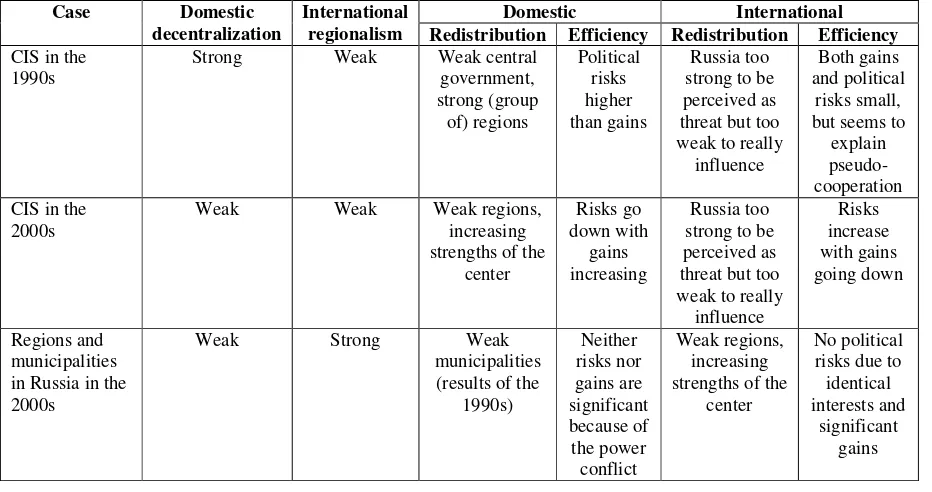
Table 1 summarizes the results of the analysis of four post-Soviet cases once again.
Table 1: Four cases of decentralization and regional integration: explanatory factors
Case Domestic
decentralization
International regionalism
Domestic International
Redistribution Efficiency Redistribution Efficiency
CIS in the 1990s
Strong Weak Weak central
government, strong (group of) regions Political risks higher than gains Russia too strong to be perceived as threat but too weak to really influence
Both gains and political
risks small, but seems to
explain pseudo- cooperation CIS in the
2000s
Weak Weak Weak regions,
increasing strengths of the
center Risks go down with gains increasing Russia too strong to be perceived as threat but too weak to really influence Risks increase with gains going down Regions and municipalities in Russia in the 2000s
Weak Strong Weak
municipalities (results of the
1990s) Neither risks nor gains are significant because of the power conflict Weak regions, increasing strengths of the
center
No political risks due to identical interests and
24
outcomes in the 1990s Cross-border
cooperation in the 1990s
Strong Strong Weak central
government, strong (group
of) regions
Limited political costs, significant,
gains
5. Conclusion
This paper aimed to examine the problem of interaction between two aspects of the multi-level governance initiatives: domestic decentralization and international integration – which remained relatively unexplored in the literature. For this purpose it developed a simple framework combining the analysis of distributional conflicts and efficiency trade-offs for two complementary processes within and between countries. Then it looked at the devolution and regionalism in one particular region of the world – the post-Soviet countries – and demonstrated that in this group different combinations of domestic and international processes were observed under, generally speaking, not so different external political and economic environment – and thus provided a suitable background to applying and testing the developed framework.
Strong and successful domestic decentralization was combined with an extremely weak international integration in the three largest countries of the CIS in the 1990s. During this period, on the one hand, both power conflicts were characterized by extreme power asymmetries: on the one hand, weakness of the central authority versus regions, and on the other hand, combination of “too strong to cause fear” and “too weak to interfere” for Russia in the international relations – thus, given different nature of these two “vertical” and “horizontal” conflicts partly explaining the results observed. For the international conflict the respective domestic efficiency trade-off was associated with significantly higher political risks than gains given strong foreign policy preferences of regions partly contradicting the nation-building project; for the domestic conflict the international trade-off, probably, did not provide strong gains and costs whatsoever given the caution of post-Soviet regimes with respect to support devolution and secessions in their neighboring states – however, this trade-off is likely to explain the observed persistence of formal pseudo-cooperation, when regional governments signed treaties without implementing them.
25
cooperation remained very weak. Here one finds, once again, clear evidence that the development of the power potential of all bargaining parties supported the evolution described: stronger central government vis-à-vis regions and still absent sufficient power potential of Russia (and partly Kazakhstan) in international relations. The domestic efficiency trade-off showed that gains were much higher than risks (thus supporting domestic re-centralization as a tool to “untie one’s hands” in the international relations), and the international efficiency trade-off slowly reduced the gains, making risks more prevalent (given stronger position of central regimes in the CIS countries against separatists, autonomists and any other form of opposition the support from abroad was not needed any more). Therefore, once again, efficiency trade-offs enforced the power conflicts.
In order to find a case for strong regionalism and weak decentralization I had to look “one level deeper” in the jurisdictional architecture – the probably most reasonable case for comparison in this framework is the re-centralization in the region-municipal relations in the Russian Federation in the 1990s. Here the results, once again, are related first to the outcomes of two power conflicts, were stronger center enforced re-centralization from weaker regions, and stronger regions supported re-centralization from weaker municipalities. However, the “international” efficiency trade-off (which in this case refers to the relations between the federal and the regional governments) seems to have enforced re-centralization on the region-municipality level, because there seems to be little political risk (in the particular power constellation neither the federal government nor the regions were interested in strong municipalities – and political risks require differences in preferences between bargaining parties) and offered some gains (for example, kind of a “reward” for regions for being supportive to federal re-centralization). The “domestic” efficiency trade-off (within regions) does not seem to provide neither costs nor gains for both parties given the weakness of municipal governments as outcome of the power struggles at this level in the 1990s.
26
It remains to conclude that in all cases there indeed exists a link between the domestic and the international multi-level governance. Specifically, two types of links were observed: on the one hand, the results of the power conflicts often influenced the political risks and the potential gains in the efficiency trade-offs; and on the other hand, efficiency trade-offs had a clear impact on the power potential in the distribution conflicts. Anyway, however, no unique combination of the multi-level governance structures within individual countries and across their borders was observed: and therefore decentralization and regionalism can form different stable combinations of institutions.
Literature
Alesina, Alberto, and Roberto Perotti (1998): Economic Risk and Political Risk in Fiscal Unions. Economic
Journal 108:989-1008
Alesina, Alberto, Spolaore, Enrico, and Romain Wacziarg (2000): Economic Integration and Political
Disintegration. American Economic Review 91:381-385
Alexeev, Mikhail (2000): Russia’s Periphery in the Global Arena: Do Regions Matter in the Kremlin’s Foreign Policy? Ponaris Policy Memo No. 158
Bache, Ian (1998): The Politics of European Union Regional Policy, Sheffield Academic Press
Barabanov, Oleg (1999): Regional’nye Vlasti i Mestnoe Samoupravlenie: Problemy Vzaimodeistviya. In: Regionu Rossii v 1999 godu. Moscow
Baskaran, Thushyanthan (2009): Supranational Integration and National Reogranization: On the Maastricht
Treaty’s Impact on Fiscal Decentralization in EU Countries. Constitutional Political Economy, forthcoming
Blejer, Mario I., and Graciana del Castillo (1999): Contagion: From Higher Risk to Risk Aversion and the Danger of Protectionism. Mimeo
Blyakher, Leonid (2008): Vozmozhen Li Postimperskiy Proekt: Ot Vsaimnykh Preternsiy k Obshemu
Budushemu. Politiya (1)
Crosston, Matthew (2004): Shadow Separatism: Implications for Democratic Consolidation. Aldershot: Ashgate D’Anieri, Paul (1997): International Cooperation among Unequal Partners: The Emergence of Bilateralism in the
Former Soviet Union. International Politics 34:417-448
DiMaggio, P.J. (1998): The New Institutionalism: Avenues of Collaboration. Journal of Institutional and
Theoretical Economics, 154(4)
Enikolopov, Ruben, Zhuravskaya, Ekaterina, and Sergei Guriev (2002): Rossiiskii Federalism: Scenarii Razvitiia. Mim
Feld, Lars P., and Wolfgang Kerber (2006): Mehr-Ebenen-Juristiktionensysteme: Zur variablen Architektur von Integration, in: Vollmer, Uwe (ed): Oekonomische und politische Grenzen von Wirtschaftsraeumen. Berlin: Duncker & Humblot, pp. 109-146
Feld, Lars P., Schaltegger, Christoph, and Jan Schnellenbach (2008): On Government Centralization and Budget
Referendums: Evidence from Switzerland. European Economic Review 52:611-645
Filippov, A. (1995): Smysl Imperii: K Sociologii Politicheskogo Prostranstva, in: Chernyshev, S. (ed): Inoe:
Hrestomatiya Novogo Rossiiskogo Samosoznaniya. Moscow
Garrett, Geoffrey, and Jonathan Rodden (2003): Globalization and Fiscal Decentralization, in: Kahler, Miles,
and David Lake (eds.): Governance in a Global Economy: Political Authority in Transition. Princeton
University Press
Gel’man, Vladimir (2006): Vozvrashenie Leviafana? Politika Recentralizatsii v Sovremennoi Rossii. POLIS (2):90-109
Gel’man, Vladimir (2007): Ot Mestnogo Samoupravleniya – K Vertikali Vlasti. Pro et Contra 11(1):6-18
Gel’man, Vladimir, and Evgenia Popova (2003): Regional’nye Politicheskie Elity i Strategii Regional’noi
Identichnisti v Sovremennoi Rossii, in: Gel’man, V., and T. Hopf (eds.): Centr i Regional’nye Identichnosti
v Rossii. St. Petersburg
Golovnin, Mikhail, Ushkalova, Daria, and Aleksandra Yakusheva (2010): Vliyanie Vneshnikh Shokov na
Ekonomiki Stran SNG v Period Krizisa 2007-2009 gg. (Global’nyi i Regional’nyi Aspekty). Evraziiskaya
27
Golunov, Sergei (2005): Rossiysko-Kazakhstanskaya Granitsa: Problemy Bezopasnosti i Mezhdunarodnogo Sotrudnichestva. Volgograd
Guliev, M. (2009): Investicionnye Initsiativy po Razvitiyu Proizvodstvennoi Integracii. Evraziiskaya Integraciya
(5):63-65
Hancock, Kathleen J. (2009): Regional Integration: Choosing Plutocracy. Palgrave MacMillan
Hooghe, Liesbet, and Gary Marks (1996): “Europe with the Regions”: Channels of Regional Representation in
the European Union. Publius: The Journal of Federalism 26(1):73-91
Hooghe, Liesbet, and Gary Marks (2003): Unraveling the Central State, but How? Types of Multi-Level
Governance. American Political Science Review 97(2):233-243
Hooghe, Liesbet, and Gary Marks (2009): Does Efficiency Shape the Territorial Structure of Government? Annual Review of Political Science 12:225-241
Hooghe, Liesbet, and Michael Keating (1994): The Politics of European Union Regional Policy. Journal of
European Public Policy 1(3):367-393
Hurrell, Andrew (1995): Regionalism in Theoretical Perspective, in: Fawcett, Louise, and Andrew Hurrell (eds.): Regionalism in World Politics: Regional Organization and International Order. Oxford University Press Hutchcroft, Paul D. (2001): Decentralization in Administration and Politics: Assessing Territorial Dimension of
Authority and Power. Governance 14(1):23-53
Jones Luong, Pauline (2004): Economic “Decentralization” in Kazakhstan: Causes and Consequences, in: Jones
Luong, Pauline (ed.): The Transformation of Central Asia: States and Societies from Soviet Rule to
Independence. Ithaca: Cornell University Press
Kahn, Jeffrey, Trochev, Alexei, and Nikolai Balayan (2009): The Unification of Law in the Russian Federation. Post-Soviet Affairs 25(4):310-346
Kertman, G.L. (2005): SNG – Mezhdu Proshlym i Nastoyashim. POLIS (6):110-125
Knight, Jack (1992): Institutions and Social Conflict. Cambridge University Press
Kubicek, Paul (2009): The Commonwealth of Independent States: An Example of Failed Regionalism? Review
of International Studies 35:237-256
Lake, David A. (2009): Hobbesian Hierarchy: The Political Economy of Political Organization. Annual Review
of Political Science 12:263-283
Libman, Alexander (2007): Regionalisation and Regionalism in the Post-Soviet Space: Current Status and
Implications for Institutional Development. Europe-Asia Studies 59:401-430
Libman, Alexander (2009): Constitutions, Regulations and Taxes: Contradictions of Different Aspects of Decentralization. Mimeo
Libman, Alexander (2009a): Russian Federalism and Post-Soviet Integration: Divergence of Development Paths. MPRA Working Paper No.12944
Libman, Alexander (2009b): Models of Market Integration in Central Asia: Comparative Performance. MPRA Working Paper No. 17510
Libman, Alexander, and Evgeny Vinokurov (2010): Regional Integration and Economic Convergence in the post-Soviet Space: Experience of the Decade of Growth. Mimeo
Libman, Alexander, and Evgeny Vinokurov (2010a): Is It Really Different? Patterns of Regional Integration in Central Asia. Mimeo
Makarkin, Aleksei (2007): Mery: Bor’ba za Nezavisimost’. Pro et Contra 11(1):19-29
Makarychev, Andrey (2000): Islands of Globalization: Regional Russia and the Outside World. Mimeo, 2000
Malfliet, Katlijn, Verpoest, Lien, and Evgeny Vinokurov (2007, eds.): The CIS, the EU and Russia: Challenges
of Integration. London: Palgrave Macmillan
Marks, Garry, Hooghe, Liesbet, and Kermit Blank (1996): European Integration from the 1980s: State-Centric v.
Multi-Level Governance. Journal of Common Market Studies 34(3):341-378
Mattli, W. (1999): The Logic of Regional Integration: Europe & Beyond. Cambridge: Cambridge University
Press
Muenster, Johannes, and Klaas Staal (2007): War with Outsiders Makes Peace Inside. Mimeo
Nemyria, H. (1999): Regional Identity and Interests: The Case of Eastern Ukraine. In: Spillmann K.R., Wenger A., Muller D. (eds.): Between Russia and the West: Foreign and Security Policy of Independent Ukraine. Berlin: Peter Lang
Obydenkova, Anastassia (2008): Democratization, Regionalization and Europeanization in Russia: Interplay of
National and Transnational Factors. Saarbrücken: VDM Verlag
Perkmann, Markus (2003): Cross-Border Regions in Europe: Significance and Drivers of Regional Cross-Border
Co-operation. European Urban and Regional Studies 10(2):153-171
Pomfret, Richard (2009): Regional Integration in Central Asia. Economic Change and Restructuring 42:47-68
28
Ross, Cameron (2003): Putin’s Federal Reforms and the Consolidation of Federalism in Russia: One Step
Forward, Two Steps Back! Communist and Post-Communist Studies 36: 29-47
Sandler, Todd, and Keith Hartley (2001): Economics of Alliances: The Lessons for Collective Action. Journal of
Economic Literature 39:869-896
Schneider, Ebenhard (2002): Staatliche Akteure russischer Aussenpolitik im Zentrum und in den Regionen. SWP Studie S8
Sharafutdinova, Gulnaz (2003): Paradiplomacy in Russian Regions: Tatarstan’s Search for Statehood.
Europe-Asia Studies 55(4):613-629
Sheinis, Victor (2005): Vzlet i Padenie Parlamenta. Moscow (two volumes)
Silaev, N. (2009): Dvadtsat Let Raskhodyashimsya Kursom. Rossiya v Global’noi Politike 7(5)
Stegarescu, Dan (2006): Decentralized Government in an Integrating World: Quantitative Studies for OECD
Countries. Heidelberg: Physica-Verlag
Treisman, Daniel (2007): The Architecture of Government: Rethinking Political Decentralization. Cambridge
University Press
Trenin, Dmitry (2009): Rossiya v SNG: Pole Interesov, a Ne Sfera Vliyaniya. Pro et Contra 13(5-6): 82-97
Turovskiy, Rostislav (2003): Konflity na Urovne Subiektov Federacii: Tipologia, Soderzhanie, Perspektivy
Uregulirovania. Obshestvennye Nauki i Sovremennost’ (6):79-89
Turovskiy, Rostistlav (1999): Sravnitel’nyi Analiz Tendencii Regional’nogo Razvitiia Rossii i Ukrainy. POLIS
(6):49-61
Vardomsky, Leonid (2003): Russia’s New Borders in the Context of Regional Cooperation in the Post-Soviet
Space. Russian Regional Perspectives 1(2):17-19
Vardomsky, Leonid (2006): Rossiyskoe Ekonomicheskoe Prostranstvo: Voprosy Edinstva v Usloviyakh Globalizatsii. Mimeo
Vardomsky, Leonid (ed., 2009): Mirovoi Finansovyi Krizis v Postsovetskikh Stranakh: Nacional’nye Osobennosti i Ekonomicheskie Posledstviya. Moscow: IERAS
Vardomsky, Leonid (2009a): Rossiiskoe Porubezhie v Usloviyakh Globalisatsii. Moscow, LIBROKOM
Voigt, Stefan (1999): Implicit Constitutional Change – Changing the Meaning of the Constitution without
Changing the Text of the Document. European Journal of Law and Economics 7(3):197-224
Way, Lucan A. (2002): The Dilemmas of Reform in Weak States: The Case of Post-Soviet Fiscal
Decentralization. Politics and Society 30(4):579-598
Zabello, Ya., and A. Sobyanin (2001): Regiony Rossii v Kazakhstane i Srednei Azii: Pravila Effektivnogo Partnerstva. Transkaspiyskiy Proekt, June 26