Technology Policy Implementation Road: Exploring
Firms’ Technology Readiness in a Mandatory Vertical
Diffusion Environment
Victoria E. Erosa
International Graduate Center (IGC), University of Applied Sciences (Hochshule), Bremen, Germany. Email: [email protected]
Received October 2nd, 2013; revised November 6th, 2013; accepted November 28th, 2013
Copyright © 2013 Victoria E. Erosa. This is an open access article distributed under the Creative Commons Attribution License, which permits unrestricted use, distribution, and reproduction in any medium, provided the original work is properly cited. In accor- dance of the Creative Commons Attribution License all Copyrights © 2013 are reserved for SCIRP and the owner of the intellectual property Victoria E. Erosa. All Copyright © 2013 are guarded by law and by SCIRP as a guardian.
ABSTRACT
Technology Transfer and Technology Diffusion body of knowledge emerge from the research interest to explore the demand side of technology transfer by identifying the firm’s technology readiness to operate a new technology—prod- uct and process—in the context of the transfer of technology from a single source to multiple receivers/users—termed vertical diffusion—, where the adoption is by mandate. Demarcating the e-Invoice document as technology transfer
object, this paper presents results of quantitative study performed with data collected from a 137 small retail firms, ori- ented to identify their technology readiness in terms of technology infrastructure and skills to operate under the elec- tronic invoice legal procedure, as well as their perceived barriers for the diffusion. Results of factor analysis reveal in- sufficient information among all the participant firms, reflecting poor communication from the technology source, low awareness for the software solution available and of the competences/skills required to operate it as well as a passive attitude from the adopter who leans in a third party option to face the mandate.
Keywords: Technology Transfer; Vertical Diffusion; Technology Readiness; e-Invoice; Business Practices
1. Introduction
Two key Management of Technology (MOT) concepts to take a technological innovation to its end user had been largely studied: Technology Transfer and Technology Diffusion. Defined as the transfer of systematic knowl- edge for the manufacture of a product or provision of a service [1], as the movement of science and technology from one group to another [2], and as the movement of know-how, technical knowledge, or technology from one organizational setting to another [3], TechnologyTrans- fer addresses the assessment, adoption and implementa-
tion of technology. There is more than a two decades tra- dition of research on Technology Transfer topic as evi- denced by works of Zhao and Reisman [4] (1992) and Bozeman [5] who claim to have found 579 works from period 1975-1999 in the Georgia Tech card catalog as well as 1 032 online published articles during 1990-1999 period. This body of work related to international tech- nology transfer and/or transfer in the private sector from
one company or institution to other receives little atten- tion here, being the focus and research interest in the context of the transfer of technology from a single source to multiple receivers/users [6,7].
TechnologyDiffusion relates to the process by which
an innovation is communicated through certain channels over time among the members of a social system ([8], being referred as vertical dissemination when referring to diffusion from a technical source to receiver [9]. Issues on the matter had been reviewed thoroughly in the con- text of Information Technology (IT) diffusion [10], mainly under the assumption of adopters making voluntary deci- sions to accept or reject the technology use according to the expected benefits to generate. From the supply side or technology source view, IT diffusion moves in the range of (1) adoption by management encouragement [11], to (2) adoption by mandate [12].
implementation of public technology policies affecting the whole span of business environment at national level—adoption by mandate—, being the Government
the source of technology transfer (one point source) and the universe of taxpayers of a country the receivers (mul-tiple points/massive users), in diffusion literature is known as vertical diffusion [9]. Application of the referred term by mandate to a specific context in a massive environ- ment is not yet found in MOT literature. Upon this view, moving such concepts as Technology Transfer and Tech- nology Diffusion from theoretical to the application arena reveals to be a much complex task to manage, mainly when introducing facts such as the user’s tech- nologyreadiness to engage in mandatory use of technol-
ogy based business process. The complexity of such a research context is shown in Diagram 1, where is clear
that either at national or corporate level, it all starts in the Technology Policy dimension.
Moving to electronic processes implementation to gain efficiencies and enhance competitiveness, is made by business and government agencies as well. Due to its operational nature, IT is subject to be adopted by gov-
ernment agencies to support service and operational proc- esses (e-Government), being at the same time subject to public technology policies definition oriented to define technology infrastructure support, public investments, op- erational guidelines and rules, and other topics such as tax benefits to obtain by technology use introduction and/ or innovation activities. Under this circumstances, gov-ernment is identified as the technology source or
tech-nology supply side for provision of a service to the coun-try’s population. Considering that Technology Transfer addresses the assessment, adoption and implementation of technology [1], the notion of technologyuser or tech-
nology receiver should be taken into account. In MOT arena, this practice in which the technology supply side
seeks for a matching technology demand is identified as
the technologypush perspective of the technology trans-
fer stage of the innovation life cycle [13-15].
As concepts move to operational field questions arouse— such as whom the user might be? Are they ready to use the technology to be implemented?—concepts of other disciplines such as supply and demand are introduced from Economic Theory as well as customer profile and
Open service (e-Invoice) TECHNOLOGY POLICY
Civil services
Registry services
Payment Collector services
Tax services ONLINE SERVICES
E-Government E-Business
E-Commerce OTHER
E-Banking etc…
INNOVATION SOURCE -Technology Supply Side-*Technology Transfer activator
INNOVATION USER -Technology Demand Side-*Technology Transfer receiver *Technology Diffusion Subject Technology based process User
(E-Invoice Generation/Reception) *Consumer
(goods and Services Purchases)
*Firms, Business, Institutions & Government Agencies (Manufacturing, Commercial and Service provider) *Persons
(Producers, Traders & Service providers)
TECHNOLOGY
READINESS
Research Focus Technology Transfer
for Massive Technology Diffusion
market segments from Market Theory. Among these con- cepts is the one correspondent to CustomerProfile which
is translated into MOT language as the user or innovation receiver to be. In the realm of technology user analysis
emerge the interest of Technology Readiness to receive and use the new technology. Technology Transfer re-search points that Technology Transfer is difficult both to research and to manage in part because the circum-stances surrounding the interaction between technology developmentsourcesandtechnologyreceiversdifferfrom transfertotransfer, even within the boundaries of a
sin-gle organization [16].
Upon this premises, efficient transfer from the innova- tion and/or technology development (I/TD) sources to receivers requires information input regarding the re-
ceiver/user/customer’s profile, to gain deep understand- ing of the context of technology application and about the capabilities for the technology based process opera- tion. Putting the pieces together the research interest is to explore the demand side of technology transfer by iden- tifying the firm’stechnologyreadiness to operate a new
technology—product and process—in the context of the transfer of technology from a vertical diffusion perspec- tive, understood as a single source to multiple receiv- ers/users, where the adoption is by mandate.
This complex context of interest is operationalized in a research purpose in which boundaries are set in the retail small size firms segment to engage in electronic proc- esses in response to mandatory technology policies of a country, as a means to generate information useful for the technology implementation process. This paper ad- dresses these concepts implementation issue, considering that the economic benefits of new technology depend on the embedding of technology in society, and in consis- tency with the research trend that states that Technology policy will have to swift the attention from the supply side—new technology—to the demand side: technology users and consumers [17]. Analysis in such a research context provides its unique characteristic to this paper supporting the originality of the study object.
2. Theoretical References
2.1. Technology Transfer
The view of Technology as the ensemble of theoretical and practical knowledge and skills used by firms to de- velop and produce goods and services [18], is consistent with the conceptual approach for Technology Transfer mentioned in the work regulation of the United Nations [1], where is viewed as the transfer of systematic knowl- edge for the manufacture of a product or provision of a service. Traditionally Technology transfer has was con- ceptualized as the transfer of hardware objects, but today
also involves information [19]. This view is related to the movement of knowledge of products and services from one firm to another, as in the case of knowledge embod- ied in new physical products or disembodied in other forms of technical knowledge. Another approach to Tech- nology Transfer is related to the transfer mode or method [20-22]. It is widely recognized that effective Technol- ogy Transfer requires careful handling of the tacit knowl- edge of its developers [23], as well as a deep under- standing of the context of application [24]. From the process view, Technology Transfer relies on organiza- tional and individuals capabilities as key success issues.
2.2. Technology Diffusion
Literature on the topic makes clear that diffusion can be contrasted with innovation which refers to knowledge, products, and processes development [25]. Due to the e-Invoice characteristics, firms and tax payers operating under the traditional paper environment perceive this electronic document and its operational process as an innovation. Following Rogers [18] concept, an innova- tion is an idea, practice or project that is perceived as new by an individual or other unit of adoption, while
diffusion is the process by which an innovation is adopted
by members of a certain community, being influenced by four factors: 1) the innovation itself; 2) the communica- tion channels used to spread information about the inno- vation; 3) time and 4) as in Spinardi [23], the nature of the society to whom it is introduced [26]. This view also involves the dissemination of know-how and technical information, as well as further adoption by users. Re- garding this topic, Leonard-Barton [27] pointed that usu- ally the end user of the innovation is not the decision maker person. For e-Invoice transfer and diffusion this argument is settled by the unique characteristic of a per- ceived innovation resulted from a Macro Policy deter- mination, specifically a Tax Policy, therefore the end user is subject to the four stages of a innovation decision making process: 1) knowledge derived from information; 2) persuasion/perceived usefulness of the technology; 3) decision for the technology use which leads to imple- mentation and 4) evaluation/decision confirmation.
in the process of e-Invoice diffusion. Additionally learn- ing costs, operational lack of expertise and/or ignorance regarding the impact of the document in the business practices are other structurally barriers against technol- ogy diffusion [28].
Some actions suggested by Shapira and Rosenfeld [25] to overcome this potential barriers are, a) for adopters: awareness-building and technology demonstration, which seek to make potential users more knowledgeable about available technologies, their possible applications, bene- fits and costs (see SAT webpage) and efforts that aim to reduce the information search costs associated with tech- nology diffusion; b) for the users: technical assistance and consultancy, support experts to assess business prob- lems, and assistance during implementation. Intensive training options to avoid subsequent inefficiencies of use are conducted in forms such as on-the job training, class- room training, on-line training (tutorials, demos, etc.) team-building workshops and other learning formats. Due to the pressure for adoption it is expected that during the implementation stage, the users will turn to peers or
“someone like me” as a highly reliable source of infor- mation, perceiving that experienced users have more credi- bility than the official sources of information, as in the vertical diffusion concept discussed by Leonard-Barton and Rogers [9]. The Theoretical Framework used for the analysis is presented in Diagram 2.
3. The Study
3.1. Demarcating the Transfer Object
Recognized as a key challenge in technology transfer actions, the demarcation of the transfer object [5], is the starting point in this research oriented to identify the exist- ing match between mandatory technology use—derived from technology policies—, and the technology readiness of the users to be. A unique opportunity to gain under- standing on the demand side of a verticaldiffusion tech-
nology transfer context is provided by a mandatory tech- nology policy of a Latin American country in which the compulsory introduction at country level of a commercial document in electronic format—with the same value than
TECHNOLOGY TRANSFER
(Yu, 1990)
Transfer of Systemic Knowledge
…Provision of a Service…
Transfer Mode/Method (Megantz, 2002; Boyett & Boyett, 2001; Thomas, 1998; Linklater & Paines, 990; Thomas, 1998) E-INVOICE
DEEP UNDERSTANDING OF THE CONTEXT OF APPLICATION (Mollas-Gallart & Sinclair, 1998)
RELIES ON ORGANIZATIONAL AND INDIVIDUAL CAPABILITIES
SUCCESSFUL TRANSFER
TECHNOLOGY DIFFUSION (Leonard-Barton & Rogers, 1981; Leonard-Barton, 1982; Rogers,1995)
Perceived as an Innovation
Context of Application
Process by which is Adopted
Tax Payers Firms/Individuals
Knowledge Persuasion Decision Implementation
Evaluation
its paper predecessor—raises various questions regarding the standardized technology readiness required among all users-to-be. The electronic document denominated e- Invoice is demarcated as the object of technology trans- fer from the Government as technology source to the taxpayers as technology users. Consistent with Yu [1], e-invoice mandatory use represents the transfer of sys- tematic knowledge for a service provision (tender an elec- tronic document from the seller to the buyer), using a technology platform to operate a business operational procedure through electronic means. For this reason in this research it is not merely considered as the transfer of the software application but also knowledge and skills for its use and operation [29].
3.2. Technology Description
Electronic Document. An invoice is a document that
verifies the closing of a commercial transaction between buyer and seller, when is prepared with electronic means is transformed into an electronic voucher or e-Invoice. In the country of the study setting (Mexico), e-Invoice fol- lows the legal standards defined by the Budget Act (Miscelanea Fiscal) of the year 2004 in its Annex 20 [30], providing the legal validity for the generation, transmis- sion and custody of the document by electronic means in XML format (open, flexible, portable, legible and accu- rate. As shown in a Digital Fiscal Certificate (e-Invoice) issued in September 2013 for a USD 18 laundry payment of Figure 1—received through the taxpayer e mail ad-
dress—each issued e-Invoice comprises a digital stamp or electronic signature that corroborates the origin and provides validity to the Fiscal Agency (SAT, equivalent to the IRS) and a folio to identify the transaction number. Electronic signature operates as an invoice coded sum- mary content.
E-Invoice components. The e-invoice components in-
cludes data of the firm/person that issues the invoice (1.1), receiver customer data (1.2), time and date of document generation (2.0), transaction concept (3.0), year
and approval number (2.2), serial number (2.3), and folio approval number (2.1), (4.0) original electronic chain (public code cryptography using RSA Private Encrypt Algorithm and RSA Public Decript Algorithm, security 1.15 × 1077 possible combinations), digital fiscal number or electronic signature/stamp (5.0). Data conservation is regulated by the Mexican Official Standard, NOM-151. To deal with such technical characteristics firms require technical infrastructure consisting in computers, wide band internet access, an e-invoice software to run Windows operative system 3×, XP or larger, Web page, Pentium II Processor, printing peripherals and a registered electronic signature certificate.
FixedandVariable components: Additional data rele-
vant for the firm or business partners such as supplier code, purchase order number or product series, are inte- grated in a specific camp or format within the XML file of the e-Invoice termed “addenda”. XML schema creates business communication between business data and proc- ess models. As the content of the addenda is not regu- lated by the SAT each firm is free to define the informa- tion and structure in a format consistent with the e-In- voice receptor requirements, usually contains data struc- tured as an element, attribute, condition, data type and description. While the e-Invoice is a tax document, the addenda contains commercial information from the firms’ client or business partners’ interest, being many addenda as clients’ requirements. This component adds a charac- teristic to the e-Invoice document: a fixed requirement for tax purpose and a variable component for business information identification that could be integrated or not.
TechnologyAvailability. In November, 2010, were iden-
tified on the web 27 e-invoice software suppliers author- ized by SAT to operate in the country, targeting SMEs and Large firms. Software suppliers are concentrated in the five major cities of the country, suggesting an uneven technology distribution and support. The number moved to more than 100 in July 2013, with a new diffusion op- tion consisting in the emergency of former paper invoice
Digital Stamp of the Document (Digital Fiscal Certificate)
M7TZds+mSi0XQWBc50iq4FAqC88wE78ZkGe/W02z1AGj9tRV3AZ2SyNjm24XM1turAkJOiHyn54 x7LgyySequzK9goHA4A+zVRnARgViDX2w5ObXk3/moZ3bOIAgPPGwpgIQDvPGPGtEQL6ZiXpuK ryY8NOOhErlG6MJlc54d0U=
Digital Stamp of Fiscal Authority
HTw11BE+XkUGJ1LxBJWaeofi8WzzSe4BaE+5url4AtNslU0bVX85T87MdS66okhwm67T5OL7m USNUWXysuBm4/VW/uJk81J5yMaU2lbPpmKL2uRLQoWqaN3vzyBPuXhX5ff1ISP617p5CRmDCo R7WEa8PWZzKWLNj2x1smkdBkY=
Original chain of SAT digital certificate complement
||1.0|4A733255-6A2E-45A6-B984-896461E4F6AB|2013-09-23T01:27:48|M7TZds+mSi0XQWBc5 0iq4FAqC88wE78ZkGe/W02z1AGj9tRV3AZ2SyNjm24XM1turAkJOiHyn54x7LgyySequzK9goHA4 A+zVRnARgViDX2w5ObXk3/moZ3bOIAgPPGwpgIQDvPGPGtEQL6ZiXpuKryY8NOOhErlG6MJlc5 4d0U=|0000
printers and accountancy bureaus as e-Invoice folio sup- pliers from whom few unit series can be purchased by small users along the fiscal year to cover specific re-quirements.
3.3. Business Processes Involved
Electronic invoicing includes business processes, such as the followed by the seller to generate and register the invoice—with the regulatory requirements fulfilled—and the customer’s payment mode, in the electronic mode this process includes the tax authority on-time operation register for both parties involved in the commercial transaction. Some of the reasons for changing this man- datory document to electronic means are the expected benefits such as cost reductions due to paperless printing, high volume speed emission, processing time reduction and archive custody security of the resulting transactions. In this new process several players are involved: from the supply side, the e-Invoice source of change is the Gov- ernment Agency responsible of the tax payment man- agement at national level (Tax Agency/Sistema de Ad- ministración Tributaria, SAT), while from the demand side persons (individual taxpayers), firms, business and companies end users of the software application for e- Invoice emission, as well as end user customers who receive the document as an official evidence of a pur- chase transaction and the accountants responsible of the tax’ register and mandatory reports. Supporting the op- erations are the authorized folio control agencies, e-In- voice application suppliers, designated certifiers, and a number of training services providers and small consult- ants acting as intermediate receptors of the electronic documents.
Operational Context. With a long preparation history,
from its legal acceptance in May 2000 [30], and the in- clusion in the Fiscal Code in January 2004 [31], a tech- nical standard (Official Norm-NOM 151) issue, the reg- ister and diffusion of the electronic signature certificate
at country level since 2005, the systems application set- ting, the web system operation, to the general certifica- tion process and operational scheme development. This complex and long process, in which many players were involved, resulted in a technology and procedural plat- form—operated partially since middle last decade by ma- jor companies [32], mandatory from 2011 for firms with more than 4.0 MMP—will enter into operation in January 1st, 2014 for the country’s active taxpayers (conformed
by 39 million 478 thousand active tax payers. [33], inthe range of more than 250,000 MXP annual income mean-
ing a non official estimation of number adopters in- crease of one more million to be added to the 802,662 tax payers issuing e-Invoices in April 2013 [34].
3.4. Research Approach
Among the referred technology receivers population is an important group of firms in different stages of technol- ogy and information readiness [35,36], operating in the small retail business in models such as Pop & Mom Stores and commerce of the kind distributed along the country territory (1,740,522 retail business, from which 908,161 are Pop & Mom Stores [37]. For this importance research attention is attracted to this segment in Mexico adding the criteria of exploration in a region different from the country’s Capital City or highly industrialized or commercial areas of the country. The selected region has registered a number of 42,345 economic units in the retail segment—from which 14,032 are small retail stores from the Pop & Mom type—providing employment to 129,274 persons (SIEM/Mexican Enterprises Information System 2010).
Using a mixed research approach, the study was struc- tured in two stages, being the first of qualitative nature in which materials collected from the technology source (SAT webpage) as well as from the technology users- to-be through semi structured interviews to identify their knowledge and awareness regarding e-Invoice legal plat- form, the electronic document components as well as about the technical infrastructure required for the use, the players involved and available to support the operation of the compulsory procedure on the web. In this stage, to learn about the technology characteristics that could in- fluence the diffusion process, a wide array of software solutions suppliers for the internal firm operation were analyzed, deriving from this analysis the operational re- quirements from the users’ perspective.
Supported by qualitative analysis results, the second stage of the research project consisted in a quantitative study performed with data collected from a convenience sample comprised by 137 small retail active business operating in the selected region of the country, that ac- cepted to provide direct data through a 5 set of items
questionnaire oriented to identify their technology readi- ness in terms of technology infrastructure and skills to operate under the electronic invoice legal procedure, as well as their perceived barriers for the diffusion. Due to prevailing contextual factors such as security issues and lack of tradition to collaborate in research activities, the firms were reluctant to provide information of any kind, being visited almost 500 stores in three cities of the re- gion, finally was possible to collect 137 complete ques- tionnaires, which covers Factor Analysis criteria of the sample size [38,39]. Using Likert Scale, the first set of items of the questionnaire focused on the adopter percep- tions regarding advantages or perceived usefulness of the
ences for the use. In this instrument a third set of items focus on the technology readiness in terms of object transfer (e-invoice components) knowledge, the aware- ness of the e-Invoice application, technology infrastruc- ture availability, and the existing competences required to operate it. Each set of items was grouped in new, gen- eralized meaningful dimensions using Factor Analysis technique [38,39]. The principal components method was used for factor extraction while to identify the factor so- lution number criteria recommended by the literature were used: scree-plot graphic, eigen-values associated to each factor and variance percentage explained by the number of factors solution. This paper presents the re- sults of the quantitative analysis.
4. Findings
4.1. Object Transfer (e-Invoice) Knowledge
As suggested by Spinardi [23], effective Technology Transfer requires careful handling of the tacit knowledge of its developers, task assumed in this research by the technology source represented by the Government Agency (SAT) and by the software suppliers. The end users group reveals a wide range of persons and firms involved with the document processing for different purposes, being then an adopting firm and an end user as mentioned by Leonard-Barton [27]. Transfer process takes place be- tween the Tax Agency and the adopter firms while diffu- sion takes place among end users. In this context, Tax Agency transfer actions are mainly oriented to provide freeinformationand technicalassistance onlineregard- ingtheoperationalrequirementsandthewebbasedproc- ess (www.sat.gob.mx) tobefollowedforthetransactions.
Supporting the transfer process, a brief media campaign about the e-Invoice compulsory introduction for the tax payers was promoted in the last two months of 2010. Further information from the source was founded for 2013 [40,41]. The general information provided in 2010 from the technology source to the adopters is summa- rized in a 10 points guideline used as key input to iden- tify user’s knowledge about the general e-Invoice proc- ess.
1) Look for general information for e-Invoice use at SAT web page.
2) Verify that the firm has accountancy registers in electronic applications.
3) Assess current accountancy registers application. 4) Identify if an “addenda” is required.
5) Identify if complementary nodes from the SAT are required.
6) Acquire an e-Invoice software solution certified by the SAT.
7) Obtain from the SAT an electronic signature cer-
tificate.
8) Validate the software solution operation in internal systems.
9) Test software solution operation with e-Invoice re- ceptor clients.
10) Provide training to the Software application users. Regarding the certification and folios issue, a payment must be done by the tax payer in the same way that a printed paper invoice must be paid (100 folios = ap- proximately $80 USD per year) therefore is perceived as expensive. On the skills arena, Software solution suppli- ers’ main marketing feature is to provide training for the direct user, being clearly a technology transfer by sale in which the buyer pays the price for the full rights to use the technology solution and for the training required to operate it, a popular tool for training is a free demo on the supplier’s webpage. The effectiveness of the transfer actions regarding information is explored by means of the knowledge of guidelines items analysis, considering it
as the first stage required by the adopter to take an inno- vation decision.
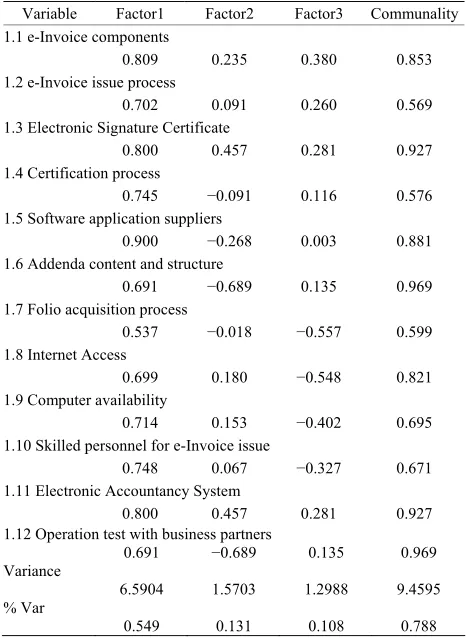
From the information variable set (Table 1), a three
[image:7.595.306.539.419.738.2]Factor solution in regard of technology knowledge re- sulted from the Factor Analysis after the Varimax rota-
Table 1. Knowledge resulting from the information actions. Factor analysis results.
Variable Factor1 Factor2 Factor3 Communality 1.1 e-Invoice components
0.809 0.235 0.380 0.853 1.2 e-Invoice issue process
0.702 0.091 0.260 0.569 1.3 Electronic Signature Certificate
0.800 0.457 0.281 0.927 1.4 Certification process
0.745 −0.091 0.116 0.576 1.5 Software application suppliers
0.900 −0.268 0.003 0.881 1.6 Addenda content and structure
0.691 −0.689 0.135 0.969 1.7 Folio acquisition process
0.537 −0.018 −0.557 0.599 1.8 Internet Access
0.699 0.180 −0.548 0.821 1.9 Computer availability
0.714 0.153 −0.402 0.695 1.10 Skilled personnel for e-Invoice issue
0.748 0.067 −0.327 0.671 1.11 Electronic Accountancy System
0.800 0.457 0.281 0.927 1.12 Operation test with business partners
0.691 −0.689 0.135 0.969 Variance
6.5904 1.5703 1.2988 9.4595 % Var
tion. The first factor structure reveals that participant firms have knowledge of the software application suppli- ers (0.900 highest load), the e-Invoice components or data to be included (0.0809), the need of an electronic signature certificate (0.800) and of the availability of an electronic accountancy system (0.800). As other vari- ables such as computer and skilled personnel resulted highly loaded the first factor was termed Infrastructure Knowledge. In contrast, results of the second factor show
little knowledge of the addenda component and of the suggested operational test with the firm’s business part- ners, therefore the second factor receive the name of Is- suesIgnored. The third factor shows lack of knowledge
about the folio acquisition process and the wide band internet access, being termed as IncompleteKnowledge.
Results from Table 1 suggest that firms are partially
informed about the requirements for the e-Invoice adop- tion as determine by the steps of the process guideline. To operate the e-invoice process, knowledge about tech- nology infrastructure should be completed with the folio numbering and the authentication procedure, while the operations requires to be tested with the main business partners systems due to the two way nature of the invoice. Incomplete information challenges the diffusion process, if the firm considers that buying the software application and obtaining the electronic signature certificate is the unique requisite to run the e-invoice operations. These lead to consider that the innovation itself is perceived as complex and difficult to operate, providing a reason to create a barrier for adoption.
4.2. Perceived Technology Usefulness
Focused on the adopter perceptions regarding advantages
or perceived usefulness of the technology is a second set of results. Addressed in the form of ease-of-use and use- fulness of technology [42], an attitude is defined as “a psychological tendency that is expressed by evaluating a particular entity with some degree of favor or disfavor” [43]. Davis [42], pioneered advances in Theory of Rea- soned Action [44], by postulating that Perceived Useful- ness (PU) and Perceived Ease of Use (PEU) are key de- terminants that inevitably lead to the actual Usage (U) of a particular technology or system, defining Perceived Usefulness as the extent to which a person believes that
using a particular system or technology will enhance his or her job performance, while PerceivedEase ofUse is
defined as the extent to which a person believes that us- ing the particular system or technology will be free of effort. PEU is usually related to the intrinsic characteris- tics of IT (ease of use and ease of learning the technol- ogy), while PU relates to extrinsic factors like efficiency and effectiveness. Perceived Usefulness is a key driver of behavioral intention to utilize a specific technology.
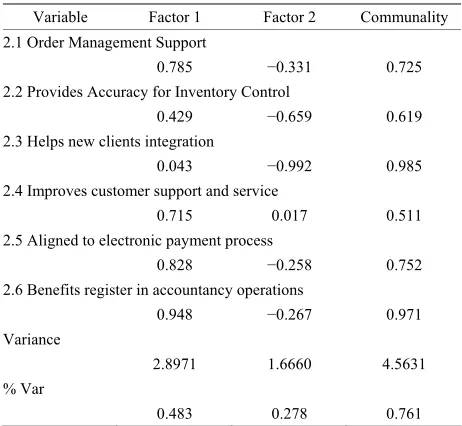
Results in Table 2 present a satisfactory two factor
solution for the e-Invoice perceived usefulness, being factor one is structured by three items related to opera- tionalefficiencies and one item related to competitiveness.
In the first group of items the perceived benefits derived from the accountancy operations register (0.948) belongs to internal procedures while alignment to electronic pay- ments (0.828) and order management support (0.785) are transactional operations in nature. Dominant items struc- ture reveals that e-Invoice usefulness is perceived to gain internal efficiencies and to improve transactions with business partners, mainly in the invoice-payment cycle which is a key issue for the firms’ working capital man- agement. In factor 2 the dominant item is the negative perception of the use of the innovation to support new customer integration (−0.992), followed by the (−0.659) negative usefulness perception to provide accuracy for inventory control, suggesting lack of knowledge or in- formation regarding the addenda role in the electronic document. Results reveal that the adopters are not fully aware of the benefits of the innovation being this a pos- sible reason of indifference for the implementation.
4.3. Readiness
[image:8.595.307.538.522.735.2]From the process view, Technology Transfer relies on organizational and individuals capabilities as key success issues, decisions about technology use and implementa- tion require the adopter readiness in two arenas: tech- nology infrastructure (tangible resources) and developed skills to operate such infrastructure (intangible resources). This view also involves the dissemination of know-how and technical information, as well as further adoption by
Table 2. Technology usefulness perception. operational ad- vantages from e-invoice use.
Variable Factor 1 Factor 2 Communality 2.1 Order Management Support
0.785 −0.331 0.725 2.2 Provides Accuracy for Inventory Control
0.429 −0.659 0.619 2.3 Helps new clients integration
0.043 −0.992 0.985 2.4 Improves customer support and service
0.715 0.017 0.511 2.5 Aligned to electronic payment process
0.828 −0.258 0.752 2.6 Benefits register in accountancy operations
0.948 −0.267 0.971 Variance
2.8971 1.6660 4.5631 % Var
users as stated by Tassey [26].
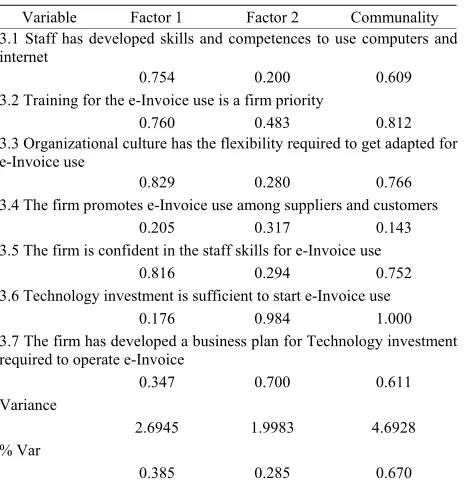
Results in Table 3 reveal that firms have high level of
perceived readiness in both technology infrastructure availability (0.754) and staff skills to operate it (0.816), willing to be trained to operate the e-Invoice software application (0.760), a solid change culture and even a business plan to face investments needed. Such a de- clared fertile context is surprising in the micro and small retail business format of the country of the analysis, and calls to deep into the analysis in order to identify non declared barriers for diffusion, mainly under the light of results about technology based business practices in retail industry firms [36] and in technology infrastructure re- search performed in this segment of firms along the Mexican-American border [45].
As the user has training needs to respond to the adopter decisions, external influences for the diffusion are ex- plored in four variables related to the interaction between suppliers and customers in a Supply Chain Management context (Table 4), where the technology diffusion driver
[image:9.595.307.541.119.304.2]is the dominant business partner (0.857) and without the e-Invoice competitive position could be lost (−736). In retail industry Technology dissemination is made mainly by dominant business partners such as large store chains who look for supplier development or by Multinational suppliers who are challenged by scattered clients’ distri- bution. Such a context seems to be consistent with Leo- nard-Barton [26] point that usually the end user of the innovation is not the decision maker person, therefore the end user is not subject to the different stages of an inno- vation decision making process.
Table 3. Technology readiness. technology infrastructure.
Variable Factor 1 Factor 2 Communality 3.1 Staff has developed skills and competences to use computers and internet
0.754 0.200 0.609
3.2 Training for the e-Invoice use is a firm priority
0.760 0.483 0.812
3.3 Organizational culture has the flexibility required to get adapted for e-Invoice use
0.829 0.280 0.766
3.4 The firm promotes e-Invoice use among suppliers and customers
0.205 0.317 0.143
3.5 The firm is confident in the staff skills for e-Invoice use
0.816 0.294 0.752
3.6 Technology investment is sufficient to start e-Invoice use
0.176 0.984 1.000
3.7 The firm has developed a business plan for Technology investment required to operate e-Invoice
0.347 0.700 0.611
Variance
2.6945 1.9983 4.6928 % Var
0.385 0.285 0.670
Table 4. Diffusion drivers. e-Invoice Use within retail in-dustry.
Variable Factor 1 Factor 2 Communality 4.1 Rules for e-Invoiceprocess are defined by the firm’s main business partners
0.666 −0.558 0.755 4.2 Decisions regarding e-Invoice software application and technology infrastructure are made by the firm’s main business partners
0.857 −0.414 0.906 4.3 In retail industry e-Invoicing is a major business practice
0.447 −0.637 0.606 4.4 Without e-Invoice use the firm loses its competitive position
0.352 −0.736 0.665 Variance
1.5015 1.4303 2.9318 % Var
0.375 0.358 0.733
4.4. Perceived Barriers and Advantages
To analyze the diffusion of the e-Invoice five sources of impediments were considered and explored by means of a set of five variables: 1) barriers related to the usefulness
of technology [42], measured by the perceptions regard- ing the impact in the efficiency of the business cycle; 2) barriers from the operationalcosts view, measure by the
perception of cost reduction for integration with business partners such as in supply chain management practices; 3) perceived absence of benefits, also in the technology usefulness field; 4) barriers related to technology return on investment risk; and 5) barriers perceived about the
security of the transactions, measured by the preference for the traditional paper invoice. When positive, the se- lected set of variables turns into a perceived advantage.
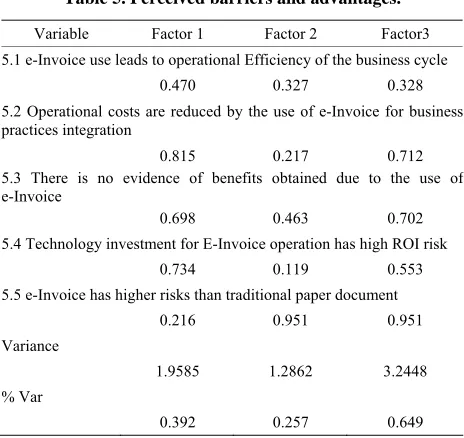
A dual environment is identified from the results of
Table 5. Factor 1 structure is dominated by the positive
perceptions regarding advantages in cost reduction (0.815) and the high ROI risk, which is explained by the non- always-known cost of each invoice issue process. Factor 2 reveals a perceived security risk that could be inter- preted either by the resistance to change or by the need to have physical control on the transaction document. In short, for this group of firms the electronic process is not sufficient to meet security risks being a major concern that their investment could fail if the right technology decisions are not taken or due to the non-profit nature of the technology to be implemented to run the invoicing process.
5. Conclusions
[image:9.595.58.290.493.733.2]Table 5. Perceived barriers and advantages.
Variable Factor 1 Factor 2 Factor3 5.1 e-Invoice use leads to operational Efficiency of the business cycle
0.470 0.327 0.328
5.2 Operational costs are reduced by the use of e-Invoice for business practices integration
0.815 0.217 0.712
5.3 There is no evidence of benefits obtained due to the use of e-Invoice
0.698 0.463 0.702
5.4 Technology investment for E-Invoice operation has high ROI risk
0.734 0.119 0.553
5.5 e-Invoice has higher risks than traditional paper document
0.216 0.951 0.951
Variance
1.9585 1.2862 3.2448 % Var
0.392 0.257 0.649
here—can impact the adoption and diffusion. This com- plexity provides one reason to explain why the adoption of advanced integration technologies that enable firms to execute their business transactions electronically is still relatively low, especially among SMEs and in develop- ing countries, such as recent research findings reports [46, 47]. This also seems to be true in the context of the ob- tained results due to the number of adopters in relation of the size of the tax payer population. For such a number of firms targeted for a country level technology transfer, re- sults suggest that the technology readiness analysis seems to be a useful tool to gain deep understanding of the context of application ([24].
A relevant conclusion emerges from firm’s declaration regarding technology readiness far to be considered as an adoption barrier, contrasted con the declared practice of produce paper documents by printing the electronic in- voice message to “keep a hard copy” reflecting a tech- nology culture under construction far related to the busi- ness culture characteristics of profit orientation and effi- ciency search as means for profit creation [48].
The analysis leads to conclude that technology readi- ness for the small business segment is not completed, as identified by partial levels of information regarding cer- tificate and folios payment, insufficient information about standardized software, different criteria for addenda struc- ture, training under software applications suppliers hands, complex ease of use of the technology and a strong tradi- tional culture with little understanding of the nonprofit nature of the technology investments. These are some of the challenges to overcome in the technology transfer arena, while the perceived advantages related to opera- tional cost reduction and efficiency are strong reasons to be used as key reasons to reach the technology diffusion
goals.
While the resolution of these issues is in progress, the effort continues and more firms are added to the change. So far, Technology Culture is extended through the in- corporation to e-Invoice use into operations of other type of business firms such as gas stations, large supermarket chains, few mini supermarket stores, government agen- cies and even laundry business, following a diffusion strategy “by imitation”. For those taxpayers in the range of 250,000 MXP annual income that still have printed invoice vouchers, ready or not the use of e-Invoice could not be postponed further than the beginning of year 2014. From the research study can be drawn several lessons regarding the imposing of a substantial burden on would be technology adopters as mentioned by Fichman [10], and about the importance of stimulate awareness among the new population of users, coordinated actions among transfer players and the need to develop a safety net in terms of assistance. In such technology transfer context, wide array of business opportunities rise for business consultants and training firms.
REFERENCES
[1] X. Y. Yu, “International Economic Law,” University Press, Nanjing, 1990.
[2] P. G. Abbott, “Technology Transfer in the Construction Industry Infrastructure and Industrial Development,” Special Report No. 223, The Economist Intelligence Unit, The Economist Publications Ltd., London, 1985.
[3] J. D. Roessner, “Technology Transfer,” In: C. Hill, Ed.,
Science and Technology Policy in the US. A Time of
Change, Longman, London, 2000.
[4] L. M. Zhao and A. Reisman, “Toward Meta Research on technology-Transfer,” IEEE Transactions on Engineering Management, Vol. 39, No. 1, 1992, pp. 13-21.
[5] B. Bozeman, “Technology Transfer and Public Policy: A Review of Research and Theory,” Research Policy, Vol. 29, No. 4-5, 2000, pp. 677-625.
[6] W. Souder, “Managing New Products Innovations,”D. C. Heath Canada, Limited, Ma. Lexington, 1987.
[7] A. Rubenstein, “Managing Technology in a Decentralized Firm,” Wiley, New York, 1989.
[8] E. Rogers, “Diffusion of Innovations,” 5th Edition, Free Press, New York, 2003, p. 12.
[9] D. Leonard-Barton and E. Rogers, “Horizontal Diffusion: An Alternative Paradigm to the Classical Diffusion Model,” Working Paper No. 1284-81, Alfred P. Sloan School of Management, Massachusetts Institute of Tech-nology, Cambridge, 1981.
http://opensource.mit.edu/papers/1569088836.pdf [10] R. Fichman, “Information Technology Diffusion: A Re-
view of Empirical Research,” Proceedings ICIS’92. Pro-
ceedings of the 13th International Conference on Infor-
1992, pp. 195-206.
[11] D. Leonard-Barton and I. Deschamps, “Managerial In- fluencies in the Implementation of New Technology,”
Management Science, Vol. 34, No. 10, 1988, pp. 1252-
1265.
[12] G. C. Moore and I. Benbasat, “Development of an In- strument to Measure the Perceptions of Adopting an In- formation Technology Innovation,” Information Systems Research, Vol. 2, No. 3, 1991, pp. 192-222.
http://dx.doi.org/10.1287/isre.2.3.192
[13] E. Roberts and L. Frohman, “Strategies for Improving Research Utilization,” Technology Review, Vol. 80, No. 5. 1978, pp. 32-39.
[14] E. Roberts, “What We Have Learned: Managing Innova- tion and Invention,” Research-Technology Management, Vol. 50, No. 1, 1988, pp. 11-19.
[15] G. Gaynor, “Innovation by Design,” American Manage- ment Association, New York, 2002, p. 84.
[16] D. Leonard-Barton, “The Intra-Organizational Environ- ment: Point-to-Point vs. Diffusion,” In: F. Williams and D. Gibson, Eds., Technology Transfer, A Communication Perspective, SAGE Publications, Thousand Oaks, 1990, pp. 43-62.
[17] L. Smits, J. Leyten and P. den Hertog, “Technology As- sessment and Technology Policy in Europe: New Con- cepts, New goals, New Infrastructure,” Policy Science, Vol. 28, No. 3, 1995, pp. 271-299.
[18] P. K. De, “Gap between Strategy and Management of Technology: A Review of Indian Scenario,” In: Hosni and Kalil, Eds., Management of Technology. Internet
Economy: Opportunities and Challenges for Developed
and Developing Regions of the World, Elsevier, Ltd., Amsterdam, 2004.
[19] L.-H. Richard, “From Technology Transfer to Knowledge Transfer. A Study of International Joint Venture Projects in China,” Proceedings of the 12th International Confer-
ence on Technology Management, (IAMOT), Nancy, 13-
15 May 2003, pp. 1-16.
www.iamot.org/paperarchive/li-hua.pdf
[20] E. Autio and T. Laamanen, “Measurement and Evaluation of Technology Transfer: Review of Technology Transfer Mechanisms and Indicators,” International Journal of Technology Management, Vol. 10, No. 7-8, 1995, pp. 643-664.
[21] A. Thomas, “Acquisition and Licensing of Intellectual Property,” Managerial Law, Vol. 40 No. 6, 1998, pp. 5- 15.
[22] R. Megantz, “Technology Management: Developing and Implementing Effective Licensing Programs,” John Wiley & Sons Inc., New York, 2002.
[23] G. Spinardi, “Defense Technology Enterprises,” Science and Public Policy, Vol. 19, No. 4, 1992, pp. 198-206. [24] J. Mollas-Gallart and T. Sinclair, “From Technology
Generation to Technology Transfer: The Concept and Reality of the ‘Dual-Use technology Centers’,” Economic
and Social Research Council, International Conference
on Technology Policy and Innovation, Lisbon, 3-5 August
1998, pp. 1-10.
[25] P. Shapira and S. Rosenfeld, “An Overview of Technol- ogy Diffusion Policies and Programs to Enhance the Technological Absorptive Capabilities of Small and Me- dium Enterprises,” Organization for Economic Coopera- tion Development (OECD), Directorate of Science, Tech- nology and Industry,Paris, 1996.
www.gatech.edu/mod
[26] G. Tassey, “Technology Infrastructure and Competitive Position,” Kluwer Academic Publishers, Norwell, 1992. http://dx.doi.org/10.1007/978-1-4615-3608-6
[27] D. Leonard-Barton, “Applying Innovations Diffusion Theory to the Management of Change,” Working Paper No. 1295-82, Alfred P. Sloan School of Management. Massachusetts Institute of Technology,Cambridge, 1982. http://dspace.mit.edu/bitstream/handle/1721.1/46833/appl yinginnovati00leon.pdf?sequence=1
[28] H. Ergas, “Does Technology Policy Matter?” In: B. Guile and H. Brooks, Eds., Technology and Global Industry:
Companies and Nations in the World Economy, National
Academy Press, Washington DC, 1987, pp. 191-280. [29] D. Sahal, “The Form of Technology,” In: D. Sahal, Ed.,
The Transfer and Utilization of Technical Knowledge,
Lexington Publishing, Lexington, 1982, pp. 125-139. [30] Federation Official Bulletin January 5th 2004. Mexican
Government, Mexico. DOF. Diario Oficial de la Fe- deración del 5 de Enero del 2004.
[31] Federation Official Bulletin May 30th, 2000, Mexican Government, Mexico. DOF. Diario Oficial de la Fe- deración del 30 de Mayo del 2000.
[32] V. E. Erosa and P. Arroyo, “Characteristics of Firms In- terested in e-Invoice Adoption, in Change Commitment,” Mexican Association for Electronic Commerce, Mexico, 2003, pp. 269-291. (Caracteristicas de las empresas que tienen interés en incorporarse a la Factura Electronica. In El Compromiso con el Cambio: Identificando Opor- tunidades de Negocios en la Cadena de Valor. AMECE. Asociacion Mexicana de Estandares para el Comercio Electronico. Direccion de Investigacion y Desarrollo. México, Mayo 2003.)
[33] Tax Management System, “Tax Management Report,” 2013. Mexico, 2013, pp. 4. SAT. Sistema de Administra- cion Tributaria. Informe Tributario y de Gestion. 2 Tri- mestre 2013. Secretaria de Hacienda y Credito Publico. Sistema de Administracion Tributaria. 2013.
http://www.sat.gob.mx/sitio_internet/informe_tributario/i nforme2013t2/tributario.pdf
ftp://ftp2.sat.gob.mx/asistencia_servicio_ftp/publicacione s/boletines/com2012_121.pdf
[34] L. F. S. Velazco, “E-Invoice Statistics in April 30, 2013,” Estadisticas de la Factura Electronica. Suplementos Cor- porativos, S. A. de C. V. Suplemento Factura Electronica, 2013.
http://www.suplementofacturacionelectronica.com/2013/0 6/estadisticas-al-30-de-abril-de-2013/
[35] V. E. Erosa and P. Arroyo, “Readiness Analysis for Data Base Synchronization between Clients and Suppliers,”
matica. INEGI. Mexico, 2003. Año XXVI. Numero 1, pp. 31-5.
http://www.inegi.org.mx/inegi/contenidos/espanol/prensa/ contenidos/Articulos/tecnologia/capacidademp.pdf [36] V. E. Erosa. “Technology Gap among Suppliers and Pop
& Mom Stores as a Key Distribution Cost Issue,” Man- agement of Engineering and Technology, 2008. Proceed-
ings PICMET 2008. Portland International Conference
on Management of Engineering and Technology 2008,
Capetown, 27-31 July 2008, pp. 2623-2630.
[37] National Institute of Statistics, Geography and Informat- ics, “Statistics Yearbook of the United Mexican States,” Mexico 2013, pp. 470, Table 16.1. INEGI. 2013. Anuario Estadistico de los Estados Unidos Mexicanos, 2012-2013. 470. Cuadro 16.1.
[38] J. Stevens, “Applied Multivariate Statistics for the Social Sciences,” Lawrence Erlbaum Associates, Hissdale, 1986. [39] J. Hair, W. Black, B. Babin, R. Anderson and R. Tatham, “Multivariate Data Analysis,” 6th Edition, MacMillan Publishing Company, New York, 2006.
[40] Tax Management System, Mexico, “Information about e-Invoice (2013),” Secretaria de Hacienda y Credito Pub- lico. SAT. Sistema de Administracion Tributaria Infor- macion sobre Factura Electronica (2013). 2013.
ftp://ftp2.sat.gob.mx/asistencia_servicio_ftp/publicacione s/cfd/PyRFactElect.pdf
[41] Tax Management System, Mexico, “Assistance about e- Invoice (2013),” Secretaria de Hacienda y Credito Pub- lico. SAT. Sistema de Administracion Tributaria Asist- encia sobre Factura Electronica (2013). 2013.
http://www.sat.gob.mx/sitio_internet/asistencia_contribuy ente/principiantes/comprobantes_fiscales/66_19339.html [42] F. D. Davis, “Perceived Usefulness, Perceived Ease of Use, and User Acceptance of Information Technology”, MIS Quarterly, Vol. 13, No. 3, 1989, pp. 319-339.
http://dx.doi.org/10.2307/249008
[43] A. Eagly and S. Chaiken, “The Psychology of Attitudes,” Harcourt, Brace, Jovanovich, Fort Worth, 1993, p. 1. [44] M. Fishbein and I. Ajzen, “Belief, Attitude, Intention and
Behavior: An introduction to Theory and Research,” Ad- dison Wesley, Reading, 1975.
[45] V. E. Erosa, “Comparative Analysis of Technology Based Business Practices among Retail Industry Firms. A Bina- tional Approach between Tamaulipas. Mexico and Texas USA,” Mexico-United States Research Journal. CIMEXUS, Vol. V, No. 2 July-December, 2010, pp. 163-202. Ana- lisis comparativo de las practicas de negocio basadas en tecnologia en empresas del Sector Comercio Minorista. Un enfoque binacional en la zona fronteriza Tamaulipas- Texas. CIMEXUS. Revista de Investigaciones Mexico- Estados Unidos, 2010
[46] T. Janner, F. Lampathaki, V. Hoyer, S. Mouzakitis, Y. Charalabidis and C. Schroth, “A Core Component-Based Modelling Approach for Achieving e-Business Semantics Interoperability,” Journal of Theoretical and Applied Elec- tronic Commerce Research, Talca, 2008, Vol. 3, No. 3, 2008, pp. 1-16.
[47] R. Odigie and L. Hua, “Unlocking the Channel of Tacit Knowledge Transit: The Concept of Technology Transfer in Developing Countries,” In: CAMOT 2008 International Conference Proceedings (Hendrix, Ed.) Technology Man- agement and Innovation in China. Beijing, 2008. siif.croatia.com/hr/service/download/file/id/292