
Journal of Chemical and Pharmaceutical Research, 2018, 10(10): 52-62
Research Article
CODEN(USA) : JCPRC5
ISSN : 0975-7384
52
Synthesis and Characterization of Tetra Amide Macro Cyclic Metal-Complex
of Co (Ii), Ni (Ii), Cu (Ii) and Zn (Ii) and its Antimicrobial Property
Giriraj S.Mandloi
1, Smita Joshi
2, Surendra Sarsaiya
3and Sulbha Amlathe
*1Department Applied Chemistry, UIT, Barkatullah University, Bhopal – 462064, MP, India 2
Chemistry Department, SNGPG College, Bhopal – 462064, MP, India
3Departmentof Chemistry, Govt. Geetanjali Girls' P.G. (Autonomus) College, Bhopal, MP, India
____________________________________________________________________________
ABSTRACT
The synthesis and characterization of complexes [M (L1) Cl2], (M= Co (II), Ni (II), Cu (II) and Zn (II); and L1=2, 2’-[ethane-1, 2-diylbis (Oxyacarbony1)] dibenzoic acid has been analysed by FE-SEM/EDS, FT-IR, UV-Visible and XRD etc. The L1 proved to be coordinated with tetra amide divalent transition metals giving precipitates upon self-assembly at 00C temperature. The FT-IR and powder XRD supported the continuation of a complexion with transition metal cations indicates the formation of self–assembled through O-H… O; C-H... O interface of the end dicarboxylic acids. The complexes were screened out for the antimicrobial activity by disc diffusion agar technique. The potency of compound [M (L1) Cl2] was tested against the bacteria (Escherichia coli and Staphylococcus aureus) and fungi (Aspergillus niger and Candida albicans) strains. The Ampicilline was used as standard for bacteria and fluconazole for fungi. The Cu2+ and Ni2+ metal complex showed the highest in vitro antibacterial activity (Escherichia coli and Staphylococcus aureus) as compared to the standard drug while the all the metal complexes were less effective antifungal activity against test fungi (Aspergillus Niger and Candida Albicans). The finding revealed that the metal complexes from the synthesized compounds, which is high potential for the industry and environment.
Keywords: Self assembles; Bolaamphiphiles; Rigid rod; Antimicrobial activity
_____________________________________________________________________________
INTRODUCTION
After a duo years of general research work in many laboratories all-inclusive, macrocyclic chemistry is an ingrained
and the highly documented branch of science. The amide bases have provided a charity limestone for the
construction of existing macrocyclic chemistry [1]. A spacious variety of amide macrocycles has been evolved from
the early studies. The macrocyclic legends, which have hollow with the N-H group have an intensive area of study
with the many transition metals [2-4]. The macrocyclic molecules containing with unusual spacers are also able to
forming complexes with transition metal ions Co(II), Ni(II), Cu(II) and Zn(II) in close proximity which is
considered to be an important factor in increasing the efficiency in activation of substrates [5-7]. Similar way the
macrocyclic metal complexes are also applying for biological fields such as antimicrobial, antifertility, antimalarial,
53
with a novel macrocyclic tetradentate nitrogen donor legend, that give rise to environmental, industrial or
health-related potential application [15-19]. All these compounds possessing N-H group in general results into the gel or
solid materials [20]. The strong COOH-COOH interaction in these molecules interestingly provides a multiplicity of
many superstructures such as rod, helix, knots,etc. The macrocyclic compounds possessing various potential
applications, we motivated to synthesis varieties of some new macrocyclic molecules containing N-H group
diester-dicarboxylic compounds. Carboxylic acid is being the ligand, with metal ion leads into the verities of metal
complexes. The transition metal complexes have played an essential role in a huge number of widely differing
biological processes.
Recently, the tetra-amide base complexes have acquired special attention in the industrial and pharmaceutical field
since they show excellent anti-biological activities. Tetra amide macrocyclic transition metal-complex have been
reported to show a multiplicity of biological actions, which is accountable for various antibacterial, antifungal
activities. They formed a novel motivating class of macro cyclic complexes that has been popularised used in the
coordination chemistry of transition, and main group elements. The present investigation was mainly focused on the
synthesis of a series of compounds containing tetra amide divalent transition metals and to evaluate their
antimicrobial potency.
MATERIALS
Materials, Instruments and Reagents
All the chemicals are purchased from Aldrich & Co. and are used without any further purification. The melting
points were determined routinely in open capillaries, the morphology (FE-SEM/EDS) was performed on a Model
JOEL JSM-5600, Japan, the microanalyses of the compounds were done using an Elemental HITACHI CHNS/O
analyzer, Germany at CSIR, AMPRI, Bhopal. Mass analysis was performed using electron spray ionization (ESI+)
technique on water QT micro mass spectrometer. FT-IR spectra were recorded using KBr pellets on a Perkin-Elmer
spectrum GX FT-IR spectrometer. A powder X-ray diffraction (XRD) pattern of dried samples was taken by the
reflection method on a Rigaku diffractometer (RINT 2000) using d-space elliptical side by-side multilayer optics
monochromatic cu Ka radiation (50 kV,40 mA). The molar conductance of solid divalent transition metal
complexes in DMF (10-3 M) was precise using Sybron–Barnstead conductometer (Meter- PM.6, E = 3406).
Staphylococcus aureus and Gram negative bacteria Escherichia coli and fungi like Aspergillus Niger and Candida albicans were collected from the Department of Microbiology Barkatullah University (BU), Bhopal, Madhya Pradesh, India.
Synthesis of 2, 2’-[Ethane-1,2-Diylbis (OxycarbonyI) Dibenzoic Acid (L1 )
54
Scheme 1. Diester dicarboxylic Bolaamphiphiles compound with their functional role
Preparation of the Metal Complexes [M (L1) Cl2]
A mixture of L1 (1.7g, 0.005 mmol) and ethylene diamine (0.335ml, 0.005 mmol) dissolved in 50ml ethanol was
magnetic stirred for about one hour. A hot ethanolic solution of the appropriate metal chloride (0.0025 mmol) was
then added. The mixture was stirred with gentle heating (60-90°C) for a total of 5h. cooling up gave a solid colored
precipitate of the complexes was filtered off, washed several times with cold ethanol and dried under vacuum.
Procurement and Maintenance of Culture
Fungal culture (Aspergillus niger and Candida albicans) and bacterial culture (Escherichia coli and Staphylococcus aureus) were procured from the Department of Microbiology, Barkatullah University, Bhopal, Madhya Pradesh, India for the research study. The cultures were maintained on potato dextrose agar and nutrient agar media plates
and tubes at 37°C and 28°C, respectively.
Filter Paper Disc Diffusion Plate Assay
The experiments of antimicrobial activity were conducted using filter paper disc diffusion plate assay as described
by [21] for the fungi, fungal inoculum was prepared in Tween 80 saline solution. Each fungal suspension was
poured into the sterilized petri plates. After that molten potato dextrose agar (PDA) medium was poured into the
petri plates containing inoculum and rotated to mix the inoculum and the medium uniformly and kept for
solidification. After solidification, the sterile blotting paper disc (5 mm) was soaked in the diluted metal complex in
different concentrations. The disc was dried in controlled temperature to remove excess of solvent and used for
study. Fluconazole (for fungi) and Ampicilline (for bacteria) were used as positive controls. The plates were
incubated at 37°C and 28°C for 24-72 hours. The results were expressed in terms of the diameter of the inhibition
zone. All experiments were carried out in triplicates.
To Determine the Antibacterial and Antifungal Activity against Test Microorganisms
The filter paper disc diffusion plate assay was employed to determine the antimicrobial activity of metal complex
[M (L1) Cl2] derivatives) against a test organism. The inoculum was spread over the nutrient agar plate using a
sterile cotton swab in order to obtain uniform microbial growth. Then the prepared antimicrobial metal complex [M
(L1) Cl2] derivatives discs were kept over the lawn and pressed slightly along with control [Fluconazole (for fungi)
and Ampicilline (for bacteria)]. The plates were incubated at 28°C for 72 hours in case of fungi and 37°C for 24
hours in case of bacteria. The identical course of action was adopted for standard drugs. The movement was
determined by using the technique at an attentiveness of 100 μg/mL solution of synthesized [M (L1
55
100 μg/mL solution of the standard drugs, Fluconazole (for fungi) and Ampicilline (for bacteria) were also
equipped. The antimicrobial activity was evaluated and diameter of inhibition zones was measured in millimetre
(mm). An experiment was carried out in triplicate and the average diameter of zone of inhibition was recorded.
RESULTS AND DISCUSSION
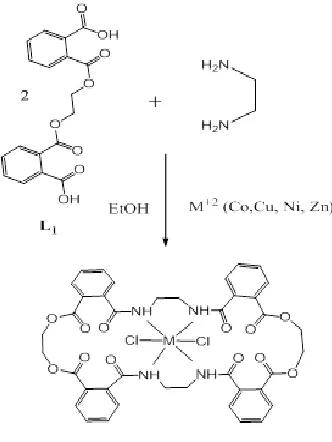
The M (L1) Cl2] complexes is subjected to elemental analysis. The results are recorded with different
molecular formula and melting points are presented in Table-1. The results are obtained in good agreement with
those calculated from the suggested formula. The sharp melting points are indicating the purity of the preparation
macrocyclic complexes is given by the scheme-2.
[image:4.612.235.401.222.443.2]Scheme 2. Synthetic rout of metal complexes
Table 1. Colour, melting point, molar conductance and analytical data of the compound
Compound Colour Melting
point (⁰C)
Λm
(cm2 Ω-1
mol-1)
Mol. Wt.
Found (Clacd.) (%)
M Cl C H N O
[CoL1 CL2] Green, Brown
179 66 954.79 6.59
(7.23) 7.93 (8.44) 53.70 (54.72) 4.06 (5.17) 6.26 (7.20) 21.46 (22.41)
[NiL1 CL2] Light Blue 152 15 928.43 6.56
(7.21) 7.93 (8.52) 53.72 (54.27) 4.06 (5.17) 6.26 (7.21) 21.47 (22.39)
[CuL1 CL2] Dull Green 134 17 959.32 7.07
(7.1) 7.89 (8.10) 53.43 (53.89) 4.04 (4.87) 6.23 (7.11) 21.35 (22.07)
[ZnL1 CL2] White 240 28 961.18 6.56
(7.21) 7.93 (8.54) 53.72 (53.24) 4.06 (5.18) 6.26 (7.20) 21.47 (22.40)
Composition and Structure of Metal Complexes
The formation of tetra amide macrocyclic compound of Co(II), Ni(II), Cu(III), and Zn(II) (chlorides) with the L1
56
identify their tentative formulae in a trial to elucidate their molecular structures. The results of elemental analyses
listed in Table-1 suggest the formulae type [M (L1) Cl2], [M= Co (II), Ni (II), Cu (II) and Zn (II)].
Molar Conductivity Measurements
The tetra amide metal complexes were dissolved in DMF and the molar conductivity concentrations of 10-3M of
their solutions at 25°C were measured. Table-1 shows the molar conductance values of the transition metal
complexes. The molar conductance values of the complexes fall in the range 15–66 Ω_1 mol_1cm2 indicating that
these complexes are non-electrolytes.
Electron Microscopic Observation
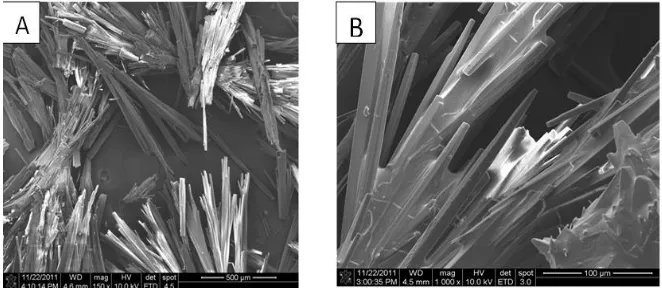
The FE-SEM of the transition metal complexes was recorded to understand the formation of rigid rod structures. To
elucidate the rigid rod structures are accountable for the coordination with the metal ions, respectively. We carried
out the FE-SEM images in Fig.1 and 2 display the 1/Cu2+ complexes upon self-assembly at room temperature. The
1/Cu2+ complex stick is almost similar to those of the organic nano fibres as before reported [22,23]. The metal
cation complexes are also self-possessed of the rigid rod. We also carried out EDS to clear percentage amount of
metal present in the tetra amide metal complexes. The EDS of each rigid rod shows the peaks ascribable to Co(II),
Ni(II), Cu(II), and Zn(II), respectively. This pronouncement supported that the structure are actually composed of
the metal complexes of Bolaamphiphiles ligand (L1). Uniform widths of the metal-complexes rigid rod indicates
that both the length of the end terminal carboxylic acids and the kinds of metal cations have little effect on the
[image:5.612.140.471.486.632.2]morphologies of the rigid rod (Figures 1 and 2).
57
Figure 2. EDS Spectrum of the Cu2+ complex, self-assembled at room temperature
FT-IR and XRD Analyses
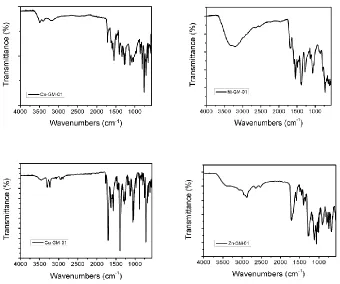
The FT-IR data of the spectra of the metal complexes are listed in table 2. The FT-IR spectrums in Figure 3, shown
the complex formation the changeable in the direction of the lower side of [υ(N–H)] band and the band of amides.
This is recommend the harmonization from side to side the nitrogen of amide [–NH group (N4)] and supported by
the outward show of a medium intensity band in the rang 426-496 cm-1 ascribed to [ʋ(M–N)] and [ʋ(M–Cl)] exterior
weak band in the rang 280-320 cm-1 [23,24].
[image:6.612.170.510.397.681.2]58
A pointed band observed 3182-3284 cm-1 may be assigned to [υ(N–H)] of the secondary amine group (Table 2) [25].
The FT- IR spectrum of the metal complexes does not show signs of any band equivalent to the free primary
[image:7.612.68.547.159.279.2]diamine and the hydroxyl group.
Table 2. FT-IR Vibrational frequencies of the compounds
S. No. Compound ʋ (N-H) ʋ (C-H) Co2+ Ni2+ Cu2+ Zn2+ ʋ(M-N) ʋ(M-Cl) Ring vibration
1 [CoL1 CL2] 3270,3200 2900 1680 1490 1240 690 440 300 1230,1015,860
2 [NiL1 CL2] 3300,3240 2910 1700 1500 1270 680 440 300 1225,1010,865
3 [CuL1 CL2] 3290,3230 2910 1690 1520 1240 660 440 300 1235,1010,855
4 [ZnL1 CL2] 3290,3290 2880 1700 1520 1250 660 430 320 1225,1010,850
Thus, the two sets of FT-IR peaks appeared in this region indicate the presence of the terminal and the spacer COO
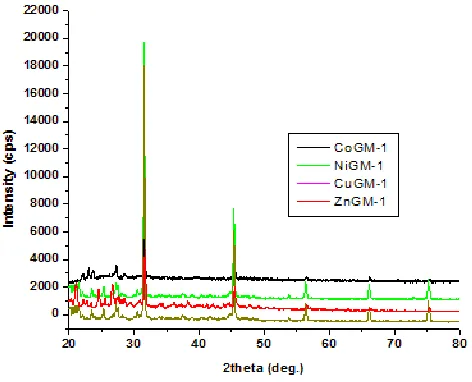
group in all these metal complexes. The XRD patterns of the isolated and dried Co2+, Ni2+, Cu2+, and Zn2+,
complexes upon self-assembly at room temperature are shown in Fig-4. Even though the intensities are moderately
sharp for the reason that of the crystalline nature of the 1/Cu2+ although the intensities are relatively strong reflection
peaks appear in a similar way as the organic sharp rigid rod structure. The absence of strong periodic reflection
peaks in the small-angle region suggests that the rod is based on no long-range organization. All the results of the
microscopic observation, FT-IR spectrum, and XRD analysis supported to the metal harmonization of fatal carbonyl
anions take place on the organic sharp rigid rod structure.
Figure 4. XRD patterns of the isolated and dried (a) Co2+, (b) Ni2+, (c) Cu2+, and (d) Zn2+ complexes upon self-assembly at room
[image:7.612.185.421.469.660.2]59
UV-Vis Spectra
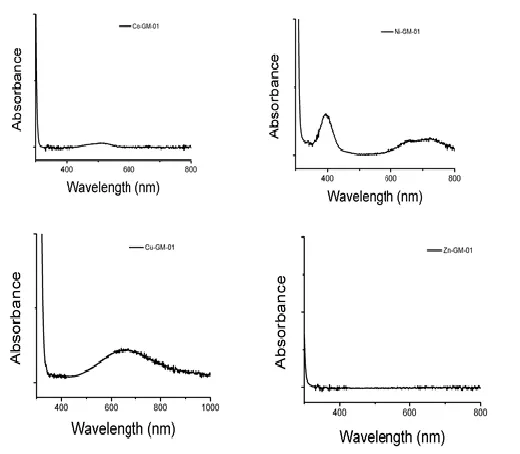
The experimental positions of the absorption bands in the electronic spectra of the Co2+, Ni2+, Cu2+, and Zn2+,
macrocyclic complexes recorded in DMSO showed a weak intensity band at 19151,26954, 14947 and 22675cm-1
corresponding to a high spin classification which may be assigned dependable with an octahedral situation in the
area of the all transition metal complexes. However, the cobalt (II) complexes exhibit two bands in the 21739, 20366
and 17953, 19157 cm-1 regions which may also correspond to high spin system assignable transitions, respectively,
dependable with an octahedral geometry in the region of the Co (II) ions. The complexes, everyone showed a
magnetic moment analogous to a spin free multifaceted. Their UV spectrum showed two separate bands arising from
the octahedral geometry of the Ni (II), complexes. The two bands are around 40160, 37664 and 28490, 26954 cm-1
and one broadband around 11150 and 11250 cm-1 assignable transition, respectively. The UV spectrum of the Zn (II)
complexes, each showed a main broadband in the 20250, 20400 cm-1 region along with the 16450, 16550 cm-1
region respectively. This may absolutely be assigned to the transitions, corresponding to a distorted octahedral
geometry. Their magnetic moment values further support the above-proposed geometry. The high intensity bands
observed around 36764 cm-1 for all the complexes in the UV region may be assigned as a metal-to-ligand charge
[image:8.612.177.437.415.642.2]transfer excitation shown in Figures 4 and 5.
60
Antibacterial and Antifungal Activity of [M (L1) Cl2] Derivatives
The results of an in vitro antimicrobial activity showed that the activity of metal complex [M (L1) Cl2] derivatives
constituents possess antimicrobial activity against the selected test organism (Escherichia coli, Staphylococcus aureus, Aspergillus niger and Candida albicans). In the filter paper disc diffusion plate method, out of total four metal complex, the Cu L1 Cl2 complex was found to be most effective against the Escherichia coli showing
inhibition zones of 15mm which was highest among all the metal complex used in the study followed by Ni L1Cl2
complex showing inhibition zone of 14mm against Escherichia coli and Staphylococcus aureus. Moderate activity was shown against four metal complexes with Co L1 Cl2 and Zn L1 Cl2 showing inhibition zone of 13-14 mm against
both Escherichia coli and Staphylococcus aureus, respectively. Minimum activity was shown by four metal complexes of Cu L1 Cl2 and Zn L1 Cl2 exhibiting 12 mm inhibition zones against Staphylococcus aureus.
Ampicilline and Fluconazole used as positive controls and were found to be less effective than some of the metal
complexes against the entire test.
In case of fungi, the data shown in Fig-6 showed that out of total four metal complex shown, the NiL1Cl2
complex was found to be most effective against both the test fungi (Aspergillus Niger and Candida albicans) followed by ZnL1Cl2 complex showing inhibition zone of 2mm against Aspergillus Niger. Minimum activity was
shown against four metal complexes with CoL1Cl2 and CuL1Cl2 showing inhibition zone of 1 mm against both
Aspergillus niger and Candida albicans, respectively.
The results of the antibacterial activity showed that the zone of habitation tends to make the complexes act as more
[image:9.612.123.490.404.604.2]powerful and potent antibacterial agents, thus killing more of the bacteria than the fungi.
Figure 6. In vitro antimicrobial activity of metal complex [M (L1) Cl
2] derivatives [(A) Cu2+, (B) Ni2+, (C) Co2+, (D) Zn2+ Complexes]
against against test microbes
zo
ne
o
f
inh
ibi
tio
n
(m
m
)
Compound code
61
Figure 7. Antibacterial activity of metal complex [M (L1) Cl
2] derivatives against test microbes (E.coli and Staphylococcus areas). [(A):
Cu2+, (B): Ni2+, (C): Co2+, (D): Zn2+ complexes, (E): control]
The enlargement inhibitory effects of transition metal ions are significant against antibacterial activities (Figures
5-7). The behaviour of transition metal ions to allocate charge with the donor groups are reduced ahead chelating. The
transition metal complexes are less effective anti-fungal agents than its metal complexes. The tetra-amide based
macrocyclic complexes are newly reported and are tested for their antibacterial action against some bacteria like
Staphylococcus aureus (S. aureus), Escherichia coli (E. coli) in which the metal complexes are less active against
the two pathogenic microorganisms specifically Aspergillus niger, and Candida albicans. The transition metal ion
complexes are vastly active against above two types of bacteria. E. coli was originating to give the details high
action towards complexes; fairly they are active towards the complex. Staphylococcus aureus (S. aureus) was
originated to be extremely active against amide complexes. The prepared compound was active towards both types
of bacteria such as Escherichia Coli and Staphylococcus aureus, respectively
CONCLUSION
The tetra amide macrocyclic complexes make in the way with transition-metal cations, such as Co2+, (b) Ni2+, (c)
Cu2+, and (d) Zn2+ producing the through molecular self-assembly. The FE-SEM images have been observed
revealed the metal-complexes formation of rigid rod structure. In a similar manner as the rigid rods formed from the
metal complexes, the Co2+ were found to form the rigid rods by coordination with metal cations. It is concluded that
in these complexes from the molecular prescription as deduced from elemental analysis. All of the tested compounds
showed a remarkable biological activity against different types of bacteria such as Staphylococcus areas and Escherichia coli and fungi, Aspergillus niger and Candida albicans.
On comparing the biological activity of the standard and metal complexes with the standard Ampicilline (an
62
1. The biological activity of transition metal complexes is moderate in comparison with the standards used. It has less
antifungal activity towards test fungi.
2. The remaining metal complexes have more or less biological activity that follow the order: Ni (II)> Cu (II) ≥Zn (II)
> Co (II).
ACKNOWLEDGMENTS
The authors are grateful to AMPRI, (M.P), CSMCRI, (Gujarat), CSIR, INDIA, and the HOD of department of
Microbiology BU, Bhopal for providing culture for this work. G.S.M acknowledges Director General, MPCST for
an award of Young Scientist Training Fellowship for partial completion of the work. And we also acknowledge to
SISTech, Bhopal (M.P.) for recording FT-IR spectra.
REFERENCES
[1] S Kumar; D Dhar; PN Saxena. Scientific Industrial Res. 2009, 68, 181-187. [2] KY Choi; HY Lee; B Park. Polyhedron. 2003, 20.
[3] TW Hambley; LF Lindoy; JR Reimers; P Turner; W Wei AN W-Cooper. J Chem Sco Dalton Trans. 2001,
614.
[4] EQ Gao; HY Sun; DZ Liao; ZH Jiang; SP Yan. Polyhedron. 2002, 21, 359.
[5] M Costas; C Anda; A Lobet; T Patella; EH Stoeckli; E Pinilla. Eur J Inorg Chem.2004, 857-865. [6] CJ McKenzie; H Toftlund; M Pietraskiewics; Z Stojek; K Slowinski. Inorg Chim Acta. 1993, 143-149. [7] M Pietraszkiewicz; O Pietraszkiewicz; R saf; K Hummel; A Skorupa; J Mrozinski. J Incl Phenom &
macrocyel Chem. 1999, 38 , 233-242.
[8] A Chandhary; S Dave; R Swaroop; RV Singh. J Ind Chem Soc. 2002, 79, 371. [9] DP Singh; R Kumar; V Malik; PJ Tyagi. J Enzyme Inhib Med Chem. 2007, 22, 177. [10]FMAM Aqra. Transition Met Chem. 2003, 28,224.
[11]YS Kim; R Song; CO Lee; YS Sohn. Bioorg Med Chem Lett.2004, 14. [12]TM Hunter; SJ Paisey; HS Park. J Inorg Biochem. 2004, 98,713.
[13]JA Parkinson; M Weishaupl; RO Gould. J Am Chem Soc. 2002,124,9105. [14]S Chandra; LK Gupta. Spectrochimica Acta.2004, A60, 2767.
[15]C Anda; A Lobet; V Salvador; AE Martell; RJ Motekaities. Inorg Chem. 2000, 39, 3000-3008. [16]S Chandra; S Raizada; M Tyagi; A Gautaus. Bioinorganic Chem and Appl. 2007.
[17]Giriraj S Mandloi; PM Selvakumar; S Joshi; Sulbha Amalathe. IOSR Journal of Appl Chem. 2014, 2278-5736.
[18]A Smania; DF Monache; ML Gil; LC Benchetrit; FS Cruz. J of Ethnopharmacol. 1995, 45,177-181. [19]JH Fhrhop; T Wang. Chem Rev. 2004, 104, 2901-2937.
[20]T Shimizu. J Polymer Science: part A: polymer Chemistry. 2008, 46, 2601-2611. [21]A Aggeli; M Bell; N Boden. Nature. 1997, 386, 259.
[22]M Sharkir; SP Varkey; PS Hameed. Polyhedron. 1993, 12, 2775. [23]S Chandra; LK.Gupta. Trans Met Chem. 2002, 27, 329.
[24]M Shakir and SP Varkey. Polyhedron. 1995, 14, 1117.
![Figure 6. In vitro antimicrobial activity of metal complex [M (L1) Cl2] derivatives [(A) Cu2+, (B) Ni2+, (C) Co2+, (D) Zn2+ Complexes]](https://thumb-us.123doks.com/thumbv2/123dok_us/8734197.887967/9.612.123.490.404.604/figure-vitro-antimicrobial-activity-metal-complex-derivatives-complexes.webp)
![Figure 7. Antibacterial activity of metal complex [M (L1) Cl2] derivatives against test microbes (E.coli and Staphylococcus areas)](https://thumb-us.123doks.com/thumbv2/123dok_us/8734197.887967/10.612.109.504.70.250/figure-antibacterial-activity-metal-complex-derivatives-microbes-staphylococcus.webp)
