International Journal of Emerging Technology and Advanced Engineering
Website: www.ijetae.com (ISSN 2250-2459, Volume 2, Issue 5, May 2012)357
Authentication Watermarking for Transmission of Hidden Data
using Biometrics Technique
Dr.Shubhangi D.C
1, Manikamma Malipatil
21, 2 Dept. of Computer Science & Engineering Poojya Doddappa Appa college Gulbarga,India 1
Abstract—This paper covers, a novel scheme of protecting hidden transmission of biometrics using authentication watermarking. The proposed scheme uses watermark embedding algorithm. Compared with traditional personal identification techniques such as passwords and personal
identification number codes, automated biometrics
authentication provides a convenient and reliable method in diverse application but their validity must be guaranteed. Watermarking technique provides solution to ensure the validity of biometrics; proposed scheme is composed of three parts: watermark embedding, data embedding and data extraction. One of the applications of our proposed scheme is verifying data integrity for images transferred over the internet.
Keywords—Authentication watermarking, Biometrics, Hidden transmission, New Fragile Watermarking Algorithm, Steganography.
I. INTRODUCTION
Biometrics based personal identification techniques that use physiological or behavioural characteristics are becoming increasingly popular compared to traditional token-based or knowledge based techniques such as identification cards, passwords, etc.One of the main reasons for this popularity is the ability of the biometrics technology to differentiate between an authorized person and an imposter who fraudulently acquires the access privilege of an authorized person [1][7]. Among various commercially available biometric techniques such as face, voice, fingerprint, iris, etc, the biometric techniques offer a reliable method for personal identification, the problem of security and integrity of the biometrics data poses new issues. For example, if a person’s biometric data is stolen; it is not possible to replace it as compared to replacing a stolen credit card, identification card or password.Schneier [2] points out that, a biometric based verification system can guarantee that the biometric data came from the legitimate person at the time of enrolment.
In order to promote the wide spread utilization of biometric techniques, an increased level of security of biometric data is necessary [3].
Encryption and watermarking are among the possible techniques to achieve this. Encryption does not provide security once the data is decrypted. On the other hand, watermarking involves embedding information into the host data itself, so it can provide security even after decryption. These two techniques can be divided into two categories. One method is to ensure the integrity of biometrics [6].Another method is to ensure the security or privacy the biometric data [8-9].
Watermarking is a popular technique that is used for copyright protection and authentication. This embeds data into digital contents such as text, video images and audio data without degrading the overall quality of the digital media[5]. A watermark is the information is to be hidden and also indicates that hidden information is transparent, the watermarked data is the media which contains the watermark. The difference between watermarking and other technology is of three important aspects: Firstly, unlike encryption, watermark is imperceptible so that the image will not be detract from the aesthetic sense.Scondly, the watermarks and the works they embedded in are inseparable. Even if the works were displayed or converted into other file formats, the watermark will not be eliminated.Finally,the watermark will have exactly the same transformation experience as one sent by sender after adding data. The performance of any watermarking technique can be evaluated by considering the factors such as: capacity, robustness and visibility. Watermarking techniques can be divided in various ways, depending on the property that is taken into account. If we refer to the type of document, the host data can be images, audio, text or video files. According to application we can refer to source based methods and destination based methods. Based on human perception we can divide the watermarking algorithms as visible or invisible.
International Journal of Emerging Technology and Advanced Engineering
Website: www.ijetae.com (ISSN 2250-2459, Volume 2, Issue 5, May 2012)358 As the goal of steganography is to hide the presence of a message and to create a covert channel, it can be seen as the complement of cryptography, whose goal is to hide the content of a message. A message is embedded in a digital cover image through an embedding algorithm, with the help of a secret key. The resulting stego image is transmitted over a channel to the receiver where it is processed by the extraction algorithm using the same key. During transmission the stego image can be monitored by unauthenticated viewers who will only notice the transmission of an image without discovering the existence of the hidden messages.Steganography can be used for wide range of application such as, in defence organization for safe circulation of secret data, in military and intelligence agencies, in smart identity cards where personal details are embedded in the photograph itself for copyright control of materials.
There are many techniques for hiding data or message in image such a manner that the alterations made to the image are perceptually indiscernible. Common approaches of steganography include [4]: Least significant bit insertion (LSB), Masking and filtering, and Transform techniques. Steganographic techniques have various features which characterize their strengths and weaknesses, the features include: Embedding capacity, perceptual transparency, robustness, tamper resistance and computational complexity.
II. PROPOSED SYSTEM ARCHITECTURE
A proposed scheme of authentication watermarking for protecting hidden transmission of biometric is composed of three parts namely, watermark embedding model, data embedding model and data extraction model.
A. Watermark Embedding
In this model, we are embedding watermark data to the original host image using the new fragile watermarking algorithm. The host image may be signature face or any biometric identification. The result of this is the watermarked image as shown in Fig.1.
Fig.1 watermarking process
B. Fragile Watermarking Algorithm:
In this algorithm, we propose a novel new fragile watermarking for JPEG image[16]. This is an extension of an existing CWSA algorithm. A fragile watermark is a watermark that is readily altered or destroyed when the host image is modified through a linear or nonlinear transformation. The sensitivity of fragile marks to modification leads to their being used in image authentication. A fragile watermarking systems are categorized into two categories according to the working domain.First, fragile watermarking that works directly in the spatial domain [10][11].Second fragile watermarking that works in a transform domain.
It performs watermarking directly the JPEG quantized DCT coefficients and using robust chaotic functions to improve its cryptographic characteristics as shown in Fig.1.1.This has some features such as:
This algorithm uses two chaotic generators. We propose the use of a Piecewise Linear Chaotic Map (PWLCM) for chaotic system1 [12] and a cascaded recursive filter with the skew tent non-linear function for the chaotic system2 [13]. The PWLCM is a chaotic function composed of multiple linear segments:
(1)
The chaotic system2 is composed of two cascaded recursive filters with non-linear function [14].
(2)
It embeds the watermark information both on the DC coefficient and on those AC coefficients with a value greater than a threshold T.
In this scheme, the initial value of the chaotic system2 is obtained using part of the secret key:
(3)
New fragile watermarking
algorithm Original
image
International Journal of Emerging Technology and Advanced Engineering
Website: www.ijetae.com (ISSN 2250-2459, Volume 2, Issue 5, May 2012)359 Where: is the initial value of the chaotic
system2, is the analyzed coefficient with the LSB plane
set to 0 and is part of the secret key.
In this way the attacker will not have access to the initial value of the chaotic map.
The iteration of the chaotic function a variable number of times when n is computed:
(4)
Fig.1.1 watermark embedding process using fragile algorithm
C. Data Embedding
For hiding the data, a user name and password are required prior to use the system. Once the user login to the system, the user can use the information together with the secret key to hide the data inside the chosen image. Using a steganography algorithm, these data will be embedded and hided inside image with almost zero distortion of the original image as shown in Fig.2.
Fig.2 Data embedding process
D. Data Extraction
To retrieve data a secret key is required which is embedded in image. An unauthorized user without secret key receives tampered data. So, this ensures integrity and confidentiality of the data as shown in Fig.3.
Least-Significant-Bit: A digital image consists of a matrix of color and intensity values. In a typical gray scale image, 8 bits/pixel are used. In a typical full-color image, there are 24 bits/pixel, 8 bits assigned to each color components. The simplest steganographic techniques embed the bits of the message directly into the least-significant-bit plane of the cover image in a deterministic sequence.
Modulating the least-significant-bit does not result in a human-perceptible difference because the amplitude of the change is small. Other techniques “process” the message with a pseudorandom noise sequence before or during insertion into the cover image. The advantage of LSB embedding is its simplicity and many techniques use these methods [15]. LSB embedding also allows high perceptual transparency. However, there are many weaknesses when robustness, tamper resistance, and other security issues are considered. LSB encoding is extremely sensitive to any kind of filtering or manipulation of the stego-image. Scaling, rotation, cropping, addition of noise, or lossy compression to the stego-image is very likely to destroy the message. Furthermore an attacker can easily remove the message by removing (zeroing) the entire LSB plane with very little change in the perceptual quality of the modified stego-image.
Fig.3 Data Extraction process Input
Image
Quantized DCT coefficient fQ
f0c+kx0
X
0Chaotic system2
Watermarked data
Watermarke d quantized DCT coefficient fqw
Output image Entropy decoding Set LSB=0 Map to initial value of chaotic system
Chaotic system1 Key
n
N iterations of chaotic system2 starting from x0
Add into LSB
Entropy coding
Watermarked image with data Watermarked
image
Secret key
Data
Encrypted watermarked
image
Extract tampered data
Encrypted watermarked image
Authen ticate?
Watermarked image
International Journal of Emerging Technology and Advanced Engineering
Website: www.ijetae.com (ISSN 2250-2459, Volume 2, Issue 5, May 2012)360
III. EXPERIMENTAL RESULTS AND DISCUSSION
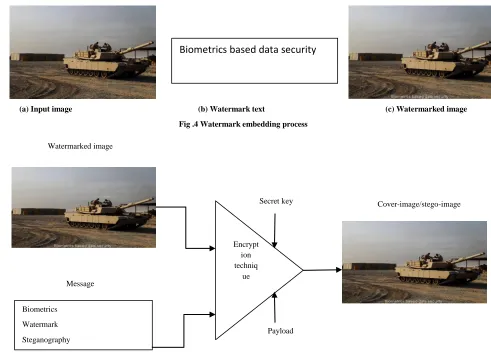
The original input image is embedded with watermark data and the resultant output image is as shown in Fig.4 (a), Fig.4 (b) and Fig.4(c) respectively.
The resultant output image returned from Fig.4 is used for data embedding process using steganography technique. The Fig.5 shows the detailed approach followed and final output image is called stego image or cover image. Similarly Fig.6 shows the data extraction process carried out on the receiver end. Finally the watermarked image and message are separated. In this experiment, we found that the size of information to be hidden relatively depends on the size of the cover-image. The message size must be smaller than the image. A large capacity allows the use of fixed size, and thus decreases the bandwidth required to transmit the stego-image.
As shown in Fig.4, the watermarked image with our proposed new fragile watermarking algorithm is less distorted then the watermarked image using the CWSA algorithm. This is mainly due to the choice of the watermarked coefficients. The original CWSA algorithm embeds the watermark data on all AC coefficients. This makes it slow, because of the large number of coefficients that need to be processed and makes the modification to the image visible. We propose to embed the watermark both on the DC and AC coefficients with a value greater than a threshold.
The project which has been developed and proposed for the future work will give raise to the new trend in the information security by using the biometric methods. We propose a new concept in the information security using biometrics which is combination of data authentication, privacy and security.
[image:4.612.70.561.345.700.2](a) Input image (b) Watermark text (c) Watermarked image
Fig .4 Watermark embedding process
Fig.5 Data embedding process
Biometrics based data security
Biometrics
Watermark
Steganography
Encrypt ion techniq
ue Watermarked image
Message
Secret key
Payload
International Journal of Emerging Technology and Advanced Engineering
Website: www.ijetae.com (ISSN 2250-2459, Volume 2, Issue 5, May 2012)361
Fig.6 Data extraction process
IV. CONCLUSION
In our proposed scheme, new fragile watermarking algorithm is used to convert the original host image into watermarked image. Then we applied steganography technique to hide the data in digital media for confidentiality of information and provide a means of communicating privately. The experiment results demonstrate that our proposed scheme protects hidden transmission of biometrics this can be used for any biometrics data e.g. fingerprint, iris, signature etc. The proposed application is used to ensure the data integrity over the images transferred on the internet.
REFERENCES
[1] A. Jain, S. Pankanti, and R. Bolle, eds., Kluwer,”BIOMETRICS:
personal identification in networked society”, 1999.
[2] B. Schneier,”The uses and abuses of biometrics”, Comm. ACM,
vol.42, no.8, pp.136, Aug, 1999.
[3] N. K. Ratha, J. H. Connell, and R. M. Bolle,”An analysis of minutia
matching strength”, Proc Third AVBPA, Halmstad, Sweden, pp.223-228, June 2001.
[4] N. F. Jonson, S. Jajodia,”Steganalysis: The investigation of Hiding Information”, IEEE, pp.113-116, 1998.
[5] S.jain, “digital Watermarking techniques: a case study in fingerprint
& face “,Pmc.ICVGIP 2000, Bangalore, India, pp.139-144, Dec.2000.
[6] N. K. Ratha, J. H. Connell, and R. M. Bolle,”Secure data hiding in wavelet compressed fingerprint images”, Proc. ACM Multimedia 2000 workshops, Los Angeles, CA. pp:127-130, 2000.
[7] M. K. Khan, J. S. Zhang, L. Tian, ”Chaotic Secure Content based Hidden Transmission of Biometric Templates”, Chaos, Solitons, Fractals, Vol.32, No.5, pp:1749 1759, 2007.
[8] Anil K J, U. Uludag, and R. L. hsu,”Hiding a face in a fingerprint image”, Proceedings of International Conference on Pattern Recognition 2002, pp: 756-759, 2007.
[9] Anil K J, U. Uludag,”Hiding Biometric Data”, IEEE Transaction on
Pattern Analysis and Machine Intelligence, Vol.25, No.11, and pp: 1494 1498, 2003.
[10]Zaho Y.,”Dual Domain Semi-Fragile watermarking for Image
Authentication”, Master Thesis, University of Toronto, 2003.
[11]Walton S.,”Information Authentication for A Slippery New Age”, Dr.Dobbs Journal, vol.20, no.4, pp.18-26, 1995.
[12]S. Li. G. Chen, X. Mou,”On the Dynamical Degradation of Digital Piecewise Linear Chaotic Maps”, International Journal of Bifurcation and Chaos, 2005.
[13]S.EI Assad, H. Noura, I. Taralova, Design and analysis of efficient chaotic generator for cryptosystems Lecture notes in IAENG Transaction on Electrical and Electronical Engineering, vol.1, 2008, 10 pag.
[14]H. Noura, S. Henaff, I. Taralova et S.EI Assad, Efficient cascaded
1-D and 2-D chaotic generators, Second IFAC Conference on Analysis and Control of Chaotic System Chas, 2009.
[15]M. Z. I. Shamsuddin,”Menggunakan Least Significant Bit:
Stegnografi”, 2002. Decryption
technique
Biometrics
Watermark
Steganography Secret key
Payload
Watermarked image
International Journal of Emerging Technology and Advanced Engineering
Website: www.ijetae.com (ISSN 2250-2459, Volume 2, Issue 5, May 2012)362
[16]Daniel Caragata, Anca Livia Radu, Safwan EI Assad ,”Fragile
Watermarking using Chaotic Sequence”, International Journal for Information Security Research (IJISR),volume 1, Issue 1, March 2011.
[17]M. M Amin, M. Salleh, S. Ibrahim, M.R.K atmin, and M.Z.I.
Shamsuddin”, National Conference on excommunication
Technology Proceedings, Shah Alam, Malaysia 0-7803-7773-7/03/$17.00 0 2003.
[18]Shumin Ding,Chunlei Liy,Ahoufeng Liu,”Protecting Hidden
Transmission of Biometrics using Authentication Watermarking”, 978-0-7695-4080, 2010.
[19]M. Iwata, K. Miyake, A. Shiozaki,”Digital watermarking method to