ISSN Online: 2160-8717 ISSN Print: 2160-8709
The Effect of Partial Removable Denture Use
on Oral Health Related Quality of Life and
Masticatory Function, after 5 Years Use
Mantshumba Milolo Augustin
1*, Duyck Joke
2, Sekele Isouradi Bourleyi
1, Lutula Pene Shenda
1,
Nyimi Bushabu Fidele
3,4, Tshombe Mulamba Van
5, Ntumba Mulumba Kanda
1, Ignace Naert
21Prosthodontics and Orthodontics Service, Affiliated Hospital of Kinshasa University, Kinshasa, DR Congo 2Department of Oral Health Sciences, Prosthetics Section, Katholieke Universiteit Leuven, Leuven, Belgium 3Department of Oral and Maxillofacial Surgery, Second Affiliated Hospital of Jiamusi University, Jiamusi, China 4Affiliated Hospital of Kinshasa University, Kinshasa, DR Congo
5Laboratory Center of Research Nuclear of Kinshasa University, Kinshasa, DR Congo
Abstract
The aim of this study was to evaluate whether partial removable denture use indeed leads to improved oral health related quality of life and masticatory function. Mate-rials and Methods: Partially edentulous patients presenting for removable denture treatment at the Prosthodontics Service in the Hospital Affiliated to Kinshasa Uni-versity (Democratic Republic of Congo) were assessed for enrolment in this study. After applying exclusion criteria, 378 patients were included in the study, and ran-domly assigned into 2 groups. Oral health related quality of life (OHIP-23) and mas-tication time (MaT), number of chewing cycles (MaC), masmas-tication frequency (MaF), and the sizes of the peanut fragments (FraS) were compared in both groups. Statisti-cal significance was set at p < 0.05. Results: The average MaC, MaT, MaF, and FraS were 119 (± SD 53.70), 86.75 (±SD 35.35), 1.38 (±SD 0.25), and 3.3 (±SD 3.25) for the denture group and 77.9 (±SD 23.9), 60.2 (±SD 17.91), 1.29 (±SD 0.15), and 1.5 (±SD 0.7) for the non-denture group, respectively. Conclusion: The overall oral health related quality of life was best in the non-denture than denture.
Keywords
Partial Removable Denture Acrylic Resin, Mastication, and Oral Health Related Quality of Life
1. Introduction
Mastication, the first step of digestion, is defined as a process by which the food placed How to cite this paper: Augustin, M.M.,
Joke, D., Bourleyi, S.I., Shenda, L.P., Fidele, N.B., Van, T.M., Kanda, N.M. and Naert, I. (2016) The Effect of Partial Removable Den- ture Use on Oral Health Related Quality of Life and Masticatory Function, after 5 Years Use. Open Journal of Stomatology, 6, 201- 210.
http://dx.doi.org/10.4236/ojst.2016.610026
Received: August 27, 2016 Accepted: October 21, 2016 Published: October 24, 2016
Copyright © 2016 by authors and Scientific Research Publishing Inc. This work is licensed under the Creative Commons Attribution International License (CC BY 4.0).
in the mouth is mechanically modified to make it suitable for swallowing [1]. The teeth are essential for grinding food and to prepare the food bolus for digestion, the tooth loss leads to impair mastication function [2] and sufficient antagonistic tooth contact is required to chew food [3].
In early days, there was a tendency to replace all missing teeth [4]; however, it’s gen-erally accepted that it is not required to replace all teeth to restore oral function. The shortened denture arch concept is well documented since its introduction by Kayser A.F. et al., Gotfredsen K. et al., Kanno T. et al., twelve anterior teeth and eight posterior teeth are necessary and sufficient to ensure the mandibular stability required for a good mastication provided that the teeth are effective [5] [6] [7]. A study of Gerritsen, Witter
et al. indicates that a shortened dental arch is a sustainable solution for partially
eden-tulous patients, as they report that 87% of the patients with shortness dental arcade (SDA) were still in the same condition after more time than 40 years of function [8].
All oral diseases, which affect the number, structure and position of the teeth are supposed to have an impact on the quality of life, on the mastication and consequently on the nutrition [9][10]. Replacing lost teeth by means of a removable denture is ex-pected to improve mastication and thereby nutrition. The other authors indeed found an improved ability to reduce the bolus particle size when using partial removable den-ture, although the masticatory function and the teeth’s sensory function [11] could not be re-established completely. Also applies to other studies, however, indicate that oral rehabilitation by means of partial denture does not lead to improved energy and nutri-ent intake [12] [13]. These results attenuate the association of mastication with food and/or nutritional intake and indicate that mastication alone cannot explain food and/or nutrient intake. If food choice was exclusively influenced by impaired mastica-tion, the provision of dentures to partially edentulous persons would improve their diet. However, intervention studies have not shown any significant effects even after the provision of new prosthesis. It is assumed that oral health, particularly masticatory function, may contribute to the food selection of elderly people.
One of the main objectives of the oral rehabilitation with acrylic partial removable denture is to improve the masticatory function by replacing the missing teeth [14]. Be-sides the uncertainty about its effect on oral function, partial denture treatment also holds risks for the remaining dentition. The recent study of Jepson N.J et al. showed that, removable partial dentures (RPDs) have the potential to negatively impact differ-ent aspects of oral health [15]. Furthermore, there are very few studies [16] that have investigated whether the RPDs have any impact on general health. From the limited li-terature available, it appears that RPDs can possibly improve quality of life, and this is relevant in the era of patient-centered care.
The aim of this study was therefore to evaluate the effect of partial removable denture treatment on oral health related quality of life and masticatory function after 5 years of function.
2. Materials and Methods
It’s an interventional prospective study of all partially edentulous patients (except pa-tients with class 4 of Kennedy) presenting for removable denture treatment at the Prosthodontics Service in the Hospital Affiliated to Kinshasa University, Democratic Republic of Congo between May 2008 to August 2008, were assessed in this study. Cri-teria for exclusion were joint diseases (n = 22), hematological diseases (n = 3), allergies (n = 19), current or history of chemotherapy and radiotherapy (n = 1), on a special diet prescribed by a physician (n = 17), a DPSI equal to or above 2 after oral hygiene in-structions (n = 20), carious or infection of endodontic teeth (n = 25), and unwilling to participate in the study due to refusal to be without prosthesis when selected to be in the non-denture group. After this applying exclusion criteria and after receiving oral hygiene instructions and providing informed consent, 379 patients (between 19 to 89 years old) were included in the study. They were randomly assigned into 2 groups. One group of patients received a removable acrylic denture (denture group, n = 189) than the other group did not (non-denture group, n = 189). After five years of function, 138 patients were still in the study (60 for the denture group and 78 for the non-denture group). 241 participants lost to follow-up: dropped out because they moved to another town (n = 24), because they did not respond to the recall invitation (n = 181), because of a changed oral status (n = 24), and due to death (n = 12). It was after informed con-sent of patients and obtained an ethical committee from the School of health of medi-cine faculty of Kinshasa University number ESP/CE/018 bis/2009 du 09 Jun 2009 that the study started [19].
2.1. Oral Health Related Quality of Life
Oral health related quality of life was evaluated using the OHIP-23 [20] [21] and adapted on the African context. Each question had to be answered by yes or no, de-pending on whether the participants was satisfied (outcome = 1) or dissatisfied (out-come = 0) about a specific aspect of his or her oral health related quality of life. The overall oral health related quality of life per participant was represented by the sum of the outcomes of the individual questions. The questions are similar for both groups, although the formulation of the questions was according to the participants’ oral condi-tion (wearing a denture or not).
2.2. Masticatory Function
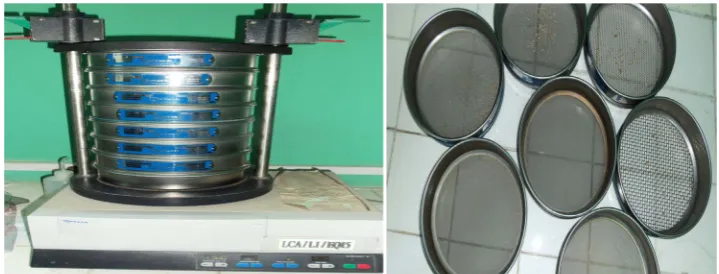
evaluation of kinetic parameters of the mastication, also the time of each sequence of chewing. A stopwatch and the number of cycles was counted by two independent in-vestigators. Instead of swallowing, the participants were asked to spit the chewed pea-nuts in a cup and the participants were asked to rinse with water several times to clear the mouth. Also the rinsing water was collected in the cup. The sizes of the peanut fragments (FraS) were measured in mm and used to evaluate mastication efficacy. Par-ticle size analyses were performed at the central laboratory of nuclear research of Kin-shasa University. The crushed food or homogenates was separated from the super-natant and was left in the open air for dissecation in 48 hours before the sifting. The homogenates were passed through a decreasing sieve mesh column 5.6 mm, 4 mm, 2 mm, 1 mm, 0.5 mm, 0.25 mm and 0.125 mm (Retsh AS 200, Retsh GmbH, Haan, Ger-many) (Figure 1). The homogenates were sifted in the laboratory under vibrator that was adjusted so standardized to its maximum power for a period of one minute.
After each sifting, the content of each sieve was weighed with an analytical balance (Sartorius model CPA225D, Sartorius GmbH, Goettingen, Germany), with a sensitivity of 0.00001 g.
The outcome variables of OHIP, MaT, MaC, MaF, and FraS in the denture and non- denture group were compared using ANOVA (SPSS 20.0, Inc, and Chicago, IL, U.S.A). Statistical significance was set at p < 0.05.
3. Results
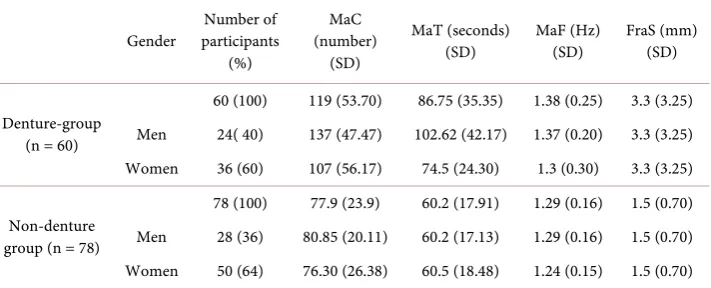
[image:4.595.193.553.548.685.2]The average age in this study in denture group and no-denture-group was 53.15 ± 22.05 and 31.59 ± 11.98 years. Women have been more participated than the men in both groups with respectively 36 (60%) and 50 (64%) (Table 1). In the denture and the non-denture group, 24 and 21 patients had a Kennedy Class 1 edentulism, 12 and 18 patients had a Kennedy Class 2 edentulism, and 24 and 39 patients had a Kennedy Class III edentulism respectively. The result from OHIP-23 variable showed that the partici-pants enrolled in the non-denture-group were most satisfied on the oral health related quality of life than the denture-group by affected appearance, respiration, the bad taste, taking food, having pain in jaw, eating pain, dental pain and anxiety. However, there are some non-significant differences between these two groups for the appearance (p =
Table 1. Masticatory parameters according to gender in both groups.
Gender participants Number of (%)
MaC (number)
(SD)
MaT (seconds)
(SD) MaF (Hz) (SD) FraS (mm) (SD)
Denture-group (n = 60)
60 (100) 119 (53.70) 86.75 (35.35) 1.38 (0.25) 3.3 (3.25) Men 24( 40) 137 (47.47) 102.62 (42.17) 1.37 (0.20) 3.3 (3.25) Women 36 (60) 107 (56.17) 74.5 (24.30) 1.3 (0.30) 3.3 (3.25)
Non-denture group (n = 78)
78 (100) 77.9 (23.9) 60.2 (17.91) 1.29 (0.16) 1.5 (0.70) Men 28 (36) 80.85 (20.11) 60.2 (17.13) 1.29 (0.16) 1.5 (0.70) Women 50 (64) 76.30 (26.38) 60.5 (18.48) 1.24 (0.15) 1.5 (0.70) Legend: MaC = number of mastication cycles, MaT = mastication time, MaF = mastication frequency, and FraS = peanut fragment size in mm.
0.3), bad taste (p = 0.3), pain during the dinner (p = 0.4), anxiety or unrest (p = 0.1), physical disability with diminished taste (p = 0.3), dental brushing (p = 0.3), avoid to eat (p = 0.2), diet (p = 0.3), not easy at repast (p = 0.3) and p = 0.2 for avoid to laugh (Table 2).
Mastication Kinetics
The masticatory cycle of denture-group was higher compared by non-denture-group, the same to gender variable with 137 ± 47.47 and 107 ± 56.17, against 80.85 ± 20.11 and 76.30 ± 26.38 for the non-denture-group respectively. But in the non-denture group, the mastication time for women was longer than men (Table 1).
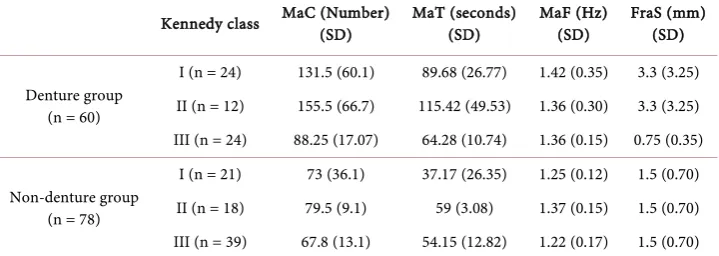
Table 3 showed that, the distribution of MaC, MaT, MaF, and FraS were increased in denture than non-denture. The increasing distribution of MaC in both group was de-pending to the number of occluding pairs, but FraS was not dede-pending on the number of occluding pairs in denture than non-denture group. The average FraS was signifi-cantly lower for the denture 3.3 (±SD 3.25) compared to the non-denture group 1.5 (±SD 0.70) mm, (p = 0.02). These changes were independent of gender, age, occluding pairs. On Kennedy classification; only the class 3 of Kennedy showed a masticatory ef-ficiency by giving small fragments size with 0.75 (±SD 0.35 mm) (Table 4).
4. Discussions
The aim of this study was to evaluate whether partial removable denture use indeed leads to improved oral health related quality of life and masticatory function. The pre-sent study found that the oral health related quality of life was best in the non-denture- group than the denture-group (p = 0.00).
Table 2. Oral health impact profile (OHIP).
ITEMS-OHIP-23
Denture-group (n = 60) Non denture-group (n = 78)
p value Insatisfaction
(%) Satisfaction (%) Insatisfaction (%) Satisfaction (%)
1. Functional limitation
Mastication 24 (40) 36 (60) 25 (32) 53 (68) 0.06 Bad pronounciation 36 (60) 24 (40) 51 (65) 27 (35) 0.03 Affected appearence 29 (49) 31 (52) 30 (38) 48 (62) 0.3
Respiration 17 (28) 43 (72) 17 (22) 61 (78) 0.01 Bad taste 27 (45) 33 (55) 16 (25) 49 (75) 0.3 Affected food intake 14 (23) 46 (77) 25 (32) 53 (68) 0.01 Difficult adaptation 17 (28) 43 (72) 48 (62) 30 (38) 0.01
2. Physical pain
Pain in the jaw 23 (38) 37 (62) 62 (79) 16 (21) 0.01 Dental sensibility 37 (57) 26 (43) 48 (62) 30 (38) 0.01 Dental pain 36 (60) 24 (40) 49 (63) 29 (37) 0.04 Pain during the dinner 25 (41) 35 (59) 41 (53) 37 (47) 0.4 3. Psychological discomfort
Anxiety/unrest 20 (33) 40 (67) 34 (44) 44 (56) 0.1 Disquiet/miserable unhappy 20 (33) 40 (67) 29 (37) 49 (63) 0.02
Esthetic 23 (38) 37 (62) 20 (26) 58 (74) 0.05 4. Physical inability
Unclear speech 17 (28) 43 (72) 7 (9) 71 (91) 0.01 Diminished taste 33 (55) 27 (45) 31 (40) 47 (60) 0.3
Dental brushing 31 (52) 29 (48) 18 (23) 60 (77) 0.3 Food avoidance 34 (57) 26 (43) 35 (45) 53 (55) 0.2 Poor diet 37 (62) 23 (38) 45 (58) 33 (42) 0.3 Not easy at eaten 28 (47) 32 (53) 31 (40) 47 (60) 0.3 Avoid to laugh 37 (62) 23 (38) 41 (53) 37 (47) 0.2 Lack of appetite 39 (65) 21 (35) 20 (26) 58 (74) 0.01 5. Discomfort psychological
Stomach upset 50 (83) 10 (17) 62 (79) 16 (21) 0.01
According to [23], the number of pair occluding or functional dental unit plays a very important role in the conservation of the masticatory performance of patients with partial removable denture.
Table 3. Masticatory parameters according to pairs occluding in both groups.
Occluding pairs MaT (number) (SD) MaT (seconds) (SD) MaF (Hz) (SD) FraS (mm) (SD)
457 119 (52.34) 84 (34.87) 1.38 (0.25) 3.3 (3.25)
Denture-group (n = 60)
0 - 2 156.20 (54.08) 111.17 (35.68) 1.42 (0.34) 3.3 (3.25) 3 - 5 88.5 (22.62) 65.63 (13.76) 1.34 (0.14) 3.3 (3.25) 6 - 8 83 (17.76) 60 (8.26) 1.37 (0.11) 3.3 (3.25) 390 77.9 (23.9) 60.2 (17.91) 1.29 (0.15) 1.5 (0.70)
Non-denture-group (n=78)
0 - 2 100 (33.29) 82.8 (23.91) 1.19 (0.08) 1.5 (0.70) 3 - 5 77 (11.16) 58.8 (11.21) 1.32 (0.08) 1.5 (0.70) 6 - 8 64.18 (9.08) 51.63 (9.33) 1.26 (0.18) 1.5 (0.70)
Table 4. Distribution of masticatory parameters in different class of Kennedy.
Kennedy class MaC (Number) (SD) MaT (seconds) (SD) MaF (Hz) (SD) FraS (mm) (SD)
Denture group (n = 60)
I (n = 24) 131.5 (60.1) 89.68 (26.77) 1.42 (0.35) 3.3 (3.25) II (n = 12) 155.5 (66.7) 115.42 (49.53) 1.36 (0.30) 3.3 (3.25) III (n = 24) 88.25 (17.07) 64.28 (10.74) 1.36 (0.15) 0.75 (0.35)
Non-denture group (n = 78)
I (n = 21) 73 (36.1) 37.17 (26.35) 1.25 (0.12) 1.5 (0.70) II (n = 18) 79.5 (9.1) 59 (3.08) 1.37 (0.15) 1.5 (0.70) III (n = 39) 67.8 (13.1) 54.15 (12.82) 1.22 (0.17) 1.5 (0.70)
that the participants in the denture-group having at least two functional units had a good masticatory performance than the non-denture-group (Table 3). These results are also likewise with the studies of others authors. However, Tsakos G. et al. have reported that the number of occluding pairs is more related to the quality of oral health as the number of natural teeth [24]. In contrary, it was found by Sheiham A. et al. that it was difficult to establish a relationship between intake of nutrients and the number and dis-tribution of teeth in people over 20 natural teeth [25]. They concluded that, the intake of dietary fiber was higher in people with more teeth and significantly associated with the number of occluding pairs. But, it’s also been demonstrated by other authors that, the number of occluding pairs units controls the masticatory efficacy [10] [17] [26], which is similar to our results. With gender, a significant difference was found between two groups (p = 0.02 and p < 0.00), and men had much higher mastication perfor-mance than women (Table 1). These results are similar to those observed in previous studies [27][28], who reported that the men have higher index efficacy than women.
[image:7.595.194.554.292.420.2]within the same group of participants. This study shows that the patients in the den-ture-group work an average of 119.05 ± 53.70 cycles before swallowing (Table 3). This variability is also observed in the non-denture-group. The increase in the number of cycles thus appears to be a compensatory mechanism of the mastication disability. These results are similar to those [10][11][16] [29]. The variations of the number of cycles can be explained by intrinsic and extrinsic factors. So, depending on the perso-nality, environment and circumstance.
The frequency of mastication in the denture-group was conducted an average of 1.38 (±SD 0.25) Hertz and with 1.29 (±SD 0.15) Hertz for the non-denture-group (Table 1). The incidence of mastication was higher in the denture-group. Those results are similar to the studies of Bessadet M et al. and study of Sanchez-Ayala Aetal [10][30].
Hope to have a larger size of sample and from different regions than used in this study and the changes addresses and telephone numbers of patients, and a few deaths cases were among the limitations of our work.
5. Conclusion
There are significant differences in oral health related quality of life between the den-ture and the non-denden-ture group. The overall oral health related quality of life was satis-fied in the non-denture than denture. Denture wearing participant displayed signifi-cantly more mastication cycles and needed more mastication time, which resulted in significantly smaller peanut fragment sizes compared to the non-denture wearing par-ticipants.
Acknowledgements
The authors would like to thank Pr. Dr. Fons Verdonck, Frans Vinckier, Mvumvi Le lo and Dr. Phillippe Vuylesteke from KU Leuven University and from Kinshasa Universi-ty for their relevant scientific contribution and financial.
Conflict of Interest
The authors confirm that this article content has no conflict of interest.
References
[1] Azerad, J. (1992) Physiologie de la manducation. 1ère Edition, 1-116.
[2] Barbato, P.R. and Peres, M.A. (2009) Tooth Loss and Associated Factors in Adolescents: A Brazilian Population-Based Oral Health Survey. Revista de Saúde Pública, 43, 13-25. [3] Van Der Bilt, A. (2011) Assessment of Mastication with Implications for Oral Rehabilita-
tion. Review. Journal of Oral Rehabilitation, 38, 754-780.
http://dx.doi.org/10.1111/j.1365-2842.2010.02197.x
[4] Levin, B. (1974) Editorial: The 28-Tooth Syndrome or Should All Teeth Be Replaced? Den-tal Survey, 50, 47.
[6] Gotfredsen, K. and Walls, A.W. (2007) What Dentition Assures Oral Function? Clinical Oral Implants Research, 18, 34-45. http://dx.doi.org/10.1111/j.1600-0501.2007.01436.x
[7] Kanno, T. and Carlsson, G.E. (2006) A Review of the Shortened Dental Arch Concept Fo-cusing on the Work by the Kayser/Nijmegen Group. Journal of Oral Rehabilitation, 33, 850-862. http://dx.doi.org/10.1111/j.1365-2842.2006.01625.x
[8] Gerritsen, A.E., Witter, D.J., Bronkhorst, E.M. and Creugers, N.H. (2013) Increased Risk for Premolar Tooth Loss in Shortened Dental Arches. Journal of Dentistry, 41, 726-731.
http://dx.doi.org/10.1016/j.jdent.2013.05.013
[9] Ikebe, K., Hazeyama, T., Kagawa, R., Matsuda, K. and Maeda, Y. (2010) Maeda Subjective Values of Different Treatments for Missing Molars in Older Japanese. Journal of Oral Re-habilitation, 37, 892-899. http://dx.doi.org/10.1111/j.1365-2842.2010.02123.x
[10] Bessadet, M., Nicolas, E., Sochat, M., Hennequin, M. and Veyrune, J.L. (2013) Impact of Removable Partial Denture Prosthesis on Chewing Efficiency. Journal of Applied Oral Sci- ence, 21, 392-396.
[11] Mishellany, A., Woda, A., Labas, R. and Peyron, M.A. (2006) The Challenge of Mastication: Preparing a Bolus Suitable for Deglutition. Dysphagia, 21, 87-94.
http://dx.doi.org/10.1007/s00455-006-9014-y
[12] Moynihan, P., Thomson, M., Walls, A., et al. (2009) Researching the Impact of Oral Health and Diet and Nutritional Status: Methological Issues. Journal of Dentistry, 37, 237-249.
http://dx.doi.org/10.1016/j.jdent.2008.12.003
[13] Gunji, A., Kimoto, S., Koide, H., Murakami, H., Matsumaru, Y., Kimoto, K., et al. (2009) Investigation on How Renewal of Complete Dentures Impact on Dietary and Nutrient Adequacy in Edentulous Patients. Journal of Prosthodontic Research, 53, 180-184.
http://dx.doi.org/10.1016/j.jpor.2009.06.001
[14] Kumpanya, P.N., Mantshumba, M.A., Sekele, I.B., Mayunga, M., Lutula, P.S. and Ntumba, M.K. (2015) Syndrome ectodermique de cap de pont et réhabilitation orale prothétique. A propos d’un cas clinique. Odonto-Stomatologie Tropicale, 38, 43-45.
[15] Jepson, N.J., Moynihan, P.J., Kelly, P.J., Watson, G.W. and Thomason, J.M. (2001) Caries Incidence Following Restoration of Shortened Lower Dental Arches in a Randomized Con-trolled Trial. British Dental Journal, 191, 140-144.
[16] Liang, S., Zhang, Q., Witter, D.J., Wang, Y. and Greugers, N.H.J. (2015) Effects of Remova- ble Dental Prostheses on Masticatory Performance of Subjects with Shortened Dental Arches: A Systematic Review. Journal of Dentistry, 43, 1185-1194.
http://dx.doi.org/10.1016/j.jdent.2015.05.008
[17] Veyrune, J.L., Tubert-Jeannin, S., Dutheil, C. and Riordan, P.J. (2005) Impact of New Pros- theses on the Oral Health Related Quality of Life of Edentulous Patients. Gerodontology, 22, 3-9. http://dx.doi.org/10.1111/j.1741-2358.2004.00048.x
[18] Sekele, I.B., et al. (2016) Influence de la Prothèse amovible Partielle en résine acrylique sur la santé bucco-dentaire et la qualité de vie. Odonto-Stomatologie Tropicale, 39, 36-45. [19] Mantshumba, M.A., Duyck, J., Sekele, I.B., Lutula, P.S., Nyimi, B.F., Bile, B.G., Sofi, N.P.,
Kalala, E.K., Ekofo, I.E., Kumpanya, N.P., Mayunga, M., Ntumba, M.K. and Naert, I. (2016) Risks Factors of Caries and Periodontal Diseases in Patients, after 5 Years Use a Partial Removable Denture. Open Journal of Stomatology, 6, 185-192.
http://dx.doi.org/10.4236/ojst.2016.68024
[21] Yengopal W, Naidoo S. (2008) Do Oral Lesions Associated with HIV Affect Quality of Life?
Oral Surgery, Oral Medicine, Oral Pathology, Oral Radiology and Endodontics, 106, 66-73.
http://dx.doi.org/10.1016/j.tripleo.2007.12.024
[22] Lahti, S., Suominen, T. and Hausen, H. (2008) Oral Health Impacts among Adults in Fin-land: Competing Effects of Age, Number of Teeth, and Removable Dentures. European Journal of Oral Sciences, 116, 260-266. http://dx.doi.org/10.1111/j.1600-0722.2008.00540.x
[23] Yamashita, S., Sakai, S., Hatch, J.P. and Rugh, D. (2000) Relationship between Oral Func-tion and Occlusal Support in Denture Wearers. Journal of Oral Rehabilitation, 27, 881-886. [24] Tsakos, G., Marcenes, W. and Sheiham, A. (2004) The Relationship between Clinical Dental
Status and Oral Impacts in an Elderly Population. Oral Health & Preventive Dentistry, 2, 211-220.
[25] Sheiham, A. and Steele, J. (2001) Does the Condition of the Mouth and Teeth Affect the Ability to Eat Certain Foods, Nutrient and Dietary Intake and Nutritional Status amongst Older People?Public Health Nutrition, 4, 797-803. http://dx.doi.org/10.1079/PHN2000116
[26] Decerle, N., Nicolas, E. and Hennequin, M. (2013) Chewing Deficiencies in Adults with Multiple Untreated Carious Lesions. Caries Research, 47, 330-337.
http://dx.doi.org/10.1159/000348397
[27] Witter, D.J., Cramwinckel, A.B., Van Rossum, G.M. and Kayser, A.F. (1990) Shortened Dental Arches and Masticatory Ability. Journal of Dentistry, 18, 185-189.
http://dx.doi.org/10.1016/0300-5712(90)90107-P
[28] Akeel, R., Nilner, M. and Nilner, K. (1992) Masticatory Efficiency in Individuals with Nat-ural Dentition. Swedish Dental Journal, 16, 191-198.
[29] Ueda, T., Sakurai, K. and Sugiyama, T. (2006) Individual Difference in the Number of Chewing Strokes and Its Determinant Factors. Journal of Oral Rehabilitation, 33, 85-93.
http://dx.doi.org/10.1111/j.1365-2842.2006.01537.x
[30] Sanchez-Ayala, A., Farias-Neto, A., Campanha, N.H.,Matheus, R.C. and Garcia, R. (2013) Relationship between Chewing Rate and Masticatory Performance. The Journal of Cranio- mandibular & Sleep Practice, 31, 118-122. http://dx.doi.org/10.1179/crn.2013.019
Submit or recommend next manuscript to SCIRP and we will provide best service for you:
Accepting pre-submission inquiries through Email, Facebook, LinkedIn, Twitter, etc. A wide selection of journals (inclusive of 9 subjects, more than 200 journals)
Providing 24-hour high-quality service User-friendly online submission system Fair and swift peer-review system
Efficient typesetting and proofreading procedure
Display of the result of downloads and visits, as well as the number of cited articles Maximum dissemination of your research work