Effects of Hub Profiles on Efficiency and Flow of Jet Fan
with Single Stage Impeller
Shinpei Kametaka, Daichi Deki, Toshiaki Kanemoto, Ryunosuke Kawashima Faculty of Engineering, Kyushu Institute of Technology, Kitakyushu, Japan
Email: [email protected]
Received January 14, 2013; revised February 15, 2013; accepted February 22, 2013
Copyright © 2013 Shinpei Kametaka et al. This is an open access article distributed under the Creative Commons Attribution Li-cense, which permits unrestricted use, distribution, and reproduction in any medium, provided the original work is properly cited.
ABSTRACT
The traditional jet fans have equipped with the tandem impellers and the exclusive motors, and such designs are asso- ciated with the expensive initial cost. This serial research proposes how to simplify the fan profile for reducing the ini-tial cost without the performance deteriorations. The paper discusses the effects of the hub profiles installed in the tradi- tional/commercial jet fan, on the performances in the several type single-stage work. The hub with the long tail corn gives the best efficiency, and not only the stay vanes but also the cooling fins deteriorate more or less the performances, accompanying the impeller works as follows. The efficiency at the reverse rotation of the original impeller, namely at the flow condition running from the outlet to the inlet, is doubtlessly lower than one at the original rotation. The unique cascade, where the leading and the trailing edges of the blade are alternated in the tangential direction, was prepared in anticipation of improving the performances. These results advise the desirable profile of the jet fan equipped with the single-stage impeller, and the numerical simulation provides the optimum blade profile for the bidirectional flow.
Keywords: Jet Fan; Bidirectional Flow; Impeller; Initial Cost; Performance
1. Introduction
The jet fan installed in the driveway tunnel is required to exhaust the injurious gasses in the bi-directions, namely the inlet and/or the outlet, at the emergency such as fires, traffic accidents and so on. Then, the traditional jet fan is generally equipped with the two-stage impellers which are effective to one direction, and each impeller is driven by the exclusive and particular motor. The impeller pro- files have been optimized by many researchers and engi- neers [1-4], but above assemblages make not only the dimensions large but also the initial cost expensive.
To overcome such weak points, this serial research proposes how to simplify the jet fan profile for reducing the initial cost without the performance deteriorations as possible. This paper discusses the effect of the hub pro- files, installed in the traditional/commercial jet fan, on the performances, while the several type impellers are in the single-stage work.
2. Model Jet Fan and Experiments
2.1. Model Jet Fan
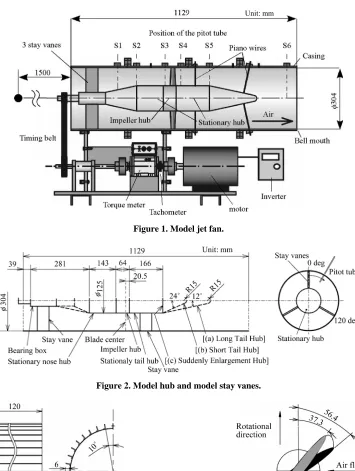
Figure 1 shows the model jet fan where the length of the
casing is 1.129 m, the duct diameter is 0.304 m with the
hub ratio 0.41. The model jet fan was designed so as to meet the downsized dimensions of the standardized jet fan with the bore 1.025 m [5]. The motor is, however, set on the outside of the casing and drives the single impeller through the pulley system with the torque meter and the tachometer because the large sized motor was provided for the experiments. The rotational speed of the impeller was kept constant at 1700 min−1 by the inverter control.
The flow is measured with the 3-holes pitot tube as the steady state conditions, at the Sections S1-S6 shown in
Figure 1.
Three kinds of hub and stay vanes are prepared, the profiles and position of are shown in Figure 2, which
have (a) the long tail corn with the half convergent angle 12 degrees (Long Tail Hub), (b) the short tail corn with the angle 24 degrees (Short Tail Hub) and (c) have not the tail corn (Suddenly Enlargement Hub). The cylindri- cal hub with the tail corn is supported by the three thin piano wires at two positions. Figure 3 shows the air-
Unit: mm
[image:2.595.119.474.79.550.2]Figure 1. Model jet fan.
Figure 2. Model hub and model stay vanes.
Figure 3. Model air-cooling fin.
[image:2.595.348.499.479.598.2]2.2. Impeller Profiles
Figure 4 shows the original blade profile of the model
impeller composed of 8 blades with the tip diameter 0.302 m, which is appropriated from the traditional/ commercial jet fan with the tandem impellers. The blade element has no camber but is twisted to make the swirl- ing velocity component constant in the radial direction. Three kinds of the impellers/cascades were prepared in
Figure 4. Original blade profiles.
the experiments, as shown in Figure 5. These are called
(a) “Original Type Impeller” taking Figure 4 as it is, (b)
“Alternate Type Impeller” where the leading and the trailing edge positions of the original blade are alternated in the tangential direction, and (c) “Reverse Type Impel- ler” reversing Original Type Impeller. The blade setting angle were also adjusted between ±7 degrees from the normal dimensions given in Figures 4 and 5 (the
Rotational direction
Rotational direction
Rotational direction
[image:3.595.101.486.80.212.2](a) (b) (c)
Figure 5. Impeller profiles. (a) Original type impeller; (b) Alternate type impeller; (c) Reverse type impeller.
in the clockwise).
[image:3.595.325.520.240.437.2]3. Effects of Impeller Profile
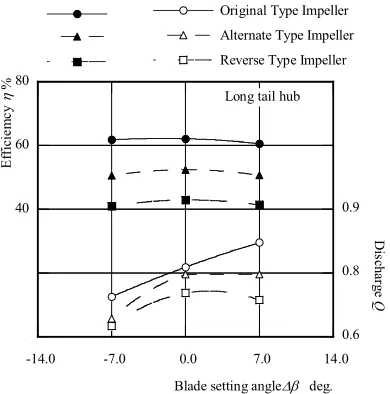
Figure 6 shows effects of the blade setting angle on the
fan efficiency with Long Tail Hub, where η is the jet fan efficiency [=QΔPT/L, Q: the discharge, ΔPT: the
differ-ence of total pressure between Sections S1 and S6, L: the shaft power]. Original Type Impeller takes the maximum efficiency, and the efficiency of Alternate Type Impeller is between those of Original and Reverse Type Impellers. Besides, the impellers with the normal dimension, Δβ = 0 degree, have the maximum efficiency regardless of the impeller types.
To know the acoustic noise from the model jet fan, the microphone of the sound-level meter was set at 1.5 m front of the inlet on the centerline of the shaft as shown in Figure 1. The measured data was accumulated mo-
mentarily in the computer and the characteristics were processed by the FFT analyzer. The level and the fre- quency of the acoustic noise were evaluated without the background noises emitted from the motor, pulley system and the ambient circumstances. To normalize these noises, the specific sound level LSA [=SPL – 10log
+ 20] is shown in Figure 7. The increase of the
blade adjusting angle, namely the impeller giving the higher head and/or discharge, has the acceptable effect to suppress comparatively the noise. Reverse Type Impeller generates the higher noise than the other type impellers, because not only the cusp leading edge causes the stall on the large scale but also the blunt trailing edge brings markedly the velocity defect. Alternate Type Impeller can reduce the effects of the stall at the leading edge and the wake flow from the trailing edge, but the noise is unfortunately larger than Original Type Impeller, as it is.
2T Q P
Figure 8 shows the effects of the hub profiles on the
jet fan efficiency η at Δβ = 0. The efficiency is better with the moderate increase of the tail corn length. It can hardly ask the suddenly enlargement hub to take the high efficiency.
Figure 9 shows the specific sound level LSA derived
0 20 40 60 80
0.6 0.8 0.9 1.0 1.2
-14.0 -7.0 0.0 7.0 14.0
Original Type Impeller Alternate Type Impeller Reverse Type Impeller
Di
sc
ha
rg
e
Q
E
ff
ic
iem
cy
from Figure 8. The level seems to be in counter propor-
%
[image:3.595.321.523.476.673.2]Blade setting angle deg. Long tail hub
Figure 6. Effect of the impeller profiles on the jet fan effi-ciency and discharge.
48 50 52 54 56
-14.0 -7.0 0.0 7.0 14.0
Original Type Impeller Alternate Type Impeller Reverse Type Impeller
S
pe
cif
ic
s
oun
d
le
ve
l
L SA
dB
(A
)
Blade setting angle deg. Long tail hub
Figure 7. Effect of the impeller profiles on the specific
on to the efficiency in Figure 8, as the flow separation
sound level.
ti
30 40 50 60 70 80
= 0 deg.
Original Type Impeller Alternate Type Impeller Reverse Type Impeller
Long Tail Hub Short Tail Hub Suddenly Enlargement Hub Ef fi ci en cy %
Figure 8. Effect of the hub profiles on the fan efficiency.
48 50 52 54 56
Original Type Impeller Alternate Type Impeller Reverse Type Impeller = 0 deg.
Long Tail Hub Short Tail Hub Suddenly Enlargement Hub
Sp ec ific so un d le ve l LSA dB (A )
Figure 9. Effect of the hub profiles on the specific.
nd promotes the noise.
4. Effects of Air-Cooling Fan and Vanes
near
tay vanes as shown in Figure 2,
w
5. Modification of Blade Profile
on trial with the numeri-
Fin Tail Hub Long Tail Hub Short EnlSuddenly ub
a
The air-cooling fin may work partly to turn the flow the hub wall to the axial direction as if the guide vane, but such an effect is tiny. Table 1 shows the effects of
the air-cooling fin on the jet fan efficiency η and the spe-cific sound level LSA at Δβ = 0. The fin scarcely
deterio-rates the efficiency but makes the specific sound level increase more or less.
The effects of the s
hich are the flat plates with rounded leading and trail- ing edges, on and LSAare shown in Table 2 while Δβ =
0 with Long Tail Hub. The stay vane causes the separa- tion on the large scale at the leading edge and disturbs the flow discharged from the impeller. Then, it is desir- able to equip with the cambered vanes or the slender bodies like circular cylinders in place of the flat plates.
5.1. Numerical Simulation
The blade profile was modified
Table 1. Effect of the air-cooling fin on jet fan perform-ances. argement H without Jet fan ef without Specific sound
62.1 58.5 38.7
ficiency
η[%] with 62 58.2 38.4
49.8 50.8 50.5
level LSA
[dB(A)] with 50.6 51.2 51.6
Table 2. Effect of the stay vane on jet fan performances.
SA ]
Stay Jet fan efficiency η[%] Specific sound level L [dB(A)
with 55.6 52.1
without 65.3 52
al simulations by the commercial CFD code of AN-
5.2. Flow Conditions around Original Impeller
s
5.3. Blade Profile Suitable for Bi-directions
ed to c
SYS-CFX ver.12 with SST turbulent model, to provide the single stage impeller for the bidirectional type jet fan. The domain of the simulation is shown in Figure 10. The
domain was divided into the rotational domain with the impeller, upstream and downstream stationary domains. The number of grid is about 800,000 for the rotating do- main and about 800,000 for the stationary domains. These domains were connected with the frozen-rotor in- terface, while the boundary conditions are at the inlet and the constant static pressure at the outlet.
Figure 11 shows the axial VA and the swirling velocitie V at Sections S3 and S4, where the velocities are di-
vided by the impeller tip speed uT, R is the dimensionless
radius with Long Tail Hub divided by the duct diameter. The commercial CFD code may simulate the flow around the impeller. Table 3 shows the fan efficiency and the
average axial flow velocity VAM (divided by uT) at Sec-
tion S6. The predicted results are in agreement with the experimental results.
The blade suitable for the bi-direction was design get the axial velocity VAM as the same as VAM of Original
Type Impeller at the same rotational speed, with the aid of the numerical simulation whose reliability was veri- fied above, and shown in Figure 12 (call Modified Im-
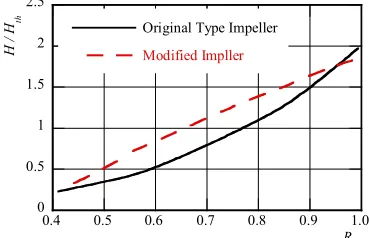
peller). The blade has no camber and the same profile at the leading and the tailing edges. Figure 13 shows the
partial head H in the radial direction in comparison with
H of Original Type Impeller, where Hth is the theoretical
(a)
[image:5.595.89.258.85.299.2](b)
Figure 10. Domains of numerical simulation. (a) Single impeller; (b) Tandem impeller.
-0.4 -0.2 0 0.2 0.4 0.6
-0.2 0 0.2 0.4 0.6 0.8
0.2 0.4 0.6 0.8 1
Exp. CFD
V
V
R
Hub at Section S3
Section 3
= 0 deg.
Swiling velocity Meridian velocity
Original Type Impeller
(a)
-0.4 -0.2 0 0.2 0.4 0.6
-0.2 0 0.2 0.4 0.6 0.8
0.2 0.4 0.6 0.8 1
Exp. CFD
V
V
R
Section 4 Swiling velocity Meridian velocity
Original Type Impeller
= 0 deg. Hub at Section S4
(b)
Figure 11. Flow conditions. locity distribution at Sec-
city at
Sec-Average axial flow velocity VAM Efficiency η[%]
(a) Ve
[image:5.595.307.538.108.300.2]tion S3; (b) Velocity distribution at Section S4.
Table 3. Efficiency and average axial flow velo tion S6.
E . xp 0.41 65.26
[image:5.595.96.250.333.707.2]CFD 0.36 66.2
Figure 12. Optimized blade profile suitable for the bidirec- tional flows.
0 0.5 1 1.5 2 2.5
0.4 0.5 0.6 0.7 0.8 0.9 1.0
Original Type Impeller
Modified Impller
H /
Hth
R
Figure 13. Partial head in the radial direction.
20 30 40 50 60
-10 -5
0 2.5 v AM
m/s
1500 1800 2100 2400 Rotational speed min-1 Tandem impeller
(Original blade = 0 deg)
Modified Impeller
Figure 14. Effect of the blade profiles on the average axial
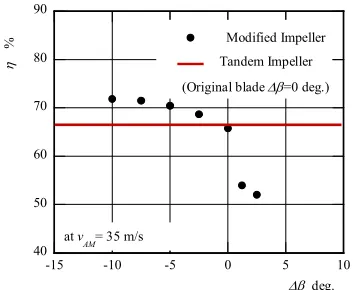
ow the effects of the blade adjusting angle Δβ on the
velocity VAM.
sh
average axial velocity VAM and the fan efficiency η, in
[image:5.595.330.515.343.462.2] [image:5.595.342.503.493.645.2]40 50 60 70 80 90
Modified Impeller
-15 -10 -5 0 5 10
%
deg. Tandem Impeller
(Original blade =0 deg.)
at v
[image:6.595.83.260.84.229.2]AM= 35 m/s
Figure 15. Effect of the blade profiles on the effici cy.
andem Impeller). Tandem Impeller takes the maximum
6. Concluding Remarks
or reducing the initial cost
en
T
velocity VAM regardless of the rotational speed. As for
Modified Impeller, the normal adjusting angle, Δβ = 0, gives the higher velocity with the higher efficiency as compared with one of Tandem Impeller. Modified Im-peller with Δβ = 0 satisfies the rated velocity, VAM = 35
m/s, at the rotational speed n = 1816 min−1.
To simplify the jet fan profile f
without the performance deteriorations, the effects of the hub profiles on the performances and the flow conditions were investigated experimentally and numerically, using three type impellers/cascades. The efficiency at the re- verse rotation of the original impeller, namely at the flow condition running from the outlet to the inlet, is doubt- lessly lower than one at the original rotation. The unique cascade, where the leading and the trailing edges of the blade are alternated in the tangential direction, was pre- pared in anticipation of improving the performances, and gives the expected results. The hub with the long tail corn takes the best efficiency, but the stay vanes deterio- rate the efficiency due to the flow separation at the lead-
ing edge. On the contrary, the air-cooling fins scarcely affect the efficiency and the flow condition. Based on these discussions, the blade profile was modified so as to take the acceptable performances.
7. Acknowledgements
The authors wish to thank Mr. S. Harada graduated from Kyushu Institute of Technology for helping the experi- ments, Mr. H. Kawakami and Mr. Y. Mitsuzuka of Fuji Electric Systems Co. Ltd. for fruitful discussions about the prototypes. Some parts of this research were thank- fully co-sponsored by the 29th Harada Memorial Foun- dation.
REFERENCES
[1] M. Nishi, K. Yoshida, K. Kojima and H. Ishii “Aerody-namic Performance of a 2-Stage Jet Fan (Usage of a Ro-tor with Symmetric Blades),” Journal of Society of Me-chanical Engineers, No. 38, 2004, pp. 129-130.
[2] S, Oba, “Development of the High Velocity Jet Fan,”
Dengyosya Technical Review, Vol. 31, No. 1, 2007, pp. 9-13.
[3] M. Johkoh, T, Nishioka and T. Kanno, “Development of High-Speed Low-Noise Jet Fan for Modern Tunnel Ven-tilation Systems,” Proceedings of 9th Asian International Conference on Fluid Machinery, Jeju, 16-19 October 2007.
[4] H, Hayashi, “Effects of Blade Geometry on Flow and Noise Characteristics of Jet Fan,” Proceedings of 9th Asian International Conference on Fluid Machinery, Jeju, 16-19 October 2007.
[5] K, Hayashi, Y. Niizeki and S. Itoh, “JF-1000 High-Velo- city Jet Fan,” Toshiba Review, Vol. 61, No. 8, 2006, pp. 32-35.