Munich Personal RePEc Archive
Short Communication: DEA based
auctions
Papakonstantinou, A. and Bogetoft, P.
Copenhagen Business School, Department of Economics
2012
Short Communication: DEA based auctions
Athanasios Papakonstantinou
and
Peter Bogetoft
∗Copenhagen Business School, Department of Economics,
Porcelaenshaven 16 A, DK-2000 Frederiksberg, Denmark
February 6, 2013
Abstract
In this paper we use simulations to numerically evaluate the Hybrid DEA -Second Score Auction. In a procurement setting, the winner of the Hybrid auction by design receives payment at the most equal to the Second Score auction. It is therefore superior to the traditional Second Score scheme from the point of view of a principal interested in acquiring an item at the minimum price without losing in quality. For a set of parameters we quantify the size of the improvements and show that the improvement depends intimately on the regularity imposed on the underlying cost function. In the least structured case of a variable returns to scale technology, the hybrid auction only improved the outcome for a small percentage of cases. For other technologies with constant returns to scale, the gains are consider-ably higher and payments are lowered in a large percentage of cases. We also show that the number of the participating agents, the concavity of the principal value functions, and the number of quality dimensions impact the expected payment.
1
Introduction
Multi-dimensional auction mechanisms select winners based on a multiplicity of factors in addition to price (cost). They have therefore been widely used in public procurement. For example, in a contract for a construction project, the price (budget) of the project is obviously important, but so is the design of the construction, the quality of the materials, and the effects on the environment, and it is often not possible for the procurer to specify these dimensions in all details beforehand.
In his seminal paper, Che [4] designed a series of auctions for such settings. They allow a procurer to balance the economic value from different designs or qualities and the corresponding cost. However, Che assumed that there are no correlations among the participants’ costs of providing the different qualities. This is clearly unrealistic in
many applications, specifically when those participating in the auction belong in the same industry or share the same resources. If cost correlations are not exploited, the cost to the procurer increases. Given the amount of funds involved in procurement (e.g. public procurement accounts for 16% of EU GDP [5]) lowering the costs by exploiting such costs affiliations is very important.
The DEA - Second Score Hybrid auction introduced in the article entitled ’DEA based auctions’ [1]1 does exactly that. It assumes some structure on the underlaying costs, and is hereby able to lower the expected costs to the procurer compared to Cher’s Second Score Auction (SSA). The Hybrid auction shares the properties of being individually rational, incentive compatible and socially optimal (allocatively efficient) with the SSA, and at the same time, it may lower the costs to the procuring principal. The size of the cost improvements, however, has never been quantified.
In this paper, we therefore introduce a framework that allows us to simulation such auctions and to quantify the cost improvements by comparing the payment in the Hy-brid auction to that of the Second Score auction. Moreover, we examine how payments are affected by the assumed cost regularities, the number of agents participating in the auctions, the concavity of the principal’s value function, and the number of quality di-mensions involved.
The rest of the paper is organized as follows: In Section 2 we analyze the DEA -Second Score Hybrid auction. In Section 3 we introduce the simulation framework and in Section 4 we present the numerical results. Finally in Section 5 we analyze our findings and draw conclusions
2
The DEA - Second Score Hybrid Auction
We consider a setting where different agents can produce different outputs, which can specify the design, the quality of materials used, the environmental impact etc., at costs which are consistent with some underlying but unknown cost function. This cost function belongs to a broad class of cost functions, e.g. the set of all increasing and convex cost functions.
The Hybrid auction works by first assigning scores to the cost-output bids submitted by the agents. These scores are used to identify the agent with the highest potential to contribute to social welfare. That agent wins the auction and is paid the minimum of the second-score payment and the DEA yardstick cost, based solely on the bids from other bidders.
To formalize, let us introduce a minimum of notation2. Let the set of bidders be I = {1, ..., n}, the output profile offered by bidder i denoted as yi and its possibly
manipulated cost as xi. The value function, V(yi), measures the principal’s benefit
from different output profiles, and is increasing and concave in yi. Lastly, the Data
Envelopment Analysis estimated cost function which is based on all bids but the bid of
1
Other DEA based approaches in procurement and more recent literature on the subject can be found in [6]
2
Figure 1: Graphical representation of the Hybrid auction using VRS technology.
bidder iis defined as follows:
CDEA−i(y;k) = min{ X
j∈I,j6=i
λjxj :y≤ X
j∈I,j6=i
λjyj, λ∈Λn−1(k)} (1)
where k represents the specific DEA model. If the underlying production technology has variable returns to scale, k = VRS, we have Λn−1(V RS) ={λ∈
Rn−0 1|
P
j∈I,j6=iλ j =
1}. If the underlying technology is a constant returns to scale technology, k = CRS and Λn−1(CRS) =Rn−1
0 .
With these definitions, the The DEA - Second Score Hybrid auction can be formalized as follows:
Step 1: The bidders submit price-output bids (xi, yi), i∈I.
Step 2: Each bid is assigned a score Si =S(xi, yi) =V(yi)−xi, i∈I.
Step 3: The bid with the highest score wins, i.e. ignoring ties, the project is allocated to agent i when Si =S(1)
Step 4: The winner iis compensated with
bi(x, y) =min{CDEA−i(yi;k), V(yi)−S(2)}
and losers are not compensated
In this outline, S(1) is the highest value of Si, i∈ I and S(2) is the second highest value of Si, i∈I
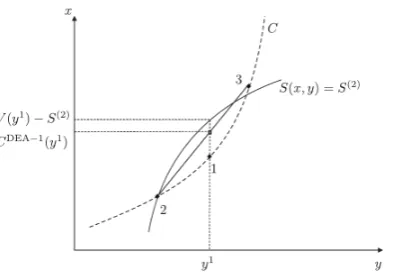
The winner of the auction, as illustrated in Figure 1, is agent 1 and his payment is the minimum of the second score paymentV(yi)−S(2), and the DEA paymentCDEA−i(yi;k).
Assuming a VRS technology, the DEA payment is found as a convex combination of agents’ 2 and 3 bids, and it leads to the smallest payment in this case.
3
Simulation Framework
Based on the Hybrid auction described in the previous section we now introduce the simulation framework. We consider a scenario in which the principal’s value function is given by V(y) = 4(1−e−αy). This particular value function3 not only is increasing and concave as required, but it also has a constant Arrow-Pratt coefficient of absolute risk aversion r(y) =−V′′(y)/V′(y) = α, withα >0. The Arrow-Pratt coefficient[7] is a
mea-sure for the principal’s risk-aversion, with a high value corresponding to an increasingly risk-averse principal whose value function is more convex (curved). Furthermore, the agents’ cost function is assumed to bex(y) = cy2 in the VRS technology simulations and x(y) =cy in the CRS technology simulations. Note that the cost functions are consistent with the axioms of the DEA technologies, cf. e.g. [1, 2]. The parameter c represents the agents’ private information of their common unit costs and is drawn from the uni-form distributionU(0,1). Lastly, the output (quality) level y, is drawn from the uniform distribution U(0,2). In a given iteration, all agents face an underlying cost function of the same form, but their output levels and cost parameters differ. We will introduce multi-dimensional generalizations below.
We always simulate the process of the mechanism 104 times. In every iteration we simulate the agents’ costs and qualities (randomly drawncand y), perform the selection of the agent with the highest score and record the payment it receives for Hybrid auc-tions using the VRS, and CRS DEA technologies and the second score auction. Due to the number of iterations we perform, the standard error in the mean values plotted is smaller than the symbol size in the plot (less than 10−3) and thus we omit it for clarity. Technically, all simulations are done in R and all DEA programs are solved using the ”Benchmarking” package for R, cf. [2] and [3]
Our simulations can be grouped in two sets. In the first set (Figures 2 and 3) we examine how the concavity of the principal’s value function affects the winner’s payment. In the second set (Figure 4) we consider multi-dimensional output (qualities). In both sets we explore how sensitive the payments are to the number of agents (from 3 to 60) participating in the auction.
4
Simulation Results
Having detailed the simulation’s input parameters and objectives, we now present our numerical findings. The most notable result for both cases (single and multi-dimensional qualities) is that the expected payment for the winning agent depends intimately on the assumed regularity of the underlying cost function. With the least ex ante assumptions, i.e. in the Hybrid VRS auction, the payment is the same or almost identical to the second score auction. For the Hybrid CRS auction however, the payment is significantly less than the second score auction. This can be seen in Figures 2 and 3 (Plots a and b) for the single-dimensional quality case and in Figure 4 (Plots a and b) for the multi-dimension quality case. In the following sections we look at each case in greater detail and provide the intuition behind the main result.
3
Mas-Collel et. al suggest the use of u(y) = −αe−αy+β (Example 6.C.4). In our scenario we set
10 20 30 40 50 60
0.4
0.6
0.8
1.0
Plot a: Payments for SSA and Hybrid VRS
Number of agents
A v er age P a yment
Quadratic Costs SSA
VRS
10 20 30 40 50 60
0.2
0.4
0.6
0.8
Plot b: Payments for SSA and Hybrid CRS
Number of agents
A v er age P a yment
Linear Costs SSA
CRS
10 20 30 40 50 60
70 75 80 85 90 95
Plot c: Occurrences of pay SSA < pay DEA VRS
Number of agents
% of iter
ations
Quadratic Costs
10 20 30 40 50 60
0 10 20 30 40 50 60
Plot d: Occurrences of pay SSA < pay DEA CRS
Number of agents
% of iter
ations
[image:6.595.128.460.69.317.2]Linear Costs
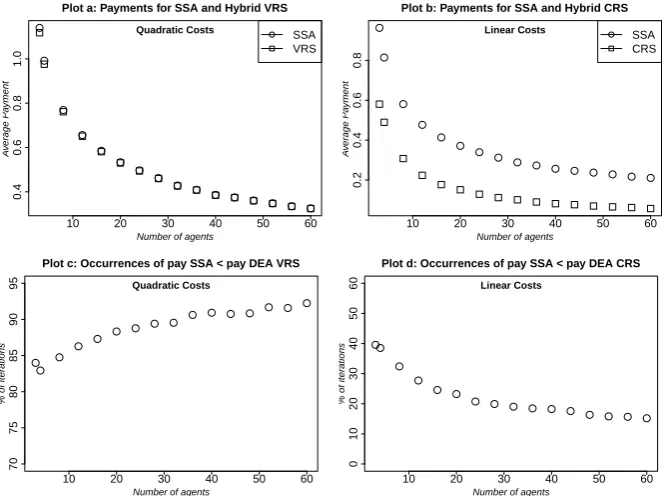
Figure 2: Single dimensional qualities for n ={3, ...,60} agents, α= 1, c∼U(0,1), and y∼U(0,2).
4.1
Single-dimension output
Initially we fix the concavity of the principal’s value function by α= 1 and compare the payment the winner expects to derive in the Hybrid auction (min{CDEA−i(yi;k), V(yi)−
S(2)}) with the second score auction (V(yi)−S(2)) as the number of agents increases from 3 to 60. First, we use VRS technology (k=VRS) and simulate the costs using a quadratic cost function x(y) = cy2. Next, we use the CRS technology (k=CRS), with costs being simulated by a linear cost functionx(y) =cy. We see that as the number of agents increases the winner’s average Hybrid VRS payment is almost equal to the second score auction payment (Figure 2 : Plot a), with the ratio between Hybrid VRS and SSA ranging from 0.98 to 0.99. For the linear cost counterparts, the Hybrid CRS payment is significantly lower than the expected payment in the second score auction (Figure 2: Plot b) with the ratio ranging from 0.6 to 0.27.
We proceed to study the Hybrid VRS auction in more detail. We see (Figure 2 : Plot c) that for 82.9% to 92.25% of the iterations of the algorithm, the second score payment V(yi)−S(2) is lower than the DEA VRS paymentCDEA−i(yi;V RS). This result suggests
1 2 3 4 5 0.10 0.15 0.20 0.25 0.30 0.35
Plot a: Payments for SSA and Hybrid VRS
Parameter alpha A v er age P a yment
Quadratic Costs SSA
VRS
1 2 3 4 5
0.05
0.10
0.15
0.20
Plot b: Payments for SSA and Hybrid CRS
Parameter alpha A v er age P a yment
Linear Costs SSA
CRS
1 2 3 4 5
60
70
80
90
Plot c: Occurrences of pay SSA < pay DEA VRS
Parameter alpha
% of iter
ations
Quadratic Costs
1 2 3 4 5
15
20
25
30
Plot d: Occurrences of pay SSA < pay DEA CRS
Parameter alpha
% of iter
ations
[image:7.595.127.460.68.317.2]Linear Costs
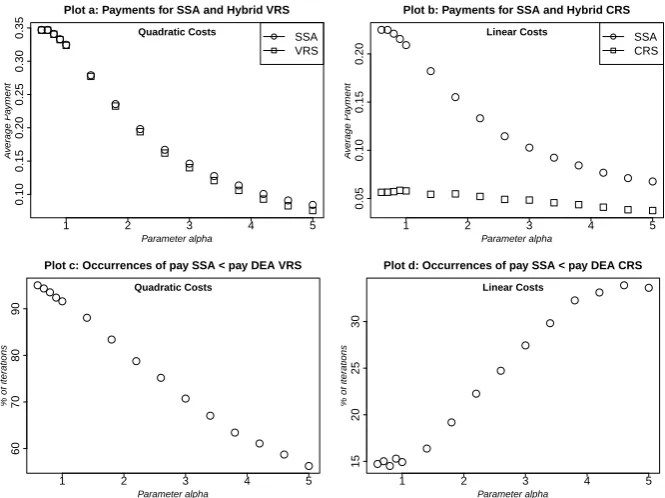
Figure 3: Single dimensional qualities forα ={0.5,0.6,0.7,0.8,0.9,1,1.4,1.8,2.4...5}and n= 60 agents.
For the second part of these simulations we fix the number of participating agents to 60 and begin to examine the dependence of the expected payments on the concavity of the principal’s value function. We measure the concavity, based on the Arrow-Pratt coefficient which for the particular value function used is equal to α. We follow an identical process by plotting the expected payments for the winners of both the VRS and the CRS Hybrid auctions and second score auctions (Figure 3: Plots a and b) for α in
{0.5,0.6,0.7,0.8,0.9,1,1.4,1.8,2.4...5} and then the percentage of iterations where the second score payment is lower than the DEA VRS and CRS payments (Figure 3: Plots c and d).
As before, we see (Figure 3 : Plot a and b) that the average Hybrid VRS payment is very close to the second score auction payment, while for linear costs, the average SSA payment is again higher than the average Hybrid CRS payment. However, as opposed to previous simulations, there is a clear indication that as αincreases, average Hybrid VRS payment is in-fact less than the average second score payment. The intuition behind this result, is that as the principal’s risk aversion increases, the utility function becomes more and more curved. Consequently, the score function gets less power since it will tend to envelop the points less closely. A secondary result is that all (Second Score and both Hybrid auctions) average payments decrease as the parameter α increases for α >= 0.7. This is to be expected, since a heavy risk averse principal (high value of parameter α), will favor lower qualities which result in lower payments.
10 20 30 40 50 60 1.6 1.8 2.0 2.2 2.4 2.6 2.8
Plot a: Payments for SSA and Hybrid VRS
Number of agents
A v er age P a yment
Quadratic Costs SSA
VRS
10 20 30 40 50 60
1.0
1.5
2.0
2.5
Plot b: Payments for SSA and Hybrid CRS
Number of agents
A v er age P a yment
Linear Costs SSA
CRS
10 20 30 40 50 60
92
94
96
98
Plot c: Occurrences of pay SSA < pay DEA VRS
Number of agents
% of iter
ations
Quadratic Costs
10 20 30 40 50 60
0 10 20 30 40 50 60
Plot d: Occurrences of pay SSA < pay DEA CRS
Number of agents
% of iter
ations
[image:8.595.128.460.70.317.2]Linear Costs
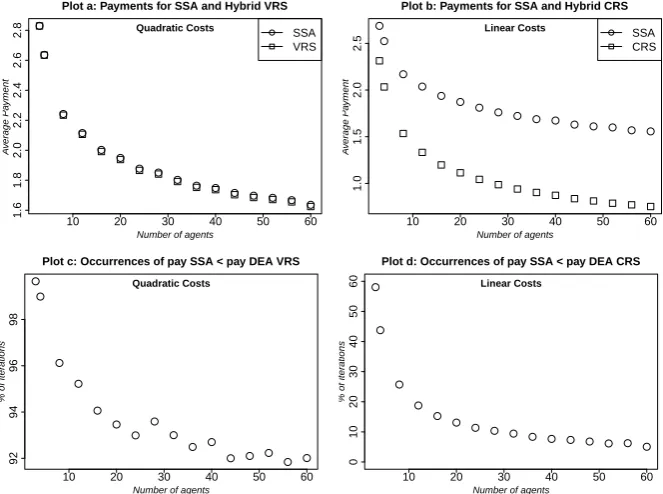
Figure 4: Multi dimensional qualities for n = {3, ...,60} agents, α1 = α2 = α3 = 1 and c1, c2, c3 ∼U(0,1).
4.2
Multi-dimensional output
In this set of simulations we consider three dimensional qualities. We therefore adjust the principal’s value function to V(y) = 4(3−ea1y1 −ea2y2 −ea3y3) with y1, y2, y3 ∼U(0,2).
Likewise, we adjust the agents’ cost functions tox(y) = c1y2
1+c2y22+c3y32 in the quadratic case and to x(y) =c1y1 +c2y2+c3y3 in the linear case, with c1, c2, c3 ∈(0,1].
Again, we calculate the payment the winner gets in the Second Score auction and the Hybrid VRS and CRS auctions (Figure 4 : Plot a and b), with the number of the participating agents varying from 3 to 60. In terms of the ordering of the average payments the results are similar to the case on one dimensional quality. In addition to that, the appearance of a hyper-efficient winner almost follows the pattern of the single-dimensional simulations i.e. for the Hybrid VRS there is a hyper-efficient winner in 87.5% and 81.9% of the iterations for 3 and 4 agents and in 33.8% of the iterations for 60 agents. In the single-dimension counterparts the occurrences of the cases where the SSA payment is lower than the DEA VRS payment decreased monotonically with the number of agents. In the multiple dimension case, this does not happen in the VRS case (Figure 4 : Plot c) but in the CRS case it does still holds (Figure 4 : Plot d).
Finally, for any auction the expected payment to the winner is higher in the multi-dimensional case than in the single-multi-dimensional case. Indeed, the introduction of 3 di-mensions results in an increase of the average payments with a factor 2.5 to 7.4 depending on the number of agents and the use of a VRS or CRS technology.
5
Conclusions and Future Work
payment to the providers, and more so, the stronger assumptions (linear, quadratic) we impose on the underlying cost function. The VRS DEA technology provides a relatively small decrease in the principal’s payment compared to a Second Score multi-dimensional auction. On the contrary, in a CRS technology, the improvements are sizable.
In addition to that, we showed that the ability of the score function to limit payments to the provider depends on the concavity of the score function. As the principal’s utility function gets more concave, i.e. as he gets more risk averse with a higher value of α, the role of the DEA benchmarks becomes more important. The intuition is that the more curved score function gives a score based approximation more similar to the the so-called DEA FDH model where we only impose free disposability of inputs and outputs.
We also showed how the number of bidding agents impact the outcome. In general, more agents will make both the SSA and the DEA based payments lower. In particular for a low number of bidders, extra bidders will have a large marginal impact on the payments. This suggests that the procuring principal should make an effort to engage more bidders.
Lastly, we showed that the introduction of additional output (quality) dimensions significantly increases the expected payment. We are aware that this may not be a surprising result since now the average costs and principal’s value function are higher since three outputs are produced. However, this increase can be also be attributed to fact than now the ability of DEA to approximate the cost function and the power of the the second score principle to limit the payments are both undermined by the extra dimensions. That is, with more dimensions quite a few extra bidders are needed in order to span the cost function with a given precision. This suggests that the principal should think carefully on which qualities really matter with an attempt to limit these effects.
Future work should extend the Hybrid DEA auction in different ways. In particular, from an applied perspective, it seems worthwhile to consider the cases of multiple winners and multiple bids from each agent. For both cases it remains to be seen whether the eco-nomic properties of the Hybrid DEA auction (i.e. incentive compatibility and individual rationality) can be maintained. Also, it will be useful to investigate through simulations how such extended mechanisms perform with respect to the parameters introduced in this paper i.e. DEA technologies, number of agents, value function concavity and output dimensions.
References
[1] P. Bogetoft and K. Nielsen. Dea based auctions. European Journal of Operational Research, 184:685–700, 2008.
[2] P. Bogetoft and L. Otto. Benchmarking with DEA, SFA, and R. Springer, New York, 2011.
[3] P. Bogetoft and L. Otto. Benchmark package. Technical report, R, 2012.
[5] N. Costantino, M. Dotoli, M. Falagario, and F. Sciancalepore. Balancing the addi-tional costs of purchasing and the vendor set dimension to reduce public procurement costs. Journal of Purchasing and Supply Management, 18(3):189–198, 2012.
[6] M. Falagario, F. Sciancalepore, N. Costantino, and R. Pietroforte. Using a dea-cross efficiency approach in public procurement tenders. European Journal of Operational Research, 218:523–529, 2012.