DOI: doi:10.1016/j.bbapap.2009.06.015 Reference: BBAPAP 38206
To appear in: BBA - Proteins and Proteomics
Received date: 19 April 2009 Revised date: 16 June 2009 Accepted date: 17 June 2009
Please cite this article as: Andrew G. McDonald, Keith F. Tipton, Sin´ead Boyce, Tracing Metabolic Pathways from Enzyme Data, BBA - Proteins and Proteomics (2009), doi:10.1016/j.bbapap.2009.06.015
ACCEPTED MANUSCRIPT
Tracing Metabolic Pathways from Enzyme Data
Andrew G. McDonald, Keith F. Tipton* and Sinéad Boyce
Department of Biochemistry, Trinity College, Dublin 2, Ireland
*Corresponding author: Email address: [email protected] Telephone: 00353-1-8961802 Fax: 00353-1-6772400
Short title: Tracing Metabolic Pathways
ACCEPTED MANUSCRIPT
Abstract
ACCEPTED MANUSCRIPT
Introduction
The International Union of Biochemistry and Molecular Biology (IUBMB) Enzyme List, “Nomenclature and Classification of Enzymes by the Reactions they Catalyse,” classifies enzymes in terms of their catalytic functions [see 1, 2]. It is restricted to classification and recommendations on nomenclature and is widely used by other databases as a source for avoiding ambiguity in the recognition of enzymes as catalytic entities. The data contained within it are, as far as possible, strictly factual and should provide a system for the unambiguous identification of the enzyme(s) being studied in terms of the reaction or type of reactions catalysed. Several other databases, including
BRENDA[3], ExPASy [4], GO [5] and KEGG[6], incorporate the Enzyme List data, as a primary source of information. Each enzyme is identifiable by an unique four-digit Enzyme Commission (EC) number, a systematic name and an “accepted name”, which is often the name in most common use for that enzyme, provided it is not ambiguous or misleading,
The enzyme data, including associated literature references, are stored in MySQL databases that are accessed through a web application, ExplorEnz[2]. This allows more detailed searching facilities, including the use of Boolean algebra to include or exclude terms from the selected fields as well as searching with regular expressions. It can be downloaded in a number of different formats and is also used as a source of the flat-file version on the official IUBMB nomenclature and terminology web site [7]. Since the
ACCEPTED MANUSCRIPT
what can be achieved using the list itself and derivatives of it. A preliminary account of this work has been published previously [8].
Methods
Finding Enzyme Involvements – the “enzyme-centric” approach
The Enzyme Listcan be searched to find all of those enzymes that catalyse reactions involving a specific substrate or product. For example, a search for L-serine yields a list of 41 enzymes. It is possible to construct a simple pictorial representation from this, as shown in Fig. 1. Such “enzyme-centric” searching can be useful in
predicting the possible effects of drugs or other manipulations that are targeted against a specific metabolic reaction, since they will show other pathways that might also be affected.
It is also possible to list groups of enzymes linked by common substrates and products, as shown in Fig. 2. The results of attempts to display these interactions in graphical form can, however, appear quite complex because of the multiplicity of edges that occurs when forming connections between enzymes. From combinatorics, the general formula for the number of ways ritems can be taken from nis:
n
Cr= n!/[r!(n-r)!] n
C2therefore represents the total number of possible enzyme (node) pairs, where each
ACCEPTED MANUSCRIPT
representations, such as that shown in Fig. 2, although fully searchable, are not generally helpful as visual aids.
Clearly the situation can become more complicated than this if one considers the possibility of having several shared metabolites for each enzyme. Such a representation can readily be searched for any given enzyme. It has the advantage that each enzyme only occurs once in the diagram, as opposed to the hand-crafted, artistic, versions, such as the Nicholson metabolic pathways charts [see 9, 10] or in the Roche Applied Science "Biochemical Pathways" wall chart, which can be searched, in segments, through
ExPASy [11], where the separation of different metabolic systems in the display can result in the same enzyme occurring in several different places.
The substrate-centric approach
The reactions database was initially prepared by extracting all of the reactions in
ExplorEnz, the MySQL version of the Enzyme List[2]. These were used to create a separate MySQL Reactions databaseand a web application, created with the PHP
ACCEPTED MANUSCRIPT
rendered by the web application using the regular-expression based system described previously [2].
As with ExplorEnz, the query engine supports both case-insensitive and regular-expression substring searches. This, at least in theory, should allow all reactions
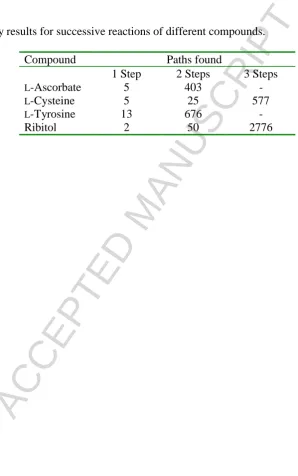
involving any given substrate or product to be displayed. It should also allow one to trace the number of reactions n-steps from any given starting substrate, so that its metabolic fates can be better appreciated. However, just as in the case of edge multiplicity in the “enzyme-centric” approach, the system rapidly gains complexity. This is illustrated for some simple metabolites in Table I.
One major cause of this rapidly expanding complexity is the involvement of a reactant that is used or produced by several different enzymes. For example, if a reaction produces or uses ATP it will be linked to many other reactions (the kinases etc). This can be addressed by specifically excluding some compounds, such as H2O, H+, ATP, ADP,
AMP, phosphate, diphosphate, NADP+, NADPH, NAD+, NADH, NAD(P)+, NAD(P)H, A, AH2, acceptor and reduced acceptor from the search. However, if one were to exclude,
for example, NAD+, that would eliminate ADP-ribosylation reactions as well as oxidoreductases and excluding ATP would eliminate several adenylyltransferase
reactions. This problem can be better addressed by selective elimination of reactant pairs rather than single reactants from the initial searches. These might include:
ATP <=> ADP
ATP <=> AMP
AH2 <=> A
ACCEPTED MANUSCRIPT
NADP+ <=> NADPH
NAD(P)+<=> NAD(P)H
CoA <=> acetyl-CoA
In the cases of H+and H2O, which occurs in about 1,260 listed enzyme reactions, even
if the peptidases are excluded, there is no practical alternative but to remove them from substrate/product searches.
Results & Discussion
Searching ExplorEnz for reactants is limited to the accepted name used in the Enzyme Listplus any entries that occur in the “glossary”, which relates the commonly used biochemical name to the IUPAC-approved name in some instances, and those alternative names that may occur in the references titles listed. The reaction database contains a large list of compound synonyms, and space and hyphen distinctions are ignored, for example, llysine, l-lysine and Llysine will all go to the entry for L-lysine. Similarly F6P, F-6P, F6-P, and F-6-F6-P, whether in upper or lower case will all return the same 3 compounds, D -fructose 6-phosphate, D-hexose 6-phosphate and D-hexose phosphate, as shown in Fig. 3. Each of the primary terms used for the parent compounds is given a unique compound number (C number) internally. Links are provided for the primary term to the relevant entry in the KEGG database as well as to the PubChem entries for it and its derivatives, where such entries exist. A complete list of the primary terms of substrates and products as well as the compound numbers can be found from “Stats” on the tool bar. Selecting one of these will give the number of reactions, identified by reaction numbers, from the
ACCEPTED MANUSCRIPT
separate reactions involving D-fructose 6-phosphate (see Table 2) and one each for D -hexose 6-phosphate and D-hexose phosphate. Such inexact searching can be helpful in ensuring comprehensive results and can also aid those who can never remember, or do not care to remember, where the hyphens go in compounds like glucose 6-phosphate. While inexact searching is enabled by default, options for “exact” searches and those using regular expressions are also provided. If an exact search fails to find any
compound, a dialogue box appears that offers the option of repeating the search using the inexact search option.
Representations
Although the Reactions Databasecan provide lists of reactions, an additional tool is needed for display purposes. This is provided by Reaction Explorer, which is a multi-platform application, written in REALbasic, for constructing basic metabolic network graphs. The software requires an active internet connection in order to query the
Reactions Database. Versions are currently available for the following operating systems: Mac OS X 10.1 or higher, Mac OS 9.x, Linux x86 and Windows 95 or higher and can be downloaded from the Reaction Explorerhomepage [12]. Selecting any
ACCEPTED MANUSCRIPT
The output is designed to be simple because its purpose is to convey the basic
information as efficiently clearly as possible, rather than to construct works of art. Thus, it is not designed as a competitor for the craftsman-designed Nicholson metabolic pathways charts [9,10], or the computationally-based representational systems, such as
GraphViz[13] and the BioCyc Pathway Tools [14], but rather to display the essential information quickly and easily. However, different output formats to accord with those required by such systems could be provided in the future, as has already been done for
ExplorEnz[2].
Applications
As indicated above, Reaction Exploreris an aid to visualize reactant interconnections in biochemical pathways. In fact one can generate searchable
connection graphs with any dataset that is entered in the Reaction Explorerfile format, such as those shown in Figs. 2 and 4. The ability to indicate possible metabolic pathways involving any chosen compound could be of value for assessing the possible
ramifications of inhibiting, or amplifying, any single step in the pathway and for predicting the likely effects of substrate, or product, analogues on other metabolic processes. Thus the approach can readily produce models for systems biological quantitation. The system can also be of educational value in allowing students to trace known metabolic pathways and possible alternatives, from any chosen starting
compound. The ability to trace the fates of each product, or substrates through different alternative pathways allows complex networks to be readily built.
ACCEPTED MANUSCRIPT
However, its further development for use in conjunction with the substructure-search tool
BiSSCat [15] and the Generator of Reaction Equations & Pathways, GREP[16], should allow its extension to predicted pathways involving orphan metabolites. Furthermore, there are limitations imposed not by the programme but by the nature of the system involved. As discussed in connection with Table 1, a tree that describes all reactions proceeding for nsteps from any named reactant would not to be expected to be simple. Similarly, a single, unique, pathway connecting two distant metabolites does not usually occur in metabolite space. Thus the question “find the pathway from glucose to pyruvate and lactate” might be expected to yield glycolysis, but it would also give very many other pathways (>500). That is because there are very many ways in which glucose can be converted into pyruvate, including the synthesis and breakdown of compounds such as cholesterol. Similarly glucose glycogen glucose pyruvate would not be an invalid pathway, despite our perceptions that glycolysis and glycogenenolysis are different processes. Neither does the Enzyme Listcontain any information on the thermodynamic feasibility of pathways, as will be discussed later. Although the possibilities might be reduced by specifying the number of steps allowed, not all metabolic pathways necessarily use the minimum number of steps.
ACCEPTED MANUSCRIPT
citrate = cis-aconitate + H2O
However, in the operating citric-acid cycle, the overall process catalysed includes a second reaction:
cis-aconitate + H2O = isocitrate
leading to an overall process of citrate = isocitrate
Although this was known at the time the enzyme was first included in the Enzyme List, in 1961, only the first reaction was given because the equilibrium of the reaction very much favours citrate (the equilibrium mixture is 91% citrate, 6% isocitrate and 3% aconitate) and the existence of the second reaction was indicated only in the comments. Thus, this is an example of the misleading inferences that can be drawn from considering isolated enzyme thermodynamics rather than system thermodynamics. The second reaction has been added to the Reactions Database; both it, and the overall reaction, are now included in the reaction field of theEnzyme Listentry for aconitase.
The second example concerns the metabolism of trehalose [17], as shown in Fig. 5. The enzyme EC 2.4.1.15, -trehalose-phosphate synthase (UDP-forming), was listed as catalysing the reaction:
UDP-glucose + D-glucose 6-phosphate = UDP + -trehalose 6-phosphate However, the enzymes that might use this product, such as trehalose-phosphatase (EC 3.1.3.12) were shown as using trelalose 6-phosphate:
ACCEPTED MANUSCRIPT
rather than-trehalose 6-phosphate. Thus, any search for-trehalose 6-phosphate would not reveal this, or other enzymes in the process. This was, in fact, an example of changes in nomenclature. In earlier formulations of the Enzyme List, some common enantiomeric designations were omitted. For example, it was assumed that all amino acids were L-amino acids unless otherwise specified. Similarly inositol was regarded as being synonymous with myo-inositol and trehalose was-trehalose. Since many biochemists were not familiar with these arcane conventions, some of the omitted enantiomeric designations were added in more recent formulations of the Enzyme List
but, somehow, this was not done for all the relevant trehalose entries. This has now been corrected. Fig. 6 uses this pathway to illustrate nomenclature difficulties that had to be rectified.
Limitations and future developments
It is perhaps unreasonable to expect the Enzyme Listto have functions for which it was not designed. However, there are several aspects that limit its applicability for simple adaptation to reaction pathway tracing through systems such as Reaction Database&
Explorer. Some of the limitations and approaches to addressing them are described below.
(a) Not all reactions catalysed by a given enzyme are listed
ACCEPTED MANUSCRIPT
However, this can result in judgements about what is, and what is not, physiologically important.
For example aromatic-L-amino-acid decarboxylase (EC 4.1.1.28) is given as catalysing two reactions
(1) 3,4-dihydroxy-L-phenylalanine = dopamine + CO2
(2) 5-hydroxy-L-tryptophan = 5-hydroxytryptamine + CO2
but the enzyme will also catalyse the decarboxylation of L-tyrosine, L-tryptophan and L -phenylalanine. Although these reactions may be of lesser physiological significance, they are not unimportant and can, indeed, have major significance in the responses to therapy involving some antidepressant drugs.
In some cases additional information on the specificity is also given in the “comments” associated with the Enzyme-Listentry. For example, the
6-phosphofructokinase (EC 2.7.1.11) reaction is given as
ATP + D-fructose 6-phosphate = ADP + D-fructose 1,6-bisphosphate
but the comments also state: “D-Tagatose 6-phosphate and sedoheptulose 7-phosphate can act as acceptors. UTP, CTP and ITP can act as donors”. Clearly such material, although readily accessible in an ExplorEnzsearch, need to be incorporated into the
Reactions Database. The comprehensive lists of substrates provided by the BRENDA
database [3], which also contains, somewhat arbitrary, listings of “natural substrates”, can be most valuable for this purpose.
In the case of L-threonine 3-dehydrogenase (EC 1.1.1.103), only one reaction is listed L-threonine + NAD+= L-2-amino-3-oxobutanoate + NADH + H+
ACCEPTED MANUSCRIPT
L-serine + NAD = L-2-amino-3- oxopropionate + NADH + H
An additional complication can occur when spontaneous (uncatalysed) reactions occur. Although one would not expect the Enzyme Listto include reactions that are not enzyme-catalysed, such reactions do occur in vivoand will break a metabolic chain if not added to systems, such as the Reactions Databaseand Explorer.For example, the
Enzyme Listentry for L-threonine 3-dehydrogenase includes the comment: “The product spontaneously decarboxylates to aminoacetone. This may be essential information for tracing the metabolic fates of L-threonine, since aminoacetone is known to be a substrate for the primary-amine oxidase (EC 1.4.3.21), (R)-aminopropanol dehydrogenase (EC 1.1.1.75) and glycine C-acetyltransferase (EC 2.3.1.29).
In some cases a spontaneous reaction may compete with catalysed reactions. For example, putrescine aminotransferase (EC 2.6.1.82) catalyses the reaction
putrescine + 2-oxoglutarate = 4-aminobutanal + L-glutamate
and the 4-aminobutanal can be spontaneously converted to 1-pyrroline or oxidizes by aldehyde dehydrogenase (EC 1.2.1.3) or aminobutyraldehyde dehydrogenase (EC 1.2.1.19) to form 4-aminobutanoate.
(b) Overlapping specificities
It is not uncommon to find that more than one enzyme may be capable of catalysing the same reaction. These will be treated differently by the Enzyme Listif they have sufficiently different substrate specificities. For example, some aldehydes may be
ACCEPTED MANUSCRIPT
1.1.1.2), aldehyde reductase (EC 1.1.1.21) and aldehyde oxidase (EC 1.2.3.1), among several other enzymes.
Carnitine O-palmitoyltransferase (EC 2.3.1.21) catalyses the reaction:
palmitoyl-CoA + L-carnitine = CoA + L-palmitoylcarnitine
and the comments indicate that it has a “broad specificity to acyl group, over the range C8
to C18; optimal activity with palmitoyl-CoA”. The related enzyme carnitine O
-octanoyltransferase (EC 2.3.1.137) catalyses
octanoyl-CoA + L-carnitine = CoA + L-octanoylcarnitine
Thus both these enzymes will use octanoyl-CoA to extents that will depend on their respective activity levels, distribution and kinetic parameters.
In such cases, the much of the necessary data are in the Enzyme List, supplemented by the additional information in BRENDA[3]. The problem is simply one of ensuring that all enzymes that may work with a given metabolite are considered.
(c) General or Markush terms
In the case of enzymes with broad substrate specificities, such as alcohol
dehydrogenase (EC 1.1.1.1), where the number of substrates, or potential substrates, is very large, the Enzyme Listoften gives a single generic reaction. For example, the alcohol dehydrogenase reaction is given as
an alcohol + NAD+ = an aldehyde or ketone + NADH + H+ and that of L-amino-acid oxidase (EC 1.4.3.2) is given as:
ACCEPTED MANUSCRIPT
The problem with this approach is that it does not indicate which alcohols, or L -amino acids, are not substrates. Again, the BRENDAdatabase [3] can be invaluable in such cases, although it should always been borne in mind that the absence of a
compound from the substrate/product list does not necessarily mean that it is not a substrate, but may simply mean that nobody yet has tried it.
The example, discussed above, of searching for F6P yielding D-hexose 6-phosphate as well as D-fructose 6-phosphate is because the reaction of hexokinase (EC 2.7.1.1) is listed as:
ATP + D-hexose = ADP + D-hexose 6-phosphate
Markush terms are also used for some reactions. For example the reaction catalysed by primary-amine oxidase (EC 1.4.3.21) is given as:
RCH2NH2+ H2O + O2= RCHO + NH3+ H2O2
and that of carbonyl reductase (NADPH) (EC 1.1.1.184) as: R-CHOH-R′+ NADP+= R-CO-R′+ NADPH + H+
Although such formulations are somewhat more informative than the general reactions described above, and the Markush terms are searchable in ExplorEnzand Reaction Explorer, it is still necessary to revert to BRENDAfor information on the exact substrates that are known to be used.
ACCEPTED MANUSCRIPT
polynucleotides and polysaccharides. For example the reaction catalysed by (-amylase) (EC 3.2.1.1) is given as
Endohydrolysis of 1,4--D-glucosidic linkages in polysaccharides containing three or more 1,4--linked D-glucose units.
and the reaction of exodeoxyribonuclease I (EC 3.1.111) is given as
Exonucleolytic cleavage in the 3′- to 5′-direction to yield nucleoside 5′ -phosphates
(d) Internal synonym inconsistencies
There have been many changes in nomenclature since the Enzyme Listwas started in 1952. Normally these have been made to correct or rationalize nomenclature, for example, the change from DPN (even before that, it was called coenzyme I) to NAD+ caused considerable dissent at the time [see 18], whereas the change from diphosphate to bisphosphate for those compounds where the phosphate groups are attached to different groups on the same molecule went comparatively smoothly. Generally, the Enzyme Listis punctilious about correcting entries but, as will be discussed below, a few may escape the notice of the IUBMB-IUPAC Joint Commission on Biochemical Nomenclature and of those who use the Enzyme List. As discussed above, pathway tracing can be of value in finding, and correcting, such inconsistencies.
(e) Reaction directionality
ACCEPTED MANUSCRIPT
direction in which the reaction is believed to operatein vivo. Thus the reaction is presented as A+ B = C + D, and not A+ B C + D or A+ B C + D. By convention, the direction chosen for the reaction in any given sub-subclass is the same for all enzymes. Systematic names are based on this written reaction and, therefore, also carry no information about the favoured reaction direction. Although, this might seem to be less helpful than it might, it must be remembered that, for some enzymes, such as glutamate dehydrogenase [NAD(P)+] (EC 1.4.1.2) and fructose-bisphosphate aldolase (EC 4.1.2.13), the preferred reaction direction varies with cellular conditions.
Furthermore, the equilibrium constant of the reaction may be misleading in terms of the direction in which it actually operates in vivo. For example, the equilibrium for the oxidation of ethanol by alcohol dehydrogenase (EC 1.1.1.1)
CH3CH2OH + NAD+ = CH3CHO + NADH + H+
very much favours ethanol formation under physiological conditions, but ethanol oxidation is the dominant direction in vivobecause acetaldehyde (ethanal) produced is rapidly removed in the essentially irreversible reaction catalysed by aldehyde dehydrogenase (NAD+) (EC 1.2.1.3)
CH3CHO + NAD+ + H2O = CH3COOH + NADH + H+
Thermodynamic data for many enzymes can be found in the GTDThermodynamics of Enzyme-catalysed Reactions database [19] and the kinetic data are included in the
BRENDAdatabase [3] may provide sufficient detail to determine reaction equilibria through Haldane relationships. However, it should be emphasised that only data that refer to 'physiologically relevant conditions' should be used and that it is the
ACCEPTED MANUSCRIPT
that are important in determining the flux direction [see 20,21]. For this reason, the desktop application version of Reaction Explorerdoes not generate directed graphs (digraphs).
(f) Species differences
In general the Enzyme Listdoes not give information on the species, tissue or cell compartment in which the enzyme is found. Some information may be found in the references associated with each entry and the “comments’ may refer to species in terms of behaviour that may not apply to the enzyme from all sources. For example, the entry for alcohol dehydrogenase contains the comment “Acts on primary or secondary alcohols or hemi-acetals; the animal, but not the yeast, enzyme acts also on cyclic secondary alcohols”. The BRENDAdatabase [3], however, contains extensive species data that can be used in this context, and gene and protein databases may also provide valuable information about the species in which an enzyme might be expressed.
(g) Overlapping specificities
It is not uncommon to find that more than one enzyme may be capable of catalysing the same reaction. Such enzymes will be classified separately by the Enzyme Listif they have sufficiently different substrate specificities. For example, an aldehyde may be a substrate for alcohol dehydrogenase (EC 1.1.1.1), alcohol dehydrogenase (NADP+) (EC 1.1.1.2), aldehyde reductase (EC 1.1.1.21) and aldehyde oxidase (EC 1.2.3.1), among many other enzymes.
ACCEPTED MANUSCRIPT
palmitoyl-CoA + L-carnitine = CoA + L-palmitoylcarnitine
and the comments indicate that it has a “broad specificity to acyl group, over the range C8
to C18; optimal activity with palmitoyl-CoA”. The related enzyme carnitine O
-octanoyltransferase (EC 2.3.1.137) catalyses
octanoyl-CoA + L-carnitine = CoA + L-octanoylcarnitine
Thus both these enzymes will use octanoyl-CoA to extents that will depend on their respective activity levels, distribution and kinetic parameters.
In such cases, the necessary data are in the Enzyme List, supplemented by the additional information in BRENDA [3]. The problem is simply one of ensuring that all enzymes that may work with a given metabolite are considered.
Conclusions
There are several other enzyme data systems that present metabolic pathways for selected systems, including KEGG[6], MetaCyc[21] and UMBBD[23], and the Enzyme List, itself, also contains some pathways and reaction systems. BioCarta [24] contains many attractively presented pathways and the PathwayExplorer website [25] collects many of these together. Whereas, these are largely static pictures, Pathway Hunter Tool
[26] allows the user to generate KEGGpathways between selected metabolites. However,
Reaction Explorerdiffers from these by allowing the used to follow metabolites to build up pathways de novowith no inbuilt constraints other than the Enzyme List/ExplorEnz
dataset on which it is currently based.
ACCEPTED MANUSCRIPT
reaction, it is sometimes appropriate to include details of a spontaneous reaction that follows or precedes the enzyme-catalysed reaction, especially in cases where there would otherwise be a gap in a metabolic pathway.
It has been frequently suggested that the Enzyme Listshould give each reaction catalysed a separate EC number. Thus, for example there would be different numbers for hexokinase catalysing the phosphorylation of D-glucose, D-mannose, D-fructose, sorbitol and D-glucosamine. Such a system would, of course, not be consistent with function of the Enzyme Listitself, but such a parallel approach might be beneficial. Such a system could be developed from the reaction numbers used here, but the reactant-pair (RP) identifiers used by KEGG[6] might provide an easier approach.
Synonyms are important to allow the compounds to be found. The Enzyme List
includes commonly used synonyms (other names) for each enzyme but it is not its function to include synonyms for all possible substrates. Synonyms are needed for searching Reaction Databaseand Explorerbecause many people use different names for the same compound and few use the often-unwieldy IUPAC-approved names. There are excellent small molecule databases, such as ChEBI [27] and KEGG LIGAND[28]. However, for convenience and since it is not uncommon to find that chemists prefer different alternative names from those favoured by biochemists and pharmacologists,
ACCEPTED MANUSCRIPT
SMILES to names [e.g., 31, 32] that can be used to generate search terms. In the future the option of searching by InChI key might be the most appropriate [33].
A major remaining challenge is to populate the Reactions Databasewith additional reactions that are not found in the Enzyme List, such as those provided by BRENDA [3]. Some reactions, such as those of aconitase, have already been added, and to facilitate data entry a curatorial web interface, adapted from that already employed by ExplorEnz[2] is being developed. It will also be necessary to address the species problem, but at least for now, but the problem of thermodynamic information may be best served by links to other sources.
Acknowledgement
We are grateful to Science Foundation Ireland for support.
References
1. S. Boyce, and K.F. Tipton. History of the enzyme nomenclature system.
Bioinformatics16 (2000) 34-40.
2. A.G. McDonald, S. Boyce, K.F. Tipton. ExplorEnz: the primary source of the IUBMB enzyme list. Nucleic Acids Res. 37 (2009) D593-597. http://www.enzyme-database.org/
3. BRENDA – The Comprehensive Enzyme Information System: http://www.brenda-enzymes.info/
ACCEPTED MANUSCRIPT
6. KEGG - Kyoto Encyclopedia of Genes and Genomes: http://www.genome.jp/kegg/
7. IUBMB Recommendations on Biochemical & Organic Nomenclature, Symbols & Terminology etc: http://www.chem.qmw.ac.uk/iubmb/enzyme/
8. A.G. McDonald, K.F. Tipton, S. Boyce. From the enzyme list to pathways and back again. Proceedings of the 3rd International Beilstein Workshop on Experimental Standard Conditions of Enzyme Characterizations (Edited by M.G. Hicks & C. Kettner) (2008) pp. 109-122, Beilstein Institut, Frankfurt, Germany. 9. D. Nicholson. The evolution of the IUBMB-Nicholson maps, IUBMB Life50
(2000) 341-344.
10. IUBMB-Nicholson Metabolic Maps, Minimaps & Animaps: http://www.iubmb-nicholson.org/
11. ExPASy Biochemical Pathways: http://www.expasy.ch/tools/pathways/ 12. Reaction Explorer: http://www.reaction-explorer.org/
13. Graphviz - Graph Visualization Software: http://www.graphviz.org/
14. S.M. Paley and P.J. Karp. The Pathway Tools cellular overview diagram and Omics Viewer. Nucleic Acids Res. 34 (2006) 3771-3778.
15. M. Kotera, A.G. McDonald, S. Boyce and K.F. Tipton. Functional group and substructure searching as a tool in metabolomics. PLoS ONE3 (2008) e1537. 16. M. Kotera, A.G. McDonald, S. Boyce and K.F. Tipton. Eliciting possible
ACCEPTED MANUSCRIPT
Chem. Inf. Model. 48 (2008) 2335-2349.
17. Z.Y. Wang. J.M. Jenkinson, L.J. Holcombe, D.M. Soanes, et al. (2005) The molecular biology of appressorium turgor generation by the rice blast fungus
Magnaporthe grisea. Biochem. Soc. Trans. 33, 384-388.
18. EC Webb. Enzyme nomenclature: a personal retrospective. FASEB J. 7 (1993) 1192-1194.
19. R.N. Goldberg, Y.B. Tewari, T.N. Bhat. Thermodynamics of enzyme-catalyzed reactions—a database for quantitative biochemistry. Bioinformatics20 (2004) 2874-2877. http://xpdb.nist.gov/enzyme_thermodynamics/
20. R.A. Alberty. Calculation of equilibrium compositions of systems of enzyme-catalyzed reactions. J. Phys. Chem. B 110 (2006) 24775-24779.
21. R.A. Alberty. Thermodynamics of Biochemical Reactions, (2003) John Wiley, USA.
22. R. Caspi, H. Foerster, C.A. Fulcher, P. Kaipa, et al. The MetaCyc Database of metabolic pathways and enzymes and the BioCyc collection of Pathway/Genome Databases. Nucleic Acids Res. 36 (2008) D623-D631. http://metacyc.org/
23. L.B.M. Ellis, D. Roe and L.P. Wackett. The University of Minnesota
Biocatalysis/Biodegradation Database: The First Decade. Nucleic Acids Res., 34 (2006) D517-D521. http://umbbd.msi.umn.edu/
24. BioCarta. http://www.biocarta.com/
ACCEPTED MANUSCRIPT
Nucleic Acids Res. 33 (2005) W633-W637. https://pathwayexplorer.genome.tugraz.at/
26. S.A. Rahman P. Advani, R. Schunk, R. Schrader and D. Schomburg. Metabolic pathway analysis web service (Pathway Hunter Tool at CUBIC). Bioinformatics 21 (2005) 1189-1193.
27. K, Degtyarenko, P. de Matos, M. Ennis, J. Hastings, et al. ChEBI: a database and ontology for chemical entities of biological interest. Nucleic Acids Res. 36 (2008) D344-350. http://www.ebi.ac.uk/chebi/
28. S. Goto, Y. Okuno, M. Hattori, T. Nishioka and M. Kanehisa. LIGAND: database of chemical compounds and reactions in biological pathways. Nucleic Acids Res.
30 (2002) 402-404. http://www.genome.jp/ligand/
29. ChemFinder. http://chemfinder.cambridgesoft.com/reference/chemfinder.asp 30. The Merck Index 13th Edition 2001 John Wiley & Sons.
http://www.merckbooks.com/mindex/online.html/ 31. Online SMILES Translator and Structure File Generator.
http://cactus.nci.nih.gov/services/translate/
32. InChI converter. http://www.inchi.info/converter_en.html/
ACCEPTED MANUSCRIPT
Legends to Figures
Fig. 1. The substrate-centric approach: a diagrammatic view of the enzymes having
L-serine as a substrate or product.
Fig 2. The enzyme-centric approach: a network of 525 enzymes with links
representing shared metabolites. There are 3,985 connections made amongst the enzymes in this subset, from which H+, H2O, and common cofactor pairs (e.g.,
ATP/ADP) were excluded.
Fig. 3. Results of a search for F6P in Reaction Explorer.
Fig. 4. Diagram of the early stages of porphyrin biosynthesis, produced by Reaction
Explorer. The network can be extended through links from each metabolite.
Fig 5. Trehalose metabolism in M. grisea (adapted from ref. 24).
Fig. 6. A reconstruction of trehalose metabolism, drawn by Reaction Explorer,
indicating the potential nomenclature difficulties from ExplorEnz data that had to
ACCEPTED MANUSCRIPT
Table 1.
Some query results for successive reactions of different compounds. Compound Paths found
1 Step 2 Steps 3 Steps
L-Ascorbate 5 403
-L-Cysteine 5 25 577
ACCEPTED MANUSCRIPT
Table 2.
Results of reaction explorer search for D-fructose 6-phosphate
15 reactions found involving 'D-fructose 6-phosphate'
R0000017 D-mannitol 1-phosphate + NAD+= D-fructose 6-phosphate + NADH + H+ R0000134 D-sorbitol 6-phosphate + NAD+= D-fructose 6-phosphate + NADH + H+ R0001270 sedoheptulose 7-phosphate + D-glyceraldehyde 3-phosphate = D-erythrose
4-phosphate + D-fructose 6-phosphate
R0001489 UDP-glucose + D-fructose 6-phosphate = UDP + sucrose 6-phosphate R0001827 L-glutamine + D-fructose 6-phosphate = L-glutamate + D-glucosamine 6-phosphate
R0001892 ATP + D-fructose = ADP + D-fructose 6-phosphate
R0001898 ATP + D-fructose 6-phosphate = ADP + D-fructose 1,6-bisphosphate R0001974 diphosphate + D-fructose 6-phosphate = phosphate + D-fructose
1,6-bisphosphate
R0002024 ADP + D-fructose 6-phosphate = AMP + D-fructose 1,6-bisphosphate R0002336 D-fructose 1,6-bisphosphate + H2O = D-fructose 6-phosphate + phosphate
R0002370 β-D-fructose 2,6-bisphosphate + H2O = D-fructose 6-phosphate +
phosphate
R0002842 D-glucosamine 6-phosphate + H2O = D-fructose 6-phosphate + NH3
R0003393 D-fructose 6-phosphate + phosphate = acetyl phosphate + D-erythrose 4-phosphate + H2O