Journal of Criminal Law and Criminology
Volume 30
Issue 6
March-April
Article 5
Spring 1940
Preliminary for a Study of Problems of Discipline in
Prisons
L. M. Jr. Hanks
Follow this and additional works at:
https://scholarlycommons.law.northwestern.edu/jclc
Part of the
Criminal Law Commons,
Criminology Commons, and the
Criminology and Criminal
Justice Commons
This Article is brought to you for free and open access by Northwestern University School of Law Scholarly Commons. It has been accepted for inclusion in Journal of Criminal Law and Criminology by an authorized editor of Northwestern University School of Law Scholarly Commons.
Recommended Citation
PRELIMINARY FOR A STUDY OF PROBLEMS
OF DISOIPLINE IN PRISONS
L. M. HANKs, JR.'
This study was directed toward the problem of differentiating on the basis of available material convicts who were disciplined from convicts who had not encountered disciplinary difficulties. The problem is relevant to both prison administration and to classifica-tion systems for segregaclassifica-tion of offenders. From the point of view of a prison administrator our question might be stated: Are there accessible criteria by which one can predict that a given convict will violate the rules in a given prison? From the point of view of a board of classification: With which individuals must we allow for the effects of discipline in planning the individual program of rehabilitation? This study is an approach toward the answer to such questions.
As each prison possesses certain unique features of adminis-tration of discipline, it would have been advisable to set the problem over against the institutional features of the Wisconsin State Prison where this study was made. An adequate exposition of this system would lengthen this study to monograph proportions, so that we have had to omit this material. For a summary description of the general prison conditions the Handbook of the American Prison Association may suffice the interested reader.2
Subjects
The subjects for this study were 100 convicts who had been committed to solitary confinement (to be referred to subsequently as the disciplined group). Selection of those in the disciplined group was made as follows: the names of all persons committed to solitary confinement, beginning arbitrarily on March 1, 1936, were cumu-lated until the number reached 100. The last man to be included in the group was committed to solitary confinement in late August,
1936. This period was arbitrarily selected. Whether there are
1 Department of Psychology, University of Illinois. The writer is indebted for their assistance in this study to the officials of the Wisconsin State Prison, particu-larly to Mr. Lysond Morgan of the Record Office, and to the State Board of Control.
2 Handbook of American Prisons and Reformatories. Vol. I, 1933, Pp. 1000-1018.
L. M. HANKS, JR.
seasonal variations in the number of commitments to solitary con-finement is not known. The sole untoward event which happened was an attempted escape which involved three men, bringing them into the disciplined group. This, however, was not very influential in altering the constitution of the disciplined group.
Procedure
The results of this study have been divided into two sections: (1) Comparison of the group of 100 disciplined convicts with the prison population at large. (2) Comparison of the 100 disciplined convicts with another group of 100 convicts which had never been committed to solitary confinement and which was paired with the disciplined group on the basis of crime for which the indi-viduals were sentenced, length of sentence and length of time served in prison. The data used for these comparisons were gathered from the record office and the files of the hospital of the prison. For the most part literal acceptance of this material on the records wag maintained in the construction of the statistical material that follows:
Results
A. Comparison of experimental group with prison at large.
The total population of the prison is in the neighborhood of 1600. All records were not available for tabulation so that the num-ber in the population for comparison does not always equal the total population. The prison population used for this study was 1402.
1. Occupation.
DISCIPLINE IN PRISONS 881
size of the group's contribution. This difference is, however, not statistically reliable (Diff/SD diff = 1.80), though we may consider
it as a suggestive difference between classes of occupations.
TABLE I
Distribution of Types of Offense for the Disciplined Group and Prison at Large
Disciplined Prison Diff/SD
Types of Offense Group Population diff
Chastity ... 9 16 2.4 Public Policy ... : ... 1 6 4.2 Person ... 9 15 1.9
Property ... 80 62 13.4
Unclassified ... 1 1 0
2. Type of Crime.
The disciplined group was compared with the prison population on the basis of type of crime. Table I represents these results.. Using the state classification of crimes, offenses have been divided into four classes: offenses againt chastity (all sex crimes), against public policy (non-support, drunkenness, vagrancy, repeater), against person (all except robbery),3 against property (including robbery, forgery, embezzlement, arson) and miscellaneous (includ-ing escape, habitual criminal, narcotic violators). From this table we may observe: (1) There is a significantly larger number of persons in the disciplined group who are violators against property than one would expect were there chance selection from the prison population (Diff/SD diff - 13.4); (2) There are significantly fewer in the disciplined group from the class of offenders against public policy than would be expected by chance selection from the prison population at large (DIff/SD diff = 4.24).
Following this lead further, offenses against roperty were sub-divided according to statutory classification. The offenses treated were arson, burglary, larceny, forgery, embezzlement, fraud, injury to property, obtaining money under false pretenses, operating automobile without owner's consent, receiving stolen property, possessing burglar tools, robbery, accessory to the crime of rob-bery and extortion. Differences occurred to show that slightly more persons convicted of robbery and burglary were present in the experimental group. However, the only difference approaching
[image:4.454.71.384.157.283.2]L. M. HANKS, JR.
statistical reliability was in the case of forgery where fewer were in the disciplined group than would be expected by chance selection from the total prison population (Diff/SD/diff - 2.65).
3. Length of Sentence.
The disciplined group was compared with the prison popula-tion with respect to length of sentence. No significant differences were found between the disciplined group and the prison popula-tion on this basis.
B. Comparison of disciplined group with a control group.
In selection of the control group it was not always possible to match men exactly for length of sentence and length of time served in prison. In a few cases where long sentences were involved the statutory sentence varied occasionally as much as five years. With the shorter sentences difficulty of matching did not arise, there being relatively more men with shorter than with longer sentences. 'Where it was impossible to match a man for crime and term, the case was thrown out, and a new one substituted that would permit matching. This occurred in only two instances.
1. Intelligence: On the basis of the latest measurement of intelligence by the original Stanford-Binet scale no significant differences in either central tendency or scatter was found between the disciplined group and the control group. (Av. disc. = 79.9, S.D. disc. = 14.96; Av. cont. = 80.6, S.D. cont. = 15.49).
2. Age: The disciplined group was compared with the control group on the basis of age at time of admission. The results appear in Table II where frequency distributions of the age of the two groups are represented. The average age of the disciplined group is 29.1 years while that of the control group is 35.1 years, a differ-ence of six. The table shows that (1) the differdiffer-ences between the group in average is due to a slightly greater number in the disci-plined group between the'ages of twenty and thirty; and (2) slightly fewer cases are in the disciplined group than in the control group between the ages of 45 and 55.
sim-DISCIPLINE IN PRISONS 883
TABLE
II
Distribution of age at Time of Admission
of Disciplined and Control Group
30-25
/
20
no
cases. 15
of
/
-,.
1
15
20 25 30 35 40 45 50 55
years of age
Disciplined Group
Control Group
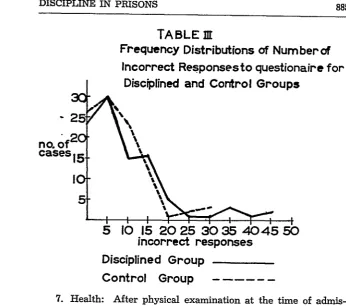
ilar to the control group, but the extreme cases are all in the disciplined group; no cases above 30 incorrect responses are in the control group, while five of the disciplined group show 35 or more neurotic responses.
[image:6.454.48.375.92.383.2]L. M. HANKS, JR.
5. Background: If the convict at time of admission claimed residence in a town under 5,000 in population, he was classified as coming from a rural background; if from a town of larger popula-tion, he was classified as urban. Table IV shows the disciplined and control group divided on this basis. We observe that there are slightly more in the disciplined group from an urban background and slightly fewer in the disciplined group from rural background. The difference, though indicative of a tendency, is not statistically reliable (Diff/SD diff - 2.46).
TABLE IV
Distribution of Disciplined. and Control Groups According to Size of Resident Community
Urban Rural
Disciplined ... 80 20 Control ... 66 34
Total ... 146 54
6. Marital State: The individuals were classified at time of admission according to marital state, whether married, single, divorced, separated or widowed. Table V represents the results of this classification, the divorced, separated and widowed being grouped together. From this table we observe: (1) There are fewer in the disciplined group who are married than would be expected by chance. This difference is reliable (Diff/SD diff - 4.0).
(2) Somewhat more persons are in the disciplined group who are single than one would expect by chance. This difference is statisti-cally reliable (Diff/SD diff - 3.58). (3) No significant difference exists between the disciplined and control group for those who were separated, divorced or widowed.
TABLE V
Distribution of "Disciplined and Control Groups According to Marital Status
Divorced Separated Married Single Widowed
Disciplined ... 10 72 18 Control ... 32 48 20
Total ... 42 120 38
DISCIPLINE IN PRISONS 885
TABLE
Mi
Frequency Distributions of Numberof
Incorrect Responsesto questionaire for
Disciplined and Control Groups
.25-no. of
20
cases1
55
10
15 20 25 3035 404550
incorrect responses
Disciplined Group
Control Group
7. Health: After physical examination at the time of
admis-sion the individuals were roughly rated as to state of health into three groups: good, fair and poor. No reliable differences between the disciplined and the control groups on these ratings of health were found.
Conclusions
Should one be requested on the basis of these findings to characterize the convict who is most likely to become involved in disciplinary difficulties, he might be characterized as follows:
[image:8.454.38.385.74.380.2]886 L. M. HANKS; JR.
problem, while if he is over 45, he is less apt to be a disciplinary problem. (8) He is more apt to be single than married. These
may be considered as the probable characteristics of the offender who is going to be a disciplinary problem.
The question may be asked whether these characteristics are unified. Do they indicate a single, recognizable type or pattern? Certainly it is probably nothing new for a prison administrator to find that a young, single offender against property from the-city is more apt to be a disciplinary problem than an older man from the country. Again, although we were unable to confirm it abso-lutely, the prison administrator knows that the habitual offender is more apt to be a model prisoner than he who has had only one or two previous convictions. In line with our findings regarding the psychoneurotic inventory, the man who has been disciplined several times is apt to be nervous, perhaps tends to become neurotic. How-ever, the administrator will think of all these as different types of convicts. We have no reason to believe that they would represent any single type. Certainly the wide variety of offenses which lead to solitary confinement, varying from a continuous series of minor offenses to such major ones as insolence to a guard and escaping, would lead one to expect no single type of offender. Thus; if these evidences are sufficient, we may say that there are likely to be many kinds of offenders against discipline. The discovered char-acteristics may amass several types, no one of which is distinct or separate.
There is one objection that can be raised against this study. It is indicated that the attitude of the guards may often be largely responsible as a causal factor in sending men to solitary confine-ment. If the attitudes of the guards were the important factor, all of the foregoing tabulation would be useless. No direct evidence to answer this objection is available. From casual observation of the names of guards who turn in conduct reports to the Deputy Warden, a difference in frequency of these reports among various guards certainly is apparent. Some guards report many more breaches of conduct than others. This may be interpreted as being a measure of officiousness, ill will or sadism on the part of a guard, but this interpretation is not necessary for the following reasons:
DISCIPLINE IN PRISONS 887
the individual convict must overtly misbehave for the offenses, we found, such as fighting, insolence, continued talking, etc. (3) Even though there is wide variation in the number of offenses reported
by various guards, this is, in part, a function of the situation in
which the guard is found; for example in the prison school a large number of misconduct reports were made even though there were several different guards stationed there. (4) If personal likes and dislikes of the guards were the sole factor in causing commitment to solitary confinement, we should not have found the distinguish-ing characteristics that have already appeared. One guard would not dislike single men above all others, another dislike men between the ages of 15 and 25. Likes and dislikes do not run on such a basis. For these reasons we believe that the effect of the individual whims of the guards is not very important in defining the foregoing results.
Indications for Future Work
We believe that these easily available characteristics are of only slight value in determining who shall be the offenders against prison rules. More fruitful would be an attempt to define a number of types of convicts who are disciplinary problems and then to validate these types with objectiiie criteria. Some such criteria might be: The attitude toward prison and society in general; expectation of future employment and the degree to which plans for the future have been made; the status in society from which the individual has come. These and others might be important as criteria of types of offenders. Then by determining the individual approximation to these types, a prediction of disciplinary difficulties may be made. We believe that this approach toward a definition of type of offenders is the most promising step to follow in the pursuit of this problem.
Summnary