© 2017, IRJET | Impact Factor value: 5.181 | ISO 9001:2008 Certified Journal | Page 2248
A REVIEW ON CRYOGENIC ROCKET ENGINE
Bhaskar Thakur
1, Indra Jyoti Pegu
21,2
Student, Dept. of Mechanical Engineering, Guru Nanak Dev Engineering college, Punjab, India
---***---Abstract
-Cryogenic engines are commonly used in rocketsfor launching geosynchronous class satellites This paper is all about Cryogenic Technology used in rocket’s engine for all its space missions & its applications. This technology consists of use of two basic elements of universe Liq. Hydrogen(-253°C) &Liq. Oxygen (-183°C). This engine follows Newton’s basic 3rd law of motion. This is the only engine that gives 100% efficiency without any greenhouse emissions or pollution up to the date on earth.
Key Words:Cryogenic Engine, Rocket Engine, Cryogenic Temperature, Liquid Hydrogen and Oxygen, Newton
third law of Mechanics.
1.INTRODUCTION
Cryogenic originated from two Greek word “Kyros” which means cold or freezing “gene” which means burn or produced [1]. Cryogenic is the study of production of very low temperature nearly about ‘123 k’ in which the material behavior and properties are studied at that temperature. Cryogenic engine is a type of rocket engine designed to use the fuel or oxidizer which must be refrigerated to remain in liquid state [2].Liquid propellant Rocket engine(LPRE) are commonly used in space technology. Thrust chamber is one of the most important subsystem of a rocket engine. The liquid propellant (i.e.…liquid hydrogen and liquid oxygen) are metered, injected, atomized, vaporized, mixed and burned to form hot reaction gas product, which in turned are accelerated and ejected at supersonic velocity [3]. Payload capacity of the space vehicle can be increased with the propulsion system having higher specific impulse, in general liquid propellant engines result in longer burning time than conventional solid rocket engine which result in higher specific impulse [4].
2. HISTORY OF TECHNOLOGY
This Rocket Technology has a great History involving many giant nations including USA, Russia, Japan, France etc. A close competition was lead in later half of 20th Century for this technology since it's invention by USA. When USA successfully launched its 1st Atlas V rocket in 1963 boosted up the cold war between Russia & USA which played a significant role in rapid advancement in this technology in such a short period of time. After USA Russia started its tests of launch vehicles. Firstly, Russia carried a dog named ‘Linus’ in space in 1983. Russia was first to take human in space using sputnik. During this period lot of European countries
were trying their rockets with same technologies &succeeded later, But no human being till 1985.
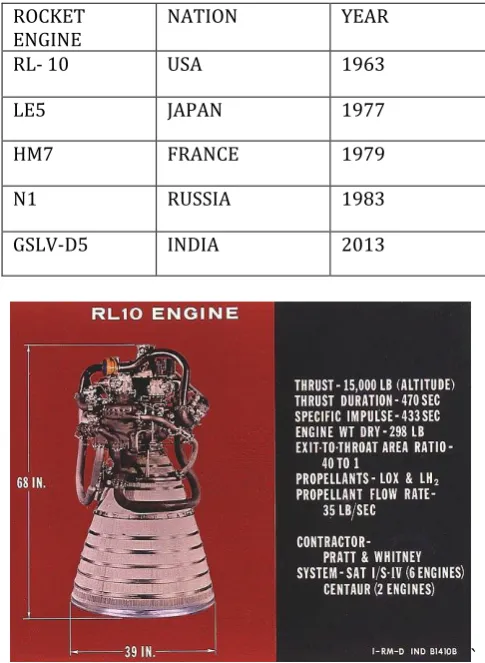
TABLE 1. Development of cryogenic engine (country)
ROCKET
ENGINE NATION YEAR
RL- 10 USA 1963
LE5 JAPAN 1977
HM7 FRANCE 1979
N1 RUSSIA 1983
GSLV-D5 INDIA 2013
[image:1.595.312.555.248.580.2]`
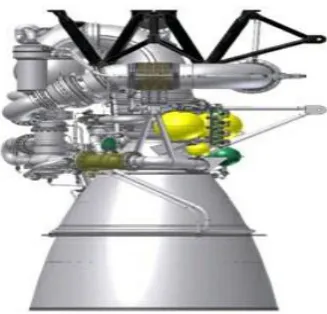
Fig 1. RL 10 Engine
2.1 India
© 2017, IRJET | Impact Factor value: 5.181 | ISO 9001:2008 Certified Journal | Page 2249
3. CRYOGENIC TECHNOLOGY
A cryogenic technology is the process of involvement or including of usage of rocket propellants at a cryogenic temperature. It can be the combination of liquid fuels such as: Liquid Oxygen (LOX), and liquid hydrogen (LH2) as an oxidizer and fuel in the different mixtures or proportions. The mixture of fuels offers the highest energy efficiency for the rocket engines that produces very high amount of thrust. Here, the oxygen remains liquid only at the temperature below (–183 C) and hydrogen at below (–253 C). This is a type of rocket engine that is functionally designed to use the oxidizer which must be refrigerated in the liquid state. Sometimes, the liquid nitrogen (LN2) is sometimes used as a fuel because the exhaust is also nitrogen. Liquid oxygen is injected below critical temperature but above critical pressure. In our atmosphere nitrogen is nearly about 78%. Nitrogen is a non-pollutant gas and during exhaust no other harmful gases are produced. Hence its efficiency is very high than any other Jet engines.
[image:2.595.36.289.502.667.2]
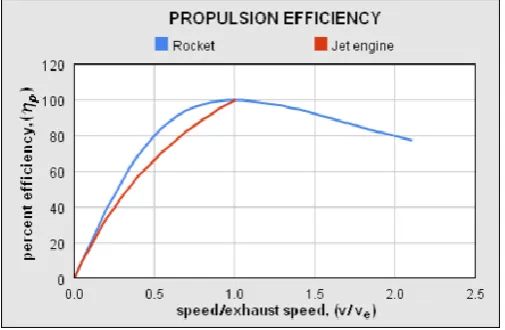
According to Newtonian third law of mechanics: ‘Action and Reaction are equal and opposite in direction’. Rocket engine operates through force of its exhaust pushing it backwards. Thrust is in opposite direction and more efficient in lower atmosphere or vacuum (sometimes). It makes the use of liquid oxygen as an oxidizer and liquid hydrogen as fuel. Pure liquid oxygen as oxidizer operates significantly at hotter combustion chambers due to which extremely high heat fluxes are produced which is not available in any jet engines. In jet engines petrol, diesel, kerosene, gasoline, LPG, CNG and PNG, etc., are used having the properties of hydrocarbons[2].
Fig 2 Propulsion Efficiency curve
4. COMPONENTS
4.1 Gas Generator
The gas generator is used to drive the turbo by a gas flow. The gas generated produces this energy by pre-burning
some amount of liq. Fuel. Use of Gas generator aligned with Turbo pump increases the efficiency of this engine.
4.2Turbo Pumps
The working of this engine is very easy to understand as it does not involve any complicated cycles or any reciprocating mechanism. The fuel from tanks is firstly passed through the turbo pumps which rotates at a speed of about 14000 rpm by which the mass flow rate of fuel increases to about 2.4 tons before reaching the combustion chamber.
4.3 Injector
Injector plays the most key role in the rocket engine it is like heart of the engine that pumps out the appropriate amount of fuel from the turbo pump to the combustion chamber as per requirement. Injector ensures the stability of the combustion chamber therefore deigning of injector is the most challenging part of the designs department of cryogenic engine even today. The frequency of the combustion chamber is to be maintained between 100-500 cycles per second. If this rate is affected even slightly shifted above or below leads to the failure of engine which has been seen in tragedy of ‘Discovery Spacecraft’. But if injector is so designed to increase the specific impulse more than 700 Space crafts can travel much long distances in the universe. Injector is the only component of this engine which is still under construction yet.
4.4 Combustion Chamber
Finally, when this finely distributed fuel droplets enter the thrust chamber at such high velocities & at their cryogenic temperatures they colloid to each other in the trust chamber, this reaction at such specific conditions increases the pressure of chamber to about 250 bars with a release of huge amount of thrust which is more than 15000 lb.
This high amount of trust is then manipulated bay narrow opening towards the nozzle. The opening is kept narrow to follow law of rate of discharge which states that ‘velocity is inversely proportional to area’. By this technique we get the desirable amount of thrust which helps a space craft to achieve its escape velocity. Due this reaction in continues period the temperature of Combustion Chamber as well as nozzle raises up to 3000-4000°C. To withstand such an elevated temperature for extended period of time without any deformation a cooling Jacket is required.
4.5. Cooling Jacket
© 2017, IRJET | Impact Factor value: 5.181 | ISO 9001:2008 Certified Journal | Page 2250 the tubes provided from between the jackets. The liq.
propellant passed are already at their cryogenic temperature so provide a very effective cooling. This simple mechanism permits the. Use of this technology throughout its journey without any deformation in Combustion chamber or Nozzle. When all these components work in their perfect algorithm, only then we can achieve our goal a successful launch of a space vehicle for its space mission.
4.6. NOZZLE
[image:3.595.34.290.312.467.2]The pressure generated in combustion chamber can be used increased thrust by acceleration of combustion gas to high supersonic velocity. Nozzle generally passes parabolic enters. Because when high velocity gases entrance and at exit of the nozzle, pressure of exhaust gas increases with high value and hence velocity and hence velocity reduces [5].
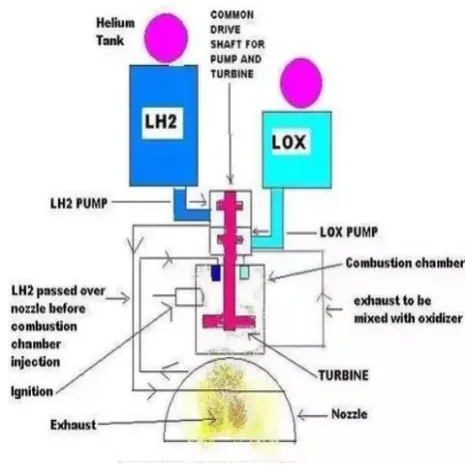
Fig 3. Construction of rocket engine
5. WORKING
Cryogenic Engines are rocket motors designed for liquid fuels that must be held at very low "cryogenic" temperatures to be liquid - they would otherwise be gas at normal temperatures. Typically, Hydrogen and Oxygen are used which need to be held below 20°K 423°F) and 90°K (-297°F) to remain liquid.
The engine components are also cooled so the fuel doesn't boil to a gas in the lines that feed the engine. The thrust comes from the rapid expansion from liquid to gas with the gas emerging from the motor at very high speed. The energy needed to heat the fuels comes from burning them, once they are gasses. Cryogenic engines are the highest performing rocket motors. One disadvantage is that the fuel tanks tend to be bulky and require heavy insulation to store the propellant. Their high fuel efficiency, however, outweighs this disadvantage.
The Space Shuttle's main engines used for liftoff are cryogenic engines. The Shuttle's smaller thrusters for orbital
maneuvering use non-cryogenic hypergolic fuels, which are compact and are stored at warm temperatures. Currently, only the United States, Russia, China, France, Japan and India have mastered cryogenic rocket technology.
The cryogenic engine gets its name from the extremely cold temperature at which liquid nitrogen is stored. Air moving around the vehicle is used to heat liquid nitrogen to a boil. Once it boils, it turns to gas in the same way that heated water forms steam in a steam engine. A rocket like the Ariane 5 uses oxygen and hydrogen, both stored as a cryogenic liquid, to produce its power. The liquid nitrogen, stored at -320 degrees Fahrenheit, is vaporized by the heat exchanger. Nitrogen gas formed in the heat exchanger expands to about 700 times the volume of its liquid form. This highly pressurized gas is then fed to the expander, where the force of the nitrogen gas is converted into mechanical power [6].
Fig 4. Working principle of cryogenic rocket engine
6.CRYOGENIC FUELS/PROPELLANT
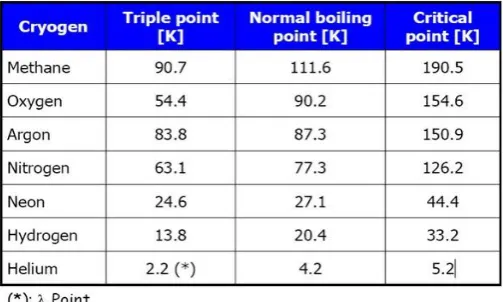
[image:3.595.325.558.337.571.2]© 2017, IRJET | Impact Factor value: 5.181 | ISO 9001:2008 Certified Journal | Page 2251 Table 2. Characteristic temperatures of cryogenic fluids
Liquid Neon is a clear, colorless liquid with boiling point
at 27.1 K and commonly used in neon advertising boards. It‟s also used as cryogenic refrigerant and this cryogen is compact, inert and less expensive as compared to liquid Helium. [image:4.595.41.293.129.280.2]Liquid Nitrogen boils at 77.3 K and freezes at 63.2 K. It exists in two stable isotopes N14 & N15 in ratio of 10000:38. Heat of vaporization of this fluid is 199.3 KJ and it is produced by distillation of liquid air. Nitrogen is primarily used toprovide an inert atmosphere in chemical and metallurgical industries. It is also used as a liquid to provide refrigeration. For food preservation, blood, cells preservation liquid Nitrogen is used and it is has property of high temperature superconductivity. Liquid oxygen (LOX) is in blue color due to long chains of O4. Density of LOX is 1141 kg/m3. O2 is slightly magnetic and exists in 3 stable isotopes- O16, O17, and O18 in ratio of 10000:4:20. Because of the unique properties of oxygen, there is no substitute for oxygen in any of its uses- widely used in industries and for medical purpose. It is largely used in iron and steel manufacturing industry. It applies in Oxidizer propellant for spacecraft rocket[9].
Table 3. Properties of cryogen
Cryongenic Critical pressure (Mpa)
Density
(kg/m3) Latent Heat (kJ/kg)
oxygen 5.08 1141 213
Air 3.92 874 205
Nitrogen 3.39 807.3 199.3
Hydrogen 1.315 70.79 443
Helium 0.229 124.8 2090
7. ADVANTAGES
Storable liquid stages of PSLV and GSLV engines used presently release harmful products to the environment. The trend worldwide is to change over to eco-friendly propellants. Liquid engines working with cryogenic propellants (liquid oxygen and liquid hydrogen) and semi cryogenic engines using liquid oxygen and kerosene are considered relatively environment friendly, non-toxic and non-corrosive. In addition, the propellants for semi-cryogenic engine are safer to handle & store. It will also reduce the cost of launch operations. This advanced propulsion technology is now available only with Russia and USA. India capability to meet existing mission requirements. The semi cryogenic engine will facilitate applications for future space missions such as the Reusable Launch Vehicle, Unified Launch Vehicle and vehicle for interplanetary missions.
(1)High Specific Impulse. (2)Non-toxic and non-corrosive propellants. (3)Non-hypergolic, improved ground safety.
8. DISADVANTAGES
(1) Low density of liquid Hydrogen-More structural mass. (2)Low temperature of propellants -Complex storage. (3)Transfer systems and operations. (4)Hazards related to cryogens.
(5)Overall cost of propellants relatively high (6) Need for ignition system.
9. NEXT GENERATION CRYOGENIC ENGINE
If things go as planned, the Indian Space Research Organization (ISRO) will flight-test the semi-cryogenic engine, which uses refined kerosene as propellant, by 2021. With the success of the Geosynchronous Satellite Launch Vehicle Mk-III (GSLV Mk-III), ISRO’s Liquid Propulsion Systems Centre (LPSC) here at Valiyamala is now focusing on the next level – the development of the much-delayed semi-cryogenic technology.
© 2017, IRJET | Impact Factor value: 5.181 | ISO 9001:2008 Certified Journal | Page 2252 the semi-cryo. The rocket will retain the cryogenic upper,
third stage.
The advantage of inducting the semi-cryogenic stage is the payload capacity of the GSLV Mk-III will increase from four tonnes to six tonnes. Using refined kerosene as fuel has quite a few advantages: It is eco-friendly and cost-effective [8].
[image:5.595.69.233.195.352.2]Fig 5. semi cryogenic engine
10. CONCLUSION
Cryogenic propellants in liquid rocket engine provide high specific impulse which is suitable for use in rocket upper and booster stages. Also, while comparing Rocket engine with jet engine, thrust produced in rocket engine is outwards and that in the jet engine is inwards. Hence this efficiency cannot be achieved by any other engine. From the analysis result it is found that cryogenic rocket engine with the propellant combination of LH2/LOX is suitable for design of upper stage rocket.
REFERANCE
[1] N Y Mohite et al, “Cryogenic- Birth of an era”, Proceeding of the national conference on Innovation Paradigm in engineering and technology, 2012
[2]Akhil Chhaniyara, “Cryogenic Rocket Engine”, International journal of Mechanical engineering and robotics Research, vol. 2, no. 2, October 2013
[3] Aneema Babu et al, “Fatigue life Prediction of s rocket combustion chamber”, (ISOR-JMCE), vol. 11, Sep-oct 2014 [4] S. senthilkumar et al, “(IJERT), vol. 2, August 2013 [5] Yash muthe et al, study of cryogenic rocket engine, “International journal of advance Technology in engineering and science, vol. 3, March 2015
[6] Akhil Garg et al, “cryogenic technology and rocket engine”, International journal of Aerospace and Mechanical engineering, vol. 2, No. 5 August 2015
[7]http://www.google.co.in/images/cryogenicrocket engine.
[8] http://www.vssc.gov.in/VSSC_V4/index.php/retired- employee-portal/57-technology/1338-semicryogenic-propulsion-2,accessed 22 August 2017