http://dx.doi.org/10.4236/ojs.2014.410082
Model Detection for Additive Models with
Longitudinal Data
Jian Wu, Liugen Xue
1College of Applied Sciences, Beijing University of Technology, Beijing, China 2College of Science, Northeastern University, Shenyang, China
Email: [email protected],[email protected]
Received 1 October 2014; revised 28 October 2014; accepted 15 November 2014
Copyright © 2014 by authors and Scientific Research Publishing Inc.
This work is licensed under the Creative Commons Attribution International License (CC BY).
http://creativecommons.org/licenses/by/4.0/
Abstract
In this paper, we consider the problem of variable selection and model detection in additive mod-els with longitudinal data. Our approach is based on spline approximation for the components aided by two Smoothly Clipped Absolute Deviation (SCAD) penalty terms. It can perform model selection (finding both zero and linear components) and estimation simultaneously. With appro-priate selection of the tuning parameters, we show that the proposed procedure is consistent in both variable selection and linear components selection. Besides, being theoretically justified, the proposed method is easy to understand and straightforward to implement. Extensive simulation studies as well as a real dataset are used to illustrate the performances.
Keywords
Additive Model, Model Detection, Variable Selection, SCAD Penalty
1. Introduction
Longitudinal data arise frequently in biological and economic applications. The challenge in analyzing longitudinal data is that the likelihood function is difficult to specify or formulate for non-normal responses with large cluster size. To allow richer and more flexible model structures, an effective semi-parametric regression tool is the additive model introduced by [1], which stipulates that
( )
( )
1,
d l l l
Y
µ
m Xε
=
= +
∑
+ (1)where Y is a varaible of interest and
(
( )1, , ( ))
T d
unknown constant, and
( )
( )
( ) 1d l
l l
m X =
∑
=m X are unknown nonparametric functions. As in most work onnonparametric smoothing, estimation of the non-parametric functions
( )
( )
( ) 1d l
l l
m X =
∑
=m X is conducted on acompact support. Without loss of generality, let the compact set be X =
[ ]
0,1d and also impose the condition( )
( )
l 0l
E m X = which is required for identifiability of model (1.1), l=1,,d. We propose a penalized
method for variable selection and model detection in model (1.1) and show that the proposed method can correctly select the nonzero components with probability approaching one as the sample size goes to infinity.
Statistical inference of additive models with longitudinal data has also been considered by some authors. By extending the generalized estimating equations approach, [2] studied the estimation of additive model with longitudinal data. [3] focuses on a nonparametric additive time-varying regression model for longitudinal data.
[4] considered the generalized additive model when responses from the same cluster are correlated. However, in semiparametric regression modeling, it is generally difficult to determine which covariates should enter as nonparametric components and which should enter as linear components. The commonly adopted strategy in practice is just to consider continuous entering as nonparametric components and discrete covariates entering as parametric. Traditional method uses hypothesis testing to identify the linear and zero component. But this might be cumbersome to perform in practice whether there are more than just a few predictor to test. [5] proposed a penalized procedure via the LASSO penalty; [6] presented a unified variable selection method via the adaptive LASSO. But these methods are for the varying coefficient models. [7] established a model selection and semiparametric estimation method for additive quantile regression models by two-fold penalty. To our know- ledge, the model selection and variable selection simultaneously with longitudinal data have not been investi- gated. We make several novel contributions: 1) We develop a new strategies for model selection and variable selection in additive model with longitudinal data; 2) We develop theoretical properties for our procedure.
In the next section, we will propose the two-fold SCAD penalization procedure based on QIF and compu- tational algorithm; furthermore we present its theoretical properties. In particular, we show that the procedure can select the true model with probability approaching one, and show that newly proposed method estimates the non-zero function components in the model with the same optimal mean square convergence rate as the standard spline estimators. Simulation studies and an application of proposed methods in a real data example are included in Sections 3 and 4, respectively. Technical lemmas and proofs are given in Appendix.
2. Methodology and Asymptotic Properties
2.1. Additive Models with Two Fold Penalized Splines
Consider a longitudinal study with n subjects and ni observations over time for the ith subject
(
i=1,,n)
for a total of
1
n i i
N=
∑
=n observation. Each observation consists of a response variable Yij and a covariate vector Xij∈Rd taken from the ith subject at time tij. We assume that the full data set(
)
{
X Yij, ij ,i=1,, ,n j=1,,ni}
is observed and can be modelled as
( )
( )
1, 1, , , 1, , ,
d l
ij l ij ij i
l
Y
µ
m Xε
i n j n=
= +
∑
+ = = (2)where εij is random error with E
(
εij Xij)
=0 and 2 εσ
.At the start of the analysis, we do not know which component functions in model (1.1) are linear or actually
zero. We adopt the centered B-spline basis, where B X
( )
={
Bs l,( )
xl :1≤ ≤l d,1≤ ≤s J}
T is a basis system( )
( )
{
(
) ( )
}
( ), 1, 1, 1, 1, l
s l l s l l s l l l x
B x = K b + x − E b+ E b b and
( ) ( )
1d l l
x = x = . Equally-spaced knots are used in this
( )
( )
( )
( )( )
( ) , 1 . Jl sp l l
l l sl s l
s
m x m x
β
B x=
≈ =
∑
(3)To simplify notation, we first assume equal cluster size ni = < ∞m , and let βl =
(
β1l,,βJl)
T,{
T T}
T00 1
1 , , , d
Jd
β
β β
β
+= be the collection of the coefficients in (2.3), and µ β= 00, denote
( )
{
( )
( )( )
( )}
T1, ,
1 , ,
l l l
ij l ij J l ij J
B X B X
× =
B and
{
( ) ( )}
( )
T
1 T T
1 1 1, , , d
ij ij ij
Jd+ ×
=
B B B , then we have an approximation
( )
Tij ij
m
µ+ X =B β. We can also write the approximation of (2.1) in matrix notation as
T ,
i = i
β ε
+ iY B (4)
where
{
,1, ,}
T ( 1) ii= i im n×Jd+
B B B , Yi =
{
Y Yi1, i2,,Yim}
T and εi ={
ε εi1, i2,,εim}
T. [8] introduced the QIF that approximates the inverse of R by a linear combination of some basis matrixes, i.e.1
0 1 1 K K,
a a a
− ≈ + + +
R I M M
where I is the identity and Mi are known symmetric basis matrices and a a0, 1,,aK are unknown
constants. The advantage of the QIF approach is that it does not require the estimation of the linear coefficients
i
a 's associated with the working correlation matrix, which are treated as nuisance parameters here.
( )
( )
{
}
{
}
{
}
T 1
T 1 2 1 2 1
1 1
T 1 2 1 2
1 1
.
i i i i
n n
i i i i i
n i
i i
i i K i i i
n n β β β β β − − − = = − − − − = = −
∑
∑
B A Y B
B A M A Y B
G g
B A M A Y B
(5)
The vector Gn
( )
β
contains more estimating equations than parameters, but these estimating equations can be combined optimally using the generalised method of the moment. So according to [8], the QIF approach estimates β by setting Gn as close to zero as possible, in the sense of minimizing the quadratic inference function Qn( )
β
.( )
T( )
1( ) ( )
,
n
β
n nβ
nβ
nβ
− =
Q G C G (6)
where
( )
( ) ( )
1 1 1 . n Tn i i
i
n
β
β
β
−
=
=
∑
C g g
Our main goal is to find both zero components (i.e., mj ≡0) and linear compoents (i.e., mj is a linear function). The former can be achieved by shrinking mspj to zero. For the latter, we want to shrink the second derivative msp ''j( ) to zero instead. This suggests the following minimization problem
( )
( )
(
( ))
1 2
1
ˆ arg min d sp d sp '' ,
n l l
l l l
n pλ m n pλ m
β
β
β
= =
= Q +
∑
+∑
(7)where
( )
1pλ ⋅ and pλ2
( )
⋅ are two penalties used to find zero and linear coefficients respectively, with two regularization parameters λ1 and λ2, and sp T ( )ll l
m =
β
B , B( )l ={
B1,l,B2,l,,BJ l,}
T. Note that since ( ) 2(
( )
)
(
( )
)
2 T
ˆ l d
sp
l l k kl kl k k l k l
m =
β
B =∫
∑
β
B x∑
′β
′B′ x x and( ) 2 ( ) 2 ( )
( )
( )( )
T
ˆ d ,
sp '' l '' '' l l kl kl k l k l
k k
m β β B x β ′B′ x x
′ = =
∑
∑
∫
B sp lm and mlsp ''( ) can be equivalently written as T l
l l l l
β = β β
D D and
T
l
l l l l
β = β β
with
(
k k, ′)
entry of Dl being 1( ) ( )
0Bkl x Bk l′ x dx
∫
.2.2. Asymptotic Properties
To study the rate of convergence for µˆ and
β
ˆ, we first introduce some notations and present regularity conditions. We assume equal cluster sizes(
ni= < ∞m)
, and(
Y Xi, i)
,i=1,,n are i.i.d. from(
Y X,)
with(
)
T1, ,
i= Yi Yim
Y , and Xi=
(
XiT1,,XimT)
T. For convenience, we assume that mj( )
⋅ is truly nonparametric for 1≤ ≤j d1, is linear for d1+ ≤ ≤1 j d1+d2 =s, and is zero for s+1≤ j≤d. The asymptotic result still hold for data with unequal cluster sizes mi using a cluster-specific transformation as discuss in [4]. For any matrix A, A denotes the modulus of the largest singular value of A. To prove the theoretical arguments, we need the following assumptions:(A1) The covariates Xi=
{
XiT1,,XimT}
T are compactly supported, and without loss of generality, we assume that each XijT has support χ=[ ]
0,1d. The density of XijT, denoted by fj( )
x , is absolutely conti- nuous and there exist constants C1 and C2 such that 0<C1≤minx∈χfj( )
x ≤C2< ∞ for all j=1,,m.(A2) Let e= − −Y
µ
m( )
X . Then TEee
Σ = is positive definite and for some δ >0, E e2+δ < +∞. (A3) For each l=1,,d, ml
( )
⋅ has r continuous derivatives for some r≥2.(A4)
( )
T 1 2 1 2
1
0
T 1 2 1 2
1
lim .
i i i i n
n
i i K i i
E J
n
β
− −
→∞
− −
= =
B A M A B G
B A M A B
(8)
(A5) Let M=
(
M0T,,MkT)
T. Assume the modular of the singular value of M is bounded away from 0 and infinity.(A6) The matrix A defined in Theorem 3 is positive definite.
Theorem 1. Suppose that the regularity conditions A1-A5 hold and the number of knots K=Op
(
n1 2( r+1))
,1, 2 0
λ λ → . Then there exists a local minimizer of (2.7)such that
( )
(
2 1)
0
ˆ Op n r r , µ µ− = − +
( )
( )
{
}
2(
2 (2 1))
1 1 1
1 ˆ
max .
i
m n
r r l l p l dni j m x m x O n
− +
≤ ≤
∑∑
= = − =For mi =m=1, it reduces to a special case where the responses are i.i.d. The rate of convergence given here is the same optimal rate as that obtain for polynomial spline regression for independent data [9] [10]. The main advantage of the QIF approach is that it incorporates within-cluster correlation by optimally combing estimating equations without estimating the correlation parameters. the estimator of two fold penalized QIF achieve the same rate of convergence as un-penalized estimator. Furthermore, we prove that the penalized estimators
{ }
1ˆ d
l l
β
= in Theorem 1 possess the sparsity property, mˆl =0 almost surely for l= +s 1,,d. The sparsity property ensures that the proposed model selection is consistent, that is, it selects the correct variables with probability tending to 1 as the sample size goes to infinity.
Theorem 2. Under the same assumptions of Theorem 1, and if the tuning parameter nr(2r+1)min
{
λ λ1, 2}
→ ∞. Then with probability approaching 1.a) ˆmj ≡0, 1s+ ≤ ≤j d
b) ˆmj is a linear function for d1+ ≤ ≤1 j s
Finally, in the same spirit of that [11], we come to the question of whether the SIC can identify the true model in our setting.
Theorem 3. Suppose that the regularity conditions A1-A5 hold and the number of knots K=Op
(
n1 2( r+1))
as assumed in Theorem 1, The parameters λˆ1 and λˆ2 selected by SIC can select the true model with pro- bability tending to 1.3. Simulation Study
In this section, we conducted Monte Carlo studies for the following longitudinal data and additive model. the continuous responses
{ }
Yij are generated from( )
( )
1, 1, , , 1, , 5
d l ij l ij ij
l
Y m X
ε
n j=
=
∑
+ = (9)where d=10 and the number of clusters n=100, 250, 500. The additive functions are
( )
(
)
(
(
)
)
( ) (
)
2( )
( )
( )
1 5sin 2π 2 sin 2π , 2 8 0.5 , 3 2 , 4 , 5
m x = x − x m x = x− m x = x m x =x m x = −x. Thus the last 5
variables in this model are null variables and do not contribute the model. The covariates
(
( ) ( ))
T1 10
, ,
ij = Xij Xij
X
are generated independently from uniform. The error εi=
(
εi1,,εi6)
T follows a multivariate normal distribu- tion with mean 0, a common marginal variance σ =2 1, it has first-order autoregressive (AR-1) and an com- pound symmetry (CS) correlation (i.e. exchangeable correlation) structure with different within correlation coefficient, and consider ρ =0.8 and ρ =0.3 representing a strong and weak within correlation structure.The predictors
(
( ) ( ))
T1 10
, ,
ij = Xij Xij
X are generated by Xij( )l = Φ
( )
Zij( )l , Zij =(
Zij( )1,,Zij( )l)
N( )
0,Σ , 1, , , 1, ,i= n j= m, where Φ is the standard normal c.d.f. and
(
)
( ) T 1 r d d× r d dΣ = − I + 1 1 . The parameter
(
0 1)
r ≤ <r controls the correlation between Zij( )l ,1≤
( )
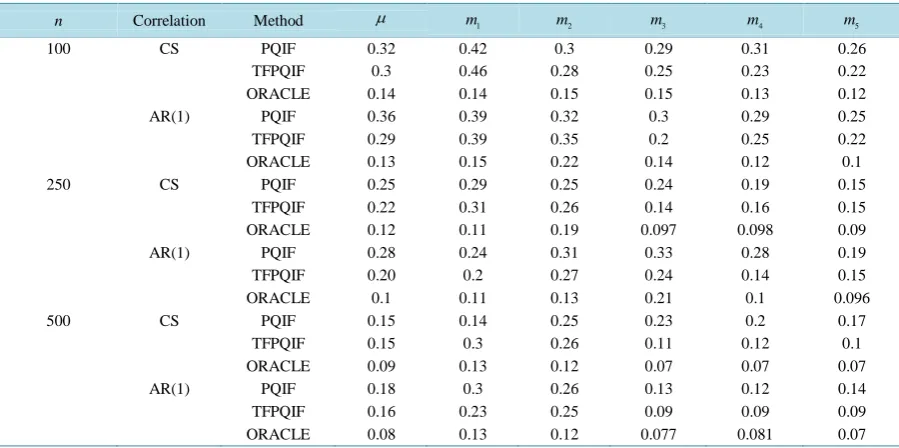
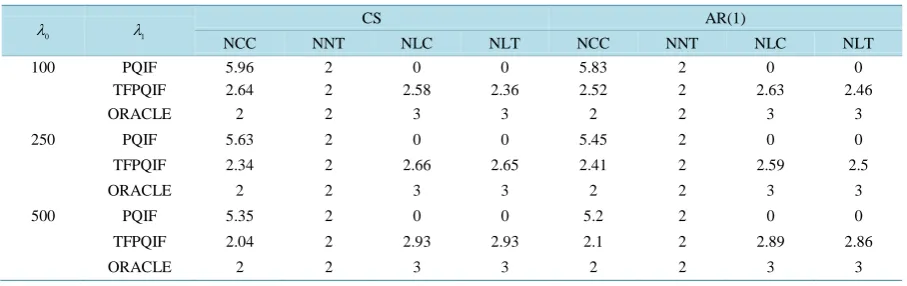
l ≤d . [image:5.595.88.538.498.722.2]To illustrate the effect on estimation efficiency, we compare the penalized QIF approach in [4] (PQIF) and an Oracle model (ORACLE). here the full model consists of all ten variable, and oracle model only contains the first five relevant variables and we know it’s a partial additive model. The oracle model is only available in simulation studies where the true information is known. In all simulation, the number of replications is 100 and the result are summarized in Table 1 and Table 2. In Table 1, the model selection result for both our procedure
Table 1. The estimation results for our estimator (TFPQIF) and sparse additive estimator (PQIF) and ORACLE esitmator.
n Correlation Method µ m1 m2 m3 m4 m5
100 CS PQIF 0.32 0.42 0.3 0.29 0.31 0.26
TFPQIF 0.3 0.46 0.28 0.25 0.23 0.22
ORACLE 0.14 0.14 0.15 0.15 0.13 0.12
AR(1) PQIF 0.36 0.39 0.32 0.3 0.29 0.25
TFPQIF 0.29 0.39 0.35 0.2 0.25 0.22
ORACLE 0.13 0.15 0.22 0.14 0.12 0.1
250 CS PQIF 0.25 0.29 0.25 0.24 0.19 0.15
TFPQIF 0.22 0.31 0.26 0.14 0.16 0.15
ORACLE 0.12 0.11 0.19 0.097 0.098 0.09
AR(1) PQIF 0.28 0.24 0.31 0.33 0.28 0.19
TFPQIF 0.20 0.2 0.27 0.24 0.14 0.15
ORACLE 0.1 0.11 0.13 0.21 0.1 0.096
500 CS PQIF 0.15 0.14 0.25 0.23 0.2 0.17
TFPQIF 0.15 0.3 0.26 0.11 0.12 0.1
ORACLE 0.09 0.13 0.12 0.07 0.07 0.07
AR(1) PQIF 0.18 0.3 0.26 0.13 0.12 0.14
TFPQIF 0.16 0.23 0.25 0.09 0.09 0.09
Table 2. Model selction results for our estimator (TFPQIF) and sparse additive estimator (PQIF) and ORACLE esitmator.
0
λ λ1
CS AR(1)
NCC NNT NLC NLT NCC NNT NLC NLT
100 PQIF 5.96 2 0 0 5.83 2 0 0
TFPQIF 2.64 2 2.58 2.36 2.52 2 2.63 2.46
ORACLE 2 2 3 3 2 2 3 3
250 PQIF 5.63 2 0 0 5.45 2 0 0
TFPQIF 2.34 2 2.66 2.65 2.41 2 2.59 2.5
ORACLE 2 2 3 3 2 2 3 3
500 PQIF 5.35 2 0 0 5.2 2 0 0
TFPQIF 2.04 2 2.93 2.93 2.1 2 2.89 2.86
ORACLE 2 2 3 3 2 2 3 3
with the one penalty QIF when the error are Gaussian, and we also list the oracle model as a benchmark, the oracle model is only available in simulation studies where the true information is known inTable 1, in which the column labeled “NNC” presents the average number of nonparametric components selected, the column “NNT” depicts the average number of nonparametric components selected that are truly nonparametric (truly nonzero for one penalty QIF), “NLC” presents the average number of linear components, “NLT” depicts the average number of linear components selected that are truly linear.
In Table 2, we conduct some simulations to evaluate finite sample performance of the proposed method. Let
( )
ˆk
m ⋅ be the estimator of a nonparametric function mk
( )
⋅ and{ }
1M s s
u = be the grid points, the performance of
estimator mˆj
( )
⋅ will be assessed by using the square root of average square errors(RASE), we compare the performance of above estimators. On the nonparametric coponents, the errors for estimators with a single penalty and our procedure are similar, and both are qualitatively close to those of the oracle estimator. However, for the parametric components, our estimator is obviously more efficient,leading to about 40% - 50% reduction in RASE.( )
( )
2 1 2 1 11
ˆ .
M d
k s k s s k
RASE m u m u
M = =
= −
∑∑
4. Real Data Analysis
In this subsection, we analyze data from the Multi-Center AIDS Cohort Study. The dataset contains the human immunodeficiency virus, HIV, status of 283 homosexual men who were infected with HIV during the follow-up period between 1984 and 1991. All individuals were scheduled to have their measurements made during semi- annual visits. Here t iij, =1,, ,n j=1,,mi denotes the time length in years between seroconversion and the
j-th measurement of the i-th individual after the infection. [12] analyzed the dataset using partial linear models. The primary interest was to describe the trend of the mean CD4 percentage depletion over time and to evaluate the effects of cigarette smoking, pre-HIV infection CD4 percentage, and age at infection on the mean CD4 cell percentage after the infection.
In our analysis, the response variable is the CD4 cell percentage of a subject at distinct time points after HIV infection. We take four covariates for this study: X1, the CD4 cell percentage level before HIV infection; and
2
X , age at HIV infection; X3 the individual’s smoking status, which takes binary values 1 or 0, according to whether a individual is a smoker or nonsmoker; Tij denote i=1,, ,n j=1,,m, denotes the time length in years between seroconversion and the j-th measurement of the i-th individual after the infection. We construct the following additive model;
( )
( )
( )
( )2( )
( )31 1 2 3 0 .
ij
ij ij ij ij ij
Y = +µ m X +m X +m T +β X +
the partially linear additive models instead of additive model because of the binaray variable X( )3, but we not select the linear component. using our procedure, we wang to ensure which is linear component and which is zero in the non-parametirc function. For implement our procedure, linear transformation be used to the variable
( )1 ( )2 , ,
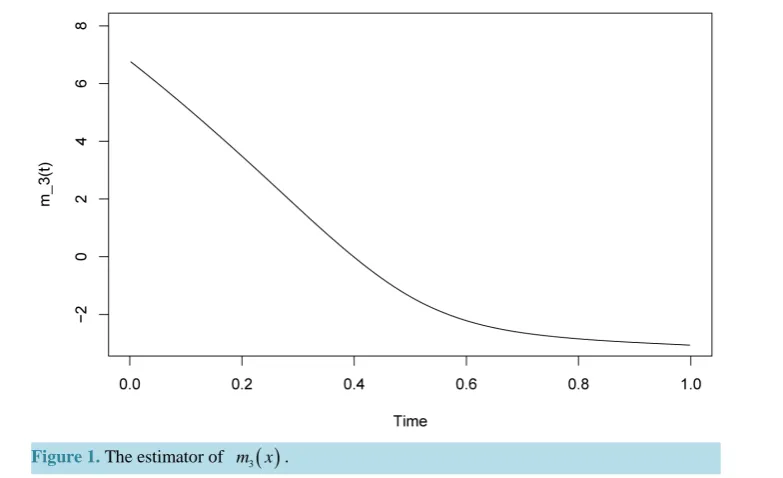
X X T . The result of our procedure select the m1 is zero function and select the m2 is a linear function,
3
Figure 1. The estimator of m x3
( )
.depletes rather quickly at the beginning of HIV infection, but the rate of depletion appears to be slowing down at four years after the infection. This result is the same as before [13].
5. Concluding Remark
In summary, we present a two-fold penalty variable selection procedure in this paper, which can select linear component and significant covariate and estimate unknown coefficient function simultaneously. The simulation study shows that the proposed model selection method is consistent with both variable selection and linear components selection. Besides, being theoretically justified, the proposed method is easy to understand and straightforward to implement. Further study of the problem is how to use the multi-fold penalty to solve the model selection and variable selection in generalized additive partial linear models with longitudinal data.
Acknowledgements
Liugen Xue’s research was supported by the National Nature Science Foundation of China (11171012), the Science and Technology Project of the Faculty Adviser of Excellent PhD Degree Thesis of Beijing (20111000503) and the Beijing Municipal Education Commission Foundation (KM201110005029).
References
[1] Hastie, T.J. and Tibshirani, R.J. (1990) Generalized Additive Models. Chapman and Hall, London.
[2] Berhane, K. and Tibshirani, R.J. (1998) Generalized Additive Models for Longitudinal Data. The Canadian Journal of Statistics, 26, 517-535. http://dx.doi.org/10.2307/3315715
[3] Martinussen, T. and Scheike, T.H. (1999) A Semiparametric Additive Regression Model for Longitudinal Data. Bio-metrika, 86, 691-702. http://dx.doi.org/10.1093/biomet/86.3.691
[4] Xue, L. (2010) Consistent Model Selection for Marginal Generalized Additive Model for Correlated Data. Journal of the American Statistical Association, 105, 1518-1530. http://dx.doi.org/10.1198/jasa.2010.tm10128
[5] Hu, T. and Xia, Y.C. (2012) Adaptive Semi-Varying Coefficient Model Selection. Statistica Sinica, 22, 575-599.
http://dx.doi.org/10.5705/ss.2010.105
[6] Tang, Y.L., Wang, H.X., Zhu, Z.Y. and Song, X.Y. (2012) A Unified Variable Selection Approach for Varying Coef-ficient Models. Statistica Sinica, 22, 601-628. http://dx.doi.org/10.5705/ss.2010.121
[7] Lian, H. (2012) Shrinkage Estimation for Identification of Linear Components in Additive Models. Statistics and Probability Letters, 82, 225-231. http://dx.doi.org/10.1016/j.spl.2011.10.009
Func-tions. Biometrika, 87, 823-836. http://dx.doi.org/10.1093/biomet/87.4.823
[9] Huang, J.Z. (1998) Projection Estimation in Multiple Regression with Application to Functional ANOVA Models. The Annals of Statistics, 26, 242-272. http://dx.doi.org/10.1214/aos/1030563984
[10] Xue, L. (2009) A Root-N Consistent Backfitting Estimator for Semiparametric Additive Modeling. Statistica Sinica, 19, 1281-1296.
[11] Wang, H., Li, R. and Tsai, C.L. (2007) Tuning Parameter Selectors for the Smoothly Clipped Absolute Deviation Me-thod. Biometrika, 94, 553-568. http://dx.doi.org/10.1093/biomet/asm053
[12] Xue, L.G. and Zhu, L.X. (2007) Empirical Likehood for a Varying Coefficient Model with Longitudinal Data. Journal of the American Statistical Association, 102, 642-654.
Appendix: Proofs of Theorems
For convenience and simplicity, let C denote a positive constant that may be different at each appearance throughout this paper. Before we prove our main theorems, we list some regularity conditions that are used in this paper.
Lemma 1. Under the conditions (A1)-(A6), minimizing the no penalty QIF arg min n
( )
ββ= Q β . Then
2 2 1 0 , r r O n
µ µ− = − +
{
( )
( )
}
2(
2 (2 1))
1 1
1
1
max n mi r r .
l ij l ij p i j
l d
m x m x O n n
− +
= =
≤ ≤
∑ ∑
− =Proof: According to [14], for each l=1,,d, we can get
1
d l l
m= +µ
∑
=m satisfying the condition (4). There exists a constant C>0 and a spline function m∈Gn, such that rm m− ∞≤CK− . Using the triangular
in equality
{
( )
( )
}
2{
( )
(
0)
}
2(
2)
1 1 1 1
1 2
.
i i
n m n m r
l ij l ij l ij l l
i j m x m x i j x O K
n n β β
−
= = − ≤ = = − +
∑ ∑
∑ ∑
B Therefore, it is su-fficient to show that
(
0)
2{
( )
(
0)
}
2(
1)
1 1
1
. i
n m
l β βl l n n i j l xij β βl l Op n K
−
= =
− =
∑ ∑
− =B B According to [8] entail
that for any >0. exists sufficiently large C>0. such that n→∞
(
0inf)
( )1 2( )
( )
0 1 ,n
n n C K n
p
β β− ≤ β β
> > −
B
Q Q
therefore
(
)
1 2 0 . p n K p O n β β − =
B Furthermore, for each l=1,,d. There exists a constant C>0.
such that
(
)
(
)
1 2
2 2
0 0
.
l l p
n n
K
C O
n
β β− ≤ β β− =
B B
Proof of Theorem 1. Let
( )
( )
1( )
2( )
1 1
d d
n n j j
j j
n pλ m n pλ m
β β
= =
′′
= +
∑
+∑
L Q
be the object function in (2.7), where T
j
j j j j
β = β β
D D and
T
j
j j j j
β = β β
E E , as a special case of no
penalty QIF. Let β=arg minβ Qn
( )
β , andT
j j
m =B β , well known result is T
(
)
(
)
0 p
n O K n
β β− =
B , we
want to show that for large n and any ε >0, there exist a constant C large enough such that
( )
( )
1 2( )
( )
T 1
0
:
inf n n 1 .
C nK
p
β β β
β β
− −
− =
> ≥ −
B
L L
(A1)
As a result, this implies that Ln
( )
⋅ has a local minimum in the ball{
β
: BT(
β β
−)
}
. Thus,(
)
(
)
T 1
1
p n O nK
β β− = −
B . Further, the triangular inequality gives Tˆ p
(
(
1)
1 2 r)
.n
m O nK K
β− = − − + −
B
To show (A1), For convenience, we assume that mj is truly nonparametric for 1≤ ≤j d1 is linear for
1 1 1 2
d + ≤ ≤ =j s d +d and zero for s+ ≤ ≤1 j d.
( )
( )
( )
( )
1 11 2 2 1 1 ˆ . j j j j s
n n j n n j j j
j d
j j
j
n p p
n p p
λ λ
λ λ
β β β β β β
β β = = − ≥ − + − + −
∑
∑
D D E EL L Q Q
(A2)
Since ˆj 0j
n
β −β . Since
λ λ
1, 2 =o( )
1 . We have1 j j 1 j j 1
p p λ
β
= pλ β
→ D D
similarly,
2 j j 2 j j 1
p p λ
β
= pλ β
→
E E
. If
1
l≤d . These facts imply that
1 1
1 j 1 0
j
d d
j j
j j
n =pλ β −n =pλ β ≥
∑
D∑
D and
2 2
1 j 1 0
j
d d
j j
j j
n =pλ β −n =pλ β ≥
∑
E∑
E with probability
tending to 1. If
λ λ
1, 2=o( )
1 , max( )
jj C Dj
β ≥ λ
D , βj Ej ≥Cλmax
( )
Ej , for i=1,,d. Therefore, when n
is large enough,
1 1 1 2 1 1 1 0 j j d
j j j j n
j j
n pλ β pλ β C nK− λ β β
=
− = − →
∑
D D∑
2 2 1 2 2 2 1 0 j j d
j j j j n
j j
n pλ β pλ β C nK− λ β β
=
− = − →
∑
E E∑
By the definition of SCAD penalty function, removing the regularizing terms in (A2)
( )
( ) (
) ( ) (
T 1) ( )(
T)
{
( )
}
1 1
2
n β − n βj = β β− n βj + β β− n β β β− +op
Q Q Q Q (A3)
with Qn and Qn being the gradient vector and hessian matrix Qn, respectively. Following [8], and Lemma
A1 in supplement, for any β with T
(
)
(
1)
1 2n C nK
β β− = − −
B , one has
(
) ( ) (
T)
T T( ) ( ) ( )
1{
( )
}
( )
1 1
j n j j n j n j n j p
n β β− Q β =n β β− G β C− β G β +o =O K
and
(
) ( )(
T) (
)
T T( ) ( ) ( )(
1)
{
( )
}
( )
1 1
j n j j n j n j n j n j j op O K
β β− β β β− = β β− β − β β β β− + =
Q G C G
where Gn is the first order derivative of Gn. Therefore, by choosing C large enough, the second term on (A3) dominates its first term. therefore (A1) holds when C and n are large enough. This completes the proof of Theorem 1.
Proof of Theorem 2. We only show part (b), as an illustration and part (a) is similar. Suppose for some
1
d < ≤j s, BTjβˆj does not represent a linear function. Define
β
ˆj to be the same asβ
ˆ except that βˆj is replaced by its projection onto the subspace {β
j:BTjβ
j represents a linear function}, we have( )
( )
( ) ( )
1 12 2
ˆ ˆ ˆ ˆ ˆ
ˆ ˆ .
j j
j j
n n j n n j j j
j
j j
j
n p p
n p p
λ λ
λ λ
β β β β β β
β β − = − + − + −
∑
∑
D D E EL L Q Q
As in the proof of Theorem 1, we have
1 1
ˆ ˆ 1
j j
j j
P p λ β −pλ β →
D D
and thus with probability ap-
proaching 1
( )
( )
( )
( )
2ˆ ˆ ˆ
0 .
j
n n j n n j j j
n pλ
β β β β β
≥ − = − +
∑
EL L Q Q (A4)
(
) (
T)
1 2( )
T
0 0 2
ˆ ˆ ˆ ˆ ˆ .
j
j j j j j j j j j p
K
O o
n
β = β β = β −β β −β = = λ
E E E 2 2
ˆ
j j
j j
pλ β E = λ β
E
, with
probability tending to 1. by the definition of SCAD penalty. βˆj−βˆj =Op
(
KβˆTjEjβˆj)
,(
)
2
T T
2
ˆ ˆ ˆ ˆ .
j j j j j j
Proof of Theorem 3. For any regularization parameters
λ
=(
λ λ
1, 2)
, we denote the estimator of two fold penaltyβ
ˆλ, and denote byβ
ˆ the minimizer when the optimal sequence of regularization parameters is chosen. There are four separate cases to considerCASE 1: Bjβλj represents a linear component for some j≤d1. Similar to the proof of Theorems 1 and 2, we have
( ) ( ) (
) ( ) (
T 1) ( )(
T)
{
( )
}
ˆ ˆ ˆ ˆ ˆ ˆ ˆ ˆ ˆ ˆ 1 1 .
2
n β − n βλ = β β− λ n βλ + β β− λ n β β β− λ +op
Q Q Q Q
Since true mj not linear and βˆj is consistent in model selection, ˆ ˆ
K
λ β β−
is bounded away form zero,
thus log 1
( )
ˆ log 1( )
ˆ(
1 2) ( )
log , 2n n
n C K C
n β n βλ n
− > +
Q Q for any 0≤C C1, 2≤d, with probability tending to 1 and the SIC cannot select such λ.
CASE 2:
β
ˆλj is zero for some 1≤ ≤j s. The proof is very similar with CASE 1 and therefore omitted. CASE 3: Bjβˆj represents a nonlinear component for some d1< ≤j s. Here when considering CASE 3, we implicity exclude all previous cases that no underfitting cases.β
~ is the estimator of minimizing the no penalty QIF (2.6) 1 n( )
ˆ 1 n( )
.K O
n βλ n β n
− ≥ −
Q Q Thus log 1 n
( )
ˆ log 1 n( )
K O
n βλ n β n
− ≥ −
Q Q and
( )
log( )
( )
log( )
1 ˆ 1
log log
2 2
n n
K n d n
n βλ n n β n
+ ≥ +