ScholarWorks @ Georgia State University
ScholarWorks @ Georgia State University
Middle-Secondary Education and Instructional Technology Dissertations
Department of Middle-Secondary Education and Instructional Technology (no new uploads as of Jan. 2015) Spring 5-7-2011
Identifying Complex Cultural Interactions in the Instructional
Identifying Complex Cultural Interactions in the Instructional
Design Process: A Case Study of a Cross-Border, Cross-Sector
Design Process: A Case Study of a Cross-Border, Cross-Sector
Training for Innovation Program
Training for Innovation Program
Lillian R. Russell Ph.D. Georgia State University
Follow this and additional works at: https://scholarworks.gsu.edu/msit_diss
Part of the Education Commons
Recommended Citation Recommended Citation
Russell, Lillian R. Ph.D., "Identifying Complex Cultural Interactions in the Instructional Design Process: A Case Study of a Cross-Border, Cross-Sector Training for Innovation Program." Dissertation, Georgia State University, 2011.
https://scholarworks.gsu.edu/msit_diss/80
This Dissertation is brought to you for free and open access by the Department of Middle-Secondary Education and Instructional Technology (no new uploads as of Jan. 2015) at ScholarWorks @ Georgia State University. It has been accepted for inclusion in Middle-Secondary Education and Instructional Technology Dissertations by an authorized administrator of ScholarWorks @ Georgia State University. For more information, please contact
ACCEPTANCE
This dissertation, IDENTIFYING COMPLEX CULTURAL INTERACTIONS IN THE INSTRUCTIONAL DESIGN PROCESS: A CASE STUDY OF A CROSS-BORDER, CROSS-SECTOR TRAINING FOR INNOVATION PROGRAM, by L. ROXANNE RUSSELL, was prepared under the direction of the candidate’s Dissertation Advisory Committee. It is accepted by the committee members in the partial fulfillment of the requirements for the degree Doctor of Philosophy in the College of Education, Georgia State University.
The Dissertation Advisory Committee and the student’s Department Chair, as representatives of the faculty, certify that this dissertation has met all standards of excellence and scholarship as determined by the faculty. The Dean of the College of Education concurs.
______________________________ ______________________________
Wanjira Kinuthia, Ph.D. Laurie Brantley-Dias, Ph.D.
Committee Chair Committee Member
______________________________ ______________________________
Mary B. Shoffner, Ph.D. Geeta Verma, Ph.D.
Committee Member Committee Member
______________________________ Date
______________________________ Dana L. Fox, Ph.D.
Chair, Middle, Secondary and Instructional Technology Department
______________________________ R.W. Kamphaus, Ph.D.
By presenting this dissertation as a partial fulfillment of the requirements for the
advanced degree from Georgia State University, I agree that the library of Georgia State University shall make it available for inspection and circulation in accordance with its regulations governing materials of this type. I agree that permission to quote, to copy from, or to publish this dissertation may be granted by the professor under whose direction it was written, by the College of Education’s director of graduate studies and research, or by me. Such quoting, copying, or publishing must be solely for scholarly purposes and will not involve potential financial gain. It is understood that any copying from or publication of this dissertation which involves potential financial gain will not be allowed without my written permission.
NOTICE TO BORROWERS
All dissertations deposited in the Georgia State University library must be used in
accordance with the stipulations prescribed by the author in the preceding statement. The author of this dissertation is:
L. Roxanne Russell 1217 Roman Point Drive
Norcross, GA 30093
The director of this dissertation is:
Wanjira Kinuthia, Ph.D.
Middle/Secondary Education & Instructional Technology Department Georgia State University
P.O. Box 3978
L. Roxanne Russell
ADDRESS: 1217 Roman Point Drive Norcross, GA 30093
EDUCATION: PH.D. 2011 Georgia State University
Instructional Technology & Design M.A. 1997 Auburn University
English
B.S. 1995 Troy State University at Dothan English and American History
PROFESSIONAL EXPERIENCE:
2002-present Online Faculty
University of Phoenix Online 2008-present Online Course Reviewer
Southern Polytechnic State University 2009-present Graduate Teaching Assistant
Georgia State University 2008-2009 Graduate Research Assistant Georgia State University 2007-2009 Research Fellow
India, China & America Institute 2005-2007 E-learning Designer & Instructor International Business English, Inc. 2003-2004 Instructor
North Carolina State University 2003 Instructor
Shaw University 2001-2003 Instructor
Michigan State University
PUBLICATIONS
Russell, L. R. & Shoffner, M. B. (2010, April). Performance Analysis Case Study of United States to India Software Development Migration Process. Performance Improvement 49(4), pp. 35-40.
Kinuthia & S. Marshall (Eds.) Cases'n'Places: Global Cases in Educational Technology.
Russell, L. R. (2008). Training for innovation in India: Cultural considerations and strategic implications. Performance Improvement Quarterly 21(2), pp. 37 - 48.
PRESENTATIONS
Russell, R. & Cuevas, J. (2010). Animating the High School Student Reading
Experience: A DIY Guide. In Proceedings of World Conference on Educational Multimedia, Hypermedia and Telecommunications 2010 (pp. 3070-3075). Chesapeake, VA: AACE.
Russell, R. L., Stone, D., Wang, Q. & Wang, X. (2010). Exploring the Use of Social Networking Tools to Support a Community of Practice in China. In Z. Abas et al. (Eds.), Proceedings of Global Learn Asia Pacific 2010 (pp. 1372-1375). AACE.
Russell, L. R. & Wang, C. X. (2009, October). Cross-sector, cross-border team navigating the instructional design process: A case study. Presented at the Association for Educational Communications and Technology (AECT) 2009 International Convention, Louisville, KY.
Russell, L. R. & Cuevas, J. A. (2009). Design Decisions between Teacher and Technologist in Developing Classroom Reading Modules with Everyday Software. In I. Gibson et al. (Eds.), Proceedings of Society for Information Technology and Teacher Education (SITE) International Conference 2009 (pp. 2109-2114). Chesapeake, VA: AACE.
HONORS
Outstanding Doctor of Philosophy Student, Georgia State University, College of Education,
Instructional Technology Program, 2008-2009
Royal Flame Award, Intercultural Program of the Year, Georgia State University, for Graduates in Instructional Technology Student collaboration with Zoo Atlanta’s Academy for
Conservation Training in China, 2009
IDENTIFYING COMPLEX CULTURAL INTERACTIONS IN THE INSTRUCTIONAL DESIGN PROCESS: A CASE STUDY OF A
CROSS-BORDER, CROSS-SECTOR TRAINING FOR INNOVATION PROGRAM
by
L. Roxanne Russell
The purpose of this research is to identify complex cultural dynamics in the
instructional design process of a cross-sector, cross-border training environment by
applying Young’s (2009) Culture-Based Model (CBM) as a theoretical framework and
taxonomy for description of the instructional design process under the conditions of one
case. The guiding question of this study is: How does culture, as defined by Young’s
(2009) CBM framework, interact with the instructional design process in this case of a
cross-sector, cross-border training program?
This research uses the qualitative approach of case study and applies a cultural
design framework to examine the process of instructional design by a team of
designers-by-assignment in a NASA/university consortium program to train applied research and
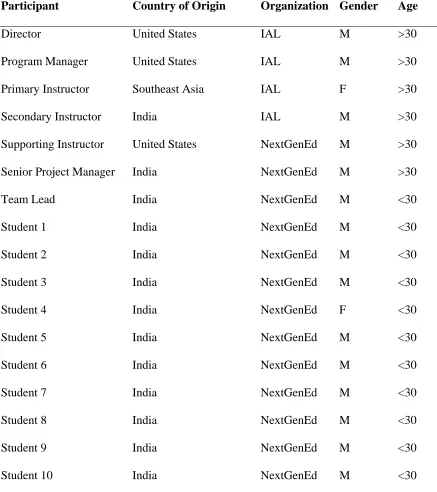
development teams for an education software company headquartered in India. Fifteen
representative participants were chosen to reflect each role involved in the training
program and instructional design process, including management, instructors and
students. In over two years of engagement with participants, data was gathered at a
NASA space center and in Mumbai, India through interviews, observation and artifact
analysis. Data was analyzed to identify where components of the design process,
decisions of the design team, and perceptions of the stakeholders overlap with culture as
The findings indicate that at least twenty-three distinguishable elements of culture
interact with every component of the design process in the: 1) goals and funding
decisions of the client; 2) goals and design decisions of the design team; 3) perceptions
of the training program of all stakeholders; and 4) the observable outcomes of the training
program. The findings also offer insight into what stakeholders do or do not consciously
attribute to culture. By empirically illuminating the pervasive presence of cultural
interactions across the instructional design process, this study advocates for culture to be
recognized as a construct of importance in our field and demonstrates the powerful
capabilities of using a comprehensive descriptive model as a lens for exploring cultural
IDENTIFYING COMPLEX CULTURAL INTERACTIONS IN THE INSTRUCTIONAL DESIGN PROCESS: A CASE STUDY OF A
CROSS-BORDER, CROSS-SECTOR TRAINING FOR INNOVATION PROGRAM
by
L. Roxanne Russell
A Dissertation
Presented in Partial Fulfillment of Requirements for the Degree of Doctor of Philosophy
in
Instructional Technology in
the Department of Middle-Secondary Education and Instructional Technology in
the College of Education Georgia State University
Copyright by L. Roxanne Russell
ii
I would like to thank my committee chair, Dr. Wanjira Kinuthia, for inspiring me
to take on the challenging topic of culture in this research project and for her insight and
support throughout the process. I am very grateful to Dr. Laurie Brantley-Dias, Dr. Geeta
Verma, Dr. Mary B. Shoffner, Dr. Jagdish Sheth and Dr. Charles Xiaoxue Wang for their
thoughtful feedback and guidance throughout this research project and in my doctoral
program. I would also like to thank Dr. Chris Oshima and Dr. Deron Boyles for being
excellent teachers and prioritizing their interactions with students as part of their faculty
responsibilities.
I am most grateful to the participants in this study, who were welcoming and
generous with their time, knowledge and memories. I could not have completed all of the
work of this project without those who helped with data analysis and presentation: Reeny
Madathany, Dr. Winnie Tsang-Kosma, Daina Plitkins-Denning, and Dr. Anissa
Lokey-Vega.
I would like to thank all of my classmates in the doctoral program for enjoyable
learning experiences. In particular, I appreciate Dr. Joshua Cuevas for engaging with me
in a productive and still generative research and design collaboration; and David Stone,
for sharing his strength, craft and experience in this field to push me to the next level.
I am lucky to have too many wonderful and influential people in my life to list
here, but I have leaned heavily on all of my friends and family and would like to express
my deep gratitude and affection for their support. I am thankful for my father, Bill
Russell, my sister, Candi Dickerson, and my best-friend, Trena Thierry for always being
iii
welcoming me into their family and home and playing an active role in the daily support
of my family to make this possible. I wish to honor the memory of my mother, Cookie
Crews, and my grandfather, Williamson B. Simmons, for influencing me to greet each
new day and person with practical enthusiasm. Their positive energy still keeps me
going.
Finally, I thank my incredible husband, Adarsh Char, for encouraging me to take
iv
TABLE OF CONTENTS
TABLE OF CONTENTS ...iv
LIST OF TABLES ...vi
LIST OF FIGURES ... vii
CHAPTER 1: STATEMENT OF THE PROBLEM ... 1
Introduction ... 1
Problem ... 2
Theoretical Framework ... 8
Guiding Questions ... 10
Purpose ... 11
Significance ... 11
Assumptions ... 12
Limitations ... 12
Terms and Definitions ... 13
Conclusion ... 16
CHAPTER 2: REVIEW OF THE LITERATURE ... 17
Introduction ... 17
Instructional Technology and Design in the Global Context ... 19
ICTs in Emerging Economies ... 20
Cross-Border Collaborations ... 23
Attention to Culture in Instructional Design and Technology Literature ... 24
Culturally determined educational or pedagogical values ... 24
Culture and ethical standards ... 25
Culture and educational psychology constructs ... 26
Cultural considerations in collaboration and communication ... 27
Culture and the instructional design process ... 28
Review of ISD Models Acknowledging Culture ... 30
Limitations of Current Cultural Models for Research ... 33
Conclusion ... 36
CHAPTER 3: METHODOLOGY ... 38
Introduction ... 38
Guiding Questions ... 38
Methods and Rationale ... 39
Rationale ... 39
Research Design ... 39
Gaining Entry ... 45
Pilot Study ... 47
Data Collection ... 49
Ethical Considerations ... 63
Researcher’s Role and Bias ... 64
Trustworthiness ... 67
Conclusion ... 72
CHAPTER 4: CASE DESCRIPTION ... 73
Introduction ... 73
Case Description ... 73
Conclusion ... 80
v
Introduction ... 81
Cultural constructs of the CBM framework found to be evident in the data ... 82
Cultural interactions with technology and content ... 84
Cultural interaction with design specifications, technology format, audience assessment and quality .. 117
Cultural interaction with the composition of the design team ... 135
Cultural interactions with assessing student learning ... 152
Cultural interaction with financial support and affordability, involvement of stakeholders, consideration of cultural context and learning goals of the training program ... 159
Cultural interaction with designing learning environments and opportunities ... 184
Conclusion ... 205
CHAPTER 6: AGGREGATE FINDINGS ... 206
Introduction ... 206
Limited participant acknowledgement of interaction between decisions, perceptions and outcomes with culture ... 206
Systemic presence of cultural interactions in the instructional design process ... 208
Conclusion ... 213
CHAPTER 7: DISCUSSION ... 214
Introduction ... 214
Guiding Questions ... 214
Culture in the Instructional Design Process ... 215
Cultural Experiences and Design Decisions ... 215
Cultural Interaction with Technology and Content Choices ... 216
Cultural Interactions with Project Management ... 218
Using a Cultural Expert ... 220
Cultural Interactions with Perspectives on the Role of Educators ... 221
Cultural Interactions with Assessment ... 224
Cultural Interactions with Funding ... 226
Cultural Interactions with Balancing the Needs of Stakeholders... 226
Cultural Interactions with the Design of Learning Environments & Opportunities ... 227
Limitations of this Case Study ... 229
Implications for Researchers and Practitioners ... 230
Implications for Young’s model ... 232
Conclusion ... 234
REFERENCES ... 236
vi
Table Page
Table 1 Comparing Hofstede’s Cultural Dimensions and Young’s Cultural Elements ... 36
Table 2 Overview of Institute for Advanced Learning Training Curriculum ... 41
Table 3 Overview of NextGenEd’s i3Dv First YearTraining Agreement with IAL ... 41
Table 4 Participant Information ... 43
Table 5 Artifact Descriptions ... 44
Table 6 ID-TABLET Components of Young’s Culture Based Model (CBM) ... 50
Table 7 Inquiry Design Factors of CBM ... 85
Table 8 Cultural Interaction Matrix: Inquiry ... 116
Table 9 Development Design Factors of CBM ... 117
Table 10 Cultural Interaction Matrix: Development ... 134
Table 11 Team Factors of CBM ... 135
Table 12 Cultural Interaction Matrix: Team ... 151
Table 13 Assessment Design Factors of CBM ... 152
Table 14 Cultural Interaction Matrix: Assessment ... 159
Table 15 Brainstorming Design Factors of CBM ... 161
Table 16 Cultural Interaction Matrix: Brainstorming ... 183
Table 17 Learners Design Factors of CBM ... 185
Table 18 Cultural Interaction Matrix: Learners ... 204
vii
LIST OF FIGURES
Figure Page
1 Young’s 2009 Culture Based Model ……… 9
CHAPTER 1: STATEMENT OF THE PROBLEM
Introduction
Policy advisors have made a global call for nations to prioritize their
knowledge-economy-building initiatives, and this call is being answered by a surge of non-profit and
market-driven strategies to produce innovative educational technologies (Britz, Lorc,
Coetzee & Bestere, 2005; Dahlman & Utz, 2005; Daniel, 1996; Morey, 2004; van der
Wende, 2002). For organizations to innovate in the educational technology space, they
have been forming partnerships across sectors and across borders in order to train
personnel for high level innovation. Such cross-sector, cross-border training for
innovation environments continue to increase in number and provide rich ground for
examining dynamics of culture in the process of instructional design in a globalized
knowledge economy. But culture is an abstract and slippery construct that poses a
challenge for researchers and practitioners in the instructional design discipline.
Because instructional design and technology (IDT) research draws on the
practices and beliefs of several research traditions from multiple disciplines, defining
culture in the context of IDT requires pulling from interdisciplinary points of view. In his
often cited and highly generative work on cultural dimensions, industrial anthropologist
Hofstede (1984) defined culture as a “programming of the mind” (p.51). Young (2008)
suggests that culture can be viewed from sociological, anthropological and psychological
perspectives. From the sociological perspective, culture is a part of tradition and heritage;
anthropologically, culture is a way of doing, thinking, acting, feeling and being;
2
(1999), culture functions on the following levels, societal, organizational, group,
individual and domain/discipline. As an abstract concept, culture is often described in the
ways that it functions or is manifested. For example, observable artifacts or behaviors
may be characterized culturally, such as forms of communication.
Yet, characterizing an observed phenomenon culturally prompts questions about
the confounding variables of individual influences or differences. This slipperiness of the
concept of culture presents a problem for traditional methods of research in the
instructional design discipline, but does not obviate the need for further study of it. Much
of the current empirical research on culture in IDT relies on reductive characterizations of
learners according to broad generalizations about national, regional or ethnic cultures
(Gunawardena, Jayatilleke, & Lekamge 1996; Ku & Lohr, 2003; Paulus, Bichelmeyer,
Malopinsky, Pereira & Rastogi, 2005). What is needed is more acknowledgement of the
slipperiness of the construct of culture while exploring ways to capture empirical
glimpses of its complexity. Identifying complex cultural interactions in the instructional
design process may allow us to better understand where the group-wide tendencies,
frames of reference or characteristics of all stakeholders, not just learners, interact with
the design process and learning experiences. This understanding is important to updating
our concept of the IDT process to be more relevant and responsible in a globalized
context.
Problem
The roots of instructional design cling to the soil of the military-industrial
complex and its call for more effective, efficient and productive processes for uniform
environments that reflect the transitional growth from industrial to knowledge-based
economies, calls for effectiveness, efficiency and productivity are accompanied by calls
for equity, sustainability and innovation (Vrasidas, Zembylas & Glass, 2009). For
example, development was once seen from the Western point of view as a measure o2f
economic growth through attention to gross domestic product indices; whereas, newer,
more globally inclusive views show attention to development as a process of improving
individual human rights and attention to environmental sustainability (Sen, 2006 qtd. in
Vrasidas, Zembylas & Glass, 2009). Petrina (2004) argues that the models proposed by
instructional designers are lacking because “universal formulas” could only work in
apolitical environments which arguably, do not exist. Visser and Suzuki (2007) observe
that “the professional literature of the instructional design field draws heavily on the
experience of its application and development in one country, the United States of
America” (p.235). These critiques of applying Western-based models gain more
significance as the practice of IDT continues to occur in increasingly global contexts.
Furthermore, the global proliferation of IDT projects has outpaced the availability
of trained designers. Case studies of cross-border collaborations and reviews of emerging
instructional technology trends in other nations repeatedly stress the need for local
designers while acknowledging the lack of instructional design training available globally
(Chitiyo & Harmon, 2009; Kim & Santiago, 2005; Perkins, Gwayi, Zozie & Lockee,
2005; Soulier, 1999). Merrill (2007) refers to those who design without training as
designers-by-assignment and claims that “95% of all instructional design is done by
designers-by-assignment” (p. 336). In describing factors impacting ID model validation,
4
expert designers and novice designers” (p.177). These findings suggest that instructional
design models in the global context must take novice practitioners into account.
Are current ISD models, based on the fundamental model of ADDIE, flexible, yet
descriptive enough to provide cultural guidance for designers-by-assignment in
environments of cross-sector, cross-border training for innovation?
Gustafson and Branch (1997) would answer yes. In a review of the history and
emerging trends of instructional development models, these authors defend the
fundamentals of ADDIE and its progeny of models as broadly applicable and accurate
against claims that it is not well-suited to current pedagogies or conditions of dynamic,
constructivist and cross-cultural environments. They acknowledge developments in
instructional development models such as rapid prototyping and use of expert systems,
but conclude that these models do not depart from earlier models if one views the process
as iterative and recursive rather than linear and progressive: “While we have no quarrel
with those who are exploring alternative ways of developing learning environments, we
believe many claims for uniqueness are overstated” (p.86). They argue that the
fundamental ADDIE model still accurately encapsulates the basic steps in the process of
instructional design.
Yet, in a later collaboration, Gustafson with Visscher-Voerman (2004) found in
gathering data from highly reputable designers that their activities “indeed, do deviate
from the activities and order proposed by ADDIE models” (p. 70). Visscher-Voerman
and Gustafson (2004) collect data through interviews and document analysis on
twenty-four highly reputable designers in order to fill a gap in empirical research to support
diverse” than those described in the ADDIE model (p. 70). This study shows some
movement away from traditional views of ISD and welcoming of more complex
characterizations of the process of instructional design.
However, Richey, Morrison and Foxon state that the “majority of ID practice is
still dominated by instructional systems design models such as Dick & Carey’s” (p.175,
2007). In “The Dick and Carey model: Will it survive the decade?,” Dick (1996)
examines his popular and widely –used ISD model for future viability by reviewing its
evolution and competitors. He pinpoints the first public introduction of the model to a
presentation in 1968, “New Directions in Learning.” He attributes changes in the most
recent edition of the model (1996) to influences from: performance technology, context
analysis, multi-level evaluation models, and total quality management. In a statement
that may sum up the basis for much of the criticism of the lack of empirical basis for
prescriptive models in instructional design, he admits: “There were almost no
practitioners when the model was developed, therefore, it was never intended to be a
reflection of what practitioners actually do” (p.58). Similarly, culture-focused research is
emergent in the instructional design discipline (Richey, 2009) and proposed cultural
models are often, like the Dick and Carey model, either untested or tested only by their
creators and tend to prescribe rather than describe instructional design processes
(Edmundson, 2007; Henderson, 1996; Young, 2009).
From a systemic view, every component of the instructional design process (from
steps taken to products generated) engages culture. In a review of the history of
instructional systems development models, Gustafson and Branch (1997) describe ISD as
6
where the whole system responds to individual stimuli because of non-linear
relationships between components. Banathy (1987) describes the systems approach as
addressing large-scale highly complex problems; the globalization of instructional
technology and proliferation of cross-sector, cross-border training environments can be
viewed as a large-scale, highly complex problem. The systems approach also uses
strategies and tools that pay attention to interrelated concepts and principles for
synthesis-oriented and holistic analysis of problems. Including process in the discussion and
research on culture in instructional design represents part of a systems approach to the
challenges of instructional technology and design in a global context. Branch and
Deissler (2008) also note that “useful processes must be capable of responding to
emerging trends in instructional technology” (p.210).
There is a growing body of IDT literature acknowledging the need to better
understand the function, impact and implications of culture and the globalization of IDT
(Damarin, 1998; Heemskerk, Brink, Volman & ten Dam, 2005; Powell, 1993; Seufert,
2001; Willis, 2005). Analytical perspectives call our attention to systemic considerations
and examine the holistic influences of learners, teachers and environments (Henderson,
1996; Zhang, 2010). However, empirical research in this area has primarily focused on
the culture of learners, whether it be to customize content, identify learning styles,
explore communication challenges or understand attitudes towards technology
(Gunawardena et al.,1996; Ku & Lohr, 2003; Paulus, et al., 2005). Several studies about
projects with multicultural stakeholders do acknowledge the complexity of cultural
dynamics in their projects, but usually do so as afterthoughts or lessons-learned (Chitiyo
2005). Few empirical studies focus on multiple stakeholders and seek to identify cultural
interactions across the process of instructional design.
This research contributes to the IDT discipline by examining culture in the
instructional design process in a way that goes beyond reductive cultural
characterizations of learners and towards identifying the complex interaction of the
cultures of all stakeholders with the design process.
The Case
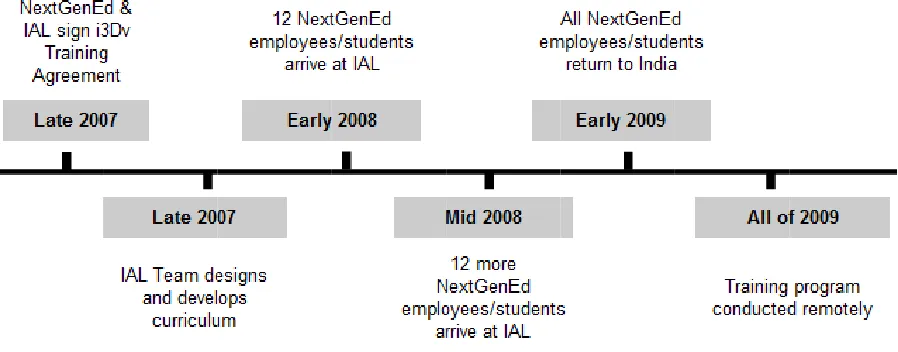
In 2007, NextGenEd (pseudonym), a private education software company
headquartered in India, contracted with the Institute for Advanced Learning (pseudonym)
(IAL), a consortium of three US state universities, a community college and one of
NASA’s Space Centers, to train up to fifty employees to build applications that produce
3D graphical representations for fully immersive stereoscopic virtual environments.
NextGenEd initiated this training program as a research and development project to
potentially produce software and build immersive three-dimensional virtual (i3Dv)
environments for thousands of higher education, primary and secondary institutions in
India, the US and Europe. The IAL team, subject-matter experts in i3Dv programming
with minimal experience as educators, prepared and offered an on-site training program
at their location on the campus of a NASA space center. From January 2008 to December
2008, NextGenEd sent twenty-four employees to participate in this training program as
students. This case study examines this training program from the initial planning stages
beginning in late 2007 until post-training stages of research and development still in
8
Theoretical Framework
So far, one of the most comprehensive design frameworks with attention to
culture in the process of instructional design has been offered by Young in her body of
work from 1999-2009. Young finds that methods of integrating culture in design are
limited in scope: “design has not caught up with technology and that to create for diverse
audiences the process must be deliberate… the integration of culture in the design of
ICTs will require novel ways of engaging the design process” (2008, p.14). Young
(2009) seeks to establish culture as a design construct. First, she establishes that design is
a deliberate, creative, social action that generates meaning and that “design constructs
function to explain, predict and interpret design related data” (p.26). Then, she proposes
that “culture is a design” that is also a creative, social act that generates meaning and
order (p.26). She sees this as a semiotic relationship that should be acknowledged in
design frameworks.
Young offers the Culture-Based Model (CBM) with the acronym ID_TABLET:
inquiry, development, team, assessments, brainstorming, learners, elements, and training
with 70 design factors tied to these features (see Figure 1). As part of the ID-TABLET
framework, she lists twenty-five elements that “can be used to understand, define or
evaluate the target audience” in three categories: anthropology of culture, psychology of
F Y in m th fr F R co Y w
Figure 1You
Young (2009
nstructional d
measurability
he ADDIE m
ramework to
oreword to Y
Richey (2009 omponent to Young’s mod world” (p.xi) ung’s (2009) ) emphasize design, citin
y and explain
model (p. xv)
o align cultur
Young’s boo
9) calls Youn
o a somewha
del is “comp
. Young’s w
) Culture Ba
es that her wo
ng Reigeluth
ning that the
). She propo
re with the A
ok, Instructio
ng’s model a
at traditional
atible with a
work is new a
ased Model
ork maintain
’s (1983) em
se processes
ses to fill the
ADDIE mod
onal Design
an “over-lay
ID model”
a systemic (r
and cannot y
ns the traditi
mphasis on sy
s are “ground
e gap where
el has not be
Framework
model, one
(p. ix). How
rather than a
yet claim to h
onal definiti
ystematic pr
ded in the ge
a “compreh
een available
ks and Interc
which adds
wever, she als
systematic) have empiric ion of rocesses and eneric system hensive
e” (p. xv). In
cultural Mod
the cultural
so says that
view of the
cal support d
m” of
n the
10
evaluating the effectiveness of what it prescribes to designers; however, Richey (2009)
declares that Young’s model is supported by rock-solid research. Young’s method for
developing the model is grounded in empirical observation and qualitative analysis of
instructional design artifacts.
Therefore, applying the CBM taxonomy as a descriptive tool is consistent with its
empirical basis and provides a research lens to investigate cultural dimensions of this
case. However, no members of the IAL staff were aware of Young’s Culture-Based
Model framework nor set out to engage in activities in the manner prescribed by the
CBM framework. The focus of this research will be to examine data about the design
process and identify cultural elements, as identified in the CBM framework, to explore
how they interact with the decisions and practices of a team of designers-by-assignment
in a cross-sector, cross-border context. This focus also provides a chance to consider how
descriptive some aspects of Young’s prescriptive model are revealed to be in the
circumstances of this case. Young’s (2009) model offers: 1) a useful taxonomy for
discussing the complexity and dynamism of culture as a construct in the instructional
design process; 2) an existing instructional design paradigm in which to frame this
approach; and 3) the opportunity to apply and explore the generative capabilities of a new
model in the field that acknowledges culture as a complex construct.
Guiding Questions
How does culture interact with the instructional design process, as defined by Young’s
Culture-Based Model (CBM) framework, in this case of a cross-sector, cross-border
a) What design team decisions, stakeholder perceptions, and program outcomes
relate to ID-TABLET components of the CBM framework?
b) With which CBM Elements of culture do design team decisions, stakeholder
perceptions and program outcomes interact?
Purpose
In this study, I seek to problematize traditionally reductionist approaches of IDT,
in particular because of the cross-cultural implications of imposing only one world view
as the truth. The purpose of this case study is to identify complex cultural dynamics in the
instructional design process of a cross-sector, cross-border training environment by
applying Young’s (2009) Culture-Based Model as a theoretical framework and taxonomy
for description of the instructional design process under the conditions of this case.
Significance
Trends of globalization in the practice of instructional design necessitate attention
to culture in the instructional design process because of the systemic, cross-cultural and
global development implications of assuming a universal perspective when approaching
the design of learning opportunities. Using Young’s (2009) CBM model to examine
culture in the process of instructional design by a team of designers-by-assignment in a
cross-sector, cross-border training project can provide referential guidance for
12
applicability or modification of Young’s (2009) CBM model or other ISD models; 2)
practice of IDT; and/or 3) development of tools for IDT in similar contexts.
Assumptions
1. I take a pragmatic view with this case study approach in assuming knowledge
about the IDT process is context-dependent and potentially useful for
cross-referencing with other cases.
2. Culture is an abstract concept that may be viewed operationally for the
purposes of empirical study (Kroeber & Kluckhohn, 1952).
3. Young’s (2009) CBM model may be applied as a theoretical framework and
taxonomy for examination of attention to cultural factors in the instructional
design process in a context where the model was not used to guide the
process.
Limitations
1. This case study is limited in generalizability by the special circumstances of
this training program.
2. The anonymity of this case limits the amount of information available for
cross-referencing this case and providing an audit trail (Yin, 2003).
3. Results of this case study will be “limited to describing phenomenon rather
than predicting future behavior” (Merriam, 1998, p.41).
4. Participant sampling in this case represents only one client perspective of the
5. Observation data in this case is limited to demonstrations and tours and does
not include observation of training activities.
6. Document analysis is limited by the extent of “authenticity and accuracy” of
the documents (Merriam, 1998).
7. Using Young’s (2009) CBM as an a priori theoretical framework and
taxonomy may limit the discovery of emergent themes by providing
convenient categories for “data selection” instead of “generation” (Glass &
Strauss, qtd. in Merriam, 1998).
Attempts to mediate these limitations are described in Chapter 3 on Methodology.
Terms and Definitions
Cross-sector: This study uses the term cross-sector to describe the partnership of
academic, government and private, for-profit organizations. In this study, that partnership
is between a US Government agency/public university consortium in the Southeastern
US and a private education software company with headquarters in India and subsidiaries
in the US.
Cross-border: This study uses the term cross-border to describe both the partnership of
organizations across national borders and the placement of students in a foreign country.
In this study, that partnership is between organizations in the US and India, and the
14
Culture: Culture in this study is defined by using Young’s (2009) CBM Elements as
taxonomy. The Elements component of ID-TABLET in the CBM framework provides a
potentially comprehensive picture of what makes up all culture: both tangible and
intangible (Young, 2009). Young (2009) pulls from cultural anthropology, cultural
psychology and science to propose this compilation of elements which might be shared
by a group. The purpose of Elements in the CBM framework for instructional design is to
guide designers in exploring cultural factors when investigating their target audience. In
this research, the Elements are used as taxonomy to classify aspects of cultural
interactions in the design process. The CBM Elements of culture are applied to multiple
cultures in this case study rather than only the target audience to explore cultural
dynamics in the decisions and perceptions of all stakeholders.
The cultures distinguished in this study are categorized at two levels: national and
organizational. The national cultures of the participants were determined by nation of
origin and nation of current residence at the time of data gathering; some participants
represent multiple cultures. National cultures represented by participants in this study
include: India, US and a country in Southeast Asia. Only one participant in the study was
originally from a country in Southeast Asia and now resides in the US. The nations where
training program activities took place and observations were conducted include India and
the US only. The organizational culture represents where training activities and
observations occurred and where participants were employed at the time of the training
Designers-by-assignment: Subject-matter-experts without formal instructional design
training who have been assigned to provide instruction (Merrill, 2007, p.336).
Innovation: This study uses the term innovation as an economic term evolved from
Schumpeter’s (1936) characterization of innovation as a new production function. In this
study, that new production function is the entrepreneurial effort by the Indian company to
use applied research and development in order to be the first to bring a new product, i3Dv
environments, to the Indian market on a large scale.
Instructional systems design (ISD) models: Instructional systems design models are
distinguished from “generic lesson planning in their technological character” and involve
“scientific thinking” such as the use of “empirical data gathering” throughout the process
(Branch & Deissler, 2008, p. 207).
Process: Process theories posit that “events result from particular input states that
produce particular output states” and can be either descriptive or prescriptive: 1)
“descriptive theories are passive, explain phenomena, illustrate relationships, and
describe conditional (if-then) statements;” 2) “prescriptive theories are active,
goal-oriented, rule-based, normative guidelines and strategies, used to construct models,
methods and procedures for practice” (Branch & Deissler, 2008, p.199). Branch and
Deissler (2008) define systematic processes as those that follow rules and procedures that
apply to all steps in the process and predictably generate consistent results. Branch &
16
individual stimuli because of non-linear relationships between components. In this case,
the instructional design process is defined and categorized through Young’s ID-TABLET
framework.
Conclusion
A review of institutionalized and emerging views of ISD models reveals different,
sometimes conflicting, perspectives on whether fundamental models like ADDIE are
flexible, yet descriptive enough to provide cultural guidance for designers-by-assignment
in cross-sector, cross-border environments. Though there is much enthusiasm and
optimism for the potential role of instructional design and technology globally for
purposes of development, often these views of development are based on the
championing of modernization prevalent in Western cultures; it is important to maintain a
holistic view of emerging globalization in IDT trends in order to avoid the accompanying
negative impact on cultural traditions and the environment. This chapter has introduced
this problem and posited a theoretical framework and guiding questions for a study to
contribute to the body of research informing the use or expansion of ISD models in the
global context by examining the process of IDT under cross-sector and cross-border
conditions with the lens of a culturally informed instructional design framework. In
Chapter 2, literature on 1) IDT in the global context, 2) attention to culture in
instructional technology and design literature, and 3) culturally informed ISD models will
be examined to establish the gap in research this study seeks to fill and support the
CHAPTER 2: REVIEW OF THE LITERATURE
Introduction
The amount of interest and research on culture in instructional design and
technology (IDT) might be characterized by a quick internet search, which reveals a vast
and growing number of journals, conference presentations, professional associations,
divisions within existing professional associations, online discussion forums, blogs and
social networks dedicated to this topic (See International Journal of Education and
Development using Information and Communication Technology (IJEDICT); NAFSA:
Association of International Educators; International Division of the Association for
Educational Communications and Technology; UNESCO Education for All World
Education Forum; International Higher Education Consulting Blog; The Global
Education Collaborative Ning). In this vast body of research, there is attention to a wide
array of topics such as the digital divide, multicultural education, cultural relevance,
internationalization and localization of educational content and cross-cultural awareness
(Aydin & McIsaac, 2004; Barta, Jette & Wiseman, 2003; Bentley, Tinney & Chia, 2004;
Debry, 2002; Powell, 1997). In addition to empirical studies in those areas, critiques,
analysis, definitions and theories of culture abound as trends of globalization grow
(Gunawardena & LaPointe, 2008; Perkins, 2008; Subramony, 2004; Thomas, Mitchell &
Joseph, 2002).
Clearly, a great amount of attention has been paid to culture in the research and
design projects of the instructional design discipline in recent years, yet there is still a
noticeable absence of attention to culture in some of the major publications of the field
18
Communications and Technology, 3rd edition just published in 2007. When culture is
attended to in the institutionalized texts of the field, it is often approached as a
manageable factor of targeting the needs of an audience. For example, in the widely-used
textbook, Trends and Issues in Instructional Design and Technology, in a chapter on
Instructional Design in Business and Industry, Richey, Morrison and Foxon (2007)
address globalization of training by acknowledging the trends of internationalization and
localization, claiming that “internationalization produces a culturally free product”
(p.181). This type of claim relies on the assumption that instructional designers and
products can somehow achieve cultural neutrality and that the culture of the audience
being targeted is the only factor influencing the design of a product.
Other views seek to avoid the messy entanglement of sorting out culture. In
reviewing competencies for instructional designers in the same textbook,
Davidson-Shivers and Rasmussen (2007) list attention to characteristics of the target population,
environment and situation as necessary for instructional designers; however, they do not
mention culture. Perkins (2008) considers whether the challenges concerning
culturally-sensitive design may not deal with “the nebulous concept of culture, but instead context”
(p. 19). Yet, context may be distinguished from culture in that culture, as defined across
disciplines, describes influences on an individual or group derived from what humans
share or have shared at a social level over at least an incubating period of time (Kroeber
& Kluckhohn, 1952). Context, on the other hand, may operate on for an individual
without being shared and may exist only in a fleeting capacity. Context, though it may
overlap in some places with culture, may not sufficiently address the complex,
Distinguishing culture from context squares with Tessmer and Richey’s (1997) approach
to contextual analysis, where they identify culture as one of several contextual
considerations.
This introduction highlights a lag in attention to culture in the institutionalized
literature and divergent views on whether it should be recognized as a distinct construct
of significance in the discipline. This current state of discourse on culture is similar to
that of emergent fields of research in any discipline. Because attention to culture is
emergent in the IDT literature, this review must weave together analytical and empirical
studies on systemic considerations of IDT in the global context as well studies that show
attention culture in a wide variety of ways in the IDT literature. Finally, culturally
informed ISD models will be examined to establish the gap in research this study seeks to
fill and to support the rationale and design of this research study.
Instructional Technology and Design in the Global Context
To place this research within a systemic view of IDT and information and
communication technologies (ICTs), I begin with a review of literature with attention to
trends and implications educational technology and ICTs in emerging economies and
cross-border collaborations. Anecdotal, qualitative and analytical approaches in this body
of research provide multiple perspectives and particularistic findings on cultural factors
20
ICTs in Emerging Economies
In reflecting on a previously conducted survey, Zhang and Shin (2002) compare
the open and distance education models of China, India and Hong Kong. This study
considers types of courses, delivery methods, student demographics, including gender
and access, funding and staffing. They also show that India’s flagship open learning
institution (IGNOU) is primarily staffed by part-time adjunct faculty and that ICT
initiatives lag behind the other two countries. These researchers conclude that the China’s
program is indigenous and Hong Kong and India’s are imported. Zhang and Shin’s
findings are relevant to the case study for this research, design team members and
students work with IGNOU to potentially introduce i3Dv technology into their open
learning system.
In “Taking Ownership: Strengthening Indigenous Cultures and Languages
Through the Use of ICTs” Lieberman (2003) considers the dynamics of using ICTs for
the benefit of indigenous cultural causes. He develops this overview by starting from the
broad perspective of the impact of globalization on indigenous cultures then narrowing
his focus to the impact of ICTs. Though Lieberman acknowledges both actual and
potentially negative consequences of ICTs on indigenous cultures, his aim in this article
is to identify examples of positive initiatives and explore the potential for further use and
benefits. He highlights indigenous culture ICT initiatives for community building,
language revitalization, education, commerce and environmental protection and considers
these initiatives with attention to policy, capacity building, usage and implementation.
empowerment, self-determination and ideological sustainability in order to reach positive
ends through ICTs.
Lieberman does not only focus on the use of ICTs in education, yet his examples
of political and economic uses still lie in a form of education- the dissemination of
information. By grounding his examples in the broader discussion of the impact of
globalization and ICTs on indigenous cultures, Lieberman (2003) highlights some of the
central questions about the socio-cultural implications of educational technology. Does
widespread use of ICTs: Encourage homogenization of cultures? Replace indigenous
forms of learning or the wisdom of tradition and elders? Reinforce detrimental economic
hegemonies? His answer to these questions seems to be, “Possibly”; however, he states,
“it is preferable to take a pro-active and culturally sensitive approach to technology
introduction.” The argument he makes in this article is that 1) the use of ICTs is already
widespread and inevitable, and 2) policies towards productive and positive uses of ICTs
may mediate the potential for negative consequences. Lieberman’s analysis is relevant to
this case study which offers an opportunity to examine cultural interactions with the
decisions and perceptions of stakeholders in a project to introduce an educational
technology innovation in a country where indigenous cultural causes are still prevalent.
In the context of higher-education, Ezer (2006) interviews faculty and students in
India to get an impression of the attitudes towards ICTs and ICTs in education in India.
Ezer explores what Indian faculty and students believe to be the purpose of ICT. In
particular, he poses the question of whether ICT and ICT education should work towards
the benefit of individuals or society. He lays the groundwork for his findings about
22
the educational system in India. He concludes that students and faculty show optimism
about ICT and seem to have whole heartedly adopted the Western model of
individualistic, rational and imperialistic success. He uses his conclusion to claim that
this model does not follow Ghandian philosophy. Ezer’s research is particularly relevant
to the case in this research because attitudes towards ICTs by faculty and students in
India interact significantly with the purpose of the training program, the students’
experience in the training program and the potential market for the i3Dv product.
In a chapter on African Education Perspectives on Culture and E-learning
Convergence, Kinuthia (2007) highlights the complexities of encountering culture in
e-learning environments while stressing its importance as a factor in design decisions.
Resistant to prescriptive models, she proposes acknowledgement of the multiple
perspectives involved for “jointly-negotiated advances” in e-learning. This study is
designed to gather and present multiple perspectives of complex cultural interactions in
order to work towards more dialogic views of the instructional design process.
As the above review reveals, analysis and findings in the literature point to a need
for more flexibility and attention to culture in the process of instructional design and
integration of instructional technology in emerging economies. Research on distance
education in the global context also provides insight from nations with developed
economies, revealing the same need for attention to culture (Marchessou, 1999). For
example, in a chapter for the Handbook of Distance Education reviewing literature on
“Learning in a Global Society,” Visser (2007) characterizes cognition as a complex
“ecological phenomenon” (p.641). He explores implications of global diversity on
Albrechtsen, Mariger and Parker (2001) review the history and current trends of distance
education in Europe and Japan and emphasize the challenges of language and cultural
differences in Europe, calling it a “Babel effect” (p.109).
Cross-Border Collaborations
Studies on open learning and distance education in nations with emerging
economies show a trend of collaborations with universities and expert instructional
designers from nations with developed economies (Merrill, 2001; Perkins, et al., 2005;
Visser & Berg, 1999). This same trend of cross-border collaboration is evident in the
literature on the impact and integration of ICTs in nations with emerging economies. In a
case study describing a World Bank Institute sponsored project encompassing East and
West Africa, Burniske (2003) found that participants faced cultural challenges in
“fundamental activities in the telecollaborative process” (p. 108). Luschei, Padmo and
Spector (2009) report on a partnership between the Open University of Indonesia and
Florida State University and emphasize the importance of building friendships beyond
professional relationships across borders to increase the “potential for real collaboration”
(p. 22).
From a cross-border consultant’s point of view, Marchessou (2001) argues that
“The ethical dilemmas we are confronted with today as educational consultants
overseas… could be roughly summarized in three pairs of alternatives: (a) connectivity
vs. exclusion, (b) access vs. excess, and (c) transience vs. permanence” (p. 111).
Reflecting on ten years of cross-border ICT consulting in West Africa, Hergert (2003)
24
the situation and an “empathetic” posture (p. 33). The above findings related to project
management, such as ethics, roles, relationships, communication and barriers to
implementation in cross-border collaborations highlight the need for attention to culture
not only in the design of learning opportunities, environments and products, but also in
the process of instructional design.
Attention to Culture in Instructional Design and Technology Literature
This section will review the literature exploring cultural dynamics specifically in
the IDT context and draw preliminary connections between findings in the literature and
Young’s (2009) CBM to help illuminate later discussion of data. The following topics
related to culture will be covered: educational or pedagogical values, ethical standards,
educational psychology constructs, collaboration, communication, and the instructional
design process.
Culturally determined educational or pedagogical values
Several researchers have provided critical analysis of educational or pedagogical
values across cultures (Bentley, Tinney & Chia, 2004; Ku, Pan, Tsai, Tao & Cornell,
2004; Loewer, 2003; Zhang, 2010). These analytical approaches often rely on literature
review and reports of historical and current trends to frame characterizations of learning
cultures defined by national, regional or tribal boundaries. Zhang (2010) defines learning
culture as “historically-rooted attributes related to learning and education carried by an
identifiable community. These cultural attributes are demonstrated as collective, intuitive
understanding of what learning is about and how it should be practiced” (p. 232). In this
behaviors of learners and inform educational initiatives in these contexts or to advocate
for resistance to the imposition of outside learning culture influences. In Young’s (2009)
CBM model cultural beliefs and values are included as an element of the psychology of
culture and defined as “the ideals, principles, or standards” that “evolved historically
from the various social and economic contexts in a society” (p.235).
Culture and ethical standards
Along with attention to culture in educational or pedagogical values, there is also
a discussion in the IDT literature about the challenges of establishing ethical standards
across cultures. There is consensus in this discussion that uniform rules for any online
community should reflect a compromise and negotiated set of standards for that
community (Bradshaw, Keller, & Chen, 2003; Dodig-Crnkovic & Horniak, 2006;
Hergert, 2003; Marchessou, 2001). However, often this is not the case; rather rules are
often established through power and to benefit those who are in power. Bradshaw, Keller
and Chen (2003) suggest that “the cultural and social-power position of the ethics code
creators, within both local and global contexts, and the cultural distribution and
representation of individuals charged with making decisions regarding ethical standards,
are important factors in considering the applicability of a code of ethics to an
international community” (p. 18). Bradshaw et al. frame their discussion of power
relations with the term “cultural capital” which they define as “symbolic power based on
a variety of factors related to social status and cultural ascendancy” (p. 15). Young’s
(2009) CBM model includes attention to cultural capital as an element of the
26
economics of a society or culture with a focus on production, distribution and
consumption characteristics of a culture or target learner.
Culture and educational psychology constructs
Educational psychology constructs have also been examined in the IDT literature
with attention to cross-border or cross-cultural dynamics. For example, in looking at
components of motivation in a group of international distance education students, Visser,
Plomp, Amirault and Kuiper (2002) use the ARCS model (attention, relevance,
confidence and satisfaction) to find that attempts to personally customize motivational
messages for students was time-consuming and no more effective than collective
messages. Gunawardena et al. (1996) used Kolb’s Learning Style Inventory to
characterize the learning styles of adult learners in Open University students in Sri Lanka.
Kolb’s Learning Style Inventory identifies learning styles as accommodator, diverger,
converger or assimilator on a Cartesian coordinate polarizing concrete experience and
abstract conceptualization and active experimentation and reflective observation.
Gunawardena et al. (1996) found the dominant learning style to be Assimilators and
posit that “the dominant Assimilator style to a certain degree reflects the traditional ways
in which students are taught in Sri Lanka, in a face-to-face lecture-style classroom where
the acquisition of theory, facts, and abstract knowledge is of primary concern” (p.117).
However, they do acknowledge that “one of the questions that remains to be answered in
order to better understand learning styles is related to the appropriateness of the LSI for
this cultural context” (p. 116). As Tirri and Campbell (2010) point out in a discussion of
psychological measurements is a one-way flood of American constructs” (p.20). Young’s
(2009) CBM approach to psychology of culture allows for inductive analysis of learners
in a particular situation through qualitative inquiry and avoids the problematic
implications of applying psychological constructs across cultures.
Cultural considerations in collaboration and communication
Cultural dynamics related to collaboration and communication in learning teams
and online settings has received a great deal of attention in the IDT literature (Burniske,
2003; Ku & Lohr, 2003; Paulus, Bichelmeyer, Malopinsky, Pereira & Rastogi, 2005;
Shih & Cifuentes, 2003). For example, Paulus et al. (2005) address the challenges of
teams of international students working on project-based learning activities in a study
exploring “whether or how one component of culture, power distance, could provide
insight into group dynamics” (p.43). Paulus et al. (2005) take a case study approach and
collect data through observation, interview and questionnaire data, and analyzed using an
affinity diagram technique to organize. The participants are members of an elective
course in graduate design at a large Midwestern university in the US, including both US
and international students. Paulus et al. (2005) discuss the results in relation to Hofstede’s
two levels of power distance: low and high. They described the activities of the groups
and cross-referenced with low or high power distance indicators to show where groups
fell in different group dynamic topics, e.g. roles, decision-making, etc. They found that
low power distance was revealed within group interactions of international students and
high power distance was revealed in inter-group conflict between international students
28
cultural influences in the online learning environment. Problems associated with the use
of Hofstede’s dimensions will be discussed later in this literature review. Young’s (2009)
CBM model addresses group dynamics with attention to cultural relations, providing
questions for guided inquiry of how learners relate to each other.
Burniske (2003) takes a case study approach to examine an online community of
educators in Ghana and Uganda, finding that communication issues related to culture
were a challenge: “Participants confronted myriad challenges, including a cultural bias
with respect to questions and criticism (two fundamental activities in the telecollaborative
process), which predisposed them to consider such gestures ‘impolite’ among strangers”
(p. 107). In a case study of intercultural online communications between US and
Taiwanese college students, Shih & Cifeuntes (2003) found “six intercultural issues and
phenomena during [e-mail] exchanges: a) the need for visual images, b) bewilderment of
Taiwanese students, c) excessive expressions of gratitude of Taiwanese students, (d)
disparate expectations, (e) direct versus indirect writings, and (f) misinterpretation” (p.
86). Young’s (2009) model provides extensive attention to cultural communications,
defined as the exchange or transmission of information, and provides levels of inquiry on
this topic that include: language, nonverbal and verbal; writing; temporal
communications; visual communications; and semiotics, signs and symbols.
Culture and the instructional design process
In a review of literature on the impact of culture in online education, Wang and
Reeves (2007) assume most designers recognize the importance of cultural factors but
definitions of culture back to the original provided by British anthropologist Sir Edward
Tylor in 1871. They also provide a review of Hofstede’s oft-cited cultural dimensions,
including criticism of his choice of nations as units for studying culture. They identify
four threads of research on culture in online education: “(1) the interactions in an online
course which involved culturally-diverse adult learners; (2) the access to the Internet
among different groups; (3) the assessment criteria applied in online education; and (4)
the design of virtual learning environments to accommodate the needs of culturally
diverse learners” (pp. 9-10). Notably missing from Wang and Reeves’ (2007) list is a
thread of research on the impact of the processof developing online education.
A line of research on the cultural dynamics of engaging the process of
instructional design has been emerging over the last decade or so. Two collections of
studies, Armstrong (2004) and Kinuthia and Marshall (2010) illustrate the sensitivity of
the process of IDT to environments and systems by presenting case studies of a variety of
situations and discussing implications for instructional designers. In these collections,
scholars and practitioners reflect on the use of instructional design practices across
sectors and across borders and provide insight on lessons learned and challenges faced.
Rogers, Graham and Mayes (2007) interviewed 12 instructional designers about
their experiences creating online instruction for people of other cultures. In response to
their question about importance placed on cultural differences, these barriers emerged:
“a) an over-emphasis on content development as the center of practice and under
emphasis on context and learner experience, b) a relative lack of evaluation in real-world
practice, and c) the creation of less than ideal roles that instructional designers assume in
30
cultural awareness on instructional design and use a metaphor of “building bridges” to
“[stimulate] a) separating deeper principles from particular application, b) identifying
gaps where bridges are needed, c) allowing for more flexibility in the design process, and
d) educating other stakeholders so they are invested in bridge building too” (p. 210).
Debry (2002) explores the process of globalizing instructional materials at seven global
companies, finding that all companies involved participants from target cultures in the
design process.
Several case studies in the literature provide general descriptions of international
projects and conclude with a list of challenges or lessons learned about the process of
design in the cross-cultural, cross-border or cross-sector context. Common themes that
emerge include: 1) culture as an important factor during stages of the instructional design
process (Chitiyo & Harmon, 2009; Eastmond, Gutierrez & Shanley, 2010; Lim, 2007;
Perkins, et al., 2005); and 2) calls for design models or modifications to models that
better fit such situations by taking culture into account (Arya, Margaryan & Collis, 2003;
Soulier, 1999; Visser & Berg, 1999; Zagoumennov, 2010). Young’s (2009) CBM is an
attempt to answer these calls for attention to culture in the design process and as a design
construct. This study seeks to fill a gap observed in the literature with attention to culture
in the IDT context: an empirical case study applying Young’s (2009) CBM to examine
and describe cultural dynamics in the processof IDT.
Review of ISD Models Acknowledging Culture
The following section reviews models and theories that have been offered to