Open Access
Research article
Referral patterns and attitudes of Primary Care Physicians towards
chiropractors
Barry R Greene*
1, Monica Smith
2, Veerasathpurush Allareddy
1and
Mitchell Haas
3Address: 1Department of Health Management and Policy, College of Public Health, The University of Iowa, Iowa City, Iowa, USA, 2Palmer Center for Chiropractic Research, Davenport, Iowa, USA and 3Western States Chiropractic College, Portland, Oregon, USA
Email: Barry R Greene* - [email protected]; Monica Smith - [email protected];
Veerasathpurush Allareddy - [email protected]; Mitchell Haas - [email protected] * Corresponding author
Abstract
Background : Despite the increasing usage and popularity of chiropractic care, there has been limited research conducted to examine the professional relationships between conventional trained primary care physicians (PCPs) and chiropractors (DCs). The objectives of our study were to contrast the intra-professional referral patterns among PCPs with referral patterns to DCs, and to identify predictors of PCP referral to DCs.
Methods : We mailed a survey instrument to all practicing PCPs in the state of Iowa. Descriptive statistics were used to summarize their responses. Multivariable logistic regression analyses were conducted to identify demographic factors associated with inter-professional referral behaviors.
Results : A total of 517 PCPs (33%) participated in the study. PCPs enjoyed strong intra-professional referral relationships with other PCPs. Although patients exhibited a great deal of interest in chiropractic care, PCPs were unlikely themselves to make formal referral relationships with DCs. PCPs in a private practice arrangement were more likely to exhibit positive referral attitudes towards DCs (p = 0.01).
Conclusion : PCPs enjoy very good professional relationships with other PCPs. However, the lack of direct formalized referral relationships between PCPs and chiropractors has implications for efficiency, continuity, quality, and patient safety in the health care delivery system. Future research must focus on identifying facilitators and barriers for developing positive relationships between PCPs and chiropractors.
Background
An increasing number of Americans are receiving health care from alternative care providers [1-3]. A study con-ducted by Eisenberg et al [1] demonstrated that more Americans are consulting alternate care providers than conventional allopathic trained physicians, and that 425
million visits were made to providers of unconventional therapy in 1990. This number far exceeded the estimated 388 million visits made to conventional primary-care physicians. A follow-up survey revealed that the number of visits to alternate practitioners increased from 425 mil-lion in 1990 to 629 milmil-lion in 1997 [2]. Approximately Published: 01 March 2006
BMC Complementary and Alternative Medicine2006, 6:5 doi:10.1186/1472-6882-6-5
Received: 22 September 2005 Accepted: 01 March 2006
This article is available from: http://www.biomedcentral.com/1472-6882/6/5 © 2006Greene et al; licensee BioMed Central Ltd.
42% of Americans consulted at least 1 of 16 alternate care provider types. Chiropractic care was found to be one of the most frequently sought after alternative care, and evinced a high level of patient satisfaction and continuous utilization [4-6]. Despite evidence of increasing usage and popularity of chiropractic care in the United States, there is a dearth of research examining the professional rela-tionships between chiropractors and conventional pri-mary-care physicians (PCPs), namely medical doctors and osteopaths. To our knowledge very few studies have exam-ined the professional relationships between physicians and alternate care providers [7,8]. The purpose of this study is to examine PCP referral patterns, intra-profes-sional relationships among PCPs, inter-profesintra-profes-sional rela-tionships between PCPs and chiropractors from the perspective of the PCP, and characteristics of PCPs that best predict referral behaviors towards chiropractors. Other study objectives were to examine the intra- and inter-professional relationships from the perspective of chiropractors; these reciprocal objectives, along with per-formance in focus groups on these topics will be pub-lished elsewhere.
Methods
Drawing from information obtained during initial pilot groups of PCPs and chiropractors, we developed a survey instrument to measure patterns of referrals/consults and bidirectional communication between chiropractors and PCPs in Iowa. Specifically, we examined two dimensions of cross-disciplinary activities between the two
practi-tioner types: sharing of patients (referrals), and sharing of patient information (clinical records). We examined both formal referrals and consults, as well as informal processes such as lay referrals and curbside consultations. We con-sidered lay referrals as those in which patients were advised to contact the other practitioner on their own. Curbside consultation was explicitly defined within the survey instrument as "an informal process whereby a pro-vider (typically an MD) obtains information or advice from another provider (typically an MD) to assist in the management of a particular patient, but the consultant neither reviews the patient's records nor examines the patient and does not document his/her recommenda-tions" [9-13].
The survey instrument was pilot-tested on a convenience sample of PCP clinical faculty at University of Iowa – Carver College of Medicine, and their feedback was used to refine the instrument. The final survey instrument is appended as Appendix 1. The study was approved by The University of Iowa IRB.
[image:2.612.57.555.99.358.2]We obtained the roster of MD and DO physicians from the database of the University of Iowa Office of Statewide Clinical Education Programs (OSCEP). OSCEP is an administrative unit within the College of Medicine. The OSCEP tracks all Iowa-licensed physicians, physician assistants, nurse practitioners, pharmacists, and dentists. The survey instrument was ground-mailed to all 1,561
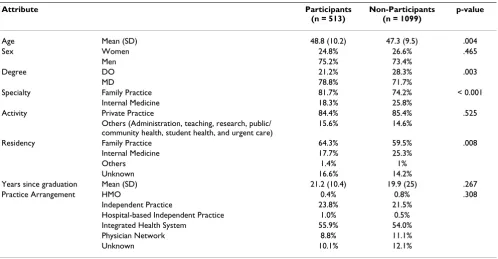
Table 1: Profile of Iowa PCPs
Attribute Participants
(n = 513)
Non-Participants (n = 1099)
p-value
Age Mean (SD) 48.8 (10.2) 47.3 (9.5) .004 Sex Women 24.8% 26.6% .465
Men 75.2% 73.4%
Degree DO 21.2% 28.3% .003
MD 78.8% 71.7%
Specialty Family Practice 81.7% 74.2% < 0.001 Internal Medicine 18.3% 25.8%
Activity Private Practice 84.4% 85.4% .525 Others (Administration, teaching, research, public/
community health, student health, and urgent care)
15.6% 14.6%
Residency Family Practice 64.3% 59.5% .008 Internal Medicine 17.7% 25.3%
Others 1.4% 1%
Unknown 16.6% 14.2%
Years since graduation Mean (SD) 21.2 (10.4) 19.9 (25) .267 Practice Arrangement HMO 0.4% 0.8% .308
MD's and DO's in the OSCEP list, with two follow-up mailed reminders to non-respondents.
We used chi-square tests and t-tests where appropriate to compare participants to non-participants. Simple descrip-tive statistics compare the responses of the 2 subgroups of PCPs: MD's and DO's. Chi-square tests were used to com-pare the referral patterns of PCPs to other PCPs and to Chiropractors.
Multivariable logistic regression models were used to identify variables that are most predictive of PCP relation-ships with chiropractors (DC). Separate logistic regression models were built to model each of six dichotomous out-come variables: 1) recommend patient see DC, 2) recom-mend patient contact DC, 3) make formal referral to DC, 4) receive referral from DC, 5) advise DC, and 6) receive
advice from DC. The predictor variables used were sex (female is reference), MD degree (DO degree is reference), age, time since graduation, private practice (other practice set ups is reference, see table 1), internal medicine resi-dency (family practice is reference), and metropolitan county (non-metropolitan is reference). The Hosmer and Lemeshow goodness-of-fit test was used to examine the adequacy of the multivariable models. A two-tailed p-value of less than 0.05 was deemed to be statistically sig-nificant for all the analyses. SAS version 9.1 (Cary, NC) and SPSS version 13.0 (Chicago, IL) were used for statisti-cal analyses.
Results
Five hundred seventeen physicians responded to the sur-vey. This is 33% of the entire universe of 1,561 primary care physicians in the state of Iowa. These rates are
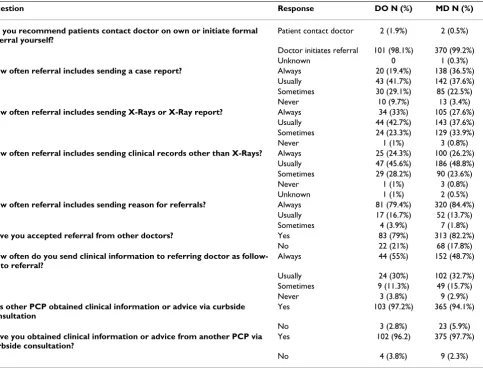
com-Table 2: Intra-professional relationships of PCPs
Question Response DO N (%) MD N (%)
Do you recommend patients contact doctor on own or initiate formal referral yourself?
Patient contact doctor 2 (1.9%) 2 (0.5%) Doctor initiates referral 101 (98.1%) 370 (99.2%) Unknown 0 1 (0.3%)
How often referral includes sending a case report? Always 20 (19.4%) 138 (36.5%) Usually 43 (41.7%) 142 (37.6%) Sometimes 30 (29.1%) 85 (22.5%) Never 10 (9.7%) 13 (3.4%)
How often referral includes sending X-Rays or X-Ray report? Always 34 (33%) 105 (27.6%) Usually 44 (42.7%) 143 (37.6%) Sometimes 24 (23.3%) 129 (33.9%) Never 1 (1%) 3 (0.8%)
How often referral includes sending clinical records other than X-Rays? Always 25 (24.3%) 100 (26.2%) Usually 47 (45.6%) 186 (48.8%) Sometimes 29 (28.2%) 90 (23.6%) Never 1 (1%) 3 (0.8%) Unknown 1 (1%) 2 (0.5%)
How often referral includes sending reason for referrals? Always 81 (79.4%) 320 (84.4%) Usually 17 (16.7%) 52 (13.7%) Sometimes 4 (3.9%) 7 (1.8%)
Have you accepted referral from other doctors? Yes 83 (79%) 313 (82.2%) No 22 (21%) 68 (17.8%)
How often do you send clinical information to referring doctor as follow-up to referral?
Always 44 (55%) 152 (48.7%) Usually 24 (30%) 102 (32.7%) Sometimes 9 (11.3%) 49 (15.7%) Never 3 (3.8%) 9 (2.9%)
Has other PCP obtained clinical information or advice via curbside consultation
Yes 103 (97.2%) 365 (94.1%) No 3 (2.8%) 23 (5.9%)
Have you obtained clinical information or advice from another PCP via curbside consultation?
Yes 102 (96.2) 375 (97.7%) No 4 (3.8%) 9 (2.3%) PCP = Primary Care Physician
[image:3.612.70.553.100.469.2]parable to that obtained in similar surveys of physicians and other health professionals [14,15]. After excluding ineligible surveys (i.e. respondents no longer in active practice), 513 PCPs were included in the analysis. The study group then consisted of 404 medical doctors and 109 osteopaths.
A profile comparison revealed only small differences between study participants and non-participants (Table 1). Respondents were less likely to be osteopaths, less likely to have specialized in internal medicine, and more likely to have completed a family practice residency.
PCP intra-professional relationships
Table 2 summarizes the responses of medical doctors (MDs) and osteopaths (DOs) to questions that assessed their referral patterns to/from other PCPs. The results indi-cate that both DO's and MD's preferred to initiate formal referral to other PCPs (> 98%) rather than have the patient make the initial contact with the doctor. Over 70% of referring physicians sent a case report or clinical records "usually" or "always." Less than 10% of physicians "never" included a report with the referral. All physicians included an explanation for the referral at least "some of the time", and over 96% did so "routinely".
[image:4.612.79.555.101.507.2]Seventy nine percent of DO's and 82% of MD's reported that they "always accepted" referrals from other PCPs (or
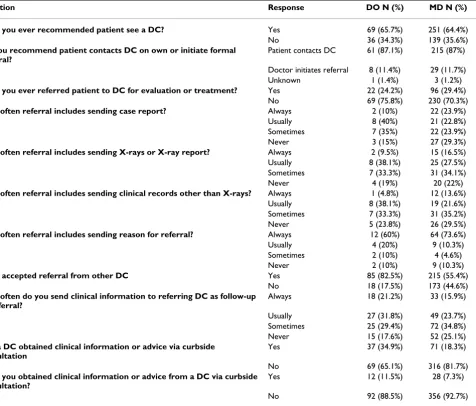
Table 3: Inter-professional relationships between PCPs and chiropractors
Question Response DO N (%) MD N (%)
Have you ever recommended patient see a DC? Yes 69 (65.7%) 251 (64.4%) No 36 (34.3%) 139 (35.6%)
Do you recommend patient contacts DC on own or initiate formal referral?
Patient contacts DC 61 (87.1%) 215 (87%) Doctor initiates referral 8 (11.4%) 29 (11.7%) Unknown 1 (1.4%) 3 (1.2%)
Have you ever referred patient to DC for evaluation or treatment? Yes 22 (24.2%) 96 (29.4%) No 69 (75.8%) 230 (70.3%)
How often referral includes sending case report? Always 2 (10%) 22 (23.9%) Usually 8 (40%) 21 (22.8%) Sometimes 7 (35%) 22 (23.9%) Never 3 (15%) 27 (29.3%)
How often referral includes sending X-rays or X-ray report? Always 2 (9.5%) 15 (16.5%) Usually 8 (38.1%) 25 (27.5%) Sometimes 7 (33.3%) 31 (34.1%) Never 4 (19%) 20 (22%)
How often referral includes sending clinical records other than X-rays? Always 1 (4.8%) 12 (13.6%) Usually 8 (38.1%) 19 (21.6%) Sometimes 7 (33.3%) 31 (35.2%) Never 5 (23.8%) 26 (29.5%)
How often referral includes sending reason for referral? Always 12 (60%) 64 (73.6%) Usually 4 (20%) 9 (10.3%) Sometimes 2 (10%) 4 (4.6%) Never 2 (10%) 9 (10.3%)
Have accepted referral from other DC Yes 85 (82.5%) 215 (55.4%)
No 18 (17.5%) 173 (44.6%)
How often do you send clinical information to referring DC as follow-up to referral?
Always 18 (21.2%) 33 (15.9%) Usually 27 (31.8%) 49 (23.7%) Sometimes 25 (29.4%) 72 (34.8%) Never 15 (17.6%) 52 (25.1%)
Has a DC obtained clinical information or advice via curbside consultation
Yes 37 (34.9%) 71 (18.3%) No 69 (65.1%) 316 (81.7%)
Have you obtained clinical information or advice from a DC via curbside consultation?
Yes 12 (11.5%) 28 (7.3%) No 92 (88.5%) 356 (92.7%) DC = Chiropractor
peers), and only 4% of DO's and 3% of MD's "never" sent follow-up clinical information to referring physicians. PCPs did not accept referrals from physicians when they felt that caring for the referred patient was beyond their scope of expertise or were not covered by insurance.
Curbside consultation was common practice among both DO's and MD's. Physicians were about equally likely to receive or give a consultation. The referral patterns of both DO's and MD's were very similar.
Inter-professional relationships
The results of the responses of PCPs to questions assessing their referral patterns to/from chiropractors are summa-rized in Table 3. Eighty-one percent of DO's and 87% of MD's reported that their patients had asked them for information about chiropractic, and close to 75% of PCPs have patients who have requested a referral to a chiroprac-tor. Approximately 65% of DO's and MD's had recom-mended that their patients consult a chiropractor. However, only 24% of DO's and 29% of MD's had
them-selves formally referred a patient to a chiropractor. The common reasons for referring a patient to a chiropractor were back or neck pains, unresponsive chronic pain, fibro-myalgias, and musculoskeletal conditions. A vast majority of both DO's and MD's preferred that their patients con-tact chiropractors on their own rather than the physicians initiating a formal referral themselves.
While 82.5% of DO's accepted referral from a chiroprac-tor only 55.4% of MD's accepted a referral from a chiro-practor. The common reasons for not accepting a referral from chiropractors were the absence of a formal referral and health problems outside the PCP's area of expertise. Eighteen percent of DO's and 19% of MD's indicated that chiropractors did not send them any clinical information about the referred patient.
[image:5.612.53.553.98.438.2]Thirty-five percent of DOs mentioned that a chiropractor obtained curbside advice from them. Only 18% of MD's mentioned that a chiropractor obtained curbside advice.
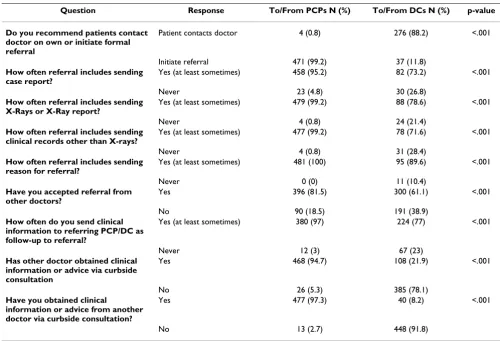
Table 4: PCP referral patterns to other PCPs and DCs (Univariate analysis*)
Question Response To/From PCPs N (%) To/From DCs N (%) p-value
Do you recommend patients contact doctor on own or initiate formal referral
Patient contacts doctor 4 (0.8) 276 (88.2) <.001
Initiate referral 471 (99.2) 37 (11.8)
How often referral includes sending case report?
Yes (at least sometimes) 458 (95.2) 82 (73.2) <.001 Never 23 (4.8) 30 (26.8)
How often referral includes sending X-Rays or X-Ray report?
Yes (at least sometimes) 479 (99.2) 88 (78.6) <.001 Never 4 (0.8) 24 (21.4)
How often referral includes sending clinical records other than X-rays?
Yes (at least sometimes) 477 (99.2) 78 (71.6) <.001 Never 4 (0.8) 31 (28.4)
How often referral includes sending reason for referral?
Yes (at least sometimes) 481 (100) 95 (89.6) <.001 Never 0 (0) 11 (10.4)
Have you accepted referral from other doctors?
Yes 396 (81.5) 300 (61.1) <.001 No 90 (18.5) 191 (38.9)
How often do you send clinical information to referring PCP/DC as follow-up to referral?
Yes (at least sometimes) 380 (97) 224 (77) <.001
Never 12 (3) 67 (23)
Has other doctor obtained clinical information or advice via curbside consultation
Yes 468 (94.7) 108 (21.9) <.001
No 26 (5.3) 385 (78.1)
Have you obtained clinical
information or advice from another doctor via curbside consultation?
Yes 477 (97.3) 40 (8.2) <.001
No 13 (2.7) 448 (91.8) * Chi-square tests.
DC = Chiropractor
Univariate analysis
The combined responses of DO's and MD's to questions assessing their referral behaviors to other PCPs and chiro-practors are summarized in Table 4. Approximately 99% of the PCPs responded that they would initiate a patient referral to other PCPs, whereas only 12% said that they would initiate a referral to a chiropractor (p < 0.001). Close to 95% sent a case report when referring a patient to another PCP, but only 73% sent a case report when refer-ring a patient to a chiropractor (p < 0.001). PCPs were also more likely to send X-rays or X-ray report and other clini-cal records to another PCP than to a chiropractor (p < 0.001).
Eighty-one percent of PCPs had accepted a referral from another PCP but only 61% of PCPs had accepted a referral from a chiropractor (p < 0.001). PCPs were also not con-sistent in sending follow-up clinical information to refer-ring chiropractors. Only 77% of PCPs who had accepted a referral from a chiropractor sent follow-up clinical infor-mation about the patient to the chiropractor, whereas 97% of PCPs who had accepted referral from another PCP sent follow-up clinical information to the referring physi-cian (p < 0.001). Close to 95% of PCPs mentioned that other PCPs had obtained curbside clinical information or advice from them, whereas only 22% of PCPs mentioned that chiropractors had obtained curbside clinical advice from them (p < 0.001). PCPs were also more likely to obtain curbside clinical advice from other PCPs when compared to obtaining advice from chiropractors. Approximately 97% of PCPs mentioned that they had obtained curbside clinical advice from other PCPs, whereas only 8% of PCPs had obtained curbside clinical advice from chiropractors (p < 0.001).
Multivariable analysis
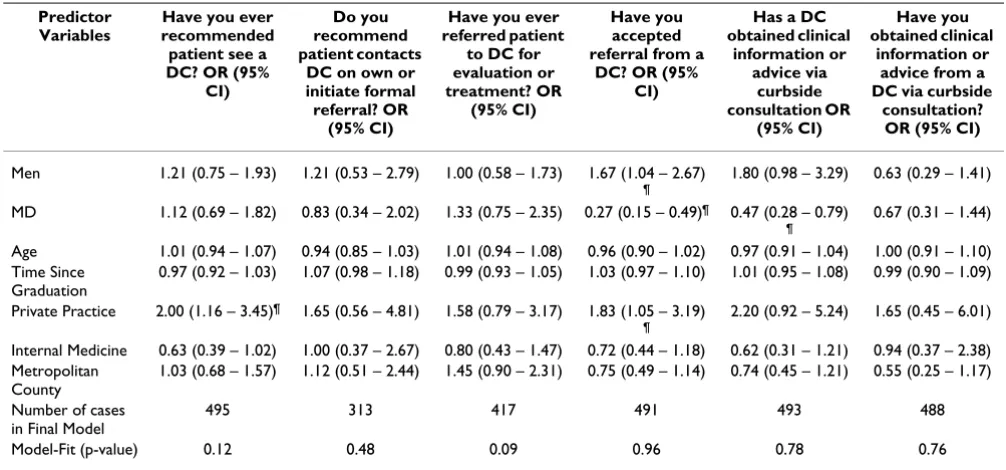
Results from the Multivariable logistic regression analy-ses, including odds ratios and 95% confidence intervals for each predictor variable, are summarized in Table 5. All 6 models had a good fit. The first model shows that the odds that PCPs in private practice would recommend that their patients see a chiropractor were twice that of PCPs in other practice arrangements, after adjusting for other model predictors (p = 0.012). The next 2 models revealed no strong predictors of referral or type of referral to chiro-practors. The 4th model identified several predictors of
accepting referrals from chiropractors: The odds of accept-ing referrals were 67% higher for men than women (p = 0.032), 3.7 times higher for DOs than MDs (p < 0.001), and 83% higher for PCPs in private practice than for those in other practice arrangements (p = 0.031). In Model 5, we found that the odds that an MD was approached by a chi-ropractor for curbside advice was only 47% of the odds that a DO would be approached (p = 0.004).
Discussion
In our study, clearly a majority of PCPs were willing to rec-ommend that patients consult a chiropractor, yet they were reluctant to actually make a formal referral them-selves. Only 30% of PCPs in our study and 50% in previ-ous studies [16-18] have ever made a formal referral to a chiropractor. An important finding from our study is that when PCPs recommend chiropractic care, close to 88% preferred that patients contact a chiropractor on their own. There are several possible explanations for their unwillingness to "formalize" their relationships with chi-ropractors. PCPs fear malpractice litigations [19]. A per-ception that alternative care providers could be a threat to their practices could also have been an influence. Some of the PCPs in our study mentioned that they do not know enough about chiropractic to have an opinion, or do not view chiropractic as a legitimate health profession.
The lack of direct formalized referral relationships between PCPs and chiropractors has implications for effi-ciency, quality, and patient safety in the health care deliv-ery system. It has been documented that allowing patients to contact other physicians on their own is likely to break continuity of care [20,21]. Patients are caught directly in the middle of this uncertainty between provider types. More research needs to be directed at better understand-ing of those issues surroundunderstand-ing the coordination and the loss of care which results from the poor professional rela-tionships between these two provider types. This should include an examination of educational interventions to improve the documentation and sharing of clinical infor-mation and thereby enhance cross-disciplinary standards of care. Coulter et al in their study examined the inter-referral patterns between primary care physicians and alternate medicine providers and described a network sys-tem that can potentially provide an administrative struc-ture to facilitate changes in physician attitudes in terms of referrals for their patients [7].
It is evident that the patients demonstrated a strong inter-est in chiropractic care. This finding is consistent with other studies [22,23]. Patient interest in alternate care is a great driving force for the PCP to refer or recommend them to chiropractors [22,23]. Several studies have revealed that general practitioners refer to alternate care providers for back pain, musculoskeletal conditions, and neck problems [21,23]. This is consistent with our finding that the most frequent reason for referral to a chiropractor was chronic musculoskeletal pain that does not respond to conventional treatments.
set-tings. Several authors have shown that physicians in solo practice are more open to unorthodox methods of treat-ment [23,24]. Also, Easthope et al [25] demonstrated that general practitioners in smaller practices view comple-mentary therapies more favorably than those in larger practices.
A few studies have shown that age and sex influence phy-sicians' perceptions of usefulness of alternate care thera-pies [26,27]. Sikand and Laken [26] have shown that younger physicians are more likely to exhibit positive atti-tudes towards complementary and alternative medicine. Glodsmitz et al[27] demonstrated that female general practitioners are more likely than their male counterparts to view complementary health care practices as useful. In contrast to these studies, sex and age were not significant predictors in our models, after adjusting for other model predictors. However, male physicians were more likely to have accepted referrals from chiropractors.
Our study adds precision to understanding the referral patterns of PCPs. A vast majority of PCPs seem to enjoy very good intra-professional relationships. However, it is clear that there is a major communication problem in inter-professional relationships with chiropractors. While chiropractic care has become popular with patients, PCPs in Iowa do not generally have a positive impression about
chiropractic care and it is the case that MDs are very reluc-tant to make/receive referrals.
An issue to be considered is that our study assessed the views of primary care physicians in a predominantly rural state. It is quite possible that chiropractors play in differ-ent role in the primary care system of rural areas. Attitudes towards alternative care may differ between rural and urban physicians and between regions of the country. Hence, caution should be exercised in generalizing the study findings.
[image:7.612.53.556.100.335.2]Finally, only 33% of the entire population of Iowa PCP physicians solicited to participate in this study responded to our survey and this raises questions about generaliza-bility of our findings to all Iowa PCPs. While the informa-tion presented in Table 1 shows only minor differences between respondents and non-responders, there could still be some non-response bias attributable to unmeas-ured covariates. Previous studies requiring physician par-ticipation have encountered similar problems [28,29]. However, we should note that when compared to the gen-eral population, physicians constitute a relatively homog-enous group. If our sample is representative, then the external validity of a study can still be achieved with rela-tively smaller sample sizes [29,30].
Table 5: PCP referral patterns to DCs (Multivariable analysis)
Predictor Variables
Have you ever recommended patient see a DC? OR (95%
CI)
Do you recommend patient contacts
DC on own or initiate formal referral? OR
(95% CI)
Have you ever referred patient
to DC for evaluation or treatment? OR
(95% CI)
Have you accepted referral from a
DC? OR (95% CI)
Has a DC obtained clinical
information or advice via
curbside consultation OR
(95% CI)
Have you obtained clinical
information or advice from a DC via curbside
consultation? OR (95% CI)
Men 1.21 (0.75 – 1.93) 1.21 (0.53 – 2.79) 1.00 (0.58 – 1.73) 1.67 (1.04 – 2.67)

1.80 (0.98 – 3.29) 0.63 (0.29 – 1.41) MD 1.12 (0.69 – 1.82) 0.83 (0.34 – 2.02) 1.33 (0.75 – 2.35) 0.27 (0.15 – 0.49)¶ 0.47 (0.28 – 0.79)

0.67 (0.31 – 1.44) Age 1.01 (0.94 – 1.07) 0.94 (0.85 – 1.03) 1.01 (0.94 – 1.08) 0.96 (0.90 – 1.02) 0.97 (0.91 – 1.04) 1.00 (0.91 – 1.10) Time Since
Graduation
0.97 (0.92 – 1.03) 1.07 (0.98 – 1.18) 0.99 (0.93 – 1.05) 1.03 (0.97 – 1.10) 1.01 (0.95 – 1.08) 0.99 (0.90 – 1.09) Private Practice 2.00 (1.16 – 3.45)¶ 1.65 (0.56 – 4.81) 1.58 (0.79 – 3.17) 1.83 (1.05 – 3.19)

2.20 (0.92 – 5.24) 1.65 (0.45 – 6.01) Internal Medicine 0.63 (0.39 – 1.02) 1.00 (0.37 – 2.67) 0.80 (0.43 – 1.47) 0.72 (0.44 – 1.18) 0.62 (0.31 – 1.21) 0.94 (0.37 – 2.38) Metropolitan
County
1.03 (0.68 – 1.57) 1.12 (0.51 – 2.44) 1.45 (0.90 – 2.31) 0.75 (0.49 – 1.14) 0.74 (0.45 – 1.21) 0.55 (0.25 – 1.17) Number of cases
in Final Model
495 313 417 491 493 488 Model-Fit (p-value) 0.12 0.48 0.09 0.96 0.78 0.76 ¶ – Statistically significant at p < 0.05 level.
DC = Chiropractor
Conclusion
PCPs enjoy very good professional relationships with other PCPs. However, the lack of direct formalized referral relationships between PCPs and chiropractors has impli-cations for efficiency, continuity, quality, and patient safety in the health care delivery system. Further research must focus on identifying facilitators and barriers of developing positive relationships between PCPs and chi-ropractors.
Competing interests
The author(s) declare that they have no competing inter-ests.
Funding
This research was made possible by funding by NIH-NCCAM – Project #AT-01-001 – Analysis of DC MDPCP Interprofessional Relationships. This investigation was conducted in a facility constructed with support from Research Facilities Improvement Grant Number C06 RR15433 from the National Center for Research Resources, National Institute of Health.
Appendix 1
For the following questions, we define formal referralto mean that the referring provider facilitates the introduc-tion or initial contact between the patient and a particular consultant.
1A
When you refer a patient to another medical doctor, do you more typically recommend that the patient contact the medical doctor on their own, or do you offer to initi-ate the contact with a formal referral from you to the other doctor?
1 I typically recommend that the patient contact the other medical doctor on their own
2 I typically offer to formally refer the patient to the other medical doctor
How many times have you formally referred a patient to another medical doctor during the past year? times
When you formally refer a patient to another medical doctor, how often does your referral include sending the following clinical information about the patient:
Other clinical information (please specify):
1B
Have you ever accepted a formal referral from another medical doctor? ★ Yes ★ No
If "Yes", how many times have you accepted a formal referral from another medical doctor during the past year?
If "Yes", when you receive patients referred from another medical doctor, how often do you also receive the follow-ing clinical information about the patient?
Other clinical information (please specify):
If "Yes", when you receive patients referred from another medical doctor, how often do you send clinical informa-tion to the other medical doctor as a follow-up to their referral?
1 Always 2 Usually 3 Sometimes 4 Never
1C
Have you ever refused a formal referral from another medical doctor? ★ Yes ★ No
If "Yes", for what reasons have you refused a referral from a medical doctor?
2A
Has a patient ever asked you for information about chiro-practic? ★ Yes ★ No
Has a patient ever asked you to refer them to a chiroprac-tor? ★ Yes ★ No
2B
Have you ever recommended to a patient that they might try seeing a chiropractor for their health complaint?
(If NO, then check NO box and skip to next page) ★ Yes
★ No
If "Yes", how many times have you made such a recom-mendation during the past year?
For what type(s) of health complaints have you recom-mended that patients might try a chiropractor? (please list)
If "Yes", do you more typically recommend that the patient try a particular chiropractor or just any chiroprac-tor in general?
2 I typically recommend any chiropractor in general
If "Yes ", do you more typically recommend that the patient contact the chiropractor on their own, or do you offer to initiate the contact with a formal referral from you to the chiropractor?
1 I typically recommend that the patient contact the chi-ropractor on their own
2 I typically offer to formally refer the patient to a chiro-practor
For the following questions, we define formal referralto mean that the referring doctor facilitates the introduction or initial contact between the patient and a particular chi-ropractor
2C
Have you everformally referred a patient to a chiropractor for evaluation or treatment? ★ Yes ★ No
(If No, then check NO box and skip to next page)
If "Yes", how many times have you formally referred a patient to a chiropractor during the past year?
If "Yes", for what type(s) of health complaints have you
formally referred a patient to a chiropractor?
If "Yes", please indicate how often your formal referral to the chiropractor included the following clinical informa-tion about the patient.
Other clinical information (please specify):
3A
Have you ever accepted a formal referral from a chiro-practor? Yes No
If "Yes", how many times have you received a formal refer-ral from a chiropractor during the past year?
If "Yes", when you receive patients referred from a chiro-practor, how often do you also receive clinical informa-tion about the patient?
1 Always 2 Usually 3 Sometimes 4 Never
If "Yes", when you receive patients referred from a chiro-practor, how often do you send clinical information to the chiropractor as a follow-up to their referral?
1 Always 2 Usually 3 Sometimes 4 Never
3B
Have you ever refused a formal referral from a chiroprac-tor? ★ Yes ★ No
If "Yes", for what reasons have you refused a referral from a chiropractor?
"Formal consultation" is a process whereby a healthcare provider refers a patient to another healthcare provider, e.g. for assistance with the diagnosis or treatment of the patient. The consultant reviews the patient's records, examines the patient, and formally documents his/her recommendations or plan for the patient's care.
[image:9.612.54.553.660.720.2]"Curbside consultation" is an informal process whereby a provider (typically an MD) obtains information or advice from another provider (typically an MD) to assist in the
Table 6:
Always Usually Sometimes Never
a) A case report 䊐 䊐 䊐 䊐
b) X-rays or X-ray report 䊐 䊐 䊐 䊐 c) Clinical records other than X-ray 䊐 䊐 䊐 䊐 d) Reason for referral 䊐 䊐 䊐 䊐
Table 7:
Always Usually Sometimes Never
e) A case report 䊐 䊐 䊐 䊐
management of a particular patient. The consultant nei-ther reviews the patient's records nor examines the patient and does not document his/her recommendations.
3C
Has another medical doctor ever obtained clinical infor-mation or advice from you, by way of informal "curbside consultation"? ★ Yes ★ No
If "Yes", how many times has this occurred during the past year?
Have you ever obtained clinical information or advice from another medical doctor, by way of informal "curb-side consultation"? ★ Yes ★ No
If "Yes", how many times has this occurred during the past year?
Has a chiropractor ever obtained clinical information or advice from you, by way of informal "curbside consulta-tion"? ★ Yes ★ No
If "Yes", how many times has this happened during the past year?
Have you ever obtained clinical information or advice from a chiropractor, by way of informal "curbside consul-tation"? ★ Yes ★ No
If "Yes", how many times has this occurred during the past year?
3D
Do you consider your medical practice to be generalist,
specialist, or both. (circle one)
If specialist or both, please list your specialty here.
If both, what percentage of your practice hours are more oriented toward generalist practice. %.
What percentage of your practice hours consist of provid-ing services that you consider "primary care" %.
Acknowledgements
The authors would like to acknowledge Drs. Jane F Pendergast and Thomas E Vaughn for their critical review of the manuscript. The authors would like to acknowledge Junlin Liao for his project management in the conduct of the study and Lynne Carber from Palmer College Research for assistance with survey data management..
References
1. Eisenberg DM, Kessler RC, Foster C, Norlock FE, Calkins DR, Del-banco TL: Unconventional medicine in the United States. Prevalence, costs, and patterns of use. N Engl J Med 1993,
328(4):246-252.
2. Eisenberg DM, Davis RB, Ettner SL, Appel S, Wilkey S, Van Rompay M, Kessler RC: Trends in alternative medicine use in the United States, 1990-1997: results of a follow-up national sur-vey. Jama 1998, 280(18):1569-1575.
3. Astin JA: Why patients use alternative medicine: results of a national study. Jama 1998, 279(19):1548-1553.
4. Cherkin DC, MacCornack FA: Patient evaluations of low back pain care from family physicians and chiropractors. West J Med 1989, 150(3):351-355.
5. Carey TS, Garrett J, Jackman A, McLaughlin C, Fryer J, Smucker DR:
The outcomes and costs of care for acute low back pain among patients seen by primary care practitioners, chiro-practors, and orthopedic surgeons. The North Carolina Back Pain Project. N Engl J Med 1995, 333(14):913-917. 6. Nyiendo J, Haas M, Goldberg B, Sexton G: Pain, disability, and
sat-isfaction outcomes and predictors of outcomes: a practice-based study of chronic low back pain patients attending pri-mary care and chiropractic physicians. J Manipulative Physiol Ther 2001, 24(7):433-439.
7. Coulter ID, Singh BB, Riley D, Der-Martirosian C: Interprofessional referral patterns in an integrated medical system. J Manipula-tive Physiol Ther 2005, 28(3):170-174.
8. Sawyer CE, Bergmann TF, Good DW: Attitudes and habits of chi-ropractors concerning referral to other health care provid-ers. J Manipulative Physiol Ther 1988, 11(6):480-483.
9. Schulte M, Mehler PS: Promoting primary care-subspecialist interaction through curbside consultations. J Gen Intern Med
1999, 14(3):207.
10. Kuo D, Gifford DR, Stein MD: Curbside consultation practices and attitudes among primary care physicians and medical subspecialists. Jama 1998, 280(10):905-909.
11. Golub RM: Curbside consultations and the viaduct effect. Jama
1998, 280(10):929-930.
12. Bergus GR, Randall CS, Sinift SD, Rosenthal DM: Does the struc-ture of clinical questions affect the outcome of curbside con-sultations with specialty colleagues? Arch Fam Med 2000,
9(6):541-547.
13. Keating NL, Zaslavsky AM, Ayanian JZ: Physicians' experiences and beliefs regarding informal consultation. Jama 1998,
280(10):900-904.
14. McBride PE, Massoth KM, Underbakke G, Solberg LI, Beasley JW, Plane MB: Recruitment of private practices for primary care research: experience in a preventive services clinical trial. J Fam Pract 1996, 43(4):389-395.
15. Russell ML, Verhoef MJ, Injeyan HS, McMorland DG: Response rates for surveys of chiropractors. J Manipulative Physiol Ther
2004, 27(1):43-48.
[image:10.612.58.543.101.161.2]16. White AR, Resch KL, Ernst E: Complementary medicine: use and attitudes among GPs. Fam Pract 1997, 14(4):302-306.
Table 8:
Always Usually Sometimes Never
i) A case report 䊐 䊐 䊐 䊐
Publish with BioMed Central and every scientist can read your work free of charge "BioMed Central will be the most significant development for disseminating the results of biomedical researc h in our lifetime."
Sir Paul Nurse, Cancer Research UK
Your research papers will be:
available free of charge to the entire biomedical community
peer reviewed and published immediately upon acceptance
cited in PubMed and archived on PubMed Central
yours — you keep the copyright
Submit your manuscript here:
http://www.biomedcentral.com/info/publishing_adv.asp
BioMedcentral
17. Berman BM, Singh BK, Lao L, Singh BB, Ferentz KS, Hartnoll SM: Phy-sicians' attitudes toward complementary or alternative medicine: a regional survey. J Am Board Fam Pract 1995,
8(5):361-366.
18. Blumberg DL, Grant WD, Hendricks SR, Kamps CA, Dewan MJ: The physician and unconventional medicine. Altern Ther Health Med
1995, 1(3):31-35.
19. Studdert DM, Eisenberg DM, Miller FH, Curto DA, Kaptchuk TJ, Brennan TA: Medical malpractice implications of alternative medicine. Jama 1998, 280(18):1610-1615.
20. Lee T, Pappius EM, Goldman L: Impact of inter-physician com-munication on the effectiveness of medical consultations. Am J Med 1983, 74(1):106-112.
21. Mainous AG, Gill JM, Zoller JS, Wolman MG: Fragmentation of patient care between chiropractors and family physicians.
Arch Fam Med 2000, 9(5):446-450.
22. van Haselen RA, Reiber U, Nickel I, Jakob A, Fisher PA: Providing Complementary and Alternative Medicine in primary care: the primary care workers' perspective. Complement Ther Med
2004, 12(1):6-16.
23. Verhoef MJ, Sutherland LR: Alternative medicine and general practitioners. Opinions and behaviour. Can Fam Physician 1995,
41:1005-1011.
24. Anderson E, Anderson P: General practitioners and alternative medicine. J R Coll Gen Pract 1987, 37:52-55.
25. Easthope G, Tranter B, Gill G: General practitioners' attitudes toward complementary therapies. Social Science and Medicine
2000, 51:1555-1561.
26. Sikand A, Laken M: Pediatricians' experience with attitudes toward complementary/alternative medicine. Arch Pediatr Adolesc Med 1998, 152:1059-1064.
27. Goldszmidt M, Levitt C, Duarte-Franco E, Kaczorowski J: Comple-mentary health care services: a survey of general practition-ers' views. Cmaj 1995, 153(1):29-35.
28. Cummings SM, Savitz LA, Konrad TR: Reported response rates to mailed physician questionnaires. Health Serv Res 2001,
35(6):1347-1355.
29. Singh B, Liu XD, Der-Martirosian C, Hardy M, Singh V, Shepard N, Gandhi S, Khorsan R: A national probability survey of American Medical Association gynecologists and primary care physi-cians concerning menopause. Am J Obstet Gynecol 2005, 193(3 Pt 1):693-700.
30. Babbie E: The Practice of Social Research. 102004.
Pre-publication history
The pre-publication history for this paper can be accessed here: