Open Access
Research article
Wellness through a comprehensive Yogic breathing program – A
controlled pilot trial
Anette Kjellgren*
1, Sven Å Bood
1, Kajsa Axelsson
1, Torsten Norlander
1and
Fahri Saatcioglu*
2Address: 1Department of Psychology, Karlstad University, Karlstad, Sweden and 2Department of Molecular Biosciences, University of Oslo, Oslo,
Norway
Email: Anette Kjellgren* - [email protected]; Sven Å Bood - [email protected]; Kajsa Axelsson - [email protected]; Torsten Norlander - [email protected]; Fahri Saatcioglu* - [email protected]
* Corresponding authors
Abstract
Background: Increasing rates of psychosocial disturbances give rise to increased risks and vulnerability for a wide variety of stress-related chronic pain and other illnesses. Relaxation exercises aim at reducing stress and thereby help prevent these unwanted outcomes. One of the widely used relaxation practices is yoga and yogic breathing exercises. One specific form of these exercises is Sudarshan Kriya and related practices (SK&P) which are understood to have favourable effects on the mind-body system. The goal of this pilot study was to design a protocol that can investigate whether SK&P can lead to increased feeling of wellness in healthy volunteers.
Methods: Participants were recruited in a small university city in Sweden and were instructed in a 6-day intensive program of SK&P which they practiced daily for six weeks. The control group was instructed to relax in an armchair each day during the same period. Subjects included a total of 103 adults, 55 in the intervention (SK&P) group and 48 in the control group. Various instruments were administered before and after the intervention. Hospital Anxiety Depression Scale measured the degree of anxiety and depression, Life Orientation Test measured dispositional optimism, Stress and Energy Test measured individual's energy and stress experiences. Experienced Deviation from Normal State measured the experience of altered state of consciousness.
Results: There were no safety issues. Compliance was high (only 1 dropout in the SK&P group, and 5 in the control group). Outcome measures appeared to be appropriate for assessing the differences between the groups. Subjective reports generally correlated with the findings from the instruments. The data suggest that participants in the SK&P group, but not the control group, lowered their degree of anxiety, depression and stress, and also increased their degree of optimism (ANOVA; p < 0.001). The participants in the yoga group experienced the practices as a positive event that induced beneficial effects.
Conclusion: These data indicate that the experimental protocol that is developed here is safe, compliance level is good, and a full scale trial is feasible. The data obtained suggest that adult participants may improve their wellness by learning and applying a program based on yoga and yogic breathing exercises; this can be conclusively assessed in a large-scale trial.
Trial Registration: Australian Clinical Trial Registry ACTRN012607000175471. Published: 19 December 2007
BMC Complementary and Alternative Medicine 2007, 7:43 doi:10.1186/1472-6882-7-43
Received: 26 January 2007 Accepted: 19 December 2007
This article is available from: http://www.biomedcentral.com/1472-6882/7/43 © 2007 Kjellgren et al; licensee BioMed Central Ltd.
Background
Relaxation exercises offer a means to reduce the physio-logical and psychophysio-logical reactions to stress [1,2]. Current achievement-based, demanding and high-tempo society has incurred increased risks and vulnerability for stress-related chronic pain and other illnesses [3-5]. A multitude of techniques for relaxation and stress-reduction are described, e.g. flotation-REST [6], Tai Chi Chuan [2], meditation [7] and yoga [8,9].
The different relaxation techniques often lead to specific psychological and physiological changes termed the 'relaxation response' (RR) [10]. The RR is identified as the physiological opposite of the stress or 'fight-or-flight response' [11]. The RR is associated with instantly occur-ring physiological changes that include reduced sympa-thetic nervous system activity, reduced metabolism, lowered heart rate, reduced blood pressure, and decreased respiratory rate [12,1]. At the psychological level, individ-uals typically report that RR techniques result in genuine rest, recovery from fatigue, better sleep quality, as well as an increased sense of control and efficacy in stressful situ-ations [13].
Yoga is one of the many different techniques for achieving relaxation. Yoga has its origin in ancient India and in its original form consisted of a system of spiritual, moral and physical practices [9]. The most central and common aspects of yoga practice today are different bodily postures (asanas) and breathing exercises (pranayamas) [14,9] that aim to focus the mind, achieve relaxation and increase wellness. Various health benefits of yoga have been described in previous studies. A review of anti-depressive effects of different forms of yoga [9] indicated potential beneficial effects of yoga on depressive disorders. Other studies reported beneficial effects of yoga on anxiety, stress reduction and general well-being [15-17]. However, the results need to be interpreted carefully since many of the published studies about yoga are small and no system-atic and comprehensive reviews of scientific research on yoga have been published. It may also be difficult to com-pare studies done on different forms of yoga since benefits of yoga practice might differ by the style of the practice [18].
Sudarshan Kriya and related Practices (SK&P) is a form of yoga practice that emphasizes breathing exercises. In addi-tion to asanas, three different forms of pranayamas are practiced in succession [19]. Previous studies suggested that SK&P may be useful for relieving depression, improv-ing the antioxidant defenses of the body, givimprov-ing rise to beneficial EEG patterns, and possible improvements in blood chemistry [19-21]. For example, Janakiramaiah et al. found that the degree of depression significantly decreased (68–73 %) in subjects with clinical depression
after they practised SK daily for three weeks and this decrease was as effective as conventional pharmacological treatment [19]. Another study indicated concurrent high activity of both alpha and beta waves in the EEG in SK practitioners indicating focus and relaxation at the same time, suggesting improved brain function [8]. A drop in blood lactate level, yet increase in the antioxidant enzymes superoxide dismutase, catalase, and glutathione, indicated favourable effects on antioxidant status [21].
The aim of the present study was to develop a protocol that can investigate whether SK&P could be considered in connection with increased wellness. Even though what constitutes wellness can be debated, there are a number of studies demonstrating that the variables included in this study are among the most relevant to feeling of wellness by different approaches [22-24]. To that end, outcome measures that were evaluated included depression, anxi-ety, mood, optimism, energy levels, and experience of altered states of consciousness.
Methods
ParticipantsThis study included 103 participants (109 subjects to start with where 5 persons from the control and 1 person from the yoga group dropped out). The SK&P group was recruited through advertisement in the local paper and fli-ers. The control group was yoga naive, but had an interest in yoga and related practices, and were recruited in a sim-ilar way. The control group consisted of 55 participants (12 men, 43 females) and the yoga group of 48 partici-pants (13 men, 35 females); mean age for the whole study was 31.92 years (SD = 11.33) (for the control group M = 31.90 years, SD = 10.84, and for experimental group M = 31.95 years, SD = 11.85).
The yoga group participated in the beginner's course in the SK&P program in November – December 2004 at the Art of Living Yoga Center in Karlstad and Eskilstuna, Swe-den. The participants of the control group were recruited among yoga-interested students at Karlstad University. There were no significant differences between the groups (Mann-Whitney U test) regarding gender, occupation, education, phase in the menstruation cycle and usage of contraceptives (ps > 0.42). Analysis with Independent Samples T-test did not reveal any significant differences between the groups at baseline regarding age, degree of depression, stress, energy, ongoing pain, affective person-ality (PANAS-test), number of sleeping hours, minutes awake before falling asleep, experienced sleep quality, consumption of nicotine (cigarettes/snuff) or alcohol (ps
> 0.11).
between the groups regarding degree of optimism and anxiety assessed by the Independent Samples T-test. The control group had lower degree of anxiety (M = 4.63, SD
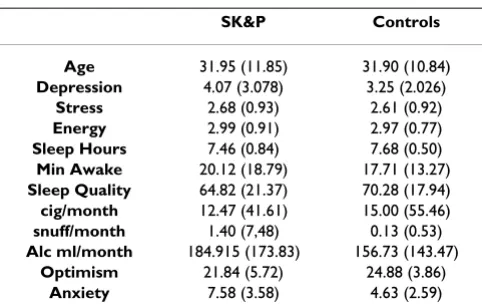
= 2.59) than the yoga group (M = 7.58, SD = 3.58) (p < 0.001, t (101) = 4.73). The control group also experienced higher degree of optimism (M = 24.88, SD = 3.86) com-pared to the yoga group (M = 21.84, SD = 5.72) (p = 0.002, t (101) = 3.11). The basis for these differences is not clear; however, the higher anxiety for the yoga group are not indicative of clinical anxiety diagnosis, and the values for optimism are in the normal range for both groups. Please see Table 1 for a comparison of baseline character-istics.
Several criteria were used for subject inclusion and exclu-sion. Inclusion: having an interest in yoga and relaxation exercises and that they would like to practice some kind of relaxation practise daily for 6 weeks. Exclusion: preg-nancy, ongoing psychiatric disease, younger than 18 years, clinical depression or anxiety-problems.
The study was approved by the Ethical Committee at Karl-stad University. All participants signed consent forms and they were treated according to the ethical guidelines of APA. Participants were informed that their data will be kept anonymous, participated by their free will and were free to leave the experiment whenever they wished with-out giving any reason for it.
Description of intervention
Sudarshan Kriya (SK) and related practices (SK&P) are derived from the Yogic Science of Breath derived from Vedic texts. SK&P includes gentle stretches (yoga pos-tures), specific breathing exercises (the central technique is SK; see below), and cognitive coping and stressor
evalu-ation strategies. SK&P is traditionally understood to dis-solve emotional distress and create the subjective experience of rest and well-being. The instructors in SK&P were trained by the International Art of Living Foundation in two residential courses of two weeks each which included approximately one year of practical field work in between.
The breathing techniques that are part of SK&P are: (a) Three-Stage Pranayama with Ujjayi or "Victory Breath", (b) three sets of Bhastrika or "Bellow's Breath", and (c) SK or the "Healing Breath Technique" and they were prac-ticed in that order. The breathing practices are done in a sitting posture, either in a chair or on the floor. Eyes are kept closed throughout the sessions.
Normal breathing is at the rate of 14 to 16 breaths per minute. Ujjayi is a slow and deep breathing technique at 2 to 4 breaths per minute. Three-Stage Pranayama with Ujjayi breath is an advanced form using a specific ratio of inhalation and exhalation, and breath-holds. Participants practice this component where specific arm positions are held for approximately ten minutes in total.
The second breathing component of SK&P is Bhastrika. Here the breathing is vigorous and faster, about twenty to thirty respiratory cycles per minute. Three approximately one-minute rounds of Bhastrika are followed by a few minutes of normal breathing. Arm movements are used to increase the force and depth of inhalation and exhalation. Practice of this component lasts for approximately five minutes.
The central component of SK&P is SK which is an advanced cyclical breathing exercise of slow, medium, and fast rates in succession. Slow breaths are about 20 res-piratory cycles per minute, medium breaths are about 40– 50 respiratory cycles per minute, and the fast breathing is about 60–80 cycles per minute. The participant rotates through these breathing patterns during SK. Daily home practice of SK takes approximately 10 minutes. During the instruction phase, several longer group sessions of SK, lasting approximately thirty minutes, are practiced.
SK&P course was held in 6 consecutive days of approxi-mately 3 hours each. Ujjayi breath and bhastrika were introduced on the first day, yoga on day 2, and SK on days 3 and 4. All techniques were performed everyday from day 3. Discussion of different cognitive coping and stressor evaluation strategies took place at different time points throughout the course.
[image:3.612.55.296.521.675.2]The control intervention consisted of sitting in an arm-chair with the eyes closed and with gentle attention on the breath, and lasted for at least 15 min. per session. If
Table 1: Baseline characteristics:
SK&P Controls
Age 31.95 (11.85) 31.90 (10.84) Depression 4.07 (3.078) 3.25 (2.026)
Stress 2.68 (0.93) 2.61 (0.92) Energy 2.99 (0.91) 2.97 (0.77) Sleep Hours 7.46 (0.84) 7.68 (0.50) Min Awake 20.12 (18.79) 17.71 (13.27) Sleep Quality 64.82 (21.37) 70.28 (17.94) cig/month 12.47 (41.61) 15.00 (55.46) snuff/month 1.40 (7,48) 0.13 (0.53) Alc ml/month 184.915 (173.83) 156.73 (143.47)
Optimism 21.84 (5.72) 24.88 (3.86) Anxiety 7.58 (3.58) 4.63 (2.59)
thoughts were coming, participants were instructed to let go of the thoughts and start counting their breathing from 1 to 10 (Benson-breathing) [10].
Design
The current study used a two-way split plot design. Time
was relaxation (sitting in an armchair, or yoga) with assessments before and after the treatment period (6 weeks) and it constituted the within-subject factor and where Treatment (control, yoga) constituted the between-subject factor. The treatment for the yoga group was a six-day introduction course in SK&P and thereafter daily home practice (approximately 1 hour) for the next 5 weeks. The control group participants had meetings with the experimenter during the first six days for the same amount of time as the SK&P group. They met in a silent room and were instructed to relax in an armchair for 15 minutes; after that, they performed armchair relaxation daily during the remaining 5 weeks.
The dependent variables measured were: depression, anx-iety, dispositional optimism, stress, energy and degree of altered states of consciousness. Qualitative data (written reports) about personal experiences were collected twice during the treatment period.
Procedure
In the very beginning, the participants were informed that their participation is voluntary and that they can leave the study at anytime without the need for any explanation. The participants then answered questionnaires for back-ground data, as well as the tests HAD, LOT, SE, PANAS and PAI (see instruments) in random order. The yoga group then began their SK&P course of six days. The con-trol group also met with a course leader for six consecutive days in a dimly lighted room and relaxed in an armchair for 15 min each session. At day 4, the EDN test (see Instru-ments) was given and in the end of day 6 verbal written reports on experiences of the interventions were collected as qualitative data.
A final assessment was done at the end of the treatment period (6 weeks) with the test instruments HAD, LOT, and SE in randomized order. A second qualitative written report was collected in response to the question "Have these six weeks resulted in any changes in your life?" as well as checking how many times per week they have per-formed the relaxation exercises. The extent of home prac-tice during the treatment period was monitored by a written self-report in response to the question 'How many days of the week did you practice at home?' at the post-test session. Only those who practiced at least 3 times a week were included in the analysis.
Instruments
Background data
Questions were included about participants' age, gender, educational level, occupation, usage of contraceptive pills and phase in menstruation cycle (for females), sleeping habits and consumption of tobacco and alcohol.
HAD – Hospital Anxiety Depression Scale
The HAD is a rating scale concerning degree of anxiety and depression. The HAD scale measures the degree of anxiety and depression, wherein values under 6 are considered normal, those between 6 and 9 are borderline and values over 10 points are indicative of a probable depression or anxiety diagnosis. It was originally constructed by Zig-mond and Snaith [25], for use with physically ill people. It has since then been revised to be used as a rating scale for anxiety and depression. The instrument consists of fourteen statements with four response alternatives (i. e. 0 to 3), ranging from positive to negative or vice versa and there are seven statements regarding anxiety and seven regarding depression. The validity and reliability of HAD has been described (Hermann, 1997 #32).
LOT – Life Orientation Test
The LOT test [26] consists of eight items, plus four filler items. The task of each subject is to take up a standpoint to the extent of whether or not one is in agreement with each of the items described, on a scale of 0 – 4, where 0 indicates "strongly disagree" and 4 indicates "strongly agree". The test measures dispositional optimism, defined in terms of generalized outcome expectancies. Parallel Test Reliability of LOT is reported as 0.76 and internal consistency was 0.76 (Scheier, 1985 #23). LOT is also regarded to have an adequate level of convergent and dis-criminate validity (Scheier, 1985 #23).
SE – Stress and Energy
PANAS – Positive affect and Negative Affect Scales
The PANAS-instrument [31-34] assesses the degree of affect, both negative (NA) and positive (PA). The instru-ment consists of 10 adjectives for the NA-dimension and 10 adjectives for the PA-dimension. In the test manual [34], it is postulated that the adjectives describe feelings and mood. The participants were asked to estimate how they had been feeling during the last week. Response alter-natives are presented on 5-degree scales ranging from 0 = "not at all" to 5 = "very much". The PANAS-scale has been validated through studies focused upon several different routinely used scales within psychopathology [35].
PAI – Pain Area Inventory
The test, developed by Human Performance Laboratory, Karlstad University, for use in research studies on pain [36] and consists of two anatomical images of a human being, one frontal and one dorsal. The task of the partici-pants is to indicate with a colour pen their areas of pain and colour them in. A transparent, plastic film is then placed over the colored areas on both figures and the numbers of colored areas are counted.
EDN – Experienced deviation from normal state
An instrument modified for use with floatation-REST [37,6] utilizing the internationally-applied psychometric instruments APZ-questionnaire and OAVAV [38] for obtaining judgments of altered states of consciousness and the relaxation response. Several studies indicate strong connections between altered states of conscious-ness and different RR techniques such as Qigong [39], Tai Chi [40] and muscle relaxation training [41]. In total, the EDN consists of 29 questions whereby each is responded to on a visual analogy scale (0–100). A complete "index of experience" was constructed from the points obtained from all 29 questions and were averaged to provide a "sum of experience." These values reflect the total experi-ence of deviation from normal states. Cronbach's alpha for EDN was 0.973 in the present study. Typical EDN-val-ues after an individual's experience of flotation-REST is around 30 EDN-points for the first experience of flota-tion-REST and 40 EDN-points for further occasions [42]. This should be compared to the experience of resting on a bed in a dark quiet room (15 points) [43].
Data analysis
All statistical analysis was done using SPSS v13.1. The qualitative part was analysed by thematic analysis [44]. Statistical analysis were carried out using two-way split plot ANOVA with Time (before, after) as the within sub-ject factor and Group (control, yoga) as between subsub-ject factor, and with depression, anxiety, optimism, stress and energy as the dependent variables.
Results
Personality variables
Depression
The analysis yielded a significant difference for Time [F
(1,91) = 13.47, p < 0.001, Eta2 = 0.13, power = 0.95] where the degree of depression diminished from 3.67 (SD = 2.56) to 2.97 (SD = 2.02) during the treatment period. There was a significant interaction between Time and Group [F (1,91) = 11.24, p = 0.001, Eta2 = 0.11, power = 0.91] where the yoga group significantly lowered the degree of depression from 4.11 (SD = 2.99) at pretreatment to 2,73 (SD = 2.19) at posttreatment, while control group had a score of 3.25 (SD = 2.03) at pre-treatment and had no sig-nificant alteration at posttreatment (M = 3.19, SD = 1.84).
Anxiety
The analysis yielded a significant difference for Time [F(1,91) = 30.21, p < 0.001, Eta2 = 0.25, power = 1.00] where the degree of anxiety diminished from 6.06 (SD = 3.50) at pretreatment to 5.19 (SD = 3.01) at posttreatment. Fur-thermore, there was a significant interaction between Time and Group [F(1,91) = 26.15, p < 0.001, Eta2 = 0.22, power = 1.00] where the degree of anxiety in the yoga group significantly decreased, from 7.60 (SD = 3.71) at pretreatment to 5.87 (SD = 3.18) at posttreatment, while the control group did not show any significant alterations (from 4.63, SD = 2.59 to 4.56, SD = 2.72).
Optimism
The analysis yielded a significant difference for Time [F(1,91) = 4.55, p = 0.036, Eta2 = 0.05, power = 0.56] where optimism increased from 23.14 (SD = 4.91) at pretreat-ment to 23.65 (SD = 4.62) at posttreatment. Furthermore, there was a significant interaction between Time and Group [F(1,91) = 9.86, p = 0.002, Eta2 = 0.10, power = 0.87] where the degree of optimism was significantly increased in the yoga group from 21,29 (SD = 5.27) at pretest to 22.60 (SD = 5.16) at posttest, while the control group started at 24.88 (SD = 3.86) and had no significant alter-ation upon intervention (M = 24.63, SD = 3.84).
Stress
Energy
The analysis yielded no significant differences or interac-tions regarding energy for either group (ps > 0.96).
Experience of altered states of consciousness – EDN scale
A one-way ANOVA was used to compare the means of EDN measurements. The analysis showed a significant difference between the control and yoga groups regarding EDN [F(1,97) = 177.14, p < 0.001, Eta2 = 0.65, power = 1.00]. For the yoga group the EDN score of 42.50 (SD = 19.40) was significantly higher than that found for the control group of 3.19 (SD = 2.89).
Discussion
The aim of this pilot study was to develop a protocol that can investigate whether SK&P can be of interest in connec-tion with increased wellness in adult participants. As vari-ables for wellness, a number of parameters were tested, such as degree of depression, anxiety, optimism, stress and energy.
The results suggested that the current protocol can be adopted for a full-scale trial and that the aspects of well-ness measured in our study increased in the yoga group. The participants in the SK&P program had decreased level of depression and anxiety as well as increased degree of experienced optimism. There was also a decrease of stress experience in the SK&P group compared with the control group. Furthermore, SK&P induced an altered state of con-sciousness (ASC) during the practice of the program, but not in the control group.
The yoga group which practiced SK&P for 6 weeks decreased their degree of depression by 33% (according to the HAD scale) whereas the control group did not have any significant change during the treatment period. Earlier studies have shown that those with clinical depression can benefit from SK&P [19]. The current study, where only apparently healthy people without clinical depression were included, suggests that SK&P does not only have util-ity as a possible therapeutic strategy for patients, but also may be a method for healthy people who would like to increase their wellness.
The strong decrease in the experienced anxiety that the SK&P practitioners exhibited is interesting. There was no clinical anxiety diagnosis in the participants, but the yoga group had higher degree of anxiety before treatment (in the borderline zone between normal and anxiety diagno-sis according to the HAD scale) compared with the control group. The SK&P group decreased the anxiety scores down to normal values after 6 weeks of practice.
Heightened optimism is another important aspect of the wellness experience. There was an increase in the degree of
optimism in the SK&P group during the treatment period, whereas there were no changes in the control group. There was a difference in optimism before the treatment where SK&P group was less optimistic than the control group; the basis of this is currently unclear.
A reduction in stress was observed in the yoga group com-pared with no change in the control group. The value of a simple, functional method for stress reduction may be of significance. To have access to an effective method for stress reduction (i.e. SK&P) can lead to better health and a more effective daily life [7,10].
The increased experience of altered states of consciousness (ASC) during SK&P is also very interesting. Experience of ASC has been associated with deep relaxation and stress release [37,6]. That an ASC-state is achieved during SK&P can be interpreted as an indication of deep rest and relax-ation. During an ASC-state many different psychological changes occur compared with normal waking state, for example, very deep relaxation, the feeling that the border between body and surroundings is eliminated, and this changes the sensation of time or mindset where new and creative thoughts are generated. A mild ASC-state is often described as having the character of daydreaming. This aspect of relaxation has previously been documented by our earlier work in connection with relaxation training in flotation-tank [6,42]. This technique is a method for deep relaxation where the subjects lie down on their back float-ing in a dark, isolated specially constructed tank filled with salty water at body temperature. The research on floatation tank therapy showed that the ASC-aspect of relaxation is an important aspect for inducing deep relax-ation and other positive effects on quality of life [6,42]. Since SK&P was comparable to flotation rest in inducing ASC, it indicates that a very deep relaxation was experi-enced as a result of SK&P which could be the basis for the effects that are observed on wellness parameters.
practice of this program. Despite their written statements on their experience of having more energy, this was not detected by statistical analysis based on the SE instrument. One possible reason for this could be that the increased energy that they have experienced was used to assimilate all the new impressions that they have received. These new impressions consisted, among others, increased thought activity about how they live their lives, how they think, and how they feel. Furthermore, it could be that the energy was used to handle the feelings and emotions that they previously suppressed. Additional work that utilizes multiple instruments is needed to assess these possibili-ties.
The shortcomings of this pilot study are that, first, this was not a randomised controlled trial. It is therefore possible that there has been a selection bias in the formation of the two groups. This could be alleviated with proper randomi-zation in a full-scale trial. Second, checking for longer term effects of the interventions are desirable. Are they only effective for 6 weeks, or are they durable, as long as the techniques are practiced on a regular basis? This is important to determine for the possible long term utility of SK&P. Third, even though the two groups were treated as equally as possible, significantly more interaction occurred with the SK&P group and the instructor than that with the control group and its instructor which may have had some effects. Therefore, in a full trial, comparable interaction of the subjects with the instructor is desirable. Fourth, sampling was not preceded by a power estima-tion; instead participants that were available were included. Fifth, blinding was not possible. Sixth, co-inter-vention effects cannot be ruled out. Therefore, larger and longer term full-scale trials with a randomised protocol are required for the future.
As SK&P appears to have the potential to generate positive effects on wellness, it would be interesting to conduct studies that also focus on physiological parameters, such as biochemical markers, as this can give indications as to the mechanism that underlie the effect of these practices, as well as providing a means to objectively test the efficacy of this program. It would also be interesting to conduct additional qualitative studies that specifically focus on psychological experiences during SK&P as this appears to be a method with the potential of generating insight into the psyche.
The need for well-documented methods for increasing wellness is large. There exist a number of techniques, which could increase quality of life and health for many people but they may have shortcomings by different crite-ria. Data presented here suggest that SK&P may be an effi-cient and practical method to increase wellness and thus further evaluations are warranted.
Conclusion
The current findings suggest that adult participants of nor-mal health can improve their wellness by learning and applying a program based on yoga and yogic breathing exercises. This pilot study, with its limitations discussed above, has allowed a number of recommendations to be made to facilitate the design of a large-scale trial. These easily learned and applied cost-effective yogic practices can thus be offered as an intervention to the adult popu-lation at large to relieve psychosocial stress and its associ-ated disorders; this in turn may result in the prevention of a score of mental and physical disorders. Full-scale trials are required to conclusively assess the validity of this hypothesis.
Competing interests
The author(s) declare that they have no competing inter-ests.
Authors' contributions
AK carried out the design of the study, supervision of data collection, and in data analysis, as well as drafting and finalizing of the manuscript. SB assisted with data collec-tion and analysis. KA helped design the study, was the major person in data collection, and drafted the manu-script. TN was the main person in analysing the data and performed the statistical analysis. FS participated in the design and coordination of the study as well as in drafting and finalizing of the manuscript. All authors read and approved the final manuscript.
Acknowledgements
KA, SB, and TN were supported by the University of Karlstad, and FS by University of Oslo. We would like to thank Art of Living Foundation – Karl-stad with help in implementing the SK&P intervention, and Ronnie Newman for suggestions to the text.
References
1. Hoffman JW, Benson H, Arns PA, Stainbrook GL, Landsberg GL, Young JB, Gill A: Reduced sympathetic nervous system respon-sivity associated with the relaxation response. Science 1982,
215(4529):190-192.
2. Sandlund ES & Norlander, T.: The effects of Thai Chi Chuan relaxation and exercise on stress responses and well-being: An overview of research. Journal of Stress Management 2000,
7:139-149.
3. Lundberg U & Melin, B.: Stress in the development of muscu-loskeletal pain. In Avenues for the prevention of chronic musculoskele-tal pain and disability Edited by: Linton S. Amsterdam , Elsevier Science; 2002:165-179.
4. Lundberg U & Wentz, G.: Stressad hjärna, stressad kropp. Om sambandet mellan psykisk stress och kroppslig ohälsa (Stressed brain, stressed body. The link between psycholog-ical stress and bodily health). Falun, ScandBook AB; 2004. 5. Lundberg U: Stress hormones in health and illness: the roles of
work and gender. Psychoneuroendocrinology 2005,
30(10):1017-1021.
6. Kjellgren A: The experience of flotation-REST (Restricted Environmental Stimulation Technique): Consciousness, cre-ativity, subjective stress and pain. In PsychologyVolume Ph.D.. Gøteborg , Gøteborg University; 2003.
response. Neuroscience and biobehavioral reviews 1992,
16(3):415-424.
8. Bhatia M, Kumar A, Kumar N, Pandey RM, Kochupillai V, EEG study, BAER study, P300 study: Electrophysiologic evaluation of Sudarshan Kriya: an EEG, BAER, P300 study. Indian J Physiol Pharmacol 2003, 47(2):157-163.
9. Pilkington K, Kirkwood G, Rampes H, Richardson J: Yoga for depression: the research evidence. Journal of affective disorders
2005, 89(1-3):13-24.
10. Benson H, Greenwood MM, Klemchuk H: The relaxation response: psychophysiologic aspects and clinical applica-tions. International journal of psychiatry in medicine 1975, 6(1-2):87-98. 11. Esch T, Fricchione GL, Stefano GB: The therapeutic use of the relaxation response in stress-related diseases. Med Sci Monit
2003, 9(2):RA23-34.
12. Bleich HL, Boro ES: Systemic hypertension and the relaxation response. The New England journal of medicine 1977,
296(20):1152-1156.
13. Setterlind S: [From hypnosis and suggestion to relaxation and meditation. A research review - in Swedish]. Orebro , Welins; 1990.
14. Parshad O: Role of yoga in stress management. The West Indian medical journal 2004, 53(3):191-194.
15. Lavey R, Sherman T, Mueser KT, Osborne DD, Currier M, Wolfe R:
The effects of yoga on mood in psychiatric inpatients. Psychi-atric rehabilitation journal 2005, 28(4):399-402.
16. Malathi A, Damodaran A: Stress due to exams in medical stu-dents--role of yoga. Indian J Physiol Pharmacol 1999, 43(2):218-224. 17. Ray US, Mukhopadhyaya S, Purkayastha SS, Asnani V, Tomer OS, Prashad R, Thakur L, Selvamurthy W: Effect of yogic exercises on physical and mental health of young fellowship course train-ees. Indian J Physiol Pharmacol 2001, 45(1):37-53.
18. Cowen VS & Adams, T.B: Physical and perceptual benefits of yoga asana practice: results of a pilot study. Journal of Bodywork and Movement Therapies 2005, 9:211-219.
19. Janakiramaiah N, Gangadhar BN, Naga Venkatesha Murthy PJ, Harish MG, Subbakrishna DK, Vedamurthachar A: Antidepressant effi-cacy of Sudarshan Kriya Yoga (SKY) in melancholia: a rand-omized comparison with electroconvulsive therapy (ECT) and imipramine. Journal of affective disorders 2000, 57(1-3):255-259.
20. Naga Venkatesha Murthy PJ, Janakiramaiah N, Gangadhar BN, Sub-bakrishna DK: P300 amplitude and antidepressant response to Sudarshan Kriya Yoga (SKY). Journal of affective disorders 1998,
50(1):45-48.
21. Sharma H, Sen S, Singh A, Bhardwaj NK, Kochupillai V, Singh N:
Sudarshan Kriya practitioners exhibit better antioxidant sta-tus and lower blood lactate levels. Biological psychology 2003,
63(3):281-291.
22. Cowen EL: The enhancement of psychological wellness: chal-lenges and opportunities. American journal of community psychology
1994, 22(2):149-179.
23. Wardle J, Steptoe A, Gulis G, Sartory G, Sek H, Todorova I, Vogele C, Ziarko M: Depression, perceived control, and life satisfac-tion in university students from Central-Eastern and West-ern Europe. International Journal of Behavioral Medicine 2004,
11(1):27-36.
24. Adams T, Bezner J, Steinhardt M: The conceptualization and measurement of perceived wellness: integrating balance across and within dimensions. Am J Health Promot 1997,
11(3):208-218.
25. Zigmond AS, Snaith RP: The hospital anxiety and depression scale. Psychiatrica Scandinavica 1983, 67:361-370.
26. Scheier MF, Carver CS: Optimism, coping, and health: assess-ment and implications of generalized outcome expectancies.
Health Psychol 1985, 4(3):219-247.
27. Kjellberg A, Iwanowski K: The stress/arousal question: Develop-ment of a method for assessDevelop-ment of mood at work. Labour D
1989, 26:.
28. Iwanowski S: Utprovning av adjektivchecklistan [Testing the adjective checklist]. Labour AD 1989.
29. Kjellberg A, Bohlin G: Self-reported arousal: further develop-ment of a multi-factorial inventory. Scandinavian journal of psy-chology 1974, 15(4):285-292.
30. Nowlis V & Green, B. E.: Research with the mood adjective checklist. In Affect, cognition and personality Edited by: Izard SSTCE. New York , Springer; 1965:352-389.
31. Kercher K: Assessing, subjective well-being in the old-old: the PANAS as a measure of orthogonal dimensions of positive and negative affect. Research on Aging 1992, 14(131-168):. 32. Norlander T, Bood SÅ, Archer T: Performance during stress:
Affective personality, age, and regularity of physical exer-cise. Social Behavior and Personality, 2002, 30(495-508):.
33. Bood S, Archer T, Norlander T: Affective personality in relation to general personality, self-reported stress, coping and opti-mism. Individual Differences Research 2004, 2:26-37.
34. Watson D, Clarke LA, Tellegen A: Development and validation of brief measure of positive and negative affect: the PANAS scale. Journal of Personality and Social Psychology 1998,
54():1063-1070.
35. Huebner ES, Dew T: Preliminary validation of the positive and negative affect schedule with adolescent. Journal of Psycho-edu-cational Assessment, 1995, 13:286 -2293.
36. Bood S, Sundequist U, Kjellgren A, Nordström G, Norlander T:
Effects of Flotation-REST (Restricted environmental stimu-lation technique) on Stress Related Muscle Pain: What Makes the Difference in Therapy, Attention-Placebo, or the Relaxation Response? Pain Res Management 2005, 4:201 – 209. 37. Kjellgren A, Sundequist U, Norlander T, Archer T: Effects of
flota-tion-REST on muscle tension pain. Pain Res Manag 2001,
6(4):181-189.
38. Dittrich A: The standardized psychometric assessment of altered states of consciousness (ASCs) in humans. Pharma-copsychiatry 1998, 31 Suppl 2:80-84.
39. Jones BM: Changes in cytokine production in healthy subjects practicing Guolin Qigong : a pilot study. BMC complementary and alternative medicine 2001, 1:8.
40. Yocum DE Castro, W. L., & Cornett, M.: Exercise, education, and behavioral modification as alternative therapy for pain and stress in rheumatic disease. Rheumatic Disease Clinical North Amer-ica 2000, 26:145-159.
41. Stenstrom CH, Arge B, Sundbom A: Dynamic training versus relaxation training as home exercise for patients with inflammatory rheumatic diseases. A randomized controlled study. Scandinavian journal of rheumatology 1996, 25(1):28-33. 42. Bood S, Sundequist U, Nordström L, Nordström K, Kjellgren A,
Nor-dström G: Eliciting the relaxation response with help of flota-tion-REST (Restricted Environmental Stimulation Technique) in patients with stress related ailments: The direct effects and effects four months after treatment. Inter-national Journal of Stress Management, 13 2006, 13(130-141):. 43. Kjellgren A, Sundequist U, Sundholm U, Norlander T, Archer T:
Altered consciousness in flotation-REST and chamber-REST: Experience of experimental pain and subjective stress. Social Behaviour and Personality 2004, 32():103-115. 44. Hayes ND: Doing psychological research. Buckingham: Open
press university; 2000.
Pre-publication history
The pre-publication history for this paper can be accessed here: