14th International Conference on Wireless Communications, Networking and Mobile Computing (WiCOM 2018) ISBN: 978-1-60595-578-0
Resource and Interference Minimization Channel Allocation in
MCMR Networks
Xiaohui Zhou, Tao Peng, Yueqing Xu and Gang Li
Abstract: Multi-channel multi-radio (MCMR) network has always been a hot topic for researchers, as MCMR network can significantly increase network capacity and reduce interference by utilizing multiple non-overlapping channels simultaneously over different interfaces. Although the advantages are obvious, the complexity of network management for MCMR networks is also on the rise. In this paper, we focus on the traffic-independent channel allocation with the goal of dedicating as few interfaces as possible, to achieve baseline connectivity. An algorithm called Resource and Interference Minimization(RIM) is proposed in this paper. It adopts a distributed method to ensure network connectivity while minimizing resources and interference. So that the RIM algorithm is able to adapt to any traffic changes in MCMR network. 1
Keywords: MCMR Networks, Channel assignment, resource minimization
1. INTRODUCTION
In a wireless ad hoc network where the hardware cost of the node is limited and the real-time performance of the network communication is not high, Single Channel Single Radio (SCSR) network can be used. At this time, the adjustment of the coordination mechanism is implemented by dividing the time slots to improve the channel utilization. But when the number of nodes' interfaces is greater than two, there is a better way to use multiple channels. That is MCMR network, which can utilize multiple channels simultaneously over different interfaces, significantly increasing network performance.
There is a lot of work on channel allocation in the MCMR network. According to the channel allocation execution mode, it can be divided into the centralized channel allocation scheme and the distributed channel allocation scheme. It can also be divided into static allocation and dynamic allocation based on the distribution method. Static channel allocation refers to the channel at a certain period of time or permanently bound to a fixed interface. It will not bring about the switching delay caused by channel switching. Management of channel in static allocation is easy, interference is also relatively easy to control [1]. The algorithm in [2] is a centralized channel allocation scheme aiming at minimizing resources. An algorithm named CLICA [3] by setting priority order for nodes guarantees the best channel is selected to be assigned to nodes' links.
Although the two centralized algorithms mentioned above have achieved basic network connectivity, it needs entire network information. In practice, it may be more
1
Xiaohui Zhou, Tao Peng , Yueqing Xu, and Gang Li ,Beijing University of Posts and Telecommunications, Beijing 100876, China
2
limited than the distributed algorithm. Therefore, compared with the centralized channel allocation algorithm, researchers have focused more on distributed algorithms. In [4], its purpose is to use the minimum resources to achieve the basic network connectivity without considering the traffic. [5] separates the channel assignment problem from the routing and makes full use of all independent channels in the network to improve the network performance. However, the backbone network is additionally provided in [5], and the entire network is guaranteed through the backbone network. This will lead to more complex network management. While [6] discusses a channel allocation algorithm that maximize per node throughput. The algorithm proposed in [7] is a distributed channel allocation scheme based on game theory. However, the MBM algorithm was introduced in the channel allocation to find the maximum match. This will lead to the integration of global information in the channel allocation process. [8] discusses a localized channel allocation scheme that uses distributed collision graphs. A distributed channel assignment scheme is proposed in [9]. It introduces a concept of alpha device, similar to the gateway. The process of channel allocation tends to allow each node to connect to alpha device. This makes it more limited in ad hoc networks.
The work of this paper focuses on static allocation methods. Different optimization goals will result in different channel allocation algorithms. The goal considered in this paper is to achieve network connectivity with minimizing resources and interference. Although the algorithm proposed in this paper is also a static channel allocation method, its purpose is to adapt to dynamic changes in traffic by dedicating as few interfaces as possible. Moreover, the algorithm proposed in the paper is totally distributed, and it can realize the connection of the network without introducing interference.
The rest of the paper is organized as follows. We first explain the network model and related concepts in Section II. Then we present our algorithm in Section III. Resource utilization and topology analysis will be analyzed in detail in Section IV. Finally, we conclude the paper in Section V.
2. MODEL AND METRIC FORMULATION
In terms of channel allocation, firstly we should ensure the connectivity of the nodes in the network. We can denote the number of channel as Cand the number of interface as K. According to the classic theory of pigeonhole [3], when C2K , if the number of interfaces of each node is the same, the random allocation method can guarantee the network connectivity. When C2K , it is necessary to design a corresponding channel allocation scheme according to the characteristics of the network environment. Our goal is to ensure the connectivity of the network while ensuring that the nodes in the network use the least resources.
System Model
There are many models for the MCMR network. This paper adopts the MCMR network model used in [2].
the network is represented by the set C. In a specific time period, each node of the
radio corresponds to a channel. Although all the interfaces can occupy any one channel, we consider that the cost of channel switching is too high, so nodes cannot receive message on one channel and transmit on another with the same interface.
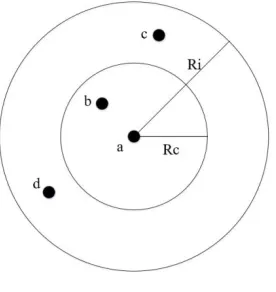
[image:3.612.228.366.197.343.2]Communication-interference model using this dual-disk model. The model has two concentric circles, the inner circle is the communication range, the communication radius is Rc, the area between the outer circle and the inner circle represents the interference range, and the interference radius is denoted by Ri.
Figure 1. Dual-disk model.
As shown in the figure 1: The communication range of a refers to a circular area with center node a and radius Rc , and the node b is a node within the communication range of a . The node within the interference range of node a has node c and node d .
Define the communication matrix and interference matrix. If nodes iand j are
within each other's communication range then CR i[ ][ ]j , it can be seen that the CR
matrix is a symmetric matrix. CRi represents the neighbors set of node i. Similarly, if
node i and node j are within the interference range of each other, then IR i[ ][ ] 1j
and IR is also a symmetric matrix. N represents a one-hop neighbor matrix. If the
value of N i[ ][ ] 1j , then i and j are one-hop neighbors. The condition is that i and
j are within the scope of each other's communication and assigned the same channel.
2
N represents the two-hop neighbor matrix of the node, and the dimension is V V. The condition that i and j are two-hop neighbors is that N i k[ ][ ] 1 and N k[ ][ ] 1j , and i k j . One-hop neighbor matrices and two-hop neighbor matrices are symmetric matrices. Ni represents the one-hop neighbors set of node i.
Metric formulation
min | i|
i V C
(1)where Ci is the set of channels to which node i is assigned. Each node is
equipped with K interface, which means that each node can be divided into a maximum of K channels.
( )
| |Ci K i V (2)
3. Distribute Resource and Interference Minimized Algorithm
This paper proposes an algorithm named Distribute Resource and Interference Minimized algorithm (RIM), which is implemented in a distributed manner and achieves the basic connection of the MRMC network and with minimal resources. And it also guarantees that there will be no potential interference in the interference range. Each node only needs to know the information of the nodes in its neighbor range.
We use figure 2 as an example for analysis: First, the channel allocation starts from node a . Node b to node f is within the communication range of node a, so node a is assigned the same channel. When the sub-network centered on node a is expanding, it will select an appropriate node from the neighbors of node a for expansion. The selection criteria is to ensure that the expanded node has the largest number of unconnected neighbor nodes. As shown in the figure: Node d has the largest number of unconnected neighbors. So expand from node d. This can use the minimum resources to complete the basic connectivity of the network. And when expanding, it is possible to maximize the connectivity without disturbing the already formed subnets. Then the node that is about to expand selects a channel. To judge whether a channel can be allocated to a node, the following conditions must be met: The number of channels allocated to the node is smaller than the number of interfaces. And nodes that may cause interference do not use this channel.
Figure 2. Network analysis.
ALGORITHM 1 RIM
1 v1,c1 2 While CRvNv, v V
3 for iV and CR v i 1do
4 if Ci {c} is eligible then
5 CiCi {c}
6 end
7 end
8 for iV do
9 score[i]|CR | |i Ni|
10 end
11 varg maxi V (score i[ ])
12 for mC do
13 if Cv {m} is eligible then
14 cm
15 break
16 end
17 end
18 end
4. PERFORMANCE ANALYSIS
The algorithms chosen for comparison are the centralized RMCA algorithm and the distributed RMCA algorithm [2]. The following introduces these two algorithms.
1) Centralized RMCA algorithm
assign the channel, so the network connectivity increases. And so on. Finally reached the purpose of all nodes are connected.
2) distributed RMCA algorithm
The idea of distributed algorithms is to try to assign to the nodes the channels in use by the nodes within their communication range, in order to reduce the interference and increase the connectivity. The goal of the distributed algorithm is to make the nodes within the communication range of the node become their two-hop neighbor node. Traversing nodes in the network to keep them connected to the same channel as possible within the communication range. The purpose of this algorithm is to make the nodes within the communication range of each node become their own two-hop neighbor nodes.
Topology result
The following is a topological diagram generated by the three algorithms under the same network conditions. We run multiple simulations, and we set the number of nodes | |V to 20. The nodes are placed in a rectangular area with edges of length 2 and 0.5, and we change Rc to 0.5, 0.8 and 1.1 with Ri1.75*Rc . The change of
communication range causes the number of network nodes to hop from 2 to 6 hops. Using the rectangle area, we can see the multi-hop network without increasing the number of nodes. We also changed the number of interfaces per node from 2 to 4.
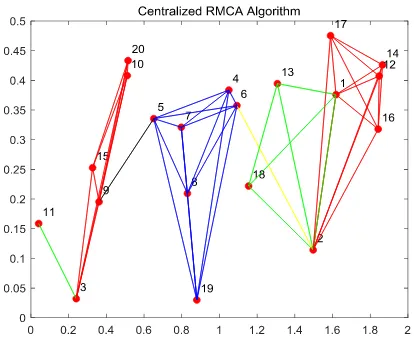
Figure 3 to Figure 5 show that the subnet distribution in the network generated by the centralized RMCA and RIM algorithm is relatively clear, and the topology generated by the distributed RMCA algorithm overlaps between different subnets. Overlapping parts can result in the allocation of redundant channels. And it will affect the already formed network. The initial stage of the centralized RMCA algorithm also tends to form a subnet, but after the subnet is formed, it is based on the node in the network that has not yet assigned a channel as the next traversal node. This will cause the subscript of the node to have a great influence on the formation of the network topology. Therefore, the topology formed by the algorithm will have a great deal of randomness. The distributed RIM channel allocation algorithm will weaken the randomness. And its advantage is that the connected network can be expanded in a distributed manner, and starting from the edge nodes in the formed network nodes, the network diagram formed compared with other algorithms is relatively neat.
Figure 3. Centralized RMCA Topology.
Figure 4. Distributed RMCA Topology.
[image:7.612.193.398.529.695.2]TABLE I. RESOURCE USAGE.
c
R Algorithm
0.5 0.8 1.1
Centralized RMCA
0.4265 0.3823 0.3627
Distribute RMCA 0.5033 0.4250 0.3710 RIM 0.4085 0.3712 0.3565
Mathematical analysis
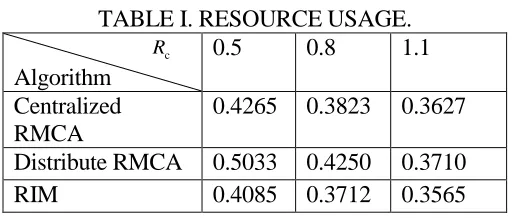
The data in Table 1 represents the average number of interfaces used by each node in the network when the number of interfaces is three.
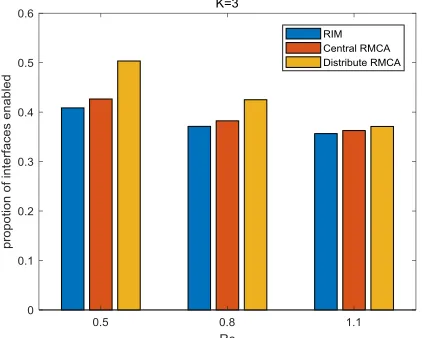
Figure 3 to Figure 5 show that the usage of resources in the network generated by the three algorithms in the case where the number of interfaces is 2, 3 and 4, respectively.
Taking Figure 6 as an example, the X-axis represents the communication range
c
R , and the Y-axis represents the average number of interfaces used by the node. From the figure it can be seen that in either case, the expanded RMCA uses fewer radios than the centralized RMCA and distributed RMCA. When Rc is 0.5, as you can
see from the table, the RIM algorithm uses 18.8% less than the distributed RMCA algorithm and 4% less than the centralized RMCA algorithm. As the Rc increases, the
resource usage of three algorithms gradually approaches. Because as the communication range increases, the nodes in the entire network will all communicate with each other. This will cause all nodes to be in the same subnet and tend to share the same channel. Because both RIM and the two RMCA algorithms initially allocate the same channel for a node and its neighbors.
sub-network edge. Although the topology generated by the centralized RMCA and the RIM algorithm are similar, the centralized algorithm traverses from the node that does not allocate a channel after forming the subnet. The RIM travers from the edge nodes of the subnet. Compared to the centralized algorithm, it can ensure that no channel resources can be wasted. And the channel allocation process will not introduce interference. Reducing the number of interfaces assigned independently of traffic conditions reduces energy consumption because the cost of enabling and operating the interface is not negligible.
Figure 6. Proportion of Network Interfaces Assigned (K = 2).
[image:9.612.188.399.420.589.2]Figure 8. Proportion of Network Interfaces Assigned (K = 4).
5. CONCLUSION
In this paper, we consider the channel allocation problem in the MCMR network. We propose a distributed channel allocation with the goal that the network achieves connectivity by minimizing resources and interference. The distributed nature of the algorithm can guarantee a wide range of applications in practice. The method of forming a network is also very instructive. It extends the edge nodes of the network to achieve maximum connectivity, and does not introduce potential interference within the range of node interference, and the interference impact on the already formed network is minimized.
In the MCMR network, the basic connectivity of the network should be set up with minimum resources and limited interference so as to achieve the statically assignment target, and then more resources are left for the transmission of traffic (TD) to maximize the traffic in the network.
REFERENCES
1. Kaiming Liu, Nan Li, Yuanan Liu, “Min-interference and Connectivity-Oriented Partially Overlapped Channel Assignment for Multi-Radio Multi-Channel Wireless Mesh Networks” in IEEE,2017.
2. R. Irwin, A. MacKenzie, and L. DaSilva, “Resource-minimized channel assignment for multi-transceiver cognitive radio networks,” IEEE J. Sel. Areas Commun., vol. 31, no. 3, pp. 442–450, Mar. 2013.
3. M. Marina, S. Das, and A. Subramanian, “A Topology Control Approach for Utilizing Multiple Channels in Multi-radio Wireless Mesh Networks,” Computer Networks, 2010.
4. R. Irwin, A. B. MacKenzie, and L. DaSilva, “Resource-Minimized Channel Assignment for Multi transceiver Wireless Networks,” in Proceedings of IEEE Global Communications Conference (GLOBECOM), 2011.
5. M. Shin, S. Lee, and Y. ah Kim, “Distributed Channel Assignment for Multi-radio Wireless Networks,” in Proceedings of IEEE Mobile Adhoc and Sensor Systems (MASS), pp. 417–426, 2006.
7. F. Wu, S. Zhong, and C. Qiao, “Globally optimal channel assignment for non-cooperative wireless networks,” in Proc. INFOCOM’08, pp. 1543– 1551.
8. A. Plummer, T. Wu, and S. Biswas, “A cognitive spectrum assignment protocol using distributed conflict graph construction,” in Proc. IEEE MILCOM, Orlando, FL, USA, 2007, pp. 1–7.