2018 2nd International Conference on Applied Mathematics, Modeling and Simulation (AMMS 2018) ISBN: 978-1-60595-580-3
Application of a Mixed Integer Programming Model in Coordinating
Stopping Schedules of Intra- and Inter-trains for a High Speed Rail Line
Hui-ling FU
*, Madison Merrill Billy BERTO and Hong ZHANG
School of Traffic and Transportation, Beijing Jiaotong University No. 3 Shangyuancun, Haidian District Beijing 100044 P. R. China
*Corresponding author
Keywords: Train stopping schedule, Mixed integer programming model, High speed rail.
Abstract. In a high speed rail network, there are usually two types of trains running on a single rail
line, which are intra-trains and inter-trains. Inappropriate stopping schedules for both types of trains may cause negative influence on train operation, e.g., stopping schedules lack regularity, inter-trains consume too much route capacity of intra-trains, and intra-passengers are transported by inter-trains instead. This paper applies a mixed integer programming model in coordinating stopping schedules of intra- and inter-trains for a high speed rail line. The goal is to increase regularity of both types of trains on a main rail line, in the meanwhile, to rationalize the division of labor of intra- and inter-trains in term of transporting intra- and inter-passengers. A numerical experiment is implemented based on a real-world instance. The results show that a series of coordination indicators are improved compared to those of an original train stopping schedule, which demonstrates the effectiveness of our application approach.
Introduction
In many countries or regions, high speed rail lines are highly connected and operated as an integrated network. For a single rail line, therefore, there are two types of trains distinguished from their origin and destination stations. One type of train running on this main rail line is named intra-train, and the other type is inter-train with its route merging to or diverging from the main line.
Because both two types of trains make intermediate stops along their routes within a main line, and they share the same route capacity, in the case of the stopping pattern is not appropriately determined by a plan maker, negative influence on train operation may happen. As an example, if the stopping schedule of inter-trains severely lacks regularity and the trains dwell too many times, they will consume route capacity and sacrifice the operation efficiency of intra-trains. In addition, inter-trains often carry a number of passengers supposed to be transported by intra-trains on the main rail line, accordingly the transport capacity for inter-passengers is instead occupied, and the service level for inter-passengers is lowered.
candidate train stop patterns, it was estimated by a logit-based model. However, very few previous studies concern the coordinative optimization of stopping schedules of intra- and inter-trains for high speed railway.
This paper applies a mixed integer programming model in coordinating stopping schedules of intra- and inter-trains for a high speed rail line, with the aim of increasing regularity of both types of trains on a main rail line, in the meanwhile, rationalizing the division of labor of intra- and inter-trains in term of transporting intra- and inter-passengers. The remainder of this paper is organized as follows. Section 2 describes the mixed integer programming model and explains its application. Section 3 provides a numerical example from the China HSR network. Section 4 concludes the study and brings forward the future work.
Application of a Mixed Integer Programming Model
The mixed integer programming model to be used as a basis for coordinating stopping schedules of intra- and inter-trains is a well-accepted model which can be found in reference [3]. We further make some alterations to let it adapt to a non-cyclic train operation mode, in addition, we neglect some of technical constraints which are unnecessary to our newly defined problem.
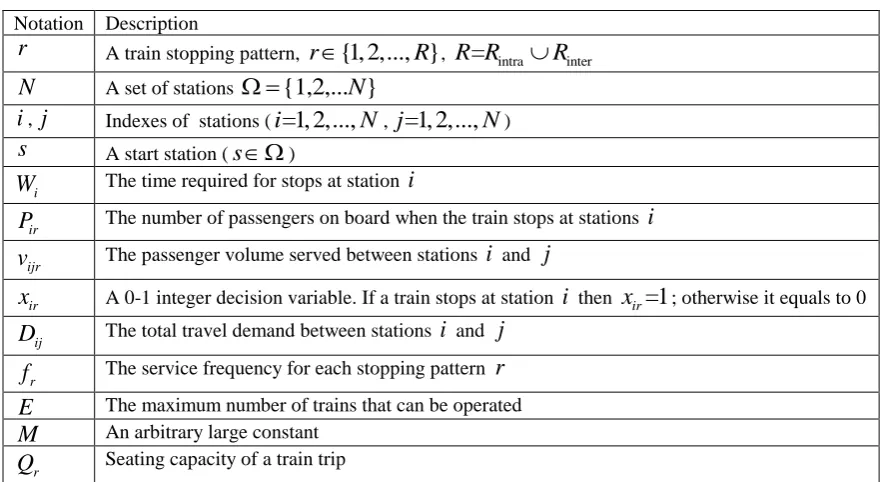
The basic model is outlined as follows and related notations are listed in Table 1.
1
1 1
Minimize
R N
i ir r i s
Z W P
(1) s.t.
1 1
1 1
(1 ); 1,..., 1
i N
N i ir pqr qpr ir
p s q i q i p s
p v v M x i s N
(2)
1
; R
ijr ij
r
v D
i1, 2,...,N; j1, 2,...,N(3)
1
Nir sr
i s
x N s x
(4)
r sr
f Mx
(5)
1 1
; ,...,
N ijr
N jir irj j
v v Mx i s N
(6)
1
R r rf E
(7)
1
; 1,...,
j N pqr r r p s q jv Q f j s N
(8)
1
; 1,...,
j Nqpr r r
p s q j
v Q f j s N
timetable structure as much as possible when scheduling train stops. As a result, the cost objective will have a minor impact on the returned solution. That is also the reason why we do not involve constraints with respect to the number of trainsets in the model.
Constraints (2) specify pir for the objective (1). Constraints (3) limit that the travel demand Dij
must be met by the total passenger volume vijr served by all train stopping patterns r. In constraints
(4) a train trip based on the stopping pattern r must start from an origin station s, where xsr=1. If
=0 sr
x , the train stopping pattern r cannot be formed, and accordingly, the service frequency fr in constraints (5) equals to 0. Constraints (6) ensure that no passenger can board or alight at station i if a stopping pattern r does not stop at station i. Constraints (7) state that an upper capacity bound E
[image:3.595.77.522.263.504.2]cannot be exceeded when operating trains. Constraints (8) or constraints (9) denote that the seating capacity of train trips should satisfy the total one-way passenger volume.
Table 1. Notations in the mixed integer programming model.
Notation Description
r A train stopping pattern, r{1, 2,..., }R , R R= intra Rinter
N A set of stations {1,2,... }N
i, j Indexes of stations (i=1, 2,...,N, j=1, 2,...,N)
s A start station (s)
i
W The time required for stops at station i
ir
P The number of passengers on board when the train stops at stations i
ijr
v The passenger volume served between stations i and j
ir
x A 0-1 integer decision variable. If a train stops at station i then xir=1; otherwise it equals to 0
ij
D The total travel demand between stations i and j
r
f The service frequency for each stopping pattern r E The maximum number of trains that can be operated
M An arbitrary large constant
r
Q Seating capacity of a train trip
We make two extensions to let the application of above model adapt to the optimization goals of this paper, when considering to coordinate stopping schedules of intra- and inter-trains for a high speed rail line.
(1). Extension 1: candidate train stopping patterns are constructed for intra-trains (notated as Rintra)
and inter-trains (notated as Rinter), respectively. By doing this, the regularity level of inter-trains can be reasonably controlled.
(2). Extension 2: some of the intra-passengers are imposed to be transported by intra-trains, that is,
for intra-passengers vijr is further added a restriction that rRintra.
Numerical Example
L an g fa n g B ei ji n g S o u th T ia n ji n S o u th C an g zh o u W es t D ez h o u E as t Ji n an W es t T ai an Z ao zh u an g X u zh o u E as t S u zh o u E as t B en g b u S o u th C h u zh o u S o u th N an ji n g S o u th Z h en ji an g W es t C h an g zh o u N o rt h W u x i E as t S u zh o u N o rt h S h an g h ai H o n g q ia o Ji n an
Stations can serve as terminals
[image:4.595.110.489.73.246.2]Intermediate stations K u n sh an S o u th Q u fu E as t
Figure 1. Topology of study HSR network.
In our experiment small-sized stations with very few passenger volumes are omitted (including stations of Tengzhou East, Suzhou East, Bengbu South, Dingyuan, Chuzhou, and Danyang), such that the complexity of enumerating candidate trains is largely reduced. The existing timetable contains 12 intra-trains and 4 inter-trains. Based on the existing train stopping patterns, we additionally design 17 patterns for candidate intra-trains and 10 patterns for candidate inter-trains, respectively. As before mentioned, we make a pretreatment for decision variables vijr (rRintra ) that majority of the
intra-passengers are imposed to be transported by intra-trains.
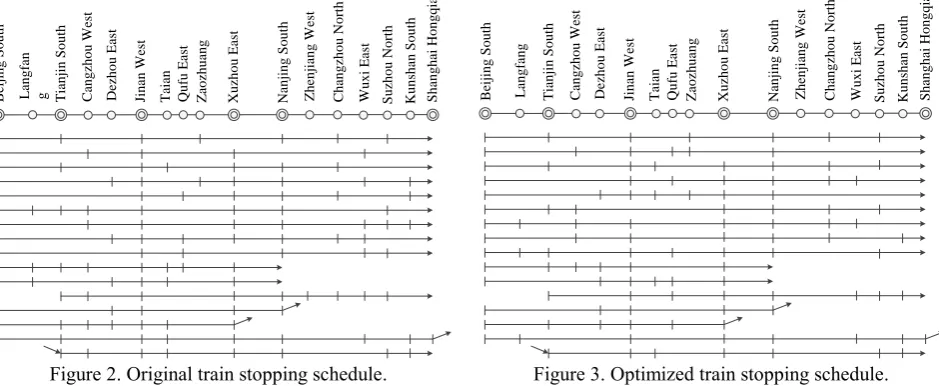
The model is directly coded and solved using the Lingo 11.0 optimizer. It returns an optimal solution that the total number of train stops of our optimized train stopping schedule is 92. The original and optimized schedules are comparatively shown in Fig. 2 and Fig. 3. We next analyze the results from the perspective of a series of coordination indicators.
L an g fa n g B ei ji n g S o u th T ia n ji n S o u th C an g zh o u W es t D ez h o u E as t Ji n an W es t T ai an Z ao zh u an g X u zh o u E as t N an ji n g S o u th Z h en ji an g W es t C h an g zh o u N o rt h W u x i E as t S u zh o u N o rt h S h an g h ai H o n g q ia o K u n sh an S o u th Q u fu E as t L an g fa n g B ei ji n g S o u th T ia n ji n S o u th C an g zh o u W es t D ez h o u E as t Ji n an W es t T ai an Z ao zh u an g X u zh o u E as t N an ji n g S o u th Z h en ji an g W es t C h an g zh o u N o rt h W u x i E as t S u zh o u N o rt h S h an g h ai H o n g q ia o K u n sh an S o u th Q u fu E as t
Figure 2. Original train stopping schedule. Figure 3. Optimized train stopping schedule.
(1) The potential impact of train stopping schedules on route capacity utilization
The optimized schedule still uses 16 train stopping patterns, while the structure of train stops distribution is different from that of the original schedule. Table 2 shows the difference in detail.
[image:4.595.62.532.441.634.2]Table 2. Comparison of the structure of train stopping schedules (within the Beijing-Shanghai section).
The existing train stopping schedule The optimized train stopping schedule
No. of intermediate stops 3 4 5 6 7 8 3 4 5 6 7
No. of train trips 1 1 3 3 7 1 1 1 3 7 4
(2) The regularity level of stopping schedules of intra- and inter-trains
Each train trip in the original schedule uses a totally different stopping schedule; therefore, it leads to a weak regularity. In the optimized schedule, the average number of stops a train makes is 6 or 7, and intra-trains use similar stopping patterns that they almost stop at all big-sized stations and alternatively visit small-sized stations. Inter-trains’ stopping pattern also applies this rule, in addition, intra- and inter-trains’ stops supplement to each other, making it feasible that some intra-passengers still can find an inter-train to ride even though no intra-trains offer direct-connection service.
By increasing the regularity level of stopping schedules of intra- and inter-trains, the number of stops made by different trains is relatively balanced. The difference of travel speed of trains is reduced, and the homogeneity of train paths can be improved, which is beneficial to a high speed rail line which is in particular busy.
(3) The division of labor of intra- and inter-trains
Inter-trains make a number of stops in the original schedule on the Beijing-Shanghai section, and that is the reason why many intra-passengers choose to ride on inter-trains. This phenomenon is avoided in our optimized schedule because, on the one hand, we strictly generate train stopping schedule by imposing majority of intra-passengers to be transported by intra-trains, and on the other hand, reduce the number of stops inter-trains can make.
However, in order to realize the goal of rationalizing the division of labor of intra- and inter-trains in term of transporting intra- and inter-passengers, booking limit of ticket selling strategy still should be applied in practice.
Conclusion
In this paper a mixed integer programming model was applied in coordinating stopping schedules of intra- and inter-trains for a high speed rail line. The optimization goal is to increase regularity of both types of trains on a main rail line, in the meanwhile, to rationalize the division of labor of intra- and inter-trains in term of transporting intra- and inter-passengers. We selected the Beijing-Shanghai high speed rail line in China as a background to conduct a numerical experiment. The results showed that a series of coordination indicators were improved compared to those of an original train stopping schedule, including indictors of route capacity utilization, regularity level of stopping schedules, and the division of labor of intra- and inter-trains. Another future work is to further quantize influencing factor of route capacity by incorporating train timetabling constraints into the current model.
Acknowledgement
This research was financially supported by the National Natural Science Foundation of China (No. 61703030), Beijing Training programme for the Excellent Talents (No. 2017000020124G003), and the Fundamental Research Funds for the Central Universities (No. 2015JBZ011).
References
[1] H.W. Hamacher, A. Liebers, A. Schöbel, D. Wagner, and F. Wagner, “Locating new stops in a railway network,” Electronic Notes in Theoretical Computer Science, 50(1): 1-11 (2001).
[3] Y. Chang, C. Yeh, and C. Shen, “A multiobjective model for passenger train services planning: application to Taiwan’s high-speed rail line,” Transportation Research Part B, 34: 91-106 (2000).
[4] C. Lee and W. Hsieh, “A demand oriented service planning process,” The World Congress on Railway Research, (2001).