EFFICIENT ENERGY BASED MULTIPATH CLUSTER
ROUTING PROTOCOL FOR WIRELESS SENSOR
NETWORKS
1A.P.SRIDEVI, 2Dr.A.RAJARAM 1
Research Scholar, Bharathiar University, Coimbatore
2
Assoc. Prof., Department of Electronics and Communication Engineering, Coimbatore
E-mail: [email protected] , [email protected]
ABSTRACT
Wireless sensor networks consist of sensor nodes that have limited processing capability, small memory and low energy source. These nodes are deployed randomly and often densely in the environment. In monitoring applications, sensor nodes sense data from the environment periodically and then transmit them to a base station which is called sink node. Thereby data transmission consumes node’s energy based on transmission distance. In most wireless sensor networks, the energy source of the node is limited and cannot be minimized. Here, we have proposed the Efficient Energy based Multipath Cluster Routing Protocol for minimizing the energy consumption in WSNs. It consists of four phases. In this cluster formation, cluster head records all the cluster members. In multipath routing, network is organized as a group of networks. It provides load balancing and increased throughput to the network. In last two phases, both energy consumption model and condition for minimizing average energy consumption was proposed. The proposed scheme attains balance end to end delay, delivery rate and energy efficiency in WSNs. By simulation results, the proposed EEMCRP achieves better data delivery ratio, improved network lifetime, less end to delay and energy consumption in terms of mobility, time, throughput, simulation time and number of nodes than the existing scheme.
Keywords: Wireless Sensor Network, Cluster formation, Multipath routing, energy consumption model, , network lifetime, end to end delay, energy consumption, throughput and delivery ratio.
1. INTRODUCTION
Wireless Sensor Network is made up of a large number of inexpensive nodes that are networked via low power wireless communications. Recent
technological advances in microelectronics,
sensing, signal processing, wireless
communications and networking have enabled the realization of a dense network of inexpensive wireless sensor nodes, each having sensing, computational and communication capabilities. Proposed applications of sensor networks include
environmental monitoring, natural disaster
prediction, smart homes, health care,
manufacturing, transportation, home appliances and entertainment.
The common characteristic of any WSN application is that
sensor nodes are deployed either in regular or random fashion and are assigned the task of monitoring the environment. These nodes detect events and communicate them to the sink node,
where alerts are raised to indicate the abnormalities. A single sink can serve only a limited number of sensor nodes, but, for dense deployments multiple sinks can be included to serve a patch of the nodes.
1.1. Major goals of Wireless Sensor Networks WSNs)
Based on the application, different architecture, goals and constraints have been considered for WSNs.
a. Improving Energy Efficiency
these nodes remain unattended and normally draining their batteries continuous on regular basis, it is too hard to replace these batteries. So energy is the most important constraint for the WSN type’s networks. In last decade a significant amount of research has been done in the field of WSN, and most of the part was focusing about the energy concern. There are couple of different reasons for energy loss with the node including, un efficient routing, mixed traffic, run time change network topology, mobility, deployment of the nodes and distance from the sink. Dealing with real-time requires all the nodes live and in contact with the sink, if any node from the loop is just died just because of energy reason then the complete real-time communication will be dropped. Past recent work shows more attention on this critical issue and, about designing different energy efficient routing protocols with different energy efficient mechanism, but even, it still requires more significant attention.
b. Energy Conservation without losing
accuracy
Sensor nodes can use up their limited supply of energy performing computations and transmitting information in a wireless environment. As such, energy conserving forms of communication and computation are essential. Sensor node lifetime shows a strong dependence on the battery lifetime. In a multihop WSN, each node plays a dual role as data sender and data router. The malfunctioning of some sensor nodes due to power failure can cause significant topological
changes and might require rerouting of packets and reorganization of the network.
c. Reliability based on Fault Tolerance
Fault tolerance can be defined as the ability of sensor network to sustain network functionalities in case of any un desired conditions occurred and may be few nodes not working properly. Sensor nodes may fail or be blocked due to lack of power, have physical damage or environmental interference. The failure of sensor nodes should not affect the overall task of the sensor network. This is the reliability or fault tolerance issue.
d. Standard Quality of Service
In some applications, data should be delivered within a certain period of time from the moment it is sensed; otherwise the data will be useless. Therefore bounded latency for data delivery is another condition for time-constrained applications. However, in many applications, conservation of
energy, which is directly related to network lifetime, is considered relatively more important than the quality of data sent. As the energy gets depleted, the network may be required to reduce the quality of the results in order to reduce the energy dissipation in the nodes and hence lengthen the total network lifetime. Hence, energy-aware routing protocols are required to capture this requirement.
2. RELATED WORK
In this paper [1], a dynamic clustering routing algorithm for WSN was presented. It is comprised of three phases including cluster head (CH) selection, cluster setup and inter-cluster routing. Cluster heads are selected based on residual energy and node load. Then the non-Cluster head nodes choose a cluster by comparing the cost function of its neighbor CHs. Cluster heads communicates with base state using multi-hop communication.
In this paper [2], hybrid QEA-based energy-efficient routing algorithm (HERA) was proposed which is based on LEACH and PEGASIS algorithms in the environment of wireless sensor networks. To reduce the transmission distance, the algorithm uses the hybrid quantum evolutionary algorithm (HQEA) to establish the best cluster-based multi-chain topology. To balance the energy dissipation, node’s residual energy and its distance from the target are considered.
In this paper [3], load balance routing algorithm was proposed based on uneven clustering to do uneven clustering and calculate optimal number of clustering. It prevents the number of common node under some certain cluster head from being too large which leads load to be overweight to death through even node clustering. It constructs evaluation function which can better reflect residual energy distribution of nodes and at the same time constructs routing evaluation function between cluster heads.
In this paper [5], it was proposed an energy-aware dynamic routing strategy in order to provide balanced energy consumption in wireless sensor networks, hence, prolonging the lifetime of the network. This routing algorithm uses local betweenness centrality to estimate the energy consumption of the neighboring nodes around a given local sensor node, without requiring global information about the network topology or energy consumption, and to divert traffic from nodes that are more heavily used. Because nodes with large local betweenness centrality consume energy more quickly, the network lifetime can be prolonged by redistributing energy consumption to nodes with smaller local betweenness centrality.
In this paper [6], a new protocol called Equalized Cluster Head Election Routing Protocol (ECHERP) was proposed which pursues energy conservation through balanced clustering. It models the network as a linear system and, using the Gaussian elimination algorithm, calculates the combinations of nodes that can be chosen as cluster heads in order to extend the network lifetime.
In this paper [7], it was focused to concentrate on the residual energy of every node including the cluster head, and every new round the cluster head will attend selecting a new cluster head. In practical applications, the surrounding of each WSN’s node is unknown and may be quite different. After a period of time running, the residual energy of each node will change very much unlike the ideal state; that means the cluster head still may be the node of the cluster with the biggest residual energy. To prolong the lifetime of the network as long as possible, the cluster head with the largest residual energy must be selected for a cluster head again. Under this mechanism, the message load can be reduced greatly during the process of cluster head selecting.
In this paper [8], the energy balanced routing protocol was proposed with link quality by creating mixed potential field in terms of energy density, residual energy, depth and link quality. The goal of this protocol is to forward packets towards to sink through dense energy and protect the nodes from low residual energy. The link quality mechanisms rely on aggregation of the high quality links to maintain network connectivity for long time, which avoids unwanted transient topology break down.
In this paper [9], a multi-hop routing algorithm was proposed based on integrated metrics (MRIM) for
wireless sensor networks by research current routing algorithms. The core of MRIM has two parts as following. Firstly, a clustering algorithm based on time delay (CATD) was presented. It has clustering algorithm having more obviously
improvement on the network performance,
comparing with the algorithm for LEACH and the based on the timer of clustering algorithm for TB-LEACH. Secondly, the algorithm of the CATD is improved in cluster data transmission phase after the cluster heads are selected, called MRIM, which can be used in large scale. In the algorithm, it makes the equal distributed cluster-heads of the network into constructing a routing tree by means of the multi-hop transmission way so that this may reduce the number of cluster head nodes, when it communicates directly the base station (BS).
In this paper [10], clustering algorithm was proposed with multiple cluster heads within the cluster of sensor nodes is proposed to improve lifetime of wireless sensor network. It was demonstrated that proposed clustering algorithm using multiple cluster heads is more effective in prolonging the lifetime of sensor network than using single cluster head and LEACH algorithm. In proposed algorithm energy utilization is distributed among the cluster heads which makes it work longer than the cluster with single cluster head. Also in case of cluster head failure due to the energy depletion, other cluster head continues to work without affecting the topology of the sensor network thus maximizing the network lifetime.
In this paper [11], Geographic Load Balanced Routing (GLBR) was proposed to explore a technique called Load balancing for WSNs which can be a viable solution to the challenges of geographic routing. Load balancing can be realized through two approaches. It defines parameters based on communication overhead at sensor nodes and wireless link status through which load can be balanced across whole network. This approach exploits the existing Geographic Routing approach i.e. Greedy forwarding by considering not only the distance between next hop and destination as single parameter for packet forwarding but also consider overhead at node. When load at a node is high, it looks for an alternate option for packet forwarding. Thus it divert traffic to obviate congestion and hence avoid disconnections in the network
routing to achieve lifetime improvements by load balancing and exploiting cross-layer information in wireless sensor network. The cluster-based wireless sensor network (WSN) can enhance the whole network lifetime. In each cluster, the cluster head (CH) plays an important role in aggregating and forwarding data sensed by other common nodes. Fuzzy logic scheme is used in this algorithm.
In this paper [13] , the protocol Energy Efficient and QoS multipath aware routing was proposed to increase the lifetime of network. The main drawback of base paper was there was increase in the energy consumption in cost of end-to-end delay. The end-to-end delay was minimized but energy consumption was increased in real time application.
In this paper [14], it was proposed an Energy Efficient Chain based Routing Protocol (EECRP) for wireless sensor networks. The main goal of this protocol is to minimize energy consumption, transmission delay and especially energy × delay metric. It can meet both requirements for a prompt-response and energy-saving applications. It organizes sensor nodes into a set of horizontal chains and a vertical chain so that each sensor node receives from a previous neighbour and transmits to the next neighbour.
In this paper [15], it was presented an efficient energy-saving non-uniform cross-clustering routing algorithm. The algorithm combines the advantages of various clustering algorithms and improves them. In the calculation of the cluster radius, two of the dynamic variables of the cluster size were introduced in the parameters. The node residual energy and the distance between node and the BS implement the dynamic variable of the cluster size. At the same time, introducing cluster adjacent node into the communication between clusters for data forwarding, it effectively reduces the energy loss of the cluster head. In addition, the routing address uses hierarchical addressing from lower grades to the high level, it is simple and efficient to implement.
In this paper [16], the issue of routing in cognitive radio sensor networks (CRSNs) was presented. The network layer of CRSNs has to major challenges, and those are i) joint node channel assignment for enabling dynamic spectrum access and ii) design of energy efficient routing protocol for prolonged lifetime of the network. It was proposed a Chain based Routing protocol for CRSNs called as CRC
that leverages the power of cognitive radio technology. The propose protocol extends the lifetime of the network by forwarding the data packets towards the base station in an energy balanced manner.
In this paper [17], an energy-balanced routing method was proposed based on forward-aware factor (FAF-EBRM) is proposed in this paper. In this method, the next-hop node is selected according to the awareness of link weight and
forward energy density. Including this, a
spontaneous reconstruction mechanism for local topology is designed additionally. Nodes can vary transmission power according to the distance to its receiver. The sink node can broadcast message to all sensor nodes in the sensing field. The distance between the signal source and receiver can be computed based on the received signal strength. Regional central nodes are not selected at the beginning, on the contrary, they spring up during the topology evolution.
The paper is organized as follows. The Section 1 describes introduction about WSNs, energy consumption and design goals of WSNs. Section 2 deals with the previous work which is related to the energy efficient models. Section 3 is devoted for the implementation of proposed algorithm. Section 4 describes the performance analysis and the last section concludes the work.
3. IMPLEMENTATION OF PROPOSED
ALGORITHM
In the proposed protocol efficient cluster routing is formed. Cluster heads all the cluster member information including their energy status to improve the network lifetime. In multipath routing, cluster head monitors the data delivery to all cluster members to achieve load balancing. Energy consumption model is proposed to give clear guidance to consume minimum energy. Average energy can be minimized by initializing similar conditions to all sensor node.
3.1 Cluster formation
keeps a neighbor table that records all the IP address of its neighbor cluster head.
Cluster member nodes exchange routing and data information through Hello Messages. A cluster member node includes its IP address into its Hello message and a cluster head adds the IP address of its cluster member into its Hello message as well. In order to facilitate the cluster head route discovery process, cluster member keeps the IP addresses of other cluster head that can hear. When the previous cluster head moves away or a cluster member does not receive five Hello packets continuously from its cluster head, it considers that the wireless link between cluster regions is broken. Thus, a cluster member chooses the latest refresh cluster head in its routing table as its new cluster head, which is one hop from it, or becomes itself a cluster head if it cannot hear any existing cluster head. After broadcasting its Hello right next packet, the selected cluster head is informed that a new cluster member has joined its group. The cluster member will obtain the confirmation of its new cluster head when it receives the Hello packet that carries its IP address.
3.2 Multipath Routing
In the proposed multipath routing scheme, the network is organized as a collection of cluster node. Each cluster has its own cluster head. The cluster head is chosen based on the higher priority depends on communication status among the nodes, bandwidth, frequency, energy level. If two cluster
participant nodes m1, m2 want to communicate
between different regions, they need to get
permission from CH1, CH2. In the proposed
scheme, certain constraints are to be followed.
• The node in Cluster (C), only if the hop
count is below the node’s hop value.
• Each node should have minimum four
multiple paths to reach the particular destination D.
• The energy level of the clusters is
determined based on the energy level of cluster nodes. The threshold energy level is calculated by cluster head (CH).
• The RREQ message is transmitted when
the source node is reached and to create a new entry in the local routing neighbor table.
In this phase multi path data transmission is
initiated where each cluster member sensor node Bi
discovers the possible paths to reach its data
collector node. Let Ddenote the path from node Bi
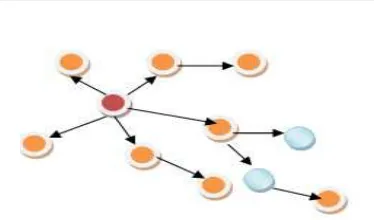
to the base station (BS). Fig.1. illustrates the
[image:5.595.316.503.122.232.2]multipath route construction.
Fig.1. Multipath Route Construction
Also, let node Mj be the first data collector on
path D between Bi and BS. Here local paths are
determined based on number of disjoint paths from
Bi to Mj . Moreover Bi discovers its local path set using the Local Path Discovery procedure. Hence there is n paths that connects sensor node Bi to its
data collector Mj . Even though number of paths is
established, multi path data transmission is
deployed when Bi has a low energy consumption
level and reputation value which indicates there may be possible compromised nodes in the
neighborhood. Whenever this situation happens, Bi
first decides the number of paths to send the data,
say k, then select k most reliable paths from its local
path set.
Input: Data collector Mj , cluster member sensor
node Bi and Bi's neighboring nodes.
Output: Local path set from Bi to Mj .
Step 1: Bi broadcasts a small route request message
Lrreq that has destination address Mj .
Step 2: Each one of Bi's neighboring nodes
forwards an Lrreq message towards j after adding its
ID to Lrreq. j receives a number of Lrreqs with a list of
nodes that relayed the Lrreq.
Step 3: Mj replies to each Lrreq with an Lrrep message along with the ID list of Lrreq.
Step 4: Each Lrrep message follows the same path of
its Lrreq. Bi receives each Lrrep message along with the ID lists. Each ID list refers to a path Bi to Mj . Step 5: Bi selects n paths and saves those paths as
its local path set to data collector Mj.
3.3 Multipath Creation Phase
• Initially, the destination node starts to
establish the multipath path construction phase to create a set of neighbors that is the address of all nodes that are able to transmit data from the source.
• In this process route request control
a data packet to the known neighboring nodes. It does not maintain the whole routing information. It is necessary to store the routing information and it reduces the overhead of sensor node while it requires the proactive protocol.
• The multipath routing protocol has to
calculate some information to record in the routing table of sensor node, the energy expense is less than transmit and receive. Furthermore, it supports multipath data forwarding, not using the fixed path. So the energy consumption will be distributed and the lifetime of network is prolonged.
• The major activities in this phase are routing
path formation for each node and neighbor table creation. The sink node broadcasts the route request packet to discover the one hop nodes / level 1 nodes, the nodes which are receiving them first.
• Route Request control messages are used to
identify nodes in different levels. After a route request message is sent by sink node, the hop count records how many hops it has travelled from the sink.
• Destination node initiates the multipath
creation phase to create a set of multi hop neighbors to transmit the packet from the source node.
• Once the transmission process initiated,
route request messages are transformed between the nodes.
• Each sensor node broadcasts the route
request packet once and maintains its own
routing table. When sensor node
disseminates a data packet, it only needs to know its neighboring node to transfer.
• Here maintaining the whole path
information is not needed. Since the paths are formed whenever it is required unlike proactive routing protocols where it is necessary to store the routing information, it reduces the overhead of sensor node.
• Although the multipath routing protocol
has to compute some information to record
in the routing table of sensor node, the energy expense is less than transmit and receive.
• Furthermore, it supports multipath data
forwarding, not using the fixed path. So the energy consumption will be distributed as well as minimized and the lifetime of network is prolonged.
3.4 Energy Consumption Model
The main goal of this model is to maintain the minimum energy consumption among all sensor nodes. In energy consumption model, free space
propagation model is deployed if the
communication distance between cluster members is less than the distance threshold value. Hence, the transmission energy of cluster head over a distance d is given as,
≥
+
<
+
=
+
=
− − 0 4 0 2)
,
(
)
(
)
,
(
d
d
d
n
nE
d
d
d
n
nE
d
n
E
n
E
d
n
E
amp elec fs elec amp tx elec tx txξ
ξ
(1)Eelec is the transmitter circuitry dissipation per bit.
elec elec
rx
rx
n
E
n
nE
E
=
=
−
(
)
)
(
(2)
For wireless sensor networks, the main goal is to minimize the energy cost in the network to prolong the lifetime, so the
mathematical model is given as,
tot
E
=E
t+
E
r+
E
i+
E
s(3)
tot
E
is total energy cost in the network. Etis thetransmission energy, Er is the receiving energy, Ei is
the energy while being cluster member in idle
state, Es is the energy cost while sensing. In the
energy consumption model, the receiving cost, idle cost and sensing cost for a node is almost constant while its transmission cost is variable.
3.5Minimizing the Energy Consumption
Average Node Energy consumption (EN) measures
is calculated as, D
q q
res w init w M p N
dataN
M
e
e
AE
1 , ,
1
(
)
= =
∑
∑
−
=
(4)
Where M is the number of nodes, ew,init and ew, res
are respectively the initial energy and residual energy levels of node p, D is the number of
destination nodes and data Nq is the number of data
packets received by destination q.
Let a0, b0 denotes the coordinates of the access
point in sensor networks and ai, bi be the coordinates
of the ith sensor nodes. The distance between the
access point and the ith sensor node is given by,
di=
(
a
0−
a
i)
2+
(
b
0−
b
i)
2(5)
The average energy is minimized at
a
E
∂
∂
at a
= a0 and
b
E
∂
∂
at b= b0 where the condition executes
at
max
→
min
.
∈A ti
i
E
4. PERFORMANCE ANALYSIS
The proposed protocol is stimulated with Network simulation Tool (NS2.34). It is one of the best simulation tools available for Wireless sensor Networks. Backend language is C++ and Front end language is Tool Command Language (TCL). In our simulation, 100 mobile nodes move in a 1000 meter x 1000 meter square region for 60 seconds simulation time. All nodes have the same transmission range of 250 meters. Our simulation settings and parameters are summarized in table 1.
A. Performance Metrics
We evaluate mainly the performance according to the following metrics.
Control overhead: The control overhead is defined as the total number of routing control packets normalized by the total number of received data packets.
End-to-end delay: The end-to-end-delay is averaged over all surviving data packets from the sources to the destinations.
Packet Delivery Ratio: It is the ratio of the number .of packets received successfully and the total number of packets transmitted.
Throughput: It is defined as the number of packet received at a particular point of time.
Table 1. Simulation Settings And Parameters Of EEMCRP
No. of Nodes 100
Area Size 1000 X 1000
Mac 802.11
Radio Range 200m
Simulation Time 100 sec
Traffic Source CBR
Packet Size 80 bytes
Mobility Model Random Way Point
Protocol LEACH
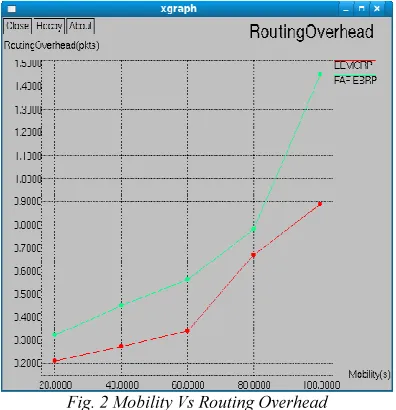
[image:7.595.308.506.355.560.2]The simulation results are presented in the next part. We compare our proposed algorithm (EEMCRP) with FAF-EBRM [17] in presence of energy consumption. Figure 2 shows the results of Routing Overhead for varying the mobility from 20 to 100. From the results, we can see that EEMCRP scheme achieves minimum overhead than the FAF-EBRM scheme.
Fig. 2 Mobility Vs Routing Overhead
Fig.3. Pause Time Vs Energy Consumption
Fig. 4, presents the network lifetime comparison for EEMCRP. It is clearly seen that number of epochs consumed by EECRP is high compared to FAF-EBRM.
Fig. 4. No. Of Nodes Vs Network Lifetime
Fig. 5, presents the comparison of data delivery ratio. It is clearly shown that the data delivery ratio of EEMCRP is higher than the FAF-EBRM scheme.
Fig. 5. Throughput Vs Data Delivery Ratio
Figure 6 shows the results of Simulation time Vs End to end delay. From the results, we can see that EEMCRP scheme has slightly low end to end delay than FAF-EBRM scheme because of multipath routing.
5. CONCLUSION
In this paper, we have developed a cluster based multipath routing protocol which attains multipath routing, multipath construction and energy consumption model to make a correct balance between network life time, energy consumption and end to end delay in the sensor nodes. In the first phase of the scheme, clustering scheme is proposed to select cluster head. In second phase, construction of multipath routing tree is implemented. In third phase, energy consumption model and average energy consumption can be minimized based on the condition of average packet delivery rate. It is demonstrated that energy consumption of each node. By simulation results we have shown that the EEMCRP achieves good throughput, high network lifetime, low energy consumption, good delivery ratio while attaining low delay, energy consumption than the existing schemes FAF-EBRP while varying the number of nodes, simulation time, throughput and pause time.
REFERENCES:
[1] Yi Sun, Can Cui, Shanshan Ke, Jun Lu, “
Research on Dynamic Clustering Routing Considering Node Load for Wireless Sensor Networks”, Communications and Network, 2013, Vol.5, pp.508-511
[2] Lingxia Liu and Qiang Song, “ A Kind of
Energy-efficient Routing Algorithm for WSN Based on HQEA”, International Journal of Hybrid Information Technology, vol.6, No.4, 2013, pp.1-10.
[3] Liang Yuan*, Chuan Cai, “A Load Balance
Routing Algorithm Based on Uneven
Clustering”, TELKOMNIKA, Vol. 11, No. 10, October 2013, pp. 5758 ~ 5762.
[4] Haifeng Jiang, Yanjing Sun, Renke Sun and
Hongli Xu, “Fuzzy-Logic-Based Energy
Optimized Routing for Wireless Sensor Networks”, International Journal of Distributed Sensor Networks, 2013, pp.1-8.
[5] Xiao-Hui Li and Zhi-Hong Guan,
“Energy-Aware Routing in Wireless Sensor Networks
Using Local Betweenness Centrality”,
International Journal of Distributed Sensor Networks, 2013, pp.1-9
[6] Stefanos A. Nikolidakis 1,*, Dionisis Kandris
2, Dimitrios D. Vergados 1 and Christos Douligeris, “Energy Efficient Routing in Wireless Sensor Networks Through Balanced Clustering”, Algorithms, Vol.6, 2013, pp.29-42.
[7] Yang Wang, “Distributed Energy Balance
Clustering Algorithm in Wireless Sensor Networks”, Cybernetics and Information Technologies, Vol.13, 2013, pp.88-99.
[8] Sridevi P.M, Jitendranath Mungara, K.
Sundeep Kumar, Manoj Challa, “ Energy Efficiency by Utilizing Link Quality and Loop Breaking In WSN”, International Journal of Engineering and Advanced Technology, Vol.2, Issue 5, 2013, pp.484-486.
[9] Fengjun Shang, “A Multi-hop Routing
Algorithm based on Integrated Metrics for
Wireless Sensor Networks”, Applied
Mathematics & Information Sciences, Vol.7, No.3, pp.1021-1034.
[10]Vaibhav V. Deshpande, A. R. Bhagat Patil, “
Energy Distributed Clustering for Improving Lifetime of Wireless Sensor Network”, International Journal of Emerging Science and Engineering, Vol.1, No.7, 2013.
[11]Robin Guleria, Ankit Kumar Jain, “
Geographic Load Balanced Routing in Wireless Sensor Networks”, International Journal of Computer Network and Information Security, Vol.8, 2013, pp.62-70.
[12]M. Amareswara Kumar, K. B. Pullama and B.
Shiva Vishnu Mohan Reddy, “ Energy
Efficient Routing In Wireless Sensor
Networks”, International Journal of Emerging Technology and Advanced Engineering, Vol.9, Issue 9, 2013, pp.172-176.
[13]Sunita, O.S Khanna, Amandeep Kaur, “
Minimize the Energy Consumption and Maximize the Throughput for Wireless Sensor
Network using Routing Algorithm”,
International Journal of Computer
Applications, Vol.63, No.1, 2013, pp.53-57.
[14]Razieh Sheikhpour, Sam Jabbehdari, “ An
Energy Efficient Chain-based Routing Protocol
Transactions on Internet and Information systems, Vol.7, No.6, 2013, pp.1357-1378.
[15]Wang Tong,Wu Jiyi, Xu He, Zhu Jinghua and
Charles Munyabugingo, “A Cross Unequal Clustering Routing Algorithm for Sensor Network”, Measurement Science Review, Vol.13, No.4, 2013, pp.200-205.
[16]Hiren Kumar Deva Sarma, Bhaskar Bhuyan
and Nitul Dutta, “An Energy Balanced Routing Protocol for Cognitive Wireless Sensor Networks”, Proceedings of the World Congress on Engineering and Computer Science, 2013, pp.1-5.
[17]Degan Zhang, Guang Li, Ke Zheng, Xuechao