ISSN: 1992-8645 www.jatit.org E-ISSN: 1817-3195
123
ANALYZING SHARING EXPERIENCES IN GOVERNMENT
SECTOR BASED ON SHARED SERVICE PERSPECTIVES
1
RAVIKA HAFIZI, 2SURAYA MISKON, 3AZIZAH ABDUL RAHMAN, 4ALEX TZE HIANG
SIM, 5NORRIS SYED ABDULLAH, 6NORASNITA AHMAD
1
Research Student, Faculty of Computing, Universiti Teknologi Malaysia, Johor, Malaysia
2,4,5,6
Senior Lecturer, Faculty of Computing, Universiti Teknologi Malaysia, Johor, Malaysia
3
Assoc. Prof., Faculty of Computing, Universiti Teknologi Malaysia, Johor, Malaysia
E-mail: [email protected], [email protected], [email protected], [email protected], [email protected],
6
ABSTRACT
Shared service exists both in private and in public sectors. The promising benefits of shared service make many governments try to implement it in different ways. This paper describes the experiences of using shared service in government sector from i) process; ii) technical; and iii) strategic perspectives. It is done by describing sharing as well as technology and organizational performance of those shared service perspectives in the government sectors. The relevant information was gathered by using conventional content analysis from three selected online databases. Overall, shared services in government have demonstrated significant effort toward successful implementation. Those shared services have aim to reduce cost and increase the effectiveness of services for many public users and business partners. It is done whether by focusing on implementation approach, technology, or step by step of implementation process. The researchers also found that there are some differences in treating shared service from different perspectives. Future research shall do identification the differences of success factors from those shared service perspectives. Future research also might identify the risks and values for each of those shared service perspectives.
Keywords: Shared Service (SS), Perspectives, Government, Conventional, Content Analysis
1. INTRODUCTION
There are many previous studies explained the definition of shared service. One of definition defined shared service as consolidating of business function by using sharing arrangement between a semi-autonomous organization unit with multiple organization units [1]. Shared service is commonly used to remove the duplication of systems and activities in large organizations which have many units under those organizations. It might be used as an instrument to improve the performance of an organization [2]. Shared service is one of potential issue that significantly increases rapidly. It has been practicing both in private and public organizations [2, 3]. It has demonstrated cost savings, improve decision making, reduce risk, business process improvement, and improve services delivery effectiveness [4, 5]. Many successful evidences of shared service implementation come from human resources, accounting, and financing organizations.
Those shared services successfully influenced the use of environment, technology and economic sectors.
1.1 Shared Service in General Use
There are many different aspects, areas, and levels of an organization that can be shared. Shared service is used in sharing the business processes, services, and businesses expertise. Shared service can be done by collaborating and adopting best practice in order to achieve higher level of service and business quality.
ISSN: 1992-8645 www.jatit.org E-ISSN: 1817-3195
124 agreement. Second, higher level of sharing in
shared service is about the collaborative
purchasing. Many organizations use collaborative purchasing because by sharing the requirements and remit for producing and tendering which might reduce the cost of procurement. In doing this, the organizations should consider to contract in order to allow others to take the advantage of terms and purchase cost. Third, common business process design or also called as Best Practice. It is sharing the requirements and design which is maintained by discussion and likely to be locally interpreted. It involves in user group to share and improve on designs to identify best practice and investigate the potential of process simplification and share.
Another thing that can be shared is ICT hardware, software, infrastructures, standards, and skills. It gives an opportunity to provide common operational standards and practices. This sharing will help in keeping the consistency during the execution and increasing the service levels. When this type of sharing is done in public sector, the existing infrastructure of the government can be used in order to continue to lower costs and increase the service levels and skills expertise. This sharing helps to automate planning system from paper to electronic processes. The organization enables to standardize forms, communication, and develop shared service where appropriate. It can bring all planning authorities to a consistent level of service delivery and leverage joint procurement power to save one time and ongoing cost.
Finally, the general idea of sharing in shared service is sharing common business processes. It is the process of sharing and executing of agreed common processes, operating design, operating model, and ICT operational configuration. This sharing normally encompasses a commercial
charging model associated Service Level
Agreement (SLA), performance measures, and improvement mechanism. But sometimes it is hard to be done because the parties involved may have different starting point from their current state which might give the result in varied benefits due to the cost of implementation. Example of this share is by developing and implementing a national licensing database which provides a single repository of personal licenses data across country.
1.2 The Existence of Shared Service in
Government Sector
Government as the biggest organization in a country provides its service for citizens, employees,
and business partners. There are many challenges that government faces which will influence its performance, such as operational duplication, lack of integration, and reduced funding. Those challenges drive government to implement new strategy to solve those problems. One of the ways is using shared service. Shared service in government was started to be used since early of 1990s such as in Australian and United States. After that, many countries have been implementing shared service whether by implementing in local, state, or national government level [6, 7]. There are some successful stories of implementation shared service such as in Australia, United States, United Kingdom, and
Netherland. Those successful stories of
implementation shared service in government influences many countries to do the same way. It is shown from responding of majority governments that believe shared service might support to achieve the goals. Shared service might useful to drive the government to the modern technology and refocus staff in critical activities to achieve government’s goals in delivering service for citizens and improve
working relationship between staffs in
government’s departments.
In implementing shared service in organization whether private or public sector, different perspectives are needed in appropriating the needs of organization. Each of the chosen perspective might help the developers or project team of shared service to know and have background and knowledge for what is happening and what goals they want to achieve. Implementation of shared service in government is not an easy task to do because there will be challenges in some of government levels [8]. The basic knowledge toward what and how service will be shared should be done. The definition of shared service perspective from previous authors might help the governments to decide in what perspective that they want to focus on.
By identifying shared service experiences based on different perspective, this study has aim to understand of some gaps that come up from this research problem: i) the experiences of those
governments face during shared service
implementation; ii) concept in adopting one of those shared service perspectives based on organization and technology performances. Thus, the study embarked on an exploratory phase to address this gap by using content analysis
ISSN: 1992-8645 www.jatit.org E-ISSN: 1817-3195
125 shared service perspectives in government sector. This paper also presents the identification toward concept and reason of implementing shared service from different perspective which might be used by other countries in implementing their service by using shared service too based on successful shared service stories of another country.
Research method will be presented in the next section. It is followed by result and data analysis of the study. Last section will describe summary of findings as well as recommendation for future research.
2. SHARED SERVICE PERSPECTIVES
Perspective can be defined as a point of view or an attitude toward something. It shows an understanding toward aspect and relation between subjects and to the whole. Perspective gives a way to judge the relative importance regarding facts and situations. Different perspective can be resulted based on different schema, background knowledge, and experience. Perspective will impact how the act and react toward a topic or circumstance. It includes the thoughts, feelings, and action which will be taken.
There are many authors categorize perspective of shared service based on different views.
First authors identified shared service in finance
organization by focusing on knowledge
management perspective and the perspective of people (such as service provider, client, and end-user) who involve in that sharing [9]. They found that knowledge management perspective might demonstrate the use of Shared Service Center (SSC) to redefine the activities, resources, and dynamic capabilities of an organization. Other authors mentioned in their paper about political economy perspective to consider the efficiency of
local service provision and public policy
perspective to examine the details of arrangements of shared service typology [10]. Meanwhile, Su et al. [11] synthesized shared service perspective from previous authors into finance, operation, customer, and organization perspective.
Shared service also divided into three perspective by Baida et al. [12]; i) Business science perspective which focuses on relation of actors and the service without the use of computer terminology. It is also known as a common service; ii) Information science perspective requires the organization to know the business value and relate it with the
implementation of technical process. The
organization might focus on the operational as well as implementation view of its business process; and iii) Computer science perspective where the service is made accessible on web service. This perspective requires the organization to know the business process based on activity of IT implementation and understand the information systems terms such as application and software components of service.
Based on Bangemann [13], there are four types of shared service perspectives; process, technical, operational, and strategic. i) Process perspective focuses on all key processes and activities required in order for organization to excel at providing the value expected. It determines how things get done. Process perspective helps the organization to focus on the most significant terms in service. The
organization might categories the process
ISSN: 1992-8645 www.jatit.org E-ISSN: 1817-3195
126 Meanwhile shared service perspective divided based on two categories: business and technology perspective [14]; i) Business perspective relates with the business matters of an organization. It helps the organization to know and decide the next business level based on the past experience and knowledge of business. Three important keys for business perspective are business functions, process, and knowledge and expertise. It focuses on the entire process of one business flow start from the very beginning to the end. In business
perspective, one of strategic objective in
implementing shared service is to strengthen group control. It needs to consider many aspects include the technology in order to promote coordination and integration toward different organizational level in making decision. Business perspective demands an understanding about service provider as well as IT services from the point of view of business. It also occurs for the understanding of business based on service providers’ view. It needs to consider the transformation processes of government and scope of activities of front and back office processes. ii) Second perspective is technology perspective. It has possibility for an organization which has new technologies and software but it may not be able to manage by its own self because it can be accessible by sharing.
Three important elements for technology
perspective are IT infrastructure, IT applications, and data and information. Sharing of ICT includes hardware, software, communication, and support usually hosted in single or multiple centrally environment whether real or virtual. Sharing of technology perspective should be driven by strong ICT governance. It must be actively designed for using by two or more organizations. By bundling services in one IT sharing, IT expertise can focus on only one sector which makes possibility to
observe and actively involves in national
developments. In managing organizations, the process of maintenance and control are used almost in all IT resources.
Those shared service perspectives have same common main goals, which help the organizations for cost reduction and reduce the duplication of process and/or system from two or more organization units [1, 2, 5, 15, 16].
3. RESEARCH METHODOLOGY
This paper focuses on figure out the experiences in using shared service based on different perspectives. It might help the implementation
process of shared service from different perspective based on lesson learned of successful stories in another country. In order to address the problem mentioned above, we pose the following research questions for this paper:
RQ1: What are the experiences of shared service implementation in government sector?
RQ2: What are the different concepts of shared service perspectives implementation in government sector?
Figure 1 shows the research methodology for collecting the data of content analysis for this study.
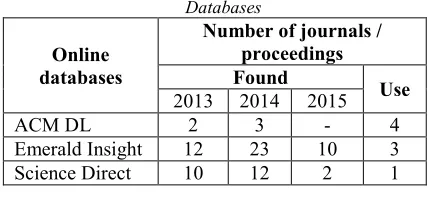
[image:4.612.306.520.521.620.2]This study will use online databases as primary source to get the information about shared service. This paper tends to describe the experience of using different shared service perspectives from various successful implementations in government. In the first phase of research methodology, the relevant papers were identified using search key terms “shared service in government” and “sharing in government”. The search results were retrieved from three selective online databases which are ACM DL, Emerald Insight, and Science Direct. Those three online databases were chosen because those are the most three online databases which are provided many results toward shared services in government rather than other online databases. The collection of the data is limited to journals and proceedings of shared service in government since 2013 until May 2015.
Table-1. Number Of Journals/Article About Shared Service In Government Based On Three Online
Databases
Online databases
Number of journals / proceedings Found
Use
2013 2014 2015
ACM DL 2 3 - 4
Emerald Insight 12 23 10 3
Science Direct 10 12 2 1
ISSN: 1992-8645 www.jatit.org E-ISSN: 1817-3195
127 provide clear explanation of the use of shared service in the government. Even, some papers do not have example of the service being shared and how they use shared service in government.
In data analysis phase, content analysis will be done toward those selected eight papers. According to Hsieh & Shannon [17], there are three approaches of content analysis for qualitative study which are conventional, directed, and summative content analysis. This study uses conventional content analysis because there is limitation of
research literature. This conventional content analysis will directly gain the information from the literatures. The findings of the study will be discussed in discussion section which will include the summary of the contribution of the findings toward the knowledge.
Those data will be presented in form of map of identification of shared service in government based on shared service perspectives.
Input Task Output
P
h
as
e
1
:
E
x
tr
ac
ti
o
n
Online databases
1.1. Unsorted papers about “shared
service in government” and “sharing in government”
P
h
as
e
2
:
S
o
rt Output from:
• Task 1.0: 1.1
2.1. Choose the papers that have case
study since the study will be based on lesson learned of successful stories
P
h
as
e
3
:
D
at
a
A
n
al
y
si
s
Output from:
• Task 2.0: 2.1
3.1. Identify the objectives toward
sharing
3.2. Identify perspectives of each
papers
3.3. Identify main focus of papers
3.4. Identify theme of sharing for
each of papers
3.5. Identify technology and
organizational performance for each of papers
P
h
as
e
4
:
In
te
rp
re
ta
ti
o
n Output from:
• Task 3.0: 3.1,
3.2, 3.3, 3.4, 3.5
4.1. Study findings
4.2. Map of identification of shared
service government based on shared service perspectives
Figure-1. Research Methodology
4. RESULTS AND DISCUSSION
This study was categorized by following perspectives of shared service based on Bangemann [13], which are i) process; ii) technical; iii) operational; and iv) strategic. Most of those case studies applied shared service for structuring the government by using different view in applying it based on different importance and different ability of each of the government.
The researchers are narrowing the focus in analyzing those papers based on i) sharing, and ii)
technology and organizational performances.
Sharing is important in the study because it has an idea or a point for each of shared service perspective. Knows the sharing will help in understanding the role play of the subjects in the contexts. There are several things in determining shared service which are data analytics, cloud & technology, talent implications, social media, multi-functional services, global business services,
business intelligence in providing new
circumstances and high competitive infrastructure to provide better service compare to traditional sharing process, innovation from providers toward 4.0 Map the data
analysis 1.0 Extract the relevant resources
2.0 Filter the extracted papers
ISSN: 1992-8645 www.jatit.org E-ISSN: 1817-3195
128 technology, and acknowledgement that sourcing is more than a technology business and process.
Meanwhile, technology performance is related with the way an organization plan and manages the technology by focusing on the effectiveness of technology. It is including throughput and availability of technology itself. It is influenced by strategic, management, and infrastructure of
technology. Meanwhile, organizational
performance can be defined as measurement toward goals and objectives of an organization compare to its performance [18] . Organizational performance is used to investigate phenomena of organization such as planning, structure, and strategy. The technology of an organization will influence the performance of its organization [19, 20]. The organization will be influenced by the use of technology, better management of technology, and role of department of technology. The differences in technology and organization performance can be seen in Table-3.
All papers in Table-2 explains experiences those successful case studies in implementing shared service in government from different perspectives. We found three papers applied strategic shared service perspective, three papers applied technical shared service perspective, and two papers applied
process perspective of shared service in
government. There are differences toward the experiences of shared service implementation in
government sector. Those differences of
experiences are caused by the different perspectives from each of government in implementing shared service from the perspectives of process, technical,
operational or strategic of shared service
implementation.
From Raudla et al., Agbabiaka & Ojo, and Mead & Homer [8, 21, 22] the researchers identified that those papers required the government to consider aspects and constructs of implementing service in those government. It is done by seeking the past, present and the next target both in every agency as well as in relation between the agencies. In strategic perspective, technology is required to have better performance by improving the use of IT suitable with the agenda of the use of shared service which has been arranged. Meanwhile, the organizational performance will be more focusing on improve capacity and ability of staffs and level of management in that government. Those case studies required the governments to focus and understand suitable approach to implement shared service.
Strategic perspectives is needed in developing SSC since there is a tension in the needs to fulfill services for customer oriented and the needs to standardize the process and ICT solutions of the organizations [8].
According to Abadi et al. [23] and Pardo et al. [24] technical shared service perspective is more focus on technology part such as email, network, data and access of service. The organization is required to enhance the use of IT and focus on restructure of organization since the technology will be increase and number of staffs will be affected because of it.
Other studies by Borman & Janssen [25] and Higgins et al. [26] described the implementation of shared service in the government agencies. In implementation process, those governments focus on process of sharing and the things that are needed during the process of sharing implementation. In technology performance, the government required to focus on mechanism and method in process of implementing shared service. Meanwhile in organizational performance, it focuses on activities of the organization, whether about what and how the sharing is done and how organization should act. It required the government organizations focus on step by step in sharing implementation until it achieves the goals. Process is very important since it can be a key of move to shared service which will influence the work practices in both private and public organization.
5. CONCLUSION
There are opportunities for the use of shared service in government will increase for the next years both in developed and developing countries.
Overall, shared services in government from different perspectives have been demonstrating significant effort toward successful implementation. The implementation of shared services in the previous studies aimed to reduce cost and increase the effectiveness of services for many public users and business partners. It is done whether by focusing on implementation approach, technology, or step by step in the implementation process.
To the best of our knowledge of shared service from the previous studies, none of them discussing shared services concept in government from the perspective of operational. Due to this paper only
ISSN: 1992-8645 www.jatit.org E-ISSN: 1817-3195
129 experiences and concept of implementing shared service from different perspective, there might have a limitation toward some information that we have not uncovered. For the future study, it shall do identification the differences of success factors from both shared service perspectives or not. Future research also might identify the risks and values for each of those shared service perspectives.
REFERENCES:
[1] S. Miskon, W. Bandara, E. Fielt, and G. Gable, "Understanding Shared Services: An
Exploration of the IS Literature,"
International Journal of E-Services and
Mobile Applications (IJESMA), vol. 2, pp.
60-75, 2010.
[2] R. W. Wagenaar, "Governance of shared service centers in public administration:
dilemmas and trade-offs," in Proceedings of
the 8th international conference on Electronic commerce: The new e-commerce: innovations for conquering current barriers, obstacles and limitations to conducting successful
business on the internet, 2006, pp. 354-363.
[3] M. Borman and M. Janssen, "The Design and
Success of Shared Services Centres," in ECIS,
2008, pp. 2209-2220.
[4] K. Gould and A. Magdieli, "Optimizing government effectiveness through shared
services: Perspectives from IBM
Corporation," IBM Global Business Services,
2007.
[5] M. Janssen and A. Joha, "Governance of shared services in public administration,"
AMCIS 2006 Proceedings, p. 284, 2006.
[6] A. Kearney, "Shared services in government: Turning private-sector lessons into
public-sector best practices," Chicago, IL: AT
Kearney, 2005.
[7] R. Tomkinson, Shared services in local
government: improving service delivery:
Gower Publishing, Ltd., 2007.
[8] R. Raudla, K. Tammel, and L. Parker, "Creating shared service centres for public sector accounting," Accounting, Auditing &
Accountability Journal, vol. 28, 2015.
[9] I. Herbert and W. Seal, "A Knowledge Management Perspective to Shared Service Centers: A Case Study of a Finance SSC," in
Shared Services as a New Organizational
Form, ed: Emerald Group Publishing Limited,
2014, pp. 133-151.
[10] B. Dollery, B. Grant, and A. Akimov, "A Typology of Shared Service Provision in
Australian Local Government," Australian
Geographer, vol. 41, pp. 217-231, 2010.
[11] N. Su, R. Akkiraju, N. Nayak, and R. Goodwin, "Shared services transformation: Conceptualization and valuation from the
perspective of real options," Decision
Sciences, vol. 40, pp. 381-402, 2009.
[12] Z. Baida, J. Gordijn, and B. Omelayenko, "A shared service terminology for online service
provisioning," in Proceedings of the 6th
international conference on Electronic
commerce, 2004, pp. 1-10.
[13] T. O. Bangemann, Shared services in finance
and accounting: Gower Publishing, Ltd.,
2005.
[14] E. Fielt, W. Bandara, S. Miskon, and G. G. Gable, "Exploring shared services from an IS perspective: a literature review and research
agenda," Communications of the Association
for Information Systems, vol. 34, pp.
1001-1040, 2014.
[15] T. J. Burns and K. G. Yeaton, Success factors
for implementing shared services in
government: IBM Center for the Business of
Government, 2008.
[16] B. Dollery, B. Grant, and L. Crase, "Love thy neighbour: a social capital approach to local
government partnerships," Australian Journal
of Public Administration, vol. 70, pp.
156-166, 2011.
[17] H.-F. Hsieh and S. E. Shannon, "Three approaches to qualitative content analysis,"
Qualitative health research, vol. 15, pp.
1277-1288, 2005.
[18] N. Melville, K. Kraemer, and V. Gurbaxani,
"Review: Information technology and
organizational performance: An integrative model of IT business value," MIS quarterly,
vol. 28, pp. 283-322, 2004.
[19] R. Kohli and S. Devaraj, "Measuring information technology payoff: A meta-analysis of structural variables in firm-level
empirical research," Information systems
research, vol. 14, pp. 127-145, 2003.
[20] T. Mukhopadhyay, S. Kekre, and S. Kalathur, "Business value of information technology: a
study of electronic data interchange," MIS
quarterly, pp. 137-156, 1995.
[21] O. Agbabiaka and A. Ojo, "Framework for
assessing institutional readiness of
government organisations to deliver open, collaborative and participatory services," in
Proceedings of the 8th International
Conference on Theory and Practice of
ISSN: 1992-8645 www.jatit.org E-ISSN: 1817-3195
130 [22] D. Mead and S. Homer, "Creating Shared
Back-Office Services in a National Library,"
Mergers and Alliances: The Operational View and Cases (Advances in Librarianship, Volume 37) Emerald Group Publishing
Limited, vol. 37, pp. 175-199, 2014.
[23] M. Abadi, M. Sutherland, M. Cook, and D. Werthmuller, "Revitalizing the capital district leveraging a regional code enforcement
repository," in Proceedings of the 14th
Annual International Conference on Digital
Government Research, 2013, pp. 275-276.
[24] T. A. Pardo, R. L. Greenberg, and D. S. Canestraro, "Combating financial crisis with government transformation: the NYS shared
services experience," in Proceedings of the
8th International Conference on Theory and
Practice of Electronic Governance, 2014, pp.
213-222.
[25] M. Borman and M. Janssen, "Reconciling two approaches to critical success factors: The case of shared services in the public sector,"
International Journal of Information
Management, vol. 33, pp. 390-400, 2013.
[26] E. Higgins, M. Taylor, P. Lisboa, and F.
Arshad, "Developing a data sharing
framework: a case study," Transforming
Government: People, Process and Policy, vol.
ISSN: 1992-8645 www.jatit.org E-ISSN: 1817-3195
131
Table-2. Selected Papers For Identifying Shared Service Government Based On Shared Service Perspectives
Sources Year Authors Objectives toward
sharing
Shared Service Perspective
Main
Focus Theme of Sharing
ACM DL
2014 Pardo,
Greenber g, & Canestrar o
Maximizing back-office efficiencies through a shared services strategy grounded in a new IT governance model
Technical
Back-office IT •
Email consolidation
•Data center
consolidation
•Network
consolidation
•Enterprise identity
and access
management
2013 Abadi,
Sutherlan d, Cook, & Werthmu ller
Use code enforcement data through shared service model by creating
collaborative environment of governance to support public safety and economic development
Technical Software
on code enforcem ent data
•Collaborative code
enforcement data
ACM DL
2013 Santos &
Costa
Implementation of public software by government and society collaborate in using free software
ecosystems under same shared platform and can be used by users, developers as well as providers of service
Technical Software •Usage of software
as central
ISSN: 1992-8645 www.jatit.org E-ISSN: 1817-3195
132
2014 Agbabia
ka & Ojo
Develop an assessment framework to determine the needs and level of readiness of government agencies to collaborate with other agencies in sharing data, systems and services for efficient service delivery
Strategic Service
collabora tion between agencies
•Aspects and
constructs in
government information sharing
•Aspects of
inter-agency interoperability
•Aspects of
collaborative data sharing
•Comparisons of
development and maturity levels of agencies
Emerald Insight
2015 Raudla &
Tammel
Putting forth a new typology of different SSC and identifying challenges for different reform models face. Focusing on financial accounting of central government
Strategic Sharing
differenc es between vertical (with stakehold er) and horizonta l (with other agencies) SSC
•Establish new SSC
•Consider the
evolution of the
types of
accounting SSC
planned and/or
implemented before
•Considering
organizational
objectives which
are cost saving,
higher quality
accounting information, customer satisfaction.
2013 Mead &
Homer
Implementing shared service across back-office functions between the National Library and National Galleries
Strategic Sharing
back-office service
•Consider past,
present, and future organizations’ objectives
•Tactical approach
to implementing
shared service
•Focus on
important issues
such as IS, HR, Finance,
ISSN: 1992-8645 www.jatit.org E-ISSN: 1817-3195
133 Emerald
Design
2014 Higgins,
Taylor, Lisboa, & Arshad
Examining the process of developing a data sharing framework between different public sector organizations
Process Sharing
process between multiple public organizat ions
•Examination of the
current customer
insight data
between partner
organizations
•Design of protocol
for shared data
•Implementation of
protocol
•An evaluation of
the protocol Science
Direct
2013 Borman
& Janssen
Enabling assessment of a proposed project before decision proceed is taken by reconciling context specific based on individual CSF (original
perspective) with universal based on project CSF (subsequent perspective) to achieve individual and project objectives
Process Assessm
ent shared service based on two different critical success factors
•Understanding the
specificity and
generally
•Require to
understand outcomes,
processes, as well
as operating
environments of
project
Table-3. Technology And Organizational Performance From Different Shared Service Perspectives
Year Authors
Technology and Organizational Performance
Technology Organizational
2014 Pardo,
Greenberg, &
Canestraro
•Identify operational improvements
such as enhanced use of IT operation, IT transformation, IT governance, and IT portfolio
•Streamline the organizational
structure
•Create meaningful metrics and
targets to help improve
performance
•Experienced staffs to design the
service together with external valuator
2013 Abadi,
Sutherland, Cook, & Werthmuller
•Congruent data structures
•Standardized processes
•Focus on optimized the use of
various devices into centralized repository system
•Good user interface influences
sharing significantly
•Build shared repository for
providing the foundation of
•Code inspectors and departments
share information of code data across jurisdictions
•Each of city and country has ability
ISSN: 1992-8645 www.jatit.org E-ISSN: 1817-3195
134
collaboration in order to standardize and assess common goal
2013 Santos &
Costa •
Understand the program of software well
•Detailed design and development of
software portfolio and software tools
•Develop a portal for building
ecosystem around software
communities
• Clear roles from different
organization
• Conducting regular meetings to
identify the planning and execution
• No license agreement between
every organizations
• Knowledge transfer about the use
of software through training
2014 Agbabiaka
& Ojo •
System readiness (operating) to provide conducive environment for inter-agency collaboration
•Infrastructure (technology)
readiness such as software,
hardware, databases
•Enabling environment (people
readiness)
•Analyze existing knowledge, skills,
sets and experience of employees
•Improve the ability and capacity of
agencies
2015 Raudla &
Tammel •
Development information society and e-government agenda
•Identify ICT solution for mitigating
challenges both in horizontal and vertical SSC.
•Bring the professionals together
into a single stand-alone
organizational entity
•Focus on horizontal SSC as well as
vertical SSC
•Reduces staffs and operating
expenses
2013 Mead &
Homer •
Common helpdesk system
development
•Security improvement
•Improve data storage and data link
speed
•Support from senior management
•Trust between parties
•Sustainable relationship
•Reduce HR team
2014 Higgins,
Taylor, Lisboa, & Arshad
•Secure data transfer method
•Data integration mechanism
•Analyze shared data to inform
decision making
•Identification of organization
activities for shared data would be beneficial
•Changes of organizational
activities
•Agreement of shared data between
partners
2013 Borman &
Janssen
•Understanding operating
environment characteristic
•Know implementation process
•Incorporating toward project and
individual viewpoints
•Understand the objective of
individual as well as project clearly
•Decision making is made by