EXPLORATIVE STUDY OF HEALTHCARE DATA
INTERCHANGE STANDARDS
1USHA BATRA, 2SAURABH MUKHERJEE, 3AJETA NANDAL, 4SHELLY SACHDEVA
1,3
ITM University, Department of CSE & IT, Gurgaon, India 2
Banasthali University, Department of CSE, Banasthali, Rajastthan, India 4
JIIT University, Department of CSE, Noida, U.P., India
E-mail: [email protected] , [email protected] , 3
4
ABSTRACT
Healthcare data interchange standards are important aspect for achieving interoperability for health information exchanges. However, there is a big void in literature that could clearly differentiate among available healthcare standards with a motive of necessity of upgrading to new standards resulting in cost effective and efficient standard to support interoperability for a National Healthcare Information System (NHIS). These standards act as key to achieve semantic interoperability in health sector to ensure patient information availability anytime and right at the point of care. In this paper we present a study and a comparative review of healthcare interoperability standards as a means of meeting the desired semantic interoperability and integration of stovepipe applications of varied Electronic Medical Records in a heterogeneous environment and achieving efficient Electronic Health Record. This study gives a flash tour on healthcare standards in terms of their scope, advantages, level of interoperability support and challenges. The paper also shows how the standards can be upgraded to next level by a possible inclusion of web services concept.
Keywords: Electronic Health Record, Electronic Medical Records, Healthcare Data Interchange
Standards, Healthcare Information System National, Interoperability, Semantic
Interoperability
1. INTRODUCTION
The healthcare data is converted into electronic record of health-related information on an individual that can be created, managed and consulted by authorized clinicians within one healthcare organization, leading to Electronic Medical Record (EMR) [1]. However, the patients may get treatment from different hospitals at different locations at different point in time which leads to the availability of patients’ information in varied EMRs in different formats. Thus, there is a need to aggregate these data available in heterogeneous environment. The healthcare data interchange standards help us perform communications among different EMRs allowing exchange of patient information to support quality in patient care right at the point of need confirming what and where is required, eliminating unnecessary delays and errors and avoiding duplication of reports. This can be achieved with a conformance (an agreement on naming and semantics of items) for a specific standard among different hospitals leading to the design of
defined [5] interoperability as “the ability to communicate and exchange data accurately, effectively, securely, and consistently with different information technology systems, software applications, and networks in various settings, and exchange data such that clinical or operational purpose and meaning of the data are preserved and unaltered”.
Healthcare data interoperability comes in three flavours [4,5] namely Technical, Syntactic and Semantic interoperability.
i. Technical interoperability counteracts effects of remoteness such as networks.
ii. Syntactic interoperability refers to the binding and communication mechanisms for data. e.g. Health Level Seven standard uses UNIX pipe (|) symbol as data delimiter that supports structuring of data in a meaningful manner. Syntactic interoperability is a fundamental requirement for semantic interoperability.
iii. Semantic interoperability is not only concerned with syntax of data but it also communicates meaning of data. Thus the goal of achieving semantic interoperability can only be met when the meaning of shared information is implicit to the application and services interoperating or communicating to exchange healthcare information.
These three types of interoperability are equally important to meet consistent and accurate approach in healthcare information exchange and hence to meet the prime objective of quality in healthcare integrity. The integrity of information often leads to errors and it becomes even more challenging when the system becomes larger and complex with an intensive increment in information, the exposure to errors increases. In other industries, these errors may be resolved but in healthcare information integrity, these errors become a matter of life or death. The solution to overcome the challenge and to maintain end to end integrity does not originate from single healthcare provider or hospital but must be a collective and cost effective effort from all healthcare providers across the industry. Thus the propagation of healthcare information in electronic health records and the transition of data across different health organizations lead to the requirement of Patient Data Exchange Standards to help healthcare effectively manage and share data. The next section details about various international organizations that have introduced variety of healthcare data exchange standards followed by a comparative analysis of most popular standards i.e. CEN, ISO, HL7, OpenEHR etc. Section 3 reviews available messaging standards, their scope and
challenges. Section 4 outlines conclusion and future work
2. HEALTHCARE STANDARDS
Healthcare data interchange standard is an agreed-upon, universal and reliable way to record and communicate health information. Healthcare Information Management Systems Society (HIMSS) defines standard as a “common terminology that facilitate interoperability and integration, create structured information models for data structure and interchange and enhance privacy & security.” ISO defines a standard as a document, established by consensus and approved by a recognized body that provides, for common and repeated use, rules, guidelines, or characteristics for activities or their results, aimed at the achievement of the optimum degree of order in a given context [6]
The aim of universal healthcare is to provide accurate patient information at right time and right at the point of care in a consistent, secure and efficient way. The ultimate goal of having a common standard in health care is to exchange patient and patient related information in a standard format e.g. different healthcare providers or hospitals aiming to interoperate and integrate needs to convert the stored information (stored in any format) to a standard communicating format (standard) i.e. patient name should always be exchanged in a common standard format FirstName, followed by MiddleName and LastName. So in a case if HOSPITAL A (which stores patient name as LastName followed by MiddleName and FirstName) HOSPITAL B (which stores patient name as MiddleName followed by FirstName and LastName) are integrated and communicate with each other based on STANDARD S, then the standard S converts the patient name in desired standard communication format i.e. FirstName, followed by MiddleName and LastName.
Communications in Medicine (DICOM) and Health Level Seven (HL7).
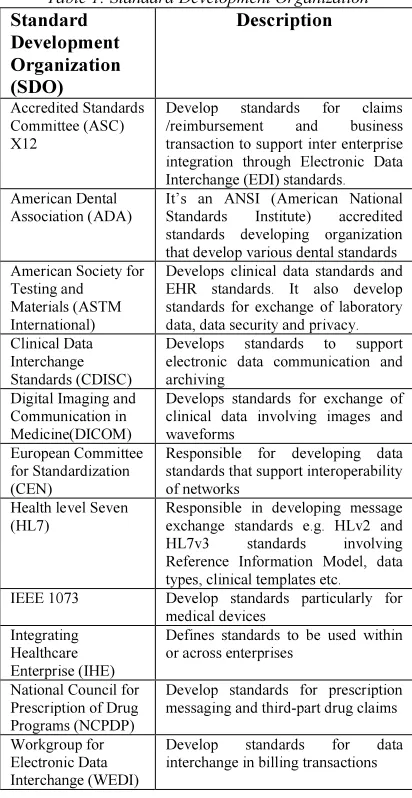
Table 1: Standard Development Organization
Standard Development Organization (SDO)
Description
Accredited Standards Committee (ASC) X12
Develop standards for claims
/reimbursement and business
transaction to support inter enterprise integration through Electronic Data Interchange (EDI) standards. American Dental
Association (ADA)
It’s an ANSI (American National
Standards Institute) accredited
standards developing organization that develop various dental standards American Society for
Testing and Materials (ASTM International)
Develops clinical data standards and EHR standards. It also develop standards for exchange of laboratory data, data security and privacy. Clinical Data
Interchange Standards (CDISC)
Develops standards to support
electronic data communication and archiving
Digital Imaging and Communication in Medicine(DICOM)
Develops standards for exchange of clinical data involving images and waveforms
European Committee for Standardization (CEN)
Responsible for developing data standards that support interoperability of networks
Health level Seven (HL7)
Responsible in developing message exchange standards e.g. HLv2 and
HL7v3 standards involving
Reference Information Model, data types, clinical templates etc.
IEEE 1073 Develop standards particularly for
medical devices Integrating
Healthcare Enterprise (IHE)
Defines standards to be used within or across enterprises
National Council for Prescription of Drug Programs (NCPDP)
Develop standards for prescription messaging and third-part drug claims
Workgroup for Electronic Data Interchange (WEDI)
Develop standards for data
interchange in billing transactions
These standards development organizations are involved in developing healthcare standards in varied categories as detailed in Table 2. Broadly healthcare standards can be categorized on the basis of either type or interoperability support.
a) Type: Terminology, Conceptual, Document, Messaging, Application etc.
b) Interoperability Support: Syntactic, Semantic, process etc.
More commonly a healthcare standard can fall in one or more types of categories on the basis of their functionalities as follows:
i. Terminology standards: Standards that define set of rules/coding mechanisms/nomenclature/terms
that are confirmed as vocabulary for exchange of data from one computer system to another. They are much like a dictionary for a language. Some of the commonly known terminology standards are: ICD, SNOMED CT,LOINC, CPT, HCPCS etc.
ii. Messaging standards: Messaging standards define common messaging structure for exchange and sharing of medical images, financial details and clinical information among different service providers or hospitals. Some of the commonly known messaging standards are HL7, OpenEHR, DICOM etc.
iii. Document standards: Defines standard format for describing and sharing patient demographic and medical details including prescription and disease information. Some of the commonly known document standards are CCR and CDA. iv. Conceptual standards: These types of standards define a set pattern for mapping “concepts” in a “standardized” way. Some of the examples of conceptual standards type include HL7, UMLS etc.
v. Application standards: Defines a common approach to integrate and interoperate diverse applications in a seamless way e.g. CCOW. vi. Legal standards: Describe the laws, regulations, and standards that govern patient confidentiality. e.g. Healthcare Insurance Privacy and
Accountability Act (HIPAA) privacy regulations etc.
This categorization of various healthcare standards is summarized in Table 2.
3. MESSAGING STANDARDS IN
HEALTHCARE
approach. However, when market relevance was taken into account, DICOM was observed to be the most advanced EHR standard in terms of content structure, access services and template libraries. Nevertheless DICOM being imaging standard was not found as universal solution for the EHR. This paper relooks the standards reviewed by Eichelberg [10]. Our study further focuses mainly on messaging standards (most commonly known OpenEHR, HL7 and DICOM) and highlights the
updating of these standards.
OpenEHR
This organization introduced the most significant idea of archetype concept [Beale 2005]. This approach proposed a two layered methodology for structuring an EHR. The archetype (clinical knowledge) approach hints at the concept of reusability as in a programming language. Like in Java, packages contain certain classes that could be used as a starting point for developing an application. Similarly, to develop an EHR, archetypes (defined earlier and maintained in an archetype library) can be reused with some external vocabulary support of LOINC, SNOMED, DICOM etc. In February 2006 the openEHR Foundation published release 1.0 of the openEHR architecture. This work was further taken up by CEN as a basis for the new standard ENV13606. The openEHR[11,12] performs the important role of semantic interoperability. i.e. exchange of patient health data requires that the meaning and context of clinical information sent by one system results in accurate interpretation by the receiving EHR[13,14]. openEHR offered a standard operating procedure with modularity, as the software does not have to be altered each time medical information or needs change - only the archetypes require to be altered. The Danish archetype proof-of-concept project [2009] has pointed out benefits and challenges using archetypes, and has identified barriers. The main viewpoints are that the archetype methodology is very useful for representing clinical content specifications of the type Observation. Furthermore, it is seen as favourable that the clinical content specifications can be stored, exchanged and imported in a standardized, machine readable format (ADL).
According to Knut Bernstein, there are differences between the vendor and openEHR reference models in regard to non-observation archetypes; that need to be resolved over time.” For designing clinical systems process, related data and specifications of the user interaction is also needed. Archetypes are
probably less suitable for representing this kind of information [11].
Health Level Seven
HL7 was founded in 1987 by ANSI. The term “Level 7” refers to the highest level of the Open System Interconnection (OSI) model of the International Organization for Standardization (ISO). HL7 is the most successful messaging standards in the healthcare field. It supports exchange of medical data among heterogeneous computer applications. HL7 [15, 16, 17] is a messaging standard for exchanging medical information. It is being developed for exchanging incompatible healthcare information among various
medical information systems. The HL7 is a practical
integration approach which provides the exchange,
management and integration of data. It achieves
data integration and manages clinical observation, laboratory, pharmacy, medical devices, imaging and
insurance transactions. With the introduction of
HL7 version 1.0 in 1987, it has done revolutionary improvements from the past more than two decades. In 1988 HL version 2.0 followed by HL7 version 2.1 in 1990 and Hl7 version 2.2 in 1994 was published. In 1995, HL7 version 2.2 received ANSI accreditation. Further, in 1996 HL7 version 2.3 was introduced. With the introduction of CCOW, in 1999 HL7 version 2.3.1 with ANSI accreditation was produced. Before the start of 2001, HL7 version 2.4 was established with first CDA 1.0 version. The progress was not limited here and in 2003 HL7 version 2.5 followed by HL7 version 3.0 in 2004, version 2.6 in 2008 and in 2010 HL7 v3 RIM R2 was published. The latest is HL version 2.7 published with ANSI accreditation in February 2011. HL7 as a Standard Development Organization too, develops various standards such as:
Messaging standards - HL7 v2.x and v3.0 Conceptual standards – HL7 RIM Document standards - HL7 CDA Application standards – HL7 CCOW
The RIM expresses the data content needed in a specific clinical or administrative context and provides an explicit representation of the semantic and lexical connections that exist between the information carried in the fields of HL7 messages. The RIM is mandatory to increase the precision and to reduce the implementation costs. HL7 version 3 specifies interoperability for health and medical transactions based on Reference Information model (RIM). With the introduction of Clinical Document Architecture, deriving their meaning from the HL7’s Reference Information Model, HL7 version 3 proved to be richly expressive in that they represent significant breadth and depth of clinical content.HL7 V3 Clinical Document Architecture (CDA) is an exchange model that specifies a common format for exchanging a patient's medical record between different hospital systems or between different hospitals. This HL7 standard works as a foundation for the universal electronic medical record. It is an XML-based mark-up standard intended to specify the encoding, structure and semantics of clinical documents for exchange. HL7 Clinical Context Object Workgroup (CCOW) allows interoperability for visual integration of user applications.
The main advantage of HL7 is that it is a standard for exchanging information between medical applications and systems. The knowledge of HL7 is widely spread. Hence it is accepted world-wide. Through HL7, Healthcare enterprise integration can be obtained by integrating various domains i.e. Admissions, discharges, Transfers(ADT), Patient History, Scheduling , Acute care , Nursing , Surgery , Billing , Epidemiology , decision Support , Immunization, Dietary , referrals, pharmacy and Laboratory.
HL7 has established a set of information and message models for the development and implementation of interfaces for communication and transmission of medical data among heterogeneous health information systems. The use and adoption of HL7 provides a native and robust interoperability framework for software development and deployment. For these reasons, HL7 is a recommended and required standard for information exchange among healthcare applications. However, HL7 leads to certain challenges [20]
• Some organizations may use different
versions of HL7, so you'll have compatibility issues ("cross-walking"). Certainly you'll run into this if you get involved in any inter-organizational data transfers.
• There is no semantic standard (for v2.x, I
think v3 may have started to address this), so even if you know what data should be in a particular field, you may not know the exact meaning or representation of those bytes.
• HL7 is a non-standard standard. It supports
vendor-specific Z-segments which are widely used and totally proprietary.
• HL7 v2.x (many values of x still in use in the
wild) is a non-XML proprietary format, so you'll need an HL7 parser to work with it. (This, you know as you already have an HL7 parsing library just including it for others)
• It does not support medical sensors.
• Other issues with HL7 includes
redundancy of data i.e. availability of same data in different fields and even in different segments in various HL7 implementations.
So, these are some important shortcomings of HL7 that impacts its usage and lead to the requirement of building a better and new standard format for exchanging information among healthcare information system in heterogeneous environment. Web protocols are installed and available for use by all major operating system platforms.
Digital Imaging and Communications in Medicine
maintains international standards for communication information using digital images and associated data. The DICOM standard can be applied on networked environment. It can be applied on off-line media environment. It can be specified on how devices claim agreement on the standards that react to commands and data being exchanged. It is structured as a multi-part document. It introduces explicit Information Objects not only for images and graphics but also for waveforms, reports, printing, etc. It specifies an established technique for uniquely identifying any Information Object. It facilitates interoperability between medical devices by specifying set of protocols (to be followed by devices), the syntax and semantics of commands and the required information related to conformance of standard.
Some of the challenges with DICOM [10] standard include:
i) it does not specify the details regarding implementation of any feature of standard.
ii) It requires the testing procedure to confirm the implementation conformance.
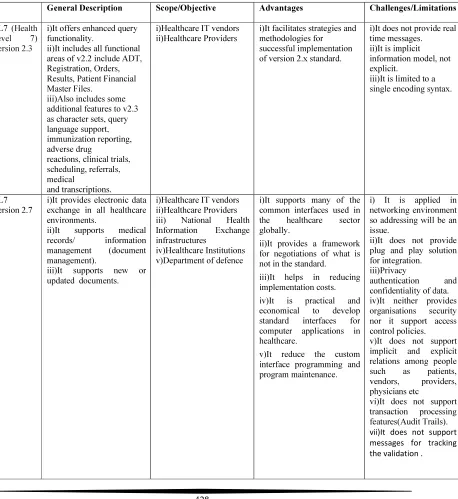
Some of the most successful messaging standards enabling harmonization of data transfer among varied healthcare providers by means of exchanging messages, their advantages, and limitations are summarized in Table 3.
4. NECESSITY OF UPGRADING TO NEW STANDARDS
To date most of the Integrating Healthcare Enterprise (IHE) profiles have focussed on the coordinated use of messaging and document standards rather than service standards [18]. There is a necessity of upgrading to new standards by possible inclusion of web services. There is a need of developing a standard that allow secure access and exchange of health information over the World Wide Web (WWW). Healthcare organizations should be able to exchange healthcare information among each other to provide efficient and secure patient care. The use of SOA within healthcare could produce significant benefits, including improved reuse of existing IT assets and an enhanced ability to respond to new business needs in a timely manner. [18,19,].
HTTP and XML provide an already at-hand solution to the problem of how programs running under different operating systems in a network can communicate with each other. Simple Object
Access Protocol (SOAP) has gained status as a common messaging protocol in Web services and Service Oriented Architecture (SOA) projects. SOAP (Simple Object Access Protocol) is a way for a program running in one kind of operating system (such as Windows 2000) to communicate with a program in the same or another kind of an operating system (such as Linux) by using the World Wide Web's Hypertext Transfer Protocol (HTTP) and its Extensible Markup Language (XML) as the mechanisms for information exchange.
5. CONCLUSIONS AND FUTURE WORKS
Having a broad range of healthcare standards, it is really very difficult to score them on a scale of 1-10, as each of these standards have their own areas of advantages, levels of interoperability support and challenges. Some of those standards have not been adopted and implemented widely. As a result there is an impression that the required data standards do not exist. The widespread use of HL7 as a messaging model can be upgraded to next level by a possible inclusion of web services concept. The utilization of Service Oriented Architecture (SOA) services may bring many benefits by providing cost effective and efficient standard to support interoperability for a National Healthcare Information System (NHIS). In future we wish to implement the possible harmonization of HL7 standard with SOA services to achieve semantic interoperability in health sector to ensure patient information availability anytime and right at the point of care.
REFRENCES:
[1] Yasuo Ishigure, Trends, Standardization, and Interoperability of Healthcare Information, Global Standardization Activities, NTT Technical Review, vol.9 No. 4 Apr.2011. [2] Tim Benson, Principles of Health
Interoperability HL7 & SNOMED, Health Informatics, Springer Pub. ISBN 978-1-84882-802.
[3] James O’Brien, George Marakas, Introduction to Information Systems. McGraw Hill/Irwin;13 edition, ISBN 0-07-304355-9
[4] Interoperability: What Is It and Why Should I Want It? Ariadne: Web Magazine for
Information Professionals at
[5] Patricia Gibbons , HL7 whitepaper “Coming to Terms: Scoping interoperability for Health Care”, (HL7-2007).
[6] A. Begoyan, An Overview of Interoperability Standards for Electronic Health Records, Integrated Design and Process Technology, USA, 2007.
[7] Minnesota e-Health- Types of ehealth standards.
http://www.health.state.mn.us/e-health/standards/overview.html
[8] Joe Anna, LOINC and other standards, 2012.
http://loinc.org/faq/getting-started/loinc-and-other-standards
[9]Rachel L Richesson and Prakash Nadkarni, Data standards for clinical research data collection forms: current status and challenges, Journal of American Medical Informatics Association. May 2011.
[10] Knut Bernstein, Ida Tvede, Jan Petersen, Kirsten Bredegaard, Can openEHR Archetypes Be Used in a National Context? The Danish Archetype Proof-of-Concept Project, Medical Informatics in a United and Healthy Europe K.-P. Adlassnig et al. (Eds.) IOS Press, 2009 , doi:10.3233/978-1-60750-044-5-147
[11] Marco Eihelberg, Thomas Aden, And Jorg
Riesmeier, and Asuman Dogac and Gokce B. Laleci, A survey and Analysis of Electronic Healthcare Record Standards. ACM computing Surveys, Vol. 37, No.4, December 2005, pp. 277-315.[12] http://www.openehr.org/knowledge/.
[13] Moner, D., Maldonado, J., Bosca, D., Fernandez, J.T., Angulo, C., Crespo, P., Vivancos, P.J.,Robles, M.: Archetype-based semantic integration and standardization of clinical data. In:Proceedings of the 28th IEEE EMBS Annual International Conference, vol. 1, pp. 5141–5144 (January 2006)
[14] Mart´ınez-Costa, C., Men´arguez-Tortosa, M., Fern´andez-Breis, J.T., Maldonado, J.A., A model-driven approach for representing clinical archetypes for Semantic Web environments. Journal of Biomedical Informatics 42(1), 150–164 (2009)
[15] www.hl7.org
[16] Evolution of HL7 -
http://www.corepointhealth.com/whitepapers /evolution-hl7
[17] Alexander Berler, Pantelis A. Angelidis, and Dimitris Koutsouris, The use of HL7, Journal of Telecommunications & Information Technology.
[18] Kensaku Kawamoto, Alan Honey, and Ken Rubin , The The HL7-OMG Healthcare Services Specification Project: Motivation, Methodology, and Deliverables for Enabling a Semantically Interoperable Service Oriented Architecture for Healthcare. Journal of the American Medical Informatics Association. 2009
Nov-Dec; 16(6): 874–
881.doi: 10.1197/jamia.M3123
[19] Bridges MW. SOA in healthcare: Sharing system resources while enhancing interoperability within and between healthcare organizations with service-oriented architecture Health Managemnt and Technology 2007;28(6):6. [PubMed]
Table 2: Categorization of various healthcare standards
Standard SDO’s
creating the standard
Category Type Domain Area Description
Continuity of Care Record (CCR)
ASTM Document Standard Clinical Summary
Documents
A standard that gives common coding mechanism for sharing important clinical information
Continuity of Care
Document (CCD)
ASTM &
HL7
Document standard Clinical Summary
Documents
An alternative implementation of ASTM CCR for organization implementing HL7 CDA
Clinical Document
Architecture (CDA), earlier known as Patient Record Architecture
HL7 Document Standard Clinical Documents An exchange model for clinical documents such as
discharge and summaries and progress notes. It makes documents both 100% machine readable and human readable.
Digital Imaging and
Communications in
Medicine (DICOM)
DICOM Message, Data
Transfer/storage/captur e standard
Radiology Messaging Standard for sharing radiology images and waveforms
Institute of Electrical and
Electronics Engineers
(IEEE1073)
IEEE Messaging standard Medical device
communication in acute care environment
A standard for interoperability between medical instrumentation and computerized HIS.
International Classification of Diseases Version 9 (ICD-9)
Terminology standard Disease Names A standard that represents a set of codes for clinical
diagnoses sometimes required for billing
International Statistical
Classification of Diseases Version 10 (ICD-10)
WHO Terminology standard Mortality Common standard to report morbidity and morbidity
information worldwide
Logical Observation
Identifiers, Names and
Codes (LOINC)
Terminology standard Laboratory report and
Clinical Information or Lab Terms
A standard coding system that uses a common set of names and codes for identifying Lab results to electronically interoperate laboratory and clinical information
Health Level Seven
Version 2 (HL7v2.x)
HL7 Message, Data
Transfer/storage/captur e standard
Data exchange
messaging
A standard for exchange of clinical, financial and administrative data
Health Level Seven
Version 3 (HL7v3.x)
HL7 Message, Data
Transfer/storage/captur e standard
Clinical data
interoperability
It is based on Reference Information Model that supports mapping of clinical concepts and domains by allowing ability to certify vendor’s conformance and hence interoperability between different standards. Clinical Context Object
Workgroup (CCOW)
HL7 Message, Data
Transfer/storage/captur e standard
Technology interoperability
Provides a specific architecture to allow secure interoperability among varied applications.
National Council for
Prescription Drug
Programs (NCPDP)
Message, Data
Transfer/storage/captur e standard
Data exchange related to prescription
A standard for exchange of pharmacy and prescription related information for online prescribing. It is used between pharmacies and processors to support common billing language for reimbursement.
Universal Medical Device
Nomenclature System
(UMDNS)
Terminology standard Communicating data
about medical devices
A standard that supports universal nomenclature for communicating data about medical devices.
Unified Medical Language System (UMLS)
Terminology standard Medical coding and
concepts
A standard for mapping medical terms to common clinical concepts.
OpenEHR ISO,CEN,H
L7
Message, Data
Transfer/storage/captur e standard
Interoperable information health computing
A standard that defines common archetypes for interoperability
Healthcare Insurance Privacy and Accountability Act (HIPAA)
Legal standard Describe the laws, regulations, and standards that
Table 3: Healthcare standards
General Description Scope/Objective Advantages Challenges/Limitations
HL7 (Health Level 7) Version 2.3
i)It offers enhanced query functionality.
ii)It includes all functional areas of v2.2 include ADT, Registration, Orders, Results, Patient Financial Master Files.
iii)Also includes some additional features to v2.3 as character sets, query language support, immunization reporting, adverse drug
reactions, clinical trials, scheduling, referrals, medical
and transcriptions.
i)Healthcare IT vendors ii)Healthcare Providers
i)It facilitates strategies and methodologies for successful implementation of version 2.x standard.
i)It does not provide real time messages. ii)It is implicit information model, not explicit.
iii)It is limited to a single encoding syntax.
HL7 Version 2.7
i)It provides electronic data exchange in all healthcare environments.
ii)It supports medical records/ information management (document management).
iii)It supports new or updated documents.
i)Healthcare IT vendors ii)Healthcare Providers iii) National Health Information Exchange infrastructures
iv)Healthcare Institutions v)Department of defence
i)It supports many of the common interfaces used in the healthcare sector globally.
ii)It provides a framework for negotiations of what is not in the standard.
iii)It helps in reducing implementation costs. iv)It is practical and economical to develop standard interfaces for computer applications in healthcare.
v)It reduce the custom interface programming and program maintenance.
i) It is applied in networking environment so addressing will be an issue.
ii)It does not provide plug and play solution for integration.
iii)Privacy
authentication and confidentiality of data. iv)It neither provides organisations security nor it support access control policies. v)It does not support implicit and explicit relations among people such as patients, vendors, providers, physicians etc
vi)It does not support transaction processing features(Audit Trails).
HL7 Version 3
i)Provides the type and format of information for drug stability report. ii)It provides internal consistency.
iii) It supports variety of implementation
technologies starting from ASCII to ORBs and XML.
i)Pharmaceutical Industry ii)Drugs Agency iii)Regulatory Agency iv)Testing Labs
i)Provide more consistent and fast analysis of stable drug reports.
ii)Provides a common and stable format for drug reporting.
iii)Allows electronic storage of information.
iv)It provides results in more specific messages. V)It uncovers hidden assumptions about application boundaries
vi)Improves internal consistency of the standard.
i)It does not support explicitly for newer technologies such as a)Object Technologies b)XML and Web Technologies
ii)It does not provide explicit support for security functions.
DICOM (Digital Imaging and Communicat ions in Medicine)
i)Handle, store and transmit information in medical imaging.
ii)Provides communication for digital imaging. iii)It can be applied on network environment or on offline media environment.
i)Network image management
ii)Imaging procedure management
iii)Endoscopists iv)pathologists v)dentists vi)dermatologists vii)Network print management
viii)Network image interpretation
management
ix) Off-line storage media management
i) It provides efficient exchange of vital signs and medical device data. ii)It provides plug and play property.
iii)It provides image interoperability.
iv)Implementable and useful.
v)Facilitates explicit information for images, graphics, as well as waveforms, reports and printings etc.
vi)Provides security and data encryption.
i)Difficult to integrate when different applications are used by different vendors. ii)Complex standard due large size of content. iii)There is no testing or validation procedure for implementation’s conformance of a standard .
(security, communication protocols, information objects)
iv)Inconsistency of dat.
Institute of Electrical and Electronics Engineers (IEEE): ISO/IEEE 11073
i)It enables communication between medical and healthcare devices with other computer systems. ii)It provides real time plug and play property.
iii)It is used for observing continuous wellness details.
i)Health and Fitness ii)Respiration rate iii)Physical activity monitor
iv)Blood coagulation
i)Increased freedom provided to users
ii)Expanded area of use iii)It includes categories from real-time medical equipment to point of care devices.
IHE - Integrating the Healthcare Enterprise
i)It provides integration between DICOM and HL7. ii) It stimulates the integration of the information systems that support modern healthcare institutions.
iii)It enables communication among different information systems.
i)Clinical laboratory ii)Radiology iii)Cardiology
i)It improves patient safety and clinical efficiency. ii)It helps in reducing delivery cost by improving efficiency, reliability, and operational flexibility for healthcare providers.
iii)It enables patient care capabilities.
iv)It expand the international marketplace for healthcare vendors. v)For labs it helps in bringing the accurate results to clinicians on time. vi)It provides safety by reducing medical errors. vii)It lowers implementation costs and provide more efficient workflow
viii)It provides faster results for both patient and clinician.
i)Neither a statement nor an agreement.
NCPDP – National Council for Prescription Drug Programs
i)It provides standard for information processing. ii)NCPDP
telecommunications standard version D.0 is an updated version of the HIPAA standard for pharmacy claims transactions.
iii)The current version of the pharmacy claim standard NCPDP is 5.1 iv)It allows the use of a standardized format for electronic communication of claims and other transactions between pharmacy providers, insurance carriers, third-party administrators, and other responsible parties.
i)Billing ii)Physicians iii)Hospitals iv)Clearing houses v)Pharmacies vi)Dentist
i)It collects billing and clinical information. ii)There are some advantages for both the originator and the processor. a)Common syntax and dictionary
b)Adaptability
c)Reduced system development expense d)Reduced equipment requirements