Fiber Distributed Data Interface
Digital Technical Journal
Digital Equipment Corporation
Volume 3 Number 2
Cover Design
Our cover depicts the dual fiber-optic ring that is the physical medium for high-speed transmission of data in Digital's new FDD/local area network. High-performance workstations, systems, servers, and other LANs can be easily connected to the ring through new bridge and wiring concentrator products, which are among the topics featured in this issue on FDDI.
The cover was designed by Dave Bryant of Digital's Media Communications Group.
Editorial
Jane C. Blake, Editor
Kathleen M. Stetson, Associate Editor Circulation
Catherine M. Phillips, Administrator Suzanne]. Babineau, Secretary Production
Helen L. Patterson, Production Editor Nancy Jones, Typographer
Peter Woodbury, Illustrator Advisory Board
Samuel H. Fuller, Chairman Richard W Beane
Robert M. Glorioso Richard]. Hollingsworth John W McCredie
Alan G. Nemeth Mahendra R. Patel F. Grant Saviers Robert K. Spitz Victor A. Vyssotsky Gayn B. Winters
The Digital Technical journal is published quarterly by Digital Equipment Corporation, 146 Main Street ML01- 3/B68, Maynard, Massachusetts 01754-2571. Subscriptions to the Journal are $40.00 for four issues and must be prepaid in U. S. funds. University and college professors and Ph.D. students in the electrical engineering and computer science fields receive complimentary subscriptions upon request. Orders, inquiries, and address changes should be sent to The Digital Technical journal at the published-by address. Inquiries can also be sent electronically to Dl]®CRL.DEC.COM. Single copies and back issues are avai !able for $16.00 each from Digital Press of Digital Equipment Corporation, 12 Crosby Drive, Bedford, MA 017 30-1493.
Digital employees may send subscription orders on the ENE T to RDVAX::JOURNAL or by interoffice mail to mailstop ML01- 3/B68. Orders should include badge number, cost center, site location code and address. All employees must advise of changes of address. Comments on the content of any paper are welcomed and may be sent to the editor at the published-by or network address.
Copyright© 1991 Digital Equipment Corporation. Copying without fee is permitted provided that such copies are made for use in educational institutions by faculty members and are not distributed for commercial advantage. Abstracting with credit of Digital Equipment Corporation's authorship is permitted.
All rights reserved.
The information in this Journal is subject to change without notice and should not be construed as a commitment by Digital Equipment Corporation. Digital Equipment Corporation assumes no responsibility for any errors that may appear in this Journal. ISSN 0898- 901X
Documentation Number EY-H876E-DP
The following are trademarks of Digital Equipment Corporation: CI, DDCMP, DEC, DECbridge, DECconcentrator, DEC FDDicontroller, DECnet, DECmcc, DECstation, DECWORLD, Digital, the Digital logo, DNA, I.AT, ThinWire, TURBOchannel, ULTRIX, VAX, VAXcluster, VMS.
AppleTalk is a registered trademark of Apple Computer, Inc. C is a registered trademark of Microsoft Corporation. Motorola is a registered trademark of Motorola, Inc. SUN is a registered trademark and NFS is a trademark of Sun Microsystems, Inc.
X Window System is a trademark of the Massachusetts Institute of Technology.
Contents
8
Foreword
Mark F. Kempf10
Fiber Distributed Data Interface Overview
Wil liam R. Hawe, Richard Graham, and Peter C. Hayden19
Development of the FDDI Physical Layer
jerry D. H utchison, Christopher B a ldwin,and Bruce W T hompson
31
FDDI Data Link Development
Henry S. Yang, Barry A. Spinney, and Stephen Towni ng
42
An Overview of the Common Node Software
Paul W C iarfclla, David Benson, and David S. Sawyer53
Development of the DECbridge
500
Product
Robert C. Kochem, James S. Hiscock, and BrianT. Mayo64
The DECconcentrator
500
Product
Wil liam]. Tiffany, G. Paul Kon i ng, and james E. Kuenzel
Fiber Distributed Data Interface
76
DECelms-Managing Digital's FDDI and Ethernet
Extended Local Area Networks
B ruce E. Sweet
85
ULTRIX Fiber Distributed Data Interface
Networking Subsystem Implementation
I
Editor's Introduction
Jane C. Blake Editor
Digital's fiber distributed data interface, FDDI , is a high-speed LAN that links workstations, systems, and other local area networks such as Ethernet. This new !.AN offers distance as well as speed, and
extends connections beyond the limits of a build ing to cover wider areas such as a campus. Papers in this issue of the
Dip,ittt! Technical joumaf
pro vide insights into the tech nology choices made dur ing FDDI development and describe the design of the layers and products that make up this 100-megabi t/second LA.J'\1 system.Among the reasons Digital's engineers chose FDDI technology were its h igh speed, h igh throughput, and consistency with exis t i ng and evolv i ng stan dards. In this issue's opening paper, .Bill Hawe. Rich Graham , and Peter Hayden review these selection criteria and discuss tbe reasoning behind the final choices. The authors additionally present an over vinv of FDDI layers and product operations, which establishes a context for the papers that follow.
The lowest FDDI layer provides the physical con nections for data transmission on the fiber-optic ring. In their paper, Jerry Hutchison , Chris Baldwin, and Bruce Thompson describe the operation of the physical layer, the .functiona I partition in g. and the choice of chip set technologies. They then exam ine the distributed clocking scbeme ami present the methods used in the design of the optical link (methods later adopted by the Physical Layer 1Yiedium Dependent Working Group of the FDDI committee).
Both the development of the physical layer and the next higher layer, the data link layer, resulted in contributions to the
ANSI
f'DDI standard. Digital's implementation of the data link layer is the subject of the next paper by Henry Yang, Barry Spinney. and Steve Town i ng. In acltl it ion to presenting several key algorithms, the authors review the functions of the three data link chips. They conclude their paper with a discussion of chip simulation and test.2
Consistent behavior in the physical and data link layers is managed by a set of re usable soft ware libraries called Common Node Software.
Paul Ciarfella, Dave Benson, and Dave Sawyer relate the events that led to the development of CNS and describe its functions. CNS implements the proto cols defined by the FDDI station managemen t stan
dard and manages the fOf)[ chip set. CNS is i ncluded
in the DEC bridge and DECconcentrator products. The DECbridge '500 product is the bridge for traffic between the high-speed FDD! LAN and the slower Ethernet H02.::'> LANs. Design considerations and DECbridge functions are presented by Bob Kochem, jim Hiscock, and Brian Mayo. Their discus sion otJcrs i nsight i nto the complexities involved in connecting fANs with different data rates, frame formats, and frame sizes.
Bi ll Tiffany, Paul Kon i ng, and jim Kuenzel then describe the DECconcentrator '500 product. The DECconcentrator, the cornerstone of the FD])] LAN, provides additional ports to which stations can be connected by radially wired cables. The authors examine the significance of Digital's choice of a dual ring of trees topology, which led to the need for a concentrator, and give detai Is of DECconcentrator development.
R emote management of the DEC:concentrator and DECbridge products, as well as of Ethernet bridges, is provided by DECelms software. Bruce Sweet outlines the challenges DECelms developers faced, including an evolving A NSI FDDr standard and differences between FDDI and Ethernet tech nologies. He then describes the network nunage ment architecture and gives details of features that benefit the network manager.
The final paper in this issue addresses the devel opment of an adapter that allows high-performance
RISC workstations to connect to FOOl. Ursula Sinkewicz, Chran-Ham Chang , Larry Palmer, Craig Smelser, and Fred Templin review ULTRIX support
for the FDDr system and then give detai Is of the DEC FDDlcontroller 700 adapter, which provides a si ngle
FDOJ attachment for DECstation '5000 workstations. The authors have included discussions of relevant performance data.
Biographies
I
Christopher Baldwin As a principal engineer i n the Network Systems Engineering Group, Christopher Baldwin is responsible for the development of the fiber-opt ic physical layer standard for
FDDI (I'M D)
and helped develop the fiber-optic hardware used in FOOl products. He also worked on fiber-optic transmission for the LA N Bridge 200. Before joi n i ng Digital i n 1986, Chris was a senior engi neer at Polaroid Corporation. He holds a H.A.(
1983, honors) i n elec trical engineering from Brown U n iversity and an M.S. (1984) from the Inst i tute of Optics at the University of Rochester.David Benson Software principal engi neer Dave Benson is a member of the Commu nications Systems Engineeri ng Group and the project leader for the Common Node Software. His next responsib i l i ty will be as a firmware project leader in the area of future FOOl products. Previously, Dave designed and imple mented the physical layer portion of CNS, codeveloped the design ve rification test (OVT) monitor tool, and was a member of t he hardware design team for the FODI tester. Dave came to D igital in 1986 with ten years' engineering experience from Honeywell Information Systems.
Chran-Ham Chang Chran-Ham Chang is a member of the ULTRJX Network Engineering Group. As a senior software engineer, he is responsible for the ULTRJX FODI a ncl Ethernet driver design and development. Earlier, Chran was i nvolved in the analysis of ULTRJX network performance and in the design of performance tools. He joined Digital in 1987 after receiving his M.S.C.S. from New jersey Imtitute of Technology. Prior to this, Chran worked as a software special ist in Taiwan for the d istributor of Digital's products.
Paul W. Ciarfella As a software sen ior engineer in the Commun ications Systems Engineering Group, Paul C iarfel la is current l y developing DECmcc soft ware ro manage FDDI networks. Pau l was one of the developers of the Common
Node Software. Previously, he performed simulation and design verification testi ng of Digital's FOOl chip set ancl developed system software for the
FDDI
Niogmpliies
4
Richard Graham Richard Graham is a consu lting engi neer in t he Local Area Networks Business Unit. Since joining Digital in 198 1 , he has worked on a num ber of projects, inc ludi ng early Ethernet development, the Ethernet repeater, the Ethernet-to-Ethernet bridge (LAN Bridge 100), DEC Standard 134, and most recently, the FDDI-to-Ethernet bridge. Prior to this, Rich was a senior engineer in the Compute r System Division of Harris Corporation. He holds a B.S. ( 1975) in electrical engi neering and an M.S. (1977) in c omputer engineering, both from Syracuse University.
William R. Hawe Sen ior consul t i ng eng ineer 13 i l l Hawe manages the LAN Architecture Group. He is i nvolved in designing new LANs and extended LAN technologies. He and his group a lso design portions of DECnet and TCP/IP archi tectures. While in Corporate Research, Bi ll worked on the design of the Ethernet with Xerox and Intel. Since joining Digital in 1980, B i l l has done extensive per formance analysis and has established this as an integral part of Digital's net worki ng architecture. He holds a B.S.E.E. and an M.S.E.E. He has published 27 papers outside Digital and has 11 patents issued or pendi ng.
Peter C. Hayden Peter Hayden is a pri ncipa l engineer in the Telecommu nicat i ons and Networks, Software Development Group. He joined Digital in
1986 as a member of the FDDI team and has contributed to the development of the FDDI technology and product set. He was instrumenta l in the development of the FDDI test riatform which a llowed for execution of test programs in both simulation and hardware environments. Pete r also Jed the team that developed the FDDI cont rol software resident in a l l FDDI products. He holds B.S.E.E. and M.S.C.S. degrees from Union College in Schenectady, NY
james S. Hiscock Principa l software engi neer James Hiscock is cu rrently a firmware project leader for a future bridge/rou ter product. Prior to this, he led the DECbridge 500 and LAN Bridge 200 firmware projects. He a lso worked o n the UN II3US-to-Ethernet adapter and the LAN Bridge 100 device. Before coming t o Digital i n 1984, J i m was employed a s a software engineer in the a i r traffic control division of Raytheon Company. He received a B.S. ( 1982) in computer systems engi neering from the University of Massachusetts.
Robert C. Kochem Robert Kochem is an engi neering m anager i n the LAN Interconnect Engineering Group. He was responsible for managi ng the DECbridge 500 development effort and is presently working on add itional LAN interconnect products. In earlier work, Bob led the hardware team that devel oped the test bed for the FDDI chip set. Before join ing Digital in 1986, he was employed by Codex and American Science and Engineering in management positions. Bob h o lds B.S. E. E. (1972) and M .E .E .E . (1973) degrees from Rensselaer Polytechn ic Institu te.
G. Paul Ko ning As a consu lting engi neer in the Distributed Systems Archi tectu re Group, Paul Koni ng is i nvolved in work related to FDDI architecture, including the specification of Digital's internal architecture and participation in the ANSI FDDI standards development. In this last capacity. he is a representa tive to the ANSI X3T9.5 standard com m ittee. Since joi n i ng Digital in 1978, Paul has a lso worked on RSTS/E and DECnet/E development projects. He has several patents pending on various aspects of LAN and WAN technology. Paul received a B.S. (1975) in physics from Lawrence Unive rsity.
James E. Kuenzel As manager of the VAXcluster Systems Engineering consul tant team, James Kuenzel is responsible for ensu ring that new products ami technological directions are wel l integrated with the existing VAXcluster system. He is currently defi n ing the long-term strategy for the next generation VAXcluster i n terconnect. Prior to this, Jim was involved in the planning and development of Digital's FDDI product strategy and was a representative to the A NSI FDDI stan dards committee. jim is a 1972 graduate of Phi lco-Ford Technical Institute.
Brian T. Mayo Brian Mayo is a principa l hardware engineer working in the LAN I n terconnect Engineering Group. He was the project engineer for the DECbridge 500 FDDI-to-Ethernet bridge. Previous work includes advanced devel opment efforts in bridging other heterogeneous networks. Before joining Digital, Brian was a product development manager at Gould-Mod icon in the Distributed Network i ng Group. He has also been both a development manager and an oper ations manager for Teradyne i n the Systems Test D ivision. Brian received his B.S.E.E. (1978) from Cornell University.
HiograjJhies
David S. Sawyer I n h is position as software pri ncipal engineer, David Sawyer was the project leader for software development on the DEC FDDlcontroller 700 adapter, common node software, and system software on the FDDI tester. Before joining the Comm u n ications Systems Engineering Group, he led efforts for the design verification of the HM chip, the FDDI physical layer protocol analysis, and the FDDI chip i mplementation. Dave came to Digital i n 1983 after receiving a B.S. E . E. (magna cum laude) from Northeastern University. He is a member of Phi Kappa Phi, Tau Beta Pi, and Eta Kappa Nu.
Ursula Sinkewicz Currently a principal engineer, Ursula Sinkewicz has spent six of her eight years at Digital working on the ULTRIX operat i ng system and
commtmications. She was the project leader for networki ng changes in lJI.TRIX
symmetrical m u l tiprocessing and worked on the 2780/3780 HJE ter m i n a l emula t i on for the lLTRfX oper a t i ng system. Ursula holds a B.S. in physics ancl mathe
m a tics from George Washington Un iversi ty a nd an
M.S.
i n mathemat ics from Rensselaer Polytechnic Institute. Her master's thesis was a mathematical model for pred icting plate subduction near earthquakes.Craig Smelser Cra ig Smelser is a principa l engineer who currently manages the ULTRJX Network Engi neering (;ro up. Prior to this, he worked i n the Tele
comm unications a nd Network Group where he designee! ancl developed the reusble operating system used thro ughout the FDDI product set. Cra ig also led the team that del ivered the :)270 ter m i n a l option for the DECserver hardware. He earned B.S. degrees ( 1980) in both mathematics and computer science from Geneva Col lege and an M.S. ( 1987) i n software engi neer i ng fro m the Wang
Institute of Graduate Stud ies. Craig joined Digital in 1987
Barry A. Spinney Si nce joi n i ng D igi t a l i n 1985, Barry S p i n ney has been responsible for managi ng the development of FDDI chips, including the
\lAC.
the RMC, ancl t he CAM. He is currently a cons u l t i ng engineer in the Distributed Systems Advanced Development c;roup worki ng on next-generation LAN prod ucts. In prior work, Barry was a sen i or software engineer at Softech, Inc. He holds a B.S. ( 1979, double honors) i n mathematics and compu ter science fromthe University of Waterloo and an tvi.S.C:.S. ( 1981 ) fro m the U n iversity of Toronto. Barry is a member of IEEE and ACM and has four patents pending.
Bruce E. Sweet Br uce Sweet is a software engineer i ng supervisor respon sible for the development of network management software for Digital's IAN Bridge and FDDI network i ng produ cts. In previous work , he was the project leader for the RBMS V2 0 prod uct a nd for the IAN traffic mon i tor V 1 .0 l istener
software. As an i ndividual contributor to the DECrouter 200 product, Bruce implemented the Ethernet data l i nk and DDCMP protocols and rea l - t i me kernel and modem contro l. He joi nell Digital i n 198:) after receiving a B.S.C:.S. from
Fred L. Templin Freel Templi n joined Digital i n 1986 and has been a member of the ULTRIX Networks and Communications team u n t i l his recent transfer. He
was technical project leader for the ULTRIX Ethernet adapter device drivers ami for the ULTRIX FOOl engineering effort. Current ly, Freel works as a sales support consultant for ULTRIX/Open Systems and networking in the Santa Clara Com mercial D istrict Sales Office. He received a B.S.C.S. ( 1983, U n iversity Scholar) and an M .S.C.S. (1986), both from Pennsylvania State Unive rsity.
Bruce W. Thompson Bruce Thompson is a consu lt ing engi neer in the Com m u n ications Systems Engineering Group. Since joining Digital in 1985, he has worked on Digital's FDDI chip set and FOOicontroller 700 adapter for the
OECstation 5000 Model 200 workstation. Bruce also helped to define Digital's FOOl wiring concentrator architecture. Previously, he was a principa l engineer at Wang Laboratories and Network Switching Systems. Bruce holds a ll.S. in elec trica l and computer engineering from the Un iversity of Massachusetts. He has one patent on an aspect of the FOOl physica l l ayer implementation.
William J. Tiffany As a principa l engineer i n the Network Systems Engineering Group, Bi ll Tiffany worked on the DECconcentrator 500 project and is currently i nvolved i n developing next-generation FDDI products. Earlier, he worked as a diagnostics/hardware engineer on the DECrepeater 200 prod uct. Before coming to Digital i n 1986, Bill was employed by Integrity Commu n ications, Raytheon Compa ny, and General Dynamics Corporation. He holds a B.S. ( 1977) i n engineering science from the U ni versity of Texas and a n M .S.E.E. from the California Institu te of Technology.
Stephen Towning Principal Engineer Stephen Town i ng is a member of the Corporate Backbone Systems Group located in I reland . He has worked i n the area of diagnostics and test for 15 years. Steve joined Digital's FDDI program i n
1986 a s an i ndependent consultant to establish test and verification strategy. H e became a fu ll-time Digit a l employee i n 1989. Steve received a B . A . ( 1975) with joint honors in biology and psychology from Keele University in England. He is a member of ACM and IEEE.
Henry S. Yang As a consu l ti ng engineer for the Distribu ted Systems Archi tecture Group, Henry Yang's responsibilities focus on the FOOl and E thernet architectu res. Since joining Digital in 1976, he has contributed to the develop ment of t he Ethernet adapters, synchronous communication adapters, the
LAN
address ROM system, Ethernet chips, the FDDI technology and products, and several Digital standards. Henry has 11 patents either issued or pending on Ethernet and FOOl . He holds a B.S.E.E. ( 1976, honors) from the University of Toronto and an M.S.E.E. ( 1988) from Northeastern University.
I
Foreword
Mark F. Kempf
Senior Consulting Engineet;
FDDI
Program Technical Director
In the early 1980s, Digital introduced local area net· work
(LAN)
products based on industry-standard, 10-megabit/second Ethernet technology These prod ucts allowed minicomputers. terminal servers, and other network devices to be connected with ease and offered unprecedented bandwidth. As local networks grew in size ami began ro strain the capabilities of a single LAN in the mid 19HOs, Digital introduced products based on the extended LAN concept. By connecting multiple IANs with fil tering and forwarding bridges, a much larger num ber of stations could be interconnected with greater aggregate bandwidth.
A few years after the introduction of extended LANs, it became apparent that once again the capabil ities of existing LANs were being strained, but this time in two dimensions. Not only was there need for greater bandwidth in the "backbone" of the net work, but with the advent of much faster work stations and servers, there was need to bring more than 10 megabits/second to a single station. The current and projected performance of workstations indicated that any new generation of LAN suitable for future Digital products would have to offer an order of magnitude increase in bandwidth deliv ered to a single point. It was also clear that it would have to adhere to a widely accepted industry stan dard, since users had come to expect the ability to interconnect equipment from many vendors.
After considerable analysis, Digital selected the emerging ANSI FOOl (fiber distributed data inter face) 100-megabit/second token ring standard as the basis for our next generation of LAN products. The standard met our important requirements and showed promise of becoming widely accepted
8
(today, of course, it is). However, because the stan dard was incomplete, our plans had to accommo date the implementation of specifications that would not always be known at convenient times. Further, because FDDI had not yet been implemented, we had to expect to discover errors in the existing document and to work with the standards organi zation to correct them. The firs� group of articles in this issue of the
Digital Technical journal
describes how we implemented the standard and some of the techniques we applied to deal with change as the standard matured.Of course, in Digital's business, the implemen tation of a I AN technology is only a means to an end. The LAN technology must be incorporated into products that provide useful services to our cus tomers. One important rroduct in Digital's initial FDDI offering, the DEC FDD!controller 700 work station adarter, meets the need for more band width delivered to a single station. But !.AN users have come to expect more: manageability, inter operability, ami a generally radial wiring scheme; and they have large existing !.AN infrastructures. Therefore, it was essential to introduce t-001 with a set of products that addressed all these needs as well. Digital's FDDI wiring concentrator, the DECconcentraror ';00, permits highly reliable, man ageable, radial wiring schemes. DECelms (extended
LAN management software) provides network man agement capability for Digital's FDDI and preexist ing extended
TAN
products.lt is important to remember that Digital does not view FDDI as a replacement for Ethernet, but rather as its complement. The large number of existing Ethernet IANs can be connected to FDDI using another element in Digital's initial FDDI product offering, the DECbridge ';00 FDDI/Etbernet bridge. This product allows multiple Ethernets to be inter connected using FDDI as a backbone. Ethernet sta tions can communicate directly with stations on FDDI as well as with stations on other Etherncts. The second group of articles in this issue describes how we developed these FDDI products.
various products and how the products would interact wi t h each o ther. In our development plans, we assumed that once a particu lar i ndependent component was designed, implemented, and tested, it could be depended on to work as expected when other components were added around it. Natura l l y, we cou ld not assume that our ini tial assessment of independence was i nfa l l i ble, and we remai ned a lert for unexpected i nteractions.
Another related design strategy was part itioning to reduce risk. As mentioned before, the FDDI stan dard was evolving and subject to change. There fore, we physical ly partitioned our design to closely mirror the separate sections of the standards docu ment. This approach helped limit to a single compo nent the impact of standards changes.
The final important des ign strategy can be sum marized as "analyze everything you can, simulate what you can't analyze, and prototype what you can't simulate." The work, expense, and recovery time from errors i ncreases with each step t hrough this progression, and the advantages are obvious. Of course, it is also obvious that this su mmary is simplistic since it is impossible to analyze, simulate, and prototype exhaustively. It is necessary to step i nto the gray area of risk assessment and engineer i ng judgment to make satisfactory progress.
FDDI LAN technology development and product development was done in three coord i nated and somewhat overlapping phases. In the first phase , we concentrated on analysis and simu lation of the u nderlying FDDI a lgorithms specified by the standard . We wanted to ensure that t hey actua l l y described mechanisms that would produce a rel i able, high-performance LA.t'l. D uring th is phase we also implemented the standard i n s i licon and soft ware, and combined these components to form com plete FDDI test stations.
Si nce standards documents, like a ll wri t ten doCli ments, are subject to in terpretation, two separate teams were given the task of implemen tation and verification. We used the test stations, first in a sim u l ation environment, to execute test scripts devel oped d irectly from t h e standards documents to verify standards compliance. The scripts were also used to verify details specific ro our i mplemen tation and had the add it ional benefit of m aking regression test ing after i ncremen tal changes rela tively easy.
In the second phase we concentrated on prov ing that significant numbers of FDDI stations, which had prev iously been shown to work i ndividually, could
be interconnected to form large rel iable rings. This was the most important appl ication of the heavily instrumented test systems. Although analysis and simulation can and did y ield important results i n t h is area, t h e complex i nteract ions between large numbers of asynchronous stations over whelm both ana lyt ical techniques and avai lable computing power.
In the third phase, the focus was on producing products. From a logic design and software stand point, Digital's FDDI prod ucts are l argely derived from the test systems used in the previous phases. Of course, la boratory test capabi lities were removed and major changes i n power and packagi ng were made; but this approach significantly reduced both the opportu nity for introducing new errors and the time to market. We were a lso able to use the capabilities of the laboratory versions to help ver
ify the correct function of the products.
Numerous other activities that contributed to the effect iveness and timely delivery of the products were carried out simultaneously with engi neeri ng design. For instance, Digital maintained a sign ifi can t presence at the FDDI standards com m i ttee to apprise the com m ittee of various tech nical prob lems we found i n the standard, to offer solutions, and to ensure that our implementation reflected the intent of the standard. In addition, the close working relationships fostered between various organizations, especially between development and manufacturing, resu lted in products with a good balance between time to market, fu nct ion, perfor mance, and manufacturing cost.
The articles in this issue of the Digital Technical
jou
·
rnal go into much greater deta il on the subj ects
I have touched on. I hope you find them i n teresting and informative.William R. Hawe
Richard Graham
Peter
C.Hayden
Fiber Distributed Data
Inteiface Overview
After exploring mrious a!tenwlii'CS to sewnd-genemtion local area netu•orks
(fANs),
Digital selected lheji'!Jer distributed data inte;face(/DDl)
-�)'Stem. FDDI inzp!ements the In lerna! iona! Standards ();;r_;a 11 i:ml ion(ISO)
jJh) ·simi lc()'er and the nzedia access control suiJ!ayer of tile data link layer This S)'Stem is bosed on a 100-megabit-per second jiber-optic ring netu·ork and uses r1 tinted-token protocol to coordinate station access to the netu·ork. D<�ilctf has det •e!oped the Ff)f)f base tecl:mo!og_); includ ing t •e;y !m:r;e-sm!e integration(\L\1)
chips ond sojitmre. These chtps, licensed to Adl'{{nced Jlicro De1•ices mtd Jlotomla. Inc.. prr!l'ide high-qua/it)' a/ternatiues in the market and j(Jster cos! reduction Digital:\ inzp!ementation (<(fDDJ, including backbones in extended LASs. r1s ll 'el/ as /ligh-.1jJeed interconnection of u •orkstations. serl 'ers. and cc 111m! cont[m ters. nwkes am ilaiJ!e a COIIljJfetc m ngc of S)'Sicm productsAs the use of loca l a rea networks (LANs) con t i nues to grow at an exponential rate. many large networks
with Ethernet backbones arc reac h i ng their u sable
capaci ty. I n add i t i o n . t he explosion in the usc of high-perform ance workstati ons is placing i n cr eas
i ng demands on network performance as larger vol u mes of data pass from station to sta t i o n . Sev eral years ago, Digital recogn ized t h is growth t rend
and began to plan and develop a sccoml-gcner a t ion LAN that woulcl t(Jl low Ethernet and provide a n evolu t ionary path to h igher pc rt(mnancc. The selection of FDDI as t he second-ge n e rat i o n LA N was made with great del i be rat i o n . This paper explores the cri te ria for that choice and the h istory of till' FI ) I )
I
system to the present. The theory ofl'DD I
o p e rat i o n , the development of the
FDD!
techno logy's role in D igital's n e t works, and the res u l t i ng p rod ucts arc also presented and d iscussed .Selection of FDDI
Many of the same criteria origina l ly used to select Ethernet were aga i n used to eval uate the a pp l i cation environmcnr t(l r the new LAN. The ncc(i to consider m igra t i o n from the popular I .ANs c u r ren t l y i n usc p resented the o n l y new concer n . Paramount a mong the reasons t( >r select i ng the FD D I tech nology were its tcnt( > ld i ncrease i n hand width over Ethe rnet, i t s consistency w i t h other I E EE H02 LANs. and the standard izat i o n effo rt al ready begun in the American N a t io n a l Standards Insti tute
(ANSI)
1 0
I t is i mportant when developi ng a n ew LAN tech
n o logy to be sure the d iffe re n t i a t i o n from c u rrent
capabi l i t ie s is sufficient to warrant the n ecessary i nvestment. Moreove r, a new LAN is a s ign ificant i nves t ment for a custome r and should offe r a large i ncrease i n capabi l i t ies such as speed and through p u r . W i t h o u t t h is i nc rease , the technology w i l l
have a short I i fe spa n ( a few years) and technology such as para l lel usc of ex i s t i ng I ANs to double
capaci t y w i l l be a rea l istic a l ternat ive to a whole sale replacement of the LAN. However, it is impor tant not to take such a large technological step that exotic ami complex implementation constra i nts
become necessary. A LAN that does not lend itsel f to a ve ry large-scale i n tegrat i o n
(VLSI)
logic solu t i o n will not i n tegrate well i n the compute r i n te r connect environment a nd will not be cost effective t(>r wide-scale usc.FDD!,
with its tenfold i n crease in speed , provides s ign ificant d i ffe re n t i at ion from Etbernet/H02.3 and c u rrent token ring and bus techno logy to just ify the new investment. Exami nation of the clocki ng, b u ffe ri ng , and state m achin e needs of the media access con t rol ( M AC :) su blayer of the data l i nk layer a l s o showed that thefDDl
technology could be implemented in several VLS! c h ip components. Fur ther, as s i l icon tech nology improves, cost red uc t i o n is possible. enhanci ng the longevity of theFDDl
LAN technology.M igration is another i mportant factor i n the selection o f a new Lf\N . Many dev ices ex ist w i t h
embedded LAN i nterfaces t ha t w i l l n ever be d i rectly connected to any other
IAN.
St i l l o t her devices w i l l not benefi t from the added capabil i ties of a higher speed i nterconnect. Examples of such devices include a processor or workstation too slow to send or to receive data any faster from the network, an output-limited print server, or commu n ications servers w i t h other, m ore constrain i ng,1/0
ports. It would never prove cost effective to upgrade t hese devices to a new h igher speed L A Ni nterface but, as a group, they would need to obtain unconstrained (no bottleneck) connectivity to the services of the new LAN for smooth m igrati o n al lowi ng protecti o n o f t h e i nvestment i n devices and LANs al ready in place.
Standards are important for networks as a way to ensure consistent interface compati b i lity and i nter operability for communications services. As the
I E E E 802 . l d standard readi ly demonstrates by
attempt i ng to interconnect d issi m i lar LANs at the J'viAC sublayer, some standards are more compatible than others. A common logical l in k control (LLC) format or t he format within the MAC frame a llows a smooth m igration between LANs by a llowing a transparent bridge to provide protocol-independent translation between LANs. Ethernet, the forerunner of I E E E 802.3, does not use the I E E E 802.2 formatted
LLC and, therefore, m igration of t hose frames is more challenging.
Lastly, the med i a selected for the new LAN has to be consistent with current and projected future needs. Even for slower speed IANs, fiber-optic med ia is gai n ing in popularity because of i ts superior qual i t ies in spann i ng greater d i stance, its noise immun i ty, and its decl i n i ng user cost.
The F D D I technology meets the necessary selec
t i o n criteria as an eme rgi ng American National Standards Institute ( A N S I
)
standard u s i ng fiber andal lowing other media i n place of fiber w h i l e pro vid ing a tenfold increase in speed. Migration of some devices could be affected d irect ly by changing con trol lers, and bridging between LANs could a l low s mooth m igration of a l l ex isting devices.
FDDI History
Both the A N S I FDDJ standards ami the i ndustry-wide
i mplementati ons of t hese standards have evolved slowly. A variety of factors have contributed to this course of development. 'T'he FOOl ring was originally
i nvented at Sperry and Bu rroughs Corporation. The ring was to be used as a machi ne room i nterconnect between processors and storage systems, much li ke the Computer Interconnect components are used in
Digital Tech nical journal Vol. j No. 2 Spring I')') I
Fiber Distributed Data Intelj(tce Oi 'ert •ieu ·
Digital's VA..Xcluster systems.' The timed-token. media access control p ro tocol itself was first publ icized i n 1982 by Bob Grow w h i le he was at Burroughs.' As a machine room interconnect between proces sors and storage systems, the i n i t ial ANSI standard
requ i rements on t he F O O l technology were quite
d iffe rent from today's needs. I n particular, as a machine room network, the number of stations was assumed to be relat ivel y small compared to a LAN and u nstructur ed cabli ng was to be used. Since most machi nes were always running, fault recovery could be accomplished by having a dual ring with fai lover to the secondary ring. Thus, a fai led stat ion or cable could be isolated without partitioning the r i ng. The FDDI technology retains this property
today. However, that basic operation capabil i t y is i nsufficient in a I A N environment wit h structured
cabl i ng requirements and a large n umber of sta t ions, any number of which m ight be unplugged or
tu rned off by users. Therefore, we have expanded the defi n i t i o n of the F D DT technology to i nclude
such products as concentrators and adapters. In 1982 the FOOl technology was brought to t he
attention of the ANSI X3T9 committee, which devel
ops standards for
l/0
i n te rconnects and channels. Since F D D I was i n tended to be u sed as a machineroom i n te rconnect, t h is commi t tee was the appro priate arena for study. Over t ime, however, as the need for a 100-megabi t-per-second LAN emerged , t h e F D D I tech nology evolved i nto a local a rea
network. Some classic standards territory confl icts developed between I E E E 802, the group that defines
all t he LAN standards, and this Al'IS I comm i t tee.
Whi le F O O l was evolving from a machine room
interconnect into a general-pu rpose lAl'-J, the require ments change d . For a machine room i n terconnect. some management operation to install ami i n i t ial i ze the network m ight reasonably be a l lowed. For example, the manage r m ight set the values of vari ous parameters to control the operation and per formance of the i nterconnect network. However. i n a general-purpose I A N , m anage r i nvolvement is unacceptable. For simpl icity, robustness, and ease of management, t he industry widely accepts that L\Ns must autoconfigure, also cal led " plug-and-play." Inevit abl y, F O D I was required to exhibit the
attributes of a true local area network . Since the
F D D I technology and standards were al ready in
development when this evolu t i o n of requirements occurred, the ANSI committee made a n attempt to accommodate the fol lowing two v iews of the net work: first, the network should be completely con figurable with almost every para meter and pol icv
Fiber Distri buted Data Interface
controlled by management; and second, the network should be a local area network with the correspond ing attri butes of simpl i city and au toconfigu ration. Incorpora t i ng both models i nto the ANSI FOOl standards made the standards complex and was one factor contributing to the eight-year- long time period to complet ion.
Theory of Operation
FDDI stations are composed of the basic elements defined by the FOOl standards. The phys ical med ium dependent (PMD) l ayer specifies the fiber-optic inter face and data driver and receiver ope ration for FDDI stations.' The physical layer protocol (PHY) specifies the encod i ng and framing of data and cont rol inJor mation exchanged between stations.' The control in formation exchanged varies with the phys ical layer protocol type, which is either PHY-A, PHY-U, PHY-M , o r PHY-S. The MAC sublaye r specifies the protocols for logical ring formation and control, for the t r:�nsmission and recept ion of packets at a stat ion, and for the rep etition and stripp i ng of packets on the ring.''· Stat ion management (SMT) provides n-layer management and a loca l
manage-DATA L I N K
LAYER r - - - -1 I I I I I
- - - -1
PHYSICAL LAYER
I I I I I I I I I I I I I I
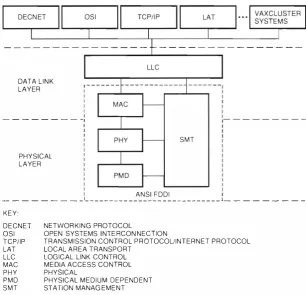
ment inte rface to the PMD, PHY, and MAC laye rs. Together these components support an IEEE 802 .2-compatible logica l l ink control capable of sup porting client p rotocols such as the D igital network i ng (DECnet) p rotocol, open systems inter connection (OS!), loca l area transport (LAT), and the transmission co ntrol protocol/intern e t pro to col (TCP/11'). Stations utilizing the FODI components can take several forms such as s ingle attachme nt stat ions (SASs), dual attachment stations (DASs), and dual attachment concentrators (OACs). An archi tectura l model is shown in Figure 1 .
Configurations of FDDI Components
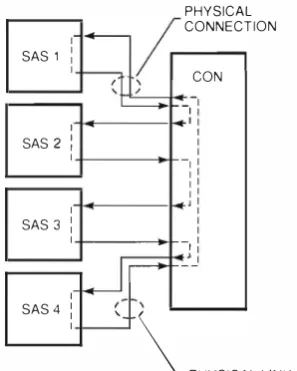
A si ngle attach ment station is the simplest configu ration and consists of the fundamental FDDI com ponents arranged as shown in Figure 2. There is a s i ngle i ncom i ng data path and a s ingle ou tgo i ng data path with a MAC i n between.
Dual at tachment stations, as s hown in Figure 3,
include a second physica l layer and provide con necti ons to a secondary ring for use in the event of breakage on the primary ring. Under fau lt-free oper ating cond itions represented by the THRU STAT E
SMT
1 ANSI F D D I
1 2
- - - -'
-KEY:
DEC NET OSI TCP/IP LAT LLC MAC P H Y P M D S M T
NETWOR K I N G PROTOCOL
OPEN SYSTEMS I NTE RCON NECTION
T R A N S M I S S ION CONTROL P R OTOCOUIN T E R N E T PROTOCOL LOCAL A R EA TRANSPORT
LOG ICAL LINK CONTROL M E DIA ACCESS CONTROL PHYSICAL
[image:14.589.139.446.410.705.2]PHYSICAL M E D I U M D E P ENDENT STATION MANAG EMENT
Figure
1A rchitectural Model
- - --- - -- -- - -, I
I
O U T I N
LLC I
_ _ _ _ _ _ _
j
� - - - - 1 I I ISMT I
I
[image:15.595.308.509.94.431.2]I I I l _ _ _ _
l
Figure 2 Single A ttachment Station
area of Figu re 3, the primary data path enters through PHY-A, travels through the lVIAC, and exits through Pf-IY-R. The secondary data path ente rs through PHY-B ancl ex its d irectly through PHY-A. If a discontinuity is detected in the primary data path, either within the station or on one of the PHYs, the station wraps the two data paths, the reby provid ing an alternate route through the secondary data path. This situation is shown in the WRAP A STATE area of Figure 3.
A dual attachment concentrator builds on the dual attachment station by add ing add itional mas ter PHYs (PHY-M) in the primary data path as shown in Figu re 4. Single at taclunent stations can then be included in the ring by connect ing them to the additionai i'HY-Ms in the concentrator.
An FDDI LAN is formed by joi n i ng m u ltiple sta t ions to form a logical ring topology. The logical ring can take two physical forms, a dual trunk ring and a tree ring.
I
•
I
•
I
Fiber Distributed Data lnterj(1ce 0f!erf!iew
M E DIA ACCESS CONTROL
+
I
I
I•
I
I�
II I I I
I I I I
I PHY-A I I PHY-B I
I I I I
I I I I
t
�
t
�
P R I MARY SECONDARY SECON DARY P R I MARY
I N OUT
I
I I II PHY-A I
I
t
+
•
I I I I II
�
I N OUT
T H R U STATE
M E D I A
ACCESS CONTROL
-- - - 1
PHY·B -- - - --- - - -1
t
P R IMARY I N
SECONDARY OUT
SECONDARY P R I MARY
IN OUT
WRAP-A STATE
Figure
3
Dual A ttaciJJnent Station StatesAs depicted in the upper portion of Figure 5, the dual trunk ring is formed by connecting dual attachment stations and concent rators to form a
LAN. This portion of the LAN consists of two data
paths in opposite d irect ions, cal led the primary
MEDIA ACCESS CONTROL
I
•
i
�
I I I I
I I I I - - - I I I I
I I
I PHY·A I
I I
I I
�
t
SECONDARY P R I MARY
OUT I N
I I I
I
�
I I
P H Y - M I P H Y·M I P H Y-M
I I
I - - - -1 I
t
�
t
�
Figure 4 Dual Attachment Concentrator
D igital Tecb11ica/ jour11al Vol. 3 No. 2 .vJring /'}'}I
I
I I
I
t
I I
I PHY·B I
I I
I I
�
t
P R I MARY SECON DARY
OUT IN
Fiber Distributed Data I nterface
DUAL T R U N K R I N G
K E Y
A PHY TYPE A
B PHY TYPE B M PHY TYPE M
S PHY TYPE S
DAS DUAL ATTAC H M E N T STATION
DAC DUAL ATTAC H M E N T CONCEN TRATOR SAS S I NGLE ATTAC HMENT STATION
r-:-T----r:':-1
T R E E-ATTACH E DCONCENTRATOR
SECON D-LEVEL TRE E-ATTAC HED CONCENTRATOR
Figure 5 FJ)Df Dual Ring of Trees Topology
and �econdary ri ngs. U nder normal operation. data flows on t he primary ring from station to station. fn t he event of a cable or a station breakage . t he sta t i o ns adjacent to the fau l t j o i n the p rimary and secon dary r ings ami then usc the secondary path to rcest abl ish a logical ri ng.
A t rt-c ri ng can be formed by connec t i ng stat ions or concent rators to the l'I I Y-.Vts of
a
concentrator as shown i n figure ). Tn t h is format i o n . the primary data path descends down each branch of the t ree pass i ng t h rough each stat i o n i n the tree. u n t i l i t fi nally reemerges i nto t h e d u a l trunk ring.Media Access Control Sublayer Operation
As me ntioned previously. the .Vtr\C sublayer provides the p rotocols fo r logi cal ring f(>rmation and data packet operati ons. To i n i t i a l i1.e the ring. a l l ,\·1.-\C:s first enter the claim process to determ i n e which .vt AC : wi I I ge n e rate the token and t o cstabl ish t he token rotat i o n t ime f<>r the ring. Each station con ti nuouslv rra n s m i ts claim frames that conta i n the1 -l
stat i o n 's requested token rotation t i me . When a MAC recc::ives claim frames wit h t imes shorter than its own. or equal to its own hut from a stat ion with a numc::rically
larger
address. it y i elds, stops send i ng c l a i m .�. and repeats the c l a i m s received fromits neighboring stat ion. Eventually the station w i t h
the shortest or "wi n n i ng" time w i l l recei ve i ts own c l a i m . Th is stat i o n then ge ne rates t h e ro.ken and the r i ng e n te rs the operat ional St:Ite.
If rile c laim process does n o t complete w i t h i n aprrox imately JOO m i I I iseco nds. the MACs i n th e ring pe rform a beacon process to confirm conti n uity of the r ing. Speci a l beacon frames are trans m i t ted con t i nuously by all M ACs u n t i l a beacon is received . at which p o i n t i t sto ps t ransm i t t i ng. This process conti nues u n t i l one :VlAC t ra n s m i t s and receives its own beacon. ind ica t i ng ring continuity. 'lo tran s m i t data packets. the MAC first wa its fo r the token to arrive, holds i t , and, then, transm i ts the packets, rcissu i ng a n ew token at the end of the transmi tted packet stream. The t i me allowan ce
a station has to trans m it packets after receiving a token is equal to the token rotation time estab l ished by the claim process.
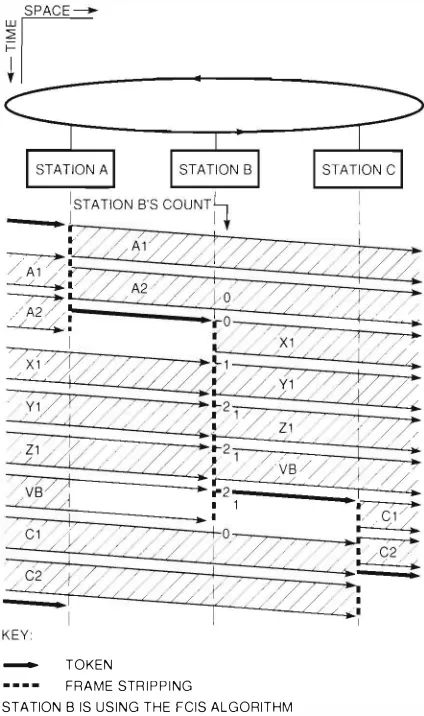
Packets received by a MAC a re e ither repeated for reception by the next station or stripped from the ring. In add ition, a MAC may store a copy of a packet for use by the station. After transmitting a frame, a MAC is responsible for stripping that frame from the ring after the frame m akes exact ly one traver sal of the ring. Frames left unstripped are cons id e red no-owner fra mes and can circu late the ring forever. This cond it ion f loods the station to wh ich the frame is add ressed and is t hus detrimental to ring performance. A MAC typically strips frames by com paring the source address i n the frame with the MAC's own address. The MAC strips any frame it has previously sent but repeats the frame, ot herwise.
FDDI Ring Formation
An FDDI ring is formed in several stages, beginning with the successfu l establishment of point-to-point l i nks between all adj acent PHYs. These li nk con nect ions are made by the co nnection ma nagement protocol (CMT) -This protocol defi n es cont rol sig nal exchanges to synchron ize the two ends of the l i nk, to exchange i nform ation about the PHY type ( i .e. , A, B, M, S) and l i nk tes t i ng requ irements of each end to perform l i nk qua l i ty testing, and to f i nal ize the connect i o n for norma l operation. Before the l i nk establ ishment enters its f i n a l p hase, t h e P H Y types o f t h e two e n d s o f t h e con nect ion are compared, and the connect ion is a l lowed if the end types conform to specific con nection ru les. These rules are carefu l l y establ ished to ensure that ri ngs are co nfigured correc tly and to prevent m isca bling, wh ich could ca use part i ti oned and unnecessarily wrapped ri ngs. An estab l ished l i nk is co nt inua ll y mon ito red for errors ind icated by the reception of im properly encoded data and is shut down if those errors exceed a pre determi ned threshold."
After the PHY connect ion is fu lly establ ished. t he stat i o n 's
MAC
is i nserted i nto the ri ng, and the cla im process begi ns. D igital's stations al l use a default requ ested token ro tation time of eight m i l l iseconds in their claim process to ensure a token rotation time, and hence traffic l atency, s i m i l a r to that experienced in other LANs l ike Ethernet. FDDI provides high aggregate bandwidth and, thus, del ivers the low delay essent ial to many !.AN app.l ications such a s d isk 1/0, i nteractive gra phics, and remote procedure cal ls. Higher set t i ngs of the requested token rota tion time result i nDigital Tee/mica/ journal V<>i. 3 ,t>,lo. l .\j1rin,� t'J'JI
Fib�tr Distribu ted Data ln telface Oueruiew
very large delays on the ring while improving the efficiency on! y sl ight l y.'' The refore, after extens ive p e rformance modeling, Digital decided to use this default value for the requested token rotation time. The resu l t ing n etwork operates with low delay and high bandwidth as the defau l t and does not need complicated network management proce dures to achieve this level of operation.
Several unique but harmful cond i t ions i n FDDI stat i ons must be addressed . An1ong them are the prevention of and protec t i o n aga i nst dupl icate addresses, no-owner frames, and the stripp i ng of frames sent by bridges or end stati ons that have multiple addresses.'" Because seve ra l of the algo rithms fundamenta l to the operation of the FDDI technology use the stations' addresses, the presence of t wo stations w i t h the same address causes nu merous ma lfunctions, ranging from beacon-claim oscil la tions to blocked communications between stati o ns. Fra mes not properly stripped from the ring can circulate forever, flooding the stat ions that copy t hese frames. To protect against strip e rrors, Digita l 's chip set has several bui lt-in mech a n is ms. Digital also greatly improved the data i n tegrity of the ring. This i mprovement is particu larly impor tant to token ring archi tecture where messages traverse virtua lly a l l of the l i nks in the network before a rr iv i ng at their destinati ons. Robust ness in the face of link bit errors becomes extremely important. Digital designed several improvements to the basic FDDI algorithms, and the ANSI com m i t tee adopted t hem to improve the undetected error rates on a network - "
Role of FDDI in Digital's Networks
The FDDI technology is more than just another data l i nk in terface that al lows the use of transm i t and receive fibers between dev ices. Digital's decision to embark on the FDDI development effort was a major program undertaking involving the develop ment of VLSI chips and, subsequent ly, FDDI software and hardware products. A.! though the development of chips may seem to be at the heart of the FDDI
program, chips are certai n l y not the products that help customers solve problems. Chips comprise only a small port ion of each l a rge printed circuit board, but this port ion is an im portant one.
Before focus ing on chip development, Digital carried out a large si m u l ation effort to ensure the ANSI standan.ls were correct aml complete. Once the st andards were verified, model i ng was performed to produce chips t hat met these standards. Al low ances and trade-offs were made for unfinished
Fiber Distributed Data Interface
sect ions ami future standards m igration. Real prod· ucts were then planned around the chips as the usc of FDDI was threaded i n to Digital's network a re hi·
tectures and ex isti ng products. An i mrlementa· t ion strategy f(Jr each product was then t<Jrmulatcd to balance the risks, the resources, and the time· J iness of customer needs.
It was i mportant for Digi t a l to understand migra· tion of cu rrent products and to t h i n k forward to the n eeds beyond the i n i t ial program goals. LA N
management and host connections take the F D D I
technology beyond a simple h igh-speed backbone t(Jr the extensi o n of bandwidth- l i m i ted ex ist i ng L ANs. Because Digital considered t he F D O I tech·
nology beyond its use as j ust another new data l i nk, this technology is the natur a l cho ice as the next step in network evol ution .
A t t h e o nset o f Digital's fDDI program, a n d at several p o ints during i ts development, a n u m be r of k e y program-wide decisions a n d policies were adopted. The com m itment to s i m u l a t i o n , both i n breadth (e.g . , ch ip design, board design, a nd soft · ware) and extent (e.g., behavioral models, gate-level models, i n tegrat ion of operational software with simulation model s) was essen t i a l to t he success of the F D D I technology devclorment. All the chips
developed were fully functional i n their first pass in s i l i con, and the i n tegration of the cont ro l l i ng and test software with the chips was fast and smooth. Given the extensive invest ment in ensu ring correctness of the F D D I tech nology, a I I FDDI p rod·
ucts were to use the same FDDI b u i ld i ng blocks,
i ncludi ng the chips ami control I i ng software." Such sharing and reuse of i n vestment el i m in ated the duplication of effort, guaranteed the consistent operation of a l l products, and shortened the t i me
to market. To ensure an even b roade r use of t his technology, major portions were made ava i lable on the open market.
Another key p rogram decision was the adoption of electrica lly alterable read-only memory (EAROM)
i n place of trad i t ional read-only memor�' (RO.Vl) to store the firmware i n each procluct. s.vrr, which is i mplemented almost e n t i rely in firmware, was a rapid ly evolving specification while the products were under ciLvelopment. To accommodate these ongoing changes ancl the threat of change after product shipment, EAROM was incl uded in a l l prod· ucts to al low firmw a re to be updated remotely ove r the network. As a resu lt. EAROM reduced the cost of prod uct e nhancement by el i m i na t i ng the need to change ROM i n the field or swap out boards ami rework t hem at the factory.
1 6
Deployment of FDDI
As a baseline effort i n deploying FDDI i n products,
Digi tal developed the FOOl design corner shown
i n Figure 6, consisting of chips ami F D D I control
firmware for usc in a l l applicat ions of F D D I . I n addi·
tion to using the design corne r i n a l l of Digital's products, two of the chips cri tical to f D D J i n ter·
operabi I ity. the .\lAC and the ELY! , together with the
S i\1 T firmware, which controls t he chips and the
behavior of the station, were l icensed to Advanced Micro Devices and to Motorola, Inc. for manufacture ami sale on t he open market. Widespread availa bil ity of this technology will foster competi t i o n to drive down cost ami increase levels of i nteropcrabi l i ty and consistency among FOD! im plementations.
FDDI-to-Ethernet Bridge
The Ethcrnet/802.:) bridge to the F D D I network is
an important device i n the first product set offe red for F D D I connect ivity The DE< :bridge ')()() product
p rovides the smooth m igration o f a l l E thernet ami IEEE 802 . .) devices currently in the marketplace to the i ncreased backbone bandwid th of the F D D I
technology. Most local networks are I .AN·based
KEY
R M C MAC PHY P M D SMT CDCT C D C R
N O D E PROC ESSOR (SMT F I RMWA R E )
R I N G M E M O R Y CONTROLLER MEDIA ACCESS CONTROL P H YS I CAL LAY E R
PHYSICAL M E D I U M D E P E N D E N T LAYER STATION MANAG E M E NT
CLOCK A N D DATA CONVERSION TRANSMITTER CLOCK A N D DATA CONV E R S I O N R E C E I V E R
Figu re (> FDDJ Design Comer
l
ANSIf
SMTwith the LANs being interconnected to for m extended LANs by the u s e of bridges. The bridges are transparent to a l l users' protocols on the LANs. This capabi l ity for t ransparent i nterconnection is one of the keys to the i nstant use of and easy m igra t ion to the added bandwidth and other benefits of
FDDI . However, prov i d i ng the transparent i nter
connect is d ifficult. Frame formats, bit ordering, paddi ng fields, and even the length of the packets d iffer between the Ethernet and IEEE 802.3 LANs. These d ifferences force the frames to be translated as they pass through the D ECbridge 500 device. This translation, coupled with a stiff requirement for data i ntegrity for the MAC bridgi ng standard I EEE 802. l d and the performance needs of dea l i ng effi ciently with packet rates approaching 500,000 per second, created a form idable design task.''
FDDJ Concentrator
To make the FDDI technology widely acceptable as
t he next generation LAN, several of the logistical obstacles i n herent i n a ring topology had to be overcome. Connecti ng new stations to a LAN can be frequenr events. These events m ust not be restricted or cause a d isruption if t he LAN is to be tru l y usable. The nature of a ring topology causes the network to break whenever a station is removed or whi le a station is bei ng i nserted . The dual ring accommodates one such event by wrapping at the adjacent stations, but two or more such events arc disastrous because they partition the network into isolated parts. A concentrator can solve this prob lem by connecti ng to a stat ion, testi ng the l i nk between the station and the concentrator, and then spl icing the new station into the ring with m i n i m a l d isruption. At the same t ime, a concentrator can automat ical l y drop a station out of the ring should the station malfunct ion or lose power.
In addition to the obstacle of connecting new sta tions, it is inconvenient to map a ring topology i nto star wiring, which is wel l known and widely u sed for its convenience and manageab i lity. Concentra tors can turn a logical ring i nto a h ierarchical star wired network, thus solving this mapping problem. Digital's OECconcentrator 500 product was bui lt to support simple instal lation and network configu ration, existing building cabl ing plants, and the cost savings and simplicity of single attachment stat ions. This FOOl concentrator is low cost and flexible, with a dual attachment and u p to eight master ports for connect i ng s i ngle attachment stati ons or add it iona l concent rators i nto the ring. Wi t h the concentrator, any of the described FDDI topologies
Digital Techuica/ jourual Vu/. 3 Nn. 2 .\jJring 1991
Fiber Distributed Data lnttt�jctce Oueruier£•
can be created to best suit a customer's cabli ng, network management, and avai lab i l i ty needs.' '
FDDlfor Workstations
Digital designed a simple high-performance FDDI
adapter for TURBOchannel workstat ions and servers in conjunction w i t h the design of the OECstat ion 5000 reduced i nstruction set compu ter (RISC)-based system.'' The a im of this product was to produce an
FDDI interface that was both inexpens ive and high
performance. With this adapter a nd ULTRIX oper
ating system support, Digital attempted to address many of the shortcom i ngs that have plagued m ost adapters a nd operat i ng system s atte m p t i ng to achieve h igh performance."·
The appl ications of the FDDJ teclmology for
workstations and servers depend on the particular choice of user applications and on the network con figuration. One application is the use of the FDDI
technology for a work group of high-performance workstations and servers. Some high-performance I/O-i ntensive appl ications need more bandwidth than a large, shared Ethernet can hand le. As a result, a work group m ay form around an FOOl network. One application example is cal led visual ization, where a large volume of rea l-time graphics or imag i ng i nformation is transmitted over the network from a compute server. Various applications of dig ital i mage transm ission have few real-time latency requi rements, but sri ll require a large banclwidth
'-Another appl ication of the FOOl technology i n workstation environments i s to achieve higher band width for server/server and backbone i nterconnec tion. A shared E t hernet for client/server as well as server/server communications can be overloaded , particularly if the popu lation of servers or work stations is large. FODI can be u sed as a backbone to
provide higher bandwidth between the serve rs. Alternatively, the network may be a hybrid, where the FOOl network is used for high client/server bandwidth by some systems and for h igh server/ server bandwidth by others. Hybrid networks often have mult iple FOOl networks and multiple Ethernet networks. This configuration is typical of evolving extended LANs, as new technology such as FDDI is
added i nto the existing network i nfrastru cture.
FDDJ in the Future
As a new technology, FODI has a long future with opportun i t ies for greater levels of circui t i ntegra t i o n , lower cost designs, ancl alternative med i a types to match t h e wide range of possible appl ica t io ns. Sign ificant progress has a l ready been made
Fiber Distributed Data In terface
in this direction with the i n t roduction of the DECcontrol ler 500 adapter, the most compact, least expensive, and one of the highest performing work station adapters in the i ndustry today. In addition, the ground-breaking techn ical work and standards committee act ivity regardi ng various types of cop per med ia offers tremendous opportunities for cost reduction which w i l l enable broader util ization of the perform ance offered by the FOOl technology.'" I n add ition to the original physical med ium dependent standard specified by A N S I for FOOl, an add itional standard has been developed for opera tion on si ngle-mode fiber over d istances up to 30
kilometers (km). This standard wi I I be particularly useful i n deployi ng an FOOl network that must span one or more distances greater than 2 km such as a campus backbone. Other medium types are currently under investigation to provide optimiza tion in areas such as cost and ease of i nsta l lation.
Acknowledgments
We wou ld like to thank the Telecommun ications and Networking lAN Architecture and Develop ment teams. Without their hard work none of the many technical advances made in bringing the FOOl technology to market would have been possible. We would also like to thank Bob Krueger for his rote in successfully lead ing the entire program. Final ly, we wou ld l ike to thank Mark Kempf, Paul Kon i ng, and Tony Lauck for their timel y review of this paper.
Riferences
1 . N. Kronenberg, H . Levy, W Strecker, and R. Merewood, "The VAXcluster Concept: An
Overview of a D istribu ted System,"
Digital
Technical journal,
vol. 1 , no. 5 (September1987): 7-21 .
2. R. Grow, "A Timed Token Protocol for Local Area Networks,"
Proceedings of
/UiL;.Electro/82
Conference,
Boston, MA (May 25-27, 1982). 3.Token Ring Physical l.c�yer, Medium Depen
den t
(PMD), ( International Standards Organi zation, reference no. ISO 9314-3, 1990). 4.Token Ring Physical Layer Protocol,
(International Standards Organization, reference no.
ISO 9314-1 , 1989) .
5.
Token Ring Media Access Control
(MAC), (Inter
national Standards Organ ization, reference no.ISO 9314-2, 1 989).
6. H. Yang, B. Spi nney, and S. Towning, " FDOI Data Link Development,"
Digital Technical journal,
vol. 3, no. 2 (Spring 1991 , this issue): 31 -41. 7 FDDIStation Management
(�MT)Preliminary
1 8
Draft Proposed A merican National Standard,
ANSI X3T9/90-X3T9.5/84-49, REV 6.2 (May 1990)
8. ). H u tchison, C. Baldwin, and B. Thompson, " Development of tlle fDDI Physical Layer,"
Digital Technical journal,
vol . 3, no. 2 (Spring1991 , this issue): 19- 30.
9. R.]ain, ''Performance Analysis of FOOl Token Ring Networks: Effect of Parameters and Guideli nes for Setting TTRT," OEC-TR 655 (Maynard: Digita l Equipment Corporation, September 1989). 10. H . Yang and K. Ramakrishnan, "Frame Content
Independent Stripping for Token lli ngs,"
Pro
ceedings of the
ACM SIGCOM'90
Symposium
( 1990): 276-286.1 1 . R . Ja in, "E rror Characterist ics of Fiber Dis tributed Data I nterface (FOOl)," tt:t:t:
Trans
actions on Communications,
vol. 38, no. 8 (August 1990).12. P C iarfella, D. Benson, and D Sawye r, "An Over view of the Common Node Software,"
Digital
Technical journal,
vol .:3,
no. 2 (Spring 1991 , this issue): 42-52.13. R. Kochem, ]. Hiscock, and B . Mayo , " Develop ment of the DEC:bridge 500 Product."
Digital
Technicaljournal,
voJ . 3, no. 2 (Spring 1991 , this issue): 53-6314. W Tiffany, P Kon i ng, and J. Kuenzel, "The DECconcentrator 500 Product,"
Digital Technical
journal,
vol . 3, no. 2 (Spri ng 199 1 , this issue)64 -75.
15. U. Si nkewicz, C Chang, L. Palmer, C. Smelser, and F Temp l i n , "lJLTRJX Fiber Distributed Data Interface Networking Subsystem Im plemen tation,"
Digital Technical journal,
vo l. 3, no. 2 (Spring 1991 , this issue) 85-93.16. W Hawe and K. Ramakrishnan, "The Work station on the Network: Performance Consider ations fo r the Com munications Inte rface,"
Proceedings of the Second Workshop on Wbrk
station Operating Systems,
Asi lomar Confer ence Center, CA (September 1989).17 K. Ramakrishnan and W Hawe, " Performance of an Extended Local Area Network for I mage Applications,"
Proceedings of the Fifth Annual
Phoenix International Conference on Com
pu ters and Communications,
Scottsdale, AZ(March 26-28, 1986).
18. S. Ginzburg, W Mall ard, and D. Newman, "FDO!
over Unshielded Twisted Pa irs," JLEh.