AN IMPROVED WATERMARKING RESISTANCE DATA
COMPRESSION ON DIGITAL IMAGES USING HAAR
WAVELET ORTHONORMAL BASIS DISCRETE COSINE
TRANSFORM
1
M.SHARMILA BANU, 2DR.C.CHANDRASEKAR
1M.Sharmila Banu, Research Scholar, Department of Computer Science ,Karpagam University,Coimbatore.
2Dr.C.Chandrasekar , Professor, Department of Computer Science ,Periyar University, Salem.
E-mail: [email protected], [email protected].
ABSTRACT
Digital watermarking is an emerging area of research for developing diverse system in order to avoid the repetition and exploitation of secret data. Digital watermarking protects data contents such as images, audio and video files with higher accuracy rate. Recently, several lossy and lossless data compression methods were developed so far but with an additional computation burden making the system not flexible. When implementing, data compression algorithm on digital images, attaining robustness is one of the challenging issues. As the noise ratio is higher, the compressed data are not well reconstructed if compression is done on digital images. In my research work, HAAR Wavelet Orthonormal based Discrete Cosine Data Compression Transformation (DCDCT) is developed to improve the resistant level and to reduce the computational burden on digital images. Initially, the HAAR Wavelet Orthonormal based DCDCT method is composed of two parts namely, watermark compression and decompression operation. In data compression phase, transformation, digitizing and Entropy Encoder operations are carried out. DCDCT method performs the transformation operation through cosine transform, where the embedding data is converted into analog frequency signal components. Secondly, digitizing operation is processed using the Orthonormal wavelet function to perform mapping and improve the resistant level (i.e.,) avoidance of noise rate on data compression. Finally, HAAR wavelet differential Manchester procedure is used on encoding operation. The same three operations are carried out in reverse order for the decompression of data from digital images in DCDCT method. Experiment is conducted on factors such as Peak Signal Noise Ratio (PSNR) Difference, bit error rate and resistance ratio level.
Keywords: Discrete Cosine Transform, Digital Watermarking, Data Compression, HAAR Wavelet
Transform, Entropy Encoder, Frequency Signal.
1. INTRODUCTION
One of the most potential models for reducing the resistance or noise rate on data compression is digital watermarking. The significance of digital watermarking is growing day-by-day with the most probability of modifying the contents and increases the computation burden on digital images. Several data compression methods for digital water marking have been introduced by different researchers.
Warped Discrete Cosine Transform (WDCT) [1] for performing data compression on digital images. To improve the high bit rates level, the frequency axis was warped with the help of
all-pass transform. However, the additional computational burden made the system more complex increasing the noise level. Spread Transform Quantization Index Modulation (ST-QIM) [2] was introduced to reduce the noise level using an enhanced Watson model and resulted in better performance. But with the increase in the size of images, the noise also proportionately increased on digital images.
encryption in DICOM. The method not only
provided authentication for user information, increased the level of confidentiality but also integrity based on encrypted MD5. However, the amount of embedded data to be watermarked remained an open issue.
A classification process was introduced in [4] that determined the parts of the image that can be watermarked using lossless modulation based on locally adapted model. Though efficient, robustness remained unsolved. To improve the robustness, Just Perceptual Weighting (JPS) [5] was introduced that incorporated several masking effects. Furthermore, to reduce the level of distortion, Generalized Gaussian Distribution (GGD) was introduced, but accuracy remained unsolved.
One of the most demanding tasks related to security is the preservation of enormous information. Though significant endeavor have been studied during the last few years, but there are several issues that remained unsolved. A moment-based color image watermarking model [6] was designed that included a novel adaptive system that included quaternion radial moments resulting in the enhancement of robustness and imperceptibility. However, the model was complex in terms of computation.
A semi fragile watermarking technique was introduced in [7] that constructed an error map and evaluated two authentication measures and addressed the problems related to tampering and modification of data. But with the changes in the image size, the authentication measure did not turned to be scalable. A modified version of fragile measures was included in [8] to increase the accuracy level of attacks being detected using DWT quantization based algorithm.
Protection of sophisticated characteristics of medical images and securitizing the same is the current requirement. In [9] a reversible watermarking method was introduced based on recursive dither modulation (RDM) and singular value decomposition (SVD). Also to increase the strength of the watermarked images, differential evolution (DE) was applied resulting in robustness and imperceptibility. However, authentication was not included.
Reversible Watermarking approach based on Histogram Processing and Block Selection (RW-HPBS) was introduced in [10] to address the issue related to authentication using location map. But it can be applied only for fixed image
quality. Robust DCT based watermarking [11] on both host and watermark image. As a result, the method was proved to be highly robust with JPEG images.
The above literatures provided several insights into the problems related to data compression on digital images. We designed an improved watermarking resistance data compression model on digital images using HAAR Wavelet Orthonormal based Discrete Cosine Data Compression Transformation. Our contributions are in four folds.
(i) To improve the resistant level and reduce the computational burden using HAAR Wavelet Orthonormal based Discrete Cosine Data Compression Transformation (DCDCT) on digital images and
(ii) to minimize the noise ratio using Orthonormal function that efficiently embeds the secret data on digital images in a linear combination
(iii) To reduce the bit error rate by applying sum of sinusoids during transformation and
(iv) to minimize the resistance ratio level using the HAAR wavelet based entropy compression.
The rest of the paper is organized as follows. Section 2 introduces the related works on watermarking the digital images using data compression. Section 3 illustrates our proposed Discrete Cosine Data Compression Transformation (DCDCT) method in detail, which includes watermark compression, entropy encoding technique and watermark decompression technique. Experimental results are provided in Section 4, with elaborated discussions with the aid of table and graph values in Section 5. Finally, conclusions are addressed in Section 6.
2. RELATED WORKS
host image. However, the method was proved to
be efficient only with grey images and not with color images.
Mixed Error Correcting Code (ECC) [14] was introduced to address the issues related to attack in the Internet community. With this, the destruction was treated as noisy distortion and was removed from the channel. An adaptive watermarking model [15] proposed a substitution method called as the Least Significant Bit (LSB) for efficient message encryption minimizing the error.
The digital services among two important giants namely robots and mobile terminals are considered to be of the significant factors with the increasing progress of robot services on the Internet. An extended DCT domain [16] for watermarking was introduced to increase the extraction ratio using quantization and scanning the images in a zig-zag fashion. However, with the increasing features, the computation time involved was higher. A blind reversible watermarking scheme was introduced in [17] with the aid of Adjacent Pixel Difference (APD). With this, the method was proved to be robust against different types of attacks. However, a tradeoff between transparency and robustness was observed.
An optimal watermarking scheme was introduced in [18] to address the issues related to the two tradeoff factors, transparency and robustness using Discrete Wavelet Transform (DWT) and Singular Value Decomposition (SVD). The optimal values were identified by applying Multiple Scaling Factors. As a result, the false positive rate was reduced considerably. A fragile zero watermarking method was introduced in [19] to minimize the level of noise using local characteristics of database itself. But the computational burden increased with the increase in the size of images being provided as input.
Based on the issues discussed above, HAAR wavelet orthonormal basis Discrete Cosine Transformation method for data compression is discussed in the forthcoming sections.
3. HAAR WAVELET ORTHONORMAL BASIS DISCRETE COSINE TRANSFORMATION METHOD FOR DATA COMPRESSION
An effective data compression method is planned in the proposed work to improve the
robustness and resistance level of compression on digital images. The HAAR Wavelet Orthonormal basis Discrete Cosine Data Compression Transformation (DCDCT) method performs the watermarking compression on both the initial (i.e., initial (i.e., sender) side and decompression operations (i.e.,) on the receiver side with higher robustness ratio.
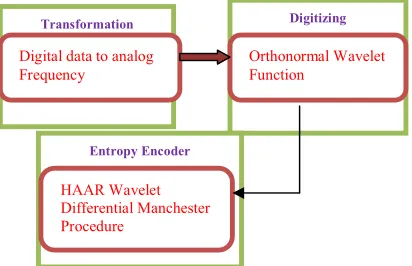
[image:3.595.314.520.339.472.2]The DCDCT method uses the Orthonormal function to embed the secret data on digital images. The DCDCT method is used to judge the performance of the digital watermarking on images. The factors mainly concentrated on DCDCT method are robustness, resistance level (i.e., noise resistant). The data compression operations are clearly illustrated in Figure 1 given below.
Figure 1: Data Compression Operation In DCDCT Method
As illustrated in Figure 1, during the compression process, the system initially performs the process of transformation that accepts the data to be compressed and produces the analog water marked frequency frequency signal. Next, the digitizing operation using the analog frequency signal performs the function of mapping of secret data with the digital images using the Orthonormal wavelet function.
The Orthonormal wavelet function is a state of class variable that highly depends on embedding the data with the specified two dimensional digital images. The embedded data is digitized and proceed to the next wavelet compression step. The final step in DCDCT method is the entropy encoder step, where HAAR wavelet differential Manchester procedure is applied.
Transformation
Digital data to analog Frequency
Digitizing
Orthonormal Wavelet Function
Entropy Encoder
1 0 1 0 0 1
Time(T)
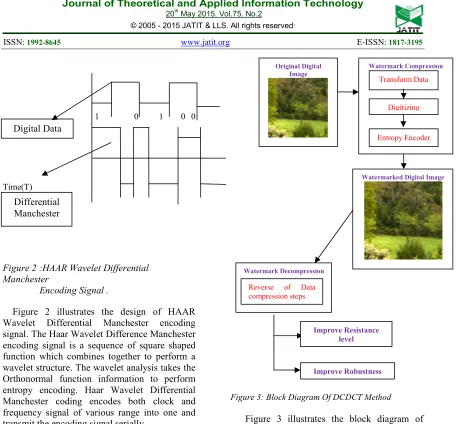
Figure 2 :HAAR Wavelet Differential Manchester
Encoding Signal .
Figure 2 illustrates the design of HAAR Wavelet Differential Manchester encoding signal. The Haar Wavelet Difference Manchester encoding signal is a sequence of square shaped function which combines together to perform a wavelet structure. The wavelet analysis takes the Orthonormal function information to perform entropy encoding. Haar Wavelet Differential Manchester coding encodes both clock and frequency signal of various range into one and transmit the encoding signal serially.
[image:4.595.85.541.73.497.2]The Block Diagram of DCDCT method is illustrated in Figure 3.
Figure 3: Block Diagram Of DCDCT Method
Figure 3 illustrates the block diagram of DCDCT method. The figure initially shows the original digital images for performing the data compression operation to improve the level of resistance. Data Compression performs three operations namely, the transforming operation, digitizing and encoding operation. Mostly the frequency signal energy is used to perform the Orthonormal function. Hence watermark encoding with the mid frequency coefficients is the final step of the watermark compression technique of the watermark compression technique in DCDCT method. Watermark encoding uses the HARR wavelet with differential Manchester procedure. Similarly, the same procedures are carried out in the reverse order on the data decompression step. This results with the data being decompressed on the receiver side with high robustness ratio.
Differential Manchester Digital Data
Watermarked Digital Image Original Digital
Image
Watermark Compression
Transform Data
Digitizing
Entropy Encoder
Watermark Decompression
Reverse of Data
compression steps
Improve Resistance level
3.1Watermark Compression technique
The principle objective of the watermark compression technique on digital images is to improve the resistance level. The resistance level improved on performing the data compression operation and algorithmic procedure is described as,
//Watermark Compression Procedure
Begin
Step 1: Read the Original Natural image from database
Step 2: Read the compression data ‘C’ to be embedded
Step 3: Watermarking Data converted to Frequency Signal ‘S’ in transformation step Step 3.1: Computes Discrete Cosine Transform value
Step 4: Transformed Frequency Signal ‘S’ on Digital Image ‘D’
Step 4.1: Orthonormal Function ‘F’ used to embed data
Step 5: Data compressed employs encoding operation
Step 5.1: Encoded using HAAR wavelet Differential Manchester Procedure
Step 6: Encoded Data compressed on ‘D’
End
The algorithmic procedure chooses the natural images to watermark the data. The watermark data is taken as a binary data of size ‘x*y’. The data compression operation is enhanced by applying transforming, digitizing and entropy encoder that improves the resistance level and reduces the bit error rate. The DCDCT method reduces the noise ratio level and improves the reconstruction process on digital images as robustness and resistance improvement is very important in DCDCT method watermarking system.
3.1.1 Discrete Cosine Transformation Process
Discrete Cosine Transform in DCDCT method is used to convert the digital data into the frequency signal ‘S’ with sum of sinusoids of varying frequencies. Let us consider a digital image ‘D’ of size ‘x*y’ D (j,k) is the intensity of the pixel in row ‘j’ and column ‘k’ of the image. D (u, v) is the coefficients in row ‘u’ and column ‘v’ of the digital image. Then the Discrete Cosine transform coefficient is described as,
()*+,-.)/*01.+ .+ 2 3
4546∑CDA9∑@<AB89: (;<=>)?;@ 89: (;D=>)?;C ---- (1)
SEand SF are the frequency signal coefficients on row ‘u’ and column ‘v’ of the digital image. The cosine structure on the ‘x’ and ‘y’ size is measured to transform the digital data into signal ‘S’. Performing the discrete cosine transform for transformation produce the error-free compression property. The transform function is used for improving the compression efficiency without any error rate.
3.1.2 Digitizing
The digitizing step using DCDCT method in watermark compression technique embed the data into the digital image ‘D’, which is performed through the Orthonormal function. The Orthonormal function in DCDCT method is formularized as,
Orthonormal (F1) 3 J K φPO M(s)N;. f(s). ds ….. (2)
Orthonormal (F2) 3 R S φT(s)U;. f(s). ds
O
P
….. (3) The Orthonormal function is used to embed with the intensity of the row ‘j’ and column ‘k’ and formularized as ‘F1’ and ‘F2’ using linear combination. The row and column are combined (i.e., embed) together on the digital Image ‘D’ as,
Orthonormal (F) 3
J φPO M(s). φT(s). f(s). ds …… (4)
The digitized Orthonormal function symbolized that the watermarking data are embedded on the digital image ‘D’ using frequency signal ‘s’.
3.1.3 Entropy Encoding Technique
Finally, the HAAR wavelet based entropy compression is employed in DCDCT method to encode the watermarking data. The HAAR employs the sequence of square shaped functions together to form an effective encoding system with the aid of differential Manchester procedure. HAAR wavelet function is described as,
HAAR Wavelet = 1 , 0 ≤ t …
(5)
0, ½ ≤ t
Eqn (5) clearly describes the wavelet function with HAAR which is approximated by linear function. HAAR wavelet differential Manchester takes the data clock signal together to perform the encoding operation.
Differential Manchester makes the
synchronization process effective by measuring the polarity value based on mid bit transition with previous and current signal value in DCDCT method to perform encoding process.
3.2 Watermark Decompression technique
In the second part (i.e.,) data decompression step the process is carried out in the reverse order to fetch the compressed data with high robustness. Initially in this phase, entropy decoding operation is carried out. Then embedded watermarking data is obtained through Orthonormal function. Finally, the frequency signal is converted into the digital data by using the discrete cosine transform on reverse end.
4. EXPERIMENTAL EVALUATION
Effective Digital Watermarking using HAAR Wavelet Orthonormal basis Discrete Cosine Data Compression Transformation (DCDCT) method is implemented using MATLAB code. HAAR Wavelet Orthonormal basis Discrete Cosine Data Compression Transformation (DCDCT) method uses the Hyperspectral images of natural scenes database taken from CVonline: Image Database set to evaluate the parametric percentage result.
Hyperspectral images of natural scenes comprise of 15 rural and urban scenes each containing, rocks, trees, leaves, grass, and earth. All images were get hold of under daylight between morning and mid-afternoon. Scenes were illuminated by direct sunlight in clear or almost clear sky when clouds were present. The predictable reflectance spectra derived for each scene is downloaded and carry out the experimental work.
Hyperspectral images are acquired with a
progressive-scanning monochrome to
perform data compression operation. The
wavelength of peak data compression varied from the range of 400–720 nm, with a full width at half maximum transmission of 10 nm at 550 nm, decreasing to 6 nm at 400 nm and increasing to 16 nm at 720 nm.
Two Hyperspectral sequences of signal images were obtained, namely a sequence of raw "scene" images and a sequence of "light-reference'' images, along with two corresponding sequences of noise images. Scene images are get hold of pointing the camera at the scene and adjust the focus and zoom, and recording the sequence. Light-reference images are obtained with the similar optical collection which interposed among the scene and the camera. Noise images were get hold of in the identical way but with the camera entrance aperture blocked.
The DCDCT method compares the proposed work with the existing Warped Discrete Cosine Transform (WDCT) and Spread Transform QIM watermarking algorithm (ST-QIM) method. Experiment is conducted with the natural images to perform the watermarking operation on the factors such as Peak Signal Noise Ratio (PSNR) Difference, frequency occurrence level on transformation, bit error rate, normalized correlation rate, resistance ratio level and robustness.
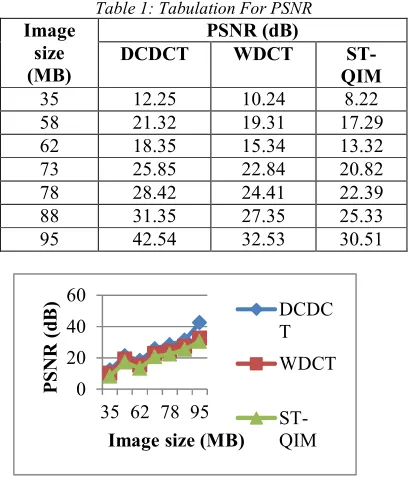
In table 1 we evaluate the performance of Peak Signal Noise Ratio value using the DCDCT method. The digital data image size used in this experiment ranges from 35 MB to 95 MB. The performance of PSNR is measured in terms of percentage (dB) that defines the noise error rate depending on the image size.
The peak signal noise ratio is obtained using the mean squared error (MSE). Given a digital image DI as input, with an image size of a * b, then the MSE using DCDCT is
MSE 3 o p> ∑ ∑rs> (DI(a, b) q
pA> rs> oA>
DIt(a, b);)
PSNR 3 10 ∗ log>B (wxy
z
w{|) ……. (7)
In order to minimize the bit error rate,
Discrete Cosine Data Compression
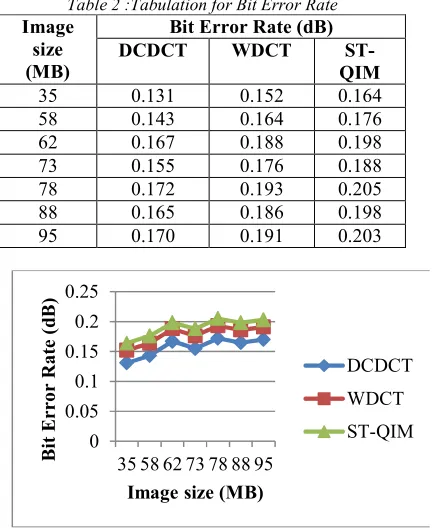
Transformation (DCDCT) method is used on digital images that reduces the Bit Error Rate based on digital image sizes. In the experimental setup, the image size ranges from 35 MB to 95 MB. The results of 7 different image sizes for water marking are listed in table 2. As listed in table 2, the DCDECT method measures the amount of bit error rate which is measured in terms of decibels (dB). The bit error rate using DCDCT method offer comparable efficiency measures than the state-of-the-art methods. The bit error rate BER using DCDCT method is the ratio of number of bit errors occurred
Number}~~•~ p€•‚ during a transformation
procedure to that of the number of bits
transferred Number•••oƒ p€•‚during a time
interval t Time.
BER 3 „Erp}~…††‡† ˆ‰Š‹
„Erp}~Š‡ŠŒ• ˆ‰Š‹∗ Time ……..(8) In table 3 we further compare the normalized correlation error rate of coarser construction of the proposed method using the referenced image intensity and deformed image intensity. The experiments were conducted using seven different sequences obtained from Two Hyperspectral sequences of signal images that measure the normalized correlation error rate which is measured in terms of percentage (%).The normalized correlation rate of orthonormal function f1 and f2 is given as
••‘(-1, -2) 3
∑˜œš›∑˜™š›’> (“”,“•)∗’; (“”=–>—,“•=–;— )
’>z(“”,“•)∗ ’;z(“”=–>—,“•=–;— )
……. (9) Here, u and v are center points of orthonormal function located and are the displacements of orthnormal function in subset represent the reference image intensity of digital image whereas P2 represents the deformed image intensity of pixel.
Finally, table 4 provides the robustness of DCDCT method for seven different image sizes that is measured in terms of percentage (%). The robustness in DCDCT method refers to the ability of the model to cope with errors.
With higher robustness observed using DCDCT, the objective is being achieved. The robustness metric is measured in terms of percentage (%).
5. RESULTS ANALYSIS OF DCDCT
The efficacy and effectiveness of the
proposed DCDCT method extensive
[image:7.595.310.514.419.659.2]experimental results are reported in table 1. The proposed DCDCT method is compared against the existing Warped Discrete Cosine Transform (WDCT) S1U and Spread Transform QIM watermarking algorithm (ST-QIM) method. The simulator MATLAB is used to experiment the factors and measure the result values with the help of table and graph values. Results are presented for different image sizes considering the peak signal noise ratio. The results reported here states that with the increase in the values of image sizes, the PSNR value is also increased, though the increase observed is not linear because of the image size.
Table 1: Tabulation For PSNR
Image size (MB)
PSNR (dB)
DCDCT WDCT ST-QIM
35 12.25 10.24 8.22
58 21.32 19.31 17.29
62 18.35 15.34 13.32
73 25.85 22.84 20.82
78 28.42 24.41 22.39
88 31.35 27.35 25.33
95 42.54 32.53 30.51
Figure 4: Measure Of PSNR
Figure 4 depicts the Peak Signal to Noise Ratio based on different image sizes. Our
proposed DCDCT method performs
extensively well when compared to two other methods WDCT S1U and ST-QIM S2U. This is
0 20 40 60
35 62 78 95
P
S
N
R
(
d
B
)
Image size (MB)
DCDC T
WDCT
because of the application of Orthonormal function that efficiently embeds the secret data on digital images in a linear combination. Furthermore, this linear combination digitized together on the digital image reduces the peak signal noise ratio using DCDCT method by 9 – 16 % compared to WDCT and
[image:8.595.303.534.86.393.2]18 – 32 % compared to ST-QIM respectively.
Table 2 :Tabulation for Bit Error Rate
Image size (MB)
Bit Error Rate (dB) DCDCT WDCT
ST-QIM
35 0.131 0.152 0.164
58 0.143 0.164 0.176
62 0.167 0.188 0.198
73 0.155 0.176 0.188
78 0.172 0.193 0.205
88 0.165 0.186 0.198
95 0.170 0.191 0.203
Figure 5: Measure Of Bit Error Rate
The targeting results of bit error rate using DCDCT method with two state-of-the-art methods [1], [2] in figure 5 is presented for visual comparison based on the varied image sizes. Our method differs from the WDCT [1] and ST-QIM [2] is the incorporation of algorithm in that we have incorporated three separate processes, digitizing, transforming and encoding using the frequency signal on the natural images and applying sum of sinusoids during transformation that efficiently transforms the digital data to analog frequency signal minimizing the bit error rate by 12 – 16 % compared to WDCT. For the most different sizes of images, the DCDCT method achieves comparable performance because the discrete cosine transform during the transformation produce, the error-free compression property and minimizing the error rate by 18 – 25 % compared with ST-QIM [2]
Table 3: Tabulation for Normalized Correlation Rate Image
size (MB)
Normalized Correlation Rate (%)
DCDCT WDCT ST-QIM
35 0.25 0.12 0.10
58 0.28 0.15 0.12
62 0.33 0.17 0.13
73 0.30 0.22 0.16
78 0.35 0.22 0.12
88 0.38 0.23 0.13
95 0.40 0.25 0.15
Figure 6 :Measure Of Normalized Correlation Rate
To explore the influence of normalized correlation rate on DCDCT method, the experiments were performed by applying seven different image sizes obtained from Hyperspectral images of natural scenes database taken from CVonline as depicted n figure 6. It also shows that the DCDCT method shows competitive results with the state-of-the-art methods, namely WDCT [1] and ST-QIM [2]. Even though the DCDCT method uses the HAAR wavelet differential Manchester, higher normalized correlation rate was recorded especially for image size 95 MB. This is because the HAAR wavelet differential Manchester initially obtains data and clock signal together resulting in the efficiency of synchronization procedure. Followed by this, the polarity value is measured based on current and previous signal value using mid bit transition resulting in the improvement of normalized correlation error rate by 37 – 48 % and 46 – 65 % compared to WDCT and ST-QIM respectively
Table 4: Tabulation for Robustness
Methods Robustness (%)
DCDCT 83.55 WDCT 71.25 ST-QIM 65.45 0 0.05 0.1 0.15 0.2 0.25
35 58 62 73 78 88 95
B it E rr o r R a te ( d B )
Image size (MB)
DCDCT WDCT ST-QIM 0 0.1 0.2 0.3 0.4 0.5
35 58 62 73 78 88 95
N o rm a li ze d C o rr el a ti o n R a te ( % )
Image size (MB)
DCDCT
WDCT
[image:8.595.83.301.227.492.2]Figure 6 :Measure of Robustness
Lastly the parameter, robustness is measured via seven sequences of images. From the figure 6 it is illustrative that the proposed DCDCT method potentially yields better results than existing WDCT [1] and ST-QIM [2]. The significant results achieved using DCDCT method is because the HAAR wavelet based entropy compression offers resistance effectiveness with most powerful differential Manchester procedure. This differential Manchester procedure using square shaped functions together perform an effective encoding system and with which the resistance ratio level further gets improved by 0.12 and 0.05 % compared to WDCT [1] and ST-QIM [2] respectively.
6. CONCLUSION
In this work, we address the problem of improving the efficiency of resistance level i.e., avoidance of noise rate and propose a Discrete Cosine Data Compression Transformation method to maintain robustness on natural images by minimizing the peak signal-to-noise ratio. We show how different image sizes can be used in a ubiquitous fashion to significantly minimize the bit error rate during the process of transformation of digital images. We study how this Discrete Cosine Data Compression Transformation method on digital images translates into improved water marking resistance model and obtain robustness. We further show attainable performance gains of the proposed method in terms of robustness that can achieve well above 0.12 and 0.05 percent compared to the state-of-the-art methods by applying Orthonormal wavelet function. Moreover, with the application of HAAR wavelet differential Manchester procedure increases the strength of resistance ratio level and normalized correlation rate for
image sizes. Performances result shows that the proposed DCDCT method provides higher level of robustness and normalized correlation rate compared to the state-of-art works.
REFERENCES
[1] K.M.M. Prabhu., K. Sridhar., M. Mischi., H.N. Bharath., “3-D warped discrete cosine transform for MRI image compression,” Biomedical Signal Processing and Control, Elsevier Journal, 2013
[2] Yanling Jiang, Yifeng Zhang∗, Wenjiang Pei, Kai Wang., “Adaptive spread transform QIM watermarking algorithm based on improved perceptual models,” International Journal of Electronics and Communications (AEÜ), Elsevier Journal., 2013
[3] Mohamed M. Abd-Eldayem,” A proposed security technique based on watermarking and encryption for digital imaging and communications in medicine”, Egyptian Informatics Journal, Elsevier, Dec 2012 [4] Gouenou Coatrieux, Wei Pan, Nora
Cuppens-Boulahia, Frédéric Cuppens, Members, IEEE, and Christian Roux,” Reversible Watermarking Based on Invariant Image Classification and Dynamic Histogram Shifting”, IEEE Transactions on Information Forensics and Security, Volu.8, Issue.1, Jan 2013
[5] Lihong Cui and Wenguo Li,” Adaptive Multiwavelet-Based Watermarking Through JPW Masking”, IEEE
TRANSACTIONS ON IMAGE
PROCESSING, VOL. 20, NO. 4, APRIL 2011
[6] E.D. Tsougenis, G.A. Papakostas, D.E. Koulouriotis, E.G. Karakasis,” Adaptive color image watermarking by the use of quaternion image Moments”, Expert Systems with Applications, Elsevier, Jan 2014
[7] Xiaojun Qi, Xing Xin,” A quantization-based semi-fragile watermarking scheme for image
content authentication”, J. Vis. Commun. Image R., Elsevier, Dec 2010
[8] Hazem Munawer Al-Otum,” Semi-fragile watermarking for grayscale image authentication and tamper detection based on an adjusted expanded-bit multiscale quantization-based technique”, J. Vis. Commun. ImageR.,Elsevier,Jan2014
0 50 100
DCDCT WDCT ST-QIM
Degree of Percentage
M
et
h
o
d
s
Robustness (%)
[9] Baiying Lei, Ee-Leng Tan, Siping Chen,
Dong Ni, Tianfu Wang, Haijun Lei,” Reversible watermarking scheme for medical image based on differential evolution”, Expert Systems with Applications, Elsevier, Feb 2013