2017 2nd International Conference on Artificial Intelligence and Engineering Applications (AIEA 2017) ISBN: 978-1-60595-485-1
Secure Performance of Cooperative System with
Channel Estimation Error
CHENG GONG, XIANYI RUI and XIAOHUI HU
ABSTRACT
Traditional two-hop and multiple relaying and forwarding cooperative communication system, in the presence of illegal eavesdropping users, the secure transmission of system information relies on the acquisition of instantaneous channel state information to a great extent. Due to the broadcasting and time variability of wireless channel, it is almost impossible to obtain instantaneous channel state information. In view of this problem, this paper uses partial relay selection as the selection criterion, taking the security outage probability and security capacity as reference basis, the simulation verifies the influence of channel estimation error on the secure performance of the cooperative system.
KEYWORDS
Channel estimation error, partial relay selection, security outage probability.
INTRODUCTION
Cooperative communication technology can make the virtual multiple antenna array by sharing the antenna between the relay nodes, then the cooperative diversity and space gain will be obtained at the receiving terminal, which can effectively counter the fading of the wireless channel. However, when there are multiple relays in the network, the nodes are transmitted on the orthogonal channel, the spectrum utilization is constrained and the design of the cooperative scheme is also more complex. Selecting a single best relay for information forwarding can effectively avoid the above problems. In [1], the proposed opportunity relay strategy can also obtain cooperative diversity by selecting a best relay for information forwarding. In [2], with the link of the lowest outage probability, the relay participates in the transmission of information, which can get better security outage performance than other relays. The above research results are based on instantaneous channel state information acquisition, but practically impossible. The paper [4] studies the performance of the Non-ideal AF cooperative system. The paper [5] studies the performance of the cooperative system in the case of multiple relaying, which uses the channel error estimation model of the random variable with the channel error as the fixed variance.
_________________________________________
Corresponding Author: Cheng Gong, Department of Electronic Information, Soochow University, Shi Zi Street, SuZhou, China; [email protected].
Xianyi Rui, Department of Electronic Information, Soochow University, Shi Zi Street, SuZhou, China; [email protected].
Aiming at the traditional two-hop cooperative system, this paper uses the channel estimation error model in the paper [5] to analyze and verify. The full text structure is as follows, the 2nd section introduces the model of cooperative system under eavesdropping environment, and gives the theoretical formula of security outage probability. The channel estimation error and the modeling of channel estimation error are introduced in the 3rd section. In the 4th section, the simulation result is given to verify the influence of channel estimation error. The 5th section summarizes the full text.
SYSTEM MODEL
The cooperative system model consists of one source S, one destination done eavesdropper E and multiple auxiliary relays RI, i∈ {1, 2... n}. Assuming all SD links and SE links are in deep fading due to environmental reasons, there is no direct link, information transmission interaction must rely on the auxiliary relays RI. Channel between any two nodes in the network is independent and obeys the flat Rayleigh fading, his, hid, he represents the channel fading coefficients of Seri Link, Rid link, and Rice link respectively. hsi~CN (0,σsi2), hid~CN (0,σid2), hie~CN (0,σie2), i.e., h~CN (0,σ2) means that channel h obeys the mean of 0 and the variance is the σ2 circular symmetric complex Gaussian distribution. In general, this paper assumes that all link noise of the receiving terminal is additive Gaussian white noise, the noise power is N0. All relay nodes are equipped with a single transmission antenna, the transmission protocol adopts the decoding and forwarding. All relay nodes adopt Half-duplex communication mode, which cannot receive and transmit signal simultaneously. The process of information transmission must be divided into two phases: in the first phase, the source broadcasts signal to all alternate relay nodes, then the selected best relay node forwards the signal to the destination in the second phase.
Relay selection is based on the instantaneous channel state information. Due to the mobile of the terminal and the time-varying of the wireless channel, it’s impossible to obtain instantaneous channel state information of all channels. When and only knowing the channel state information of a single hop link in the cooperative system, we consider using partial relay selection. Assumed only the link SR is considered, the channel state information obtained by the system according to the information feedback is identical when the relay is selected. The source broadcasts signal to all relay nodes, each relay node RI is given the instantaneous channel state information and known for the channel fading coefficients |hsi|2 of the source to its own transmission link. In order to reduce the security outage probability, the selected best relay node should have the maximum end-to-end instantaneous accept SNR (signal-to-noise ratio) in all links. The partial relay selection criteria: argmax(si)
i r
k , where risk is the link
SRi instantaneous accept SNR.
In the first phase of the information transmission, the source broadcasts signal to all relay nodes, the signal received by alternate relay node RI and the information transfer rate of the first phase:
si si S
R P h x n
y
i (1)
) 1 log( 2
1 si
si r
Where x indicates the transmitting signal of the source, Ps indicates the transmitting power of the source, nsi indicates the receiving noise of all alternate relay node Ri, rsi = PS|hsi|2/nsi indicates the link SRi instantaneous accept SNR. The eavesdropper E cannot receive information at this phase.
During the second phase, the selected best relay node Ri decoded and forwarded the received signal x0 to the destination, but the eavesdropper can also intercept the signal, the signal received by destination D and eavesdropper E:
id id Ri
D P h x n
y 0 (3)
ie ie i R
E P h x n
y 0 (4)
Where x0 indicates the relay node Ri decoded and forwarded signal, PRi indicates the forwarding power of the relay node Ri, and ned, nie indicates the receiving noise of the destination D and eavesdropper E. The information transfer rate of the second phase in the destination D and eavesdropper E:
) 1 log( 2 1 id id r
R (5)
) 1 log( 2 1 ie ie r
R (6)
Where rid=PRi|hid|2/nid, rie = PRi|hie|2/nie indicates the link RiD and RiE instantaneous accept SNR respectively. For the cooperative system, the destination D can finally obtain the information transfer rate and SD link end-to-end instantaneous accept SNR as follows:
) , min( si id
D R R
R (7)
) , min( si id
D r r
r (8)
Combined with equation (8), considering the non-negativity of channel capacity, the corresponding security capacity of for one realization of the quasi-static fading scenario as: id D ie D ie D ie D S r r r r r r R R C , 0 )), 1 log( ) 1 (log( 2 1 (9)
Since all channel fading coefficients are zero-mean complex Gaussian random variables and the instantaneous accept SNR r∝|h|2, it follows that r is exponentially distributed. The corresponding probability density functions of rD and rie are: p(rD)=(exp(- rD/r
-D))/rD, p(rie)=(exp(- rie/r
-ie))/rie, where r
-D , r
-ie are mathematical expectations for rD and rie respectively, we may write the probability of existence of a non-zero secrecy capacity as:
ie D D ie D r ie D ie D S r r r dr dr r p r p r r P C P D 0 0 ) ( ) ( ) ( ) 0According to the definition of outage probability, the corresponding outage probability of the system is:
) ( ) | ( ) ( ) | ( )
( S S S S D ie D ie S S D ie D ie out PC R PC R r r Pr r PC R r r Pr r
P (11)
Where RS is the transmission rate required by the system. Combined with the equation [10] and RS>0, P (CS<RS|rD≤rie) =1, we may write security outage probability: ) 1 2 exp( 2 1 ) ( ) | )) 1 log( ) 1 (((log( ) ( ) | ( D R ie R D ie D ie D ie D S ie D ie D ie D S S sout r r r r r r r P r r R r r P r r P r r R C P P S S (12)
CHANNEL ESTIMATION ERROR
The above analysis is based on the system can obtain the complete instantaneous channel state information, but practically impossible. For non-ideal channels, it is necessary to model channel estimation error when accurate instantaneous channel state information is not available. Then the optimal relay node selected by the partial relay selection is not necessarily optimal in the real transmission time. In the case of multiple relaying, only the link SR is considered, and the relay node with better estimation of the channel state information generally chooses to participate in the information forwarding.
Assuming that all the transmission nodes are fully synchronized when channel estimation error exists. All the relay nodes have their own channel estimation, and each link's estimated channel is independent of each other. Hi is the channel estimation of the link SRi. We assume that hi and Hi are jointly erotic and stationary Gaussian processes. Also, assuming the orthogonally between the channel estimation and the estimation error ei. The model of channels estimation based on the reference [5]. The channel estimate models of channel estimation error: h=H+e, where e indicates the channel estimation error, H~CN (0, σH2), e~CN (0, E [|h|2]-E [|H|2]). Note that e is a parameter that captures the quality of the channel estimation and can be appropriately chosen depending on the channel dynamics and estimation schemes. Throughout this paper, the above definition is applied to the SR links. Then the partial relay selection based on channel estimation: argmax(^si)
i r
k .
SIMULATION RESULTS
channel is independent of each other. The number of auxiliary relays is 5, partial relay selection criterion is used to make channel estimation only for SR links. The channel parameters of all SR links and the channel RD links are consistent, σsi2=σid2=1. Transmit power equivalence distribution of source to relay node, PS=PR, noise power N0=1. Channel estimation error sets σe2=0 and σe2=0.1 respectively. The specified transmission rate threshold for the system is 0.1bit/s/Hz, the simulation accuracy is 100000.
[image:5.612.207.381.174.323.2]Figure 1. Security outage probability with channel estimation error.
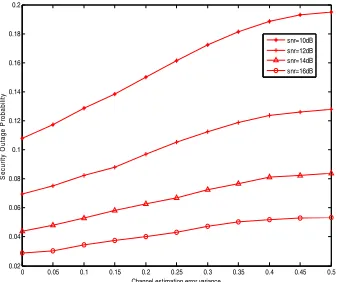
Figure 2. Security outage probability with different input SNR.
Figure 3. Average security capacity.
0 2 4 6 8 10 12 14 16 18 20
10-3 10-2 10-1
100
Average SNR(dB)
S
ec
ur
ity
ou
ta
ge
P
rob
ab
ilit
y
理想估计
非理想估计
0 0.05 0.1 0.15 0.2 0.25 0.3 0.35 0.4 0.45 0.5
0.02 0.04 0.06 0.08 0.1 0.12 0.14 0.16 0.18 0.2
Channel estimation error variance
S
ec
ur
ity
O
utage P
robabi
lity
snr=10dB snr=12dB snr=14dB snr=16dB
0 2 4 6 8 10 12 14 16 18 20
0 0.5 1 1.5 2 2.5
Average SNR(dB)
A
ver
age S
ec
ur
ity
C
apa
ci
ty
e2 = 0
e2 = 0.1
[image:5.612.213.382.359.500.2]Fig.1 shows the comparison of the system security outage probability with different channel estimation. From the Fig.1, when the channel estimation of the system has errors, the security outage probability of the channel will increases obviously. As the channel estimation error is a fixed variance in ref [5], the difference of the system security outage probability is almost fixed under Non-ideal and ideal channel estimation. Fig.2 shows the change of system security outage probability with different input SNR. According to the simulation result, the security outage probability of the system is relatively low with the high input SNR under the channel estimation error. With the increase of the input SNR, the increase of the security outage probability of the system has the tendency of slowing down. Fig.3 shows the changes of average security capacity.
CONCLUSION
In this paper, the secure performance of the DF cooperative system with channel estimation error in the eavesdropping environment is presented, with partial relay selection, and taken the security outage probability and the security capacity as the index. The simulation results show that the secure performance of the cooperative system is inversely proportional to the improvement of channel estimation error.
ACKNOWLEDGMENTS
This paper was supported by Natural Science Found of China (No.61201213). Corresponding Author: Cheng Gong, Department of Electronic Information, Soochow University, Shi Zi Street, SuZhou, China; [email protected].
REFERENCES
1. Aggelos Bletsas, Hyundong Shin. (2007)Cooperative Communications with Outage-Optimal Opportunistic Relaying. IEEE Transactions on Wireless Communications, 6(9), 3450-3460. 2. Khaled M. Eshteiwi. (2013) Outage performance of relay selection in cooperative wireless
networks over Rayleigh fading channels. Electrical and Computer Engineering (CCECE), 26, 1-5.
3. I. Krikidis. (2010)Opportunistic Relay Selection for Cooperative Networks with Secrecy Constraints [J]. IET Communications, 4(15), 1787-1791.
4. Y. Wu, M. Patzold. (2009)Performance Analysis of Cooperative Communication Systems with Imperfect Channel Estimation. IEEE International Conference on Communications, 1-6. 5. Seungyoup Han, Seongwoo Ahn, Eunsung Oh, Daesik Hong. (2009) Effect of