2017 2nd International Conference on Artificial Intelligence and Engineering Applications (AIEA 2017)
ISBN: 978-1-60595-485-1
Research on the Status of Wireless Self-organizing
Network
YANG ZHOU and LINLI ZHOU
ABSTRACT
In the seventies, the United States military organization for operational requirements developed wireless packet network, after decades of development and evolution. Wireless packet networks gradually became today's wireless self-organized network. Compared with the traditional network, the wireless self-organizing network with distributed, self-organizing, rapid deployment, low cost, etc. Nowadays the technology is not just a single application in military operations, it has been widely applied in social life practice, such as: sudden disaster communications, mobile office, etc. But because wireless self-organizing network development time is shorter, the imperfection of the related technology, wireless self-organizing network is faced with a lot of technical research In this paper, the wireless self-organized network comprehensively expounded, systematically introduces its technical characteristics, the present situation of the network structure, application and related research, etc.
KEYWORDS
Wireless self-organizing network structure, application and related research.
INTRODUCTION
The significance of the research on the status quo of wireless self - organizing network
Wireless organization network as a wireless network of the next generation of technological revolution, from the seventies of last century, the relevant wireless self-organizing network of experts and scholars on the wireless ad hoc network for a lot of technical research and improvement. Research on the focus of wireless ad hoc networks on future network trends. If the wireless self-organizing network developed enough to perfect, will bring great convenience to human life. At the same time, the wireless self-organizing network because of its relatively late development, so there are many technical defects, this defect is currently the focus of relevant scholars.
_________________________________________
Yang Zhou, University of Science and Technology of China, Hefei 230031, China; [email protected].
Paper structure
The first chapter mainly introduces the significance and value of the research on the status quo of wireless network. The second chapter introduces the definition, network characteristics, architecture and related application of self-organizing network. The third chapter generally introduces the related technology wireless ad hoc network now. The last chapter is the prospect of a future wireless ad hoc network.
AD HOC NETWORKS
Introduction of Ad hoc Wireless Self - organizing Network
Ad hoc is a wireless ad hoc network, it is and the traditional wireless communication network different from the new generation of wireless network technology. Traditional wireless networks basically transmit wireless waves to mobile terminals through fixed media (routers or base stations) that forward packets according to the path on the routing table until they are forwarded to a particular wireless terminal on which the wireless terminals are able to communicate with each other. The wireless self-organizing network is to break the limitations of traditional wireless network communication, the network of each node (the node can be portable PDA, mobile phones, laptops and other mobile devices) between the communication does not require these fixed base station Or the router forwards the packet data. Each node in the network has a dual role of receiving packet data and forwarding packet data, that is, each node is the base node of the other node and the terminal node at the same time. There is no central node in the network. When two nodes communicate with each other, the data sent by the sending node will be forwarded by the other nodes until the destination node receives the packet data.
Wireless self - organizing network
Each node in a wireless ad hoc network is a host and a router device that follows on-demand routing and multi-hop. As a host, to always listen to the client's request, and then the implementation of the relevant instructions, and finally return the corresponding data results, the common is the Web B / S structure. As a router device or base station equipment, according to the relevant routing protocol and routing table path, the relevant data packets forwarded to the next hop, from the next hop to continue forward until the destination node to receive data packets. Compared with the traditional fixed network, the wireless ad hoc network has the following salient features:
DYNAMIC TOPOLOGY
with the node and the corresponding changes, if a single node in the network because of external interference or other unpredictable causes of the node in the network communication interruption. Then, according to the characteristics of on-demand routing of self-organizing network, when a node needs to send data, it will form a new routing path, the data will be forwarded, will not cause communication between nodes interrupt problems occur.
NETWORK SELF – ORGANIZATION
The wireless ad hoc network is organized by a number of mobile devices, which are organized without the need for technical support from other external devices. No matter when and where, can spontaneously organize into a network.
NO FIXED CENTER NODE
As the wireless ad hoc network is a distributed network, nodes in the network are equal status, there is no node to control the phenomenon of other nodes. So even if one of the nodes fails, or the emergence of new nodes, will not affect the operation of the existing network. Because there is no fixed center node, the entire network has a strong anti-destruction performance and robustness.
THE LIMITATIONS OF MOBILE TERMINALS
In nodes that make up the entire wireless ad hoc network, each node is basically a mobile device with a relatively small power of mobile PDAs, mobile phones, and laptops. These devices have the computing power is weak, lack of memory, storage space and other limitations, making the operation of the entire network there is a corresponding risk.
LIMITED WIRELESS TRANSMISSION BANDWIDTH
Due to the limitations of the wireless network itself, its wireless transmission bandwidth is far less than the limited transmission bandwidth. Throughout the wireless transmission process, often the transmission will be subject to external noise interference, wireless transmission process of signal attenuation problems, or wireless channel transmission process there are hidden terminals and exposed terminals and other issues. These problems will cause the entire network bandwidth is far less than the theoretical wireless transmission bandwidth.
WIRELESS NETWORK SECURITY IS POOR
Architecture of Wireless Self - Organizing Network
According to the topology of wireless self-organization, the architecture of wireless self-organizing network can be divided into two aspects: planar distributed architecture and multi-level distributed architecture.
FLAT DISTRIBUTED ARCHITECTURE
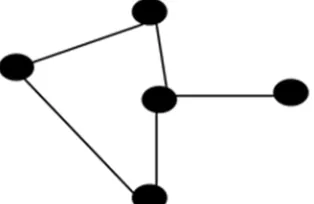
The planar distributed architecture is the most common architecture of wireless ad hoc networks. As shown in Figure .1, the relationship between each node in a planar distributed network architecture is equal and there is no central control node. This structure has a strong robustness, management is relatively simple. But once the number of nodes in the network continue to grow exponentially, then the maintenance of the entire network routing information will increase exponentially, this time will cause insufficient memory, management overhead is too large, the network is relatively low scalability phenomenon. This architecture is more suitable for small and medium-sized network structure.
MULTI - LEVEL DISTRIBUTED ARCHITECTURE
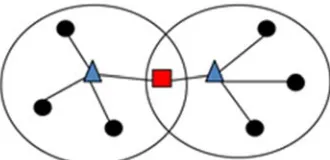
[image:4.612.224.381.582.684.2]Compared with the planar distributed architecture, the multi-level distributed architecture has the characteristics of multi-level architecture. As shown in.2, there are three types of nodes in a multi-level distributed architecture that are divided into three shapes for convenience: they are circular, triangular, and square nodes, respectively. The distributed network is divided into multi-level distributed network, the outer circle of each outer ring network is a hierarchical system in the low level network. In this network, the circular nodes represent ordinary cluster nodes, which represent the cluster head nodes in this lower level, and the intersection nodes (square nodes) of the two networks are the gateway nodes in the network. Different from the flat distributed network is that the communication between any two nodes cannot be carried out directly. If the two nodes are not in the same network range. Then the communication of the two nodes can only be forwarded by the cluster head in each lower-level network, forwarded to the gateway node, and then the gateway node will forward the next hop according to the path of the routing table until it reaches the destination node. The biggest advantage of a multi-level distributed network is that even if a single node in the network has a problem with a fault, the topology of the network will not have much impact. And the whole architecture has a strong resistance to destruction.
Figure 2. Multi-level distributed architecture.
Application of Wireless Self - organizing Network
Because of the strong self-organization ability of wireless self-organizing network, it is widely used in people's social life in all aspects, is mainly to introduce the following several common application scenarios.
THE APPLICATION IN MILITARY
Wireless self-organizing network the initial application of the scene is in the military application. The traditional network is limited by the fixed base station, easily found by the local target, and then be classified as the focus of the target. Once these base stations are destroyed, the entire combat system will be devastating losses, resulting in the failure of the entire war situation. However, the wireless self-organizing network as a combat command network to avoid such a risk, even if a node in the network by the devastating blow, but because of its dynamic topology, the entire network of other nodes between the communication is not interrupted.
APPLICATIONS IN MOBILE MEETINGS
With the accelerated pace of people's lives, wireless self-organizing network in the mobile conference applications more and more welcomed by the majority of office workers. Participants only need to open their own mobile terminal can be added to the entire mobile conference network, among the entire meeting, participants can be self-organized network through the relevant questions and related file sharing. The application of self-organizing network in mobile conference has greatly improved the enthusiasm of the participants.
THE APPLICATION IN SUDDEN DISASTER
RESEARCH ON WIRELESS SELF - ORGANIZING NETWORK
Research on Ad hoc Network Security Technology
Because wireless self-organizing network has dynamic topology, no fixed center node, mobile terminal limitations and so on. The security of wireless self-organizing networks is vulnerable to the outside world.
SECURITY WEAKNESS OF WIRELESS AD HOC NETWORKS
The security weakness of the self-organizing network has always existed for a long time. In the transmission channel, compared with the fixed cable channel, the wireless channel is more susceptible to external interference, anyone can invade the network for network monitoring. Second, because it is dynamic topology, so the nodes in the network if the outside of the intercept, and packaged into a node with the virus information, and then you can re-join the network. From the entire network of internal attacks, resulting in the entire network of paralysis. Finally, the most important point is that there are many loopholes in the network security protocol of the wireless ad hoc network. Since the WEP protocol, the WEB 802.11li protocol has made some improvements to the protocol of the wireless ad hoc network and has solved some potential loopholes, but the loopholes are still grim.
WIRELESS SELF-ORGANIZING NETWORKS ARE OFTEN SUBJECTED TO SECURITY ATTACKS
Wireless self-organizing network because of its own existence of some security issues, it is often attacked as an attack target. Common attack type flood attack, black hole attack, refused to visit and other attacks. The basic principles of studying these attacks will give scholars the basis for research on security issues.
MAC protocol
TERMINAL HIDING AND EXPOSING PROBLEMS
(a) (b) Figure 3. (a) Terminal hidden, (b) Exposed problems.
Figure 4. Single link channel communication problem.
BROADCAST PROBLEM
Each node in a wireless ad hoc network can forward data to a neighbor node. If a node in the network broadcasts a message to the entire network, the neighbor node of the node receives the message and broadcasts it to the next node. When the node continues to broadcast the same message, the neighbor node will still repeat the broadcast mode, which will cause the whole network in the channel waste.
SINGLE LINK CHANNEL
As shown in Figure .4, the communication between node a and node b is communicated with each other. In this case, node a can send data packets to node b, but node b cannot send data packets to node a because node b may not be able to cover node a because of channel interference or because of insufficient power. This results in a single link channel communication problem.
QoS technical support
Mobile self-organizing network QoS (Quality of Service) technology to connect one or more network links, to the entire network to provide adequate routing information to facilitate the network control mechanism to manage the entire network to improve the quality of network services. However, due to the mobility of nodes in infinite self-organizing networks, the bandwidth of the network is limited, and it is difficult to improve the throughput of the network. At the same time due to the dynamic topology, it is difficult to ensure the quality of service network. So the current infinite self-organizing network QoS technology is not mature enough to stay in the establishment of the QoS model, it will take a long time to study.
CONCLUSION
forward higher requirements. The future of these problems can be resolved, will give the development of wireless ad hoc network technology to bring a wider range of prospects.
REFERENCES
1. Wang Z., Crowcroft J. Quality of service routing for supporting multimedia applications [J]. IEEE Journal of Selected Areas in Communications, 1996, 14 (7): 1228 – 1234.
2. Lidong Zhou, Zygmunt J. Haas. Securing ad hoc networks [J]. IEEENetworks Speciai Issue on Network Security, 1999, 13(6) :24 - 30.
Attached to the Chinese reference:
3. Yonghong Guo, Guangsheng Li, Qiong Mao ET. The research status, problems and directions of the
network multicast routing protocol [J]. Computer application and software, 2006, 23 (4): 8-10, 65. 4. Yan Xiong, Ruiyun Wan, Bei Hua ET. Mobile ad-hoc network based on dynamic cellular QoS
routing protocol [J] electronic journal, 2003; 31 (8): 1125-1129
5. Aizhi Cheng. The current situation of wireless Ad hoc network [J] microprocessor 1002-2279 (2005) 06-0028-03