2018 International Conference on Modeling, Simulation and Optimization (MSO 2018) ISBN: 978-1-60595-542-1
Quantum-behaved Particle Swarm Optimization for Economic/Emission
Dispatch Problem of Power System
Chao-Lung Chiang
Depart. of Electronic Engineering, Nan Kai University of Technology Nan-Tou County, Taiwan
Keywords: QPSO, Economic/emission dispatch, Power system.
Abstract. This paper proposes a quantum-behaved particle swarm optimization with multiplier updating (QPSO-MU) for solving economic /emission dispatch problems (EEDP) of power system. The quantum-behaved particle swarm optimization (QPSO) has the ability to efficiently search and actively explore solutions. Multiplier updating (MU) is introduced to avoid deforming the augmented Lagrange function and resulting in difficulty to solution searching. The ε-constraint technique is employed to handle the EEDP. The proposed algorithm integrates the ε-constraint technique, QPSO, and the MU. The simulation using the proposed method is carried out on a 6-unit test system, and results are compared with that obtained using other different methods. Numerical results indicate that the proposed approach is superior to other methods in solution quality and computational burden.
Introduction
The power economic dispatch (PED) problem involves allocation of generations to different thermal units to minimize the cost of generation, while satisfying the equality and inequality constraints of the power system and keeping pollution within limits. In general, the economic dispatch problem aims to increase utilization at the lowest cost of fuel [1]. With the advent of environmental regulations, power generating unit emissions were introduced and used as part of the cost function for economic dispatch. PED became then an economic /emission dispatch problem (EEDP) to minimize the cost of generation, while satisfying the equality and inequality constraints of the power system and keeping pollution within limits [2]. Many research efforts were made for the EEDP. Niknam et al. [3] proposed an innovative tribe-modified differential evolution (Tribe-MDE) for the EEDP. Aydin et al. [4] presented an artificial bee colony algorithm with dynamic population size to combined economic and emission dispatch problem (ABCDP) for solving the EEDP. Őzyőn et al. [5] developed a charged system search (CSS) algorithm to investigate the EEDP. Rao and Vaisakh [6] provided a multi-objective optimization approach based on adaptive clonal selection algorithm (MOACSA) to solve the complex EEDP of thermal generators in power system. Pandi et al. [7] described a multi-objective bacterial foraging algorithm for solving the EEDP. A strength pareto evolutionary algorithm (SPEA) based approach was employed to handle system constraints of the EEDP [8].
Particle swarm optimization (PSO) [9] has been widely used in dealing with many real-world problems because of its simplicity and facile realization. However, because of the restricted velocity, the searching area of a particle is limited and diminishing in PSO. Which means, in a PSO system, the searching space cannot cover the whole feasible region and global convergence cannot be guaranteed [10]. This is also the main cause of the premature in PSO. In order to dispose of the disadvantages of PSO, quantum-behaved particle swarm optimization (QPSO) is proposed for solving the EEDP.
System Formulation
In the EEDP formulation, these are economy and environmental impacts. Economy Objective F1
) / ($
1 2
1 aP bP c h
F g N i i i i i i
(1)
where F1 is the total cost of generation, Pi is the generation of the ith generator, ai, bi and ci are
coefficients of the cost curve of the ith generator, and Ng is the total number of the generators.
Environmental Objective F2
The emission of sulfur dioxide, nitrogen oxides, carbon monoxide gases etc., which cause atmospheric hazards, can be mathematically modeled as [8];
iPii i i i i
i P P e
F 2
2
2 10 (2)
where , , γ, , and ζare coefficients of generator emission characteristics. System Constraints
To ensure a real power balance, an equality constraint is imposed:
0 1
D loss
N
i
i P P
P
g
(3)
where PD is the total demand, and Ploss is the real power loss in the transmission lines. The inequality
constraint imposed on generator output is
max
min i i
i P P
P (4) where Pimin and Pimax are the minimum and maximum limits on the loadings of the ith generator.
Aggregating equations (1) to (4), the multi-objective optimization problem is formulated as;
g i i i D loss N i i i i P N i P P P P P P P F P F g i , , 2 , 1 ; to subject ] , [ minimize max min 1 2 1
(5)where F1(Pi), F2(Pi) are the objective functions to be minimized over the set of admissible decision
vector Pi.
The Integrated Algorithm
The ε-Constraint Technique
The ε-constraint method is used to generate pareto-optimal solutions to the multi-objective problem. To proceed, one of the objective functions constitutes the primary objective function and all other objectives act as constraints. To be more specific, this procedure is implemented by replacing one objective in the problem as defined by (5) with one constraint. Re-formulate the problem as follows:
g i i i D loss N i i k i k i j N i P P P P P P j k k P F to subject j P F g , , 2 , 1 ; and , 2 or 1 ; 2 or 1 , min max min 1
(6)
The QPSO
In QPSO, the position of a particle is depicted by its local attractor and a prob- ability density function. In this case, the particles in QPSO have got rid of the limitation of trajectory. Analysis in [10] shows that QPSO is global convergent. Another advantage is that there is only one parameter in QPSO. Hence, QPSO is very easy to implement. More details of the QPSO used in the field of power system have shown in [11, 12].
The MU
Considering the nonlinear problem with general constraints as follows: Where hk (x) and gk (x) stand
for equality and inequality constraints, respectively.
i k
e k
x
m k
x g
m k
x h to subject
x f
,..., 1 ,
0 ) (
,..., 1 ,
0 ) ( min
(7)
where x represents a nC-dimensional variables, and hk (x) and gk (x) stand for equality and inequality
constraints, respectively. The augmented Lagrange function [13] is combined with the Lagrange function and penalty terms, yielding
e mi
k k k k k
m
k k k k k
a x f x h x g x
L
1
2 2 1
2
2 ( )
) ( )
( ,
, (8)
where k and k are the positive penalty parameters, and the corresponding Lagrange multipliers
) , , ( 1
e
m
and ( 1, , )
i
m
> 0 are associated with equality and inequality constraints, respectively. The contour of the ALF does not change shape between generations while constraints are linear. Therefore, the contour of the ALF is simply shifted or biased in relation to the original objective function, f(x). Consequently, small penalty parameters can be used in the MU. However, the shape of contour of La is changed by penalty parameters while the constraints are nonlinear,
demonstrating that large penalty parameters still create computational difficulties. Adaptive penalty parameters of the MU are employed to alleviate the above difficulties. More details of the MU have shown in [14, 15].
The Proposed QPSO-MU
The ALF is used to obtain a minimum value in the inner loop with the given penalty parameters and multipliers, which are then updated in the outer loop toward producing an upper limit of La. When
both inner and outer iterations become sufficiently large, the ALF converges to a saddle-point of the dual problem [14].
System Simulations
In this section, the proposed QPSO-MU is applied to the standard IEEE 30-bus 6-generator test system considering transmission loss for solving the EEDP. The detailed data of this system are taken from [8]. The proposed approach solves EEDP considering system constraints of power balance (3) and capacity limits (4). The MU algorithm was used in QPSO to hand the equality and inequality constraints. The computation was implemented on a personal computer (Intel(R) Core(TM) i7-3770 CPU @ 3.4 GHz with 8G Ram) in FORTRAN-90 language. Setting factors used in this test are follows; the population size is set as 5. The iteration numbers of outer loop and inner loop are set to (outer, inner) as (10, 3000). The implementation of the proposed algorithm for this test can be described as follows:
21 2 1 1
1 2 1 2 1 1
1
1( ) ( ) ( )
,
, i i i
i
a P f P h P g P
0 :
1
1
g
N
i
loss i
D P P
P
h (10)
0 )
(
: 2 2
1 F Pi
g (11) where h1 stands the violation of power balance constraint (3), and g1 stands the violation of emission
objective for expected
2 ,
, max
0.1942, 0.2215
2min 2
2 F F
[9]. The augmented Lagrange
function (9) is solved by the proposed approach. Since cost and emission are of conflicting nature, the value of objective F2 will be the maximum when the value of F1 objective is the minimum and vice
versa. So, the values of the best cost with max 2
F and the minimum emission with min 2
F are obtained by performing the ALF (9) separately. The best compromise indicates the minimum cost within expected
2. For comparison with previous reports, The expected
2 is set as min2
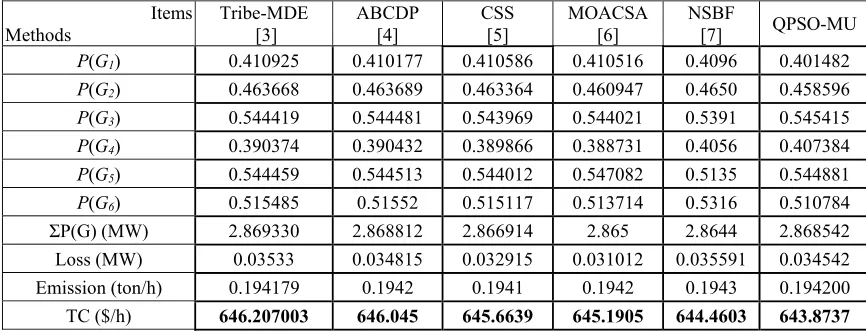
[image:4.612.88.521.353.520.2]F . Table 1 compares five computational results obtained from previous papers and the proposed QPSO-MU, Tribe-MDE [3], ABCDP [4], CSS [5], MOACSA [6] and NSBF [7]. As seen from the best solution of QPSO-MU listed in Table 1, the emission output is 0.194200 ton/h. It is observed that the best total cost (TC) utilizing QPSO-MU is 643.8737 $/h, which is much less than the best results previously reported in Tribe-MDE [3], ABCDP [4], CSS [5], MOACSA [6] and NSBF [7]. The equality constraint (10) of power balance and the expected emission limit (11) are fully satisfied. Therefore, the result obtained from the proposed QPSO-MU is an optimal and feasible solution, and Table 1 demonstrates that the proposed approach is superior to previous methods in solution quality.
Table 1. Computational results obtained from previous methods and the proposed QPSO-MU. Items
Methods
Tribe-MDE [3]
ABCDP [4]
CSS [5]
MOACSA [6]
NSBF
[7] QPSO-MU P(G1) 0.410925 0.410177 0.410586 0.410516 0.4096 0.401482 P(G2) 0.463668 0.463689 0.463364 0.460947 0.4650 0.458596 P(G3) 0.544419 0.544481 0.543969 0.544021 0.5391 0.545415 P(G4) 0.390374 0.390432 0.389866 0.388731 0.4056 0.407384 P(G5) 0.544459 0.544513 0.544012 0.547082 0.5135 0.544881 P(G6) 0.515485 0.51552 0.515117 0.513714 0.5316 0.510784 ΣP(G) (MW) 2.869330 2.868812 2.866914 2.865 2.8644 2.868542
Loss (MW) 0.03533 0.034815 0.032915 0.031012 0.035591 0.034542 Emission (ton/h) 0.194179 0.1942 0.1941 0.1942 0.1943 0.194200
TC ($/h) 646.207003 646.045 645.6639 645.1905 644.4603 643.8737
Conclusions
The QPSO-MU for solving the EEDP has been proposed herein. The QPSO helps the proposed method efficiently search and refined exploit. The MU helps the proposed method avoid deforming the ALF and resulting in difficulty of solution searching. The proposed algorithm integrates the ε-constraint technique, the QPSO and the MU that has the merit of taking a wide range of penalty parameters and a small population. The IEEE 30-bus test system is used to compare the proposed QPSO-MU with previous methods. Simulation results show that the proposed algorithm is superior to previous approaches in solution quality for solving the EEDP. Advantages of the proposed QPSO-MU are that the QPSO efficiently searches the optimal solution in the EEDP process and the MU effectively tackles system constraints of EEDP.
Acknowledgement
References
[1] J. Zhou, C. Wang, Y.Z. Li, P. Wang, C.L. Li, P. Lu and L. Mo, A multi-objective multi-population ant colony optimization for economic emission dispatch considering power system security Applied
Mathematical Modelling, 45 (2017) 684-704.
[2] D. Zou, S. Li, Z.Y. Li, X.Y. Kong, A new global particle swarm optimization for the economic emission dispatch with or without transmission losses Energy Conversion and Management, 139 (2017) 45-70.
[3] T. Niknam, H.D. Mojarrad, B.B. Firouzi, A new optimization algorithm for multi-objective economic/emission dispatch Int. J. Electrical Power and Energy Systems, 46 (2013) 283-293. [4] D. Aydin, S. Őzyőn, C. Yaşar and T. Liao, Artificial bee colony algorithm with dynamic population size to combined economic and emission dispatch problem Int. J. Electrical Power and
Energy Systems, 54 (2014) 144-153.
[5] S. Őzyőn, H. Temurtaş, B. Durmuş and G. Kuvat, Charged system search algorithm for emission constrained economic power dispatch problem Energy, 46 (2012) 420-430
[6] B. S. Rao and K. Vaisakh, Multi-objective adaptive clonal selection algorithm for solving environmental/economic dispatch and OPF problems with load uncertainty Int. J. of Electrical Power
and Energy Systems, 53 (2013) 390-408.
[7] V.R. Pandi, B.K. Panigrahi, W.C. Hong and R. Sharma, A multiobjective bacterial foraging algorithm to solve the environmental economic dispatch problem Energy Sources B, 9 (2014) 236-247.
[8] M.A. Abido, Environmental/economic power dispatch using multiobjective evolutionary algorithm IEEE Trans. Power Systems, 18 4 (2003) 1529-1537.
[9] J. Kennedy and R. Eberhart, A new optimizer using particle swarm theory Proceedings of The
Sixth International Symposium on Micro Machine and Human Science, (1995) 39-43.
[10] J. Sun, X. Xu, V. Palade, W. Fang, C. Lai and W. Xu, Convergence analysis and improvements of quantum-behaved particle swarm optimization Inf. Sci., 193 15 (2012) 81–103.
[11] T. Liu, L.C. Jiao, W.P. Ma and R.H. Shang, Quantum-behaved particle swarm optimization with collaborative attractors for nonlinear numerical problems Commun. Nonlinear Sci. Numer. Simulat., 44 (2017) 167–183.
[12] Y.Y. Li, X. Bai, L.C. Jiao and Y. Xue, Partitioned-cooperative quantum-behaved particle swarm optimization based on multilevel thresholding applied to medical image segmentation Applied Soft
Computing, 56 (2017) 345–356.
[13] Z. Michalewicz and M. Schoenauer, Evolutionary algorithms for constrained parameter optimization problems Evolutionary Computation 4 1 (1996) 1-32.