2016 International Conference on Artificial Intelligence: Techniques and Applications (AITA 2016) ISBN: 978-1-60595-389-2
The Design and Implementation of Individual Push
System Based on Android Platform
Heng-hui LIANG and Ze-hua GAO
Beijing University of Posts and Telecommunications, Beijing, China
Keywords: Push system, Individual, XMPP, Androidpn, Subscribe model.
Abstract. With the number of users of android phone increasing, the research on push technology facing android client is becoming increasingly important. There are mainly three traditional push method: Polling, SMS Push and IP Push. However, these push methods have disadvantages respectively. This article analyzed and compared above three methods firstly, and then focused on the push system based on XMPP. In addition, we designed and implemented a push system of XMPP protocol based on the open-source project Androidpn, and imported subscribe model into this push system. Finally, we verified the function of this push system.
Introduction
According to the 37th Statistics Report For China Internet Developing Situation: the amount of users of mobile phone has reached 620 million, of which 90.1 percent of users surf the Internet by mobile phone, mobile network and internet created a new pattern of life. Push technology, also known as webcasting technology, is a kind of technology of broadcasting custom information to users by internet. This kind of technology is proposed firstly by Point Cast Network Company. The presence of this technology greatly enhanced pertinence and validity of getting information to users. Therefore, the research of push technology facing mobile phone should have good potential applications and have important significance to help obtaining valid information.
According to implementation rationale, push technology based on Android can be divided to three kind of technology: Pull, SMS Push and IP Push. Compare to traditionally initiating by client and pulling data from server, proactively push technology is faster, more accurate and easier to customize. In this paper, firstly we analyzed the principle and Implementation of three kind of push technology, looking at the principle of push technology based on XMPP[1] (Extensible Messaging and Presence Protocol) and the design and implementation of push system based on open source project Androidpn (Android push notification). Finally, verified function of this push system by functional testing and analyzing this system.
Analysis of Push Technology Based on Android
The Overview of Push Technology
Push technology is a kind of technological means used to publish information. We can obtain information from Internet or Manufactures by certain technology standard or protocol and then transfer message to users by certain methods (such as e-mail, short message, webpage, notification, etc). So far, push technology facing Android platform primarily has Pulling, SMS Push, IP Push so on three methods.
Polling
or not in server by sending requests to server constantly. If there is updated message, android client will pull data to local device. Otherwise, android client will wait to send the next request. Actually, this is a polling method. This method is easy to realize, using which users can freely select update strategy and frequency as needed, but periodically connecting to Internet is not a good solution to android client whose electric quantity and data traffic is limited. What is more, if we select a long period as request cycle, using this method we can’t obtain updated message from server timely and effectively. This method is just suitable to some scenarios that don’t need highly real-time capability and have periodic trends, such as weather, news and so on.
SMS Push
We can push message to users by sending short message with base station set up by mobile telecom carrier. As long as the SIM card in your phone is active, we can send push messages to users through base station in any time. However, SMS (short messaging service) need high charge, the kind and size of message is limited using this method.
IP Push
IP Push is the most popular push technology in current most applications. Its principle is client that has fixed IP address maintains a persistent connection with server by heartbeat mechanism. We can transfer data between client and server by this persistent connection.
C2DM
C2DM(Cloud to Device Messaging) is a solution of push message that is released by google company in Android 2.2 version, which can help developer pushing message to client. This service provides a simple, light weight push solution, which can realize the function of server pushing message to client initiatively. The message which is pushed can be specific content or just a notification which is used to notify client when there are updated information or data on server. C2DM is in charge of maintaining the persistent connections between clients and server, maintaining request queue, pushing message from server to android client and so on. However, this service has significant disadvantages. Firstly, C2DM requires that the version of android client must be higher than 2.2 and devices whose version is between 1.5 and 2.1 do not support this service. Secondly, devices whose version is lower than 4.0 need to register google account and then google account must be online always because the server of C2DM could not keep in touch with this client if it is offline. Finally, this service is not stable when we use it in our country because of the server of C2DM being in foreign.
Initiative Push System
In consideration of the security of using third-party push platform, the most popular solution is setting up push platform by ourselves. Currently, MQTT (Message Queuing Telemetry Transport) and XMPP [1] (Extensible Messaging and Presence Protocol) are two of popular protocols to realize push service. MQTT is a concise, tiny, power-saving, data-traffic-saving protocol [2] which has strong expansibility. And there is sever-side component rsmb based on C++. However, MQTT is premature and not easy to realize. Moreover, the server-side component rsmb is closed and expensive to deploy. XMPP is a mature and powerful protocol which has very strong expansibility because of transporting by XML stream and extending the flexible character from XML [3]. Moreover, XMPP has been a standardization protocol which is standardized by IETF of ISO [4-5]. XMPP has been applied to many chat systems and there has been open-source project Androidpn based on XMPP protocol which is realized by Java language.
XMPP Protocol
Brief Introduction of XMPP
XMPP is the most flexible protocol, which is transported by XML stream and inherited the flexible character of XML. Therefore, applications based on XMPP have strong expansibility. We can send message and handle request from users by expanded XMPP, develop applications based on XMPP (such as content distribution system, Location-based service and so on). In addition, XMPP includes a software protocol for server-side which allows a client communicating with another client. This character allows developer to develop application for client or add function for a system.
Concept of XMPP
Jabber, as the predecessor of XMPP, is an instant messaging communication protocol which is created by open source group. The standardization work of XMPP has been finished by IETF of ISO [4-5]. The core product of standardization is the definition of transport protocol based on XML stream, which allow XMPP can be used in more specification platform of communication protocol. With the feature of easy to read and parse, XMPP becomes a concise and beautiful protocol.
Network Structure of XMPP
XMPP defines three roles: client, server and gateway [6]. Any two of the three roles support bidirectional communication. As is shown in Figure 1 below, Server is responsible for managing connection, recording routing information and client information. Gateway is in charge of communication with isomeric instant messaging system. Clients connect to server by TCP/IP protocol and then transport XML stream by this connection.
Transport Content of XMPP
The instructions to transport are relative to instant messaging. Previously, these instructions are transported either by plain text adding blank character, parameter and line break (e.g. MSN) or by binary system (e.g. QQ). However, XMPP transport instant messaging instructions by text formatted by XML, which made it easy to read, easy to parse and easy to debug and develop. The hardcore of XMPP is the stream protocol of transporting XML stream on Internet segmentally. The base of instant messaging instructions of XMPP is just this stream protocol, which is a very important network based protocol that can be further used. That is to say, what is transported in XMPP by TCP protocol is XML stream.
Address Pattern of XMPP
XML of XMPP includes three top labels: Message, Presence and IQ. Their specific meanings are as follows:
1) Message is used to send message between two users, showing specific content of message that are to send. When user sending a new message, just add message label to XML and then add specific content under this label.
2) Presence is used to express the state of users. Not every message needs to add this label. We need to add this label and mark corresponding state in XML when the state of user is changed.
The Design and Implementation of Push System
In this article, the push system based on XMPP is designed on the basis of the open source project Androidpn. This Article modified the push mechanism of Androidpn and added subscription model to Androidpn, accordingly set up personalized recommendation model that can push message to users according to their subscription topic, which improved the pertinence of pushing message. The whole system can be divided to part: one is server-side, which is used to push message, maintain persistent connection with client, manage the list of online and offline clients and the subscription topics from different clients; the other is client, which is used to register and login to server, subscribe to topics and receive push message that belong to corresponding topics and then show these message in notification bar of android client.
Deployment of Server-side
The sever-side of this push system is implemented by modifying the open source project openfire. This server includes two parts: one is the XMPP service that listening 5222 port, which is responsible for communicating with XMPPConnection. Its main role was managing registration and authentication of users and pushing message; the other is web server, which is a light weight http server that used spring framework. It is responsible for receiving the web requests from users.
Figure 1. Network structure of XMPP. Figure 2. Framework of Androidpn server.
As is shown in Figure 2 above, the framework of Androidpn server can be divided to four layers. The uppermost layer of above framework includes four parts: Session Manager, Auth Manager, Presence Manager and Notification Manager. Session Manager is in charge of managing the sessions between clients and server. Auth Manager is responsible for the authentication of users in client-side. Presence Manager is in charge of managing login status of users. Notification Manager is responsible for pushing message from server to clients.
Using this solution, we can only send text message. However, it is enough to general push demands. We can’t look forward to obtaining all of data and message by just one push message. As a general rule, we just need to notify clients that there are updated data in server-side. And then clients send request initiatively to server to obtain updated data when they received notification.
Design and Implementation of Client
Therefore, There are two part function to implement: one is registration, login, connection and a series of operations, which can make client establish persistent connection with server; the other is managing subscription topics, including selecting topics and submitting subscription topics to server so that server can push message according to corresponding topics.
We also need to configure this project to make it can establish connection with server. We need to open the project and find the file androidpn.properties of res/raw/ directory and then configure apikey (the secret key to authenticate client), xmppHost (IP address of server), xmppPort (port number listened by server) three parameters, of which if the client is installed on real phone, we configure xmppHost as the real IP address of our computer that deployed server, we need to configure xmppHost as 10.0.0.2 otherwise and xmppPort should be configure as 5222 both situation.
Working Process of XMPP Server and Client
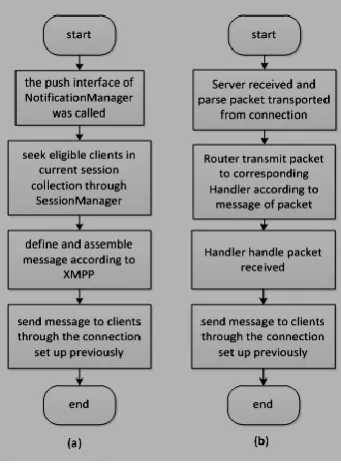
Figure 3 shows the working process of XMPP server, of which Figure 3. (a) shows the message-sending process of XMPP server and Figure 3. (b) shows message-receiving process of XMPP server. Figure 4 shows the establishing process of connection between client and server.
[image:5.595.320.540.294.528.2]
Figure 3. Flow chart of sending and Figure 4. Establishing process of Connection receiving message of server. between client and server.
Function Test of Push System
Test environment: A computer with Win7 as server host; Tomcat 7 used to deploy server; 2 real Android phones and an emulator as clients.
Result
[image:5.595.57.228.296.529.2]
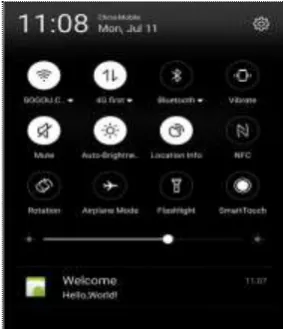
Figure 5. Connection-launching page of client. Figure 6. Notification-received page of client.
Figure 7. Notification detail page of client.
Conclusion
This Pager expounded principle and working mechanism of XMPP and designed push system based on XMPP. Importing topic-subscribed model to push system, this pager implemented a more targeted push system. This system can be used in most personalized commend applications.
References
[1] RFC 3920, Extensible Messaging and Presence Protocol (XMPP): Core/Introduction[S].
[2] Tang KL, Wang Y, Liu H, et al. Design and implementation of push notification system based on the MQTT protocol
[3] Hsu, Kuo-Hsun, Lee, Wen-Tin; Sie, Min-Yu. Extending OSGi with Instant Messaging Communications and Peer to Peer Transfer Based on XMPP [J]. Advances in information Science and Service Sciences (AISS), 2012, 4(18): 363-369.
[4] Day M, Rosenberg J, Sugano H. A model for presence and instant messaging. IETF, 2000, 2: RFC2778.
[5] Day M, Aggarwal S, Mohr G, et al. Instant messaging/presence protocol requirements. IETF, 2000, 2: RFC2779.
[image:6.595.363.505.72.237.2]