2016 International Conference on Computational Modeling, Simulation and Applied Mathematics (CMSAM 2016) ISBN: 978-1-60595-385-4
The Stochastic Stabilities and Simulations of Multi-machine
Power System Based on SDE
Jian-yong ZHANG
1,*, You-peng LI
2, Cui-yan ZHANG
3and Kai YU
21
Hohai University, Department of Mathematics and Physics, Changzhou, Jiangsu, China
2
Hohai University, School of Mechanical and Electrical Engineering, Changzhou, Jiangsu, China
3
Hohai University, College of Internet of Things Engineering, Changzhou, Jiangsu, China
*Corresponding author
Keywords: Stochastic differential equation, Power system, Stochastic stability, Dynamic simulation.
Abstract. This paper discusses the influence of random factors on power system based on theories of stochastic differential equations (SDE). Firstly, we build a stochastic power system model using the power fluctuation as random excitation, and then analyze the stochastic stability of stochastic power system. Next, based on four machine two area system, we get the dynamic curve of rotor angle of multi-excitation system through dynamic simulation. Finally, the power spectrum analysis shows that random excitation can induce regional weakly damped oscillation mode.
Introduction
There are plenty of random disturbances in complex power system, such as power fluctuation and fault, etc. These disturbances threaten the safety and reliable operation of power system. As for power fluctuation, this can be caused by both random loads such as electric vehicles and the power sources such as renewable power generation.
Though random disturbances[1] in power system attract scholars’ attention, Monte Carlo method[2] and Probabilistic Collocation method[3], have been carried out to research the probabilistic stability[4] of power system. These researches mainly focus on the simulation, while lack of theoretical analysis.
With the development of stochastic stability theory[5], the stochastic stability analysis of power system is given serious attention. Zhao Yangdong[6] analyzed stochastic stability of power system through EM and Milstein numerical methods. The reference[7] discusses the mean stability and the mean square stability of a one machine and infinite bus system with random excitation.
For nonlinear stochastic system[8], generally we use computer to obtain the dynamic responses. While in a small neighborhood of the initial point, nonlinear stochastic system can be replaced by its linearized system[7,9], which can make it easy to obtain analytical solution and analyze the dynamic behaviors and stabilities of power system under perturbation.
In the article we establish nonlinear and linearized model of multi-machine power system by using vector SDE with random excitation. According to the linearized model and analytical solution, stabilities of multi-machine and multi-excitation system are discussed. Based on the nonlinear stochastic model, we analyze the dynamic response of power system under multi-excitation.
Basic Theories
The vector stochastic differential equation is:
( ) ( ( ), ) ( ( ), ) ( )
dXt =f Xt t dt+G Xt t dB t . (1)
where T
1 2
( )t [X t( ),X ( )t ,Xn( )]t
X = is state variable, T
1 2
( )t [B t B t( ), ( ), ,Bm( )]t
B = is Gaussian white noise.
The initial condition is X( )t0 =X0, t t0, ∈T. If G X( , )t and are linear functions ofX( )t on
0 [ , ] n
T
t ×R , Eq.1 is a linearstochastic differential equation. It usually expressed as:
( , )t
( ) [ ( ) (t d)] () ()
dXt = AXt +a t+Qt dB t . (2)
Eq.1 orEq.2has unique solution when satisfying the existence conditions[10].For the Eq.2, we can also get the analytical solutions:
(
)
0 0 0
0 0
( ) ( ) ( )
0 ( ) (
( ) e t t te t t te t t ) ( )
t s ds t s d
t = A − +
∫
A − +∫
A − sa Q
X X B . (3)
whereeA(t t−0)is the elementary solution matrix of deterministic differential equation
( )t =AX( )t
X .
Multi-machine and Multi-excitation Power System Model
The Deterministic Model
In order to build multi-machine and multi-excitation system model, assumptions are as follows: (1)The multi-machine power system has an infinite system, in which the bus voltage is reference phasor.(2) The mechanical power and transient electric potential are constants, and the transient salient effect is ignored. (3) For each generator in the group have the same damping coefficient and inertia time constant ratio approximately.
Under the above assumptions, the motion state Eq.13of theith generator rotor is:
1
1
[ ( 1)].
i i
i
mi ei i i i
d dt d
P P D
dt M
δ ω
ω
ω
= −
= − − −
(4)
where Mi and Di are the inertia time constant and damping coefficients of theithgenerator rotor,
electric power Pei is equal to:
2
1,
sin( )
n
ei i ii i j ij i j ij j j i
P E G E E Y δ δ α
= ≠
′ ′ ′
= +
∑
− −(5)
The Nonlinear Stochastic Model
Whether power fluctuation caused by random power sources or random load, we describe the random power uniformly as:
( ) Li ik ik
k
P =
∑
σ W t. (6)
( ) ik
W t and 2
ik
σ denote the standard Gaussian process and variance with different frequencies respectively, and they are independent with each other.
The high frequency component corresponds to random power fluctuations caused by electrical factors such as electric vehicles, and the low frequency component corresponds to random power fluctuations caused by mechanical factors such as wind power generation.
In conclusion, combining Eq.5 and Eq.6, the Eq.4 can be rewritten as following:
1
1 1
[ ( 1)]
i i
i
mi ei i i Li
i i
d dt d
P P D P
dt M M
δ ω
ω
ω
= −
= − − − −
. (7)
The Linear Stochastic Model
= L
d dt
X
AX + BP
. (8)
where
1
1
11 12 1
1 1 1 1
1
1 2
, =
n n n n
n
n
n n nn n
n n n n
n
K
K K D
M M M M
K K K D
M M M M
0 I
X A
δ
δ ω
ω
× ×
∆
−
− − −
∆
=
∆
− − − −
∆
,
1
0
0 L
L
Ln n
P
P
P
=
, n n n n n n L
0 0
B
0 B
× ×
×
=
,
1
1 1
[ ,..., ] L
n diag
M M
B = , ei
ij j
P K
δ
∂ =
∂ ,In n× is an n-dimensional identity matrix.
Stability Analyses
Stochastic Stability
The moment stability[11]mainly reflects the stability of the statistical moment in solution process, including mean and mean-square stability and etc. In this paper we only use mean and mean-square stability. Their definition is as follows:
Definition. Assuming that X(t)is the solution process of Eq.8, if X(t) satisfies:
2
lim ( )
t→∞E‖Xt‖<c. (9)
T 2
lim || ( ) ( ) ||
t→∞E Xt X t <C. (10)
where c, Care nonnegative numbers. Eq. 9 implies mean stable and Eq. 10 is mean-square stabile.
Theorem. Suppose that X(t) is the solution process of linear stochastic power system (8), If all the real parts of eigenvalues of state matrix A is less than zero, power system is mean stable and mean-square stable. Namely, there exist two positive numbers c and C satisfies Eq.9 and Eq.10.
Theorem shows that power system is mean and mean-square stable under the smaller random excitation only if eigenvalues of the linear model of multi-machine system have negative real part.
Example of Test System
In the paper, on the base of classical model of four machine two area, which details of the system parameters are listed in the reference[12], we construct stochastic model with random excitation in Simulink, G3 is replaced by doubly-fed induction generator(DIFG) to simulate renewable energy generation, the random load is added to the load side to simulate electric vehicles charge and discharge randomly. The system figure is shown in Figure 1.
According to Eq. 8 and the reference[7], we can acquire three main modes,λ1,2=-
0.5311±i6.1327,λ3,4=-0.5434±i6.2381, λ5,6=-0.0361±i4.9852.λ1,2andλ3,4 reveals respectively the
oscillation mode within area 1 and area 2. λ5,6 is the oscillation mode between areas. The real parts
of all eigenvalues are less than zero, according to the theorem above we can get the conclusion that power system is mean stable and mean-square stable under random excitation.
Simulations and Power Spectrum Analysis
According to the stochastic system shown in Figure 1, we carry out the simulation of three kinds of circumstances, and achieve respective power spectrum.
Case 1 Only DIFG Excitation
Figure 1. Four machine two area stochastic system.
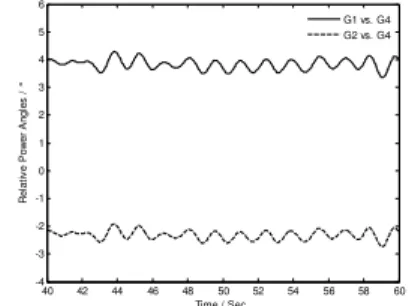
In this case, relative rotor angle curves of G1 vs. G4and G2 vs. G4 are plotted in Figure 4. Simultaneously, we obtain the spectrum of relative rotor angle between G1 vs. G4 shown in Figure 5.
Figure 2. Random wind speed. Figure 3. Relative rotor angle curve under random wind.
Figure 4. Spectrum analysis of relative rotor angle betweenG1 and G4.
It can be seen from the Figure 3 and Figure 4 that the relative rotor angle fluctuation amplitude between G1 and G4 is smaller, the reason is that the wind speed change slowly and its frequency is lower. Both of them have less impact on dynamic system. Meanwhile, Figure 4 the largest frequency of relative rotor angle spectrum is 0.6750 Hz.
Case 2 Only Random Load Excitation
Due to the great randomness for electric vehicle when charging and discharging in the grid, we can consider it as a random load whose frequency change fast. In the study random load is regarded as a random variable which satisfies the normal distribution, its size is about 5% of the bus power of the load side, where cosφ = 0.75.The simulation of random load is shown in Figure 5. In this case, the DIFG is driven by only basic wind of 11 m/s. The simulation results are shown in Figure 6 and Figure 7.
0 2 4 6 8 10 12 14 16 18 20
8 9 10 11 12 13 14 15
time / sec
ra
n
d
o
m
w
in
d
(
m
/s
)
40 42 44 46 48 50 52 54 56 58 60
-4 -3 -2 -1 0 1 2 3 4 5 6
Time / Sec
R
e
la
ti
v
e
P
o
w
e
r
A
n
g
le
s
/
°
G1 vs. G4 G2 vs. G4
0.2 0.4 0.6 0.8 1 1.2 1.4 0
0.05 0.1 0.15 0.2 0.25 0.3 0.35 0.4 0.45 0.5
Frequency / Hz
S
p
e
c
tr
u
m
o
f
R
e
la
ti
v
e
P
o
w
e
r
A
n
g
le
Figure 5. Randomload. Figure 6. Relative rotor angle curve under randload.
Figure 7. Spectrum analysis of relative rotor angle betweenG1 and G4.
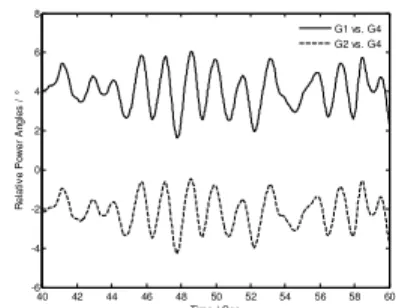
Comparing Figure 3 with Figure 6, we can see the relative rotor angle fluctuation is bigger, the reason for this is that the random load changes rapidly, and belongs to the high frequency excitation. It has a bigger influence on the system dynamic. From the calculation of spectrum, the maximum frequency is 0.7000 Hz.
Case 3 Two Kind of Excitation
Applying the random wind speed and random load in power system at the same time, the simulation results are shown in Figure 8 and Figure 9.
Comparing Figure8 with Figure 6, we can see that the relative rotor angle fluctuation is further increased. The reason is that power system is affected by two kind of random excitation. The maximum frequency is 0.7000 Hz in frequency spectrum analysis. From Figure 4, Figure 7, Figure 9, we can draw a conclusion that mode excited by random excitations is closer to the interval oscillation frequency of power system.
Figure 8. Relative rotor angle curve under random wind speed and random load.
Figure 9. Spectrum analysis of relative rotor angle betweenG1 and G4.
Conclusions
In this paper, on the basis of vector stochastic differential equations, we discuss the stochastic stability of four machine two area system in the neighborhood of initial point. Due to the real part of eigenvalues are all less than zero, power system is mean stable and mean-square stable. According to the power system stability theory, they all belong to the small signal stability. For nonlinear
40 42 44 46 48 50 52 54 56 58 60
-6 -4 -2 0 2 4 6 8x 10
5
Time / Sec
A c ti v e P o w e r / M W
40 42 44 46 48 50 52 54 56 58 60
-6 -4 -2 0 2 4 6 8
Time / Sec
R e la ti v e P o w e r A n g le s / °
G1 vs. G4 G2 vs. G4
0.2 0.4 0.6 0.8 1 1.2 1.4
0 0.1 0.2 0.3 0.4 0.5 0.6 0.7 0.8 0.9 1
Frequency / Hz
S p e c tr u m o f R e la ti v e P o w e r A n g le s
40 42 44 46 48 50 52 54 56 58 60
-4 -2 0 2 4 6 8
Time / Sec
R e la ti v e P o w e r A n g le s / °
G1 vs. G4 G2 vs. G4
0.2 0.4 0.6 0.8 1 1.2 1.4
0 0.1 0.2 0.3 0.4 0.5 0.6 0.7 0.8 0.9 1
Frequency / Hz
stochastic power system with random wind speed excitation and random load excitation, simulation results show that random excitation can induce regional weakly damped oscillation mode.
References
[1] Hanson O.W, Goodwin C.J, Dandeno P.L. Influence of Excitation and Speed Control Parameters in Stabilizing Intersystem Oscillations, J. IEEE Trans. Power App. Syst. 87(1968) 1306-1313.
[2] Timko K.J, Bose A, Anderson P.M. Monte carlo simulation of power system stability, J. IEEE Trans. Power App. Syst. 102(1983) 3453-3459.
[3] Han D, Ma J, He R, et al. Effect of uncertainty in load model on power system dynamic simulation, J. Proceedings of the CSEE. 28(2008) 69-74.
[4] Burchett R.C, Heydt G.T. Probabilistic methods for power system dynamic stability studies, J. IEEE Trans. Power App. Syst. 97(1978) 695-702.
[5] Foss S, Konstantopoulos T. An overview of some stochastic stability methods, J. Journal of the Operations Research, 2004, 47(4) 275-303.
[6] Yang D, Jun Hua Z, Hill D.J. Numerical simulation for stochastic transient stability assessment, J. IEEE Trans. Power Syst. 27(2012) 1741-1749.
[7]Jianyong Z, Ping J, Yiping Y, et al. Responses and stability of power system under small Gauss type random excitation, J. Sci China Tech Sci. 55(2012) 1873-1880.
[8] Maffezzoni P, Pepe F, Bonfanti A. A unified method for the analysis of phase and amplitude noise in electrical oscillators, J. IEEE Trans. Microw. Theory Tech. 61(2013) 3277-3284.
[9] Dhople S.V, Chen Y.C, DeVille L, et al. Analysis of power system dynamics subject to stochastic power injections, J. IEEE Trans. Circuits Syst. I, Reg. Papers. 60(2013) 3341-3353.
[10] Arnold L. Stochastic differential equations: theory and applications, John Wiley & Sons, New York, 1973.
[11] Kushner H. Stochastic stability and control, Academic Press, London, 1967.