Munich Personal RePEc Archive
Re-evaluating Hedging Performance
Cotter, John and Hanly, James
2005
Online at
https://mpra.ub.uni-muenchen.de/3523/
Re-evaluating Hedging Performance
John Cotter and Jim Hanly
July 24th 2005
Abstract
Mixed results have been documented for the performance of hedging strategies using futures.
This paper reinvestigates this issue using an extensive set of performance evaluation metrics
across seven international markets. We compare the hedging performance of short and long
hedgers using traditional variance based approaches together with modern risk management
techniques including Value at Risk, Conditional Value at Risk and approaches based on
Downside Risk. Our findings indicate that using these metrics to evaluate hedging performance,
yields differences in terms of best hedging strategy as compared with the traditional variance
measure. We also find significant differences in performance between short and long hedgers.
These results are observed both in-sample and out-of-sample.
Keywords: Hedging Performance; Lower Partial Moments; Downside Risk; Variance;
Semi-Variance; Value at Risk, Conditional Value at Risk.
JEL classification: G10, G12, G15.
____________________________________________________________________
1. Introduction
Hedging with futures contracts is perhaps the simplest method for managing market risk arising
from adverse movements in the price of various assets. The success of a hedging strategy is
measured by the extent to which it reduces risk, and many techniques have been developed and
applied to find the optimal investment in futures – the optimal hedge ratio (OHR) with the aim of
reducing risk. A large body of research has developed in the calculation and evaluation of
optimal hedging strategies (see, for example, Kroner and Sultan 1993; Park and Switzer 1995;
Choudhry, 2003). The literature on optimal hedging indicates that OHR’s estimated by OLS
generally yield the best results in-sample. There is little performance difference between models
in an out-of sample context, however, with both OLS and GARCH models failing to
significantly outperform the simple naïve hedge (see, for example Brooks et al, 2002). It is not
clear, however, whether the general results on model hedging effectiveness are specific to the
narrow performance appraisal criteria that have been applied in the literature (namely the
variance) or whether these results hold under a broad range of hedging performance metrics. The
evaluation of hedging strategies has been overwhelmingly based on the objective of minimising
variance and therefore the general results on hedging efficiency reflect models that achieve
variance minimisation as their stated aim.
A key issue not extensively explored in the literature is whether the estimates of hedging
effectiveness of optimal hedging strategies for many applied models would change if
performance criteria other than the variance were to be applied. The use of variance or standard
deviation as measures of risk have been criticised because negative and positive returns are given
equal weight, whereas a measure of hedging effectiveness that incorporates trading position and
would need to be one-sided in nature so that it can distinguish between downside and upside
risks that are relevant to short and long hedgers respectively. This paper addresses this issue of
performance evaluation in a number of ways.
First, we evaluate and compare hedging strategies using five different performance metrics.
These are the Variance, Semi-Variance; Lower Partial Moments (LPM); Value at Risk (VaR)
and Conditional Value at Risk (CVaR). With the exception of the first metric, these performance
metrics are tail specific. Second, we examine hedging effectiveness across a number of different
hedging strategies including, a no hedge strategy; a naïve approach, and a model based hedging
approach. We use three models to calculate the OHR. These are OLS using a rolling window
approach, and two time-varying multivariate GARCH approaches; the Diagonal VECH and the
Constant Correlation models. This gives a total of five hedging strategies. Third, we apply each
of the above metrics for both short and long hedgers across seven leading stock index spot and
futures contracts. This approach allows us to examine whether the dominance of Naïve and OLS
based hedging strategies is specific to the use of the variance reduction criterion or whether
different performance metrics favour different hedging strategies. To anticipate our results, we
find that while the overall dominance of Naïve and OLS based hedging strategies is confirmed,
in certain cases the use of performance metrics other than the variance may result in GARCH
models being chosen as the best performing hedging methods. This is particularly true of the
Value at Risk performance metric. Furthermore, we also find substantial differences in the
hedging performance of short as opposed to long hedgers. This suggests that the hedging
objectives and trading position of an investor should be considered when choosing a
performance metric that is appropriate for evaluating the performance of different hedging
The remainder of this paper proceeds as follows. In Section 2 we describe the metrics for
evaluating hedging performance. Section 3 details the models used for estimating optimal hedge
ratios. Section 4 describes the data and presents some summary statistics. Section 5 presents our
empirical findings on hedging performance. Section 6 summarises and concludes.
2. Performance Metrics
We examine the in-sample and out-of-sample hedging performance of five hedging strategies
using five different metrics of performance. Our performance metrics are based on the Variance,
the Semi-Variance, LPM, VaR, and CVaR. The hedging strategies we use are no hedge, a naïve
hedge, and a model based hedge where three different models are used to estimate the OHR:
Rolling OLS, Diagonal Vector GARCH (DVECH) and Constant Correlation GARCH (CC).
2.1 Hedging Effectiveness Metric 1 - The Variance
The first performance metric we use to examine hedging performance is the variance. The
variance metric (HE1) that we use measures the percentage reduction in the variance of a hedged
portfolio as compared with the variance of an unhedged portfolio. The hedged portfolios are
calculated by using the OHR’s derived from our hedging models, with the best model being the
one with the largest reduction in the variance. The performance metric is:
− =
rtfolio UnhedgedPo
folio HedgedPort VARIANCE
VARIANCE
HE1 1 (1)
This gives us the percentage reduction in the variance of the hedged portfolio as compared with
the unhedged portfolio. When the futures contract completely eliminates risk, we obtain HE1 = 1
with the futures contract does not reduce risk. Therefore, a larger number indicates better
hedging performance1.
The variance is a standard measure of risk in finance and has become the dominant measure of
hedging effectiveness used by hedgers. It has also been extensively applied in the literature on
hedging and was used by Ederington (1979) to evaluate hedging effectiveness. The advantage of
using the variance as a measure of performance is its ease of calculation and interpretation.
However, there are a number of problems with its use as a hedging performance metric. Firstly,
because the variance is a two-sided measure that attaches the same weight to both positive and
negative returns, it does not distinguish between upside and downside probabilities. This may not
be efficient since hedgers are concerned with the probabilities associated with a single tail of the
return distribution. Secondly, when return distributions are non-normal, as is standard for
financial returns, we require more than the first two moments to adequately characterise the
distribution. Thus we also use a number of alternative performance metrics.
2.2 Hedging Effectiveness Metric 2 - The Semi Variance
The semi-variance, which measures the variability of returns below the mean was used as a
measure of risk following work by Roy (1952) who developed the safety first criterion. This
introduced the concept of an investor preferring to minimise the probability of falling below
some predefined level of return, termed the disaster level. A more general approach to downside
risk developed from this, which specified risk in terms of probability weighted functions of
deviations below some target level of return. The semi-variance is the first of a class of downside
Semi-Variance=
{
(
[
]
)
2}
, 0
max R
E τ − =
(
)
( )
∞ −
−
τ
τ R 2dF R (2)
where , the target return is set to the expected return, R is the return on the hedged portfolio and
F is the distribution function of R. In the downside risk framework the weighting that is attached
to deviations from the target rate of return is based on an investors risk preference. For the
semi-variance, the deviations from the target return (τ −R)are squared. When the distribution is
symmetric and the target return is set to the mean, the semi-variance is equivalent to half the
variance. For a non-symmetric distribution, however, the semi-variance can distinguish between
the tails of the distribution. It therefore addresses the primary shortcoming of the variance and
provides a more intuitive measure of risk for hedging as it focuses on downside risk. However it
does not distinguish between investors who may have different risk preferences since only one
weighting is attached to deviations from the mean. The performance metric that we use is the
percentage reduction in the semi-variance of our hedge strategies as compared with a no hedge
position. − − − = rtfolio UnhedgedPo folio HedgedPort iance Semi iance Semi HE var var 1
2 (3)
2.3 Hedging Effectiveness Metric 3 - The Lower Partial Moment
The development of the LPM was an important development in the area of downside risk
measures and is attributed to Bawa (1975) who introduced a general definition of downside risk,
and Fishburn (1977) who developed the ( ,t) model. The lower partial moment of order n around
is defined as
LPMn ( ;R) =E
{
(
max[
0,τ −R]
)
n}
≡(
)
( )
∞ −
− τ
where F(R) is the cumulative distribution function of the investment return R and is the target
return parameter. Note that if n=2 and is set to the mean, then (4) is equivalent to the
semi-variance (3). In practice the value of will depend on an investor’s minimum acceptable level of
return. Some values of that may be considered are zero, or the risk free rate of interest. The
parameter n reflects the amount of weight an investor will attach to the shortfall from the target
return. An investor who is more concerned with extreme shortfalls would assign a higher weight
which would be represented by higher values of n. Fishburn (1977) shows that 0<n<1is
suitable for a risk seeking investor, n=1 for risk neutral, and n>1for a risk averse investor. By
changing these parameters we can form a complete set of downside risk measures. There are a
number of advantages of using LPM to examine performance in a hedging context. Firstly, since
the LPM is estimated as a function of the underlying distribution, it has been shown to be robust
to non-normality (Bawa, 1975). This is an important advantage of the LPM framework in that it
does not require the assumption of normality in the return distribution, and can therefore estimate
tail probabilities for assets whose return distributions are non-normal. Secondly, an analysis of
differential hedging performance may reveal information regarding the asymmetry of the joint
distribution of spot and futures returns for a given asset. Therefore, a downside risk approach
using LPM addresses the primary shortcoming of the traditional variance based measure of
hedging performance. This is especially important for short and long hedgers, as each type of
investor would minimize the associated risk measure over the opposite portions of the return
distribution of the hedge portfolio.
Recently, a number of studies have examined hedging using the LPM methodology (see, for
example Lien and Tse, 2002 for a comprehensive survey). The literature on the applications of
compares these ratios to the traditional minimum variance hedge ratios. Also, Lien and Demirer
(2003) calculate OHR’s designed to minimise the LPM, however their focus is on the
relationship between the inputs into the LPM calculations and the effects on the resulting OHR.
Examining their findings indicates similar levels of performance across differing values of n. A
more recent paper by Demirer et al (2005) investigates hedging performance using a number of
risk measures including LPM. The results from these studies indicate that long hedgers tend to
gain more benefit than short hedgers, as measured by the percentage reduction in the LPM’s of
their hedged portfolios. In both papers, the measure of hedging effectiveness is based on the
methodology used to estimate the OHR. For example, where the LPM minimising OHR is
estimated, the measure of hedging effectiveness used is the percentage reduction in the LPM of
the portfolios constructed using that OHR. However, no study has applied LPM based
performance measures to evaluate optimal hedging strategies based on OLS or GARCH models.
We calculate the lower partial moment as DSR measures, using n=3, which corresponds to a risk
averse investor2. The target return
τ
used in the LPM function is linked to an investor’s statedaim. From a risk management perspective the aim of a hedger is to avoid negative outcomes,
therefore we use a target returnτ =0. The performance metric that we use is the percentage
reduction in the LPM of our hedge strategies over a no hedge position. This is calculated as:
− =
rtfolio UnhedgedPo
folio HedgedPort LPM
LPM HE
3 3
3 1 (5)
2.4 Hedging Effectiveness Metric 4 – Value at Risk
The fourth metric we use to gauge hedging effectiveness is VaR. The use of VaR as a method of
asymmetry on time varying hedges using an alternative performance metric, based on Minimum
Capital Risk Requirements (MCRR’s), which is a VaR based approach. We use VaR because it
determines the maximum size of losses associated with the hedging strategy and also because of
its increasing use as a measure of risk, both for internal risk management models and for
regulatory requirements. VaR estimates the probability of a loss that may occur as a result of
changes in the value of a security or portfolio. VaR has two parameters, the time horizon (N) and
the confidence level (x). Generally VaR is the (100-x)th percentile of the return distribution of
the change in the asset or portfolio over the next N days. Using equation (4) with n = 0, we
calculate VaR as a special case of the LPM approach. By fixing the probability LPM0, the
corresponding VaR can be calculated.
)
( 0
1 LPM F
VaR= − (6)
The cumulative distribution function F(R) is the probability of the portfolio return R being less
than a given value ( ) which is exogenous. Therefore, VaR gives us the return that is exceeded
with (100-x) % probability. It is possible, however, that two portfolios will have the same VaR
but with different potential losses. This is because VaR does not account for losses beyond the
(100-x)th percentile. We address this shortcoming by estimating an additional performance metric
(CVaR) which is outlined in the next section. We calculate VaR using the 1% confidence level
under which we would expect losses in excess of the VaR to occur once every N days. The
performance metric employed is the percentage reduction in VaR.
− =
rtfolio UnhedgedPo
folio HedgedPort VaR
VaR HE
% 1
% 1
2.5 Hedging Effectiveness Metric 5 – Conditional Value at Risk
The fifth performance metric is CVaR. This measures the mean loss, conditional that we have
exceeded the VaR. We use CVaR as a hedging performance metric because it provides a hedger
with an estimate not only of the probability of a loss, but also of the magnitude of a possible loss
(for further details see Tasche, 2002). We calculate CVaR as a special case of LPM with n=1 and
the minimum return set to the VaR. This gives us the CVaR which is sometimes referred to as
the expected or target shortfall.
=
CVaR
(
)
( )
∞ −
−
τ
τ R 1dF R (8)
In calculating CVaR we again use the 1% confidence level to examine the position for different
types of hedgers. The performance metric we use to evaluate hedging effectiveness is the
percentage reduction in CVaR.
− =
rtfolio UnhedgedPo
folio HedgedPort CVaR
CVaR HE
% 1
% 1
5 1 (9)
In this section we have outlined five different performance metrics (Variance, Semi-variance,
LPM, VaR and CVaR). These include the dominant variance measure, but also include metrics
that allow a comprehensive comparison of the best hedging strategies for different types of
hedger and different trading positions. Now we outline the five hedging strategies and the
models used to estimate the OHR.
3. Hedging Models
The aim of hedging is to reduce the risk of investing in one financial asset by taking an offsetting
contracts. The OHR - the hedge ratio that minimises risk, is the slope coefficientβ obtained by a
regression of the change in the spot price against the change in the futures price. This is given
by:
t ft
st r
r =α +β +ε (10)
where rstand rftare the spot and futures returns respectively for period t, and
ε
tis thedisturbance term. This regression estimation with OLS was first used by Ederington (1979) and
has been applied extensively in the literature. However, this method assumes that the second
moments do not change over time, whereas numerous studies (see, for example, Cecchetti et al.,
1988, Baillie and Myers, 1991) have found that the joint distribution of spot and futures returns
is time-varying and therefore the hedge ratio is estimated incorrectly. Time-varying volatility is
the rule for financial time series and as the optimal hedge ratio depends on the conditional
distribution of spot and futures returns, so too should the hedge ratio. Five hedging strategies are
used therefore, three of which allow for time variation in the return distribution. The hedging
strategies used are: No Hedge, Naïve Hedge, and an OHR estimated by; Rolling Window OLS;
DVECH GARCH; and CC GARCH. This allows a broad comparison in terms of hedging
performance over a range of hedging models.
3.1 No Hedge
This assumes that the exposure is left unhedged and is used as a performance benchmark. This is
included as many firms and financial market participants choose not to hedge their exposures
3.2 Naïve Hedge
This involves adopting a futures position equal in magnitude but opposite in sign to the spot
position being hedged. The hedge ratio is therefore -1 at all times. The advantage of this method
is its simplicity, although it will not minimise risk unless both spot and futures positions are
perfectly correlated.
3.3 Rolling Window OLS
The first model we use to account for time variation is a rolling window OLS model. This
estimates the hedge ratio by conditioning on recent information using a rolling window estimator
of the variance-covariance matrix. Hedge ratios are re-estimated on a day-by-day basis whereby
the most recent observation is added and the oldest observation is removed, thus keeping the
number of estimation observations unchanged. The advantage of this method from a hedging
perspective is that by updating the information set we obtain a more efficient estimate of the
hedge ratio, which takes time variation in the return distribution into account. However, in
common with other methods that require the hedge ratio to be time-varying, it may be expensive
as changing the hedge ratio increases transactions costs.
3.4 GARCH Models
Strategies to account for time variation using the GARCH class of models have become
prevalent (see, for example, Bollerslev, 1986, 1990). In general, GARCH models assume that the
conditional variance of returns is affected by its own history and the history of the squared
to capture the behaviour of financial time series, such as serial correlation in volatility and
co-movements in volatilities. The large literature on optimal hedging has extensively used
multivariate GARCH models to generate OHR’s (see, for example, Kroner and Sultan, 1993;
Lien et al, 2002). From a hedging perspective the multivariate GARCH class of models are
particularly suitable, since they can estimate jointly the conditional variances and covariances
required for optimal hedge ratios, and they have demonstrated good performance when used to
generate forecasts of the variance-covariance matrix over short time horizons (Conrad et al,
1991, Engle and Kroner, 1995). On the other hand, the performance of the multivariate GARCH
class of models has generally been poor when used to generate forecasts over longer hedging
horizons (see, for example, Brooks et al, 2002, who also report, as stated, mixed results for
out-of-sample performance when applying these models).
The Diagonal VECH GARCH Model (DVECH)
We apply two GARCH models to allow for an extensive comparison. The first GARCH model
that we use is the Vector GARCH (1, 1) model proposed by Bollerslev, Engle and Woolridge
(1988). The diagonal parameterisation of the VECH model has been used to generate OHR’s by
Baillie and Myers (1991) and Brooks and Chong (2001). This models the conditional mean and
variance equations as follows:
st s st
r =
µ
+ε
ft f ft
r =
µ
+ε
, (11a)(
t)
t ft st
N 2
1 ~ 0,
σ
ε
ε
−
Ω
2 2
2
+ +
=
γ
α
ε
β
σ
2 1 , 2 1 , 2 − − + +
= f f f t f ft
ft
γ
α
ε
β
σ
σ
(11c) 1 , 1 , , 1 ,− − + − += sf sf st f t sf sf t
sft
γ
α
ε
ε
β
σ
σ
(11d)where rst rft are the returns on spot and futures respectively,
ε
st,ε
ft are the residuals whichrepresent the innovations in the spot and futures prices, Ωt−1represents the information set at
time t-1, 2, 2
ft st
σ
σ
denotes the variance of spot and futures andσ
sftis the covariance betweenthem, is an intercept term which is a 3x1 parameter vector, and
α
andβ
are 3x3 parametermatrices. This gives 21 parameters to be estimated ( has 3 elements and
α
andβ
each have 9elements). However, this model restricts the
α
andβ
matrices to be diagonal whereby only theupper triangular portion of the variance covariance matrix is used. This means that the
conditional variance depends on past values of itself and past values of the squared innovations
in returns. This reduces the number of parameters to 9 (now
α
andβ
each have 3 elements).This is subject to the requirement that the variance-covariance matrixis positive definite in order
to generate positive hedge ratios.
The Constant Correlation GARCH Model (CC)
The second GARCH model we use is the Constant Correlation (CC) GARCH (1, 1) model
introduced by Bollerslev (1990). The CC model has been applied extensively in a hedging
context (Kroner and Sultan, 1993; Park and Switzer, 1995; Lien et al, 2002). The model is
specified as follows:
= − + + = J j st j t s sj s st r r 1 ,
0
θ
ε
θ
, = − + + = K k ft k t f fk f ft r r 1 ,0 θ ε
(
t)
tft st
N 2
1 ~ 0,
σ
ε
ε
− Ω 2 1 , 2 1 , 2 − − + += s s st s st
st
γ
α
ε
β
σ
σ
(12b)2 1 , 2 1 , 2 − − + +
= f f f t f ft
ft
γ
α
ε
β
σ
σ
(12c)ft st sft ρσ σ
σ = (12d)
where j,k =1 for a GARCH (1, 1) model, γ,α,and β are all positive, with αi +βi ≤1 for
f s
i= , . The conditional means follow an autoregressive process. The equations 12b and 12c
maintain the assumptions of the Diagonal VECH model while the conditional correlation
coefficient between spot and futures in equation (12d) is constant. An advantage of the CC
model is that it is positive semi-definite, subject to the conditional variances being positive. This
is an important property for a model being used to generate hedge ratios as it means that the
variance-covariance matrix is always non-negative. It is therefore easy to estimate and
computationally efficient, which is a useful property as we re-estimate our model on a rolling
window basis.
Using the models outlined, out-of-sample OHR’s are computed using one-day-ahead forecasts of
the variance’s and covariances as estimated from each of the models. The parameters of the
various GARCH models were estimated using the in-sample period comprising five years of
data. Using these starting parameters, the forecasts of the conditional variance’s and covariance’s
were then computed recursively using a constant sample size which was rolled forward by
adding on the most recent observation and taking away the oldest. This method is similar in
approach to Lien et al (2002). The resulting hedge ratios are used to compile hedge portfolios
which are constructed as rs h rf
*
−
+ (short hedger) and rs h rf
*
+
f
r are the returns on the spot and futures respectively, and h*is the estimated OHR. The five
performance metrics outlined above are then used to provide a comprehensive comparison of the
hedged portfolio returns over a one-day holding period, which is consistent with the OHR
estimation.
4. Data Description
We use daily stock index and stock index futures contracts from seven major indices spanning
the period 1 January 1998 – 31 December 2003. The data include two US, three European and
two Asian equity markets indices. The indices chosen are: the S&P500 Composite, Dow Jones
Industrials, DAX 30 KURS, CAC 40, Financial Times 100, Hang Seng, and Nikkei 225 Stock
Average. These indices are representative of the most important equity stock and futures markets
over a wide geographic and economic area. Since we evaluate hedging strategies using different
performance evaluation methods, it is important that the hedging performance of the various
models be consistent with some benchmark. Various studies (see, for example, Lien et al, 2002)
have shown that hedging performance tends to be best over a short holding period. Daily data are
therefore used, where returns are calculated as the differenced logarithmic prices. For each of the
contracts the first five years observations were used to estimate the basic models and their
diagnostics. The remaining one year of observations were used to facilitate out-of-sample
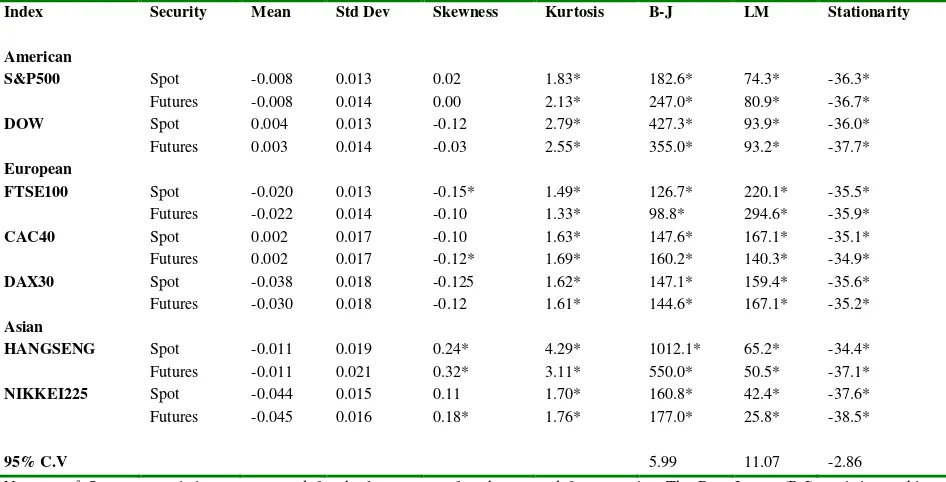
comparisons. Summary statistics for the full sample are displayed in Table I. The means of the
return series are generally negative with the exception of the DOW and the CAC40. Volatility as
evidenced by standard deviation ranges from 1.3% to 2.1% with the Asian and European indices
markedly higher than the American indices. All of the return series are non-normal as evidenced
of our return series is broadly similar within geographic regions. The HANGSENG shows the
largest deviations from a Gaussian distribution as evidenced by excess kurtosis of 4.29 for the
spot index and a correspondingly high Bera-Jarque statistic. All of the series exhibit conditional
heteroskedasticity with significant LM test statistics. This is particularly noticeable in the
European markets with the FTSE100 showing the most significant effects. This result justifies
our decision to use methods that account for time variation. The data were checked for
stationarity using Dickey Fuller unit root tests. We find that the raw series are non-stationary
while the log return series are stationary. This is important from a hedging perspective as non-
stationary series may lead to spurious regressions and therefore invalidate the estimation of
optimal hedge ratios.
[INSERT TABLE I HERE]
5. Empirical Findings
The estimated in-sample model parameters for the Rolling OLS, DVECH and CC GARCH
models are quite standard and are therefore not reproduced in detail3, however, the following
points were observed. The results of the Rolling OLS regression indicate positive significant
coefficients on the futures returns which are the OHR estimates for this model. Both the DVECH
and CC GARCH models appear to represent the conditional variance of the data quite well. The
sum of the parameter estimatesαs +βs for spot and αf +βf for futures is close to unity in most
cases indicating strong volatility persistence. All of the coefficients in the models are strongly
significant indicating the time-varying nature of the conditional variances and covariance’s.
Also, for all series the hedge ratios appear to be stationary. This result corroborates Brooks et al
(2002) and indicates that there may be a narrow performance gap between the time varying and
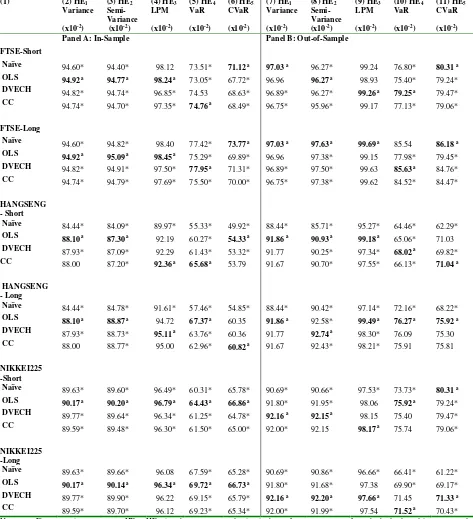
Table II presents the results of hedging performance for each hedging model for both short and
long hedgers (Panel A, In-Sample and Panel B, Out-of-Sample).
[INSERT TABLE II HERE]
We compare the hedging performance of the different hedging strategies for each of the hedging
effectiveness metrics HE1 – HE5 using Efrons (1979) bootstrap methodology. This involves the
generation of a large number of sample datasets from the short and long data for each hedged
portfolio. This enables us to test for statistical differences by employing t-tests of the differences
between models based on the point estimates of our results. We do this for each market and for
both short and long hedgers. For example, using the short hedged SP500 in-sample in column 1-
HE5, we compare the best performing OLS model with each of the other models. We therefore
calculated 210 differences between the hedging models, together with their associated t-statistics
both in-sample and out-of-sample. Of the 210 pairs tested, 170 (81%) are significant at the 1%
level in-sample, whereas 140 (69%) are significant out-of sample. This indicates substantial
differences in the statistical performance of the different hedging models across each of the
different performance metrics.
Considering the overall hedging performance using HE1 - the variance reduction criterion, both
the in-sample and out-of-sample results show substantial reductions in variance for each of the
hedge strategies as compared with a no-hedge position. In-sample, the clear winner in
performance terms is the OLS model, which yields superior performance in each of our markets,
followed by the two GARCH models. This result is consistent with other studies and is not
surprising given that the OLS and GARCH models minimise the variance and are better able to
that both the Naïve and OLS strategies tend to outperform the GARCH models, however, the
performance differences between the hedging strategies are not economically significant.
More generally we can see a number of features emerge when we examine performance using
the performance measures other than the variance. Firstly, we can see that for each metric HE2 –
HE5, both the in-sample and out-of-sample results of the hedging strategies illustrate the value of
hedging in reducing risk, irrespective of the measure of risk employed. In-sample using HE3 –
the LPM for example, there are typical reductions in the LPM’s of the hedged portfolio’s ranging
from around 70% to over 90% for each of the LPM’s calculated. Also, using HE4 - VaR, the
results show large reductions in the VaR across all markets, and for both short and long hedgers.
For example, a short hedger using the DVECH model to hedge the SP500 reduces the VaR by
over 68% as compared with a no-hedge strategy. Similar results are found when we use HE5 –
CVaR. Also, out-of-sample results out-perform the in-sample results. This occurs in 96% of all
cases and by an average of just over 8%. The only exceptions to this are the Long SP500 and
NIKKEI for the VaR and CVaR metrics.
Secondly, performance differences between short and long hedgers were also compared. This
was carried out as follows. Taking the SP500 for example, the hedging performance of the naïve
model for short hedgers was compared against the naïve model for long hedgers. This was done
for each market and for each performance metric excluding the variance, yielding 112
comparisons in total4. The results of this comparison indicate that short hedgers outperform long
hedgers in 68% of cases in-sample and 64% of cases out-of-sample. The differences between
short and long hedgers are more pronounced for some performance measures. For example,
compared with just 4% for the Semi-Variance. This result is replicated out of sample and is
consistent with those reported for short vs long hedgers in Demirer et al. (2005) and Lien and
Demirer (2003).
Finally, we examine the results on a market by market basis finding economically significant
performance differences both in-sample and out-of-sample between markets. Better performance
is observed for the SP500, DOW and FTSE, while the worst hedging performance is observed
for the DAX30. For example using performance metric HE3 - the LPM, the DAX30 typically
underperforms the SP500 by an average of around 27% in-sample and 5% out-of-sample. These
performance differences are also observed on a model by model basis. Using the OLS model and
performance metric HE1 – the Variance, the best performing hedge in-sample is the FTSE100
(HE1 94.9%) while the worst hedging performance is for the DAX30 (HE1 72.7%). This
represents a performance differential of over 30% and is consistent with lower correlation
between the DAX30 spot and futures index as compared with the other markets. We also
compare in-sample and out-of-sample results using an F-test of the ratio of the variances. The
results are significantly different in all cases at the 5% level, with the out-of sample hedging
performance better than-in-sample by an average of 6% across all hedging models and markets.
Table III provides a summary of model hedging performance for each of our stock market
indices. This demonstrates that using different performance metrics to evaluate hedging
strategies yields important differences in terms of which model is the most effective. If we
examine the dominant hedging strategy in-sample and out-of sample for both short and long
hedgers, we find substantial differences between the performance metrics. For example using the
variance as our performance metric, the dominant hedging strategies are the Naïve and OLS
we use the semi-variance, 71% for both the LPM and CVaR metrics, whereas when we examine
the best hedging model using the VaR performance metric, the GARCH models are the best
performers in 54% of cases.
This has important implications for hedgers in that their performance criteria indicate which
hedging model would be most appropriate in a given hedging context. Where hedgers have a
variety of performance aims they should, therefore, consider a variety of measures of hedging
effectiveness. Differences between markets also indicate that a different model may be chosen to
generate a hedge strategy when a performance metric other than the variance is employed. More
generally, the overall results indicate the superiority of the simpler rolling window OLS model
in-sample and both the OLS and Naïve models out-of-sample. It would appear, therefore, that
with the exception of the VaR metric, the dominance of these strategies is not specific to the use
of the variance as a hedging performance metric.
[INSERT TABLE III HERE]
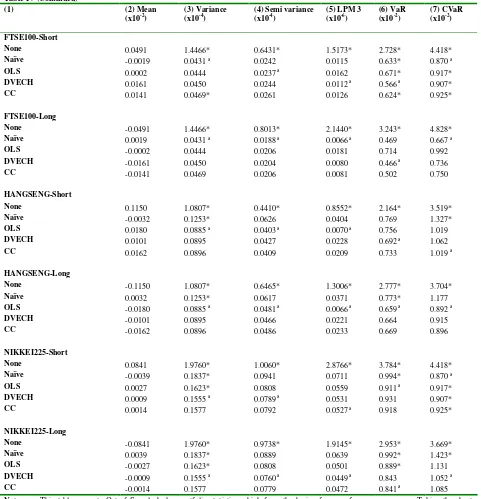
To verify our findings on the divergence of hedging effectiveness for the performance metrics
applied, we again employ the bootstrap methodology.Table IV reports mean returns for the post
sample hedge portfolios, together with statistical comparisons of performance results between
hedging models. For each performance metric we compare each of the hedging models for both
long and short hedgers with a benchmark hedge model which is the best performer (based on
lowest dispersion). Specifically, letαij =θij−θ, where θijis the ith performance measure
(Variance, Semi-variance, LPM, VaR, CVaR) for the jth hedging model (None, Naïve, OLS,
DVECH, CC) and θ is the benchmark performance measure. We test the null
is done for each contract and each performance metric. In this way we generate 280 comparisons
between hedging models and their associated t-statistics. Of these, 131 of the pairs tested are
significant at the 1% level (47%). This suggests that the performance differences reflect the
out-of-sample performance differences of the hedge positions and is not the result of sample
variation. Again we can see from Table IV the performance differences between a no hedge
position and all the other hedge strategies.
[INSERT TABLE IV HERE]
Examining column 6 and 7 - the VaR and CVaR figures clearly show the benefits from hedging.
Using the short hedged SP500 for example, the VaR figure indicates that there is a 1% chance of
the unhedged portfolio losing more of 2.082% of its value, whereas the corresponding CVaR
figure shows that the expected loss conditional that the VaR figure is exceeded will be 2.676% of
the value of the portfolio. Hedging with the best performing model, however, reduces the VaR
(using OLS) by 79% and the CVaR (using CC) by almost 76% to just 0.631% of the portfolio
value. This again demonstrates not only the value of hedging, but also that the use of different
performance metrics may differentiate between the best performing model, and therefore the best
hedging strategy.
6. Conclusion
This paper compares the hedging effectiveness of some of the commonly applied econometric
models using an extensive set of performance metrics for a range of global equity indices.
The metrics chosen are the Variance, Semi-variance, LPM, VaR and CVaR. A number of our
results are worth noting. First, we find that the overall dominance of Naïve and OLS hedge
performance. However, the choice of performance method that is used to evaluate an optimal
hedge strategy is an important consideration in determining the model that is chosen to generate
an optimal hedge ratio. Some performance metrics, especially VaR, yield different results in
terms of which econometric model provides the best hedging solution when compared with the
traditional variance reduction performance criterion. This result indicates that the measure of
hedging effectiveness that is used should also correspond to the outcome that is desired from
hedging as different performance metrics may differentiate in terms of model choice.
Second, the performance metrics applied in this paper indicate different hedging performance for
short as opposed to long hedgers. This suggests that hedgers who are interested in opposite tails
of the return distribution may benefit by considering the use of hedging performance metrics that
differentiate between the left and right tail probabilities. This result may be even more
pronounced for assets and markets that have strongly asymmetric return distributions, and is
Bibliography
Baillie, R.T., & Myers, R.J. (1991). Bivariate GARCH estimation of the optimal futures hedge.
Journal of Applied Econometrics, 6, 109 – 124.
Bawa, S. (1975). Optimal rules for ordering uncertain prospects. Journal of Financial
Economics, 2, 95-121.
Bollerslev, T. (1986). Generalized autoregressive conditional heteroskedasticity. Journal of
Econometrics, 31, 307-327.
Bollerslev, T. (1990). Modeling the coherence in short-run nominal exchange rates: A
multivariate generalized ARCH model. Review of Economics and Statistics, 72, 498–505.
Bollerslev, T., Engle, R.F., & Wooldridge, J.M. (1988). A capital asset pricing
model with time-varying covariances. Journal of Political Economy, 96, 116 - 131.
Brooks, C., & Chong, J. (2001). The cross-currency hedging performance of implied versus
statistical forecasting models. Journal of Futures Markets, 21, 1043-1069.
Brooks, C., Henry, O.T., & Persand, G. (2002). The effects of asymmetries on optimal hedge
ratios. Journal of Business, 75, 333 – 352.
Cecchetti, S.G., Cumby, R.E., & Figlewski, S. (1988). Estimation of the optimal futures hedge.
Choudhry, T. (2003). Short run deviations and optimal hedge ratios: Evidence from stock
futures. Journal of Multinational Financial Management, 13, 171 – 192.
Conrad, J., Gultekin, M., & Kaul, G. (1991). Asymmetric predictability of conditional variances.
Review of Financial Studies, 4, 597-622.
Demirer, R., & Lien, D. (2003). Downside risk for short and long hedgers. International Review
of Economics and Finance, 12, 25 – 44.
Demirer, R., Lien, D., & Shaffer, D. (2005). Comparisons of short and long hedge performance:
The case of Taiwan. Journal of Multinational Financial Management, 15, 51-66.
Ederington, L. (1979). The hedging performance of the new futures markets. Journal of Finance,
34, 157 – 170.
Efron, B. (1979). Bootstrap methods: Another look at the Jack-knife. The Annals of Statistics, 7,
1–26.
Engle, R., & Kroner, K. (1995). Multivariate simultaneous generalized ARCH. Econometric
Theory, 11, 122-150.
Fishburn, P. (1977). Mean-risk analysis with risk associated with below-target returns. The
Kroner, K.F., & Sultan, J. (1993). Time varying distribution and dynamic hedging with foreign
currency futures. Journal of Financial and Quantitative Analysis, 28, 535-551.
Lien, D., & Tse, Y.K. (2002). Some recent developments in futures hedging. Journal of
Economic Surveys, 16, 357 – 396.
Lien, D., Tse, Y.K., & Tsui, A.K. (2002). Evaluating the hedging performance of the
constant-correlation GARCH model. Applied Financial Economics, 12, 791 - 798.
Park, T.H., & Switzer, L.N. (1995). Bivariate GARCH estimation of the optimal hedge ratios for
stock index futures: A note. Journal of Futures Markets, 15, 61 - 67.
Roy, A. (1952). Safety first and the holding of assets. Econometrica, 20, 431-449.
Tasche, D. (2002). Expected shortfall and beyond. Journal of Banking and Finance, 26,
1519-1533.
Table I: Summary Statistics of Daily Stock Index Futures and Spot Returnsa
Index Security Mean Std Dev Skewness Kurtosis B-J LM Stationarity
American
S&P500 Spot -0.008 0.013 0.02 1.83* 182.6* 74.3* -36.3*
Futures -0.008 0.014 0.00 2.13* 247.0* 80.9* -36.7*
DOW Spot 0.004 0.013 -0.12 2.79* 427.3* 93.9* -36.0*
Futures 0.003 0.014 -0.03 2.55* 355.0* 93.2* -37.7*
European
FTSE100 Spot -0.020 0.013 -0.15* 1.49* 126.7* 220.1* -35.5*
Futures -0.022 0.014 -0.10 1.33* 98.8* 294.6* -35.9*
CAC40 Spot 0.002 0.017 -0.10 1.63* 147.6* 167.1* -35.1*
Futures 0.002 0.017 -0.12* 1.69* 160.2* 140.3* -34.9*
DAX30 Spot -0.038 0.018 -0.125 1.62* 147.1* 159.4* -35.6*
Futures -0.030 0.018 -0.12 1.61* 144.6* 167.1* -35.2*
Asian
HANGSENG Spot -0.011 0.019 0.24* 4.29* 1012.1* 65.2* -34.4*
Futures -0.011 0.021 0.32* 3.11* 550.0* 50.5* -37.1*
NIKKEI225 Spot -0.044 0.015 0.11 1.70* 160.8* 42.4* -37.6*
Futures -0.045 0.016 0.18* 1.76* 177.0* 25.8* -38.5*
95% C.V 5.99 11.07 -2.86
Notes: a Summary statistics are presented for the log returns of each spot and futures series. The Bera-Jarque (B-J) statistic combines
skewness and kurtosis to measure normality. LM, (with 4 lags) is the Lagrange Multiplier test proposed by Engle (1982). The test statistic for B-J and LM tests are distributed 2. Stationarity is tested using the Dickey-Fuller unit root test. *Denotes Significance at
Table II: Evaluation of Hedging Performance
(1) (2) HE1
Variance
(x10-2)
(3) HE2 Semi- Variance (x10-2)
(4) HE3 LPM
(x10-2)
(5) HE4 VaR
(x10-2)
(6) HE5 CVaR
(x10-2)
(7) HE1 Variance
(x10-2)
(8) HE2 Semi- Variance (x10-2)
(9) HE3 LPM
(x10-2)
(10) HE4 VaR
(x10-2)
(11) HE5 CVaR
(x10-2)
Panel A: In-Sample Panel B: Out-of-Sample
SP500-Short
Naïve 93.40* 92.65* 97.20* 68.19* 64.78* 96.95 a 96.28 a 99.32 a 78.00* 74.44*
OLS 93.92a 93.36 a 97.80 a 68.25* 71.58 a 96.32* 95.66* 99.19 78.96 a 75.86*
DVECH 93.63* 92.94* 97.47* 68.49 a 67.11* 96.59* 95.87* 99.26 78.91 76.01
CC 93.73* 93.05* 97.55* 68.16* 67.28* 96.50* 95.87* 99.24 78.72 76.42 a
SP500-Long
Naïve 93.40* 94.18* 98.67 79.84* 78.35* 96.95 a 97.47 a 99.61 a 75.95 76.71*
OLS 93.92 a 94.50 a 98.75 a 79.69* 78.47* 96.32* 96.84* 99.46 76.12 a 77.27 a
DVECH 93.63* 94.34* 98.71 80.52 a 78.40* 96.59* 96.99* 99.50 75.37* 76.86*
CC 93.73* 94.42* 98.74 80.37* 78.76 a 96.50* 96.99* 99.49 75.66* 77.01
DOW-Short
Naïve 92.63* 92.19* 96.99* 64.54* 65.12* 96.96 a 96.52 a 99.38 a 78.76 a 82.97 a
OLS 93.41 a 92.93* 97.39 59.91* 68.04 96.10* 95.65* 99.18 76.26* 81.17*
DVECH 93.36 93.03 97.52 71.64 a 68.30 a 96.19* 95.65* 99.20 76.35* 81.38*
CC 93.40 93.04 a 97.53 a 66.89* 68.08 96.29* 95.87* 99.25 76.63* 82.64
DOW-Long
Naïve 92.63* 93.10* 97.57 74.39* 70.15* 96.96 a 97.30 a 99.57 a 85.68 a 84.87 a
OLS 93.41 a 93.92 a 98.01 a 76.73* 73.15 a 96.10* 96.45* 99.36 81.29* 83.08*
DVECH 93.36 93.71* 97.75 77.03 71.72* 96.19* 96.62* 99.39 81.26* 82.69*
CC 93.40 93.78* 97.80 77.33 a 71.74* 96.29* 96.62* 99.40 81.94* 82.69*
CAC40-Short
Naïve 87.07* 87.54* 94.05* 61.19* 54.22* 92.44* 92.16* 97.70 71.17* 70.24*
OLS 88.33 a 88.60 a 94.80 a 64.90* 57.60 a 92.82 a 92.79 a 98.21 a 74.52 a 74.43
DVECH 87.86* 88.11* 93.54* 63.96* 55.77* 92.36* 92.25* 97.80 72.13* 70.75*
CC 88.28 88.58 93.89* 65.91 a 56.72* 92.65 92.61* 98.08 73.55* 74.47 a
CAC40-Long
Naïve 87.07* 86.57* 93.35* 59.55* 53.12* 92.44* 92.73* 97.94 a 72.15* 71.79 a
OLS 88.33 a 88.05 a 94.41 a 65.76 a 59.27 a 92.82 a 92.89 a 97.72 79.94 a 70.69*
DVECH 87.86* 87.59* 93.69* 62.09* 57.31* 92.36* 92.49* 97.63 73.83* 70.06*
CC 88.28 87.97 94.11 64.59* 57.89* 92.65 92.73* 97.86 73.97* 71.11
DAX30-Short
Naïve 70.12* 72.26* 72.51* 50.28* 40.74* 82.62* 83.55* 94.18* 61.71* 63.29*
OLS 72.70 a 73.71 a 74.67 a 52.52* 43.77 a 85.97 a 87.28* 95.94 66.55* 66.37*
DVECH 71.14* 72.09* 73.22* 51.66* 42.66* 85.84 88.08 a 96.28 a 70.95 a 68.54 a CC 72.13* 72.96* 74.36 53.47 a 43.62 85.61 87.50* 95.89 68.15* 66.73*
DAX30-Long
Naïve 70.12* 67.75* 60.20* 44.77* 35.37* 82.62* 82.22* 92.50* 54.69* 58.03*
OLS 72.70 a 71.58 a 70.83 51.34 a 40.56 a 85.97 a 84.86 a 94.22 a 61.68 61.51 a
DVECH 71.14* 70.08* 66.72* 49.96* 39.07* 85.84 83.80* 93.81 61.93 a 60.57
Table II (Continued)
(1) (2) HE1
Variance
(x10-2)
(3) HE2 Semi- Variance (x10-2)
(4) HE3 LPM
(x10-2)
(5) HE4 VaR
(x10-2)
(6) HE5 CVaR
(x10-2)
(7) HE1 Variance
(x10-2)
(8) HE2 Semi- Variance (x10-2)
(9) HE3 LPM
(x10-2)
(10) HE4 VaR
(x10-2)
(11) HE5 CVaR
(x10-2)
Panel A: In-Sample Panel B: Out-of-Sample
FTSE-Short
Naïve 94.60* 94.40* 98.12 73.51* 71.12 a 97.03 a 96.27* 99.24 76.80* 80.31 a
OLS 94.92 a 94.77 a 98.24 a 73.05* 67.72* 96.96 96.27 a 98.93 75.40* 79.24*
DVECH 94.82* 94.74* 96.85* 74.53 68.63* 96.89* 96.27* 99.26 a 79.25 a 79.47*
CC 94.74* 94.70* 97.35* 74.76 a 68.49* 96.75* 95.96* 99.17 77.13* 79.06*
FTSE-Long
Naïve 94.60* 94.82* 98.40 77.42* 73.77 a 97.03 a 97.63 a 99.69 a 85.54 86.18 a
OLS 94.92 a 95.09 a 98.45 a 75.29* 69.89* 96.96 97.38* 99.15 77.98* 79.45*
DVECH 94.82* 94.91* 97.50* 77.95 a 71.31* 96.89* 97.50* 99.63 85.63 a 84.76*
CC 94.74* 94.79* 97.69* 75.50* 70.00* 96.75* 97.38* 99.62 84.52* 84.47*
HANGSENG - Short
Naïve 84.44* 84.09* 89.97* 55.33* 49.92* 88.44* 85.71* 95.27* 64.46* 62.29*
OLS 88.10 a 87.30 a 92.19 60.27* 54.33 a 91.86 a 90.93 a 99.18 a 65.06* 71.03
DVECH 87.93* 87.09* 92.29 61.43* 53.32* 91.77 90.25* 97.34* 68.02 a 69.82*
CC 88.00 87.20* 92.36 a 65.68 a 53.79 91.67 90.70* 97.55* 66.13* 71.04 a
HANGSENG - Long
Naïve 84.44* 84.78* 91.61* 57.46* 54.85* 88.44* 90.42* 97.14* 72.16* 68.22*
OLS 88.10 a 88.87 a 94.72 67.37 a 60.35 91.86 a 92.58* 99.49 a 76.27 a 75.92 a
DVECH 87.93* 88.73* 95.11 a 63.76* 60.36 91.77 92.74 a 98.30* 76.09 75.30
CC 88.00 88.77* 95.00 62.96* 60.82 a 91.67 92.43* 98.21* 75.91 75.81
NIKKEI225 -Short
Naïve 89.63* 89.60* 96.49* 60.31* 65.78* 90.69* 90.66* 97.53* 73.73* 80.31 a
OLS 90.17 a 90.20 a 96.79 a 64.43 a 66.86 a 91.80* 91.95* 98.06 75.92 a 79.24* DVECH 89.77* 89.64* 96.34* 61.25* 64.78* 92.16 a
92.15 a 98.15 75.40 79.47*
CC 89.59* 89.48* 96.30* 61.50* 65.00* 92.00* 92.15 98.17 a 75.74 79.06*
NIKKEI225 -Long
Naïve 89.63* 89.66* 96.08 67.59* 65.28* 90.69* 90.86* 96.66* 66.41* 61.22*
OLS 90.17 a 90.14 a 96.34 a 69.72 a 66.73 a 91.80* 91.68* 97.38 69.90* 69.17*
DVECH 89.77* 89.90* 96.22 69.15* 65.79* 92.16 a 92.20 a 97.66 a 71.45 71.33 a
CC 89.59* 89.70* 96.12 69.23* 65.34* 92.00* 91.99* 97.54 71.52 a 70.43*
Notes: Figures are in percentages. HE1 – HE5 give the percentage reduction in the performance measure from the hedged model as compared
[image:30.612.72.545.89.608.2]Table III: Summary of Best Hedging Performance
Panel A: In-Sample Short Hedgers
Variance Semi -
Variance
LPM VaR CVaR
SP500 OLS OLS OLS DVECH OLS
DOW OLS CC CC DVECH DVECH
CAC OLS OLS OLS CC OLS
DAX OLS OLS OLS CC OLS
FTSE100 OLS OLS OLS CC NAÏVE
HANGSENG OLS OLS CC CC OLS
NIKKEI225 OLS OLS OLS OLS OLS
Long Hedgers
Variance Semi -
Variance
LPM VaR CVaR
SP500 OLS OLS OLS DVECH CC
DOW OLS OLS OLS CC OLS
CAC OLS OLS OLS OLS OLS
DAX OLS OLS CC OLS OLS
FTSE100 OLS OLS OLS DVECH NAÏVE
HANGSENG OLS OLS DVECH OLS CC
NIKKEI225 OLS OLS OLS OLS OLS
Panel B: Out-of-Sample Short Hedgers
Variance Semi -
Variance
LPM VaR CVaR
SP500 NAÏVE NAÏVE NAÏVE OLS CC
DOW NAÏVE NAÏVE NAÏVE NAIVE NAÏVE
CAC OLS OLS OLS OLS CC
DAX OLS DVECH DVECH DVECH DVECH
FTSE100 NAÏVE OLS DVECH DVECH NAÏVE
HANGSENG OLS OLS OLS DVECH CC
NIKKEI225 DVECH DVECH CC OLS NAÏVE
Long Hedgers
Variance Semi -
Variance
LPM VaR CVaR
SP500 NAÏVE NAÏVE NAÏVE OLS OLS
DOW NAÏVE NAÏVE NAÏVE NAÏVE NAÏVE
CAC OLS OLS NAÏVE OLS NAÏVE
DAX OLS OLS OLS DVECH OLS
FTSE100 NAÏVE NAÏVE NAÏVE DVECH NAÏVE
HANGSENG OLS DVECH OLS OLS OLS
NIKKEI225 DVECH DVECH DVECH CC DVECH
Notes: The findings indicate which models provided the best hedging performance for the different performance measures. For example, for a
short hedger holding the S&P500 with VaR as the performance criterion, the best performance out-of-sample would be the OLS