Model-Driven Machine Learning for Predictive Cloud
Auto-scaling
Hanieh Alipour A Thesis In the Department ofElectrical and Computer Engineering
Presented in Partial Fulfillment of the Requirements For the Degree of
Doctor of Philosophy (Electrical and Computer Engineering) at Concordia University
Montr´eal, Qu´ebec, Canada
May 2019
Concordia University
School of Graduate Studies
This is to certify that the thesis prepared
By: Hanieh Alipour
Entitled: Model-Driven Machine Learning for Predictive Cloud Auto-scaling
and submitted in partial fulfillment of the requirements for the degree of
Doctor of Philosophy (Electrical and Computer Engineering)
complies with the regulations of this University and meets the accepted standards with respect to originality and quality.
Signed by the final examining commitee:
Chair Dr. Nikolaos Tsantalis External Examiner Dr. Dorina Petriu Examiner Dr. Olga Ormandjieva Examiner Dr. Juergen Rilling Examiner Dr. Ferhat Khendek Supervisor Dr. Yan Liu Approved
Dr. Mustafa K. Mehmet Ali, Graduate Program Director
May 2019
Dr. Amir Asif, Dean Faculty of Engineering and Com-puter Science
Abstract
Model-Driven Machine Learning for Predictive Cloud
Auto-scaling
Hanieh Alipour, Ph.D.
Concordia University, 2019
Cloud provisioning of resources requires continuous monitoring and
analysis of the workload on virtual computing resources.
However,
cloud providers offer the rule-based and schedule-based auto-scaling
service. Auto-scaling is a cloud system that reacts to real-time metrics
and adjusts service instances based on predefined scaling policies. The
challenge of this reactive approach to auto-scaling is to cope with
fluc-tuating load changes. For data management applications, the workload
is changing and needs forecasting on historical trends and integrating
with auto-scaling service. We aim to discover changes and patterns on
multi metrics of resource usages of CPU, memory, and networking. To
address this problem, the learning-and-inference based prediction has
been adopted to predict the needs prior to provision action.
First, we develop a novel machine learning-based auto-scaling
pro-cess that covers the technique of learning multiple metrics for cloud
auto-scaling decision.
This technique is used for continuous model
training and workload forecasting. Furthermore, the result of
work-load forecasting triggers the auto-scaling process automatically. Also,
we build the serverless functions of this machine learning-based process,
including monitoring, machine learning, model selection, scheduling as
microservices and orchestrating these independent services by platform,
language orthogonal APIs. We demonstrate this architectural
imple-mentation on AWS and Microsoft Azure, and show the prediction
re-sults from machine learning on-the-fly. Rere-sults show significant cost
reductions by our proposed solution compared to a general
threshold-based auto-scaling.
Still, there is a need to integrate the machine learning prediction
with the auto-scaling system. So, the deployment effort of devising
additional machine learning components is increased. So, we present
a model-driven framework that defines first-class entities to represent
machine learning algorithm types, inputs, outputs, parameters, and
evaluation scores. We set up rules for validating machine learning
en-tities. The connection between the machine learning and auto-scaling
system is presented by two levels of abstraction models, namely cloud
platform independent model and cloud platform specific model. We
au-tomate the model-to-model transformation and model-to-deployment
transformation. We integrate model-driven with a DevOps approach
to make models deployable and executable on a target cloud platform.
We demonstrate our method with scaling configuration and deployment
of two open source benchmark applications - Dell DVD store and Netflix
(NDBench) on three cloud platforms, AWS, Azure, and Rackspace. The
evaluation shows our inference-based auto-scaling with model-driven
reduces approximately 27% of deployment effort compared to the
ordi-nary auto-scaling.
Acknowledgments
First, and foremost, I am grateful to my Ph.D. supervisor Dr. Yan Liu for her guidance, support, patience, and encouragement. She is the dedicated, professional and caring advisor. Thank you.
I thankfully acknowledge my Ph.D. committee members, Dr. Ferhat Khendek, Dr. Olga Ormandjieva and Dr. Juergen Rilling for their time, effort and constructive comments. I would also like to extend my appreciation to the external examiner Dr. Dorina Petriu for accepting to serve in my Ph.D. thesis committee.
I thank my ex-colleagues in SAP company for their help, cooperation, and encour-agements. Special thanks to Pierre-luc Orsini for his companionship, support, ideas, and fruitful discussions.
My very special thanks to Zahra Asadi and Pantea Koochemeshkian, my best friends. You were always there with me through the toughest moments. Your friendly advice, your soothing words, and your big heart helped me face all the obstacles and continue with my work. I am truly lucky to count you amongst my friends.
Also, I am forever indebted to my family for their encouragement, continuous support, love and encourage. My sincere thanks go to my mother Aseah, my dad Mohammad and my brother Hessam. Without you, this thesis would not have been possible. There are no words that can express my gratitude and love for you.
Last but not least, I owe a special thanks to my love and my best friend, Pierre Yves Lambert. I love you for being so understanding and for putting up with me through the toughest moments of my life. Thanks for being extremely supportive throughout this entire process. In addition, I thank Dr. Yves Lambert and Therese Baribeau for their kindness and support.
Table of Contents
List of Figures ix
List of Tables xii
1 Introduction 1
1.1 Problem statement . . . 1
1.2 Research Questions . . . 5
1.3 Contributions . . . 5
1.4 Structure of the thesis . . . 7
2 Related Work 8 2.1 Microservice Architecture . . . 8
2.2 Machine Learning Service . . . 10
2.3 Auto-scaling service in Cloud Computing . . . 13
2.4 Measurement . . . 15
2.5 Model-driven Software Development (MDD) . . . 16
2.6 DevOps . . . 17
2.7 Evaluation methods . . . 18
2.8 Summary . . . 18
3 Integrating Machine Learning with Auto-scaling 20 3.1 Multiple Metrics Analysis . . . 20
3.2 Machine Learning Models . . . 23
3.2.1 Model Selection Method . . . 26
3.3 Architecture Design for Forecasting based Auto-scaling Process . . . 27
3.3.2 Forecasting based Auto-scaling Process . . . 29
3.3.3 Microservice Design . . . 30
3.3.4 API Design . . . 31
3.3.5 Schedule-based Controller Service . . . 32
3.4 Evaluation of Integrating Machine Learning with Auto-scaling . . . . 33
3.4.1 Demonstration Application . . . 34
3.4.2 Deployment Components on AWS and Azure . . . 35
3.4.3 Tuning the Parameters of Machine Learning Algorithms . . . 38
3.4.4 Evaluation Results . . . 41
3.4.5 Resource Provision and De-provision . . . 43
3.4.6 Cost Estimation . . . 46
3.5 Summary . . . 48
4 Model-Driven Architecture 50 4.1 Model Driven Approach . . . 50
4.2 Cloud Platform Independent Model . . . 51
4.2.1 Machine Learning Abstraction . . . 51
4.2.2 Machine Learning Meta Model . . . 53
4.2.3 Auto-scaling Process Abstraction . . . 57
4.2.4 Auto-scaling System Meta Model . . . 58
4.2.5 The Predictive Auto-scaling System . . . 60
4.2.6 The Predictive Auto-scaling System Cloud Independent Model 60 4.3 Cloud Platform Specific Model . . . 62
4.3.1 CPSM for Machine Learning Model . . . 63
4.3.2 Constraints and Rules . . . 67
4.4 Model Validation . . . 68
4.5 Model Transformation . . . 70
4.6 Deployment Phase . . . 72
4.6.1 How to create machine learning environment? . . . 73
4.6.2 How to deploy machine learning codes on the environment? . 75 4.6.3 Architecture Deployment on Microsoft Azure . . . 76
4.6.4 Architecture Deployment on Microsoft AWS . . . 81
4.7 Run-time Phase . . . 85
5 Evaluation 87
5.1 Evaluation Metric (CMP) . . . 87
5.2 Evaluation Scenarios . . . 92
5.3 CMP Results . . . 93
5.4 Summary . . . 96
6 Conclusion and Publications 103 6.1 Threats to Validity . . . 103
6.2 Future Work . . . 104
6.3 Conclusion . . . 105
List of Figures
1 Deployment of (a) the monolithic architecture and (b) the microservice
architecture on AWS [67] . . . 9
2 A container-based microservice architecture of OpenStack. (a) Open-Stack deployment, (b) Service registration and discovery in microser-vice architecture [44] . . . 10
3 System Architecture for applying machine learning on multi-tier web application on AWS [21] . . . 11
4 Architectural overview of a predictive auto-scaling system [54] . . . . 12
5 Overview of the Resource Optimization, Allocation and Recommenda-tion System (ROAR) [62] . . . 14
6 MODAClouds approach [25] . . . 17
7 Sample of multi metrics workload generated on cloud environment . . 22
8 Final result of the Weighted Metrics with Aggregation (WMA) Fti . . 23
9 Illustrations for basic LSTM [13] . . . 24
10 Illustrations for basic Bidirectional LSTM [4] . . . 25
11 Original Auto-scaling Process . . . 28
12 An Inference-based Forecasting for Auto-scaling Process . . . 31
13 Continuous Training and Inference Phases . . . 32
14 DVD store architecture . . . 34
15 The NDBench Cluster with a Cassandra Cluster . . . 36
16 Deployment Architecture for AWS . . . 37
17 Deployment Architecture for Azure . . . 39
18 The prediction result of machine learning algorithms for Dell DVD store 42 19 The prediction result of machine learning algorithms on AWS and Azure for NDBench . . . 43
20 The prediction result of machine learning algorithms (VAR, LSTM, BI-LSTM, LR, SVR, GBR) for NDBench and DVD store . . . 44 21 Resource Provision and De-provision on AWS and Azure NDBench . 45 22 Resource Provision and De-provision on AWS for Dell DVD store . . 46 23 Model Transformation in the Life-cycle of Auto-scaling . . . 51 24 An Example of the Machine Learning Environment Commonality . . 53 25 Meta-model of Machine Learning Model . . . 55 26 Predictive Auto-scaling System based on Monitor-Analyze-Plan-Execute
(MAPE) loop . . . 58 27 Cloud Platform Independent Model for Auto-scaling System . . . 59 28 Predictive Auto-scaling System based on Monitor-Analyze-Plan-Execute
(MAPE) loop . . . 60 29 Cloud Platform Independent Model of Integrated Machine Learning
with Auto-scaling Service . . . 61 30 Adding model objects to CPSM . . . 64 31 An example of creating CPSM from CPIM . . . 65 32 Example of Cloud Platform Specific Model for Machine Learning
In-stance (SVR Algorithm) . . . 65 33 Example of Cloud Platform Specific Model for Machine Learning
In-stance (LSTM Algorithm) . . . 66 34 Example of EVL rules to validate CPSM . . . 69 35 The machine learning meta-model rule in modeling language format . 69 36 The EGL template for generation code from EMF models . . . 71 37 The EGL rule for generating JSON file . . . 71 38 The EGX driver for launch Packer . . . 72 39 Sequence of Actions for Generating CPSMs and Deployment Scripts
for Machine Learning Environment and Models . . . 74 40 Example of JSON template for creating an machine learning image . 75 41 Example of XML template for a machine learning algorithm . . . 76 42 Example of YAML template for cloning code from GitHub [11] . . . . 77 43 Architecture Deployment on Microsoft Azure . . . 77 44 Grafana Plug-in a on Azure Instance . . . 78 45 Azure Blob Storage files . . . 79
46 The example of Ansible Auto-scaling group for Azure . . . 81
47 CloudFormation Template for Creating AWS Lambda . . . 81
48 Architecture Deployment on Microsoft AWS . . . 82
49 The Ansible Auto-scaling group for AWS . . . 84
50 Example of Cloud Platform Specific Model for Controller . . . 84
51 The CM P Result for the Manual Threshold-based Auto-scaling Ser-vice, and Proposed Model-driven Method Deployment Procedure With-out Machine Learning . . . 95
52 TheCM P result for the Machine Learning, the Threshold based Auto-scaling service, and Proposed model-driven Method Deployment Pro-cedure . . . 95
List of Tables
1 Category of Auto-scaling Deployment Automation Method in Service
Level and Auto-scaling System Level . . . 10
2 Notations for Algorithm 1 . . . 28
3 Example of REST APIs . . . 32
4 AWS configuration of each node for Dell DVD store application . . . 35
5 AWS and Azure configuration of NDBench node . . . 36
6 Tuning SVR parameters on Azure . . . 39
7 Tuning SVR parameters on AWS . . . 40
8 Performance metrics results LR on Azure . . . 40
9 Performance metrics results LR on AWS . . . 40
10 Tuning GBR parameters on Azure . . . 40
11 Tuning GBR parameters on AWS . . . 41
12 Hardware Specification of Machine Learning instances on AWS and Azure . . . 41
13 Training and prediction times for machine learning algorithms for Dell DVD store on AWS only . . . 42
14 Training and prediction times for machine learning algorithms on AWS and Azure for NDBench . . . 43
15 Score Results for NDBench on AWS . . . 44
16 Score Results for DVD Store on AWS . . . 44
17 The Run-time Cost Comparison for Applications on Multi-Clouds for Duration of 1 hour . . . 47
18 The Type of Costs for Cloud Services . . . 47
19 Example of Machine Learning Algorithms for Workload Forecasting . 54 20 Notations for Constraints and Rules . . . 67
22 Hardware Specification of Machine Learning instances on AWS and
Azure . . . 80
23 Complexity Evaluation for Each Installation and Configuration Task . 89 24 Weight Evaluation for Each Installation and Configuration Task . . . 89
25 Complexity Evaluation for Each Storage and Database Task . . . 90
26 Weight Evaluation for Each Storage and Database Task . . . 90
27 Complexity Evaluation for Each Template Changes Task . . . 91
28 Weight Evaluation for Each Template Changes Task . . . 92
29 Manual procedure of auto-scaling data nodes . . . 93
30 For Scenario 1, deployment effort differences for the manual proce-dure for the threshold-based auto-scaling system on AWS, Azure and Rackspace are represented. For Scenario 2, we calculate CM P for the manual deployment procedure for the threshold-based auto-scaling system, and our model-driven method to deploy the auto-scaling sys-tem without machine learning. . . 94
31 ForScenario 3,CM P results for the model-driven deployment proce-dure for the auto-scaling system, and the predictive auto-scaling system for DVD store on AWS. . . 95
32 For Scenario 4, CM P results for the manual deployment proce-dure for machine learning service, manual deployment process of the threshold-based auto-scaling system, and our model-driven method to deploy the predictive auto-scaling system are represented. . . 96
33 Notation for CMP Calculation . . . 96
34 Manual Threshold-based Auto-scaling Deployment Actions for AWS . 97 35 Manual Threshold-based Auto-scaling Deployment Actions for Azure 97 36 MDD Auto-scaling Deployment Actions on AWS . . . 98
37 MDD Auto-scaling Deployment Actions on Rackspace . . . 98
38 Manual Machine Learning Deployment Actions for AWS . . . 99
39 Manual Machine Learning Deployment Actions for Azure . . . 100
40 MDD ML Auto-scaling Deployment Actions on AWS . . . 101
Chapter 1
Introduction
Cloud computing offers many benefits including elastic resource allocation that en-ables automated and fast deployment of services. A key value of resource elasticity is allowing the provisioning and de-provisioning of computing resources on demand, via auto-scaling [24]. We have three different auto-scaling approaches on cloud environ-ment [49]: The first approach is reactive, and it reacts to changes in the system state. It utilizes a threshold-based mechanism. The defined scaling policies adjust the num-ber of instances, within the minimum and maximum numnum-ber of instances. Second, the proactive or scheduled-based approach allows to scale the application resources based on the known load that will appear in future. It allows clients to pre-define a schedule where they proactively scale a system at certain points of time. For example, the service or application is heavily used on boxing day or black Friday and less used on other days. Third, the predictive approach predicts usage of the application in the future and thus changes done accordingly. This approach is suitable for environments with unplanned load spikes and fluctuated workload. While auto-scaling has shown considerable benefits of cloud computing, it still has remaining issues to solve.
1.1
Problem statement
Reactive and Proactive rather than Predictive approach: The current auto-scaling systems are reactive, and proactive rather than predictive [33], [50]. The reactive auto-scaling checks heuristic rules such as schedule-based, event-triggered or threshold value-based to determine whether it is necessary to perform scaling
actions. The heuristic rules involve a set of metrics of varies types and kinds, including system level, service level and application level metrics. This means that the decisions of auto-scaling actions are multi-modal. Heuristic rules lack of the adaptivity to combined effects and correlations among entities and metrics involved in the auto-scaling process.
We need to forecast future demand by taking into account the workload history. Having made a determination and prediction, the scaling engine proceeds to make a decision concerning an alternative plan because of this unexpected situation. It forecasts future demand for sustained performance despite workload fluctuations. So, we need to study the behavior of demand from workload history. There is no process that includes different cloud-based services such as a monitoring service, several ma-chine learning models, model selection and prediction in order to analyze and deter-mine the behavior of the systems under various workloads and capacity contractions. Meanwhile, we need to design an architecture where the machine learning service is composed of a set of cloud services rather than being implemented as a monolithic en-tity. The challenge is to benefit complex cloud services by enabling each independent service to be designed, implemented, scaled, upgraded independently.
Auto-scaling policy is mostly based on a single metric: The auto-scaling policy is mostly based on a single metric, including CPU or Memory usage. The group of metrics together define the behavior of the system, so scaling action based on a single metric is not sufficient. A monitoring service helps an existing auto-scaling by setting alarms to capture the workload changes and sends an alarm when there is an increase in workload to the auto-scaling service. In addition, some cloud providers offer the ability to define multi policies. This means a policy is defined for each metric if you need to consider the effect of several metrics. However, each policy will be defined separately and cannot demonstrate the relationship between metrics. Hence learning-and-inference based approach brings a novel approach to the auto-scaling system to act based on the prediction results learn from multiple metrics as the workload features.
In order to have accurate forecasting for auto-scaling, there is a need to train our models based on the multi metrics. To calculate a mix metrics effect, we need to check the dependency and weight between metrics before training our workload. There are also some important limitations that need to be considered for training the
multi metrics workload with the help of a machine learning approach. For instance, when we have multi metrics, each metric may have a different effect on the behavior of the system. Multi-metrics learning is challenging because we need to find the relationship between metrics. So, we need to calculate the mix metric effect because it is difficult to exploit potential dependencies among the target variables and show the relationship between the different target variables.
How to integrate machine learning with auto-scaling process: Machine Learning is the subject that studies methods for automatically deriving models from data, and it has been successfully applied in many areas of software engineering and cloud computing. A machine learning process includes training and inference phases. Training refers to the process of fitting a machine learning model by optimal model parameters from the sampling data. Inference refers to the process of running a trained model to make predictions. For both training and inference, there are common entities: (1) inputs, (2) outputs, (3) parameters, and (4) assessment metrics. A machine learning model requires a set of inputs and outputs. The inputs are divided into two parts: training dataset and testing dataset. Outputs are a set of data that is being predicted by the trained model. For example, in cloud services inputs can be low-level CPU, memory or network usage or higher-level kinds of data tied to the services or applications, such as requests served per second. For data of distinct categories that are non-numerical, data are first encoded into a numerical form by feature engineering techniques. Hence, in our work, we consider input and output are numeric data and time series type. Parameters include hyper-parameters and model parameters. Hyper-parameters are configuration variables that typically searched by greedy algorithms. To check the accuracy training and inference results, assessment metrics are necessary. The assessment metrics are also used for the model selection that is a process to select a suitable model from a set of candidate models. The value of assessment metrics is also numerical applied.
The machine learning techniques need to be combined with the auto-scaling pro-cess in order to scale, based on the prediction results. Integrating machine learning components with the auto-scaling system requires substantial numbers of manual tasks. In a nutshell, entities are in different scales and characters. The integration of machine learning and auto-scaling should plug-and-play different machine models in a uniform way rather than model-by-model. To support a wide range of machine
learning models, we need to generalize the common entities and represent them at an abstract level.
How to automate the process across cloud platforms: The life-cycle of the auto-scaling system includes five common parts: the auto-scaling group, the monitor, the scaling policy, the scaling engine, and the launch configuration [46]. Machine learning service also includes several components: monitoring, data and model stor-age, machine learning algorithms, validation, and model selection. Integrating ma-chine learning components with the auto-scaling system requires substantial numbers of manual tasks. There is a need to automate the machine learning integration process and reduce deployment effort. In addition, current auto-scaling approaches that are offered by cloud providers typically require an expert to manually configure the added resources for Cloud-based data management applications such as Dell DVD store database [22], [57] and Cassandra database cluster [5] because auto-scaling services only create and add the new instance to the auto-scaling group without re-configuring the cluster. Manually configuring resources may increase the system downtime. For example, for Cassandra dataset cluster [6], if we add a new instance we need to reconfigure the cluster and change some configuration files include Cassandra.yaml.
Also, models should be transformed into deployment entities to help reduce de-ployment effort. Otherwise, models remained at the design phase and isolated from the rest of the life-cycle of the machine learning process. There is a need to auto-mate the machine learning integration process and reduce deployment effort. The goal is to hide the complexities of using different technologies from developers who are responsible for managing the cloud environment. In other words, the deployment effort is based on the effort required to tackle the considerable complexities arising from the use of different cloud technologies and services. Moreover, minimizing ef-fort is extremely important in practice since deploying and configuring cloud services can be expensive. There is a need to reduce the gap between problem domains and service implementation with technologies that support the efficient transformation of the abstract model to service implementations.
1.2
Research Questions
To tackle these problems, a Model Driven Engineering (MDE) approach has been adopted to build a Cloud platform independent and Cloud specific platform models. In this approach, the models drive the process of machine learning and auto-scaling system. These models are specified at different levels of abstraction and automated tools are used for model-to-model, model-to-deployment and deployment-to-run-time transformations between the levels. Our approach aims to provide answers for four research questions.
• RQ1. How to design an architecture solution to orchestrate the machine learning process?
• RQ2. Does representing machine learning models help an auto-scaling system?
• RQ3. How to integrate the machine learning with the auto-scaling system?
• RQ4. How to evaluate the effectiveness of the proposed approach?
1.3
Contributions
• We introduce a new solution in order to train a model based on multi-metrics. We use a weighting approach based on Shannon information entropy, which expresses the relative intensities of metrics importance to signify the average intrinsic information transmitted to the decision maker. Then, we apply a mi-croservice approach to orchestrate the machine learning process for auto-scaling. Microservices are fully decoupled by means of well-defined and explicitly pub-lished interfaces. A microservices approach provides the opportunity and flex-ibility to use different technologies and different programming languages. In addition, services are communicating with each other using language-agnostic APIs. With the help of our proposed microservice process, we create and train machine learning models, and publish them as web services. One of the advan-tages of making the machine learning functions a microservice is the training and inference execution can be managed independently. Machine learning algo-rithms and strategies can be changed without impacting the other services. We calculate the run-time cost for our proposed solution and compare it with the
cost of the general process to demonstrate the improvement. For implemented applications, our solution is saving approximately 2$ for one hour (RQ 1).
• We propose a meta-model to represent the common entities of a machine learn-ing process. Hence, a specific machine learnlearn-ing model becomes an instance of the machine learning meta-model. We propose a high-level abstraction for mod-eling the features of the machine learning such as machine learning algorithm types, inputs, outputs, parameters, and evaluation scores. Furthermore, we pro-pose a new data type metric to meet the machine learning requirements. Then, we integrate a machine learning meta-model with the auto-scaling meta model and introduce the predictive auto-scaling model. A Model Driven Engineering (MDE) approach has been adopted to build a cloud platform independent and Cloud specific platform models. These models are specified at different levels of abstraction. We design the CPIM and the CPSM which they are focused on the predictive auto-scaling system (RQ 2).
• We develop a method to integrate the model-driven solution with a DevOps approach. DevOps is an emerging paradigm to actively foster the collaboration between system developers and operations in order to enable efficient end-to-end automation. DevOps is typically combined with cloud computing, which allows rapid, on-demand provisioning of underlying resources such as virtual servers, storage, or database instances using APIs in a self-service manner. The goal is to bring together the strengths of DevOps and model-driven approach in order to minimize the effort. So, models are transformed into scripts of DevOps tools. Hence, the deployment, configuration, and trigger of cloud services are carried out by DevOps tools. Thus, the result of this integration facilitates the deployment actions and make the proposed models deployable and executable on the target cloud platform (RQ 3).
• We designed a test scenario for estimating the effort of the predictive auto-scaling model on two Cloud platforms. Based on the evaluation result, we ob-serve the reduced effort using our model-driven method. The evaluation shows our inference-based auto-scaling with model-driven reduces approximately 27% of deployment effort compared to the ordinary auto-scaling (RQ 4).
In a nutshell, we categorize our research work in two groups: Scientific and De-velopment contributions.
Scientific Contributions:
• Propose a new solution in order to train a model based on multi-metrics.
• Propose a meta-model to represent the common entities of a machine learning process.
• Integrate a machine learning meta model with the auto-scaling meta-model and introduce the predictive auto-scaling model.
Development Contributions:
• Apply the microservice approach to orchestrating and managing the machine learning process for auto-scaling.
• Employ the DevOps approach to facilitates the deployment actions and make the predictive auto-scaling models deployable and executable on the target cloud platform.
1.4
Structure of the thesis
The rest of the thesis is organized as follows:
Chapter 2presents the state of the art related to machine learning, auto-scaling, model-driven development and DevOps that will explain the concepts and ideas rel-evant to this research.
Chapter 3 present the proposed architecture based on a microservice approach for orchestrating and integrating machine learning service and auto-scaling in Cloud. It also includes a new solution to train a model based on multi-metric at system-level.
Chapter 4 describes the proposed new modeling approach for machine learning service in Cloud computing. demonstrates how we integrate our proposed solution with the auto-scaling process. It also includes CPIM, CPSM, and interaction of DevOps and Model-driven approach.
Chapter 5 describes the experiments and evaluation of the approach.
Chapter 2
Related Work
In this chapter, we will discuss the works from the literature that are closely related to each of the thesis contributions. We first discuss and analyze the works related to the microservice architecture and the machine learning service. After that, we review the works related to the model-driven approach and the auto-scaling cloud service.
2.1
Microservice Architecture
Microservices are fully decoupled by means of well-defined and explicitly published interfaces. A microservices approach provides the opportunity and flexibility to use different technologies and different programming languages. In addition, services are communicating with each other using language-agnostic APIs. With the help of our proposed microservice process, we create and train machine learning models, and publish them as web services. There are several advantages in merging micro-service architecture with the cloud. Villamizar et al. [67] evaluate micro-micro-services on a cloud and report the performance difference between monolithic services and micro-services. They compare the performance metrics and cloud operation cost between two architectures. The monolithic and microservice architectures were deployed as it is shown in Figure 1.
They identified some of the benefits and challenges that microservice architectures provide to businesses. One of the benefits of using microservices is the ability to publish a large application as a set of small applications (microservices) that can be developed, deployed, scaled, operated and monitored independently. The agility, cost
Figure 1: Deployment of (a) the monolithic architecture and (b) the microservice architecture on AWS [67]
reduction and granular scalability, brings some challenges of distributed systems. Their paper [68] presents detailed performance and cost comparison of traditional clouds with microservices and the AWS Lambda serverless architecture. An enterprise application was benchmarked, and results show that serverless infrastructures can reduce cost without impacting performance. In our work, we deployed our proposed architecture on two different cloud environments: Azure and AWS and demonstrated how the workload cost is reduced by proposed microservice architecture.
The work in [44] proposes a microservice architecture for dynamic service regis-tration and discovery. This paper uses OpenStack as a case study and their work illustrates the advantages of containerizing cloud infrastructure services and com-bining with a microservice style architecture. They identified three main challenges to improving operational efficiency: (1) minimize cross-configuration of services, (2) maintain a state of running services, and (3) provide safe access to host resources. Our work leverages lambda serverless functions to form microservices. These microservices are the facades of machine learning modules running on the cloud platforms. Figure 2 shows the container-based microservice architecture on OpenStack.
This [63] paper focusing on micro-service monitoring and proposing an architec-ture by integrating management functions into the micro-services. In this paper, they proposed an architecture that enables scalable and resilient self-management of micro-services applications on the cloud.
Figure 2: A container-based microservice architecture of OpenStack. (a) OpenStack deployment, (b) Service registration and discovery in microservice architecture [44]
Table 1: Category of Auto-scaling Deployment Automation Method in Service Level and Auto-scaling System Level
Platform Automation
With ML With Model-Driven Service Level [28] [61] [36] [62] [25] [59] [34] [71] [30] Autoscaling System Level [61] [37] [38] [36] [66] [51]
2.2
Machine Learning Service
The auto-scaling system has received a great interest both within the service and the system level. Studies related to our work fall into two categories for automating the deployment of auto-scaling. The solutions proposed for automation can be classified in ”With ML (machine learning)” and ”With Model-Driven”. Table 1 lists the platform levels and automation with machine learning and model-driven, and references of work.
Machine learning techniques in resource prediction are applied to dynamically build the model of resource consumption under a specific workload. Samuel et al. [21] present methods for predicting resource utilization and provisioning strategies, to improve performance and respect SLAs. They compared three different machine learning algorithms for random-like workload traffic pattern: Support Vector Regres-sion (SVR), Neural Networks (NN) and Linear RegresRegres-sion (LR). They used WEKA for training and testing the three machine learning techniques. However, their fo-cus is only on calculating the performance of algorithms and they just used AWS
Figure 3: System Architecture for applying machine learning on multi-tier web ap-plication on AWS [21]
environment for evaluating their work (Figure 3).
They [42] present a method for learning appropriate application- and workload-specific resource provisioning policies. With the help of access log and unsupervised machine learning algorithm, they identified the parameters of workload patterns for multi-tier Web applications. The approach provides resource allocation policies for each workload.
Roy et al. [55] combined an ARMA model for workload forecasting, with the look-ahead controller in order to optimize the resource allocation problem. They use a second order ARMA for workload prediction, based on the last three observations. The predicted value is then used to estimate the response time. In [54] machine learning techniques, such as Support Vector Machine (SVM) and Neural Networks (NN), were utilized as time-series prediction techniques to model different workload patterns. SVM algorithm which is based on the structural minimization and the ANN algorithm which uses the empirical minimization principle was used. As shown in Figure 4, Monitor, Predictor, and Decision Maker are the main components of a predictive auto-scaling system. To capture the current performance of cloud comput-ing environment, auto-scalcomput-ing systems monitor one or more performance metric(s). Their result shows ANN has better accuracy in forecasting the unpredictable work-load. In addition, Mehran et al. [46] reviewed existing auto-scaling techniques for popular cloud providers. Then, they modeled core features and entities of the auto-scaling operations. Furthermore, the model allows a proactive analysis of workload
Figure 4: Architectural overview of a predictive auto-scaling system [54]
patterns and estimation of the responsiveness of the auto-scaling operations. They used Google cluster trace data to evaluate their work.
Multi-target learning has rapidly attracted interest in the machine learning liter-ature, Tsoumakas et al. [65] presents a method for multi-target regression that con-structs new target variables by the help of random linear target combinations. They also discussed how their work can connect to the multi-label classification algorithms. Furthermore, they tested their approach on 12 multi-metrics datasets. However, in our solution, we have s single continuous target instead of multiple continuous tar-gets based on the set of input variables. This work [20] introduced FIRE (Fitted rule ensembles), an algorithm for learning rule-based ensembles for multi-target re-gression problems. They tried to improve the accuracy of the algorithm by adding simple linear functions to the ensemble. The goal is having a solution that can learn multi-target models. Still, the weight calculation for metric is missing in this work. In addition, Kocev at al. [47] represented the advantage of multi-target over a single-target modeling approach. In their work, they compared single-single-target approach (a regression tree) with multi-target approach (a multi-target regression tree) for mod-eling their data. Variables in dataset are described by multiple scores. To model the multiple scores, they used two approaches: single-target and multi-target regression. With single target regression, they learn a model for each score separately, while with the multi-target regression, we learn one model for all scores. In the meantime, our dataset contains system-level metrics and we need define first the weight of each metrics before apply machine learning algorithm.
There have been a number of works on dynamic resource provisioning on Cloud computing environment. Gujarati et al. [40] introduced a new distributed approach for auto-scaling called Swayam. Their approach is working on resource efficiency and SLA compliance for ML inference services in a distributed setting. They try to provide an appropriate number of service instances by predicting load, creating new instances as needed, and removing unnecessary instances. Their work is based on single metric, while we are working on multiple metrics. Also, we proposed microservice process for machine learning service to decouple the services. Wajahat et al. [70] introduces an application-agnostic machine learning based autoscaler called MLscale. They used neural network for online (black-box) performance modeler and they also presented a regression-based metrics predictor to estimate post-scaling application and system metrics. They are working on single metric, but we consider multi metrics and scaling based on multi-metrics. We present microservice process for workload prediction, so any service can change independently. However, their work is implemented as a simple controller in Python using a few hundred lines of code.
Gandhi et al. [30] proposed ADARES, an adaptive system that dynamically tunes resources of VMs. They used the contextual bandits framework with transfer learning to optimize configurations of VMs in a cluster, and exploits cluster, node and VM-level information to promote efficient resource utilization across VMs. However, their work applied on a single metric and they didnt focusing on modeling auto-scaling system. The key component of their solution [37] is the modeling engine that characterizes the workload and then quantitatively evaluates different scaling options for that workload. Their modeling engine leverages Amdahls Law to model service time scaling in scale-up environments and queuing-theoretic concepts to model performance scaling in and scale-out environments. They employed Kalman filtering to account for inaccuracies in the model-based methodology and to dynamically track changes in the workload and cloud environment. However, they did not present the abstract model of auto-scaling system level.
2.3
Auto-scaling service in Cloud Computing
Many academics and cloud technology vendors have loosely defined the concept of auto-scaling [41]. Gartner defines auto-scaling as follows: Auto-scaling automates
Figure 5: Overview of the Resource Optimization, Allocation and Recommendation System (ROAR) [62]
the expansion or contraction of system capacity that is available for applications and is a commonly desired feature in cloud IaaS and PaaS offerings. When feasible, technology buyers should use it to match provisioned capacity to application demand and save costs. [9] [2]. Meanwhile, In RightScale [18], auto-scaling is defined as a way to automatically scale up or down the number of compute resources that are being allocated to your application based on its needs at any given time.
Sun et al. [62] proposed a ROAR modeling framework to automate, simplify and optimize the testing and derivation of cloud resource allocation for web applications to meet the QoS goal. The key components in the ROAR framework are summarized in Figure 5. Due to the uniqueness of the proposed framework, end-to end test orches-tration of resource allocation, load generation, resource utilization metric collection, and QoS metric tracking (delay, throughout) perform automatically. In addition, they support to deploy an application to multiple cloud providers. They mainly fo-cus on optimizing load testing for resource allocation and enhance the existing cloud deployment.
They do not introduce new auto-scaling and their work does not mention how to take care of ”scale out” or ”scale in” based on unexpected load. They do not think about the load fluctuation issue, which has a huge effect on auto-scaling. There is still a lack of generalization of auto-scaling and synchronization between auto-scaling mechanisms in two different cloud environments. Meanwhile, their work does not consider some quality attributes such as high availability and security.
Meanwhile, Song et al. [61] used the exponentially weighted moving average (EWMA) model to predict the demand for the number of VMs. They proposed an online bin packing approach that uses virtualization technology to allocate cloud resources dynamically based on application demands. Their proposed approach sup-ports green computing by optimizing the number of servers used. Moreover, Bunch et al. [28] designed provisioning systems that predict the future service demand to de-cide the amount of resources for provision. They designed a pluggable and cost-aware auto-scaling system that forecasts the future demand by analyzing metrics such as the request volume.
2.4
Measurement
This work [31] objects to monitor and analyze load in cloud infrastructure by ap-plying load collection and evaluation techniques. The goal is also to investigate CPU load relationship between host and guest machines under varying workload condi-tions. Also, Capra et al. [32] worked on cloud computing client-initiated workloads. An investigative presented in the work defines a process of workload trace character-ization and synthetic workload generation. They [56] provided an extensive study on the variance of the current most popular Cloud computing provider Amazon EC2. They used established micro-benchmarks to measure performance variance in CPU, Memory, and Network. Li et al. [48] collected metrics adopted in the existing cloud services evaluation work. The collected metrics were arranged following different cloud service features to be evaluated, which essentially constructed an evaluation metrics catalog. This metrics catalog can be used to facilitate the future practice and research in cloud services evaluation. Moreover, considering metrics selection is a prerequisite of benchmark selection in evaluation implementations, this work also supplements the existing research in benchmarking the commercial Cloud services. In addition, they [19] analyzed the research works in the cloud monitoring area. They have con-sidered the main activities on the cloud environment that have convincing benefit from or actual need of monitoring. They have provided background and definitions for key concepts. They derived the main properties that cloud monitoring systems should have, the issues arising from these properties, and the related contributions provided in literature so far.
2.5
Model-driven Software Development (MDD)
The complexity of applications is increasing. At the same time, there are high ex-pectations for the quality of software and applications. Model-driven development (MDD) [69] can be a solution to take care of these challenges. MDD is a software en-gineering approach that captures domain knowledge in high-level. The key goal is to concentrate on model-orientation more than code-orientation in software production. Gandhi et al. [36] presented Dependable Compute Cloud (DC2) as a new cloud service. In their model-driven auto-scaling approach, they tried to automatically scale applications in a cost-effective way. They combined a Kalman filtering technique and queuing theoretical model in DC2 to choose the right scaling action. However, they did not consider multiple clouds and the vendor lock-in issue in their approach. In addition, quality attributes, such as high availability, were missing in their work.
MODAClouds [25] follows a model-driven approach to design and execute the ap-plication on multiple clouds to support interoperability and prevent vendor lock-in. They provided automatic deployment of applications on multiple clouds with guaran-teed QoS. MODAClouds mainly aimed to support migration applications from cloud to cloud as needed. However, their work does not focus on auto-scaling mechanisms in cloud computing. MODAClouds consider three levels of abstraction: CCIM, the cloud enabled Computation Independent Model to describe an application and its data, CPIM, the cloud-Provider Independent Model to describe cloud concerns re-lated to the application in a cloud agnostic way, and CSPM, the Provider Specific Model to describe the cloud concerns needed to deploy and provision the application on a specific Cloud (Figure 6).
In order to have strong and flexible software solutions for cloud software applica-tions, Sharma et al [59] studied the MDA approach to developing software systems. They tried to highlight the benefit of incorporating the MDA approach in the de-velopment of cloud SaaS in contemplation of minimizing time, costs and efforts in application development. Furthermore, Eldein et al. [26] studied how to use Model-Driven architecture development and discussed open issues and explained future re-search problems. In fact, this paper aimed to survey and analyze the rere-search and challenges that have been emerging in Cloud computing and Model-driven.
Ferry et al. [34] [35] proposed a model-based framework called Cloud Modeling Framework (CloudMF). They employed MDE to face the complexity of developing
Figure 6: MODAClouds approach [25]
complex systems such as multi-cloud systems. They also introduced CloudML, which relies on model-driven techniques. It is domain-specific modeling language and it facilitates the specification at design-time of provisioning and deployment. On the other hand, Caglar et al. [29] presented a new model-driven engineering solution and described the design of the domain-specific modeling languages. They tried to inves-tigate model-based simulation and automated deployment in the Cloud. Moreover, they tried to reduce the complexity of price calculations and uncertainties by simu-lating performance and cost.
2.6
DevOps
The DevOps approach has been investigated for its combination with model-driven development to improve quality of service for a complex system. Guerriero et al. [39] introduced SPACE4Cloud as a DevOps environment that links the processes of design-time performance evaluation and the rundesign-time self-adaptation of a cloud application to reduce the cost of cloud applications.
Wettinger et al. [71] presented a concept that integrates the model-driven cloud management and configuration management using Chef. The Chef is an agent-based framework and requires master-agent communication. In our work, we chose Ansible
to demonstrate our work, which is simplified in terms of communication via standard SSH commands.
Bruneo et al. [27] introduced the CloudWave that employs DevOps to create an execution analytics cloud infrastructure to obtain high QoS levels. Their goal was to improve both the development of SaaS solutions and the management of their operation and execution.
2.7
Evaluation methods
We have some research related to how to calculate the effort of deployment. Jiang et al. [43] studied the maintenance of infrastructure-as-code. They reviewed the co-evolution of Puppet and Chef configuration files for 256 OpenStack projects. Their study shows bugs in those configuration files related to the number of changes and size of the files. They believe it is necessary to establish a link between infrastructure-as-code and the software quality. In addition, Elbaum et al. [52] focused on measuring effort of software development process. They compared the complexity of builds and measured the code churn. Furthermore, code churn is defined as a set of changes, such as added, modified or deleted files, from one version to another. They demonstrated the effectiveness of code complexity churn. Sharma et al. [60] developed the tool Puppeteer to detect code smells in Puppet. They analyzed common smells in software engineering and Puppet-related smells and measured them on a number of GitHub repositories. They examined 4621 repositories from GitHub. This work focused on maintainability of configuration code quality, whilst we focus on the portability of configuration code quality.
2.8
Summary
System-level metrics are server information monitored at the physical server or vir-tual machine (instance) layer, such as the utilization of CPU, memory, and network resources, memory. These data can be obtained through a monitoring platform of the cloud provider. Based on the reviewed researches, we have multiple metrics to monitor and each metric may have a different effect. Moreover, an auto-scaling so-lution from previous works tries to overcome the limitations of reactive mechanisms
by employing prediction methods. However, the prediction solutions are based on single metric and deployment efforts are still high. In some works, integrating the machine learning service with auto-scaling is missing. None of these methods address an approach for automating the deployment of predictive auto-scaling.
To the best of our knowledge, none of the existing approaches consider common-ality and diversity for machine learning service and auto-scaling system in abstract levels as well as scaling based on multi metrics.
Chapter 3
Integrating Machine Learning with
Auto-scaling
In this chapter, we explain how to use a microservice approach to orchestrate and inte-grate machine learning components with the auto-scaling system to have a predictive auto-scaling system.
3.1
Multiple Metrics Analysis
For monitoring in a cloud environment, there are two types of metrics: Application-level and System-Application-level (resource) metrics. In our work, we utilize the system-Application-level metric. The system-level metric includes resources usage of virtual instances such as CPU, memory, disks, and network interfaces. We consider resource utilization because it represents the percentage of time that the resource is busy, or the percentage of the resources capacity that is in use.
We collect samples of multi-metrics data and the following metrics were selected for prediction:
• NetworkIn: This metric identifies the volume of incoming network traffic to an application.
• NetworkOut: This metric tracks the volume of outgoing network traffic to an application.
• CPU utilization: The percentage of allocated computer units that are currently in use.
• Memory utilization: The percentage of allocated memory units that are cur-rently in use.
We monitor CPU utilization because CPU usage is a critical computational re-source that plays an important role in rere-source management [31]. In addition, we monitor memory usage as well. The previous research [32] has analyzed cloud com-puting workload characteristics and synthetic workload generation. This research has proved that there is a positive relationship between memory and CPU consumption, and they are highly correlated. Also, networkIn and networkOut metrics are impor-tant for cloud-based services such as virtual instance that rely on consistently strong network connections.
When we have multiple metrics, each metric may have different effects on the be-havior of the system. In order to calculate the effects, we need to compute the weight of each metric and find the multi-metrics mixture effect. Multiple Attribute (met-ric) Decision Making (MADM) refers to make decisions in the presence of multiple metrics. In line with the MADM concept, our focus is on building a machine learn-ing model which involves multiple criteria and determine the appropriate weight for each metric. Shannons entropy method is one of various methods for finding weights discussed in literature [45], [72]. In terms of determining metric weight, this is one of the most widely adopted approaches as it expresses the relative intensities of metric importance. Here, we present how we solve the problem of multi-metrics via analysis of metrics weights by means of entropy. In this research, we monitored one sample per minute for each metric and thus collected 20160 samples of multi-metrics for training over the course of two weeks. Figure 7 provides the workload of multi-metrics.
Moreover, our proposed solution calculates the multiple metrics mixture effect based on the weight average of metrics. We suppose there are m samples of values (V) in T time period with me number of metrics. Where m is 20160 samples for two weeks and the four metrics are CPU, Memory, NetworkIn and NetworkOut. So, the size of me is 4. The following steps demonstrate our solution for calculating the weight of each metric.
Figure 7: Sample of multi metrics workload generated on cloud environment Fnorm(Vime) = Vime/ m X i=1 Vime (1) i∈[1, m]
me∈[CP U, M emory, N etworkIn, N etworkOut]
Step 2: Calculate Entropy for each metric as :
Eme = (−K) m
X
i=1
(Fnorm(Vime) ln(Fnorm(Vime))) (2)
K is the entropy constant and is equal to
K = 1/ln(m)
Step 3: Compute the degree (weight) of importance of metrics as:
Wme = 1−Eme/
4
X
j=1
Figure 8: Final result of the Weighted Metrics with Aggregation (WMA)Fti
When we have the weight of each metric, we can use the weight average metric method to calculate the multiple metrics mixture effect which is the Weighted Metrics with Aggregation (WMA) Fti. Therefore, a metric with a higher weight contributes more to the weighted mean than metrics with a lower weight. So, for each row of the dataset, we calculate the average weight of all metrics. After we calculate the multiple metrics mixture effect, we use machine learning algorithms to train and predict the data. Figure 8 demonstrates the final result of aggregated metrics. The calculated final target captures the workload pattern on multiple metrics.
Fti = m X i=1 (Wme∗Fnorm(Vime)/ 4 X j=1 (Wme) (4)
3.2
Machine Learning Models
In our work, we apply six machine learning models: Long Short-Term Memory Model, Bidirectional LSTM, Vector Auto Regression, Support Vector Regression, Gradient
Figure 9: Illustrations for basic LSTM [13]
Boosting Regression, and Linear Regression. These six models are described below with a focus on their online training and prediction.
Long Short-Term Memory Model (LSTM):Long Short-Term Memory (LSTM) network is a variation of Recurrent Neural Networks (RNN), which, at its most basic level, extends memory. LSTMs enable RNNs to remember their inputs over a long period of time. LSTMs contain information in a memory where it can read, write, and delete information. LSTM has three gates: input, forget, and output gate. These gates determine whether new information is inputted (input gate), deleted(forget gate), or whether there is an impact on the output at the current time step (out-put gate). Different hyper-parameters affect the model capacity differently. Learning Rate is the most important hyper-parameter. The model capacity is maximized if the learning rate is set to the correct value, which may not necessarily be the largest or smallest value. The core idea behind LSTM lies in that at each time step, a few gates are used to control the passing of information along with the sequences that can capture long-range dependencies more accurately (Figure 9).
Bidirectional LSTM Model: Bidirectional LSTM (Bi-LSTM) is a combina-tion of Long Short-Term Memory (LSTM) and Bi-direccombina-tional Recurrent Networks. However, both LSTM and RNN can only receive information from the previous con-text so that further improvements are made using the Bidirectional Recurrent Neural Network (Bi-RNN). As its name suggests, Bi-RNN can receive information in two di-rections, from the front and back. The combination of Bi-RNN combined with LSTM produces Bi-LSTM. So, the advantages of LSTM, with its storage in cell memory, and
Figure 10: Illustrations for basic Bidirectional LSTM [4]
Bi-RNN, with access to information from the context before and after, combine to make Bi-LSTM excel. Bi-LSTM has the advantage of LSTM with feedback for the next layer. However, Bi-LSTM can also handle data with dependence on the long range (Figure 10).
Vector Auto Regression Model: Vector Auto Regression, known as VAR, is an extension of the univariate autoregressive model to multivariate time series data. The main idea of this model is that the value of a variable at a time point depends linearly on the value of different variables at previous instances of time.
Support Vector Regression model: The model that is produced by the Linear SVR depends on a subset of the training data. It discards any training data that is close to the models prediction. SVR works on similar principles as Support Vector Machine (SVM) classification. It can be argued that SVR is the adapted form of SVM when the dependent variable is numerical rather than categorical. SVM regression is considered a nonparametric technique because it relies on kernel functions. In addition, Lr represents the linear kernel for SVR. Also, there are two important parameters for SVR; parameter C, which is a penalty factor, and the parameter epsilon, whose value defines a margin of tolerance where no penalty is given to errors.
Gradient Boosting Regression model: The GBR computes a sequence of simple trees, where each successive tree is built for the prediction residuals of the preceding tree. The number of trees and the learning rate are key parameters for the GBR. Then estimators is the limit number of trees in the forest and the n estimators simply corresponds to the number of trees that will be fit in series to correct the prediction errors. Furthermore, the learning rate shrinks the contribution of each tree by the learning rate value. The learning rate corresponds to how quickly the
error is corrected from each tree to the next.
Linear Regression Model: Linear Regression (LR) models the relationship between one or more input variable x and a dependent output variable y by using a linear equation [33]. The generic form of the LR model is
yt =β1+β2xt (5)
Whereyis the target variable, here it is the prediction workload. xis the explained variable, here it is the time. tindexes the sample interval. The coefficientsβ1 , β2 are
determined by solving a linear regression equation based on the previous workloads yt−1, yt−2, yt−3. According to the Cramer Rule, we can obtain the solution of linear
simultaneous equations of β1 ,β2, as shown below:
β1 = P x2 t P yt− P xt P xtyt nP x2 t −( P xt)2 (6) β2 = nP xtyt− P xt P yt nP x2 t −( P xt)2 (7)
3.2.1
Model Selection Method
The Model Selection phase is a process to select a suitable model from candidate models and the information related to the performance of each model. The accuracy of machine learning models must be evaluated and the best performing model is selected for the prediction. For each model, we calculate three different performance metrics in order to measure their accuracy. We then compare the results and select the best model for online prediction. Meanwhile, the Boosting is a machine learning ensemble meta-algorithm for the group of machine learning algorithms which transform weak models to strong ones. A weak model is characterized as the one which is least accurate. A strong model is then a model that has given the best result. The Mean Absolute Error (MAE) and the Standard Root Mean Square Error (RMSE) measure accuracy and they calculate the difference between the predicted value and the actual value. A model with perfectly correct predictions would have an RMSE and MAE of 0. In addition, the Coefficient of Determination (R2) is a measure of the proportion
accuracy noted as Score:
Score=M AE+RM SE + (1−R2) (8)
Input: datasetFti,algorithm list:algorithm1..algorithmn Output: trained model , score
hyperparameters list: { parameter1: [values],
parameter2: [values],...,parametern: [values]}
all models = []
DivideFti into two disjointed subsets trainingSet,validationSet
foreach algorithmi in range (algorithm list) do
base model←algorithmi , default hyperparameters, initialized value of parameters
training(trainingSet, gridsearchCV (base model, hyperparameters list))
modeli←algorithmi, optimal setting of hyperparameters list, value of parameters
validating(validationSet ,modeli )
scorei ←M AE+RM SE+ (1−R2)
all model← hmodeli ,scorei i
end
foreach modeli in range (all models) do
if scorei ≥best scorethen
best score←scorei
best model←modeli
end end
trained model ←best model score←best score
Return: trained model , score
Algorithm 1: Unified Algorithm for Machine Learning Training
3.3
Architecture Design for Forecasting based
Auto-scaling Process
In this section, we will explain how we can support the predictive approach for the auto-scaling process by the help of machine learning forecasting. e wil then describe how we can integrate workload forecasting with the auto-scaling process.
3.3.1
Original Auto-scaling process
Auto-scaling is a service to automatically scale up or down the number of resources based on demand at any time. The life-cycle of auto-scaling service includes five main parts (Figure 11): TheAuto Scaling Group is responsible to group and manage
Table 2: Notations for Algorithm 1
Variables Description
Fti Weighted Metrics with Aggregatio as Input
algorithm list The list of algorithms used for training hyperparameters list List of Tuning Parameters
trainingSet The data is used for training validationSet The data is used for testing all models List of models for each parameters scores list List of scores for models
best score The best score result
best model The best model with best score
Figure 11: Original Auto-scaling Process
automatically instances. First(1) the Monitor checks the load on the Auto-Scaling Group based on defined metrics (CPU or memory utilization). (2) When the load for defined metric exceeds the configured threshold, the Scaling Policy is invoked by Monitor to check the defined policies for current situation. We have two types of policies: Threshold-based policy and Schedule-based policy. An example of the threshold-based policy would be if CPU usage reaches up to 80%, theScaling Engine then needs to add more resources. While, for the schedule-based policy, the Scaling Engine adds more resources during Black Friday. By checking the policies, (3) the Scaling Policy communicates with the Scaling Engine so that it will take an action. (4) TheScaling Engine is required to check theLaunch configuration, if there is a need for more resources. The Launch configuration provides all the necessary information that is required to instantiate instances. At the end, (5) the Scaling Engine adds or removes resources.
3.3.2
Forecasting based Auto-scaling Process
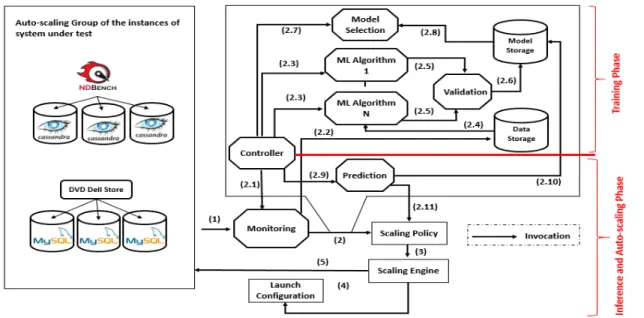
In order to support predictive approach for auto-scaling service, we need to forecast future demand by taking into account the workload history. Figure 12 illustrates our proposed machine learning-based forecasting for auto-scaling process. Each function and responsibility wraps as a module. So, each module encapsulates a set of related functions and several modules need to work together in order to complete the forecast-ing process. The proposed solution implements machine learnforecast-ing-based forecastforecast-ing as a suite of small modules. Each module is described as follows:
Monitoring module: It is responsible for monitoring and collecting the system level metrics that represent the resource demand (1).
Controller module: It coordinates and manages other modules. By changing time intervals, the Controller module periodically invokes the Monitoring module to collect the workload metrics (2.1). The Controller module also calls the Machine learning algorithms module to train models (2.3) and calls the Model selection module to select a suitable model for prediction part (2.7). Also, it launches the Prediction module(2.9).
Data storage module: This module stores the monitoring data (2.2). The data collected from the Monitoring module becomes the training samples to learn a workload pattern for prediction and forecasting.
Machine learning algorithms module: It is responsible for using machine learning to train models (2.3). Each algorithm is trained in parallel and independently.
Validation module: This module evaluates the results of each algorithm (2.5). It is important for calculating model accuracy in machine learning. After training the models, the Validation module evaluates them to determine accuracy. Each model’s trained parameters are saved to the Model storage module (2.6).
Model selection module: Validation scores are retrieved for each model from the Model storage module (2.8) and the Model selection module then selects the ap-propriate model for prediction (2.7).
Model storage module: It is responsible for keeping the information and data related to models. General data standard is used to deal with the wide variety of formats for datasets without having to be locked into a particular format. One of the popular data formats in cloud computing is a JSON which is what we use.to store the model information. For each model, we have one JSON file that contains the name
of the algorithm, the model ID, the value of parameters, the performance metrics results, and the score.
Prediction module:It is called by the Controller module to perform a real-time workload prediction upon predefined intervals (2.9). The Prediction module retrieves the selected model from the Model storage module (2.10). Finally, the prediction result is returned to the cloud auto-scaling service for resource prevision decision making.
The next step is to integrate the results of the prediction with the auto-scaling process. Most of the Cloud providers offer an auto-scaling service for a single metric, however, our proposed solution is based on multiple metrics. Thus, the solution cannot use the general auto-scaling service. We employ Ansible for provisioning and de-provisioning of resources. Ansible is one of the simplest ways to automate infrastructure and configuration management. Also, Ansible provides a lot of inbuilt modules for multiple Clouds, each of which we mapped. Ansible modules map to the Auto Scaling Group, the Scaling Policy, Launch configuration, and the Scaling Engine. Therefore, the prediction result is sent to the Ansible playbook which is Scaling Policy (2.11) in order to check the defined policies related to the results. After checking the policies, the Scaling Policy communicates with another Ansible playbook that is called the Scaling Engine to take an action (3). At the end, the Scaling Engine adds or removes resources (5).
3.3.3
Microservice Design
Each Cloud platform offers different types of services. We need to orchestrate and coordinate Cloud services in order to integrate a machine learning approach with an auto-scaling process. Each Cloud service needs to map onto one of the modules that are presented in Section 5.2. In the Cloud platform, each Cloud service represents an independent service that can be used to construct microservices architecture. The Cloud Service loose coupling promotes the independent design and evolution of a microservice implementation while still guaranteeing interoperability with other mi-croservices. If each Cloud service function as an independent microservice, it means a process is serving as single independent function and deliver the responsibility. We have different techniques and implementation services on cloud platforms. So, mi-croservices should be programming language agnostic, and each microservice should
Figure 12: An Inference-based Forecasting for Auto-scaling Process
be able to function with the help of different languages including Python, Java, or R. In order to take advantage of using different cloud services, we should be able to scale each service from small to dedicated large size. At the core of this process, each module is encapsulated as a microservice. The microservices depicted as polygons in Figure 12 are independently deployed and running. The composition of the Cloud services are through their endpoints. Each microserivces life cycle is driven by re-quests for the service that originate from the need of model training and prediction. In our solution, all the requests are launched through a controller and then transferred to other microservices. The services are the Monitoring service, the Controller service, the Data storage service and Model storage service, the Machine learning algorithms service, the Validation service, and the Model selection service.
3.3.4
API Design
As the microservices represent different Cloud services that receive inputs, there are APIs to retrieve and present information requested from other microservices. The API is a way to access functions in each microservice. The API is required because we need to achieve a high level of separation and independence in our processes. Most of the Cloud providers offer REST API for their services. The interfaces between the
Table 3: Example of REST APIs
Operation HTTP method
Get monitored metrics (2.1) GET{base URL}/API/?metrics & metric-name = CPUUtilization & start-time=2018-04-12T14:18:00 & end-time=2018-04-12T16:18:00 & period=3600 Create new machine POST{base URL}/API/?create-model & model-Name l
![Figure 1: Deployment of (a) the monolithic architecture and (b) the microservice architecture on AWS [67]](https://thumb-us.123doks.com/thumbv2/123dok_us/384163.2542548/22.918.174.805.130.374/figure-deployment-monolithic-architecture-b-microservice-architecture-aws.webp)
![Figure 2: A container-based microservice architecture of OpenStack. (a) OpenStack deployment, (b) Service registration and discovery in microservice architecture [44]](https://thumb-us.123doks.com/thumbv2/123dok_us/384163.2542548/23.918.173.802.128.376/microservice-architecture-openstack-openstack-deployment-registration-microservice-architecture.webp)
![Figure 3: System Architecture for applying machine learning on multi-tier web ap- ap-plication on AWS [21]](https://thumb-us.123doks.com/thumbv2/123dok_us/384163.2542548/24.918.175.806.135.376/figure-architecture-applying-machine-learning-multi-tier-plication.webp)
![Figure 5: Overview of the Resource Optimization, Allocation and Recommendation System (ROAR) [62]](https://thumb-us.123doks.com/thumbv2/123dok_us/384163.2542548/27.918.171.806.129.372/figure-overview-resource-optimization-allocation-recommendation-roar.webp)
![Figure 7: Sample of multi metrics workload generated on cloud environment F norm (V i me ) = V i me / m X i=1 V i me (1) i ∈ [1, m]](https://thumb-us.123doks.com/thumbv2/123dok_us/384163.2542548/35.918.234.739.131.544/figure-sample-multi-metrics-workload-generated-cloud-environment.webp)