Linear Fractional Programming Procedure for
Multi Objective Linear Programming Problem in
Agricultural System
Babita Mishra, S.R.Singh
Department of Mathematics, Banaras Hindu University
,
VARANASI-221005, INDIA
ABSTRACT
This paper presents a linear fractional programming approach for solving multi objective linear programming problem. We develop a model to solve multi objective linear programming problem into fractional programming problem and proposed a method for linearization of a fractional objective. In particular, we consider the optimization of ratio of profit and cash expenditure as fractional objective and used rest of objectives as constraints by obtaining aspiration levels. As the objectives are conflicting in nature, we used the concept of conflict and non conflict between objectives for computation of appropriate aspiration level. The method is illustrated on a problem of agricultural production system to show its suitability.
General Terms
Multi objective linear programming, Agricultural cropping system.
Keywords
Fractional programming, Multi objective programming problem, Fuzzy goal programming, Conflict and non conflict, Land-use planning.
1.
INTRODUCTION
In several decisions making problems in Economics and Management science, one has to optimize ratios. Such ratios arise in modeling the resource allocation, production, profit, transportation etc. In economic application these ratio like productivity, profit/cash input, return/cost etc. describe efficiency of a system. Such type of problems is inherently fractional programming problem. A variety of applications of fractional programming can be seen in a survey article Schaible [18]. Charnes and Cooper [3] developed a method in which linear fractional programming problem can be optimized by solving two linear programs. A comprehensive study of linear fractional programming can be viewed in Craven [5,6]. Kornbluth and Steuer [9,10] discussed the feasibility region for linear fractional programming problems and multi objective linear fractional programming problems and considered its solution. It was Luhandjula [12] who first proposed the fuzzy set theory approach to reach a satisfactory solution, which was later modified by Dutta et.al.[7] and further by Stancu-Minasian and Pop [19]. Further Nykowski and Zolkiewski [15] gave a compromise procedure for multiple objective linear fractional programming problems. Ohta and Yamaguchi [16], Chakraborty and Gupta [2] studied the solution of linear fractional
programming problems in fuzzy environment. Many more applications of fractional programming may be obtained in literature [8,11].
A goal programming procedure for solving multi objective linear fractional programming problem has been given by Pal et.al.[17]. Stanojevic and Stancu-Minasian [20] studied a fully fuzzified linear fractional programming problem where all parameters and variables are fuzzy numbers. Mehrjerdi [13] developed a fuzzy goal programming model using a linear approximation technique for solving non linear fractional programming problem. Recently Zeng et.al [21] considered a crop area planning problem and proposed a fuzzy multi objective linear programming problem with fuzzy numbers and transformed the fuzzy multi objective programming problem in an equivalent goal programming problem to crisp ones to find its solution.
The motivation of the present study is to demonstrate that converting a multi objective cropping problem of agricultural production system into a fractional programming problem lead to a better solution and optimal profit.
2
PROBLEM
DESCRIPTIONS
AND
MODEL DEVELOPMENT
Consider the modeling of complex system where several objectives are to be optimized at a time. For example, agricultural production system is a real life example of such complex systems comprising of multiple objectives that too of conflicting nature. In general modeling of an agricultural management system requires optimizing the profit cutting the cost of cultivation. Thus the core objective of the problem is to maximize the profit subject to minimization of resource requirements. But since situations are not ideal and have limited scope in production system. With changing scenario of capital intensive agricultural with mechanization and proper availability of resources, the problem changes to develop a model giving optimal profit in accordance of fulfilling resource goals. Thus such problems of multi objective linear programming can be better dealt with goal programming approach. Here we deal such problem as fractional programming problem in which fractional function (profit/ cash-input) is to be optimized and other objectives are to be dealt as constraints for getting optimal solution.
2.1 Multi objective linear programming
problem
A multi objective optimization problem with n decision variables, m constraints and k objectives is as follows
46 s.t.
.
(1)
Where (*) can be one of the ( ) , and
.
2.2
Linear
Fractional
Programming
Approach
Let there be two objectives out of k objectives such that their ratio is to be maximized as core of the problem. Let these two linear objectives are and whose ratio forms a new objective function, giving rise to linear fractional programming as
Maximize
Assuming that , therefore it is equivalent to and
where r is a positive real number, which is a restriction that the ratio should always be greater than to a level r . The rest of objectives may be converted into fuzzy goals by obtaining the maximum and minimum values for constructing the membership function with a method given by Zimmermann [22]. Consider a problem under situation that aspiration levels for each of the objective with respective tolerances are available with the decision maker. Then the rest of the objectives can be treated as fuzzy goals having fuzzy aspiration level. Thus the problem (1) can be equivalently written in a fuzzy goal programming problem as
s.t.
. (2)
2.3 Fuzzy goal programming approach
For solution of the above fuzzy goal programming problem (5), we consider the fuzzy goal programming approach given by Zimmermann [22] where membership function for various goal in the solution set is can be obtained as
For the goal of type maximization:
(3) and for the goal of type minimization:
(4)
Where is aspiration level for goal and are upper and lower tolerance limits for .
One of the major problems in solution of multi objective programming problem by fuzzy goal programming approach is to obtain appropriate priorities to various goals. As a matter of fact in agricultural planning system various goals are conflicting in nature like : production and expenditure, profit and cost of cultivation etc. Thus computation of appropriate aspiration levels corresponding to for the fuzzy goals need to consider the conflict and non conflict among various goals for realistic modeling of the problem. We consider the measure of conflict and non conflict between objectives by Cohon [4], Mohanty and Vijayaraghavan [14] to compute degree of non-conflict between objectives.
2.3.1
Computation of conflict and non conflict
between objectives
Let gradients of the jective , and be angle between gradients of objective , now the simultaneous achievement of objectives is possible if and a situation of conflict arises when
. Let be the gradients of the objectives respectively, and then angle between them is given by
(5)
A function of non – conflict between objectives is defined as
(6)
And the computed degree of non-conflict among objectives can be arranged in form of a symmetric matrix as a non conflict matrix follows
(7)
2.3.2 Appropriate aspiration level
Using membership function defined in (3) and (4), we assign aspiration level to each goal in view of its non-conflicting nature with other goals. Depending on values of associated with each goal; aspiration level can be defined by using membership function as
(8)
Similarly, we can calculate . Now the goals in (2) can be equivalently written in crisp form as
(9)
2.4
Equivalent
linear
programming
problem
Thus using (9), we obtain linear programming problem equivalent to (2) as
s.t.
(10)
This equivalent Linear Programming Problem can be easily
solved by any standard method of solving LPP.
3 NUMERICAL ILLUSTRATIONS
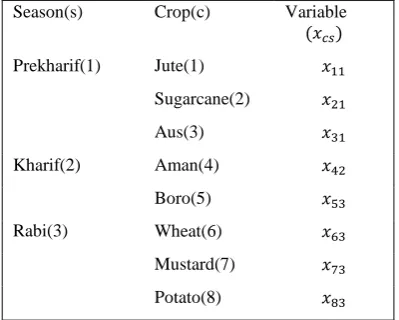
[image:3.595.60.260.609.769.2]In view of proper illustration of developed method, we consider the problem of land use planning for production of principal crops as undertaken by Biswas and Pal [1], in which different types of seasonal crops and decision variables are given in Table-1. The data for productive resource utilization, production rate and market price are given in Table-2. The data for aspiration levels of fuzzy goals and their respective tolerance limits are given in Table-3.
Table-1 The seasonal crops and the associated decision variables
Season(s) Crop(c) Variable
Prekharif(1) Jute(1)
Sugarcane(2)
Aus(3)
Kharif(2) Aman(4)
Rabi(3)
Boro(5)
Wheat(6)
Mustard(7)
Potato(8)
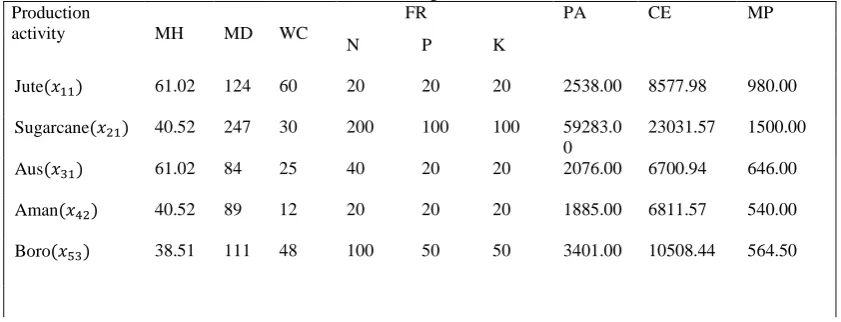
Here in the Table-2 MH=machine hour (in hrs./ha). MD=mandays (days/ha). WC=water consumption (inch/ha). FR=fertilizer (kg/ha). PA=production achievement (kg/ha). CE=cash expenditure (Rs./ha). MP=market price (Rs./qtls.) and table 3 contains data for aspiration level for various goals. Using above data Table 1-3, the complete mathematical formulation of all 19 fuzzy goals of the under taken cropping problem of agricultural system are as follows
1. Land utilization goals
(11)
(12)
(13) 2. Productive resource goals
(a) Machine hour goal
(14) (b) Man power goal
+ (15)
(c) Water consumption goals
(16)
(17)
(18) (d) Fertilizer requirement goals
(19)
(20)
(21)
3. Cash expenditure goal
(22)
4. Production achievement goals
(jute) (23)
(sugarcane) (24)
(rice) (25)
(wheat) (26)
(mustard) (27)
48 5. Profit goal
(29)
Here we solve the above multi objective fuzzy goal programming problem (11)-(29) by using fractional programming approach as discussed in section-2. In this particular problem, ratio of profit to expenditure has been taken as fractional goal. Rather to maximize profit goal and to minimize the expenditure goal, now our objective is to maximize ratio of profit to expenditure goal. Here is the profit goal and is the cash expenditure goal, and the fractional function to maximize is
. Thus the problem is equivalently written as
s.t.
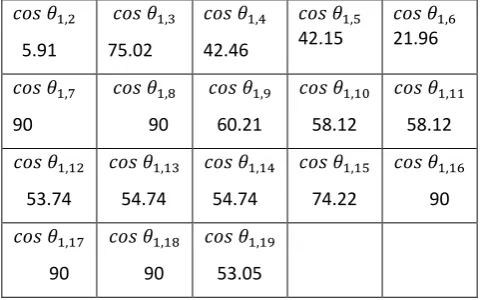
(30) In order to obtain appropriate aspiration level for rest of the goals except profit goal and expenditure goal, we apply concept of non-conflicting of one goal with respect to other goals as discussed in section 2. The method proceeds as The gradients are used to compute angle between goals. For illustration the computations of angle for the goal
[image:4.595.308.549.93.245.2]with other goals are given in Table 4.
Table - 4 Angle between goal and all other goals.
5.91 75.02 42.46 42.15 21.96 90 90 60.21 58.12 58.12 53.74 54.74 54.74 74.22 90 90 90 53.05
and similarly , we can compute for all other goals.
[image:4.595.46.288.438.588.2]Now, we calculate the function of non conflict for the goal with other goals by method given in section 3.1.2 and the results obtained are in Table-5
Table – 5 Degree of non-conflict of goal with other goals 1 .6338 .5832 .7641 .7658 0.878 0.5 0.5 0.6655 0.6771 0.6771 .7014 0.6959 0.6959 .5877 0.5 0.5 0.5 0.7053
Further, we can calculate weight of goal ,
and Similarly, we calculated weight of each of goal corresponding to all other goals and computed weights are: .
Thus we compute aspiration level of all goals using values of as above. The respective aspiration levels for goals are obtained as:
49
+
(31)
The above linear programming problem (31) has been solved by , and the solution obtained is
4. CONCLUSIONS
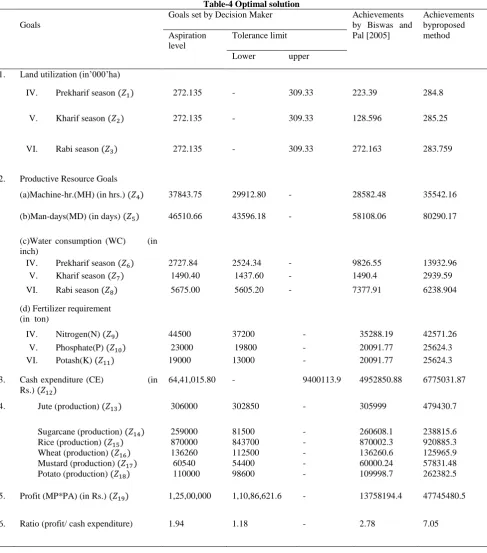
The result obtained by our proposed method of using fractional programming clearly shows the superiority of achievement of various goals under taken in the study. Thus the proposed method of fractional programming using the simple linearization of fractional function into linear function, we get much better result. Here using the proposed method we obtain a profit/ expenditure ratio of 7.05 against a ratio of 2.78 as obtained by Biswas and Pal [1]. Hence the developed method is suitable method for dealing such cropping problem of agricultural system for optimal profits. The results of attainability of different goal by our proposed method and of Biswas and Pal are given in Table 6
5. ACKNOWLEDGMENTS
[image:5.595.71.492.418.579.2]Authors are thankful to Banaras Hindu University for providing Research Fellowship and DST-CIMS for their assistance.
Table-2 Data description for utilization of productive resources, production rate, cash expenditure and market price.
Production
activity MH MD WC
FR PA CE MP
N P K
Jute 61.02 124 60 20 20 20 2538.00 8577.98 980.00
Sugarcane 40.52 247 30 200 100 100 59283.0 0
23031.57 1500.00
Aus 61.02 84 25 40 20 20 2076.00 6700.94 646.00
Aman 40.52 89 12 20 20 20 1885.00 6811.57 540.00
Boro 38.51 111 48 100 50 50 3401.00 10508.44 564.50
Wheat 36.36 74 12 100 50 50 2301.00 7685.76 700.00
Mustard 36.36 47 6 80 40 40 795.00 5093.10 1150.00
50 Table3. Aspiration levels for fuzzy goals
Sl .No. Goals
Aspiration level
Tolerance limit
Lower upper
1. Land utilization (in’000’ha)
I. Prekharif season 272.135 - 309.33
II. Kharif season 272.135 - 309.33
III. Rabi season 272.135 - 309.33
2. Productive Resource Goals
(a)Machine-hr.(MH) (in hrs.) 37843.75 29912.80 -
(b)Man-days(MD) (in days) 46510.66 43596.18 -
(c)Water consumption(WC) (in inch)
I. Prekharif season 2727.84 2524.34 -
II. Kharif season 1490.40 1437.60 -
III. Rabi season 5675.00 5605.20 -
(d)Fertilizer requirement (in metric ton)
I. Nitrogen(N) 44.50 37.20 -
II. Phosphate(P) 23.00 19.80 -
III. Potash(K) 19.00 13.00 -
3. Cash expenditure (CE) (in Rs.) 64,41,015.80 - 9400113.90
4. (a) Jute (production) 306.00 302.85 -
(b) Sugarcane (production)
259.00 81.5 -
(c) Rice (production) 870.00 843.70 - (d) Wheat (production) 136.26 112.50 - (e) Mustard (production) 60.54 54.40 - (f) Potato (production) 110.00 98.60 -
Table-4 Optimal solution
Goals
Goals set by Decision Maker Achievements by Biswas and Pal [2005]
Achievements byproposed
method Aspiration
level
Tolerance limit
Lower upper
1. Land utilization (in’000’ha)
IV. Prekharif season 272.135 - 309.33 223.39 284.8
V. Kharif season 272.135 - 309.33 128.596 285.25
VI. Rabi season 272.135 - 309.33 272.163 283.759
2. Productive Resource Goals
(a)Machine-hr.(MH) (in hrs.) 37843.75 29912.80 - 28582.48 35542.16
(b)Man-days(MD) (in days) 46510.66 43596.18 - 58108.06 80290.17
(c)Water consumption (WC) (in inch)
IV. Prekharif season 2727.84 2524.34 - 9826.55 13932.96
V. Kharif season 1490.40 1437.60 - 1490.4 2939.59
VI. Rabi season 5675.00 5605.20 - 7377.91 6238.904
(d) Fertilizer requirement (in ton)
IV. Nitrogen(N) 44500 37200 - 35288.19 42571.26
V. Phosphate(P) 23000 19800 - 20091.77 25624.3
VI. Potash(K) 19000 13000 - 20091.77 25624.3
3. Cash expenditure (CE) (in Rs.)
64,41,015.80 - 9400113.9 4952850.88 6775031.87
4. Jute (production) 306000 302850 - 305999 479430.7
Sugarcane (production) 259000 81500 - 260608.1 238815.6
Rice (production) 870000 843700 - 870002.3 920885.3
Wheat (production) 136260 112500 - 136260.6 125965.9
Mustard (production) 60540 54400 - 60000.24 57831.48
Potato (production) 110000 98600 - 109998.7 262382.5
5. Profit (MP*PA) (in Rs.) 1,25,00,000 1,10,86,621.6 - 13758194.4 47745480.5
52
6. REFERENCES
[1]. Biswas A, Pal B.B, Application of fuzzy goal programming technique to land use planning in agricultural system, Omega. 33: 2005; 391-398.
[2]. Chakraborty M, Sandipan Gupta, Fuzzy mathematical programming for multi objective linear fractional programming problem, Fuzzy Sets and Systems. 125: 2002; 335-342.
[3]. Charnes A, Cooper W.W., Programming with linear fractional functionals, Naval Res.Logistics Quart. 9: 1962; 181-186.
[4]. Cohon J.L., Multiobjective programming and planning, Academic Press, New York;1978.
[5]. Craven B.D., Fractional Programming, Heldermann Verlag, Berlin,1988.
[6]. Craven B.D., B.Mond, On fractional programming and equivalence, Nav. Res. Logistics Quart. 22: 1975; 405-410.
[7]. Dutta D, Tiwari R.N.,.Rao J.R.,Multiple objective linear fractional programming-A fuzzy set theoric approach, Fuzzy Sets and Systems. 52: 1992; 39-45.
[8]. Kao C, Liu S.T., Fractional programming approach to fuzzy weighted average, Fuzzy Sets and Systems. 120: 2001; 435-444.
[9]. Kornbluth J.S.H., Steuer R.E., Goal programming with linear fractional criteria, European Jour.Oper.Res. 8: 1981; 58-65.
[10].Kornbluth J.S.H, Steuer R.E., Multiple objective linear fractional programming, Management Sciences. 27 (9): 1981; 1024-1039.
[11].Lai Y.J., Hwang C.L., Fuzzy multiple objective Decision making, Springer: New York; 1994.
[12].Luhandjula M.K., Fuzzy approaches for multiple objective linear fractional optimization, Fuzzy Sets and Systems. 13: 1984; 11-23.
[13].Mehrjerdi, Y.Z. Solving fractional programming problem through fuzzy goal setting and approximation, Applied Soft Computing, 2010, doi: 10.1016/ j. asoc. 2010.05.016.
[14].Mohanty B.K.,Vijayaraghavan T A S., A multiobjective programming problem and its equivalent goal programming problem with approprite priorities and aspiration levels:A fuzzy approach,Computers Ops.Res. 22(8): 1995; 771-778.
[15].Nykowski I, Zolkiewski Z., A compromise procedure for the multiple objective linear fractional programming problem, European J. Oper.Res. 19: 1985; 91-97. [16].Ohta H, T.Yamaguchi, Linear fractional goal
programming in consideration of fuzzy solution, European J. Oper.Res. 92:1996; 157-165.
[17].Pal B.B.,Moitra B.N., Maulik U, A goal programming procedure for fuzzy multiobjective linear fractional programming problem, Fuzzy Sets and Systems. 139: 2003; 395-405.
[18].Schiable S., Fractional Programming: A survey, Z. Operations Res., 24: 1980.
[19].Stancu-Minasian I.M., Bogdana Pop, On a fuzzy set approach to solving multiple objective linear fractional programming problem, Fuzzy Sets and Systems. 134: 2003;397-405.
[20].Stanojevic B., Stancu-Minasian I.M., On solving fully fuzzified linear fractional programs, Advanced Modelling and Optimization. 11(4):2009; 503-523. [21].Zeng X, Kang S, .Li F, L.Zhang, P.Guo, Fuzzy
multiobjective linear programming applying to crop area planning, Agricultural Water Management. 98: 2010; 134-142.