SOLVING ECONOMIC DISPATCH PROBLEM USING PARTICLE SWARM OPTIMIZATION
SYED AKHMAL BIN SYED JAMALIL
A project report submitted in
fulfillment of the requirement for the award of the Degree of Master of Electrical Power Engineering
Faculty of Electrical and Electronic Engineering Universiti Tun Hussein Onn Malaysia
iv
ABSTRACT
ABSTRAK
vi
CONTENTS
TITLE i
DECLARATION ii
ACKNOWLEDGMENT iii
ABSTRACT iv
ABSTRAK v
CONTENTS vi
LIST OF TABLES x
LIST OF FIGURES xi
CHAPTER 1 INTRODUCTION
1.1 Project History 1
1.2 Project Objective 2
1.3 Scope of the project 3
1.4 Report Structure 4
CHAPTER 2 LITERATURE REVIEW
2.1 Common System of Electric Power 5
2.2 Energy Management System 7
2.4 Basic Formulation for Economic Dispatch 9
2.5 ED with losses consideration 10
2.6 Practical Operation Constraints of Generator 10
2.6.1 Ramp Rate Limit (RRL) 11
2.6.2 Prohibited Operating Zone (POZ) 11 2.6.3 Generation Limit Constraints 12
2.6.4 Balance Constraints 13
2.7 Evaluation function 13
2.8 Optimal Power Flow Optimization 14 2.9 Nonlinear Function Optimization 15
2.9.1 Unconstrained Parameter Optimization
15
2.9.2 Equality Constrained Optimization 17 2.9.3 Inequality Constraints Optimization 17 2.10 Power generation optimization techniques 19
2.11 Particle Swarm Optimization 19
2.11.1 Nature of PSO 20
2.11.2 PSO Algorithm 22
2.11.3 General Flowchart of PSO 23
2.11.4 PSO Advantage 26
2.12 Previous Research for PSO in ED problems 26
CHAPTER 3 METHODOLOGY
3.1 Introduction 29
viii 3.3 Practical Generators Constraints 32
3.4 Loss coefficients (B-coefficients) 36 3.5 Operation of PSO with the Proposed Fitness
Function
38
3.6 Simulation Strategies 40
3.6.1 Number of Particles „N‟ 41
3.6.2 Iteration Number 41
3.6.3 Acceleration Coefficients 41
3.7 MATLAB Software 42
3.8 Test System 42
CHAPTER 4 RESULTS AND DISCUSSION
4.1 Introduction 43
4.2 Project under Tests Results 44
4.2.1 Case 1: 6-unit systems without POZ and RRL
44 4.2.2 Case 2 : 6-unit systems with POZ and
RRL
48 4.2.3 Case 3: 15-unit systems without POZ
and RRL
51 4.2.4 Case 4 : 15-unit systems with POZ
and RRL
53 4.3 Results Comparison with research studies 56
4.4 Conclusion 58
CHAPTER 5 CONCLUSION
5.2 Discussion of project conducted 44
5.3 Recommendations of Project 61
5.4 Further Research Potential 62
REFERENCES 63
x
LIST OF TABLES
Tables No. Page
3.1 Six Generation System Unit Capacity and Coefficient 31 3.2 Fifteen Generation System Unit Capacity and Coefficient 32 3.3 Ramp Rate Limit and Prohibited Operating Zone of the 6-
Generation Units System
33
3.4 Ramp Rate Limit and Prohibited Operating Zone of the 15- Generation Units System
33
3.5 Generator Limit with Ramp Rate Limit and Prohibited Operating Zone for 6-Generation Unit System
34
3.6 Generator Limit with Ramp Rate Limit and Prohibited Operating Zone for 15-Generation Unit System
35
3.7 PSO Algorithm Parameters of the case study 40
4.1 Generation output of 6-unit system without POZ and RRL 46 4.2 Generation output of 6-unit system with POZ and RRL 48 4.3 Generation output of 15-unit system without POZ and RRL 51 4.4 Generation output of 15-unit system with POZ and RRL 55 4.5 Comparison between each case and referred studies on 6-unit
System
57
4.6 Comparison between each case and referred studies on 15-unit system
LIST OF FIGURES
Figures No. Page
2.1 Example on the flock of bird in nature 21
2.2 Example on the school of fish in nature 21
2.3 General Flow Chart of Basic PSO 24
3.1 Flow chart of the project under study 30
3.2 Flow Chart of PSO for Solving ED Problem 38
CHAPTER 1
INTRODUCTION
1.1 Project History
This project proposed the techniques of the Particle Swarm Optimization (PSO) method with proposed function which can be used to solve the Economic Dispatch (ED) problem and minimize the total cost of generating units with considerations several constraints which will be discussed in the next chapter.
The ED has the objective of generation allocation of the power generators, in such a manner that the generations cost is minimized while all operating constraints are satisfied. Conventional optimization methods assume generator cost curves to be continuous and monotonically increasing, but modern generators have a variety of nonlinearities in their cost curves making this assumption inaccurate, and the resulting approximate dispatches cause a lot of revenue loss. Evolutionary methods like PSO perform better for such problems.
solutions even for the nonlinear and discrete cost curves of the generation units but it
has the drawback of „curse of dimensionality‟, that worsens for large scale problems, leading to extremely high computation time [6].
PSO algorithms can be considered efficient to solve the non-linear model of mathematical Economic Power Dispatch. Also, PSO has been successfully applied in many complex optimization problems in power systems. The PSO method has been used successfully meeting all constraints and compared with the classical optimization techniques such as genetic algorithms (GA), and evolutionary programming (EP).
Many of these older techniques have too much complexity and converge slowly but the Optimal Power Flow (OPF) obtained using PSO can be considered very well results. The results will indicate the applicability of the proposed method to the practical ED problem. Traditionally, fuel cost function of a generator is represented by single quadratic function with ED problems with quadratic cost functions are well solved by gradient-based optimization methods [4]
1.2 Project Objective
The Economic Dispatch (ED) problem of power generation involves allocation of power generation to different thermal units‟ diverse equality and in equality constraints. Particle Swarm Optimization (PSO) is algorithm model on swarm intelligence that finds a solution to an optimization problem in a search space or model and predicts social behavior in presents as objectives. The objective of the project is to minimize the total cost of generating unit with consideration of the practical operation constraints of generators. The purposes of the project include:
(i) To study and solve ED Problem using PSO technique based on IEEE standard power generations systems (6-generation units and 15-generation units)
3 (iii) To simulate and demonstrate capability of PSO techniques to find the global solution for the optimal dispatch of power generation PSO techniques using MATLAB software.
1.3 Scope of Project
In this project, the focus will be concentrated on the controlling the committed generators‟ output such as the generation cost is minimized while satisfying the power demand and other constraints. As power demand increase and power generations cost booms in recent years, saving the operation costs of power system become an important issues. One of the choices is to operate generators to be more efficient and economically [4].
Traditionally, cost function of a generator is represented by single quadratic function. Economic Dispatch problems with quadratic cost functions are well solved by gradient based optimization method for example Lagrangian multiplier or Newton type method which are only suitable for fuel-cost curve with a linear and monotonically increasing functions. However in order to improve the accuracy of solution in ED problem studies, it requires a more accurate representation of cost function.
1.4 Report Structure
Chapter two will review about the Economic Dispatch (ED) Problems of power generating units which has always occupied an important position in the electric power industry. ED can be present a computational process where the total required generation is distributed among the generation units in operation, by minimizing the selected cost criterion, subject to load and operational constraints. The section of this chapter also explains about the Optimal Power Flow problems and Particle Swarm Optimization (PSO) technique which is quite similar to genetic algorithm and evolutionary algorithms.
Chapter three discussed about the method on how to use Particle Swarm Optimization techniques to solve the Economic Dispatch problems. Mathematical formulation of economic dispatch problem is reviewed briefly in this section. The PSO algorithm is outlined in this section and the proposed algorithm is presented.
Chapter four presents experimental results and the discussion about end result obtained from the simulation. The focus will be given on the analyzed data which converging to the optimal solutions. PSO searches for optimal solution via intersection with individual within a swarm population [4].
CHAPTER 2
LITERATURE REVIEW
2.1 Common System of Electric Power
Starting from very small utility networks, electric utilities have grown billion times larger. Now, electric power systems became widespread and complex in nature. From its birth to present, power system networks and utilities have gone through various stages of evolution. For the last one hundred years electric power systems operated as regulated dominations. In a regulated monopoly, an electric power system can be divided into four main functional zones; generation, transmission, distribution and retail service.
a) Generation – generation is the conversion of electric energy from other forms of energy like chemical (gas, coal, and hydrogen), nuclear, solar, hydro energy, geothermal energy, wind and wave energy.
b) Transmission – transmission is the transfer of bulk electric energy from one place to another through some transmission network. It connects the generator network and distribution network.
c) Distribution – distribution is the process of delivering electric power from the local network to the consumers.
In a regulated monopoly, these four functional blocks are controlled by one single entity. As today‟s power system networks are very large in production volume and geographical area, their operation became a complex phenomenon which does not only depend on the state of technology but also on complex issues like economy, social advancement, environmental impact and political decisions.
In traditional monopoly, one company is allowed to generate, transmits and distribute electrical power to the consumers in one jurisdiction. The service area is primarily determined by political map and jurisdiction. In some cases, distribution is divided among two or more electric utilities, e.g. City Corporation or other private distribution companies. Price of electricity is determined by the same utility which is justified by cost of generation, transmission and distribution.
Electric power systems in the early days were developed on the concept of natural monopoly. Natural monopoly occurs if the production costs decrease as the output grows larger. Before 1990s, all power systems in the world were running as vertically integrated monopoly system. Later it was realized that the electric power industry was not necessarily a natural monopoly at least when it came to generating electricity. It was proven that open access and competition in business lowers the unit price. The same is believed to happen in electric power industry.
7 In many of the countries where electric utility deregulation first occurred e.g. Argentina, England, the government was privatizing the industry. By deregulating i.e. by privatizing the power sector, government can withdraw huge amount of money. It has also been proved in many cases that a private organization can serve better than a government organization. Competitions also increase customer focus. Another reason for deregulation is to give customer a meaningful choice to select their supplier, although the term „customer‟ is confined only to bulk or retail buyer.
2.2 Energy Management System
The operational planning of the power system involves the best utilization of the available energy resources subjected to various constraints to transfer electrical energy from generating stations to the consumers with maximum safety of personal/equipment without interruption of supply at minimum cost. In modern complex and highly interconnected power systems, the operational planning involves steps such as load forecasting, unit commitment, economic dispatch, maintenance of system frequency and declared voltage levels as well as interchanges among the interconnected systems in power pools [33].
The generation of the power system as we know it today had its origin in the need for electric utility companies to operate their generators as economically as possible. To operate the system as economically as possible requires that the characteristics of all generating units be available so that the most efficient units could be dispatched properly along with the less efficient.
2.3 Economic Dispatch (ED)
EPAct defines “Economic Dispatch” by means of, “The operation of generation facilities to produce energy at the lowest cost to reliably serve consumers,
recognizing any operational limits of generation and transmission facilities.” [EPAct
2005, Sec. 1234 (b)]. Demand of the power keeps increasing and the energy cost swing over years.
Economic dispatch is generation allocation problem and defined as the process of calculating the generation of the generating units so that the system load is supplied entirely and most economically subject to the satisfaction of the constraints. Historically economic dispatch is being carried out since 1920. It was the time when engineers were concerned with the problem of economic allocation of generation or the proper division of the load among the generating units available.
Prior to 1930, the methods in use includes: the base load method and best point loading It was recognized as early as 1930, that the incremental method, later known as the equal incremental method, yielded the most economic results. The analogue computer was developed to solve the coordination equations. A transmission loss penalty factor computer was developed in 1954. An electronic differential analyzer was developed and used in ED for both offline and on-line use by 1955.The digital computer was investigated in 1954 for ED and is being used to date [33].
9 2.4 Basic Formulation for Economic Dispatch
The objective of ED is to simultaneously minimize the generation cost rate and to meet the load demand of a power system over some appropriate period while satisfying various generators constraints which have been discussed later. To solve ED problem, the basic constrained optimization problem at specific operating interval can be modified as
n i i iT F P
Min
F
1 ) ( (2.1)where
F
T the total fuel is cost; Fi(Pi) and Pi are the cost function and the real power output of generator i, respectively; n is the number of committed generators.
The fuel cost of each generator is usually presented by a single quadratic cost function which is expressed as in (2.2) :
n i i i i i i ii
P
P
P
F
1
2
)
(
(2.2)where i, i and i denote the cost coefficients of the i-th generator. In case of using multiple fuels for a generator, the cost function is modeled as below:-
uk i i bk i i ik i ik ik u i i b i i i i i i u i i b i i i i i i i iP
P
P
P
P
P
P
P
k
P
P
P
P
P
P
P
P
F
, , 2 2 , 2 , 2 2 2 2 1 , 1 , 2 1 1 1)
(
(2.3)2.5 ED with losses consideration
When transmission distance is very small and load density is very high, transmission losses may be neglected and the optimal dispatch of generation is achieved with all plants operating at equal incremental production cost. However, in large interconnected network where power is transmitted over a long distances with low density areas, transmission losses are major factor and affect the optimum dispatch of generation.
One common practice for including the effect of transmission losses is to express the total transmission loss as a quadratic function of the generator power outputs [8]. The simplest quadratic form is
j n i n j ij i
L
P
B
P
P
g g
1 1 (2.4)A more general formula containing a linear term and constant term, referred to Kron‟s loss formula as in (2.5):
g g gn i i i j n i n j ij i
L
P
B
P
B
P
B
P
1 00 0 1 1 (2.5) ijB are called the loss coefficients or B-coefficient, which are assumed to be constant for a base range of loads, and reasonable accuracy is expected when actual operating conditions are close to the base case conditions used to compute the coefficients. The economic dispatch problem is to minimize the overall generation cost, which will be discussed next with the other constraints.
2.6 Practical Operation Constraints of Generator
11 problem is economic dispatch generation output unit is commonly supposed that are arranged uniformly.
Practically, the operating range of all online units is restricted by their Power Generation Limits, Ramp Rate Limits (RRL), Prohibited Operating Zone (POZ), the limit of the power generation, the balance constraints and the transmission with losses consideration as previously explained. Hence all the constraints stated must be taken into account to achieve true economic operation.
2.6.1 Ramp Rate Limit (RRL)
Output power of each generator is limited to increase and decrease to a constant quality of power over a certain time interval due to the physical limitation of generators The inequality constraints due to RRL for unit generation changes are given :-
1) as generation increases
i i
i
P
UR
P
0
(2.6)2) as generation decreases
i i
i
P
DR
P
0
(2.7)where is Pi the current output power, and 0
i
P is the previous output power. URi is the up ramp limit of the i-th generator (MW/time-period); and DRi is the down ramp limit of the i-th generator (MW/time period).
2.6.2 Prohibited Operating Zone (POZ)
output Pi of a unit must avoid unit operation in the prohibited zones. These two disjoint regions form a non-convex set.
The feasible operating zones of unit i can be described as follows:
P
iP
iP
il,1min
(2.8) i l j i i u j
i
P
P
j
n
P
, 1
,,
2
,
3
,
...
,
(2.9)max 1 ,
, i i
u n
i
P
P
P
i
(2.10)Where:
j Number of prohibited zones of unit i .
i
P Output power of generator i min
i
P Minimum power output limit of generator i
max
i
P Maximum power output limit of generator i
l j i P, &
u n i i
P, Lower and upper boundaries of prohibited operation zone j
2.6.3 Generation Limit Constraints
Power generation for each generator should locate between the upper and lower limits; the following inequality constraint for each generator should be satisfied.
max , min
, i i
i
P
P
P
(2.11)Where:
i
P Output power of generator i (MW) min
,
i
P Minimum power output limit of generator i max
,
i
13 2.6.4 Balance Constraints
The total output power generation is the sum of the total power demand and total power losses. Hence the total output power is shown in Equation 2.12 below:
nt i D
Loss
P
P
P
1
0
(2.12)and Equation 2.13 shows Error in MW:
D Loss n
t
i P P
P
Error
1
(2.13) Where:
Loss
P Total active power losses of the network (MW)
D
P Total average demand forecast for the dispatch period (MW)
i
P Output power of generator i for dispatched hour (MW)
2.7 Evaluation function
The quality of each individual particle in the swarm is found using a fitness function called evaluation function. The popular penalty function method employs functions to reduce the fitness of the particle in proportion to the magnitude of the constraint violation. The penalty parameters are chosen carefully to distinguish between feasible and infeasible solution [10]
The evaluation function f(Pi) is defined to minimize the non-smooth cost function given by Equation (2.1) for a given load demand PD while satisfying the constraints given Equation (2.11) and Equation (2.13) as
21 2 1 ) ( ) (
i n k k i N i N i Loss D i i ii F P P P P P violation
P
f
(2.14)
where is the penalty parameter for not satisfying load demand and represents the penalty for a unit loading falling within a prohibited operating zone. Basically, several constraints will be taken into account to satisfy the actual operations of the generators.
2.8 Optimal Power Flow Optimization
The optimal power flow procedure consists of methods of utilizing load flow techniques for the purpose of Economic Dispatch (ED). Some of the researchers before used the ac load flow model and others have used the dc load flow model. Then later it is based on the Power Quality decomposition and then using term optimization techniques. The ac optimal load flow problem on the other hand consists of finding the active and reactive power output and the voltage magnitudes at any generator unit, in order to minimize the operating cost while meeting various security constraints. Security constrained dispatch involves those dispatch activities which are constrained to respect selected system security limits. In general, optimal power flow requires use of network modeling as well as resource modeling and naturally results in higher system costs [11].
15 In an interconnected power system, the objective is to find the real power scheduling of each power plant in such way to minimize the operating cost. This means that the generator‟s real and reactive powers are allowed to vary within the certain limits so as to meet a particular load demand with minimum fuel cost. This is called optimal power flow (OPF) problem. The OPF is used to optimize the power flow solution of large scale power system. This done by minimizing the selected objective functions while maintaining acceptable system performances in terms of generator capability limits and the output of the compensating devices. [8] The objective functions, also known as cost functions, may present economic costs, system securities or other objectives. The OPF has been studied by many researchers and many algorithms using different objectives functions and methods have been presented.
2.9 Nonlinear Function Optimization
Nonlinear function optimization is an important tool in computer aided design and is part of broader class of optimization called nonlinear programming. The underlying theory and computational methods are discussed in many books. The basic goal is minimization of some nonlinear objective cost function subject to nonlinear equality and inequality constraints. [8]
2.9.1 Unconstrained Parameter Optimization
The mathematical tools that are used to solve unconstrained parameter optimization problems come directly from multivariable calculus. The necessary condition to minimize the cost function
)
,
...
,
(
x
1,x
2,x
nf
(2.15)is obtained by setting derivative of f with respect to the variables equal to zero, i.e
n
i
x
f
i
...,
,
1
0
or
0
f
(2.17)where
n
x f x
f x
f f
, ,..., 2 1
(2.18)
which is known as the gradient vector. The terms associated with the second derivatives is given
j i
x
x
f
H
2 (2.19)The previous equation results in a symmetric matrix called Hessian matrix of the function. Once derivative of f is vanished at local extrema
(
x
ˆ
1,
x
ˆ
2,
...,
x
ˆ
n)
, for f to have the relative minimum, the Hessian matrix evaluated at(
x
ˆ
1,
x
ˆ
2,
...,
x
ˆ
n)
must be a positive define matrix. This condition requires that all eigenvalues of the Hessian matrix evaluated at(
x
ˆ
1,
x
ˆ
2,
...,
x
ˆ
n)
be positive.17 2.9.2 Equality Constrained Optimization
This type of problem arises when there are functional dependencies among the parameters to be chosen. The problem is to minimize the cost function [8]. The problem is to minimize the cost function (2.1) subject to the equality constraints
k
i
x
x
x
g
i(
1, 2,,
...
,
n)
0
1
,
2
,
...,
(2.20)Such problems may be solved by the Lagrange multiplier method. This provides an augmented cost function by introducing k-vector of undetermined quantities. The unconstrained cost function becomes
k i i ig f 1
L (2.21)
The resulting necessary conditions for constrained local minima of L are the following:-
k i i i i i ix
g
x
f
x
10
L
(2.22) 0 i i g x L (2.23)Note that equation (2.9) is simply original constraints.
2.9.3 Inequality Constraints Optimization
Practical optimization problem contain inequality constraints as well as equality constraints. The problem is to minimize the cost function
)
,
...
,
(
x
1,x
2,x
nsubject to the equality constraints
k
i
x
x
x
g
i(
1, 2,,
...
,
n)
0
1
,
2
,
...,
(2.25)and the inequality constraints
m
i
x
x
x
u
j(
1, 2,,
...
,
n)
0
1
,
2
,
...,
(2.26)The Langrange multiplier is extended to include the in equality constraints by introducing m-vector of undetermined quantities. The unconstrained cost function becomes
m i j j k i iig u
f
1 1
L (2.27)
The resulting necessary conditions for constrained local minima of L are the following: n i xi , . . . , 1 0 L (2.28) k i gi i , . . . , 1 0
L (2.29)m j uj j , . . . , 1 0
L (2.30)m j
uj j
j 0 &
0 1,...,
(2.31)Note that Equation (2.15) is simply the original equality constraints. Suppose ) ˆ , ... , ˆ , ˆ
(x1 x2 xn is a relative minimum. The in equality constraints (2.16) is said to be inactive if strict inequality holds at (xˆ1,xˆ2,...,xˆn)and j 0. On the other
hand, when strict equality holds, the constraint is active at this point, (i.e, if the constraint juj(xˆ1,xˆ2,...,xˆn)0and j 0. This is known as the Kuhn-Tucker
19 2.10 Power generation optimization techniques
One way to solve the ED problems with quadratic cost functions is by gradient-based optimization methods, for example Newton-type methods which are only suitable for fuel-cost curve with linear and monotonically increasing functions [4]. To improve more accurate solution in ED problem requires a more precise representation of cost function. Therefore, piecewise quadratic cost functions discovered in representing multiple options. However, ED problems with multiple-unit and piecewise quadratic cost functions will occur many local extreme points [4]. As a result, conventional optimization techniques are no longer the finest choice since they may fail to locate the optimal solution and result in considerable errors.
Recently, the advances in computation found a better solution of complex problems have led to using stochastic optimization techniques, such as evolutionary algorithm, differential evolution, Genetic Algorithm (GA), Artificial Bee Colony (ABC) and etc., for solving ED problems. One of them is Particle Swarm Optimization (PSO) method which is inspired from fish schooling and birds flocking [3]. It is a powerful method yet simple optimization algorithm that can perform extensive exploration of the problem space. Besides, it does not rely on derivative information to guide the search toward the problem solution. PSO and some of its variants have been proposed and successfully apply to ED problems with piecewise quadratic cost functions.
2.11 Particle Swarm Optimization (PSO)
PSO searches for optimal solutions via interaction with individuals within a swarm of population. Particle is made of two parts, the position and velocity. Position represents the objective variable and velocity is the step size a particle attempt to move in next turn. A particle represents a potential or candidate solution of the problem. The particles are responsible for searching the solutions within the multidimensional problem space according to two major operations, velocity and position updating rules. Each particle moves toward the optimal point by adding velocity to its position. Updating rules of position will be the major function of PSO with consideration the d-th dimension.
2.11.1 Nature of PSO
Originally, these began to develop computer software simulations of birds flocking around food sources and then later realized how well their algorithms worked on optimization problems. Particle Swarm Optimization might sound complicated, but it is a very simple algorithm. Suppose the following scenario a group of birds is randomly searching food in an area. There is only one piece of food in the area being searched. All the birds do not know where the food is. But they know how far the food is in every each iteration. Over a number of iterations, a group of variables have their values adjusted closer to the member whose value is closest to the target at any given moment [3].
The effective one is to follow the bird, which is nearest to the food. PSO learned from the scenario and used it to solve the optimization problems. In PSO, each single solution is a bird in the search space call as particle. All of particles have fitness values, which are evaluated by the fitness function to be optimized, and have velocities, which direct the flying of the particles. The particles fly through the problem space by following the current optimum particles.
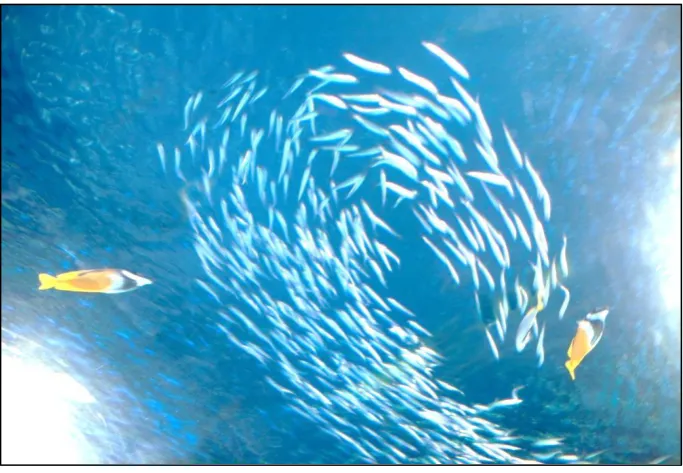
21 best value, obtained so far by any particle in the population. This best value is a global best and called global best (Gbest). When a particle takes part of the population as its topological neighbors, the best value is a local best and is called p-best. The „Figure 2.1‟ and „Figure 2.2‟ shows the nature of PSO method:
Figure 2.1: Example on the flock of bird in nature
[image:30.595.148.490.491.727.2]2.11.2 PSO Algorithm
In PSO, suppose that the target problem has „n‟ dimensions and a population of particles, which encode solutions to the problem, move in the search space in an attempt to uncover better solutions. Each particle has a position vector of Xi and a velocity vector Vi. The position vector Xi and the velocity vectorVi of the i-th particle in the n-dimensional search space can be represented as
i i in
i
x
x
x
X
1,
2,
...
,
andV
i
v
i1,
v
i2,
...
,
v
in
respectively. Each particle has a memory of the best position in the search space that it has found so far
Pbesti
, and knows the best location found to date by all the particles in the swarm
Gbest
. Let
Pbest
in Pbest
i Pbest
i x x
x
Pbest 1 , 2 ,..., and
Gbest
x
1Gbest,
x
2Gbest,
...
,
x
nGbest
be the best position of the individual i and all the individuals so far, respectively.At each step, the velocity of the i-th particle will be updated according to the following equation in the PSO algorithm as in (2.32):
k
i k k
i k i k
i k
i V c r Pbest x c r Gbest x
V 1
1 1 2 2 (2.32)Where:
k i
V Velocity of individuali at iteration k
Weight parameter
2 1,c
c Weight factors
2 1,r
r Random numbers between 0 and 1
k i
x Position of individual i until iteration k
k i
Pbest Best position of individual i until iteration k
k
23 The updating of position is given by:
) 1 ( ) ( ) 1
(
t id tid t
id
x
v
x
(2.33)Where:
t Iteration count
i Index of the particle
) 1 (t id
x
Position among the d-thdimension of the i- th particle at iteration) 1 (t id
v
Velocity among the d-thdimension of the i- thparticle at iterationIn this velocity updating process, the acceleration coefficients c1, c2 and the inertia
weight are predefined and r1, r2 are uniformly generated random numbers in the
range of [7]. In general, the inertia weight is set according to the following equation:
Iter
Iter
max min max max
(2.34)Where:
min max
,
initial and final inertia parameter weights,max
Iter maximum iteration number, Iter Iter current iteration number.
2.11.3 General Flowchart of PSO
to perform an achievement or make a right choice, showing the responsibility of each organizational unit for different part of a single process.
Figure 2.3 shows the general flowchart of PSO:
Figure 2.3: General Flow Chart of Basic PSO Result/Stop
Converge Graph Initialization Number of particle and
velocity
Evaluate the fitness function
Find Pbest and Gbest
Update Velocity Update Position
Update Pbest
Update Gbest
No
Yes
Iter = max Start
68
REFERENCES
[1] Swarnkar, K.K.; Wadhwani, S.; Wadhwani, A.K.; , "Optimal Power Flow of large distribution system solution for Combined Economic Emission
Dispatch Problem using Partical Swarm Optimization", Power Systems, 2009. ICPS '09. International Conference on , vol., no., pp.1-5, 27-29 Dec. 2009
[2] D.C Secui, I.Felea, S.Dzitac, L.Popper, “A Swarm Intelligence Approach
to the Power Dispatch Problem” Int. J of Computers, Communications & Control, 2006-2010, ISSN 8441-9836-9836, E-ISSN 1841-9844, Vol. V (2010) No.3, pp.375-384
[3] J.Kennedy and R.C.Eberhart, “Particle Swarm Optimization”, Proceedings of IEEE International Conference on Neural Networks, (ICNN‟95), Vol. IV, pp. 1942-1948, Perth, Australia, 1995.
[4] Chang-Huang Chen; Chin-Chung Lin; "Simple particle swarm optimization for economic dispatch with piecewise quadratic fuel cost
function", Innovative Technologies in Intelligent Systems and Industrial Applications, 2009. CITISIA 2009 , vol., no., pp.412-417, 25-26 July 2009 [5] H. Vennila, T.Ruban Deva Prakash, “Particle Swarm Optimization
Technique for Solving Economic Emission Dispatch Problems”, Procedia Engineering, Volume 38, 2012, Pages 2009-2021, ISSN 1877-7058.
[6] D.N. Jeyakumar, T. Jayabarathi, T. Raghunathan, “Particle swarm
optimization for various types of economic dispatch problems”,
[7] S.Y Lim, M. Montakhab, and H. Nou, “Economic Dispatch of Power
System Using Particle Swarm Optimization with Constriction Factor”, International Journal of Innovations in Energy Systems and Power (Vol. 4 no. 2, October 2009)
[8] Hadi Saadat “Power System Analysis”, McGRAW-HILL International Editions 1999 (ISBN 0-07-012235-0)
[9] Zwee-Lee Gaing “Particle Swarm Optimization to Solving the economic
Dispatch Considering the Generator Constraints”, IEEE Transactions on Power Systems, Vol 18, No.3 , August 2003
[10] K.T Chaturvedi, manjaree Pandit, Laxmi Srivastana, “Self-Organizing
Hierarical Particle Swarm Optimization for Noncovex Economic
Dispatch”, IEEE Transactions on Power System , Vol 23, No. 3, August 2008
[11] H. Chowdhury , “A Review Of Recent Advances In Economic Dispatch”, E., Member Electrical Engineering Department University of Wyoming Laramie. WY 82071, IEEE Transactions on Power Systems, Vol. 5, No. 4, November 1990
[12] Zwe-Lee Gaing, “Closure to Discussion of „Particle Swarm Optimization
to Solving the Economic Dispatch Considering the Generator
Constraints”, Ieee Transactions On Power Systems, Vol. 19, No. 4, November 2004
[13] Amita Mahor a, Vishnu Prasad b, Saroj Rangnekar, “Economic dispatch
using particle swarm optimization: A review”, Renewable and Sustainable Energy Reviews 13 (2009) 2134–2141.
[14] A. Immanuel Selvakumar, Member, IEEE, and K. Thanushkodi, “A New Particle Swarm Optimization Solution to Nonconvex Economic Dispatch Problems”,
IEEE Transactions On Power Systems, Vol. 22, No. 1, February 2007 [15] Hirotaka Yoshida Yoshikazu Fukuyama, Kenichi Kawata, Shinichi
70
Reactive Power And Voltage Control Considering Voltage Security
Assessment”, IEEE Trans. on Power Systems, Vol.15, No.4,
pp.1232-1239, November 2001, presented at IEEE PES Winter Meeting, Columbus, Jan.28-Feb.1, 2001
[16] Young-Hyun Moon, Jeong-Do Park, Yong-Hoon Lee,yun-Jong Kook, Jong-Gi Lee, "A New Economic Dispatch Algorithm for Thermal Unit Generation Scheduling in Power System", 0-7803-5935-6/00/2000 IEEE [17] Sarika Varshney, Laxmi Srivastava, Manjaree Pandit, “Comparison of
PSO Models for Optimal Placement and Sizing of Statcom”, Chennai and Dr.MGR University Second International Conference on Sustainable Energy and Intelligent System (SEISCON 2011) ,
[18] Robert Hinterding, “Constrained Parameter Optimisation:Equality
Constraints”, Victoria University of Technology, 0-7803-6657-3/01/2001-IEEE
[19] FERC Staff,"Economic Dispatch: Concepts, Practices and Issues Presentation to the Joint Board for the Study of Economic Dispatch Palm Springs, California November 13, 2005
[20] Sakom Panta, Suttichai Premrudeepreechacham, “Economic Dispatch for
Power Generation Using Artificial Neural Network”, ICPE'07 Conference in Daegu, Korea, The 7th International Conference on Power Electronics, Oct 2007
[21] Suttichai PremrudeepreechachamT. Yalcinoz, H. Altun, M. Uzam, Member, “Economic Dispatch Solution Using A Genetic Algorithm Based
on Arithmetic Crossover”, IEEE Porto Power Tech Conference, 2001
[22] David C. Walters,Gerald B. Sheble', “Genetic Algorithm Solution Of Economic Dispatch With Valve Point Loading”, IEEE Transactions on
[23] A. Bakirtzis, V. Petridis, S. Kazarlis, "Genetic algorithm solution to the economic dispatch problem",IEEE Proc.-Gener. Tmnsm. Distrib., Vol. 141, No. 4, July 1994
[24] Piyush Jain, K.K.Swarnkar, Dr. S.Wadhwani, Dr. A.K.Wadhwani,"Prohibited Operating Zones Constraint with Economic Load Dispatch using Genetic Algorithm",International Journal of Engineering and Innovative Technology (IJEIT)Volume 1, Issue 3, March 2012
[25] Amgad A. EL-Dib, Hosam K.M. Youssef , M.M. EL-Metwally , Z. Osman,"Maximum loadability of power systems using hybrid particle swarm optimization",Electric Power Systems Research 76 (2006) 485–492 [26] Tankut Yalcinoz, Halis Altun, Usama Hasan, “ Constrained ED with
Prohibited Operating Zone Hopfield Neural Network Approach”, 10th Mediterranean Electrotechnical Conference, (2000)
[27] S.Janjornmanit, S.Yachiangkam, Optimal ED for Power Generation using Aftificial Neural Network”, 978-981-05-9423 (2007)
[28] R.Bharati, M.JagdeeshKumar, DSunitha, S.Premalatha, “Opotimization of
Combined Economic Emission Dispatch Problem- A Comparative Study”, 978-981-05-9423-7, 2007
[29] Michael Burke, Power System Control,Doireann Barry, Power System Operational Planning, "ECONOMIC DISPATCH AND UNIT COMMITMENT",Eirgrid slides, April 2011
[30] Fred N. Lee Arthur M. Breipohl,"Reserve Constrained Economic Dispatch With Prohibited Operating Zones",IEEE Transactions on Power Systems, Vol. 8, No. 1, February 1993
72 [32] Website:http://shodhganga.inflibnet.ac.in/bitstream/10603/1271/18/18_app
endix .pdf, (Appendices-Appendix - A Data For Ieee-30 Bus Test System)
[33] Tahir Nadeem Malik, 2K1-UET/PhD-EE-05,"Economic Dispatch Using Hybrid Approaches",Department of Electrical Engineering University of Engineering and Technology Taxila (PAKISTAN),March 2009
[34] J. Y. Fan, Member J. D. McDonald, Senior Member,"A Practical Approach To Real Time Economic Dispatch Considering Unit‟s
Prohibited Operating Zones",IEEE Transactions on Power Systems, Vol. 9, No. 4, November 1994.
[35] Po-Hung Chen and Hong-Chan Chang,"Large-Scale Economic Dispatch By Genetic Algorithm", IEEE Transactions on Power System. Vol. 10. No. 4. November 1995
[36] Rezaul Haque,"Transmission Loss Allocation Using Artificial Neural Networks", Department of Electrical Engineering University of Saskatchewan Saskatoon, Saskatchewan,March 2006
[37] Leandro dos Santos Coelho, Chu-Sheng Lee, "Solving economic load dispatch problems in power systems using chaotic and Gaussian particle