COMPUTATIONAL STUDY OF SHEAR STRENGTHENED OF
RC CONTINUOUS BEAM USING CFRP SHEET WITH
DIFFERENT WRAPPING SCHEME
MHIMED RAMADAN OM BALKOU
UNIVERSITI TUN HUSSEIN ONN MALAYSIA
vi
ABSTRAK
CONTENTS
TITLE i
DECLARATION ii
DEDICATION iii
ACKNOWLEDGEMENT iv
ABSTRACT v
ABSTRAK vi
CONTENTS vii
LIST OF TABLES x
LIST OF FIGURES xi
viii
CHAPTER 1 INTRODUCTION 1
1.1 Problem Statement 1
1.2 Project Objectives 2 1.3 Scope of the study 3
1.4 Significance of the study 4
CHAPTER 2 LITERATURE REVIEW 5 2.1 History of FRP 5
2.2 The types of FRP are 5
2.2.1 Glass fibers 6
2.2.2 Carbon fibers 7
2.2.3 Aramid fibers 7
2.3 Advantages of FRP 8
2.4 Disadvantages of FRP 8
3.1 Introduction 22
3.2 Methodology process 22 3.3 Interview 23 3.4 Site visit 24 3.5 Questionnaire design 24 3.6 Pilot study 25 3.7 Reliability and validity 26 3.8 Data analysis 27 3.9 Methodology flow chart 28 CHAPTER 4 RESULTS AND DISCUSSION 29 4.1 Introduction 36
4.2 Ultimate Load 36
4.3 4.3.1 Load-Displacement Behaviour Load-Displacement Behaviour of Beam C2.5-C 37 38 4.3.2 Load-Displacement Behaviour of Beam C2.5-U-V 40
4.3.3 Load-Displacement Behaviour of Beam C2.5-UA-V 41
4.3.4 Load-Displacement Behaviour of beam C2.5-U-V2 42
4.3.5 Load-Displacement Behaviour of Beam C2.5-UA-V2 43
4.4 Load-Longitudinal Reinforcement Strain 44
x
C2.5-U-V2
4..4.5 Load-Longitudinal Reinforcement Behaviour of Beam C2.5-UA-V2
49
4.5.1 Load-Stirrups Strain Behaviour 50 4.5.2 Load-Stirrups Strain Graph for Beam C2.5-U-V 52
CHAPTER 5
4.5.3 Load-Stirrups Strain Graph of Beam C2.5-UA-V 4.5.4 Load-Stirrups Strain Graph of Beam C2.5-U-V2 4.5.5 Load-Stirrups Strain Graph of Beam C2.5-UA-V2 4.6.1 Load-CFRP Behaviour of Beam C2.5-U-V
4.6.2 Load-CFRP Strain Graph of Beam C2.5-UA-V 4.6.3 Load-CFRP Strain Graph of Beam C2.5-U-V2
4.6.4 Load-CFRP Strain Graph of Beam C2.5-UA-V2 4.7.1 Load-Concrete Surface Behaviour
4.7.2 Load-Concrete Surface Strain Graph of C2.5-U-V 4.7.3 Load-Concrete Surface Strain Graph of Beam C2.5-
UA-V
4.7.4 Load-Concrete Surface Strain Graph of Beam C2.5- U-V2
4.7.5 Load-Concrete Surface Strain Graph of Beam C2.5-
UA-V2 4.8 Discussions
CONCLUSION AND RECOMMANDATION
54 56 58 60 62 64 66 68 70 72 74 76 78
5.1 Introduction 79
5.2 Conclusion 5.2.1 Ultimate Load
5.2.2 Effect of Number of Layer of CFRP Strains
5.2.3 Effect of Wrapping Schame (Three Side and Four Side Wrapping)
5.3 Recommendation for future research 79
79 80 80
xi
LIST OF FIGURES
3.1 Reinforcement details 20
3.2 Cross section details 21
3.3 Loading Position 21
3.4 Cross Section for Fully Wrap (4 sides bonding) 21
3.5 Cross Section for 3 Sides Bonding 22
3.6 Flow chart of FE analysis using ABAQUS 24
3.7 Quratar of beam 25 3.8 Steel reinforcement with stirrups 26 3.9 Enter a file nama as Numerical Analysis of beam 27 3.10 Meshing of the quarter of beam 28 3.11 Defining material propertie 29
3.12 Making the model visible 30
3.13 Apply support in the Y direction at the right of the quarter of beam 31
3.15 Step of assigning load 32
3.16 Applied load 33
3.17 The full complete model of quarter of beam strengthened with CFRP 33
3.18 Viewing the Results 35
4.1 Load vs Mid Deflection of specimens 38
4.2 Comparison for simulation and experimental of Load Mid Deflection for Control beam (C2.5-C)
39
4.3 Comparison for simulation and experimental of Load Mid Deflection for C2.5-U-V
4.4 Comparison for simulation and experimental of Load Mid Deflection for C2.5-UA-V.
41
4.5 Comparison for simulation and experimental of load Mid deflection for C2.5-U-V2.
42
4.6 Comparison for simulation and experimental of load mid deflection for C2.5-UA-V2
43
4.7 Simulation of load-longitudinal reinforcement strain for five beams 44
4.8 Comparison for simulation and experimental for applied load versus longitudinal reinforcement strain,ε for C2.5-C
45
4.9 Comparison for simulation and experimental for applied load versus longitudinal reinforcement strain,ε for beam C2.5-U-V.
46
4.10 Comparison for simulation and experimental for applied Load versus longitudinal reinforcement strain,ε for beam C2.5-UA-V
47
4.11 Comparison for simulation and experimental for applied load versus longitudinal reinforcement strain,ε for beam C2.5-U-V2
48
4.12 Comparison for simulation and experimental for applied load versus longitudinal reinforcement strain,ε for beam C2.5-U2-V2
49
4.13 Comparison for simulation of applied load versu stirrups strain,for beam C2.5-C (S1,S2,S3,S4)
50
4.14 Comparison for simulation and experimental for applied load versus stirrups strain, for beam C2.5-C ( S1,S2,S3,S4)
51
4.15 Load versus stirrups strain of specimen (S1,S2.S3.S4) 52 4.16 Comparison for simulation and experimental for applied load versus
stirrups strain, for beam C2.5-U-V (S1, S2, S3, S4)
53
4.17 Load versus stirrups strain,ε of specimen (S1,S2,S3,S4) 54
4.18 Comparison for simulation and experimental for applied load versu stirrups strain, for beam C2.5-UA-V( S1,S2,S3,S4).
55
4.19 Load versus stirrups strain of specimen(S1,S,S3,S4) 56
4.20 Comparison for simulation and experimental for applied load versus stirrups Strain, for beamC2.5-U-V2( S1,S2,S3,S4)
xiii
4.21 Load versus stirrups strain,ε of specimen (S1,S2,S3,S4) 58
4.22 Comparison for simulation and experimental for applied load versus stirrups strain, for beam C2.5-UA-V2( S1,S2,S3,S4)
59
4.23 Load –CFRP Strain of Specimen (F1,F2,F3,F4) 60
4.24 Comparison for simulation and experimental for applied load versus strain in CFRP stirrups for beam C2.5-U-V( F1,F2,F3,F4)
61
4.25 Load –CFRP strain of specimen (S1,S2,S3,S4) 62 4.26 Comparison for simulation and experimental for applied load versus
strain in CFRP stirrups for beam C2.5-UA-V (F1, F2, F3, F4)
63
4.27 Load –CFRP strain of specimen (F1,F2,F3,F4) 64
4.28 Comparison for simulation and experimental for applied load versus strain in CFRP stirrups for beam C2.5-U-V2(F1, F2, F3, F4).
65
4.29 Load –CFRP strain of specimen(F1,F2,F3,F4) 66
4.30 Comparison for simulation and experimental for applied load versus strain in CFRP stirrups for beam C2.5-UA-V2 ( F1,F2,F3,F4 ).
67
4.31 Load –Concrete surface strain for specimens (C1, C2, C3, C4) 68 4.32 Comparison for simulation and experimental for applied load –concrete
surface strain for beam C2.5-C (C1, C2, C3, C4)
69
4.33 Load –concrete surface strain of specimens (C1, C2, C3, C4) 70
4.34 Comparison for simulation and experimental for applied load –concrete surface strain for bean C2.5-U-V (C1, C2, C3, C4)
71
4.35 Load –concrete surface strain for specimens (C1,C2,C3,C4) 72
4.36 Comparison for simulation and experimental for applied load –concrete surface strain for beam C2.5-UA-V(C1, C2, C3, C4
73
4.37 Load –concrete surface strain for specimens (C1,C2,C3,C4) 74
4.38 Comparsion for simulation and experimental for applied load –concrete surface strain for beam C2.5-U-V2 (C1, C2, C3.C4)
75
4.39 Load –concrete surface strain for specimens (C1,C2,C3,C4) 76
4.40 Comparison for simulation and experimental for applied load –concrete surface strain for beam C2.5-UA-V2 (C1, C2, C3.C4)
LIST OF SYMBOLS
fs
A
- Area of CFRP shear reinforcement = 2tf wf,in 2
f
A
-
Area of CFRP in positive momment region, in2f
A′
- Area of CFRP in negative moment region, in2
s
A - Area of steel in compression region, in 2
- Area of steel in tension region, in2
s
A′
B - Distance of the load from the far end support, in
bw - Width of the web of beam cross section (ACI format), in
D - Depth from the top of the section to the tension steel reinforcement centroid, in
df - Effective depth of the CFRP shear reinforcement
Ef - Elastic modulus of FRP,ksi
- Nominal concrete compressive strength of concrete (ACI format), ksi
c
f′
- Effective tensile stress in the FRP sheet in the direction of the principal fibers
fe
f
fu
f
- Ultimate tensile strength of the FRP sheet in the direction of the principal
fibers, ksi
- Yield strength of steel reinforcement,ksi y
xv
H - Total height of the T section, in
I - Moment of inertia of the member, in4
- Cracked moment of inertia of the member, in4
cr
I
- Effective moment of inertia of the entire beam, in4
e
I
- Moment of inertia at the mid-span. In4
em
I
L - Total span length, in
Le - Effective bond length, in
- Moment at support' A'kip-in
a
M
b
M
- Moment at support'B', kip-in- Cracking bending moment, kip-in
cr
M
- Factored bending moment at section, kip-in
u
M
- Modular ration for concrete
c
n
P - Applied load, Ibs
P max - Ultimate load carried by CFRP sheet,Ibs.
R - Reduction coefficient (ratio of effective average stress or strain in the FRP sheet
to its ultimate strength or elongation)
S – Spacing of steel stirrups, in
- Spacing of FRP strips, in
f
s
- Thickness of the FRP sheet on one side of the beam, in f
t
- Slab thickness, in ts
- Nominal shear strength provided by concrete,kips
c
- Nominal shear strength provided by FRP shear reinforcement f
V
- Nominal shear strength (ACI format), kips
n
V
- Nominal shear strength provided by steel shear reinforcement
s
V
u
V - Factored shear force at section
f
w
- Width of FRP strip, infe
w
- Effective width of FRP sheetX – Any distance along the span of the member, in
Y – Deflection at any point along the span, in
α – Angle between inclined stirrups and longitudinal axis of member
ß - Angle between the principal fiber orientation and the longitudinal axis of the
beam
fe
ε
- Effective strain of FRP,in/in
fu
ε
- Ultimate tensile elongation of the fiber material in the FRP composite, in/inФ – Strength reduction factor
f
ρ
- FRP fraction area = (2tf /bw)(wf/ sf)w
x
LIST OF TABLES
3.1 Specimen Details 20 3.4.1
Sikadur ®
-330 22 3.4.2 Sika Wrap-160 BI-C/15
Questionnaire
23
CHAPTER 1
1.0Introduction.
Many of the existing reinforced concrete (RC), steel, and masonry structures throughout the world are in urgent need of repair or reconstruction because of deterioration due to corrosion of their steel reinforcements, various environmental factors, seismic loading, an increase in service loads, and/ or growing amount of traffic. Moreover, during the modernization of buildings, the removal of individual supports and walls may lead to a redistribution of forces and the need for strengthening of structures. Fiber reinforced polymer (FRP) rebar have been the subject of a significant amount of research in current years. Researchers have found that one of the major drawbacks to FRP reinforcement is their brittle failure at ultimate tensile strength. When FRP
reinforcement is used as reinforcement in concrete, sudden failure of the reinforcement bars can lead to brittle structural failures (Nabila, 2001).
Strengthening of reinforced concrete structures using externally bonded carbon FRP sheets is an effective method of improving the structural performance under both service load and ultimate load. Strengthening with externally bonded FRP sheets has been shown to be applicable to many types of RC structures. Currently, this method has been implemented to strengthen such structures as columns, beams, slabs, walls, chimneys, tunnels, and silos. The uses of external FRP reinforcement may be generally classified as flexural strengthening, improving the confinement and ductility of
2
1.1 Problem statement
For many years concrete has been used as a preferred material in many structures including buildings, bridges, pavements, sewer and storm pipes, liquid holding tanks and others. Shear collapse of reinforced concrete (RC) members is catastrophic and occurs suddenly with no advance warning of distress. In several occasions existing RC beams have been found to be deficient in shear and in need of strengthening (Khalifa 1999).
Conventional shear strengthening methods such as external post tensioning, member enlargement along with internal transverse steel, and bonded steel plates are very costly, requiring extensive equipment, time, and significant labor. The aging infrastructure worldwide has prompted many researchers and organizations to seek and techniques to revive the deteriorating and deficient structures. Advanced composite materials, known as fiber reinforced polymer (FRP) composites, have received significant attention as one of the most promising materials for use as external reinforcement in repair and
strengthening of reinforced concrete (RC) structures. Also fiber reinforced polymer (FRP) composites offers significant advantages such as flexibility in design, ease of installation, reduced construction time, and improved durability. (Feras 2007)
1.2 Research objectives
The overall objective of this study program will to investigate the shear performance and modes of failure of RC beams after strengthening with externally bonded carbon FRP (CFRP) sheets .More specific objectives were to:
2) To study the behavior of RC continuous beams repair with CFRP strips wrapping schemes (4 sides bonding and 3 sides bonding) for initially strengthened
3) To compare the experimental results of repair continuous beams using CFRP strips with computational study using finite element modeling.
1.3 Scope of Research
The researchscopes of this study are as following:
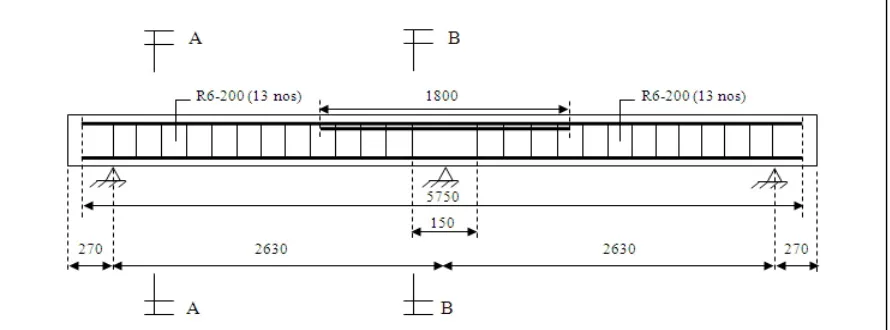
1) This study involves an experimental work and computational study on five RC continuous beams with identical size of 150 x 350 x 5800 mm.
2) All beams have an identical reinforcement details including stirrups and longitudinal reinforcement.
3) All beams were design to fails in shear.
4) The type of FRP will be used is bidirectional CFRP sheet. 5) The compressive strength of the concrete is 30 N/ mm2.
6) ABAQUS will be used to analyses all data and will be compared with the experimental study.
1.4 Significance of Study
Shear collapse of reinforced concrete (RC) members is catastrophic and occurs
suddenly with no advance warning of distress. In several occasions, existing RC beams have been found to be deficient in shear and in need of strengthening (Jayabrakash, 2006)
.
4
CHAPTER 2
LITERATURE REVIEW
2.1 History of FRP
The development of FRP rebar can be traced to the expanded use of composites in the post World War II era (ACI, 2001). The lightweight, high-strength characteristics quickly made the material popular in the aerospace industry. In the 1950’s and 1960’s, the United States, the former Soviet Union, and the United Kingdom were undertaking research projects to more broadly implement the use of FRP.With the expansion of the national highway system in the United States and the subsequent use of de-icing salts, corrosion of the reinforcing steel in pavements exposed to de-icing salts and marine water began to manifest itself as a problem.FRP reinforcement was not considered a viable alternative nor was it commercially available until the late 1970’s. The first solutions to the corrosion of pavement reinforcement were galvanized coatings, powder resin coatings, polymer-impregnated concrete, epoxy coatings, and GFRP rebar.
Technologically, in the 1980’s, the demand for nonmetallic reinforcement has increased.
6
1990’s, the deterioration of aging bridges in the United States and discovery of
corrosion in some commonly used epoxy coated rebar again brought FRP reinforcement to the attention of the design and research communities as a possible solution to
corrosion problems of reinforced pavements (ACI, 2001) (Vellore S , 2007)
.
2.2 The types of FRP are
2.2.1 Glass fibers
These are fibers commonly used in the naval and industrial fields to produce composites of medium high performance. Their peculiar characteristic is their high strength. Glass fibers typically have a Young modulus of elasticity (70 GPa for E-glass) lower than carbon or armed fibers and their abrasion resistance is relatively poor. In addition, a glass fiber has low fatigue strength.. To enhance the bond between fibers and matrix, as well as to protect the fibers and moisture, fibers undergo sizing treatments acting as coupling. Such treatments are useful to enhance durability and fatigue performance (static and dynamic) of the composite material. FRP composites based on fiberglass are
usually denoted as CFRP (Liu 2007)
.
2.2.2 Carbon fibers
rupture and fatigue and show a slight reduction of the long-term tensile strength. FRP composites based on carbon fibers are usually denoted as CFRP.
2.2.3 Aramid fibers
Aramid fibers are organic fibers, made of aromatic polyamides in an extremely orient form. Due to the anisotropy of the fiber structure, compression loads promote a localized yielding of the fibers resulting in fiber instability and formation of kinks. Aramid fibers may degrade after extensive exposure to sunlight, losing up to 50 % of their tensile strength. In addition, they may be sensitive to moisture. Their creep behavior is similar to that of glass fibers, even though their failure strength and fatigue behavior is higher than CFRP. FRP composites based on aramid fibers are usually denoted as CFRP. For strengthening purposes in civil engineering carbon fibers are the
most suitable (Liu 2007)
.
2.3 Advantages of FRP
The advantages of FRP are:
1- Reduced construction time. 2- Corrosion resistance.
3- Flexibility in design. 4- High durability. 5- Ease of installation.
6- High strength-to-weight ratio.
8
2.4 Disadvantages of FRP
The disadvantages of FRP are:
1- FRP reinforcing composites are typically brittle materials.
2- The ultimate tensile strength of FRP reinforcing bars decreases with bar diameter. 3- Theoretical methods are not currently available to predict the bond properties and durability characteristics of FRP rebar with convenient accuracy.
4- FRP rebars can be used at service temperatures below the glass transition temperature of the polymer resin system utilized in the bar.
5- New unfamiliar failure mechanisms are possible particularly in FRP plate bonding and specialist survey should be provided (Carlo Pellegrino 2009).
2.5 Shear strength of Reinforced concrete using FRP
Shear failure of reinforced concrete RC beams is catastrophic and could occur without any forewarning. Many of the existing reinforced concrete (RC), and masonry
structures throughout the world are in urgent need of repair or reconstruction because of deterioration due to corrosion of their steel reinforcements, insufficient shear
reinforcement resulting, design errors, use of outdate codes, increase in demand of service load, and construction defects and design faults .
2.5.1 The equation used to calculate shear strength
2.5.1.1ACI Code provisions for shear strength of Beams
The nominal shear strength Vn is
Vn = Vc +VS Eq (2.1)
Where.
Vc is the nominal shear strength provided by concrete.
Vs is the nominal shear strength provided by steel shear reinforcement. Therefore, ACI 318-95 allows the use of the following simplified equation.
d b c f Vc= ′ w
6 1
The nominal shear reinforcement contribution, Vs, is based on the 45-degree-truss model and where vertical stirrups, (stirrups perpendicular to the axis of member are used (œ = 90)
The ACI 318-95 limits Vs to 0.67√(f-c b w d) . In addition, a minimum amount
of web reinforcement, Av (min.), has to be provided if the applied shear force, Vu, exceeds half of the factored inclined cracking shear, φ (0.5Vc).
y
f bws mm
Av
3 ) ( =
10
vertical stirrups as the smaller. When d/2 or 610 mm if Vs fc' b w d) and when
d/4 or 305 mm if Vs > 'c b w d (Chu kia wang, sixth edition ,1998)
2.6 Contribution of FRP to Shear Capacity
Factors affecting the contribution of FRP to shearcapacity.
1- Type of FRP, and its unidirectional rigidity. 2- Amount and distribution of FRP reinforcement. 3- Fiber orientation.
4- Presence of FRP end anchor. 5- Concrete strength.
6- Concrete surface preparation and surface roughness. 7- Steel shear reinforcement index.
8- Loads and support conditions (i.e., shear strengthening in negative or positive Moment regions).
9- Shear span-to-depth ratio. (Khalifa 1999)
2.7 Khalifa Model
2.7.1 Shear Capacity of a CFRP Strengthened Section
The nominal shear strength of an RC section (Vn) is expressed in Equation (2.1).
Where:
V f is the shear contribution of the CFRP, Vs is the shear strength of the steel
reinforcement and V c is the shear strength of the concrete.
(
)
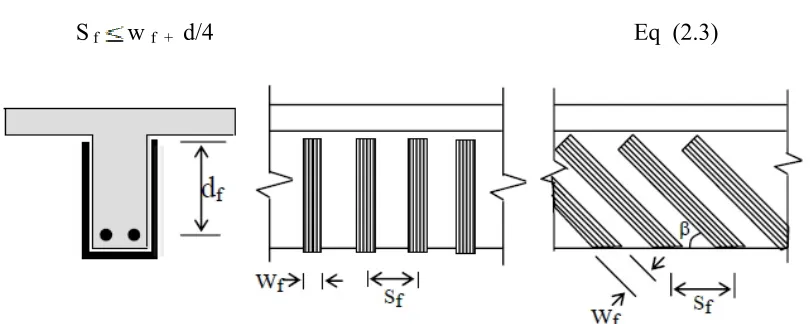
⎟ ⎟ ⎠ ⎞ ⎜ ⎜ ⎝ ⎛ − ≤ + = s w c f f fe f f V d b f s d f A V 3 ' 2 cossinβ β
Eq. (2. 2)
f
d = effective depth of the CFRP shear reinforcement (usually equal to d for
rectangular sections and d-ts for T-sections). ffe the effective CFRP stress.
f
A = area of CFRP shear reinforcement = 2tfwf
f
s = spacing of FRP strips.
Where;
f
t is the FRP thickness and is the width of the strip. The effective depth of FRP
strips , can be computed by subtracting the slab depth from the effective depth of the
beam . If continuous sheets are used, the ratio of the width of strips to spacing of
strips should be unity. The remaining variable is the effective average stress in the FRP sheet at ultimate
f w f d ) (d fe f
[image:25.612.129.534.532.694.2]S f w f + d/4 Eq (2.3)
12
Eq. (2. 4)
fu fe Rf f = Where;
R is reduction coefficient.
fu
f = ultimate tensile strength of FRP sheet in direction of principal fibers.
Since the FRP is linearly elastic until failure, the effective strain εfe at ultimate limit
state can be computed as follows.
fu
fe
R
ε
ε
=
Eq. (2. 5)Where:
fe
ε = the effective FRP strain
fu
ε = ultimate tensile elongation of the fiber material in the FRP composite
Equation (2.3) may be rewritten as follows.
f w
fe f f
f E b d
V =ρ ε (sinβ+cosβ)
Eq. (2. 6)
Where:
f
V = nominal shear strength provided by FRP shear reinforcement
f
ρ = FRP shear reinforcement ratio = (2 ) ( )
f f w f s w b t f
fe
ε = the effective FRP strain
w
b = width of the beam cross section
β = angle between the principal fiber orientation and the longitudinal axis of the beam. Where. ⎟ ⎟ ⎠ ⎞ ⎜ ⎜ ⎝ ⎛ = = f f w f f w f f S W b t s b A 2
ρ
Eq. (2.7)In the case of continuous wrap
⎟ ⎟ ⎠ ⎞ ⎜ ⎜ ⎝ ⎛ =1 f f S W Eq. (2.8)
2.7.2 Reduction coefficient Based on CFRP Sheet fracture failure
Khalifa has proposed a modification to Triantafillou effective strain model equation (2.5), (2.6) to determine the reduction coefficient R for the CFRP fracture failure.
Pf Ef 1.1 Gpa
R = 0.5622 (pf Ef) 2- 1.2188 (Pf Ef) + 0.778 (2.9)
14
2.7.3 Reduction coefficient Based on Bond Mechanism Model
For the case of shear strengthening, once a shear crack develops, only that portion of FRP extending past the crack by the effective bonded length will be capable of carrying shear. It is, therefore, suggested to replace the width of the FRP sheet, with an
effective width, f W fe W f fe d W =
If the sheet is wrapped around the beam entirely Eq. (2.9a)
Wfe = df - Le If the sheet is in the form of a U-wrap Eq. (2.9b)
Wfe = df -2Le If the sheet is bonded to only sides of the beam Eq. (2.9c)
fe
W Is equal to the sum of the width of all strips within the
f f
S W
.
The final expression for the reduction coefficient, R for the mode of failure controlled by CFRP deboning is expressed from.
(
)
2/3[
(
)
610 156 . 6 9 . 199 ' − × −
= f f
f fu fe cu E t d W f R
ε
]
Eq. (2.10)The above Eq (2.10) is only applicable for CFRP stiffness, value, ranges from 20
to 90Gpa f fE t Where: fu
ε = ultimate tensile elongation of the fiber material in the FRP composite in/in
2.7.4 Upper limit of the reduction coefficient
In order to control the shear crack width and loss of aggregate interlock, there is an upper limit of reduction coefficient (R=0.5) . This limit is such that the effective strain,
εfe, be in order of 0.005 mm/mm (including the factor) for CFRP sheets have an ultimate strain, εfu, in the order of 0.015 mm/mm. Due to the variety of the ultimate strain of CFRP sheets available in the markets, there is a constant upper limit of
effective strain to be about 0.004 mm/mm (including the φ factor). Using this value, the
upper limit of reduction coefficient, R is taken equal to 0.006/ εfu.
2.7.5 Controlled reduction coefficient
The final controlled reduction coefficient for the CFRP system is taken as the lowest value determined from the two possible modes of failure and the upper limit (Khalifa ,1999)
.
16
The contribution of the FRP strengthening to the shear capacity is given byψԌ VԌ
where ψԌ is a reduction coefficient equal to 0.95 or 0.85 for fully wrapped or U
wrapping side- bonding respectively and Vƒ is:
f
fv fe
fv f
S
d f
A
V = (sinα +cosα) Eq. (2.11)
Where.
Af is the total area of the FRP sheet wrapped or bonded.
df is the effective depth of the sheets (taken as their total depth minus the cover to the
tension steel).
Sf is the sheet spacing.
ࣵ is the inclination of the sheets to the horizontal.
Ef is the Young’s modulus of the FRP.
The effective strain for the fully wrapped case is equal to the lesser of 0.004 and 0.75 εfu
while for U-wrapping and side bonding this equals the lesser of 0.004 and ku εfu is the
ultimate strain of the FRP sheet and the reduction factor kݒ.
75
.
0
900
,
11
2 1≤
=
fu e vL
k
k
k
ε
Eq. (2.12)With the active bond length Le and the reduction factors equal to:
58 . 0
)
(
300
,
23
f f eE
nt
L
=
Eq.(2.13) Where:n = number of plies of FRP reinforcement.
f
t = nominal thickness of one ply of the FRP reinforcement, in. (mm).
3 / 2 1
27
'
⎟
⎠
⎞
⎜
⎝
⎛
=
f
ck
Eq. (2.13a) fv e fvd
L
d
18
fv e fv
d L d
k2 = − 2
(For two sides bonded) Eq. (2.13c)
The spacing of the FRP sheets should comply with the limits for stirrups given in ACI 318-08 (2008), and the total shear reinforcement Vs +Vf should not exceed
0.66 fc bwd, (ACI 440.2R, 2008)
2.9 Previous researches on shear strengthening using CFRP
H.K.L.Lee et al.( 2008) is implemented the finite element FE program ABAQUS to model CFRP strips/sheets. The predicted results are compared with experiment data (Khalifa and Nanni 2002) to assess the accuracy of the proposed FE analysis approach. A series of numerical tests were conducted to investigate the influence of stirrup lay-ups on the shear strengthening performance of the CFRP strips/sheets, to illustrate the influence of the damage parameters on the micro crack density evolution in concrete, and to investigate the shear and flexural strengthening performance of CFRP strips/ sheets. It has been shown that the proposed FE analysis approach is suitable for the performance prediction of RC beams strengthened with CFRP strips/sheets.
Tom Norris, et al (1997) carried out a study on the unretrofitted RC beam designated as control beam and RC beams retrofitted using carbon fiber reinforced plastic (CFRP) composites with ±450 and 900 fiber orientations. The effect of
retrofitting on uncracked and precracked beams was studied by using the ANSYS finite element program. The numerical results shows good agreement with the experimental values reported.
Mohammed S et al (2009) presented a study of reinforced concrete beams externally reinforced with fiber reinforced polymer (FRP) laminates using finite
CHAPTER 3
METHODOLOGY
3.1 Introduction
The first step of the study was identifying research problem which covered the significance, objective and scope of study followed by research of the literature. Information was gathered through sources such as through journals, books, reports and previous researches. The FE program of this study was done by using ABAQUS. This chapter will discuss about the specimens details which is consist of five beams and the details of each beam. This chapter also includes the material properties and explanation about the method of data analysis which was analyzed by using FE program ABAQUS.
3.2 Specimen Details
Table 3.1: Specimen Details
No .
Beam Av/d No. of Layer Wrapping scheme
1 C2.5-C -
2 C2.5-U-V 1 3sides
3 C2.5-UA-V 2.5 1 4 sides
4 C2.5-U-V2 2 3 sides
5 C2.5-UA-V2 2 4 sides
3.3 Beam details
[image:35.612.117.562.402.567.2]Figure 3.2: Cross section details
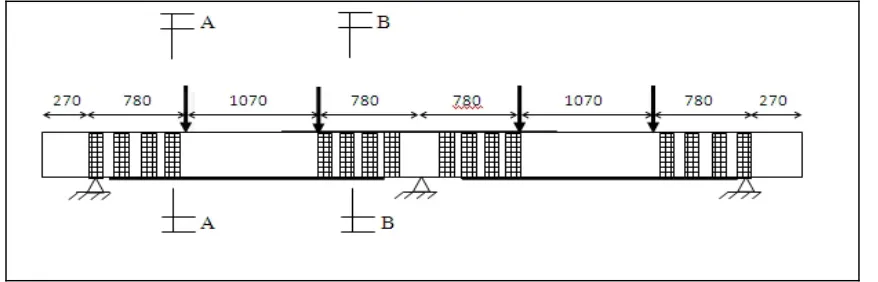
Figure 3.3: Loading Position
[image:36.612.112.544.480.604.2]Figure 3.5: Cross Section for 3 Sides Bonding
3.4 Materials properties
3.4.1- Sikadur
®
-330
Table 3.2: Properties of Sikadur-330(Sika kimia Sdn Bhd., 2009). Tensile strength E-Modulus
Flexural
Elongation at Break Tensile strength
[image:37.612.106.555.442.539.2]3.4.2- Sika Wrap-160 BI-C/15
[image:38.612.107.549.174.281.2]
Table 3.3: Properties of Sika Wrap-160 BI-C/15(Sika kimia Sdn. Bhd,2009)
Tensile strength: Tensile E-modulus: Elongation at break:
Density (g/cm3 of CFRP 3’800 N/mm2
(nominal)
230’000N/mm2 (nominal) 1.5% (nominal) 1.7
References
ACI 440.2R, 2008, “Guide for the Design and Construction of Externally Bonded FRP Systems for Strengthening of Concrete Structures,” American Concrete Institute
Chu kia (1998). “Reinforced concrete design”.
“
Carlo Pellegrino (2009) . Flexural Strengthening of Reinforced Concrete Beams with Prestressed FRP”.
“
Feras alzzoubi a, Zhang and Zheng-liang 29 April (2007). Shear strengthening of pre-damaged reinforced concrete beams with carbon fiber reinforced polymer sheet
strips”,Vol. 6 No. 4
Gamage, J.C.P.h,wong, M.B & Al mahidi R. (2005).”Performance of CFRP strengthened concrete members under elevated temperatures”.
H. K. Lee† & S. K. Ha September 22 (2008). “Finite element analysis of shear-deficient RC beams strengthened with CFRP strips/sheets”.Vol. 30, No. 2
Khalifa, A.M. (1999). “Shear performance of reinforced concrete beams strengthened with advanced composites.University of Missouri-Rolla: ph.D.Thesis.
Liu Zihong,27 July 2007 ) “Testing and analysis of a fiber reinforced polymer”.
Manfredi Gaetano and Marisa Pecce 30 August (2006). “Durability issues of FRP rebars in reinforced concrete members”.NO. 857–868
Mohamed (2009). “Finite Element Modeling o Reinforced Concrete Beams Strengthened with FRP Laminates”. Vol.30 No.4 (2009), pp.526-541
Nabil F. Grace (May-June 2001).“Strengthening of negative moment region of reinforced concrete beams using carbon fiber- reinforced polymer strips”. NO. 98-S33
Nadeem seddique (October 2009).“Experimental investigation of RC beams strengthened with externally bonded FRP composites”.
Norris (1997). “Analysis of Retrofitted Reinforced Concrete Shear Beams using Carbon Fiber Composites”.
Sikh kimia (2009). “Sikadar-330,2- part epoxy impregnation resin Malaysia”.
Vellore Gopalaratnam,( 2007). “Flexure shear response in fatigue of fiber reinforced concrete beams with FRP tensile reinforcement. Local Centre” .pp 150-153.)