
© 2016, IRJET ISO 9001:2008 Certified Journal
Page 446
Analysis of Performance Improving Parameters of DSDV using NS-3
Lakshman Naik.L
1, R.U.Khan
2, R.B.Mishra
31,2
Department of Electronics Engineering,
3 Department of Computer Science & EngineeringIndian Institute of Technology (Banaras Hindu University),Varanasi, India.
---***---Abstract –
Development of new mobile ad-hoc network(MANET) protocols necessitates testing against well-known protocols in different simulation environments. Routing protocols are acute features performing in wireless mobile networks. In MANET, mobile nodes communicate each other without possessing centralized control setup. The infrastructure less and dynamic nature of MANETs poses a major trial to accurate and effectual data routing. The routing algorithms initiate selection of routes between the source nodes and the destination nodes. Mobile ad-hoc networks are ad-hoc natured which has the features of forming and self-healing. In this paper, we have analyzed default parameter values of DSDV (Destination Sequenced Distance Vector) protocol with the revised parameter values of DSDV with the help of network simulator-3 (NS-3). Our investigations are based on different performance metrics like throughput, packet delivery ratio, end to end delay, packet loss and normalized routing load. Based on this analysis we concluded improvements of DSDV mobile ad-hoc network protocol.
Key Words: DBF, DSN, PL, DSR, AODV, DSDV,OLSR,PDR, EED,
DSDV, NS3, MANET, Throughput, Packet delivery ratio, Simulation, Packet loss, Routing.
1. INTRODUCTION
Functioning of MANETs (Mobile Ad-hoc Networks) does not require a centralized control setup and infrastructure have been the topic of important research. In mobile ad-hoc networks, nodes act as intermediate and end systems. They self-form and self-heal their communication links [1]. The key challenges in MANETs are “dy-connectivity in the face of wireless channels and nodes moving out of range from one another” [2]. Many researchers proposed new versions of MANET routing protocols but, still four well-known popular protocols are noticeable in the research community. These are: AODV(Ad hoc On Demand Distance Vector), DSDV (Destination Sequenced Distance Vector), DSR (Dynamic Source Routing) and OLSR (Optimized Link State Routing). Characteristics and performance of these four MANET routing protocols facilitates a base with which new protocols can be compared through analysis [2]. MANETs contains large or small set of nodes which establishes communication links with each other directly without the help of any infrastructure. Mobile nodes of MANETs are mobile in nature, their movements and velocity can be random. This makes them to get dynamic network topology [3]. Due to
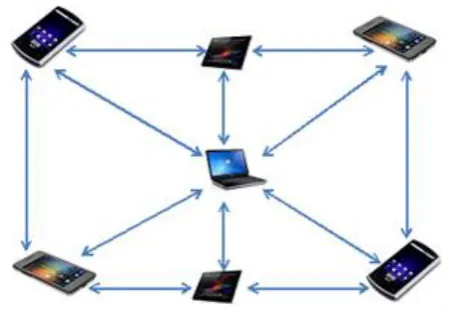
increase of hand held network devices (nodes) routing in mobile ad-hoc networks becoming challenging. Routing algorithms of ad hoc networks create accurate and efficient routes between the source-destination pairs. Mobile ad hoc network protocols are optimized to have less number of hops between the source and the destination. Mobile ad-hoc networks are expected to provide link connection proficiencies to the regions where communication infrastructure is not available. Fig. 1 demonstrates a simple mobile ad-hoc network.
Fig - 1: A Simple Mobile Ad hoc Network
[image:1.595.320.548.329.491.2]© 2016, IRJET ISO 9001:2008 Certified Journal
Page 447
table known as sequence number [5]. In DSDV, every nodeholds routing information in its routing table. Routing table of DSDV has the attributes like available destinations, sequence number allotted by the destination node and the hop count. Hop count is needed to reach the destination node. Routing tables of nodes helps in establishing communication links between the nodes. Nodes broadcast their routing information frequently through the entire network. Routing information so broadcasted has the fields such as nodes, new sequence number, destination IP address and number of hops that required reaching the requisite destination. DSDV uses “full dump “and “incremental dump” packets in overcoming transmission link overheads. The unit of broadcasting routing information is NPDU (Network Protocol Date Unit) [5]. In DSDV, routing table of a node is updated when the node receives routing information from the neighbour node. This updating is possible only when set norms are fulfilled.
2. Types of Routing Protocols in MANETs
Mobile ad-hoc network protocols can be classified into three types based on their characteristics and update mechanisms: proactive or table driven routing protocols, reactive or on-demand routing protocols and hybrid protocols. In MANETs, discovery of root takes place by means of routing process. These processes are controlled by routing protocols or routing algorithms. The main aim of these protocols is to ensure an error free route between the nodes. These protocols are responsible for accurate and discharge of data packets within the set time frame.
2.1 Proactive OR Table-Driven Routing Protocols
These protocols maintain routing information of all the member nodes of the network and update already existing routes and adding up of new routes. Updating of existing routes and adding new routes are takes place by broadcasting latest routing information among all the nodes of the network. This promotes availability of ready routes to the desired destinations as and when required. Proactive protocols are totally depends on information available in their routing table and by these tables they conclude proper and accurate routes. In case of larger dynamic networks “convergence may not be possible” [2]. Routing tables of these protocols rise along with the density and dimension of the network. These protocols have an overhead of flooding route announcements to sustain convergence. Examples of proactive protocols are: DSDV, OLSR, ACOR, and CGSR.
2.2 Reactive OR On-Demand Routing Protocols
Reactive routing protocols create routes only when routes are required. Hence, nodes do not require updating their routing tables frequently and they do not sustain routes for the member nodes of the network. When any node desires to have a route to a particular new destination then it has to
initiate route request and wait until the discovery of the required route. These protocols do not maintain routing tables which causes delay in discovery of routes to new destinations. This is a disadvantage of reactive protocols. Examples of reactive protocols are: AODV, DSR, WRF and ABR.
2.3 Hybrid Protocols
Hybrid routing protocols were developed by combining reactive and proactive protocols [6]. Hybrid routing protocols cartels the advantages of proactive as well as reactive routing protocols and at the same time hybrid routing protocols overcomes the disadvantages of proactive and reactive routing protocols [7]. Examples of hybrid protocols are: TORA, ARPAM, ZRF and OORP.
3. Parameters that affects performance
Various network and protocol parameters affect the performance of the routing protocols. Network parameters that affect protocol performance are: transmission region, number of source/sink pairs, type of traffic, mobility model, node density, node velocity and transmit power etc. Protocol parameters also affect the performance of routing protocols. Here, we are discussing DSDV and the parameters that affect its performance are: periodic update interval, settling time, maximum queue length, and maximum queued packets per destination, maximum queue time, buffering, weighted settling time, hold times, weighted factor, routing aggregation, and routing aggregation time etc. Similarly other MANET routing protocols has their own parameters and these parameters affect their routing performance.
4. Destination Sequenced distance vector (DSDV)
© 2016, IRJET ISO 9001:2008 Certified Journal
Page 448
updated packets which are “full dump “and incrementaldump” packets. In DSDV, transmission link overheads are minimized by the help of these updated packets. The “full dump” possesses the data related to the routing whereas “incremental dump” retains the changed data since the last “full dump”. These updated dump packets are also referred as the ways of broadcasting in DSDV. Whenever a node receives latest routing information, it increases the metric and retransmits the routing information by broadcasting it throughout the network. Prior to the transmission, metric increasing process is carried out because incoming packets need to travel further one hop more in order to reach its destination. Mobility of the nodes from one place to other results in link breaks. Routing tables of the nodes are assigned infinity value for broken links [5]. These infinity values of the routing tables define no next hop for the conforming destinations. In the routing tables, even number value of the sequence number field remarks that the communication link is initiated by the nodes and odd values remarks to link break, which has infinity metric. DSDV uses bidirectional links and it has a drawback of providing single route for a source and destination pair [10].
4.1 Routing Tables
In DSDV, routing table arrangement is very simple. Entries of the routing table have a sequence number which gets incremented whenever a node transmits an updated message [10]. Routing tables of the nodes gets updated periodically for network topology changes. This updated information of the routing tables is broadcasted throughout the network. DSDV upholds two routing tables one for forwarding packets and another one is for incremental routing packets. In DSDV, nodes transmits the routing information periodically which has the destination node address, new sequence number, hop count information and sequence number of that particular destination node. When change in network topology occurs, then the node transmits the information of the changes throughout the network.
4.2 Updating of Routing Tables
[image:3.595.334.545.313.431.2]In DSDV, when a node receives updated route information from the other nodes of the network, it updates its routing table as follows [10]:
a) Nodes maintain sequence numbers in their routing tables, if any new address possesses a higher sequence number then the node selects routes of higher sequence numbers and at the same time they abandon low value sequence numbers.
b) When sequence number of the incoming packet is same as already available route then the routes of low cost are selected for data communication.
c) New route information has its own metrics and all of these metrics are incremented.
d) This procedure sustains till every nodes of the network gets updated. For Identical data packets lower cost metric values are considered and rest packets are rejected. For broken links, a cost metric value of infinity and the new incremented sequence number are assigned. Sequence number of this metric is greater than or equal to the sequence number of that particular node. Fig.2 demonstrates a process in DSDV. There are eight mobile nodes in the network: A, B, C, D, E, F, G and H. Neighbors of mobile node B are: A, C, D and H. Table-1 illustrates routing table of node B. The dashed lines show no communication links between the corresponding nodes. Consequently Node B does not have any information about node H.
Fig - 2: DSDV in Process
Table-1: Routing Table of Mobile Node ‘B’
Destination
Node
Next Hop
Metric
Sequence
Number of
the
Destination
Node
A
B
C
D
E
H
A
0
C
D
D
A
1
0
1
1
2
Infinity
221
734
412
268
520
© 2016, IRJET ISO 9001:2008 Certified Journal
Page 449
5. Performance Metrics
The following performance metrics have been considered to analyze the performance of default DSDV and modified DSDV [8].
5.1 Throughput
Throughput is the amount of data transmitted from the source node to the destination node in a unit time. Unit of Throughput is Kilobits per second (Kbps).
Throughput = (Received Bytes×8) ÷ (Simulation time×1024) (1) Throughput is calculated in Kbps. Higher values of the throughput carries better performance.
5.2 Packet Delivery Ratio (PDR)
PDR is the fraction of total packets received to the total sent packets.
PDR = (received packets total) ÷ (total packets sent) × 100 % (2) PDR is calculated in % (percentage). Higher values of PDR carry better performance.
5.3 End to End Delay (EED)
EED is the average time interval between packets created at the source node and delivery of these packets at the destination node. EED is the ratio of delay sum to the packets received.
EED = (delay sum) / (total packets received) (3) It is derived in ms (mille second). Smaller values of end to end delay carries improved performance.
5.4 Packet loss (PL)
PL is the difference of sent packets total and the received packets total.
PL = (sent packets total) – (received packets total) (4) It is derived as number of packets.
5.5 Normalized Routing Load (NRL)
NRL is the fraction of number of transferred routing packets to the number of received packets [4].
NRL = (Number of sent routing packets) / (Number of data
packets received) (5)
Higher values of NRL provide reduced efficiency of the routing protocol in terms of consumption of bandwidth.
6. Simulation Setup
We have considered 3.13 version of Network Simulator-3 (NS-3) and CENTOS open source Linux for our simulation based experiments on DSDV. NS-3 is an open source discrete-event based network simulator [11]. NS-3 is developed in C++ with the optional python bindings. NS-3 has improved simulation aptitudes. NS-3 is not adjusted backward with the NS-2. NS-3 was developed from the base to replace NS-2 Application Program Interfaces (APIs). NS-3 does not support APIs of NS-2 [8].
6.1 Simulation Results
Experiments on DSDV have been carried out by using general network simulation parameters (Table-2) and modified values of DSDV parameters (Table-3). Achieved results are presented in the following tables of metrics and graphs.
Table -2: General Network Simulation Parameters
1 Number of Nodes 30,40,50,60,70,80,90,100
2 Simulation Time 150 seconds
3 Pause Time No pause time
4 Wi-Fi mode Ad-hoc
5 Wi-Fi Rate 2Mbps (802.11b)
6 Transmit Power 7.5 dBm
7 Mobility model Random mobility model Waypoint
8 No.of Source/Sink 10
9 Sent Data Rate 2048 bits per second (2.048Kbps)
10 Packet Size 64 Bytes
11 Node Speed 20 m/s
12 Protocols used DSDV
13 Region 300x1500 m
14 Loss Model Friis loss model
© 2016, IRJET ISO 9001:2008 Certified Journal
Page 450
Table -3: Revised Values of DSDV Parameters [12]Parameter Assigned Value
Periodic Update Interval 10 Seconds
Settling Time 3 Seconds
Maximum Queue Length 300 Packets
Maximum Queued
Packets per Destination 6 Packets
Maximum Queue Time 10 Seconds
Enable Buffering True
Enable Weighted Settling
Time False
Hold Time 2
Weighted Factor 0.875
Enable Route
Aggregation False
Route Aggregation Time 2 Seconds
6.1.1 Throughput:
Table - 4: Throughput in Kbps
No. of Nodes DSDV (Default) DSDV (Modified)
30 14.95 16.86
40 14.30 15.56
50 12.64 13.30
60 14.87 16.01
70 14.58 16.33
80 15.60 16.36
90 13.47 14.14
100 13.58 12.85
Fig - 3: Throughput over No. of Nodes
6.1.2 Packet Delivery Ratio:
Table - 5: Packet delivery ratio in %
No. of Nodes DSDV (Default) DSDV (Modified)
30 74.73 84.32
40 71.52 77.82
50 63.22 66.50
60 74.35 80.03
70 72.88 81.67
80 77.98 81.82
90 67.33 70.70
100 67.88 64.25
Fig - 4: PDR over No. of Nodes.
6.1.3 End to End Delay:
Table - 6: End to end delay in mille seconds
No. of Nodes DSDV (Default) DSDV (Modified)
30 8.45 4.65
40 9.96 7.13
50 14.55 12.59
60 8.62 6.24
70 9.30 5.61
80 7.06 5.56
90 12.13 10.36
© 2016, IRJET ISO 9001:2008 Certified Journal
Page 451
Fig - 5: End to end delay over No. of Nodes6.1.4 Packet Loss:
Table - 7: Packet loss (No. of Packets)
No. of Nodes DSDV (Default) DSDV (Modified)
30 1516 941
40 1709 1331
50 2207 2010
60 1539 1198
70 1627 1100
80 1321 1091
90 1960 1758
100 1927 2145
Fig - 6: Packet loss over No. of Nodes
6.1.5 Normalized Routing Load: Table - 8: NRL
No. of Nodes DSDV (Default) DSDV (Modified)
30 0.747 0.843
40 0.715 0.778
50 0.632 0.665
60 0.744 0.800
70 0.729 0.817
80 0.780 0.818
90 0.673 0.707
100 0.679 0.643
Fig - 7: NRL over No. of Nodes
7. Conclusion
© 2016, IRJET ISO 9001:2008 Certified Journal
Page 452
density etc. However, performance of the MANET routingprotocols gets affected by various technical parameters.
Acknowledgements
We would like to thank Dr.Ramesh Singh yadava and Dr. Chandan Kumar Rai, of the Computer Centre, Banaras Hindu University, Varanasi, India, for their kind support.
REFERENCES
[1] M. Conti and S. Giordano. Multihop Ad Hoc Networking:
The Theory. IEEE Communications Magazine, 45(4):78-86, April 2007.
[2] Hemanth Narra, Yufei Cheng, Egemen K. Cetinkaya,
Justin P.Rohrer and James P.G.SSterbenz “Destination-Sequenced Distance Vector (DSDV) Routing Protocol Implementation in ns-3. Information and Telecommunication Technology Center, Department of Electrical Engineering and Computer Science, The University of Kansas, Lawrence, KS 66045,USA.
[3] Bai F., Narayanan Sadagopan, and Helmy A. “Important:
a framework to systematically analyze the impact of mobility on performance of routing protocols for ad hoc networks”. INFOCOM, IEEE, 2:825{835, July 2003.
[4] Qutaiba Razouqi, Ahmed Boushehri, Mohamed Gaballah,
Lina Alsaleh. “Extensive Simulation Performance Analysis for DSDV, DSR, and AODV MANET Routing Protocols”. IEEE Computer Society, 2013.
[5] Teressa Longjam and Neha Bagoria, February 2013.
“Comparative Study of Destination Sequenced Distance Vector and Ad-hoc on-demand Distance Vector Routing Protocol of Mobile Ad-hoc Network”.
[6] C. E. Perkins, E. M. Belding-Royer and S. R. Das, 25-26
February 1999. “Ad Hoc on-Demand Distance Vector (AODV) Routing,” pp. 90-100. 2nd IEEE Workshop on
Workshop Mobile Computing Systems and
Applications,New Orleans.
[7] Prof. Dr. C. A. Dhote, Prof M.A.Pund, Prof. R.S.
Mangrulkar ,Mr. Makarand R. Shahade. “Hybrid Routing Protocol with Broadcast Reply for Mobile Ad hoc Network” International Journal of Computer Applications (0975 – 8887) Volume 1 – No. 10. 2010.
[8] Rakesh Kumar Jha, Pooja Kharga, March 2015. “A
Comparative Performance Analysis of Routing Protocols in MANET using NS3 Simulator”. *
[9] Sreekanth Vakati, Dr.Ch.Balaswamy, July 2013.
“Performance Analysis of Routing Protocols in Mobile Ad Hoc Networks”.
[10] [Online].Aailable: http://www.idc-online.com
/technical_references/pdfs/data_communications/Desti
nation_Sequenced_Distance_Vector_DSDV_Protocol.pdf
[11] NS-3 tutorial. [Online]. Available:
http://www.nsnam.org/docs/release/3.14/tutorial/sin glehtml/index.html
[12] NS-3 tutorial. [Online]. Available:
https://www.nsnam.org/docs/release/3.18/doxygen/cl
![table as follows [10]:](https://thumb-us.123doks.com/thumbv2/123dok_us/8188595.812719/3.595.334.545.313.431/table-as-follows.webp)
![Table -3: Revised Values of DSDV Parameters [12]](https://thumb-us.123doks.com/thumbv2/123dok_us/8188595.812719/5.595.310.557.126.502/table-revised-values-of-dsdv-parameters.webp)
