International Journal of Emerging Technology and Advanced Engineering
Website: www.ijetae.com (ISSN 2250-2459, ISO 9001:2008 Certified Journal, Volume 6, Issue 2, February 2016)
201
Optimization of NTRU Cryptosystem using GA and PSO
Algorithm
Himani Agrawal
1, Dr. Monisha Sharma
21
Associate Professor in E & Tc Deptt. SSGI (FET), Bhilai, India 2Professor in E&Tc Deptt. SSGI (FET), Bhilai
Abstract—Security of information has become a great demand of our life. Especially in e- business application. Basically there are two cryptographic methods i.e. symmetric and asymmetric. Symmetric cryptosystems are fast but less secure. Asymmetric cryptosystems are haning comparatively less speed but highly secure. NTRU is one of the fastest Asymmetric cryptosystems. In this paper we optimized NTRU with respect to simulation time using advanced optimization techniques i.e. Genetic Algorithm(GA) and Particle Swarm Optimization (PSO) algorithm seperately. We implemented this optimized NTRU in MATLAB and compared the simulation time of optimized NTRU with NTRU, DES, and RSA cryptosystems for different size of text files. We found that the speed of optimized NTRU is greater than the NTRU without any optimization technique.
Keywords—DES, RSA, NTRU, Genetic Algorithm, PSO, optimization, cryptography.
I. INTRODUCTION
Optimization is the act of obtaining the best result under the given circumstances. In design, construction and maintenance of any engineering systems many managerial and the technological decisions have to be taken at several stages. The ultimate goal of all such decisions is either to minimize the effort required or to maximize the desired benefit. Hence optimization can be defined as the process of finding the conditions that give the minimum or maximum value of a function, where the function represents the effort required or the desired benefit [1] or in other words maximization or minimization of one or more functions with any possible constraints is called optimization [2].
II. METHODOLOGY
A brief introduction of various cryptosystems implemented in this paper are as follows.
DES: DES is a Symmetric block cipher. It was created in 1972 by IBM, using the Data Encryption Algorithm. It was adopted by the U.S. Government as its standard encryption method for commercial and unclassified communications in 1977. DES begins the encryption process by using a 64-bit key.
The NSA restricted the use of DES to a 56-bit key length, so DES discards 8-bits of the key and then uses the remaining key to encrypt data in 64-bit blocks. DES can operate in CBC, ECB, CFB, and OFB modes, giving it flexibility.
In 1998, the supercomputer DES Cracker, assisted by 100,000 distributed PCs on the Internet, cracked DES in 22 hours. The U.S. Government has not used DES since 1998[5].
RSA: RSA is an Asymmetric cipher. It is one of the oldest and the most widely used public key cryptographic algorithms. It was the first algorithm known to be suitable for signing as well as encryption. The system works on two large prime numbers, from which the public and private keys will be generated. RSA was developed by Ron Rivest, Adi Shamir, and Leonard Adleman, in 1977. RSA derives its name from the initials of the last name of each of its developers. It is commonly used with key strengths of 1024-bits, but its real strength relies on the prime factorization of very large numbers [5]. The RSA scheme is a block cipher in which the plaintext and the cipher text are integers between 0 and n-1 for some modulus n.
International Journal of Emerging Technology and Advanced Engineering
Website: www.ijetae.com (ISSN 2250-2459, ISO 9001:2008 Certified Journal, Volume 6, Issue 2, February 2016)
202 A. Evolutionary Optimization Algorithms
Evolutionary algorithms (EAs) are developed to arrive at near-optimum solutions to a large scale optimization problem. Genetic Algorithm and Particle Swarm Optimisation are the two popular Evolutionary Optimization Algorithms. A brief description of these algorithms are as follows:
1) Genetic Algorithm (GA)
Genetic Algorithm (GA) works on the theory of Darvin’s theory of evolution and the survival-of-the fittest [3]. Genetic algorithms guide the search through the solution space by using natural selection and genetic operators, such as crossover, mutation and the selection. GA encodes the decision variables or input parameters of the problem into solution strings of a finite length. While traditional optimization techniques work directly with the decision variables or input parameters, genetic algorithms usually work with the coding. Genetic algorithms start to search from a population of encoded solutions instead of from a single point in the solution space. The initial population of individuals is created at random. Genetic algorithms use genetic operators to create Global optimum solutions based on the solutions in the current population. The most popular genetic operators are (1) selection (2) crossover and (3) mutation. The newly generated individuals replace the old population, and the evolution process proceeds until certain termination criteria are satisfied.
(i) Selection
The selection procedure implements the natural selection or the survival-of-the fittest principle and selects good individuals out of the current population for generating the next population according to the assigned fitness. The existing selection operators can be broadly classified into two classes:
(a) proportionate schemes, such as roulette-wheel selection and stochastic universal selection and
(b) ordinal schemes, such as tournament selection and truncation selection.
Ordinal schemes have grown more and more popular over the recent years, and one of the most popular ordinal selection operators is tournament selection. After selection, crossover and mutation recombine and alter parts of the individuals to generate new solutions.
(ii) Crossover
Crossover, also called the recombination operator, exchanges parts of solutions from two or more individuals, called parents, and combines these parts to generate new individuals, called children, with a crossover probability. There are a lot of ways to implement a recombination operator. The well-known crossover operators include one-point crossover. When using one-one-point crossover, only one crossover point is chosen at random, for example let there be two parent string A1 and A2 as:
A1 = 1 1 1 1| 1 1 A2 = 0 0 0 0| 0 0 Eq. 1
Then, one-point crossover recombines A1 and A2 and yields two offsprings A_1 and A_2 as:
A_1 = 1 1 1 1|1 1
A_2 = 0 0 0 0|1 1 Eq. 2
(iii) Mutation
Mutation usually alters some pieces of individuals to form perturbed solutions. In contrast to crossover, which operates on two or more individuals, mutation operates on a single individual. One of the most popular mutation operators is the bitwise mutation, in which each bit in a binary string is complemented with a mutation probability. For example,
A = 1 1 1 1|1 1
A_1 = 0 0 0 0|0 1 Eq. 3
The step-by-step implementation of GA is explained as follows:
Step 1: Initialize GA parameters which are necessary for the algorithm. These parameters include population size which indicates the number of individuals, number of generations necessary for the termination criterion, crossover probability, mutation probability, number of design variables and respective ranges for the design variables. If binary version of GA is used then string length is also required as the algorithm parameter.
International Journal of Emerging Technology and Advanced Engineering
Website: www.ijetae.com (ISSN 2250-2459, ISO 9001:2008 Certified Journal, Volume 6, Issue 2, February 2016)
203 Step 3: Obtain the values of the objective function for all the population members. The value of the objective function so obtained indicates the fitness of the individuals. If the problem is a constrained optimization problem then a specific approach such as static penalty, dynamic penalty and adaptive penalty is used to convert the constrained optimization problem into the unconstrained optimization problem.
Step 4: This step is for the selection procedure to form a mating pool which consists of the population made up of best individuals. The commonly used selection schemes are roulette-wheel selection, tournament selection, stochastic selection, etc. The simplest and the commonly used selection scheme is the roulette-wheel selection, where an individual is selected for the mating pool with the probability proportional to its fitness value. The individual (solution) having better fitness value will have more number of copies in the mating pool and so the chances of mating increases for the more fit individuals than the less fit ones. This step justifies the procedure for the survival of the fittest.
Step 5: This step is for the crossover where two individuals, known as parents, are selected randomly from the mating pool to generate two new solutions known as off-springs. The individuals from the population can go for the crossover step depending upon the crossover probability. If the crossover probability is more, then more individuals get chance to go for the crossover procedure. The simplest crossover operator is the single point crossover in which a crossover site is determined randomly from where the exchange of bits takes place. The crossover procedure is explained through Eqs. 1and 2.
Step 6: After crossover, mutation step is performed on the individuals of population depending on the mutation probability. The mutation probability is generally kept low so that it does not make the algorithm unstable. In mutation, a random site is selected from the string of individuals and it is flapped as explained through Eq. 3.
Step 7: Best obtained results are saved using elitism. All elite members are not modified using crossover and mutation operators but can be replaced if better solutions are obtained in any iteration.
Step 8: Repeat the steps (from step 3) until the specified number of generations or termination criterion is reached [4].
B. Particle Swarm Optimization
Particle swarm optimization (PSO) is a population based stochastic optimization technique.
It was developed by Dr. Eberhart and Dr. Kennedy in 1995, inspired by social behavior of bird flocking or fish schooling. PSO shares many similarities with evolutionary computation techniques such as Genetic Algorithms (GA). The system is initialized with a population of random solutions and searches for optima by updating generations. However, unlike GA, PSO has no evolution operators such as crossover and mutation. In PSO, the potential solutions, called particles, fly through the problem space by following the current optimum particles. PSO gets better results in a easier, faster, cheaper way compared with other methods. There are few parameters to adjust. One version, with slight variations, works well in a wide variety of applications. It has been used for approaches that can be used across a wide range of applications, as well as for specific applications focused on a specific requirement.
Particle swarm optimization (PSO) is a population based stochastic optimization technique developed by Dr. Eberhart and Dr. Kennedy in 1995, inspired by social behavior of bird flocking or fish schooling. PSO shares many similarities with evolutionary computation techniques such as Genetic Algorithms (GA). The system is initialized with a population of random solutions and searches for optima by updating generations. However, unlike GA, PSO has no evolution operators such as crossover and mutation. In PSO, the potential solutions, called particles, fly through the problem space by following
the current optimum particles.
Compared to GA, the advantages of PSO are that PSO is easy to implement and there are few parameters to adjust. There are two popular swarm inspired methods in computational intelligence areas: Ant colony optimization (ACO) and particle swarm optimization (PSO). ACO was inspired by the behaviors of ants and has many successful applications in discrete optimization problems. The particle swarm concept originated as a simulation of simplified social system. The original intent was to graphically simulate the choreography of bird of a bird block or fish school. However, it was found that particle swarm model can be used as an optimizer.
International Journal of Emerging Technology and Advanced Engineering
Website: www.ijetae.com (ISSN 2250-2459, ISO 9001:2008 Certified Journal, Volume 6, Issue 2, February 2016)
204 All of particles have fitness values which are evaluated by the fitness function to be optimized, and have velocities which direct the flying of the particles. The particles fly through the problem space by following the current optimum particles.
PSO is initialized with a group of random particles (solutions) and then searches for optima by updating generations. In every iteration, each particle is updated by following two "best" values. The first one is the best solution (fitness) it has achieved so far. (The fitness value is also stored.) This value is called pbest. Another "best" value that is tracked by the particle swarm optimizer is the best value, obtained so far by any particle in the population. This best value is a global best and called gbest. When a particle takes part of the population as its topological neighbors, the best value is a local best and is called lbest. After finding the two best values, the particle updates its velocity and positions with following equation (a) and (b).
v[] = v[]+c1*rand()*(pbest[] - present[])+c2*rand() *
(gbest[] - present[]) (a)
present[] = persent[] + v[] (b)
v[] is the particle velocity, persent[] is the current particle (solution). pbest[] and gbest[] are defined as stated before. rand () is a random number between (0,1). c1, c2 are learning factors. usually c1 = c2 = 2. While maximum iterations or minimum error criteria is not attained Particles' velocities on each dimension are clamped to a maximum velocity Vmax. If the sum of accelerations would cause the velocity on that dimension to exceed Vmax, which is a parameter specified by the user. Then the velocity on that dimension is limited to Vmax [10].
III. RESULT
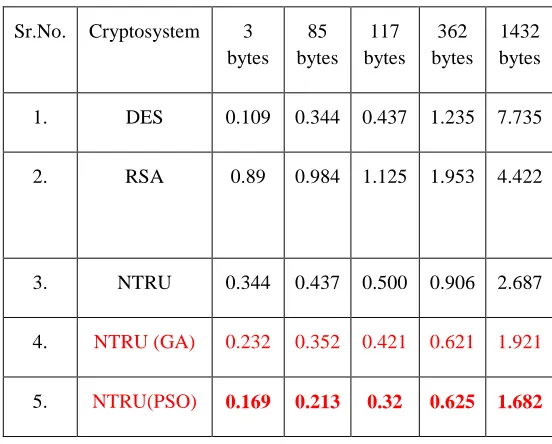
After the implementation of optimised NTRU cryptosystem using GA and PSO Algorithm, we compared these cryptosystems with some pre-existing fast Symmetric and Asymmetric Cryptosystems.
[image:4.612.317.593.227.449.2]In these algorithms DES is a very fast Symmetric Cypher. RSA is the most popular oldest Asymmetric Cypher and NTRU is faster than RSA. The comparison table is as shown below :
TABLE I
Comparison of various cryptosystems with optimized NTRU for different length of messages with respect to simulation time in
seconds.
Sr.No. Cryptosystem 3 bytes
85 bytes
117 bytes
362 bytes
1432 bytes
1. DES 0.109 0.344 0.437 1.235 7.735
2. RSA 0.89 0.984 1.125 1.953 4.422
3. NTRU 0.344 0.437 0.500 0.906 2.687
4. NTRU (GA) 0.232 0.352 0.421 0.621 1.921
5. NTRU(PSO) 0.169 0.213 0.32 0.625 1.682
International Journal of Emerging Technology and Advanced Engineering
Website: www.ijetae.com (ISSN 2250-2459, ISO 9001:2008 Certified Journal, Volume 6, Issue 2, February 2016)
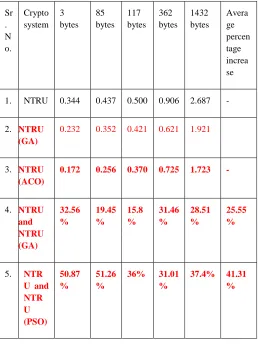
[image:5.612.40.298.168.513.2]205 TABLE III
Percentage increase in speed of the optimized NTRU as compared to the conventional NTRU for different length of messages
Sr . N o.
Crypto system
3 bytes
85 bytes
117 bytes
362 bytes
1432 bytes
Avera ge percen tage increa se
1. NTRU 0.344 0.437 0.500 0.906 2.687 -
2. NTRU (GA)
0.232 0.352 0.421 0.621 1.921
3. NTRU (ACO)
0.172 0.256 0.370 0.725 1.723 -
4. NTRU and NTRU (GA)
32.56 %
19.45 %
15.8 %
31.46 %
28.51 %
25.55 %
5. NTR U and NTR U (PSO)
50.87 %
51.26 %
36% 31.01 %
37.4% 41.31 %
From the above table the average percentage increase in speed of NTRU using Genetic algorithm is 25.55% as compared to conventional NTRU. Also the table shows that the average percentage increase in speed of NTRU using PSO algorithm is 41.31% as compared to conventional NTRU.
IV. CONCLUSION
In this paper we implemented some fast Symmetric and Asymmetric cryptosystems i.e. DES, RSA and NTRU in MATLAB. In order to construct a highly secure speedy cryptosystem we optimized NTRU using Genetic Algorithm and Ant Colony Optimization Algorithm separately.
We also implemented these algorithms in MATLAB. After implementation we compared the simulation time of these cryptosystems for different size of text files. We found that the optimized NTRU using ACO algorithm is having the minimum simulation time. We also compared the percentage increase in speed of optimized NTRU with the conventional NTRU. We found that the increase in speed of optimized NTRU using GA is 25% on average. Also the increase in speed of optimized NTRU using PSO is 41.31% on average. This comparison shows that the optimized NTRU using Particle Swarm Optimization algorithm is performing the best with respect to simulation time.
REFERENCES
[1] http://www.nptel.ac.in/courses/105108127/pdf/Module_1/M1L1slide s.pdf
[2] http://shodhganga.inflibnet.ac.in/bitstream/10603/11449/9/09_chapte r%204.pdf
[3] Holland J (1975) Adaptation in natural and artificial systems. University of Michigan Press, Ann Arbor.
[4] http://www.springer.com/978-1-4471-2747-5
[5] An Introduction to Cryptography, and Common Electronic Cryptosystems – Part I”, EnterpriseITplanet.com
[6] J. Hoffstein, J. Pipher and J. H. Silverman, NTRU: A Ring-Based Public Key Cryptosystem. Algorithmic Number Theory (ANTS III), Portland, OR, June 1998, J.P. Buhler (ed.), LNCS 1423, Springer-Verlag, Berlin, 267-288, 1998.
[7] Tommy Meskanen,”On the NTRU CryptoSystem”, TUCS
Dissertations No 63, June 2005 [8] From Wikipedia browsed on 15.7.14 [9] from Wikipedia browsed on 11.1.15
[10] file:///C:/Users/user/Desktop/fourth%20prog%20report1/Particle%2 0Swarm%20Optimization%20%20Tutorial.htm
[11] Himani Agrawal and Monisha Sharma “Implementation and analysis of various symmetric cryptosystems “ Indian Journal of Science and Technology Vol. 3 No. 12 ,Dec 2010.
[12] Akash Mandal and Mrs. Archna Tiwari, “Performance Evalution of Cryptographic Algorithm: DES and AES”, Academia
[13] http://shodhganga.inflibnet.ac.in/bitstream/10603/11449/9/09_chapte r%204.pdf
[14] Challa Narasimham and Jayaram Pradhan, “Evaluation Of Performance Characteristics of Cryptosystem Using Text Files”, Journal of Theoretical and Applied Information Technology, pp. 55-59, 2008.