An experimental study of the concrete
using polymer and metakaolin as additives
Al Menhosh, A, Wang, Y and Wang, Y
Title
An experimental study of the concrete using polymer and metakaolin as
additives
Authors
Al Menhosh, A, Wang, Y and Wang, Y
Type
Conference or Workshop Item
URL
This version is available at: http://usir.salford.ac.uk/id/eprint/38491/
Published Date
2016
USIR is a digital collection of the research output of the University of Salford. Where copyright
permits, full text material held in the repository is made freely available online and can be read,
downloaded and copied for noncommercial private study or research purposes. Please check the
manuscript for any further copyright restrictions.
SCMT4
Las Vegas, USA, August 7-11, 2016
An Experimental Study of the Concrete Using Polymer and
Metakaolin as Additives
Adel Al Menhosh
1, Yan Wang
2, Yu Wang
11
School of Computing, Science & Engineering, University of Salford, Manchester M5 4WT, UK.
E-mail: <[email protected]>, <[email protected]>.
2
School of Civil Engineering, Chongqing Jiaotong University, Chongqing, P.R. China. E-mail:
<[email protected]>
ABSTRACT
Environmental friendly and high performance concrete is very import for the applications in sewage and water treatment industry. Using mineral additives such as fly ash and silica fume has been proven an effective approach to improve concrete properties. This paper reports a study of the effect of using both polymer and metakaolin additives together on the mechanical and durability properties of concrete. Different proportion of the combination using two different polymers, metakaolin and recycled fiber reinforcement have been studied. The effects of water to cement ratio and the curing methods have also been compared. At last an optimized mixture and curing method has been suggested.
INTRODUCTION
Using mineral additives such as fly ash and silica fume has been proven an effective approach to improve concrete properties. With the increasing of the environmental concern, in recent years [Srinivasu, et.al. 2014], the use of Metakaolin (MK) as an optional additive has also raised more and more interests [Aiswarya et al 2013]. As a supplementary cementitious material MK has the expected pozzolanic nature activated by tri-calcium silicate (C3S) and tri-calcium aluminate (C3A) [Jean 1994]. When used as a partial replacement for cement, MK reacts with Portlandite (Ca(OH)2) to generate additional CSH gel
In concrete practice, polymers have been also commonly used as additives to improve concrete durability because of its effect on reducing water absorption. Styrene butadiene rubber (SBR) and poly vinyl acetate (PVA) are two polymers commonly used into concrete with the effect on reducing the pore spaces and connection [Fowler 1987]. Previous work [Bhikshma et al. 2010] has found that, while increases the strength and decease the water permeability, SBR can increase the workability of concrete as well. The work by Jamshidi and Pakravan [2014] also showed that a polymer admixture of the SBR, Acrylic and PVA generated a decrease in water permeability of the concretes. A work by Lewis and Lewis [1990] showed that the workability of SBR-modified concretes was much higher than that of normal concrete, and increases with the increase of polymer content. However, the workable time was greatly reduced when compared with normal unmodified concrete. Wang et al. [2005] studied the physical and mechanical properties of SBR modified cement mortars using different polymer/cement ratio (p/c) and a constant water/cement ratio of 0.4. They also compared two curing methods, i.e.: wet cure for 2, 6 or 27 days by immersed in 20˚C water, and mixed cure for 6 days by immersed in 20˚C water followed by 21 days at 20˚C and 70% relative humidity (RH). The results showed that the mixed cure produced an improvement on the mortar properties. Tomas and Ganiron [2013] ever investigated the influence of polymer fiber on the strength of concrete. They added two kinds of polymer fibers, i.e.: polyvinyl alcohol and polyvinyl acetate, into concrete mixes. It was found that the polymer modified concrete of 2% p/c showed the highest compressive strength and that of 6% p/c displayed a similar result as that of the conventional concrete.
EXPERIMENTAL INVESTIGATION
This research aims to investigate the combined effect using both MK and polymer together on the improvement of the concrete mechanical and durability properties. At first, control sample was made using a mixture of Portland cement, sand, and gravels. At second, modified concrete specimens were made by adding two types of polymer additives, they are SBR and PVA, and partially replacing the cement using MK. Different water cement ratios were used for all of these mixtures. In addition, plastic and glass fiber made of recycled materials were used to reinforce the concrete mixtures. Experimental tests of the concrete mixtures after different setting time have been carried for mechanical properties, including: compressive strength, splitting tensile strength, flexural strength, and the durability related property, the water absorption. The effects of using different curing methods have also been compared.
Component materials and mixtures
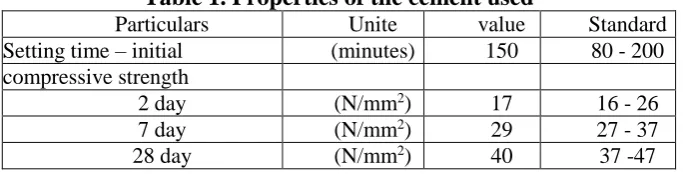
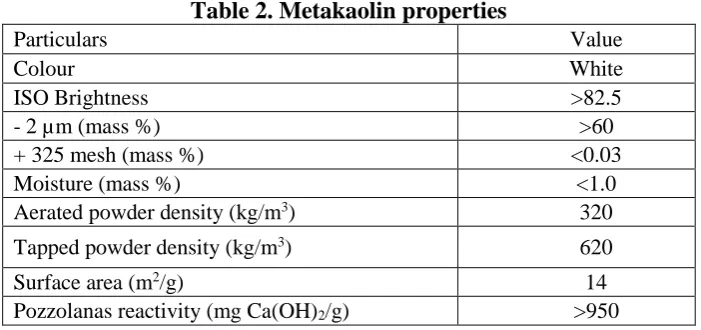
[image:3.595.128.470.656.743.2]Portland limestone cement, the CEM II/A-LL (BS EN 197-1:2011), was used in the experiment. The cement properties have been listed in the Table 1. The fine aggregate used sand, while the coarse aggregate was crashed limestone and conventional gravel with maximum size of 10 mm. Their particle size distribution followed the BS 882:1992 and BS 812: 1992. A premium metakaolin produced by Whitchem Ltd (http://whitchem.co.uk/) was used in this study. Its properties have been shown in Table 2. Both SBR and PVA were used as polymer additives. Tables 3-4 have listed out their proprieties, respectively. Alkali resistant glass fibre (GF) and a recycled polypropylene plastic fibre (PF) were also used in the study.
Table 1. Properties of the cement used
Particulars Unite value Standard
Setting time – initial (minutes) 150 80 - 200
compressive strength
2 day (N/mm2) 17 16 - 26
7 day (N/mm2) 29 27 - 37
Table 2. Metakaolin properties
Particulars Value
Colour White
ISO Brightness >82.5
- 2 µm (mass %) >60
+ 325 mesh (mass %) <0.03
Moisture (mass %) <1.0
Aerated powder density (kg/m3) 320
Tapped powder density (kg/m3) 620
Surface area (m2/g) 14
[image:4.595.123.474.126.291.2]Pozzolanas reactivity (mg Ca(OH)2/g) >950
Table 3. Styrene butadiene rubber properties
Value Particulars Cementone Brand White Colour SBR Model Name Admixture Product Type
Water, Chemical & Abrasion Resistance Resistant Type
Table 4. Poly vinyl acetate properties
Values Particulars
5°C - 25°C. Typical Performance Data(approx.)
Application Temperature
10 minutes approx. at 15°C. Wet grab
10-90 minutes at 15°C. Tack Development
Maximum strength is attained in 24 hours. Bonding white Colour Liquid Form 1.1approx. Specific Gravity
Polyvinyl Acetate Emulsion Composition
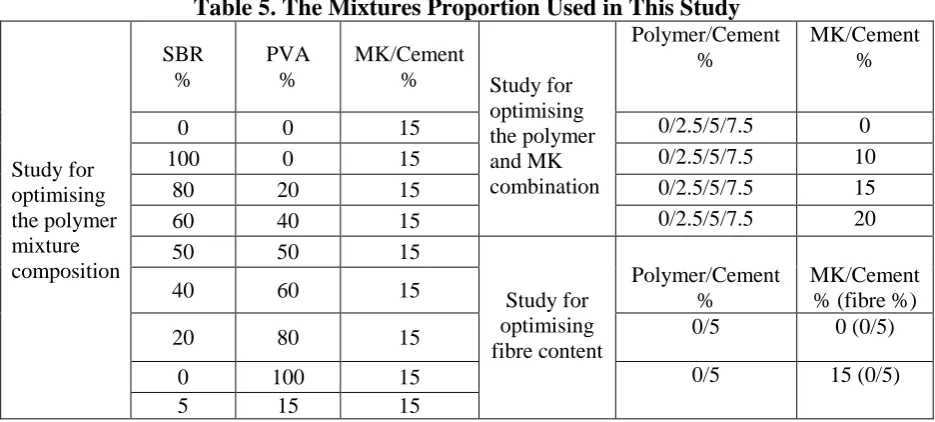
Table 5. The Mixtures Proportion Used in This Study
Study for optimising the polymer mixture composition SBR % PVA % MK/Cement% Study for
optimising the polymer and MK combination Polymer/Cement % MK/Cement %
0 0 15 0/2.5/5/7.5 0
100 0 15 0/2.5/5/7.5 10
80 20 15 0/2.5/5/7.5 15
60 40 15 0/2.5/5/7.5 20
50 50 15
Study for optimising fibre content Polymer/Cement % MK/Cement % (fibre %)
40 60 15
20 80 15 0/5 0 (0/5)
0 100 15 0/5 15 (0/5)
5 15 15
Experimental tests
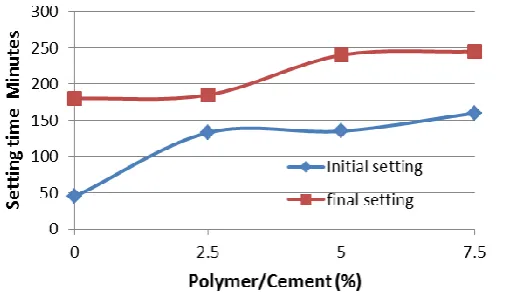
Setting time: the initial and final setting time tests were conducted on cement pastes for a standard consistency. The consistence was measured using Vicat apparatus according to ASTM C187-86:1986. The sitting time was measured according to the penetration of a needle gauge according to ASTM C 191-82: 1986.
Slump test: the workability of mixtures was tested following the BS EN 12350-2:2009.
Compressive strength: compressive test was conducted using cubic samples with a dimension of 100 (L) by 100 (D) by 100 (H) mm according to the BS 1881 part 116: 1983.
Splitting tensile strength: splitting tensile test was conducted using cylindrical samples with a dimension of 150 (D) by 300 (L) mm according to the BS 1881 Part 117: 1983.
Flexural strength: flexural test was conducted using prismatic samples with a dimension of 100 (D) by 100 (H) by 500 (L) by applying a concentrated load at the center according to ASTM C293-02.
Water absorption: water adsorption test was conducted using cubic samples with the dimension same as
that used for compressive test according to B.S. 1881: part 122: 2011.
RESULTS AND DISCUSSIONS
Fig. 1. The Setting Time of Polymer Modified Cement Paste with 0% MK
Fig.2. The Setting Time of MK Modified Cement Paste with 0% Polymer
Fig. 3: The Setting Time of Polymer Modified Cement Paste with 15% MK
[image:6.595.175.436.469.618.2]Fig. 4. Effect of Polymer and MK on Workability for modified concrete with w/c 45%
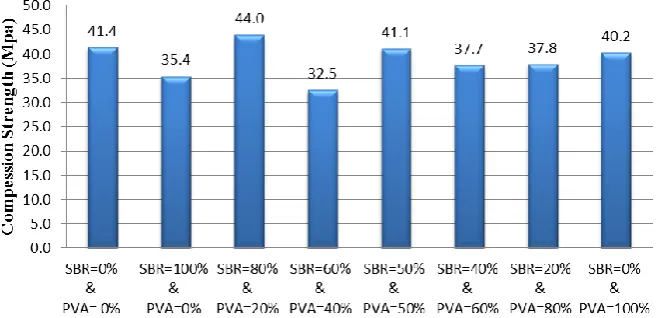
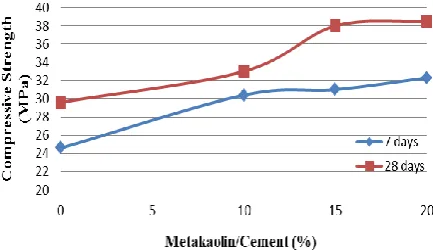
[image:7.595.133.462.439.598.2]The effect of the polymer of different composition of the SBR and PVA was studied. Fig. 5 shows that the polymer consisting of 80% SBR and 20% PVA displays the highest compressive strength. Figs. 6-8 show the effect of varied contents of the polymer consisting of 80% SBR and 20% PVA, and MK on the compressive strength. It can be seen that the mixture of 5% polymer and 15% MK displayed the highest compressive strength. It also can be seen that while the 28 days compressive strength decreases when polymer content exceeds 5%, however, both 7 days and 28 days compressive strengths increase with the increase of MK. Figs. 9 and 10 show the effect of different curing methods on the compressive strength of the modified concretes. It can be seen that the moist curing generated the best results. Fig. 11 shows the results using different types of coarse aggregates. It can be seen that limestone aggregate is better than normal aggregate.
Fig. 6. The Compressive Strength at Different Polymer Contents with 0% M/C and
W/C=45%
Fig. 7. The Compressive Strength at Different MK Contents and 0% Polymer
Fig. 8. The Compressive Strength at Different Polymer Contents at age 28 days
[image:8.595.182.395.433.543.2]Fig. 10. The Effect of Curing Methods on the Compressive Strength at Different Polymer
Contents and 15% MK at age 28 days
[image:9.595.172.407.495.646.2]Fig. 11. The Effect of the Aggregates type on the Compressive Strength at Different
Polymer Content and 0% MK at age 28 days
Fig. 12 shows the effect of plastic fiber (PF) and glass fiber (GF) on the splitting tensile strength. It can be seen that using glass fiber for reinforcement produced the highest splitting strength.
Fig. 12. Splitting Tensile Strength at Age of 28 Days
Fig. 13. Flexural strength at age 28 days
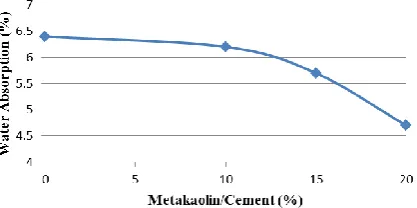
Figs. 14 and 15 show the total adsorbed water percentage in terms of the weight of dry samples. It can be seen that with the increase of polymer and MK content, the water absorption reduces remarkably. This might be due to a reduction in porosity as the result of the added polymer latex and the pozzolanic reaction of Metakaolin.
Fig. 14. Water Absorption at Different Polymer Contents
Fig. 15. Water Absorption at Different MK Contents and 0% polymer
CONCLUSIONS
The following conclusions can be drawn from the reported experimental study:
[image:10.595.182.391.515.619.2] The polymer composition of 80% SBR and 20% PVA shows an optimized result when work together with the MK.
The appropriate water/cement ratio is 0.45 for the concrete using polymer and Metakaolin additives.
That the addition of 5% optimized Polymer and 15% cement replacement using Metakaolin generates
an optimized concrete mixture for both strength and durability.
For the optimized Polymer and MK mixture, the 5%, in terms of the cement weight, addition of the plastic and glass fibres can effectively improve the tensile strength.
REFERENCES
Aiswarya, S., Prince D. and Dilip, C., (2013)
"
a Review on Use of Metakaolin in Concrete Abstract : Engineering Science and Technology"
: An International Journal, 3(3), 592–597.Bhikshma,V., Jagannadha, K. and Rao, (2010)
"
An experimental study on behaviour of polymer cement concrete"
,Asian journal of civil engineering Vol.11,No.5.Erhan , G., Mehmet,G., Seda, K. and Kasim,M. (2012).
"
Strength, permeability and shrinkage cracking of silica fume and metakaolin concretes"
. Construction and Building Materials, 34, 120–130.Fowler, D W. (1987),
"
Polymer in concrete"
, Hand book of structural concrete , Mc Graw-Hill , New York.Jamshidi, M. Pakravan, H. Pourkhorshidi, A. (2014).
"
Application of polymer admixtures to modify cocrete properties"
. Effect of polymer type and content. , 15(5),779–78.Jean A., Maximilien S., and Pera J., (1994).
"
Properties of Metakaolin Blended Cement"
s Advn Cem Bas Mat Vol 1 ,161-168.Joy M. (2005).
"
Evaluation of Metakaolin for use as supplementary cementitious materials"
, MSc. thesis , The Academic Faculty, Georgia Institute of Technology.Khatib, J.M., Negim, E.M. & Gjonbalaj, E.,(2012).
"
High Volume Metakaolin as Cement Replacement in Mortar"
. M(1),7–10.Lewis, W.J. & Lewis, G., (1990).
"
The influence of polymer latex modifiers on the properties of concrete"
. , 21(6), 487–494.Neville, A. M.,(2002).
"
Properties of concrete"
,Book, 4th Edi. London: Pearson Education Limited. Srinivasu, K., Sai, M.L.N.K. & N, V.S.K., 2014. A Review on Use of Metakaolin in Cement Mortar andConcrete. , 3(7).14697–14701.
Tomas U. Ganiron Jr, (2013).