*Correspondence to Author:
Qing-ping HU
College of Life Science, Shanxi Normal University, Linfen, China E-mail: hqp72 @ 163.com
How to cite this article:
Feng HE, Mi-mi ZHANG, Li-hong ZHANG and Qing-ping HU. Re-sponse surface methodology for the optimization of chlorpyrifos-degrad-ing conditions by Pseudomonas stutzeri ZH-1. International Journal of Bioscience and Medicine, 2018; 2:7.
eSciPub LLC, Houston, TX USA. Website: http://escipub.com/
Feng HE et al., IJBM, 2018; 2:7
International Journal of Bioscience and Medicine
(2575-7814)
Research Article IJBM (2018) 2:7
Response surface methodology for the optimization of
chlorpyrifos-degrading conditions by
Pseudomonas stutzeri
ZH-1
The removal of pesticides in the environment mainly depends on natural degradation, especially on microbial degradation. Biodeg-radation has many advantages, such as complete degBiodeg-radation,
no secondary pollution, quick effect and wide spectrum. Based
on the single-factor experiments and Box-Benhnken design, the effect of four factors on the degradation of chlorpyrifos by P. stu-tzeri ZH-1 was investigated. The four factors, including tempera -ture (°C) , oscillator speed (rpm), inoculum concentration (%) and
pH, and their interactions on the degradation of chlorpyrifos were
studied through the use of response surface analysis.The optimal
conditions of chlorpyrifos-degrading were as follows: temperature
36.7°C, oscillator speed 130.00rpm, inoculum concentration 7%, pH 7. Under these conditions,the degradation rate of chlorpyrifos
was 96.48%. Moreover, P. stutzeri ZH-1 could be used efficiently
for remediation of contaminated soils.
Keywords: response surface methodology; chlorpyrifos-degrad-ing; Pseudomonas stutzeri ZH-1
Feng HE 1, Mi-mi ZHANG 2, Li-hong ZHANG1 and Qing-ping HU 1*
1College of Life Science, Shanxi Normal University, Linfen, China
2Modern College of Humanities Sciences, Shanxi Normal University, Linfen, China
1.Introduction
In order to meet the growing demand for food, farmers grow high-yielding crop varieties all over the country in china. However, these high-yielding crop varieties are highly susceptible to various pests and diseases; thus, to protect their crops from pests and to improve their crop yields and quality of their products, farmers use pesticides[1] . Because of the
characteristics of high efficiency, low cost, easy operation in the prevention and control of pests, organophosphorus pesticide (OPPs) is widely used for agricultural production at home and abroad. Whereas almost 80% of OPPS remains in farmland, and these soluble or insoluble compounds cause serious environmental pollution. OPPs poisons the stomach of the human and inhibits enzyme activity by binding the enzyme acetylcholinesterase (AChE) through phosphorylation, resulting in the death of the human body[2]. Therefore, how to
effectively eliminate of organophosphorus pesticide residues in the environment pollution has become a severe problem to be solved urgently .
Chlorpyrifos [O,O-diethyl
O-(3,5,6-trichloro-2-pyridyl) phosphorothioate] is used world wide as an agricultural insecticide[3]. Its solubility is extremely low in
water but is relatively high in most organic solvents. Its environmental fate has been extensively studied, and its half-life in soil varies from 10 to 120 days, resulting in 3,5,6-trichloro-2-pyridinol (TCP) as the major degradation product[4]. The extensive use of
chlorpyrifos has led to widespread environmental pollution, resulting in serious damage to non-target species.The control of chlorpyrifos pollutants is of great importance because they are toxic and recalcitrant.
Bioremediation is defined as the process that organic wastes are biologically degraded to an innocuous state or to the levels below concentration limits established by regulatory authorities under controlled conditions. Bioremediation, which involves the use of microbes to detoxify and degrade pollutants, has received increased attention as an effective biotechnological approach to clean up polluted environments [5]. At present, the use of
chlorpyrifos-degrading bacteria for bioremediation of chlorpyrifos-contaminated sites has been proved to be the most potential clean-up method. Mallick et al. found the
Arthrobacter sp in the soil, which can degrade
the chlorpyrifos in the inorganic medium, and the degradation rate of the 10 ug/mL chlorpyrifos was 100% in 48h[6]. Singh et al.
isolated Enterobacter sp. B-14, one bacterial, which is capable of degrading chlorpyrifos in liquid media and soil[7]. Besides, a bacterial
strain Pseudomonas stutzeri YC-YH1, that degraded 100% of chlorpyrifos (100 mg/L) initially added with in 4 days,was isolated from sludge by Shi Yanhua[8].
Holden, Firestone and Vidali suggested that the success of microbial degradation depends on a number of factors, like pH, organic matter, moisture, temperature and nutrient status[9,10].
The aim of the present work was to optimize the conditions of the Pseudomonas stutzeri ZH-1 (P.
stutzeri ZH-1) for the degradation of chlorpyrifos
by the response surface method(RSM). It is of great significance in the development of more successful strategies aiming at exploiting more beneficial microbe resources for degradation of chlorpyrifos.
2. Materials and methods
Chlorpyrifos (in the form of Hubei Sanonda Co. Ltd., China) was purchased from a local pesticide supplier (Linfen, China). High-performance liquid chromatography (HPLC) grade methanol was purchased from the Tianjin Guangfu Chemical Reagent Co., Ltd, China. All other reagents used in this study were analytical reagent grade[11].
2.2. Microorganism and inoculum
preparation
A strain of P. stutzeri ZH-1 was separated from the sludge of the Fenhe River in Shanxi province of China. Based on the morphological, biochemical, the Bergey’s Manual of Determinative Bacterriology and 16S-rDNA gene sequence analysis, strain ZH-1 was recognized as a strain of P. stutzeri and was thereafter named P. stutzeri ZH-1.It was cultivated on standard nutrient agar (NA) medium periodically at 37℃for 24h . Fresh slant cultures were used in every batch for inoculation. Nutrient broth (NB) was inoculated with a 24 h old culture and grow at 37℃ on a shaker at 140 rpm for 12h.
2.3 Media for batch reactor studies
The composition of the Mongina medium used for chlorpyrifos-degrading was as follows: glucose = 10g/L, NH4Cl = 0.5g/L, NaCl = 0.3g/L,
KCl = 0.3g/L, MgSO4 = 0.03g/L, FeSO4 =
0.03g/L, MnSO4 = 0.03g/L, CaCl2 = 5g/L.
Tranfer 2.5g of chlorpyrifos (40%) to a 250-ml volumetric flsk , dilute with the chromatography grade methanol to volume, and mix. The concentration of the chlorpyrfos was 1 x 10⁴mg/L, which is placed in a brown glass bottle.Then 1ml of the chlorpyrifos was added to the medium of 50ml, and the concentration of chlorpyrifos in the culture medium was 200mg/L.
2.4 Single-factor experiments
For the investigation of the effect of the initial pH value on chlorpyrifos-degrading, the pH value of the medium was adjusted to3.0 4.0, 5.0, 6.0, 7.0, 8.0, 9.0, 10.0,11.0 or 12.0. For the sake of investigating the effect of the temperature on chlorpyrifos-degrading, the culture was incubated at 20, 25, 30, 35, 40 or 45℃. In order to study the effect of the inoculum concentration (v/v)on chlorpyrifos-degrading , cells were
inoculated at into cultures at 1, 2, 3, 4, 5, 6, 7, 8, 9 or 10%. To explore the effect of the oscillator speed on chlorpyrifos-degrading, the oscillator speed was controlled at 0, 40, 80, 120, 160 or 200 rpm. For all experiments, cells were inoculated at 2% (v/v) into cultures of pH 7.0, then they were incubated at 37℃ on a shaker at 140 rpm for 5 days unless otherwise stated[11]
2.5 Optimization experiments
RSM was chosen to show the statistical significance of the effects pH ,temperature, inoculum concentration and oscillator speed on the degradation of chlorpyrifos by P. stutzeri
ZH-1. The RSM experiments were designed by using the Design-Expert 7.1.3. Calculations were done at 95% of confidence level. In order to optimize the incubation conditions and investigate effects of above independent variables on the degradation of chlorpyrifos, a central-composite rotary design with the variables at three levels was used in the experiments.
2.6 Analysis of chlorpyrifos
dried over anhydrous Na2SO4 and dry using Termovap Sample Concentrator at room temperature. Residual was dissolved in an equal volume of methanol, then filter the membrane with 0.22um. All samples were analyzed by HPLC (1260LC,Rheodyne 7750i manual injector and Variable Wavelength uv Detector; Agilent Technology Co.). Zorbax Eclipse XDB-C18 stationary phase was used in the separation column (4.6 mm internal diameter and 25 cm length). The mobile phase was methanol:water(80:20, v/v), and the flow rate was1.0 ml/min. Chlorpyrifos was detected at uv wavelength of 290nm .
2.7 Calculation of Degradation Rate
Based on the peak area of control group and test group respectively to calculate chlorpyrifos concentration in the sample through the regression equation of reference standard curve, the corresponding chlorpyrifos degradation rate can be obtained.
Degradation rate = (1-C1/C0)×100%.
(1)
Where,C1 (mg/L) was the residual concentration
of the test group after the degradation of bacteria, while C0 (mg/L) was the residual
concentration of chlorpyrifos in the control group.
3. Results and Discussion
3.1 Standard curve of chlorpyrifos
Using HPLC to detect the concentration of chlorpyrifos, the standard curve of the concentration of chlorpyrifos was drawn, as shown in Fig.1 . When chlorpyrifos concentration range of 5-200 mg/L, the standard curve equation is: y = 5.3745 x + 8.9361. The standard curve equation shows that the correlation between the measured concentration of chlorpyrifos and peak area can be used to calculate chlorpyrifos concentration.
3.2 Effects of pH on the degradation of chlorpyrifos by P. stutzeri ZH-1
In previous studies, the degradation rate of chlorpyrifos is strongly related to soil pH, and the degradation is microbial degradation and not due to abiotic hydrolysis[4].The changes of
pH value have a significant impact on cell growth and chlorpyrifos-degrading. When the pH value ranges from 1 to7, the biomass increase gradually. While if the pH value changes from 7 to 12, the biomass decrease gradually. That is because the alkaline environment is not suitable for the growth of the bacteria. Suitable pH value can increase the reaction activity, and accelerate the utilization of chlorpyrifos as well as increase degradation rate of chlorpyrifos . In order to achieve the maximum degradation of chlorpyrifos, the fermentation optimum of pH gradient ranges from 3 to 12. It was indicated in Fig.1 that the maximum degradation rate of chlorpyrifos was obtained in pH 7 media, and the degradation rate reached 92.90%.
3.3 Effects of temperature on the degradation of chlorpyrifos by P. stutzeri ZH-1
In general, pesticide degradation in soil can be influenced by both biotic and abiotic factors, which are linked and supplemented in series with each other in a micro environment. Environmental conditions play an important role in the survival and proliferation of microorganisms as well as the effect on chemical stability[12] . In order to achieve the
too as the increase of biomass. However, when the fermentation temperature exceeded 40℃, degradation rate of chlorpyrifos has been significantly reduced. Lower fermentation temperature makes the growth of the bacteria be slow, thus to affect the degradation of
chlorpyrifos. On the other hand, higher temperature inhibits the growth of bacteria and the degradation of chlorpyrifos. As a result, it is well proved that the optimal temperature was 35℃.
Fig.1 Standard curve of chlorpyrifos
Fig.2. Effect of pH on chlorpyrifos-degrading rate
3.4 Effects of inoculum concentration on the degradation of chlorpyrifos by P. stutzeri ZH-1
The inoculum age and density markedly influence the productivity and economics of bioprocesses[13]. Some literature reports
demonstrated that appropriate inoculum concentration can improve the degradation of pesticide.The smaller inoculum concentration has lower utilization of chlorpyrifos.When the inoculum concentration was too high, a lot of cells grow and metabolites accumulate, which
led to a decline in the degradation of chlorpyrifos. The result of Fig.4 showed that the biomass increased when the inoculum concentration was increased from 1% to 6%. at the same time, degradation rate of chlorpyrifos increased, too. But there was a steep decrease degradation rate of chlorpyrifos once it was above 8%. Thus, the optimal inoculum concentration was 6%.
P. stutzeri ZH-1 is a facultative aerobic bacterium , the dissolved oxygen content determines the growth of the cells, what determines the degradation of chlorpyrifos. The result (Fig.5) showed that the oscillator speed was kept in 0-120 rpm for 5 days, biomass increased with the oscillator speed, and the
degradation rate of chlorpyrifos also increased. However, when the oscillator speed exceeded 160 rpm, degradation rate of chlorpyrifos has been significantly reduced. Lower oscillator speed induced the slower growth of the bacteria, thus to affect the degradation of chlorpyrifos.
Fig.3. Effect of temperature on chlorpyrifos-degrading rate
Fig4. Effect of inoculum concentration on chlorpyrifos-degrading rate
3.6 Optimization of degradation conditions P.
stutzeri ZH-1 via RSM
Appropriate degradation conditions have an important significance on the degradation of chlorpyrifos. According to the Box-Benhnken central combination experiment principle , the selection the temperature, oscillator speed, inoculum concentration, and the pH value carried on four factors three levels were displayed in the response surface analysis experiments (Table 1).Table 1 presents the design matrix for the experiment and the regression model proposed for response was given below:
j j i i ij i i ii i iiX X XX
Y 4 1 , 4 1 2 4 1
0 (2)
where Y is predicted response,XiXj are input
variables which influence the response variable Y; β0 is the offset term; βi is the ith linear
coefficient; βii the ith quadratic coefficient and βij
is the ijth interaction coefficient. The term Ɛ allows for uncertainties or discrepancies between what the model predicts and what was actually measured and stands for residual [14].
The Ɛ’s are not model parameters.While demonstrating the significant effects 3-dimensional fitted surfaces were drawn. A total of 29 experiments were carried out using the RSM method. The design expert software was performed for regression and graphical analysis of data obtained. The optimum levels of temperature,oscillator speed, inoculum concentration and pH were obtained by solving the regression equation and also analyzing the response surface contour plots.
Multiple regression analysis was used to analyse the data and thus a polynomial equation was derived from regression analysis as follows [14]:
Y=-533.66400+17.34780*X1+0.036129*X2+26.03217*X3+ 63.95650*X4+0.013288*X1*X2-0.18000*X1*X3+0.16150*X 1*X4+0.031812*X2*X3+0.047875*X2*X4-1.48500*X3*X4-0.
25974*X12-4.07797E-003*X22-100338*X32-4.72225*X42 (3)
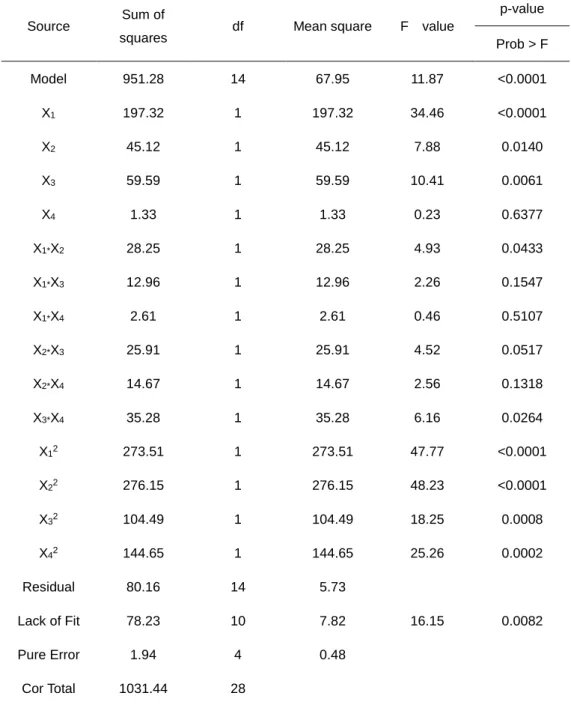
The adequacy of the model was checked using analysis of variance (ANOVA) which was tested using Fisher’s statistical analysis and the results are showed in Table 3. The Model F-value of 11.87 implies the model is significant. There is only a 0.01% chance that a "Model F-Value" this large could occur due to noise.The R2 value
(multiple correlation coefficient) closer to 1 denotes better correlation between the observed and predicted values. In this case the value of R2 (0.922) indicates good correlation
between the experimental and predicted values. The coefficient of variation (CV) indicates the degree of precision with which the experiments are compared. The lower reliability of the experiment is usually indicated by high value of CV. In the present case a low CV (2.76) denotes that the experiments performed are highly reliable.
The P values denotes the significance of the coefficients and also of importance in understanding the pattern of the mutual interactions between the variables. The regression analysis of the optimization study indicated that the model terms, X1, X3, X12, X22,
X32 and X42 were very significant (P < 0.01);
X2,X1*X2,X3*X4 were significant (P < 0.05). The
variable X4, X1*X3,X1*X4,X2*X3,X2*X4 was not
significant (P > 0.05). However, the interactions between the variables X1*X2 and X3*X4 were
Table 1. Experimental design with real value a of chlorpyrifos-degrading rate
Run X1 (℃) temperatur
e
X2(rpm) Oscillator speed
X2 (%) inoculum concentration
X4 pH
degradation Rate (%)
1 0(35) 0(120) -1(4) -1(6) 79.89
2 0 0 1(8) 1(8) 85.70
3 0 1(160) 0(6) -1 84.26
4 1(40) 1 0 0(7) 89.89
5 0 -1(80) 0 1 83.31
6 1 0 1 0 89.69
7 -1(30) 0 -1 0 79.59
8 -1 0 0 -1 81.99
9 0 0 0 0 94.09
10 0 0 0 0 95.80
11 -1 -1 0 0 78.39
12 0 -1 0 -1 81.78
13 1 0 -1 0 89.85
14 -1 1 0 0 75.56
15 0 1 0 1 93.45
16 0 1 1 0 90.53
17 1 0 0 1 77.88
18 0 0 0 0 95.39
19 0 0 0 0 96.60
20 1 -1 0 0 82.09
21 0 -1 1 0 82.60
22 0 0 1 -1 92.51
23 0 0 -1 1 84.96
24 0 0 0 0 95.72
25 -1 0 1 0 86.63
26 1 0 0 1 88.15
27 0 1 -1 0 82.19
28 1 0 0 -1 89.03
Table 2. Model coefficient estimated by multiplies linear regression
Source Sum of
squares df Mean square F value
p-value
Prob > F
Model 951.28 14 67.95 11.87 <0.0001
X1 197.32 1 197.32 34.46 <0.0001
X2 45.12 1 45.12 7.88 0.0140
X3 59.59 1 59.59 10.41 0.0061
X4 1.33 1 1.33 0.23 0.6377
X1*X2 28.25 1 28.25 4.93 0.0433
X1*X3 12.96 1 12.96 2.26 0.1547
X1*X4 2.61 1 2.61 0.46 0.5107
X2*X3 25.91 1 25.91 4.52 0.0517
X2*X4 14.67 1 14.67 2.56 0.1318
X3*X4 35.28 1 35.28 6.16 0.0264
X12 273.51 1 273.51 47.77 <0.0001
X22 276.15 1 276.15 48.23 <0.0001
X32 104.49 1 104.49 18.25 0.0008
X42 144.65 1 144.65 25.26 0.0002
Residual 80.16 14 5.73
Lack of Fit 78.23 10 7.82 16.15 0.0082
Pure Error 1.94 4 0.48
Cor Total 1031.44 28
The 3D graphs of response surface of chlorpyrifos’ degradation rate were shown in Fig. 6. The slope of the response surface reflects the interaction of various factors and the relative significance of the degradation rate of chlorpyrifos. Taking Fig. 6A as an example, the response value of the temperature change is greater than the response value of the oscillator speed variation, indicating that the change of temperature in the interaction is greater than the change of oscillator speed for the degradation of chlorpyrifos. By that analogy, the order of the
main factors was as follows: temperature > inoculum concentration > oscillator speed > pH.
theoretical value is up to 96.90, the actual measured value is lower 0.43% than the theoretical value. Consequently, this result
demonstrated the mathematical model can predict the relationship between the factors and degradation of chlorpyrifos effectively.
Fig.6. The 3D plots showing the effects of variables chlorpyrifos-degrading rate. (A) The interactionof temperature and oscillator speed. (B) The interaction of temperature and inoculum concentration. (C) The interaction of temperature and pH. (D) The interaction of oscillator speed and inoculum concentration. (E) The interaction of oscillator speed and pH. (F) The interaction of oinoculum concentration and pH.
Success or failure of bioremediation depends on several factors, such as the competitive ability of the bioremedial agents,bioavailability of pollutants and abiotic factors such as soil moisture,pH, and temperature.Successful removal of pesticides by the addition of bacteria has been previously reported for many compounds including, parathion ,coumaphos, ethoprophos and atrazine[15]. Sikora et
al.collected 21 samples of soil from the farmland where the effect of OPPs is not working, then he analyzed the activity of acid phosphatase, alkaine phosphatase, phosphodiesterase, triesterase phosphate and dehydrogenase. The results showed that these enzymes were involved in biodegradation of OPPs or the increase of biodegradation rates[16].By studying
the degradation and adsorption of TCP, Racke found that the degradation rate of TCP in soil was related to microbial components. As can be seen from the regression model, the microbial species are able to improve the degradation of TCP, and concluded that microbes work as the medium of TCP’s mineralization[17].Yang li et al
isolated a strain of DSP3 from the soil of vegetable greenhouse, which could be the only carbon source and energy growth of chlorpyrifos. The degradation rate of the bacteria in the soil experiment of 20d to the chlorpyrifos (100mg/kg) was nearly 100%[18].The Rhodopesudomonas
plaustris.HP-1, discovered by Zhang Deyong,
days. Besides, the degradation achieved 50%[19]. Xu et al. isolated a Paracoccus. Sp.
TRP from the activated sludge, which has high degradation activity for chlorpyrifos[20] . Brajesh
K. et al. demonstrated that the rapid degradation of chlorpyrifos was closely related to microorganism and pH in Australian soil[1]. Li
Xiaohui et al. separated seven new bacterium capable of utilizing chlorpyrifos as the sole carbon. Among the seven new bacterium, they also identified six genera, which could enrich the resources of chlorpyrifos-degrading bacteria[3].
4. Conclusion
This work showed that the P. stutzeri ZH-1 had a high degradation of chlorpyrifos. In general, the degradation rate of chlorpyrifos increased with the increase of bacterial content. The optimal conditions of chlorpyrifos-degrading were as follows: temperature 36.7°C,oscillator speed 130.00rpm, inoculum concentration 7%, pH 7. Under these conditions,the degradation rate of chlorpyrifos was 96.48%.
It was investigated that the degradation capacity
of P. stutzeri ZH-1 was changeable under
different environmental conditions and the environmental factors had great influence on degradation process.The acquiring of degradation bacteria’s optimum degradation conditions are able to provide data support and reference for the application of this bacteria. In addition, this also develops one new resource for pesticide degradation bacteria.
Acknowledgements
This work was supported by grants from Student's Platform for Innovation and Entrepreneurship Training Program of Shanxi Province, China(2017574), and the Natural Science Foundation of Shanxi Normal University program (No. ZR1514).
References
[1] Kizar AS, Sampa S, Paul J, et al.Acute toxicity of chlorpyrifos to embryo and larvae of banded gourami Trichogaster fasciata.Journal of Environmental Science and Health,part B,2016,(0):1–7.
[2] Mariusz C, Marcin W, Zofia P. Biodegradation of the organophosphorus insecticide diazinon by Serratia sp. and Pseudomonas sp. and their use in bioremediation of contaminated soil. Chemosphere,2009, (76) :494–501.
[3] Li XH, Jiang JD, Gu LF,et al. Diversity of chlorpyrifos-degrading bacteria isolated
from chlorpyrifos-contaminated samples.International Biodeterioration and Biodegradation,2008, (62): 331–335.
[4] Singh BK, Walk A, Morgan JAW, et al. Effects of soil pH on the biodegradation of chlorpyrifos and isolation of a chlorpyrifos-degrading bacterium. Applied and Environmental Microbiology, 2003, 69(12) :5198-5206.
[5] Singha BK, Walkera A, Wright,DJ. Bioremedial
potential of fenamiphos and chlorpyrifos degrading isolates: Influence of different environmental conditions.Soil Biology and Biochemistry, 2006,(38): 2682–2693.
[6] Mallick K, Bharati K, Banerji A, et al. Bacterial degradation of chlorpyrifos in pure cultures and in soil. Bulletin of Environmental Contamination and Toxicology, 1999, 62(1): 48-54.
[7] Singh BK, Walker A, Morgan JAW, et al. Biodegradation of chlorpyrifos by Enterobacter strain
B-14 and its use in bioremediation of contaminated soils. Applied and Environmental Microbiology, 2004, 70(8): 4855-4863.
[8] Shi YH.Isolation and identification of pesticides-degrading bacterium Pseudomonas stutzeri
[9] Holden, P.A., Firestone, M.K. Soil microorganisms in soil cleanup:how can we improve our understanding? Journal of Environmental quality ,1997,26, 32–40.
[10] Vidali, M. Bioremediation. An overview. Pure Applied Chemistry,2001,73, 1163–1172.
[11] Chen K, Liu XM, Li R, et al.Isolation of a buprofezin co-metabolizing strain of Pseudomonas sp.
DFS35-4 and identification of the buprofezin transformation
pathway.Biodegradation,2011,( 22):1135–1142.
[12] Abo-Amer, Aly E.Biodegradation of Diazinon by
Serratia marcescens DI101 and its Use in Bioremediation of Contaminated Environment. Journal of Microbiology and Biotechnology,2011, 21(1):71–80.
[13] Ramkrishna S, Swaminathan T. Response surface modeling and optimization to elucidate and analyze the effects of inoculum age and size on surfactin production.Biochemical Engineering Journal, 2004, (21) :141–148.
[14] Dhanya G, Swetha S, Ashok Pa et al.Response surface methodology for the optimization of alpha amylase production by Bacillus amyloliquefaciens. Bioresource Technology, 2008, (99): 4597–4602.
[15] Mahiudddin M, Fakhruddin ANM, Abdullah, et al. Degradation of the organophosphorus insecticide diazinon by soil bacterial isolate. The International Journal of Biotechnology, 2014, 3(1): 12-23.
[16] Sikora L J, Kaufman D, and Hornog L C. Enzyme activity in soils showing degradation of organophosphosphate insecticides. Biology and Fertility of Soils,1990, 9(1): 14-18.
[17] Racke K D, Robbins S T. Factors affecting the degradation of 3,5,6-trichloro-2-pyridinol in soil. ACS Symposium Series, 1991, 459: 93-107.
[18] Yang L,ZhaoYH and Zhang BX,et al.Isolation and characterization of a chlorpyrifos degrading bacteria and its bioremediation application in the soil. Acta Microbiologica Sinica, 2005,45(6): 905-909.
[19] Zhang DY,Tan XQ and Luo XW,et al.Isolation of photosynthetic bacteria HP-1with degradation of organic-phosphorus insecticides and studies on its biodegradation ability and capacity of increasing growth.Life Science Research,2005, 9(3): 247-253.
[20] Xu G, Zheng W, Li Y, et al. Biodegradation of chlorpyrifos and 3,5,6-Trichloro-2-Pyridinol by a newly solated Paracoccus sp. strain RP. International Biodeterioration and Biodegradation, 2008, 62(1): 51-56.