International Journal of Emerging Technology and Advanced Engineering
Website: www.ijetae.com (ISSN 2250-2459,ISO 9001:2008 Certified Journal, Volume 4, Issue 3, March 2014)
446
Survey Of Cross Layer Based TCP Congestion Control
Techniques in MANET
Nidhi Shukla
1, Neelesh Gupta
2, Naushad Parveen
31
M.tech Scholor (ECE), 2Prof & Head (ECE), 3Asst Prof ( ECE), Department Of Electronics And Communication Engg., Truba Institute of Engineering and IT, BHOPAL, INDIA
Abstract—In mobile ad hoc network (MANET), congestion is one of the most important limitations that affect the performance of the whole network. TCP (Transmission Control Protocol) are the reliable protocol for communication because of their connection oriented behavior. Multi-path routing protocol can balance and share the load better than the single path routing protocol in ad hoc networks, thereby reducing the congestion in cross layer technique because the multipath routing are more reliable and provide the alternate choice of data forwarding in network. Mobile nodes in Ad hoc Networks consists of which are organized in a random manner. It can communicate with each other without any centralized infrastructure. Due to congestion, the packet loss is heavily occurred in the particular link. In order to avoid congestion, cross layer based congestion control scheme is proposed for reducing the packet losses in the network. Here the congestion route is determined based on the path. In this paper, some of the congestion removing and load balancing routing schemes have been surveyed. The relative strengths and weaknesses of the protocols have also been studied which allow us to identify the areas for future research.
Keywords
—
MANET, Congestion, Cross layer, TCP.I. INTRODUCTION
In Ad hoc networks, it is essential to use efficient routing protocols that provide high quality communication. To maintain portability, size and weight of the device this network has lot of resource constrain. The nodes in MANET [1] have limited bandwidth, buffer space, battery power etc. So it is required to distribute the traffic among the mobile host. A routing protocol in MANET should fairly distribute the routing tasks among the mobile host. MANET consists of mobile hosts equipped with wireless communication devices. The main characteristics of MANET is, it operate without a central coordinator ,Rapidly deployable, self configuring, Multi-hop radio communication, Frequent link breakage due to mobile nodes ,Constraint resources (bandwidth, computing power, battery lifetime, etc.) and all nodes are mobile so topology can be very dynamic. So that the main challenges [2] of routing protocol in MANET is , it should be Fully distributed, Adaptive to frequent topology change ,Easy computation & maintenance, Optimal and loop free route, Optimal use of resources, It provide QoS and Collision should be minimum.
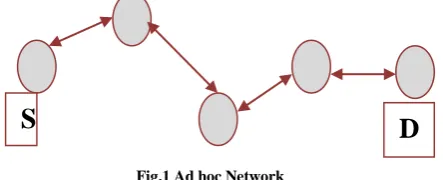
[image:1.595.326.548.289.379.2]Figure 1 represents the ad hoc network, here first connection will established in between sender S and destination D then transfer data through intermediate nodes.
Fig.1 Ad hoc Network
In a network with shared resources, where multiple senders compete for link bandwidth, it is necessary to adjust the data rate used by each sender in order not to overload the network. Packets that arrive at a router and cannot be forwarded are dropped, consequently an excessive amount of packets arriving at a network bottleneck leads to many packet drops. These dropped packets might already have travelled a long way in the network and thus consumed significant resources. Additionally, the lost packets often trigger retransmissions, which mean that even more packets are sent into the network. Thus network congestion can severely deteriorate network throughput. If no appropriate congestion control is performed this can lead to a congestion collapse of the network, where almost no data is successfully delivered. Such a situation occurred on the early Internet, leading to the development of the TCP congestion control mechanism [3].
The rest of the paper are organised as follows. In section II we describe the routing protocols and section III gives the overview of Transmission Control Protocol. Section IV is described the related work that has been done in this field and section at last section V concludes this paper.
II. ROUTING IN MANET
The Routing in a MANET [4] depends on many factors including topology, selection of routers, and initiation of request and specific underlying characteristic that could serve as a heuristic in finding the path quickly and efficiently. The low resource availability in these networks demands efficient utilization and hence the motivation for optimal routing in ad hoc networks.
International Journal of Emerging Technology and Advanced Engineering
Website: www.ijetae.com (ISSN 2250-2459,ISO 9001:2008 Certified Journal, Volume 4, Issue 3, March 2014)
Also, the highly dynamic nature of these networks imposes severe restrictions on routing protocols specifically designed for them, thus motivating the study of protocols which aim at achieving routing stability.
Classification of routing protocols in MANET:-
The routing protocols in MANET are classified depending on routing strategy and network structure. According to the routing strategy the routing protocols can be categorized as Table-driven and source initiated, while depending on the network structure these are classified as flat routing, hierarchical routing and geographic position assisted routing Based on the routing strategy the routing protocols can be classified into two parts:
Proactive (Table driven) routing protocol:-
These routing protocols are similar to and come as a natural extension of those for the wired networks. In proactive routing, each node has one or more tables that contain the latest information of the routes to any node in the network. Each row has the next hop for reaching a node/subnet and the cost of this route. Various table-driven protocols differ in the way the information about a change in topology is propagated through all nodes in the network. There exist some differences between the protocols that come under this category depending on the routing information being updated in each routing table. Furthermore, these routing protocols maintain different number of tables. The proactive protocols are not suitable for larger networks, as they need
To maintain node entries for each and every node in the routing table of every node. This causes more overhead in the routing table leading to consumption of more bandwidth. Examples of such schemes are the conventional routing schemes, Destination Sequenced Distance Vector (DSDV) [4].
Reactive (On-Demand ) routing protocol:-
Reactive routing is also known as on-demand routing protocol since they don’t maintain routing information or routing activity at the network nodes if there is no communication. These protocols take a lazy approach to routing. They do not maintain or constantly update their route tables with the latest route topology. If a node wants to send a packet to another node then this protocol searches for the route in an on-demand manner and establishes the connection in order to transmit and receive the packet. The route discovery usually occurs by flooding the route request packets throughout the network. Examples of reactive routing protocols are the dynamic source Routing (DSR) [5], ad hoc on-demand distance vector routing (AODV) [6].
Hybrid routing protocol:-
These protocols try to incorporate various aspects of proactive and reactive routing protocols. They are generally used to provide hierarchical routing; routing in general can be either flat or hierarchical. In a flat approach, the nodes communicate directly with each other. The problem with this is that it does not scale well, it also does not allow for route aggregation of updates In a hierarchical approach, the nodes are grouped into clusters, within each cluster there is a cluster head, this acts as a gateway to other clusters, it serves as a sort of default route. The advantage of a hierarchical structure is that within a cluster, an on demand routing protocol could be used which is more efficient in small-scale networks. Example of a hybrid routing protocol is the Zone Routing Protocol (ZRP) [7].
III. TCPIN MANET
International Journal of Emerging Technology and Advanced Engineering
Website: www.ijetae.com (ISSN 2250-2459,ISO 9001:2008 Certified Journal, Volume 4, Issue 3, March 2014)
448 The basic functions of TCP as a transport layer protocol include flow control, error recovery and congestion control [12,13], while the state-of-the-art techniques include fast retransmission and recovery, selective acknowledgment, etc., mainly focusing on how to promptly and effectively respond to network congestion.
By examining the TCP’s performance studies over MANETs we identified the following major problems:
TCP is unable to distinguish between losses due to route failures and network congestion.
TCP suffers from frequent route failures.
A. Challenges in TCP communication:-
Wireless ad hoc networks have some inherent adverse characteristics [14] that will significantly deteriorate TCP performance if no action is taken. In essence, these characteristics include bursty channels errors, mobility and communication asymmetry.
1) Channel Errors:-
In wireless channels, relatively high bit error rate because of multipath fading and shadowing may corrupt packets in transmission, leading to the losses of TCP data segments or ACKs. If it cannot receive the ACK within the retransmission timeout, the TCP sender immediately reduces its congestion window to one segment, exponentially backs off its RTO and retransmits the lost packets. Intermittent channel errors may thus cause the congestion window size at the sender to remain small, thereby resulting in low TCP throughput.
2) Mobility
:
-Cellular networks are characterized by handoffs due to user mobility. Normally, handoffs may cause temporary disconnections, resulting in packet losses and delay. TCP will suffer a lot if it treats such losses as congestion and invokes unnecessary congestion control mechanisms. Them handoffs are expected to be more frequent in next generation cellular networks as the micro cellular structure is adopted to accommodate an increasing number of users. Thing could be worse if TCP cannot handle handoffs gracefully. Similar problems may occur in wireless LAN, as mobile users will also encounter communication interruptions if they move to the edge of the transmission range of the access point.
3) Medium contention, Hidden terminal, and Exposed terminal problems:-
Contention-based medium access control (MAC) schemes, such as IEEE 802.11 MAC protocol, have been widely studied and incorporated into many wireless test beds and simulation packages for wireless multi-hop ad hoc networks, where the neighboring nodes contend for the shared wireless channel before transmitting.
There are three main problems, i.e., the hidden terminal problem, the exposed terminal problem, and unfairness. A hidden node is the one that is within the interfering range of the intended receiver but out of the sensing range of the transmitter. The receiver may not correctly receive the intended packet due to collision from the hidden node. An exposed node is the one that is within the sensing range of the transmitter but out of the interfering range of the receiver. Though its transmission does not interfere with the receiver, it could not start transmission because it senses a busy medium, which introduces spatial reuse deficiency. The binary exponential backoff scheme always favors the latest successful transmitter, and hence results in unfairness. These problems could be more harmful in multi-hop ad hoc networks than in Wireless LANs as ad hoc networks are characterized by multi-hop connectivity.
IV. LITERATURE SURVEY
In this section we present the various proposals which have been made in the literature to improve the performance of TCP in Ad hoc networks.
Muhammad Aamir and Mustafa A. Zaidi [1] proposed A Buffer Management Scheme for Packet Queues in MANET In this scheme, we try to achieve efficient queuing in the buffer of a centrally Communicating MANET node through an active queue management strategy by assigning dynamic buffer space to all neighbouring nodes in proportion to the number of packets received from neighbours and hence controlling packet drop probabilities.
Amanpreet Singh,Mei Xiang,Yasir Zaki [2] proposed Enhancing Fairness and Congestion Control in Multipath TCP in MANET. This paper illustrates and compares the solutions that have been proposed to ascertain that Multipath TCP can yield an improved performance while being fair to standard TCP.
Jemish V. Maisuria & Rahul M. Patel [3] proposed Overview of Techniques for Improving QoS of TCP over Wireless Links. These schemes are classified into three broad categories: end-to-end
protocols, where the sender is aware of the wireless link; link layer protocols, that provide local reliability; and split-connection protocols, which break the end-to-end connection into two parts at the base station.
International Journal of Emerging Technology and Advanced Engineering
Website: www.ijetae.com (ISSN 2250-2459,ISO 9001:2008 Certified Journal, Volume 4, Issue 3, March 2014)
Wu Hua & Gong Jian [5] proposed Analysis of TCP BIC Congestion Control Implementation in MANET. This paper studies the default TCP congestion control algorithm in Linux kernel 2.6.8, its implementation of the Linux were analyzed by analysis of the actual traces.
S.A.Jain [6] provides their deep insight to TCP congestion control mechanism and proposed route failure detection mechanisms.It is suggested that most of the mechanisms are aiming at increasing the life time of the networks and improving the performance of the parameters like packet delivery ratio, end to end delay etc. Senthil Kumaran, T. and V. Sankaranarayanan [7] presented the Congestion Free Routing in Ad hoc networks (CFR), based on dynamically estimated mechanism to monitor network congestion by calculating the average queue length at the node level. While using the average queue length, the nodes congestion status divided into the three zones like safe zone, congested zone and congested zone. The scheme utilizes the non-congested neighbors and initiates route discovery mechanism to discover a congestion free route between source and destination. This path becomes a core path between source and destination. To maintain the congestion free status, the nodes which are helping data packet transmission periodically calculate their congestion status at the node level.
K. Srinivas, A. A. Chari [8] proposed the cross layered model of congestion detection an control mechanism that includes energy efficient congestion detection, Zone level Congestion Evaluation Algorithm [ZCEA] and Zone level Egress Regularization Algorithm [ZERA], which is a hierarchical cross layer based congestion detection and control model. By experimental results the proposed approach achieved the better resource utilization, energy efficiency in congestion detection and congestion control. In [9,10,11] authors introduced the concept of cross layer design and congestion detection using cross layer approach. The aim of the work is to improve the performance based on gathering the bandwidth and delay information on the link layer.
S. Subburamm and P. Sheik Abdul Khader [9] proposed AODV-EBRP mechanism to eliminate network congestion by reducing the rebroadcasting of data packets among the neighboring nodes. In addition, when a link breakage is anticipated, this mechanism will identify a new route, having free buffer space, to establish a forward link to the destination. This mechanism would ensure that routes are generated and links established through a node that has more buffer space, in order that more number of packets could be stored/forwarded through the node free of congestion.
Yi-Cheng Chan and Hon-Jie Lee [10] proposed a new variant of hybrid TCP, Concave Convex TCP (CCTCP), to overcome this issue. CCTCP revises Reno’s congestion avoidance phase by appending delay-based features.
Through ns-2 based simulations they find that, as compared to other hybrid TCPs, CCTCP can achieve a high performance with minor dependence on bottleneck buffer sizes under a variety of network bandwidths, especially in high speed networks.
G.Rajkumar, R.Kasiram and D.Parthiban [11] proposed to go for reactive routing protocols. Proactive routing protocols use table -driven strategy that is the routing tables are exchanged periodically between nodes which results in more energy consumption. To overcome these problems, we go for DSR and AODV. These routing protocols use on-demand strategy that is the routes are established from source node to destination only on demand which minimizes the jitter level. Using "Network Simulator 2.35" the performance of AODV and DSR protocols are compared for large number of nodes in the presence of ambient noise level whereas in the existing works lesser number of nodes is only considered. From our results it is evident that AODV protocol consumes lesser energy than DSR and in the presence of high routing overhead
Purvang Dalal ,Nikhil Kothari and K. S. Das gupta [12] have proposed a new scheme with modifications at link layer and transport layer is proposed. The proposed modifications which depend on interaction between two layers (i) reduce the idle time before transmission at TCP by preventing timeout occurrences and (ii) decouple the congestion control from recovery of the losses due to link failure. Results of simulation based experiments demonstrate considerable performance improvement with the proposed modifications over the conventional TCP, when a wireless sender is experiencing frequent link failures.
Raffaele Bruno, Marco Conti, and Enrico Gregori [13] have develop an average-value analysis of the TCP performance in 802.11 WLANs. His model characterizes the equilibrium conditions of the network, and this method yields a simple, yet precise, estimate of the throughput obtained by persistent TCP flows. Via simulations he study the accuracy of the model predictions.
Yao-Nan Lien et al [14] proposed a new TCP congestion control mechanism by router-assisted approach. Their proposed TCP protocol, called TCP Muzha uses the assistance provided by routers to achieve better congestion control. To use TCP Muzha, routers are required to provide some information allowing the sender to estimate more accurately the remaining capacity over the bottleneck node with respect to the path from the sender to the receiver. With this information, TCP Muzha will be able to enhance the performance of both TCP and network.
International Journal of Emerging Technology and Advanced Engineering
Website: www.ijetae.com (ISSN 2250-2459,ISO 9001:2008 Certified Journal, Volume 4, Issue 3, March 2014)
450 The distinctive feature of their approach is that it is based on the self-organization of the network into clusters. The clusters autonomously and proactively monitor congestion within its localized scope.
S.Venkatasubramanian et al [16] proposed the QoS architecture for Bandwidth Management and Rate Control in MANETs. The bandwidth information in the architecture can be used for QoS capable routing protocols to provide support to admission control. The traffic is balanced and the network capacity is improved as the weight value assists the routing protocol to evade routing traffic through congested area. The source nodes then perform call admission control for different priority of flows based on the bandwidth information provided by the QoS routing. In addition to this, a rate control mechanism is used to regulate best-effort traffic, whenever network congestion is detected. In this mechanism, the packet generation rate of the low-priority traffic is adjusted to incorporate the high-priority traffic.
T.Karthikeyan, S. Sulthani [17] proposed QoS Agent and implemented an integrated Linear Traffic Control Dynamic Model (LTCDM) by integrating the mobile agents like VAISTC4 agent[6], MATLB agent[12], PCM agent[13], FMSA agent and IMAC agent[14] in order to control traffic congestion, giving prioritization of emergency vehicles ,optimizing traffic issue considering velocity of vehicles and providing best path for the vehicles on road network This linear dynamic model LTCDM also provides the better Quality of Service through the Q o S Agents for road networks by improving safety applications, finding best route and driver comfort. An LTCDM is a multivariate model which uses a graph in which the vehicles are represented as nodes considering time series of flows at the various data collection site and uses finite capacity queuing theory
Yung Yi et al [18] have developed a fair hop-by-hop congestion control algorithm with the MAC restriction being imposed in the form of a channel access time constraint, using an optimization based structure. In the lack of delay, they have shown that their algorithm is globally stable using a Lyapunov-function-based approach. Next, in the presence of delay, they have shown that the hop-by-hop control algorithm has the property of spatial spreading. Also they have derived bounds on the ―peak load‖ at a node, both with hop-by-hop control, as well as with end-to-end control, show that significant gains are to be had with the hop-by-hop scheme, and validate the analytical results with simulation.
Umut Akyol et al [19] have studied the problem of jointly performing scheduling and congestion control in mobile ad hoc networks so that network queues remain bounded and the resulting flow rates satisfy an associated network utility maximization problem. They have defined a specific network utility maximization problem which is appropriate for mobile ad hoc networks.
They have described a wireless Greedy Primal Dual (WGPD) algorithm for combined congestion control and scheduling that aims to solve this problem. They have shown how the WGPD algorithm and its associated signaling can be implemented in practice with minimal disruption to existing wireless protocols. In greedy algorithm the chances of best solution are minimum and also not sure about the solution is best.
Xuyang Wang et al [20] proposed a cross layer hop by hop congestion control scheme to improve TCP performance in multi hop wireless networks which coordinates the congestion response across the transport, network, and transport layer protocols. The proposed scheme attempts to determine the actual cause of a packet loss and then coordinates the appropriate congestion control response among the MAC network, and transport protocols. The congestion control efforts are invoke at all intermediate and source node along the upstream paths directed from the wireless link experiencing the congestion induced packet drop.
Yung Yi and Sanjay Shakkottai [21] develop a fair hop-by-hop congestion control algorithm with the MAC constraint being imposed in the form of a channel access time constraint, using an optimization based framework. In the absence of delay, we show that this algorithm are globally stable using a Lyapunov function based approach. Next, in the presence of delay, we show that the hop-by-hop control algorithm has the property of spatial spreading. In other words, focused loads at a particular spatial location in the network get ―smoothed‖ over space. C.S.R. Murthy and B.S. Manoj [22] proposed that QoS parameters are characterized by the requirements of multimedia traffic. But in ad-hoc networks QoS requires new constraints due to highly dynamic network topology and traffic load conditions, time-variant QoS parameters like throughput, latency, low communication bandwidth, limited processing and power capacity than wire-based network.
International Journal of Emerging Technology and Advanced Engineering
Website: www.ijetae.com (ISSN 2250-2459,ISO 9001:2008 Certified Journal, Volume 4, Issue 3, March 2014)
Dzmitry Kliazovich, Fabrizio Granelli [24] presents the problem of performance degradation of transport layer protocols due to congestion of wireless local area networks. Following the analysis of available solutions to this problem, a cross-layer congestion avoidance scheme (C3TCP) is presented, able to obtain higher performance by gathering capacity information such as bandwidth and delay at the link layer. The method requires the introduction of an additional module within the protocol stack of the mobile node, able to adjust the outgoing data stream based on capacity measurements. Moreover, a Proposal to provide optional field support to existing IEEE 802.11 protocol, in order to support the presented congestion Control solution as well as many other similar approaches, is presented. Achieved results underline good agreement with design considerations and high utilization of the available resources.
Vineet Srivastava and Mehul Motani [25] have proposed involve different layers of the protocol stack, and address both cellular and ad hoc networks. In this article, he take a step in that direction by presenting a survey of the literature in the area of cross-layer design, and by taking stock of the ongoing work. We suggest a definition for cross-layer design, discuss the basic types of cross-layer design with examples drawn from the literature, and categorize the initial proposals on how cross-layer interactions may be implemented.
Sang Ho Bae, Sung-Ju le;, William Su, and Mario Gerla [26] present ODMRP for a mobile ad hoc wireless network. ODMRP is based on mesh (instead of trec) forwarding. It applies on-demand (as opposed to periodic) multicast route construction and membership maintenance. He discovered that DVMRP suffered from high channel overhead due to control message loss in the wireless channel. Our study showed that ODMRP is more suitable in a multihop ad hoc wireless environment than DVMRP
Kun Tan [27] studied that the problem of congestion control over multihop wireless network.In such network,radio equppied nodes can communicate with their neighbor nodes directly when they are within radio transmission range.Two nodes that are far away each other may relay on intermediate node to relay traffic.
Sathya Priya. S, Murugan [28] proposed a novel cross-layer approach (Link Layer CLAMP TCP [L2CLAMP-TCP]) , which avoids TCP Acknowledgement (ACK) packet transmission over the wireless channel, thereby saving time which can be utilized by the nodes for data packet delivery. The ACK instead is generated by the base station.
V. PROBLEM STATEMENT
TCP communication provide reliable communication because that is uses acknowledgment base data delivery technique but delay is greater than as compare to UDP packet, so that if more sender share common intermediate node that increases congestion as well as maximum delay. TCP performs poorly in mobile ad hoc networks (MANETs) because TCP implicit assumption that any packet loss is due to congestion is invalid in mobile ad hoc networks where wireless channel errors, link contention, mobility and multi-path routing may significantly corrupt or disorder packet delivery. We first describe the problems of TCP in ad-hoc networks, and then present the design space and existing solutions to improve TCP throughput. Than we decide to minimize delay and minimize congestion in network using cross layer base scheme under MANET and analyze the performance of the network.
VI. PROPOSED WORK
Here we propose congestion control on the bases of queue scheme as well as drop analysis base layer working updating scheme and minimize congestion and delay of the network, for that purpose we deploy queue in each node for minimization congestion base drop and also identify drop reason of packet and if we get drop information of different drop reason like MAC, Collisions and congestion that all the drop minimize through queue technique base and routing module updating scheme. In this work [15] a Cross Layer based congestion control scheme is developed which attains congestion detection and congestion control among nodes. In the first phase of the scheme, cross layer design is proposed. Here, information is shared between the different layers of the protocol stack. In congestion detection phase, the packet loss rate is determined which ensures the detection of congestion in particular link. In congestion control phase, the route is found without congestion. Here the threshold value of path gain, congestion scales value and buffer tenancy value. By using the extensive simulation results, the proposed scheme CLCCS achieves the better throughput, packet delivery ratio, low delay and overhead than the existing schemes ECAS. After that we analyze our result and check the performance of the network.
VII. CONCLUSION
International Journal of Emerging Technology and Advanced Engineering
Website: www.ijetae.com (ISSN 2250-2459,ISO 9001:2008 Certified Journal, Volume 4, Issue 3, March 2014)
452 Hence the assumption made by TCP that any packet loss is due to network congestion is no longer valid in wireless networks. TCP performs better performance if no interruption in communication is occurring in network. In this paper, we point out the major reasons for this performance degradation of TCP protocol communication in ad hoc network. In particular, factors such as mobility, wireless channels and handoffs result in the TCP performance over single and multi hop ad hoc networks, while, aside from these factors, other factors such as medium access contention, frequent route changes, and breakages are considered to degrade the TCP performance in networks. This paper discusses various load metric and various TCP based cross layer congestion based techniques by that we aware about the different work that has been done in this field with their limitations.
REFERENCES
[1]Muhammad Aamir_ and Mustafa A. Zaidi ―A Buffer Management Scheme for Packet Queues in MANET ―TSINGHUA SCIENCE AND TECHNOLOGY ISSNll1007- 0214ll01/10llpp543-553 Volume 18, Number 6, December 2013.
[2]Amanpreet Singh, Mei Xiang, Yasir Zaki ―Enhancing Fairness and Congestion Control in Multipath TCP‖ main technical program at IFIP WMNC'2013.
[3]Jemish V. Maisuria, Rahul M. Patel .Overview of Techniques for Improving QoS of TCP over Wireless Links 2012 International
Conference on Communication Systems and Network
Technologies.
[4]G.S.Sreedhar & Dr.A.Damodaram, ― MALMR: Medium Access Level Multicast Routing for Congestion Avoidance in Multicast Mobile Ad Hoc Routing Protocol‖, Volume 12 Issue 13, pp.22-30, 2012.
[5]Wu Hua & Gong Jian Analysis of TCP BIC Congestion Control Implementation 2012 International Conference on Computer Science and Service System 978-0-7695-4719-0/12 © 2012 IEEE [6]S.A.Jain and Sujata K.Tapkir, ―A Review of Improvement in TCP congestion Control Using Route Failure Detection in MANET‖, Network and Complex Systems, Vol 2, No.2, pp.9-13, 2012. [7]Senthil Kumaran, T. and V. Sankaranarayanan, ―Congestion Free
Routing in Adhoc Networks‖, Journal of Computer Science, Vol.8, No.6, pp.971-977, 2012
[8]K. Srinivas, A. A. Chari, ― ECDC: Energy Efficient Cross Layered Congestion Detection and Control Routing Protocol‖, International Journal of Soft Computing and Engineering (IJSCE) ISSN: 2231-2307, Volume-2, Issue-2, pp.316-322, 2012. [9]S. Subburamm and P. Sheik Abdul Khader, ―Efficient Broadcasting
using Preventive Congestion Mechanism in Mobile ad Hoc Network‖, European Journal of Scientific Research, Vol.83, No.2, pp.302-313, 2012.
[10] Yi-Cheng Chan and Hon-Jie Lee ―A Hybrid Congestion Control for TCP over High Speed Networks‖ 2012 Sixth International Conference on Genetic and Evolutionary Computing. 2012 [11] G.Rajkumar, R.Kasiram and D.Parthiban ―O ptimized QoS
Metrics and Performance Comparison of DSR and AODV Routing Protocols‖ IEEE-International Conference On Advances In Engineering, Science And Management (ICAESM -2012) March 30, 31, 2012.
[12] Purvang Dalal , Nikhil Kothari and K. S. Dasgupta
―IMPROVING TCP PERFORMANCE OVER WIRELESS
NETWORK WITH FREQUENT DISCONNECTIONS‖
International Journal of Computer Networks & Communications (IJCNC) Vol.3, No.6, November 2011.
[13] Raffaele Bruno, Marco Conti, and Enrico Gregori ―Average-Value Analysis of 802.11 WLANs with Persistent TCP Flows‖ IEEE COMMUNICATIONS LETTERS, VOL. 13, NO. 4, APRIL 2009.
[14] Lien, Y.N., Hsiao, H.C.: A New TCP Congestion Control Mechanism over Wireless Ad Hoc Networks by Router-Assisted Approach. 27th IEEE International Conference on Distributed Computing Systems Workshops, 2007
[15] S. Karunakaran, S., Thangaraj, P.: A Cluster Based Congestion Control Protocol for Mobile Adhoc Networks. International Journal of Information Technology and Knowledge Management. Vol. 2, No. 2, pp. 471-474, 2010 .
[16] S. Venkatasubramanian, N.P Gopalan, "A Quality of service architecture for resource provisioning and rate control in mobile ad hoc networks. International Journal of Ad hoc, Sensor & Ubiquitous Computing (IJASUC). Vol.1, No.3, 2010.
[17] Sulthani, R.M., Rao, D.S.: Design of an Efficient QoS Architecture (DEQA) for Mobile Ad hoc Networks. ICGST-CNIR Journal. Vol. 8, Issue 2, 2009.
[18] Yung Yi et al, Athanasios V. Vasilakos and Chien-Chung Shen: Guest Editorial-Cross-Layer Design for Future Generation Wireless Networks, Wireless Pers Commun(2009)51:375–378, Springer Science+Business Media, LLC. 2009.
[19] Akyol, U., Andrews, M., Gupta, P., Hobby, J., Saniee, I., Stolyar, A.: Joint Scheduling and Congestion Control in Mobile Ad-Hoc Networks. Proceedings of IEEE INFOCOM, 2008.
[20] Wang, X., Perkins, D.: Cross-layer Hop-by-hop Congestion Control in Mobile Ad Hoc Networks. Proc., IEEE, wireless communication and networking conference, WCNC. pp 2456 – 2461, 2008.
[21] Yi, Y., Shakkottai, S.: Hop-by-Hop Congestion Control Over a Wireless Multi-Hop Network. IEEE/ACM Transactions on Networking, 2007
[22] C.S.R. Murthy and B.S. Manoj. Ad Hoc Wireless Networks: Architectures and Protocols. Pearson Education, pp. 207-208,304, 2007.
[23] S. Choi, K. Park, and C. Kim, ―Performance Impact of Inter-Layer Dependence in Infrastructure WLANs,‖ IEEE Trans. Mobile Computing, vol. 5, no. 7, pp. 829-845, 2006.
[24] Dzmitry Kliazovich, Fabrizio Granelli, ―Cross-layer congestion control in ad hoc wireless networks‖, Elsevier, Ad Hoc Networks, Vol. 4, pp. 687–708, 2006.
[25] Vineet Srivastava.& Mehul Motani ―Cross-Layer Design: A Survey and the Road Ahead” IEEE Communications Magazine • December 2005.
[26] Sang Ho Bae, Sung-Ju le;, William Su, and Mario Gerla, University of California ―The Design, Implementation, and Performance Evaluation of the On-Dem an d Multicast Routing Pro tocol in Multihop Wireless Networks‖IEEE network January/Febuary 2000.
[27] Kun Tan,Feng Jiang,Qian Zhang ―Congestion Control in multihop
wireless network‖ IEEE transaction on vehicular
technology,vol,56,no.2,march 2007.