International Journal of Emerging Technology and Advanced Engineering
Website: www.ijetae.com (ISSN 2250-2459,ISO 9001:2008 Certified Journal, Volume 5, Issue 3, March 2015)
139
Alliance Study of Perfect Difference Network & Hex-Cell
Architecture.
Sunil Tiwari
1, Prof. Rakesh Kumar Katare
2Department of Computer Science, A. P. S. University, Rewa (M.P.), India Abstract— The properties, limitation and structured
parameters are the important characteristics to the study of Architecture of interconnection network. The efficiency of communication between the processors and is easily understood by using the graphical model. The Binary relation of component of architecture and its links are the major theme for the study of connectivity and its complexity of the Hex-Cell and PDN. In this paper we are tried to present mathematical pattern for Hex-Cell & Perfect Difference Network (PDN) .Symmetry and Density of network is also a essential design issue of Interconnection network.
Keywords—Hex-Cell, Interconnection network, PDN, PDS, Reflexive relation.
I. INTRODUCTION
The structure of parallel System and Interconnection network has graceful mathematical properties and communication patterns, and there are deep relationship between these pattern and properties. In this paper we would like to provide a alliance understanding of Hex-Cell and Perfect Difference Network (PDN) with its some topological properties[3]. This study is useful to design an any hybrid Hex-Cell or Hybrid PDN. Properties and limitation of the network is a essential parameter for design an interconnection network[5]. A study of properties and limitation with mathematical pattern of Hex-Cell and PDN is presented here.
II. BASIC DEFINATION
We would like to present basic definition of Hex-Cell and PDN for understand this Architecture.
A. Hex-Cell
A Hex-Cell HC (d) represents a network with depth d, and it can be constructed by using units of hexagon cells, each of six nodes. The depth (d) of network shows the d level numbered starting from 1, where d represents the outermost level and 1 shows the innermost level corresponding to one hexagon cell. The levels of the HC (d) network are labeled from 1 to d. each level i has Ni nodes, representing processing elements and interconnected in a ring structure [10].
B. Perfect Difference Network (PDN)
Let x be a v set of the integer 0.1,v-1module is V,D is a set where D=d1, d2,…, dk. k is a subset of x for every a ≠ 0.i.e. mod V, simple difference set for each of the possible difference is formed exactly in δ ways.
di , dj, i≠j such that
di- dj=a(mod v)
If A set D fulfill the these requirement then is called a perfect difference set and the mathematical notion of perfect difference set is created perfect difference network[7].
The Perfect Difference Set of each node of the PDN can be evaluated by the remainder theorem i.e.,
N= R + D * Q,
Where N = Numerator, R = Remainder, D= Denominator And Q = Quotient The above equation can be written as
Integer = (S
i, - S
j) + (δ
2+ δ + 1) * 1
Where integer is a member of the set (l, 2, … , δ2 + δ) and
S, - Sj is numerator or the difference set. So we can write as -
(Si, - Sj) = (Integer) mod (δ2 + δ + 1)[4].
Table1
PDS of order δ in normal form[9].
δ N PDS of order δ in normal form
2 7 0,1,3 3 13 0,1,3,9 4 21 0,1,4,14,16 5 31 0,1,3,8,12,18 7 57 0,1,3,13,32,36,43,52 8 73 0,1,3,7,15,31,36,54,63 9 91 0,1,3,9,27,49,56,61,77,81 11 133 0,1,3,12,20,34,38,81,88,94,104,109 13 183 0,1,3,16,23,28,42,76,82,86,119,137,154,175
International Journal of Emerging Technology and Advanced Engineering
Website: www.ijetae.com (ISSN 2250-2459,ISO 9001:2008 Certified Journal, Volume 5, Issue 3, March 2015)
140
Fig1: PDN with n = 7, ()= 2 and PDS = {O, 1,3},Shortest paths from
node 0 to all others[1].
III. STUDY OF HEX-CELL AND PDN
Many Researchers has already explored PDN for parallel processing network [8] and some topological properties of PDNs and parallel algorithms [2], [3], [4] were suggested. Here we presented a finding / results in a form of lemmas.
Lemma 1: The total number of row of hex-cell at HC(d) is [2d-N/(6d2)].
Proof: There are on hex-cell with six node at HC(1)[9].and there are only one row of hex-cell. The two top edges are design to top row hex-cell, two bottom edges design one bottom row so, at level 2 there are 3 row and level 3 also increase number of rows one at top and one at bottom. The following fact is also presented same things.
Fig. 2: (a) HC (one level) (b) HC (two levels) (c) HC (three levels) [10]
Now, consider the lemma, given equation is 2d-N/(6d2). Where d represent the depth of HC(d) and N represent the number of nodes at HC(d), 2 is constant which shows that the number of rows is increased 2 at each level, and 6 shows the number of node at one hex-cell.
Example using the reference of fig2 :
Level 1:
Level 2:
Level 3:
Level 4:
HC(1)
2d-N/(6d
2)
Total Hex-Cell 1
2*1-6/(6*1*1)
Node 6
2-1
Row
1
1
Edges
6
HC(2)
2d-N/(6d
2)
Total Hex-Cell 7
2*2-24/(6*2*2)
Node 24
4-1
Row
3
3
HC(3)
2d-N/(6d
2)
Total Hex-Cell 19
2*3-54/(6*3*3)
Node 54
6-1
Row
5
5
HC(4)
2d-N/(6d
2)
Total Hex-Cell 37
2*4-37/(6*4*4)
Node 37
8-1
[image:2.612.50.289.447.551.2]International Journal of Emerging Technology and Advanced Engineering
Website: www.ijetae.com (ISSN 2250-2459,ISO 9001:2008 Certified Journal, Volume 5, Issue 3, March 2015)
141
Hence, it is proved that there are 2d-N/(6d2) row of hex-cell at HC(d).
Lemma2: The total number of Hex-Cell at HC(d) is
d
1 +
[a + (n-1) d] + k. i=2Proof: The total number of Hex-Cell at HC(i) is [a+(n-1)d]+k from level two onwards[9].
The total number of hex-cell at HC(d) = HC(1) + HC(2) + … + HC(d)
So, the total number of hex-cell at HC(d) =
d
[a+(n-1)d]+k
.i=2
Example using the refrence of lemma 1 : The total number of hex-cell at HC(3) =1+[1+(2-1)5]+0 + [1+(3-1)5]+1. = 1+ [1+1*5]+0 + [1+2*5]+1 =1+ 6 + 12
=19.
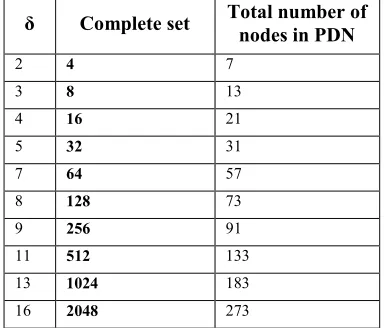
Lemma 3: PDN never be a binary complete set of node. Proof: The Perfect Difference Network (PDN) is based on a PDS and the total number of nodes is (δ2 + δ + 1)[4].The value of δ is may be even or odd. But (δ2 + δ + 1) is always a odd[9]. This way we can find PDN never be a binary complete set. Following fact is also approved the above finding.
δ Complete set Total number of nodes in PDN
2 4 7
3 8 13
4 16 21
5 32 31
7 64 57
8 128 73
9 256 91
11 512 133
13 1024 183
16 2048 273
IV. MATRIX REPRESENTATION OF HEX-CELL
0
1 2
3
4
5
0
0
1 0
0
0
1
1
1
0 1
0
0
0
2
0
1 0
1
0
0
3
0
0 1
0
1
0
4
0
0 0
1
0
1
[image:3.612.79.272.548.712.2]5
1
0 0
0
1
0
Fig. Adjacency matrix of Hex-Cell Having 6 nodes.
Lemma 4:The matrix of Hex-Cell HC(i) is n*n matrix. In Hex-Cell HC(i) matrix, the row i is formed from row(i ±1) by shifting i number of bits.
Proof: The adjacency matrix of the Hex-Cell is shown above. From the adjacency matrix of Hex-Cell, the second row of the hex-cell is obtained by shifting the bits of first row towards right as given below.
First row: 0 1 0 0 0 1
Now shift the bits of first row by one towards right, then the row will be
1 0 1 0 0 0
The row that we obtained after the shifting of bits of first row towards right is same as the second row
1 0 1 0 0 0.
Now we will do this for the third row of the adjacency matrix .For this we have to shift the bits of second row by one towards right, already obtained from first row by shifting of bits by one as given below:
Second row:
1 0 1 0 0 0
International Journal of Emerging Technology and Advanced Engineering
Website: www.ijetae.com (ISSN 2250-2459,ISO 9001:2008 Certified Journal, Volume 5, Issue 3, March 2015)
142
0 1 0 1 0 0
The row that is obtained from the second row is same as third row of the adjacency matrix of the HC (d). If we do it for the remaining rows, we can easily get the next rows of adjacency matrix of the individual level of hex-cell.
Adjacency matrix of Hex-Cell HC(2) Having 18 nodes
V. DENSITY
Density of any Architecture or Interconnection Network is also a important aspect for analysis.
Density is the ratio of edges that exists to the total number of edges possible. We may calculate density of architecture (PDN) using following formula:
Total Density = Number of Actual Links / Number of Expected Links.
So, For the calculation of density of PDN or Hex-Cell we must know,
Total number of edges of PDN/HC (d).
Possible number of edges PDN/HC (d).
Acknowledgment
With the blessing of almighty God & Sai baba, I am fortunate enough to have the help of many kinds at different occasions while through my work.
I am highly indebted to Mrs. Seema Katare, for her loving care, and thanks to dear charvi katare & prabhav katare for their constant support & help.
I would like to thank all my colleagues and friends Neha Singh, Ishan Singh, Aarti pandey , Nisha srivastava, K.K.Verma and Ritu Mishra from the Department of computer science, A.P.S. University, Rewa (M.P.) India.
On a more personal level, I would like to thank my
Family and my Parernts for all their love and support.
Thank you a lot for your patience and trust, without your help I would never complete this work. He/she always provide invaluable guidance especially when I Unsure which direction to take.
Finally, I express my special gratitude to my wife Kirti, for believing in me and encouraging me for all my endeavors.
VI. CONCLUSION
In this paper we explored the basic architecture of Hex-Cell and PDN. We have also discussed some basic properties of PDN & Hex-cell. We tried to shows architectural parameter of hex-cell. Our main contribution in this paper is extracting some aspect of Hex-Cell, Perfect Difference Network (PDN) Using graphical /Mathematical
expression/patterns. Extracting these kinds of
expression/pattern in order to describe topological properties of Hex-Cell, Perfect Difference Network (PDN) can have several benefits. For Example determining the total number of Hex-Cell at Hex-Cell HC (d) may be very helpful in designing of architecture or algorithms.
REFERENCES
[1] Behrooz, Parhami., and Mikhail, R., ―Perfect Difference Networks and related Interconnection Structures for Parallel and Distributed Systems‖, IEEE transactions on parallel and distributed systems, vol. 16, no. 8, august 2005, pp714-724.
[2] Saad, Y. and Schultz, M. H., ―Topological Properties of Hypercubes‖, IEEE transactions on computers, Vol. 37 No. 7 pp. 867-872, July 1988.
[3] Katare, R.K. and Chaudhari, N.S ―Study of Topological Property of Interconnection Networks and its mapping to Sparse Matrix Model‖, International Journal of Computer Science and Applications, 2009 Technomathematics Research Foundation.Vol. 6, No. 1, pp. 26 – 39
[4] Katare,R.K.,Chaudhari,N.S.,Mugal,S.A.,Verma,S.K.,Imran,S.,Raina, R.R.‖Study of Link Utilization of Perfect Difference Network and Hypercube‖Conference on "FECS", The 2013 World Congress in Computer Science, Computer Engineering and Applied Computing, Las Vegas, Nevada, USA, July 22-25, 2013.
[5] Azizi,S.,Hasemi,N,Zarandi,M.A.,‖Comparision between Topological Properties of HyperX and Generalized Hypercube for Interconnection Networks‖,Journal of mathematics andcomputer science9(2014),111-122.
[6] Behrooz, Parhami., and Mikhail, R., ―Application of Perfect Difference Sets to the Design of Efficient and Robust Interconnection Networks‖
0 1 2 3 4 5 6 7 8 9 10 11 12 13 14 15 16 17
International Journal of Emerging Technology and Advanced Engineering
Website: www.ijetae.com (ISSN 2250-2459,ISO 9001:2008 Certified Journal, Volume 5, Issue 3, March 2015)
143 [7] Singh,M.,Tripathi,R.―Comparison of Topological Property of Perfect
Difference Network and Hypercube‖, International Journal of Computer Applications (0975 – 8887) Volume 53– No.18, September 2012
[8] Behrooz, Parhami., and Mikhail, Rakov., ―Performance, Algorithmic, and Robustness Attributes of Perfect Difference Networks‖, IEEE transactions on parallel and distributed systems, vol. 16, no. 8, pp 725-736.2, August 2005.
[9] Tiwari,S.,Katare,R.K.‖ A Study of Hex-cell, complete graph and Perfect Difference Network (PDN), 2nd International Confrence on Emerging Trends in computer science,communication and information Technology,ISBN978-81-923487-1-1(2015).
![Fig. 2: (a) HC (one level) (b) HC (two levels) (c) HC (three levels) [10]](https://thumb-us.123doks.com/thumbv2/123dok_us/8702502.879872/2.612.50.289.447.551/fig-hc-level-b-hc-levels-hc-levels.webp)