International Journal of Emerging Technology and Advanced Engineering
Website: www.ijetae.com (ISSN 2250-2459, ISO 9001:2008 Certified Journal, Volume 5, Issue 3, March 2015)
84
Knowledge Reuse in Software Project Management
Akshay Suresh
AtoS India Private Limited, Chennai, India
Abstract-- Knowledge Reuse is an innate part of every organization especially those that belong to the Software industry. It is a part of the “holy trinity” of the Knowledge Management System along with Knowledge Sharing and Knowledge Transfer.The study aims at implementing the process of Knowledge Reuse on SAP related corporate knowledge and to realize its advantages with respect to the time and cost saved. This paper aims at elucidating the process involved in reusing the existing assets and to show its effect in a statistical manner and therefore prove that Knowledge Reuse aids in project management. The knowledge consists of documents, presentations, memos and web pages belonging to various industrial sectors. For the purpose of this study, the knowledge belonging to the manufacturing, media and service sector is considered. The results are established with respect to the cost and time savings.
Keywords-- Knowledge Management System, Knowledge Reuse, Project Management, SAP
I. INTRODUCTION
Knowledge Reuse can be defined as the process of reusing existing knowledge to aid Project Management [15]. The knowledge may be owned by the organization or may be borrowed from elsewhere. Knowledge Reuse is practised to reduce the cost, effort and the time taken for development as well as enhance the quality of the final product. Both Explicit (databases, memos, documents, notes, etc.) and Tacit knowledge(know-how, beliefs, values, and attitudes) can be deemed as reusable [12]. These reusable objects can be used as Solution Accelerators[13]. Solution Accelerators are ready to use software components which ensure quick and quality product development.
Despite its undoubted importance, the concept of Knowledge Reuse is still quite nascent in today‟s industry. A plausible explanation is that the research work carried out in this field has been scattered and the results obtained have been isolated. Knowledge Reuse involves three distinct roles that of Knowledge producer, Knowledge intermediary and Knowledge consumer[12]. Knowledge producer is someone who is responsible for creating the knowledge. The second role which that of knowledge intermediary involves the process of collecting the knowledge thereby facilitating its storage, retrieval and sharing. The role of knowledge consumer is self explanatory that is the person who uses up the stored knowledge. The data set as mentioned earlier contains documents, reports, notes, presentations, etc. belonging to SAP projects from the Manufacturing, Media and the Service sector[1]. They (knowledge) are stored in an asset library. There are a total of 873 existing objects, out of which 442 belong to the Manufacturing sector, 360 belong to Media sector and 42 belong to the Service sector. The aim is to scan these objects, identify the reusable objects, implement them in upcoming projects and realize the savings ensured.
The various modules[14]that the existing artifacts belong to are:-
APO, Basis, BI, BPML, Business Blueprint, CO, DP, FI, HR, MM, PM, PP, QM, SD, SRM
.
A. Terminologies in the Data Set:
International Journal of Emerging Technology and Advanced Engineering
Website: www.ijetae.com (ISSN 2250-2459, ISO 9001:2008 Certified Journal, Volume 5, Issue 3, March 2015)
85
TABLE 1
VARIOUS MODULES IN THE DATA SET.
Name of the Module Description APO- Advanced Planning and
Optimization Heart of Supply Chain. Enables End-End business processes. Basis-Business Application
Software Integration System
Provides support for upgrades, server environment, transport and maintenance.
BI- Business Intelligence Provides solutions to make data manipulation, analysis and information sharing easier. BPML- Business Process
Master List
Chief storage area from where worksheets are built to manage baseline configuration.
Business Blueprint A company‟s business process requirements are documented by the Business Blueprint. CO- Controlling An entity which gives
information for decision making.
DP- Demand Planning Predicts the product‟s market demand by considering different causal factors.
FI- Financial Accounting Helps to track data related to financial accounting with languages, companies, etc. HR- Human Resource Ensures effective management
of information about the people belonging to an organization. MM-Material Management Gives support to the inventory
and procurement function in business operations.
PM- Plant Maintenance Provides software support for maintenance activity performed within an organization.
PP- Production Planning Incorporates functions involved in the process of manufacture and sale after production. QM-Quality Management Helps in the implementation of
important Quality Management elements.
SD-Sales and Distribution Processes involved in selling, shipping and billing are executed by this module. SRM-Supplier Relationship
Management Helps in the coordination of key suppliers and business processes.
II. RELATED WORK
Lynne Markus M performed a detailed study about knowledge reusability with emphasis on Knowledge Management Systems and repositories[2]. This was the first attempt to put together information from a wide variety of sources and explain knowledge reusability.
The basic concept of Knowledge Reuse was explained along with the role of repositories in Knowledge Reuse. The various situations when knowledge was reused were also elucidated. The study was concluded by stating that designing repositories which meet the user needs plays a vital role in knowledge reuse being successful.
Renate Fruchter and Peter Demain discussed the factual observations of reusing knowledge by designers according to their individual occurrences. They construed that the process of knowledge reuse involved two distinct processes. One, being the ability to identify the reusable items and the other, understanding their context. They concluded their study by prescribing six degrees of exploration that helped to understand the items better[3].
Yunwen Ye, Gerhard Fischer and Brent Reeves worked on overcoming the barriers to implement reusable objects[4]. They integrated active information system and illustrated a prototype called CodeBroker in order to overcome the barriers. They have managed to raise concerns with respect to software reusability. They state that developers must make efforts to find software components which match their current problems and reuse them instead of wasting resources by developing them from scratch.
Jill Owen, Frada Burstein and William P.Hall examined how software companies implement knowledge reuse [5]. They have proposed a prototype for knowledge reuse in project management habitat which involves both the tactical and the strategic level. Specific loops and cycles have been defined in their proposal. Knowledge flow from one project to another has been traced and has been concluded stating that technology, social network and corporate culture play a vital role in effective knowledge management.
Ann Majchrzak, Lynne P.Cooper and Olivia E.Neecede liberated the use of knowledge reuse in innovations. They considered various case studies and applied the process of knowledge reuse to them. They devised a six-stage reuse process which consisted of three significant stages such as problem of reconceptualization[6]. Their conclusion was that an unassailable gap in performance was required to stimulate the decision to utilize knowledge from another source.
International Journal of Emerging Technology and Advanced Engineering
Website: www.ijetae.com (ISSN 2250-2459, ISO 9001:2008 Certified Journal, Volume 5, Issue 3, March 2015)
86
Márcio de Oliveira Barros, Cláudia Maria Lima Werner and Guilherme Horta Travassos examined the use of knowledge reuse in project management. Their study was concentrated upon constructing and reusing project management models which held knowledge about theories, strategies, actions and methods that could be imposed on another project. They conclude by stating that scenario based project management is still a work in progress and such work should progress to a more general assessment[8].
David Baxter, James Gao, Keith Case, Jenny Harding, Bob Young, Sean Cochrane and Shilpa Danibrought forward a structure for efficient knowledge reuse[9]. They critique the existing method and suggest modifications to it thus presenting a new framework. A case study is also presented to further bolster their stance. They conclude by stating thatthe structure of the database that is provided by the design Knowledge Reuse Systemaids dynamic management of the various requirements.
Marcio O Barros, Claudia M.L Werner and Guilherme H. Travassos provided an experimental analysis for executing scenario models representing knowledge reuse in project management along with an application for their suggested approach. They state that such scenario models contain useful reuse knowledge base that can be helpful for project managers. Through their study[10] they come to a belief that such scenarios can be reused and their impact on the projects can be assessed.
O.K. Harshhighlights the role of knowledge reuse management in the technical habitat[11]. He emphasized that knowledge reuse must be considered as an independent entity by organizations. A three dimensional knowledge reuse model has also been put forth by considering the time elements. He concludes by stating that if considering time and knowledge reusability as separate entities, knowledge reuse management can further be enhanced.
The above mentioned work dealt with elucidating the concept and various models of Knowledge Reuse in companies and its advantages. This particular work deals with the actual implementation of Knowledge Reuse and the statistical gains that are realized as a result.
III. METHODOLOGY
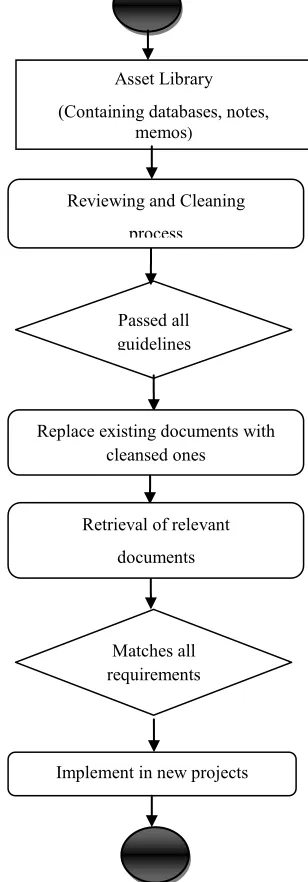
Figure 1 shows the activity diagram for the whole Knowledge Reuse process. The project artifacts such as databases, notes and presentations are stored in an asset library[1] which serves as a single common point of access. The first step involves reviewing and cleaning the objects which are stored in the library. The reusable objects are identified through the review process.
[image:3.612.343.497.275.716.2]The cleaning process involves removing information related to a specific organization from the objects. The object is then renamed. If the cleansed file passes all the set guidelines for a reusable, it then replaces the old object in the asset library else it is further cleansed. The next step involves the retrieval of those objects which would be suitable for a new project[16]. The requirements of the client are analyzed thoroughly and if the retrieved record matches those requirements perfectly, it is implemented in the project immediately else the retrieval process is done again.
Figure 1- Methodology for Knowledge Reuse Process Asset Library
(Containing databases, notes, memos)
Passed all guidelines
Matches all requirements Reviewing and Cleaning
process
Replace existing documents with cleansed ones
Retrieval of relevant
documents
International Journal of Emerging Technology and Advanced Engineering
Website: www.ijetae.com (ISSN 2250-2459, ISO 9001:2008 Certified Journal, Volume 5, Issue 3, March 2015)
87
IV. RESULTS AND ANALYSIS
The work considered the project artifacts from the manufacturing, media and the service sector[1]. The asset library consisted of a total of 873 existing objects, out of which 442 belonged to the Manufacturing sector, 360 belonged to the Media sector and 71 belonged to the Service sector. The old artifacts are cleansed and uploaded back to the asset library. Then the suitable objects were retrieved for specific clients and were implemented in the projects. The time saving was observed and using that the cost saving was calculated.
TABLE II
RETENTION OF PROJECT ARTIFACTS Name of the Sector Total no. of
objects
No. of objects reviewed and
cleansed
Manufacturing 442 259
Media 360 222
Service 71 42
Table II represents the statistics related to the number of objects which were reviewed and cleansed. Out of 442 objects in the manufacturing sector, 259 objects were identified as potentially reusable and were cleaned. Similarly 222 objects and 42 objects were retained in the media and service sector respectively
.
TABLE III
TIME SAVINGS DUE TO REUSABLE OBJECTS Name of the
Sector
No. of objects used
Estimated time taken without reusable Objects (days)
Time taken with reusable
objects (days)
Total time saved (days)
Manufacturing 3 27 9 18
Media 1 11 6 5
Service 2 14 4 10
Table III represents the time savings which were realized as a result of knowledge reuse in an organization. The number of objects that satisfied the client requirements was understandably less. The sixth column in the table shows the number of invaluable days saved as a result of using reusable objects. Two separate projects in Manufacturing sector has ensured a total of 18 days saved while projects in Media and Service have ensured 113 days and 10 days saved respectively.
TABLE IV
TOTAL COST SAVING IN INDIAN RUPEES Total no. of days saved 33
No of working hours/day
9
Exchange Rate (example:- Euro: Indian Rupees)
70
Assumed cost per hour (Euros)
20
Total Cost saved (INR) 415800
[image:4.612.353.536.157.266.2]Total Cost= No. of days saved*No. of working hours/day*Exchange Rate*Assumed cost per hour.
Table IV represents the calculated cost saving as a result of Knowledge Reuse. For calculation purposes the project is assumed to belong to a European client. Hence the exchange rate considered is that of Euro. The cost per hour of the project is assumed as 20 euros. Therefore the total cost saved would be the product of the number of days saved, number of working hours a day, exchange rate and the cost per hour.
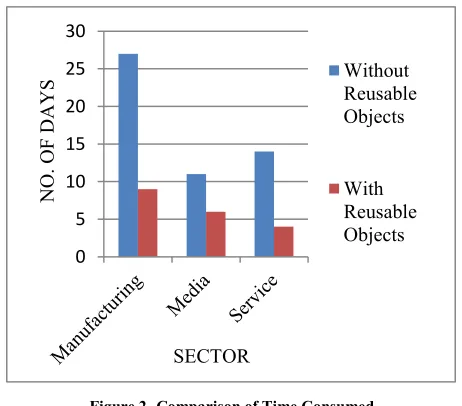
[image:4.612.42.296.294.362.2]The following bar graph shows the comparison between the time taken for completion of projects with and without the use of reusable objects.
Figure 2- Comparison of Time Consumed
Figure 2 clearly shows that advantage of Knowledge Reuse. There is a considerable difference between time taken to complete project without and with reusable objects for all three industries.
0 5 10 15 20 25 30
Without Reusable Objects
With Reusable Objects
SECTOR
NO.
OF
DA
[image:4.612.328.559.431.634.2]International Journal of Emerging Technology and Advanced Engineering
Website: www.ijetae.com (ISSN 2250-2459, ISO 9001:2008 Certified Journal, Volume 5, Issue 3, March 2015)
88
[image:5.612.49.291.173.330.2]The time saved hence would prove invaluable to any organization and also helps them financially by saving a lot of money.
Figure 3 – Proportional Cost Savings
Figure 3 shows a pie chart representing the proportional cost savings with respect to each sector
.
Since assets belonging to manufacturing sector are reused the most, it has a higher proportion of cost saved compared to media and service sector.V. CONCLUSION
In today‟s „survival of the fittest‟ industrial scenario, there are three critical challenges: to abridge the time gap between the developer and the market, to cut down the development costs considerably and to be uncompromising on the quality of the product. Therefore in order to achieve all three challenges, Knowledge Reuse is paramount for all organizations to ensure efficient project management. Three sectors were considered namely,manufacturing, media and service and objects related to them were put into the process of knowledge reuse. Once they were reviewed and cleansed, they were implemented in new projects. The time and cost savings were realized. Unlike the earlier works[2-11] which dealt with the theoretical explanation of knowledge reuse, this work concentrated more upon bringing out the numerical advantages of knowledge reuse for an organization in the form of time and cost. One drawback with regard to this work is that the cost calculation is not accurate. It will vary from organization to organization and from project to project. After the methodology was completed the results were duly obtained. According to the results obtained and tabulated, it can be clearly stated that knowledge reuse has an enormously positive impact on an organization.
This paper aims at only evaluating the time and cost savings as a result of knowledge reuse for software projects; there is future scope for the subject where it can be extended to large hardware industries like aerospace, automobile, etc. where the hardware components and designs can be reused to ensure quick development of quality products.
Acknowledgement
This paper would not have been possible without the support AtoS India Private Limited who was the source for the asset library with which the work was done.
Special regards to my superiors in the company and to my college professors for their constant support and encouragement.
REFERENCES
[1] Data Set Source: Atos India Private Limited.
[2] Lynne Markus M, 2001.“Toward A Theory of Knowledge Reuse: Types of Knowledge Reuse Situations and Factors in Reuse Success”, Journal of Management Information Systems, pp-57-93, DOI: 10.1.1.85.7939
[3] Renate Fruchter, Peter Demian, June 2002. “Knowledge Management for Reuse”, Proceedings of CIB w78 Conference, Aarhus School of Architecture, Denmark,
[4] Yunwen Ye, Gerhard Fischer , Brent Reeves, 2000. “Integrating active information delivery and reuse repository systems”,Proceedings of the 8th ACM SIGSOFT international symposium on Foundations of software engineering: twenty-first century applications, p.60-68, ,DOI: 10.1145/355045.355053, November 06-10.
[5] Jillian Owen, Frada Burstein, William P.Hall, 2003. “Knowledge Reuse in Project Management”,Proceedings of theISD '03 Twelfth International Conference on Information Systems Development - Methods & Tools, Theory & Practice, Melbourne, Australia, 25 - 27 August, DOI: 10.1007/978-1-4471-4048-1_9
[6] Ann Majchrzak, Lynne P.Cooper, Olivia E.Neece, “Knowledge Reuse for Innovation”, Management Science, 50(2), pp- 174-188, DOI: 10.1287/mnsc.1030.0116
[7] Jill Owen, Frada Burstein, Steven Mitchell,2004.” Knowledge Reuse and Transfer in a Project Management Environment”, Journal of Information Technology Case and Application Research, Volume 6, Issue 4, DOI:10.1080/15228053.2004.10856052
[8] Márcio de Oliveira Barros, Cláudia Maria Lima Werner, Guilherme Horta Travassos,2001. ”Scenario Oriented Project Management Knowledge Reuse within a Risk Analysis Process”, Proceedings of theThirteenth International Conference on Software Engineering & Knowledge Engineering (SEKE'2001), Sheraton Buenos Aires Hotel, Buenos Aires, Argentina, June 13-15, DOI: 10.1.1.424.318. [9] David Baxter, James Gao, Keith Case, Jenny Harding, Bob Young,
Sean Cochrane, Shilpa Dani, “A framework to integrate design knowledge reuse and requirements management in engineering design.”, Robotics and ComputerIntegrated Manufacturing, pp -589-593 DOI: 10.1016/j.rcim.2007.07.010
Cost Saving
Manufacturing
Media
International Journal of Emerging Technology and Advanced Engineering
Website: www.ijetae.com (ISSN 2250-2459, ISO 9001:2008 Certified Journal, Volume 5, Issue 3, March 2015)
89
[10] Márcio de O. Barros , Cláudia M. L. Werner , Guilherme Travassos,Project Management Knowledge Reuse through Scenario Models, Proceedings of the 7th International Conference on Software Reuse: Methods, Techniques, and Tools, p.227-239, DOI: 10.1007/3-540-46020-9_16
[11] O. K. Harsh, “Data, Information and Knowledge & Reuse Management Techniques”, World Congress in Engineering held in London from July 2 to July 4, 2007, DOI:10.1.1.148.8939
[12] Alan Frost(2010),”Managing Knowledge Reuse”, [Online]. Available:http://www.knowledge-management-tools.net/knowledge-reuse.html
[13] Solution Accelerators, 3i Infotech, [Online] Available: http://www.3i-infotech.com/content/index.aspx
[14] SAP Help Portal, [Online] Available: http://help.sap.com/
[15] AmitavaMitra, Amar Gupta, “Knowledge Reuse and Agile Process Catalysts for Innovation.” ISBN-13: 978-1599049212, 1st
Edition,2008.
[16] Edna Pasher, Tuvya Ronen ,” The Complete Guide to Knowledge Management: A Strategic Plan to Leverage Your Company's Intellectual Capital”, ISBN: 978-0-470-88129-3,1st Edition, John