comm
en
t
re
v
ie
w
s
re
ports
de
p
o
si
te
d r
e
se
a
rch
refer
e
e
d
re
sear
ch
interacti
o
ns
inf
o
rmation
Inferring transcriptional modules from ChIP-chip, motif and
microarray data
Karen Lemmens
*
, Thomas Dhollander
*
, Tijl De Bie
†
, Pieter Monsieurs
*
,
Kristof Engelen
*
, Bart Smets
‡
, Joris Winderickx
‡
, Bart De Moor
*
and
Kathleen Marchal
*§
Addresses: *BIOI@SCD, Department of Electrical Engineering, KU Leuven, Kasteelpark Arenberg, B-3001 Heverlee, Belgium. †Research Group
on Quantitative Psychology, Department of Psychology, KU Leuven, Tiensestraat, B-3000 Leuven, Belgium. ‡Molecular Physiology of Plants
and Micro-organisms Section, Biology Department, KU Leuven, Kasteelpark Arenberg, B-3001 Heverlee, Belgium. §CMPG, Department of
Microbial and Molecular Systems, KU Leuven, Kasteelpark Arenberg, B-3001 Heverlee, Belgium.
Correspondence: Kathleen Marchal. Email: [email protected]
© 2006 Lemmens et al.; licensee BioMed Central Ltd.
This is an open access article distributed under the terms of the Creative Commons Attribution License (http://creativecommons.org/licenses/by/2.0), which permits unrestricted use, distribution, and reproduction in any medium, provided the original work is properly cited.
Network module discovery
<p>ReMoDiscovery, a module discovery algorithm and software that uses ChIP-chip data, motif information and gene-expression profiles, is presented.</p>
Abstract
'ReMoDiscovery' is an intuitive algorithm to correlate regulatory programs with regulators and corresponding motifs to a set of co-expressed genes. It exploits in a concurrent way three independent data sources: ChIP-chip data, motif information and gene expression profiles. When compared to published module discovery algorithms, ReMoDiscovery is fast and easily tunable. We evaluated our method on yeast data, where it was shown to generate biologically meaningful findings and allowed the prediction of potential novel roles of transcriptional regulators.
Background
Complex cellular behavior is mediated by the action of regu-latory networks. The reconstruction of these networks is one of the foremost challenges of current bioinformatics research [1,2] and requires combining different high throughput 'omics' data. With the current accuracy and availability of these high throughput data, the problem of network recon-struction remains highly underdetermined. The amount of independent experimental data is not sufficient to unequivo-cally estimate all parameters of the models. Previous studies, however, have unveiled that regulatory networks are modular and hierarchically organized [3]. Inferring modules instead of full networks drastically reduces the complexity of the infer-ence problem and shows great promise for systems biology research [4]. A transcriptional network is reduced to a mod-ule consisting of a regulatory program and a corresponding set of co-expressed genes. The program, a set of regulators
and their corresponding motifs, is responsible for the condi-tion-dependent expression of the module's genes.
Traditionally, module identification methods dealt with each of the different 'omics' data sources separately (for example, solely based on microarrays [4]). However, simultaneous analysis of distinct data sources has a major advantage over their separate analysis: their integration allows gaining holis-tic insight into the network and a more refined definition of transcriptional modules can be derived [5]. Therefore, the more recent approaches for module inference combine sev-eral data sources.
Harbison et al. [6] and Kato et al. [7] both describe pragmatic approaches to analyze heterogeneous data. The approach by Segal et al. [4] focused on the identification of regulatory modules from microarray data with probabilistic models and
Published: 5 May 2006
Genome Biology 2006, 7:R37 (doi:10.1186/gb-2006-7-5-r37)
Received: 15 September 2005 Revised: 21 December 2005 Accepted: 10 April 2006 The electronic version of this article is the complete one and can be
was extended by Xu et al. [8] to incorporate ChIP-chip data. Tanay et al. [3] developed an advanced graph bicluster algo-rithm to simultaneously integrate expression data, ChIP-chip, protein interaction and phenotypic data. Bar-Joseph et
al. [9] developed a procedure that learns modules from
microarray and ChIP-chip data using a sequential analysis of the data. In a first step, the ChIP-chip data is used to find a set of genes whose upstream regions are likely to bind a common set of transcriptional regulators. In a second step, the micro-array data is used to find a subset of this gene set, containing only those genes whose expression profiles are similar to each other. Finally, the resulting core set is expanded with addi-tional genes that have a small combined p value for the same set of regulators in the ChIP-chip data.
In this paper, we present an alternative approach for module discovery based on heterogeneous data. It is different in spirit from previously suggested methods in that our algorithm takes distinct data sources related to transcriptional regula-tion, that is, microarray, ChIP-chip and motif data, into account in a concurrent (non-iterative or sequential) way. In contrast to previous methods, where motifs are mainly defined in a downstream analysis step, we use motif data as an independent information source. We demonstrate the per-formance of our method on well characterized yeast datasets.
Results
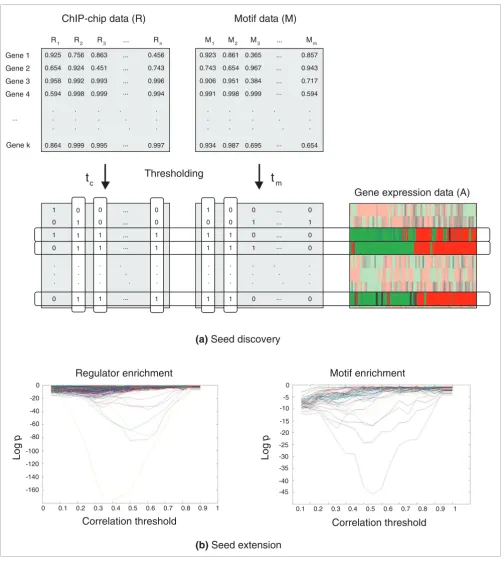
We aim at identifying transcriptional modules by searching microarray data for target genes with a common expression profile that also share the same regulatory program, based on evidence from ChIP-chip and motif data. Module detection by 'ReMoDiscovery' consists of two steps. In a first seed discov-ery step, stringent seed modules are identified (Figure 1). This seed discovery problem translates into finding gene sets (row dimension in Figure 1) that are co-expressed in microarray data (matrix M), that bind the same regulators (share the same columns in the ChIP-chip matrix) and that have the same motifs in their intergenic region (same columns in the motif matrix (Figure 1)). In a second seed extension step, the gene content of the module is extended using less stringent criteria. In the following, we discuss the specifics of this two-step procedure.
Seed discovery step
In the seed discovery step, we detect large modules with tightly co-expressed genes (pairwise correlation of at least te), directed by a common regulatory program with a minimum
number of regulators (sc) and a minimum number of
con-served motifs (sm) in the upstream region of the genes included in the module. Modules that meet these user-defined stringent criteria are user-defined as valid seed modules. We solely report 'maximal modules', defined as valid seed modules that become invalid upon extending them with any gene they do not yet contain.
An exhaustive search for all valid gene sets is not feasible, as the number of possible sets is exponential in the number of genes. However, by defining the constraints in such a way that extensions of an invalid module are never valid (that is, as hereditary constraints), we can adopt a fast Apriori-like algo-rithm to solve the problem [10] (see Materials and methods for details).
To determine the statistical significance of the obtained mod-ules, we assigned a 'seed module' p value to each seed module (see Materials and methods). As expected, seeds with a high number of genes were highly significant. Modules with one gene were only significant if they contained many regulators.
To test the sensitivity of the seed discovery step with respect to the parameters, we compared results obtained at different parameter settings using a normalized Jaccard similarity score. The overall similarity in gene and regulator content was examined separately. We varied the correlation threshold on the expression profiles, the threshold on the ChIP-chip data tc (required to convert the ChIP-chip data to a binary matrix; see Materials and methods) and the minimum number of regulators sc. Parameter settings that are more similar generally resulted in more similar gene and regulator module content. This consistency (monotonicity) eases parameter tuning. Numerical results of the sensitivity analy-sis can be found on our supplementary ReMoDiscovery web-site [11].
Seed extension step
The stringent criteria for the valid modules in the seed discov-ery step appear sufficient to reliably detect regulators and motifs, but the reported maximal gene content of such mod-ules is likely to be underestimated in size. For this reason, ReMoDiscovery contains a second module extension step, in which the gene content of statistically significant seed mod-ules is extended. This extension is performed by computing the module's mean expression profile, and ranking the remainder of the genes in the dataset according to their cor-relation with this seed profile. The genes at the top of the ranking will most likely belong to the module. However, it is not clear where to choose the cutoff on the correlation with the seed profile that is minimally required for additional genes to belong to the module. Therefore, 'module enrich-ment' p values are computed according to the enrichment of all regulators (motifs) in the extended modules as a function of the correlation cutoff. If motifs and regulators identified in the seed discovery step appear to be over-represented in the extended sets, the correlation resulting in the largest enrich-ment is considered optimal (Figure 1).
Application to biological datasets
comm en t re v ie w s re ports refer e e d re sear ch de p o si te d r e se a rch interacti o ns inf o rmation
[image:3.612.54.558.83.646.2]ReMoDiscovery analysis flow
Figure 1
ReMoDiscovery analysis flow. ReMoDiscovery consists of a seed discovery step followed by a seed extension step. ChIP-chip data, motif data, and expression data are used as input for the algorithm. These three datasets can be represented as matrices in which the rows represent the genes. For the ChIP-chip data (R) the columns represent the regulators, for the motif data (M) they represent the motifs and for the expression data (A) the different experiments. (a) The seed discovery step identifies sets of genes that are co-expressed, bind the same regulators, and have the same motifs in their intergenic region. (b) The gene content of the seed modules can be extended during the seed extension step using less stringent criteria. The logarithms of the module enrichment p values (y-axis) are plotted for all regulators (motifs) as a function of the correlation threshold (x-axis). Each line in the sample plot shows the module enrichment p values for the enrichment of its corresponding regulator (motif) as a function of the gene expression correlation threshold used. 0.925 0.654 0.958 0.864 0.756 0.924 0.992 0.999 0.594 0.998 0.456 0.743 0.994 0.996 0.997 0.999 0.993 0.451 0.863 0.995 ... ... ... ... ... . . . . . . . . . . . . . . . 0.923 0.743 0.906 0.934 0.861 0.654 0.951 0.987 0.991 0.998 0.857 0.943 0.594 0.717 0.654 0.999 0.384 0.967 0.365 0.695 ... ... ... ... ... . . . . . . . . . . . . . . . 1 0 ... ... . . . . . . 0 1 1 0 ... ... . . . . . . . . . 0 1 . . . 0 0 . . . 0 0 . . . 1 0 . . . 0 0 . . .
Thresholding
t
ct
mR1 R2 R3 Rn M1 M2 M3 Mm
Gene 1 Gene 2 Gene 3 Gene 4 Gene k . . . . . . ...
Gene expression data (A)
Motif data (M)
ChIP-chip data (R)
(a)
Seed discovery
Correlation threshold
0 0.1 0.2 0.3 0.4 0.5 0.6 0.7 0.8 0.9 1
Correlation threshold
(b)
Seed extension
0 -20 -40 -60 -80 -100 -120 -140 -160
Log
p
0 -5 -10 -15 -20 -25 -30 -35 -40 -45Regulator enrichment
Motif enrichment
0 .
. .
1 1 1 1 0 ...
0 1 1 ... 1 1 ... 0
1
1 1
1
0 1 1 ... 1 1 1 0 ... 0
0 0.1 0.2 0.3 0.4 0.5 0.6 0.7 0.8 0.9 1
Log
Using the seed discovery step, we detected 20 seed modules for the Spellman dataset [12] and 104 seed modules for the Gasch dataset [13]. Detailed results can be found in Addi-tional data files 1 and 2. Seed modules were all statistically significant when using a cutoff of 0.05 for the seed module p value. Significant seed modules that only contained one gene were omitted. To assess the biological relevance of the seed discovery step we compared our results with literature knowl-edge. We consider a seed module as verified if all of its regu-lators could be linked to the same biological process by the literature. For the Spellman dataset [12] 15 out of 20, and for the Gasch dataset [13] 53 out of 104 seed modules were sup-ported by the literature. The seed modules for the Spellman dataset [12] are displayed in Figure 2, and those for the Gasch dataset [13] are presented in Additional data file 3. Part of the seed modules (18 out of 20 for the Spellman dataset [12]; 63 out of 104 for the Gasch dataset [13]) could be extended by the second step of the algorithm. The extended modules are
described in detail in Additional data files 4 and 5 and all of their regulatory programs were found to be supported by the literature.
In some cases, seed modules could not be extended, that is, no additional correlated genes appeared to be present in the dataset under study. This implies either that the true module size was extremely small (only a few genes belong to the mod-ule) or that the module's regulatory program, although being biologically relevant, was not active in the conditions tested in the expression data. Indeed, the identification of the regula-tory program in the seed discovery step is to a large extent determined by the ChIP-chip and motif data. However, motif data are condition independent. Sharing a motif thus does not necessarily imply co-expression in the tested microarray con-ditions. Similarly, because of the discrepancies in experimen-tal conditions between available ChIP-chip and expression data, evidence from the ChIP-chip data does not
[image:4.612.57.560.85.471.2]Overview of the seed modules identified in the Spellman dataset [12]
Figure 2
Overview of the seed modules identified in the Spellman dataset [12]. For visualization purposes, seed modules with similar function are combined (indicated in green). A regulator or motif that is part of a regulatory program of an extended module is indicated in the figure by a bold edge from the regulator or motif to its module.
Nutrient deprivation
Galactose metabolism
Cell cycle Ribosome biogenesis
RAP1_YPD RAP1_SM GAT3_YPD
FHL1_YPD
FHL1_RAPA
YAP5_YPD
FHL1_H2O2HI
FHL1_SM
PDR1_YPD SFP1_SM SFP1_YPD
DAL81_SM
DAL81_YPD DAL81_RAPA GCN4_RAPA
MBP1_H2O2HI ROX1_H2O2HI HAP5_SM GLN3_SM
GLN3_RAPA UME6_H2O2HI
SWI5_YPD
REB1_YPD
STB1_YPD
HIR3_YPD
SMP1_YPD
SWI4_YPD
SWI6_YPD
NDD1_YPD
HIR2_YPD
HIR1_YPD
M_11 (SWI4)
M_67 (SWI4)
MCM1_ALPHA
M_18 (MCM1)
MCM1_YPD
M_12 (MCM1)
MBP1_H2O2LO
M_30 (MBP1)
RCS1_H2O2LO
SOK2_BUT14
TEC1_ALPHA
TBS1_YPD
ASH1_BUT14
STE12_ALPHA
FKH2_YPD
FKH2_H2O2HI
FKH1_YPD
PHO2_SM
PHO2_PI
MBP1_YPD
NRG1_H2O2HI GAL80_YPD
GAL4_YPD
GAL4_RAFF GAL4_GAL
comm
en
t
re
v
ie
w
s
re
ports
refer
e
e
d
re
sear
ch
de
p
o
si
te
d r
e
se
a
rch
interacti
o
ns
inf
o
rmation
automatically imply support by all microarray data. As a result, a module can only be extended with additional genes if its regulatory program appears to be active in the conditions underlying the used microarray study. Based on this observa-tion, we subdivided modules into those involved in general metabolism found active in both datasets (for example, ribos-ome synthesis, galactose metabolism) and those related to processes for which the activity was restricted to either one of the datasets. To the latter group belong modules involved in the cell cycle, which were extended in the Spellman dataset [12], and modules related to nutrient deprivation, stress, res-piration, amino acid metabolism, filamentous growth and meiosis extended in the Gasch dataset [13]. A more detailed description of the modules is given below.
Detailed description of the detected modules
To summarize results, modules were combined if their respective regulatory programs were involved in the same biological process.
Modules involved in ribosome biogenesis
Modules involved in ribosome biogenesis are active in both the Spellman [12] and the Gasch [13] dataset. This could be expected as ribosome biogenesis is known to be tightly cou-pled to cell cycle progression as well as to environmental changes that affect growth rate. Different regulators were found to be associated with these ribosome related modules, including Arg80, Dal81, Fhl1, Gat3, Gts1, Mbp1, Mth1, Ndd1, Pdr1, Pho2/Bas2, Rap1, Rgm1, Rme1, Sfp1, Smp1, Swi4, and Yap5. Of these, Fhl1 and Rap1 were found in most modules. Consistently, both factors have been reported as main tran-scriptional regulators of ribosomal gene expression [14,15]. Also, Sfp1 and Rgm1 have been implicated in ribosome bio-genesis and most recent data indicate that the former could act as a receiver of nutritional and stress derived signals [14,16,17].
To our knowledge, no data are available that may confirm a direct involvement of the other transcription factors in ribos-omal gene expression. Nevertheless, the processes in which these factors are known to be involved can be linked to ribos-ome biogenesis. For instance, Arg80, Dal81 and Pho2/Bas2 all function in the sensing and metabolic control of essential nutrients such as amino acids and phosphate, and it is well established that ribosomal protein gene expression is directly related to availability of essential nutrients [14,18-21]. Another example is the transcriptional regulator Gat3, an uncharacterized member of the GATA family of transcription factors that controls the expression of nitrogen catabolic genes. The GATA factors are regulated by the Tor pathway, a pathway that also regulates the expression of genes involved in ribosome biogenesis [19].
Modules involved in galactose metabolism
Both the Spellman [12] and the Gasch [13] dataset revealed active modules controlling so-called GAL genes (for example,
GAL3, GAL1, GAL7, GAL10), which encode proteins involved in galactose metabolism. These modules comprise the tran-scriptional regulators Gal4 and Gal80, which are key regula-tors of the galactose metabolism [22-24] and the transcriptional repressor Nrg1, which is known to mediate glucose repression of the GAL genes [25].
Some transcriptional regulators that were retained only from the Gasch [13] dataset point towards interactions between this module for galactose metabolism and modules for other processes, such as cell cycle control via Mbp1 (see also cell cycle module) [26] and amino acid metabolism via Met32 (see also amino acid module) [27]. In addition, the module for galactose metabolism contains the regulators Oaf1, Pip2 and Ume6, which are involved in the induction of peroxisomal genes participating in β-oxidation [28], potentially linking galactose metabolism to this process.
Cell cycle
Nine modules involved in cell cycle control were found to be active in the Spellman dataset [12]. The transcriptional regu-lators connected to these cell cycle related modules include components such as Swi4, Swi6, Mbp1 and Stb1, constituting the transcriptional complexes SBF and MBF, which operate during progression from G1 to S phase [29,30], as well as components involved in G2/M-specific transcription, such as Fkh1, Fkh2 and Ndd1 [31-33]. Further support for our analy-sis comes from the observation that other factors with a role in cell cycle regulation were also retrieved. These include the transcriptional repressor Xbp1, the corepressors Hir1, Hir2 and Hir3, and the transcription factors Pho2, Reb1 and Rcs1. Xbp1 is a repressor sharing homology with Swi4 and Mbp1 [34]. Pho2 is involved with the early G1 transcription factor Swi5 in the control of the HO gene [35]. Hir1, Hir2 and Hir3 are involved in cell cycle regulated transcription of histone genes [36,37]. The transcription factor Reb1 is known to bind with high affinity to a sequence upstream of CLB2 [38], a gene whose regulation is important for completion of the normal vegetative cell cycle. The regulator Rcs1 is involved in timing the budding event of the cell cycle [39]. Additional factors identified are Ash1, Sok2, Ste12 and Tec1. Their presence in our modules might link cell cycle to processes discussed below, like mating type switching [40] and the filamentous growth pathway (see also filamentous growth module) [41-43].
Nutrient deprivation
Six modules with transcriptional regulators that mediate con-trol of target genes under nutrient deprived conditions were active in the Gasch dataset [13]. The regulators include Gat1, Dal81, Dal82, and Gln3, which are all involved in nitrogen catabolite repression [21,44,45], Gcn4, which is the main reg-ulator in general amino acid control [46-48], Rtg3, which is a transcription factor involved in regulation of genes required
for de novo biosynthesis of glutamine and glutamate [49],
in response to nutrient availability [15], and Hap2, a tran-scription factor of the tricarboxylic acid cycle [50]. The ChIP-chip data obtained after treatment with rapamycin were espe-cially informative for identifying the different modules com-prising this nutrient deprivation module. Rapamycin is known to inhibit Tor (target of rapamycin) protein kinases, which function in a nutrient-sensing signal transduction pathway. Consistently, the processes and regulators for this module all show connections to the Tor-mediated nutrient-sensing signal transduction pathway [49-52].
Stress related conditions
Twenty modules directing general and specific stress responses were identified and extended in the Gasch dataset [12]. These modules contain several transcriptional regula-tors and subsets of them are known to help fine-tune stress responses to particular conditions. The regulators Msn2 and Msn4 present in our modules are known key regulators of stress-responsive gene expression in yeast [53-55]. Several regulators identified by our analysis can be related to trigger-ing responses upon oxidative stress, such as Skn7, Yap1, Hap5, Rox1, Hsf1, Nrg1, Pho2/Bas2 and Yap4/Cin5 [56-60]. A connection with oxidative stress may also exist for Sut1, a factor that, according to the literature, relieves hypoxic genes from repression by the Cyc8-Tup1 [61] co-repressor complex, which is recruited to many promoters via regulatory proteins such as Rox1 [62]. With regard to oxidative stress, links with other stress responses could also be derived. Indeed, Cup9 mediates copper resistance [63] while Yap6 confers resist-ance to cisplatin [64].
Some regulators present in the stress related module have been reported to be operative in aspects indirectly related to stress response, for instance, Ngr1, Rim101, Sok2 and Ume6 are linked by their roles in meiosis and sporulation (see also module for filamentation and meiosis) [65-68] and Xbp1 is a stress-induced transcriptional repressor of the cell cycle (see also cell cycle module) [69].
Respiration
The Gasch dataset [13] enabled the identification of an extendable module dedicated to respiration that includes the heme-responsive factor Hap1 and the subunits Hap2, Hap4, Hap5 of the heme-activated CCAAT-binding complex [70,71]. Two motifs, motif 7 (Esr2: GRRAAAWTTTTCACT) and 70 (CGCGnnnnnGGGS), of which the latter is defined as a 'new' motif by Kellis et al. [72], could be associated with this module.
Amino acid metabolism
The modules for amino acid metabolism were recovered upon analysis of the Gasch dataset [13]. Support for the validity of this module came from the presence of Dal81, a positive reg-ulator of multiple nitrogen catabolite repression genes [21,44,45] and from the presence of Gcn4, the main regulator in the general amino acid control [46-48]. Also present was
Leu3, a transcriptional regulator of genes involved in nitro-gen assimilation and in biosynthetic pathways of branched-chain amino acids [73,74]. The regulators Cbf1, Met4 and Met 32 of our module have previously been shown to be required for the coordinated expression of the structural genes from the sulfur amino acid biosynthesis pathway [75,76].
Additional regulators present in this module may provide links to other regulatory programs. The presence of Rox1 and Skn7 can couple this network to the program for oxidative stress response (see also stress related module) [56,57], while Sfp1, Rap1, and Gcr2, a coactivator of Rap1 [77], reflect links with ribosome biosynthesis (see also module for ribosome biogenesis) [14,21,78].
Modules involved in filamentous growth
Five modules related to filamentous growth could be retrieved from the Gasch dataset [13]. The filamentous growth pathway induces a morphogenetic switch under adverse growth, such as nutrient deprivation. This switch induces the formation of pseudohyphae, which are believed to facilitate foraging for scarce nutrients [41-43]. Consistent with the literature, these modules included the regulators Ste12 and its interacting partners Dig1 and Tec1, as well as Sok2 and its downstream regulators Ash1 and Phd1 [41-43]. The regulator Nrg1, also present in our module, is known to function as a negative regulator of filamentous growth and as a repressor of FLO11, which encodes a cell surface glycopro-tein required for filamentous growth [79] (see also galactose metabolism module).
Filamentous growth is known to be intimately linked to growth and cell cycle control. As such, it is not surprising that our analysis also retrieved for this module factors involved in cell cycle control, such as components of SBF and MBF, that is, Swi4 and Mbp1 [29,30] or Fkh2 [80] (see also cell cycle module). This close link to growth also explains the presence in our modules of Fhl1 [14,15], Hap1 [70,71] and Sut1 [61] as they all have important functions in determining the growth potential of yeast cells. Our analysis additionally retrieved Sko1, an important regulator allowing cells to cope with osmotic stress. Osmotic stress can, under some conditions, induce filamentous growth and as such the presence of Sko1 in our modules makes sense [81,82].
Modules involved in meiosis
comm en t re v ie w s re ports refer e e d re sear ch de p o si te d r e se a rch interacti o ns inf o rmation
Comparison with other module inference tools
To assess the differences between ReMoDiscovery and previ-ously described algorithms for module detection, we applied some of the well known module detection tools to which we had access to a workable implementation (that is, SAMBA [3] and GRAM [9]) along with ReMoDiscovery on the combined Spellman (microarray) [12] and Harbison (ChIP-chip) [6] dataset.
We analyzed running times on these datasets at distinct parameter settings for each of the tested algorithms on an Intel Pentium 2 GHz laptop with 512 Mb RAM. Independent of the setting for the 'overlap prior factor', the SAMBA algo-rithm [3] was rather quick, with running times around three minutes. For parameter settings close to its defaults, ReMo-Discovery performed slightly better. Running times were on the order of one minute. In general, the speed of the Apriori algorithm is roughly proportional to the number of modules that satisfy the constraints. In contrast, running times of the GRAM algorithm [9] were prohibitive if the data contained genes with more than ten significant ChIP-chip interactions due to the exponential increase in the number of candidate core modules (see [9] for details). After filtering out those genes, running times decreased to about 20 minutes at the default parameter setting.
To compare the gene and regulator content between modules obtained by GRAM [9], SAMBA [3] and ReMoDiscovery, we used an unsupervised scoring scheme that considers gene content and regulator content separately (that is, the normalized Jaccard similarity score as defined in Materials and methods). Since parameter settings influence the module composition, we calculated normalized Jaccard similarity
scores on the results for a number of parameter settings (see Materials and methods).
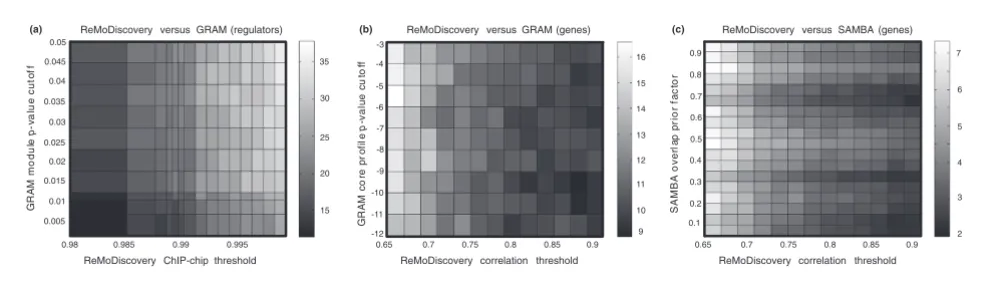
For all settings, we observed that both the overlap in gene and regulator content between the GRAM [9] modules and the seed modules of ReMoDiscovery was highly significant (nor-malized Jaccard similarity scores around 15 and 25 standard deviations, respectively). Since GRAM [9] generally returns modules with less regulator content, the similarity in regula-tory programs was best for the most stringent ReMoDiscov-ery ChIP-chip threshold (Figure 3). Accordingly, gene content was most similar if the ReMoDiscovery correlation threshold was lowered. From these results, we conclude that the ReMo-Discovery seed modules and the GRAM [9] modules repre-sent similar patterns in the data, the former focusing on modules with fewer genes and more regulators, the latter on modules with more genes and less regulators. The regulatory programs discovered by SAMBA [3], using the discretization method suggested by the authors, did not significantly resem-ble those of ReMoDiscovery or GRAM [9]. The gene content on the other hand did show some overlap (Figure 3).
We performed a similar analysis, this time with the extended seed modules of ReMoDiscovery. Extending the seeds gener-ally results in a smaller number of statisticgener-ally overrepre-sented regulators in the modules (Table 1), but an increase in gene content. Accordingly, the scores for overlap in gene con-tent with GRAM [9] and SAMBA [3] improved. The normal-ized Jaccard similarity score increased from 15 standard deviations to about 100 standard deviations for GRAM [9] and from 6 to about 21 standard deviations for SAMBA [3] (data not shown). At the same time, the regulator overlap with GRAM [9] increased to about 50 standard deviations. In other words, increasing the number of genes in a module
[image:7.612.56.554.89.232.2]Representative examples from the module content similarity analysis
Figure 3
Representative examples from the module content similarity analysis. The significance of the similarity in module content between ReMoDiscovery seed modules and GRAM [9] and SAMBA [3] output is shown at different parameter settings. The color bar on the right indicates the normalized Jaccard similarity score, that is, the number of standard deviations from the mean of the distribution of Jaccard similarity scores on randomized module partitioning. (a) Regulator content similarity between ReMoDiscovery and GRAM, with varying GRAM module p value cutoff and ReMoDiscovery Chip-chip threshold. (b) Gene content similarity between ReMoDiscovery and GRAM, with varying GRAM core profile p value cutoff and ReMoDiscovery correlation threshold. (c) Gene content similarity between ReMoDiscovery and SAMBA, with varying SAMBA overlap prior factor and ReMoDiscovery correlation threshold.
ReMoDiscovery versus GRAM (regulators) ReMoDiscovery versus GRAM (genes) ReMoDiscovery versus SAMBA (genes)
16 15 14 13 12 11 10 9 7 6 5 4 3 2 35 30 25 20 15
0.98 0.985 0.99 0.995 0.65 0.7 0.75 0.8 0.85 0.9 0.7 0.75 0.8 0.85 0.9
ReMoDiscovery ChIP-chip threshold ReMoDiscovery correlation threshold ReMoDiscovery correlation threshold
GR AM m o d u le p -v al ue c u to ff 0.05 0.045 0.04 0.035 0.03 0.025 0.02 0.015 0.01 0.005 GR AM co re pr of il e p -v a lue cu to ff -3 -4 -5 -6 -7 -8 -9 -10 -11 -12
(a) (b) (c)
(higher gene content) corresponded to decreasing the number of regulators (lower regulator content), making the results even more similar to those of GRAM [9].
All tools discussed in this study serve two purposes: they simultaneously identify clusters of co-expressed genes and the corresponding regulatory programs. To evaluate the first aspect, we calculated the average functional overrepresenta-tion of the modules detected by each of the tools on our benchmark dataset (Table 1). We used default parameter set-tings for GRAM [9], SAMBA [3] and ReMoDiscovery. From these results it appears that, for all tools, regulatory modules are well enriched for known functional classes. For ReMoDis-covery, the enrichment score improved significantly upon extension of the seeds.
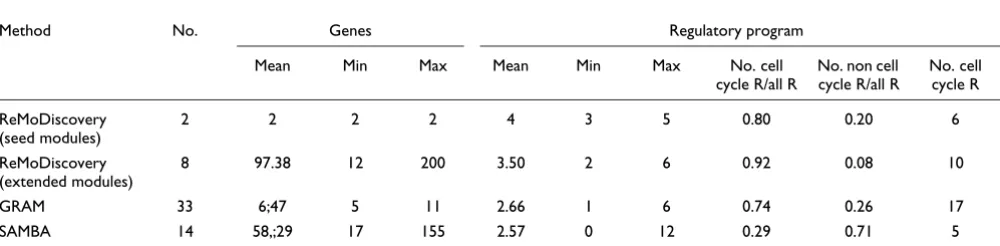
To test the sensitivity of these tools in retrieving regulators known to be involved in the cell cycle, we compiled a list of known regulators (see Materials and methods) and tested how many of these occurred in the regulatory programs of any of the cell cycle related modules (Table 2). We also displayed the ratios of the number of known cell cycle regulators over the total number of regulators detected in a module's
pro-gram, averaged over all modules. These results show that both ReMoDiscovery and GRAM [9] had a considerably higher sensitivity than SAMBA [3] in retrieving cell cycle related regulators.
Conclusions about specificity should be treated with care because, in the absence of a golden standard (that is, a com-pletely characterized network of interactions), the number of false positive predictions can never be quantified. Although the regulatory programs of GRAM [9] and ReMoDiscovery seem to be more enriched in cell cycle related regulators (larger ratio of known cell cycle related regulators over the total number of regulators than SAMBA [3]), it is not possible to distinguish between true and false positives without fur-ther experimental validation.
Discussion
[image:8.612.56.566.116.218.2]In this study, we present a two-step methodology to unravel active modules based on the concurrent analysis of three independently acquired data sources. The seed discovery step predicts putative seed modules (consisting of genes, regulators and corresponding motifs). The seed extension
Table 1
Summary of the results of the GRAM, SAMBA and ReMoDiscovery module discovery methods
Method No. Genes Regulatory program
Mean Min Max Mean functional
enrichment
Mean Min Max
ReMoDiscovery (seed modules) 20 2.05 2 3 0.05 6.15 3 12
ReMoDiscovery (extended modules) 18 67.72 6 200 2.00E-03 3.50 2 6
GRAM 274 6.80 5 33 0,02 2.35 1 8
SAMBA 205 57.53 5 265 1.10E-02 4.16 0 31
The number of modules (No.) and the mean (Mean), minimum (Min) and maximum (Max) number of genes and regulators in the identified modules are displayed, as well as the average functional enrichment of the modules (Mean functional enrichment).
Table 2
Summary of the significantly cell cycle enriched modules, identified by the GRAM, SAMBA and ReMoDiscovery module discovery methods
Method No. Genes Regulatory program
Mean Min Max Mean Min Max No. cell
cycle R/all R
No. non cell cycle R/all R
No. cell cycle R
ReMoDiscovery (seed modules)
2 2 2 2 4 3 5 0.80 0.20 6
ReMoDiscovery (extended modules)
8 97.38 12 200 3.50 2 6 0.92 0.08 10
GRAM 33 6;47 5 11 2.66 1 6 0.74 0.26 17
SAMBA 14 58,;29 17 155 2.57 0 12 0.29 0.71 5
[image:8.612.58.558.288.411.2]comm
en
t
re
v
ie
w
s
re
ports
refer
e
e
d
re
sear
ch
de
p
o
si
te
d r
e
se
a
rch
interacti
o
ns
inf
o
rmation
step optimizes the gene content of the modules and indicates whether the seed modules' regulatory program is active in the microarray data.
The data integration problem is tackled in a very direct way: using the Apriori algorithm, no iteration over the different data sources is required. As regards the algorithmic properties, a comparison of ReMoDiscovery with other mod-ule detection tools revealed that speed is one of the major advantages of the Apriori strategy. ReMoDiscovery's running times and memory requirements are drastically smaller than those of certain other module detection algorithms such as the GRAM [9] algorithm. This is important as most module discovery algorithms require repeated testing to find the opti-mal parameter settings. Together with the straightforward biological interpretation of the parameters, its speed turns ReMoDiscovery into a user-friendly, readily tunable tool.
The biological relevance of our method was assessed by applying it on the extensively studied Spellman [12] and Gasch [13] datasets. Comparison of our results with the liter-ature showed that experimental evidence existed for many of our statistically significant seed modules. For modules for which no direct evidence existed so far, a plausible explana-tion for their composiexplana-tion could very often be inferred from the literature and potential new links between the detected pathways and modules could be derived. A seed module that can be extended with more genes in the seed extension step gives a clue to the regulatory program being active in the pre-vailing conditions of the tested microarray experiment. Based on this observation, a distinction could be made between modules involved in general metabolism that were active in both datasets (for instance, ribosome synthesis, galactose metabolism) and the more specialized modules (for instance, cell cycle, nutrient deprived conditions, stress related condi-tions, amino acid metabolism, respiration, filamentous growth or meiosis) for which the activity was restricted to either one of the datasets.
In contrast to previous approaches in which motif informa-tion results from downstream analysis of the inferred mod-ules, our method used this information as an independent input source. To avoid circular reasoning, we ensured that motif information was derived from sequence information only and did not rely on any other experimental data source (for instance, as available in the motif compendium of Kellis
et al. [72]). Therefore, the compendium of motifs we used as
an input dataset is far from complete. This explains why we detected less motifs for each module compared to, for instance, Kato et al. [7] or Harbison et al. [6].
To assess to what extent ReMoDiscovery discovers modules similar to those detected by other module identification tools, we compared it with previously described tools on the same benchmark set. Compared to GRAM [9], we found a signifi-cant overlap in both gene and regulator content of the
detected modules over a sweep of different parameters. The similarity between both algorithms was larger when compar-ing the results of GRAM [9] with those of the extended seed modules than with the original seed modules. This difference reflects the trade-off between the number of regulators and the number of genes in biological modules: modules compris-ing a regulatory program with many regulators (such as our seed modules) can be expected to contain few genes with a potentially highly related function. In a module, the number of genes will usually increase with a decreasing number of regulators. Obviously, there will be more genes that only share part of their regulatory program, that is, the part that is active under the tested set of conditions. While our seed mod-ules give a view on the complete regulatory program, our extended modules highlight the program active in the micro-array dataset. They contain more genes and are more similar to the GRAM [9] output. Hence, with ReMoDiscovery we offer an algorithm that can be used to focus on very specific regulatory programs (seed modules) as well as on less specific modules with more genes (extended seed modules). The most appropriate choice depends on the specific research question under study, so usually there is no single best solution for the outcome of a module detection algorithm.
In our hands, the regulatory programs found with the SAMBA algorithm [3] did not significantly resemble those of ReMo-Discovery or GRAM [9]. The possibility might exist that SAMBA [3] focuses on other aspects of the data and, there-fore, detects fundamentally different modules. However, based on our analysis we believe that the regulatory programs recovered by SAMBA [3] are unlikely to be biologically mean-ingful as the sensitivity in detecting cell cycle related regula-tors was low. Most likely the available download of the SAMBA-Expander application [3] is not yet fully adjusted to the use of heterogeneous data sources.
Conclusion
Materials and methods
Microarray data
The Spellman [12] and Gasch [12] datasets were used as microarray benchmark sets. The Spellman dataset [12] con-tains 77 experiments describing the dynamic changes of yeast genes during the cell cycle. The Gasch dataset [13] consists of 177 experiments, examining gene expression behavior during various stress conditions. Expression profiles were normal-ized (subtracting the mean of each profile and dividing by the standard deviation across the time points) and stored in a gene expression data matrix, denoted by A, with a row for each gene expression profile and a column for each condition.
Location data
Genome-wide location data performed by Harbison et al. [6] were downloaded from their website [85]. These contain information regarding the binding of 204 regulators (although Harbison et al. [6] only describe 203 regulators) to their respective target genes in rich medium (the 106 regula-tors initially profiled by Lee et al. [86] and 98 new regula-tors). Besides rich medium, 84 regulators were profiled in at least one environmental condition other than rich medium.
For ReMoDiscovery, the ChIP-chip data matrix (denoted by R) consists of one minus the 'ChIP-chip p values' for each gene, obtained from the combined ratios of immuno-precipi-tated and control DNA using an error model (see Harbison et al. [6]). Both GRAM [9] and SAMBA [3] use ChIP-chip p val-ues and require some additional preprocessing. As the authors of GRAM [9] suggested, genes that bind more than 10 regulators (ChIP-chip p value < 0.001) were omitted. For SAMBA [3], we transformed all ChIP-chip data to a log10 scale, nullified all values above 0.02 and used a parametric discretization setting in the Expander software tool according to the authors' advice.
Motif data
The motif data used in this study were obtained from a com-parative genome analysis between distinct yeast species (phy-logenetic shadowing) performed by Kellis et al. [72]. These motifs, available online as regular expressions, were trans-formed into their corresponding weight matrices (see online information for more details [11]). Out of the 71 putative motifs described by Kellis et al. [72], the 53 most informative ones were retained. The weight matrices corresponding to these motifs was subsequently used to screen all intergenic sequences of yeast using MotifLocator [87]. The higher the score of a motif hit in a gene, the more likely it will be a true instance. Results of the screening can thus be summarized in a matrix M that contains for each gene-motif combination a score that indicates how likely it is the gene contains an instance of the respective motif.
Algorithm for seed discovery
The algorithmic details of our method are based on the obser-vation that the particular choice of the constraints guarantees
that, given an invalid module, none of its extensions can ever become valid. For this reason, we call the constraint set 'hereditary'. Such a hereditary constraint set has first been deployed in the so-called Apriori algorithm, which is described in a seminal paper by Agrawal and Imielensky [10]. In ReMoDiscovery, the constraints are the minimum number of regulators (or regulator support constraint sc), the mini-mum number of motifs (or motif support constraint sm), and a minimal pairwise correlation between genes in a module te. We apply these constraints to find regulatory modules that contain as many genes as possible. Since the regulator bind-ing and motif data consist of non-binary score values, the sup-port values are estimated by using thresholded regulator and motif scores, equal to 1 if the score is larger than a threshold tc or tm, respectively, and 0 otherwise. After thresholding, the regulator and motif data are binary, and are represented in the matrices R and M (Figure 1). Note also that the current implementation uses correlation as a measure for co-expres-sion. If required, however, other similarity measures could be used in the Apriori framework.
Using the hereditary constraints results in a significant speed-up with respect to a naïve exploration of the space of possible modules, because we do not need to explicitly check large gene sets for validity. Each subset of genes of a valid module necessarily represents a valid module. This fact can be exploited to reduce the number of times the constraints need to be evaluated. Indeed, only gene sets for which all sub-sets have been found to be valid modules need to be checked, and they can be discarded a priori if one of their subsets turns out to be invalid, even before checking the constraints. In summary, a high level description of the algorithm is: first, choose parameter values sc, sm, te, tm and tc; second, threshold the regulator and motif data using thresholds tm and tc, yield-ing the binary tables R and M; third, find all maximal mod-ules for which the support constraints specified by sc and sm are satisfied, and for which the correlation between the gene expression profiles of any pair of genes in the module exceeds the required threshold te; and fourth, report maximal mod-ules along with the motifs and regulators that support them.
To assess statistical significance, we assigned a seed module p value to each module obtained at a specific parameter setting. To this end, we randomly permuted the gene labels for each dataset (ChIP-chip, motif data, gene expression) separately. This randomization procedure was repeated 100 times. The results of ReMoDiscovery seed discovery on these random datasets were used to construct an empirical joint distribu-tion on the number of regulators and genes from which we calculated a seed module p value for each of the seeds found in the real data sets.
Module extension: calculate enrichment of motifs and regulators
comm
en
t
re
v
ie
w
s
re
ports
refer
e
e
d
re
sear
ch
de
p
o
si
te
d r
e
se
a
rch
interacti
o
ns
inf
o
rmation
with n genes, we first calculated the mean score of that motif in the module by averaging out the entries in the original motif (regulator) data matrix in the column corresponding to the motif (regulator) and the rows corresponding to genes in the module. We then compared this mean score to the distri-bution of scores obtained on a random selection of n genes, for the same motif (regulator). Note that the mean score of a module by random gene selection is approximately Gaus-sianly distributed (central limit theorem), with mean equal to the mean over all genes, and variance equal to the overall variance divided by the size of the module. This Gaussian approximation of the H0-hypothesis is used to calculate a module enrichment p value for a particular motif or regulator.
Application of ReMoDiscovery to the yeast data
The total data matrix used consisted of 6,144 genes (that is, the intersection of the number of rows of the motif, ChIP-chip and microarray matrices). When applying our algorithm to the yeast dataset, we used the default parameters, that is, the motif threshold tm equaled 0.9, the ChIP-chip threshold tc was 0.99, and the correlation threshold te was 0.75. The minimal number of motifs sm was set to 1 such that we find seed mod-ules that have at least 1 motif in their regulatory program. We varied the minimal number of regulators sc over the values 3, 4, 6, 8 and 10 for the Spellman [12] dataset and over 4, 6, 8 and 10 for the Gasch [13] dataset. Resulting seed modules with a seed module p value > 0.05 were evaluated during the second seed extension step.
Comparison with other methods
We downloaded the java implementation of the SAMBA [3] software package from [88]. The Matlab code of the GRAM algorithm [9] was obtained from the authors upon request.
We used ReMoDiscovery with a ChIP-chip threshold (one minus the ChIP-chip p value) equal to 0.99, a correlation threshold of 0.75 and a minimum of one motif and four regu-lators, respectively. When comparing regulator content from ReMoDiscovery to SAMBA [3] and GRAM [9], we looked at the ReMoDiscovery seed modules for a minimum number of regulators equal to 3, 4, 6, 8 and 10. We also examined the influence of a variation in ChIP-chip threshold, in the range [0.98 to 0.999] (values below 0.98 were not tested as the quality of the biological outcome started to decrease). The SAMBA [3] 'overlap prior factor' was varied between 0 and 1, in steps of 0.05. The latter parameter describes the extent of overlap that is permitted between different modules in the same solution. For the GRAM algorithm [9], we varied all user defined parameters in a wide range: the base 10 loga-rithm of the 'core profile p value cutoff' between minus 12 and minus 3, the 'num in core cutoff' between 5 and 97 and 'mod-ule p value cutoff' between 0.001 and 0.05. When comparing gene content from ReMoDiscovery to SAMBA [3] and GRAM [9], we considered ReMoDiscovery output for varying corre-lation threshold, in the range (0.65 to 0.9).
Module comparison was based on the normalized Jaccard similarity score [89]. For a specific parameter setting, we ver-ify for each pair of genes (regulators) whether these two genes (regulators) occur together in at least one module. Doing so for all gene (regulator) pairs and for both methods, one can define the number of true positives TP as the number of gene pairs occurring together at least once in both methods. Anal-ogously, the number of false positives FP, true negatives TN and false negatives FN can be defined. As in [89], we used the Jaccard similarity score TP/(TP + FP + FN) to score the over-lap between two module compositions. In addition, randomi-zations were used to determine the significance of a specific score. This leads to the notion of normalized similarity scores, expressed as the number of standard deviations from the mean of the distribution of Jaccard similarity scores for ran-domized module compositions. For a more detailed descrip-tion of our module comparison approach, we refer to our supplementary website [11].
Evaluating the statistical significance for functional category enrichment of modules
The hypergeometric distribution was used to determine which functional categories were statistically overrepre-sented in the extended modules. For each module we com-puted the fraction of genes associated with each functional category in the MIPS database [90] and used the hypergeo-metric distribution to calculate a corresponding 'functional enrichment p value'. Modules with a functional enrichment p value below 0.05 (no compensation for multiple testing) were considered significantly enriched.
List of cell cycle regulators
We compiled a list containing every regulator that was present in the regulatory program of at least one cell cycle enriched module identified by ReMoDiscovery, GRAM [9] or SAMBA [3]. The regulators in this list that are involved in cell cycle according to the Saccharomyces Genome Database [91] were considered 'cell cycle regulators': ACE2_YPD, FKH1_YPD, FKH2_H2O2Hi, FKH2_H2O2Lo, FKH2_YPD, MBF1_YPD, MBP1_H2O2Hi, MBP1_H2O2Lo, MBP1_YPD, MCM1_Alpha, MCM1_YPD, NDD1_YPD, RFX1_YPD, RPN4_YPD, STB1_YPD, SWI4_YPD, SWI5_YPD SWI6_YPD, YOX1_YPD (nomenclature adopted from Harbison et al. [6]). We used this list of 19 regulators to cal-culate the method's sensitivities.
Other software
Networks were drawn using Cytoscape [92].
Additional data files
Gasch [13] dataset. Additional data file 4 and Additional data file 5 consist of the extended modules identified in the Spell-man [12] and Gasch [13] datasets, respectively. Additional data file 6 includes the stand-alone version of ReMoDiscovery and a corresponding ReMoDiscovery help file.
Additional File 1
The seed modules for the Spellman [12] dataset The seed modules for the Spellman [12] dataset Click here for file
Additional File 2
The seed modules for the Gasch [13] dataset The seed modules for the Gasch [13] dataset Click here for file
Additional File 3
Graphical overview of the seed modules identified in the Gasch [13] dataset
Graphical overview of the seed modules identified in the Gasch [13] dataset
Click here for file Additional File 4
The extended modules identified in the Spellman [12] dataset The extended modules identified in the Spellman [12] dataset Click here for file
Additional File 5
The extended modules identified in the Gasch [13] dataset The extended modules identified in the Gasch [13] dataset Click here for file
Additional File 6
Stand-alone version of ReMoDiscovery and a corresponding ReMoDiscovery help file
Stand-alone version of ReMoDiscovery and a corresponding ReMoDiscovery help file
Click here for file
Acknowledgements
T.D. is research assistant of the Fund for Scientific Research - Flanders (FWO-Vlaanderen). This work is partially supported by: IWT projects, GBOU-SQUAD-20160; Research Council KULeuven, GOA Mefisto-666, GOA-Ambiorics, IDO genetic networks, CoE EF/05/007 SymBioSys; FWO projects, G.0413.03, and G.0241.04; IUAP V-22 (2002-2006). We would like to thank Dr Gerber and Dr Tanay for their useful advice regarding GRAM and SAMBA.
References
1. Greenbaum D, Luscombe NM, Jansen R, Qian J, Gerstein M: Inter-relating different types of genomic data, from proteome to secretome: 'oming in on function. Genome Res 2001, 11:1463-1468.
2. Cavalieri D, De Filippo C: Bioinformatic methods for integrat-ing whole-genome expression results into cellular networks. Drug Discov Today 2005, 10:727-734.
3. Tanay A, Sharan R, Kupiec M, Shamir R: Revealing modularity and organization in the yeast molecular network by integrated analysis of highly heterogeneous genomewide data. Proc Natl Acad Sci USA 2004, 101:2981-2986.
4. Segal E, Shapira M, Regev A, Pe'er D, Botstein D, Koller D, Friedman N: Module networks: identifying regulatory modules and their condition-specific regulators from gene expression data. Nat Genet 2003, 34:166-176.
5. Van den Bulcke T, Lemmens K, Van de Peer Y, Marchal K: Inferring transcriptional networks by mining 'omics' data. Current Bioinformatics in press.
6. Harbison CT, Gordon DB, Lee TI, Rinaldi NJ, Macisaac KD, Danford TW, Hannett NM, Tagne JB, Reynolds DB, Yoo J, et al.: Transcrip-tional regulatory code of a eukaryotic genome. Nature 2004, 431:99-104.
7. Kato M, Hata N, Banerjee N, Futcher B, Zhang MQ: Identifying combinatorial regulation of transcription factors and binding motifs. Genome Biol 2004, 5:R56.
8. Xu X, Wang L, Ding D: Learning module networks from genome-wide location and expression data. FEBS Lett 2004, 578:297-304.
9. Bar-Joseph Z, Gerber GK, Lee TI, Rinaldi NJ, Yoo JY, Robert F, Gor-don DB, Fraenkel E, Jaakkola TS, Young RA, et al.: Computational discovery of gene modules and regulatory networks. Nat Biotechnol 2003, 21:1337-1342.
10. Agrawal R, Imielenski T: Mining association rules between sets of items in large databases. In Proceedings of the 1993 ACM SIG-MOD International Conference on Management of Data: May 26-28 1993 Edited by: Buneman P, Jajodia S. Washington, DC. New York: ACM Press:207-216.
11. Supplementary website ReMoDiscovery [http:// homes.esat.kuleuven.be/~kmarchal/
Supplementary_Information_Lemmens_2006/Index.html]
12. Spellman PT, Sherlock G, Zhang MQ, Iyer VR, Anders K, Eisen MB, Brown PO, Botstein D, Futcher B: Comprehensive identification of cell cycle-regulated genes of the yeast Saccharomyces cer-evisiae by microarray hybridization. Mol Biol Cell 1998, 9:3273-3297.
13. Gasch AP, Spellman PT, Kao CM, Carmel-Harel O, Eisen MB, Storz G, Botstein D, Brown PO: Genomic expression programs in the response of yeast cells to environmental changes. Mol Biol Cell 2000, 11:4241-4257.
14. Jorgensen P, Rupes I, Sharom JR, Schneper L, Broach JR, Tyers M: A dynamic transcriptional network communicates growth potential to ribosome synthesis and critical cell size. Genes Dev 2004, 18:2491-2505.
15. Martin DE, Soulard A, Hall MN: TOR regulates ribosomal pro-tein gene expression via PKA and the Forkhead
transcrip-tion factor FHL1. Cell 2004, 119:969-979.
16. Marion RM, Regev A, Segal E, Barash Y, Koller D, Friedman N, O'Shea EK: Sfp1 is a stress- and nutrient-sensitive regulator of ribos-omal protein gene expression. Proc Natl Acad Sci USA 2004, 101:14315-14322.
17. Cipollina C, Alberghina L, Porro D, Vai M: SFP1 is involved in cell size modulation in respiro-fermentative growth conditions. Yeast 2005, 22:385-399.
18. Klein C, Struhl K: Protein kinase A mediates growth-regulated expression of yeast ribosomal protein genes by modulating RAP1 transcriptional activity. Mol Cell Biol 1994, 14:1920-1928. 19. Powers T, Walter P: Regulation of ribosome biogenesis by the
rapamycin-sensitive TOR-signaling pathway in Saccharomy-ces cerevisiae. Mol Biol Cell 1999, 10:987-1000.
20. Thevelein JM, Cauwenberg L, Colombo S, De Winde JH, Donation M, Dumortier F, Kraakman L, Lemaire K, Ma P, Nauwelaers D, et al.: Nutrient-induced signal transduction through the protein kinase A pathway and its role in the control of metabolism, stress resistance, and growth in yeast. Enzyme Microb Technol 2000, 26:819-825.
21. Winderickx J, Holsbeeks I, Lagatie O, Giots F, Thevelein J, de Winde H: From feast to famine: adaptation to nutrient availability inyeast. In Yeast Stress Responses Edited by: Hohmann S, Mager WH. Berlin: Springer; 2003:306-386.
22. Timson DJ, Ross HC, Reece RJ: Gal3p and Gal1p interact with the transcriptional repressor Gal80p to form a complex of 1:1 stoichiometry. Biochem J 2002, 363:515-520.
23. Diep CQ, Peng G, Bewley M, Pilauri V, Ropson I, Hopper JE: Intra-genic suppression of Gal3C interaction with Gal80 in the Sac-charomyces cerevisiae GAL gene switch. Genetics 2006, 172:77-87.
24. Pilauri V, Bewley M, Diep C, Hopper J: Gal80 dimerization and the yeast GAL gene switch. Genetics 2005, 169:1903-1914. 25. Zhou H, Winston F: NRG1 is required for glucose repression of
the SUC2 and GAL genes of Saccharomyces cerevisiae. BMC Genet 2001, 2:5.
26. Koch C, Moll T, Neuberg M, Ahorn H, Nasmyth K: A role for the transcription factors Mbp1 and Swi4 in progression from G1 to S phase. Science 1993, 261:1551-1557.
27. Blaiseau PL, Isnard AD, Surdin-Kerjan Y, Thomas D: Met31p and Met32p, two related zinc finger proteins, are involved in transcriptional regulation of yeast sulfur amino acid metabolism. Mol Cell Biol 1997, 17:3640-3648.
28. Schuller HJ: Transcriptional control of nonfermentative metabolism in the yeast Saccharomyces cerevisiae. Curr Genet 2003, 43:139-160.
29. Costanzo M, Schub O, Andrews B: G1 transcription factors are differentially regulated in Saccharomyces cerevisiae by the Swi6-binding protein Stb1. Mol Cell Biol 2003, 23:5064-5077. 30. Ho Y, Costanzo M, Moore L, Kobayashi R, Andrews BJ: Regulation
of transcription at the Saccharomyces cerevisiae start transi-tion by Stb1, a Swi6-binding protein. Mol Cell Biol 1999, 19:5267-5278.
31. Kumar R, Reynolds DM, Shevchenko A, Shevchenko A, Goldstone SD, Dalton S: Forkhead transcription factors, Fkh1p and Fkh2p, collaborate with Mcm1p to control transcription required for M-phase. Curr Biol 2000, 10:896-906.
32. Wittenberg C, Reed SI: Cell cycle-dependent transcription in yeast: promoters, transcription factors, and transcriptomes. Oncogene 2005, 24:2746-2755.
33. Loy CJ, Lydall D, Surana U: NDD1, a high-dosage suppressor of cdc28-1N, is essential for expression of a subset of late-S-phase-specific genes in Saccharomyces cerevisiae. Mol Cell Biol 1999, 19:3312-3327.
34. Mai B, Breeden LL: Identification of target genes of a yeast transcriptional repressor. Methods Mol Biol 2006, 317:267-277. 35. Bhoite LT, Yu Y, Stillman DJ: The Swi5 activator recruits the
Mediator complex to the HO promoter without RNA polymerase II. Genes Dev 2001, 15:2457-2469.
36. Spector MS, Raff A, DeSilva H, Lee K, Osley MA: Hir1p and Hir2p function as transcriptional corepressors to regulate histone gene transcription in the Saccharomyces cerevisiae cell cycle. Mol Cell Biol 1997, 17:545-552.
37. Prochasson P, Florens L, Swanson SK, Washburn MP, Workman JL: The HIR corepressor complex binds to nucleosomes gener-ating a distinct protein/DNA complex resistant to remode-ling by SWI/SNF. Genes Dev 2005, 19:2534-2539.
comm
en
t
re
v
ie
w
s
re
ports
refer
e
e
d
re
sear
ch
de
p
o
si
te
d r
e
se
a
rch
interacti
o
ns
inf
o
rmation
Reb1p interacts with the CLB2 UAS outside of the G2/M control region. Nucleic Acids Res 2003, 31:4597-4607.
39. Gil R, Zueco J, Sentandreu R, Herrero E: RCS1, a gene involved in controlling cell size in Saccharomyces cerevisiae. Yeast 1991, 7:1-14.
40. Cosma MP: Daughter-specific repression of Saccharomyces cerevisiae HO: Ash1 is the commander. EMBO Rep 2004, 5:953-957.
41. Pan X, Heitman J: Sok2 regulates yeast pseudohyphal differen-tiation via a transcription factor cascade that regulates cell-cell adhesion. Mol Cell Biol 2000, 20:8364-8372.
42. Gancedo JM: Control of pseudohyphae formation in Saccharo-myces cerevisiae. FEMS Microbiol Rev 2001, 25:107-123.
43. Gagiano M, Bauer FF, Pretorius IS: The sensing of nutritional status and the relationship to filamentous growth in Saccha-romyces cerevisiae. FEMS Yeast Res 2002, 2:433-470.
44. Daugherty JR, Rai R, el Berry HM, Cooper TG: Regulatory circuit for responses of nitrogen catabolic gene expression to the GLN3 and DAL80 proteins and nitrogen catabolite repres-sion in Saccharomyces cerevisiae. J Bacteriol 1993, 175:64-73. 45. Hofman-Bang J: Nitrogen catabolite repression in
Saccharomy-ces cerevisiae. Mol Biotechnol 1999, 12:35-73.
46. Albrecht G, Mosch HU, Hoffmann B, Reusser U, Braus GH: Monitor-ing the Gcn4 protein-mediated response in the yeast Saccha-romyces cerevisiae. J Biol Chem 1998, 273:12696-12702.
47. Natarajan K, Meyer MR, Jackson BM, Slade D, Roberts C, Hinnebusch AG, Marton MJ: Transcriptional profiling shows that Gcn4p is a master regulator of gene expression during amino acid starvation in yeast. Mol Cell Biol 2001, 21:4347-4368.
48. Hinnebusch AG: Translational regulation of GCN4 and the general amino acid control of yeast. Annu Rev Microbiol 2005, 59:407-450.
49. Dilova I, Aronova S, Chen JC, Powers T: Tor signaling and nutri-ent-based signals converge on Mks1p phosphorylation to regulate expression of Rtg1.Rtg3p-dependent target genes. J Biol Chem 2004, 279:46527-46535.
50. Cutler NS, Pan X, Heitman J, Cardenas ME: The TOR signal trans-duction cascade controls cellular differentiation in response to nutrients. Mol Biol Cell 2001, 12:4103-4113.
51. Cooper TG: Transmitting the signal of excess nitrogen in Sac-charomyces cerevisiae from the Tor proteins to the GATA factors: connecting the dots. FEMS Microbiol Rev 2002, 26:223-238.
52. Valenzuela L, Aranda C, Gonzalez A: TOR modulates GCN4-dependent expression of genes turned on by nitrogen limitation. J Bacteriol 2001, 183:2331-2334.
53. Martinez-Pastor MT, Marchler G, Schuller C, Marchler-Bauer A, Ruis H, Estruch F: The Saccharomyces cerevisiae zinc finger proteins Msn2p and Msn4p are required for transcriptional induction through the stress response element (STRE). EMBO J 1996, 15:2227-2235.
54. Schmitt AP, McEntee K: Msn2p, a zinc finger DNA-binding pro-tein, is the transcriptional activator of the multistress response in Saccharomyces cerevisiae. Proc Natl Acad Sci USA 1996, 93:5777-5782.
55. Gorner W, Durchschlag E, Martinez-Pastor MT, Estruch F, Ammerer G, Hamilton B, Ruis H, Schuller C: Nuclear localization of the C2H2 zinc finger protein Msn2p is regulated by stress and protein kinase A activity. Genes Dev 1998, 12:586-597. 56. Wong CM, Ching YP, Zhou Y, Kung HF, Jin DY: Transcriptional
regulation of yeast peroxiredoxin gene TSA2 through Hap1p, Rox1p, and Hap2/3/5p. Free Radic Biol Med 2003, 34:585-597.
57. Raitt DC, Johnson AL, Erkine AM, Makino K, Morgan B, Gross DS, Johnston LH: The Skn7 response regulator of Saccharomyces cerevisiae interacts with Hsf1 in vivo and is required for the induction of heat shock genes by oxidative stress. Mol Biol Cell 2000, 11:2335-2347.
58. Pinson B, Gabrielsen OS, Daignan-Fornier B: Redox regulation of AMP synthesis in yeast: a role of the Bas1p and Bas2p tran-scription factors. Mol Microbiol 2000, 36:1460-1469.
59. Nevitt T, Pereira J, Rodrigues-Pousada C: YAP4 gene expression is induced in response to several forms of stress in Saccharo-myces cerevisiae. Yeast 2004, 21:1365-1374.
60. Vyas VK, Berkey CD, Miyao T, Carlson M: Repressors Nrg1 and Nrg2 regulate a set of stress-responsive genes in Saccharo-myces cerevisiae. Eukaryot Cell 2005, 4:1882-1891.
61. Regnacq M, Alimardani P, El Moudni B, Berges T: SUT1p
interac-tion with Cyc8p(Ssn6p) relieves hypoxic genes from Cyc8p-Tup1p repression in Saccharomyces cerevisiae. Mol Microbiol 2001, 40:1085-1096.
62. Deckert J, Perini R, Balasubramanian B, Zitomer RS: Multiple ele-ments and auto-repression regulate Rox1, a repressor of hypoxic genes in Saccharomyces cerevisiae. Genetics 1995, 139:1149-1158.
63. Knight SA, Tamai KT, Kosman DJ, Thiele DJ: Identification and analysis of a Saccharomyces cerevisiae copper homeostasis gene encoding a homeodomain protein. Mol Cell Biol 1994, 14:7792-7804.
64. Furuchi T, Ishikawa H, Miura N, Ishizuka M, Kajiya K, Kuge S, Naga-numa A: Two nuclear proteins, Cin5 and Ydr259c, confer resistance to cisplatin in Saccharomyces cerevisiae. Mol Pharmacol 2001, 59:470-474.
65. Steber CM, Esposito RE: UME6 is a central component of a developmental regulatory switch controlling meiosis-spe-cific gene expression. Proc Natl Acad Sci USA 1995, 92:12490-12494.
66. Bogengruber E, Eichberger T, Briza P, Dawes IW, Breitenbach M, Schricker R: Sporulation-specific expression of the yeast DIT1/ DIT2 promoter is controlled by a newly identified repressor element and the short form of Rim101p. Eur J Biochem 1998, 258:430-436.
67. Shenhar G, Kassir Y: A positive regulator of mitosis, Sok2, func-tions as a negative regulator of meiosis in Saccharomyces cerevisiae. Mol Cell Biol 2001, 21:1603-1612.
68. Rothfels K, Tanny JC, Molnar E, Friesen H, Commisso C, Segall J: Components of the ESCRT pathway, DFG16, and YGR122w are required for Rim101 to act as a corepressor with Nrg1 at the negative regulatory element of the DIT1 gene of Saccha-romyces cerevisiae. Mol Cell Biol 2005, 25:6772-6788.
69. Mai B, Breeden L: Xbp1, a stress-induced transcriptional repressor of the Saccharomyces cerevisiae Swi4/Mbp1 family. Mol Cell Biol 1997, 17:6491-6501.
70. Schneider JC, Guarente L: Regulation of the yeast CYT1 gene encoding cytochrome c1 by HAP1 and HAP2/3/4. Mol Cell Biol 1991, 11:4934-4942.
71. Zitomer RS, Lowry CV: Regulation of gene expression by oxy-gen in Saccharomyces cerevisiae. Microbiol Rev 1992, 56:1-11. 72. Kellis M, Patterson N, Endrizzi M, Birren B, Lander ES: Sequencing
and comparison of yeast species to identify genes and regu-latory elements. Nature 2003, 423:241-254.
73. Hu Y, Cooper TG, Kohlhaw GB: The Saccharomyces cerevisiae Leu3 protein activates expression of GDH1, a key gene in nitrogen assimilation. Mol Cell Biol 1995, 15:52-57.
74. Kohlhaw GB: Leucine biosynthesis in fungi: entering metabo-lism through the back door. Microbiol Mol Biol Rev 2003, 67:1-15. 75. Thomas D, Surdin-Kerjan Y: Metabolism of sulfur amino acids in Saccharomyces cerevisiae. Microbiol Mol Biol Rev 1997, 61:503-532. 76. Blaiseau PL, Thomas D: Multiple transcriptional activation com-plexes tether the yeast activator Met4 to DNA. EMBO J 1998, 17:6327-6336.
77. Menon BB, Sarma NJ, Pasula S, Deminoff SJ, Willis KA, Barbara KE, Andrews B, Santangelo GM: Reverse recruitment: the Nup84 nuclear pore subcomplex mediates Rap1/Gcr1/Gcr2 tran-scriptional activation. Proc Natl Acad Sci USA 2005, 102:5749-5754.
78. Devlin C, Tice-Baldwin K, Shore D, Arndt KT: RAP1 is required for BAS1/BAS2- and GCN4-dependent transcription of the yeast HIS4 gene. Mol Cell Biol 1991, 11:3642-3651.
79. Kuchin S, Vyas VK, Carlson M: Snf1 protein kinase and the repressors Nrg1 and Nrg2 regulate FLO11, haploid invasive growth, and diploid pseudohyphal differentiation. Mol Cell Biol 2002, 22:3994-4000.
80. Zhu G, Spellman PT, Volpe T, Brown PO, Botstein D, Davis TN, Futcher B: Two yeast forkhead genes regulate the cell cycle and pseudohyphal growth. Nature 2000, 406:90-94.
81. Zaragoza O, Gancedo JM: Pseudohyphal growth is induced in Saccharomyces cerevisiae by a combination of stress and cAMP signalling. Antonie Van Leeuwenhoek 2000, 78:187-194. 82. Pascual-Ahuir A, Posas F, Serrano R, Proft M: Multiple levels of
control regulate the yeast cAMP-response element-binding protein repressor Sko1p in response to stress. J Biol Chem 2001, 276:37373-37378.
83. Mitchell AP: Control of meiotic gene expression in Saccharo-myces cerevisiae. Microbiol Rev 1994, 58:56-70.
![Figure 2Overview of the seed modules identified in the Spellman dataset [12]](https://thumb-us.123doks.com/thumbv2/123dok_us/8669718.872277/4.612.57.560.85.471/figure-overview-seed-modules-identified-spellman-dataset.webp)