International Journal of Emerging Technology and Advanced Engineering
Website: www.ijetae.com (ISSN 2250-2459, ISO 9001:2008 Certified Journal, Volume 7, Issue 7, July 2017)
265
A Systematic Literature Review and Implementation of
Software Usability Estimation Model for Measuring the
Effectiveness
Surabhi Saxena
1, Dr. Devendra Agarwal
21Ph.D. Research Scholar, Department of Computer Application, Babu Banarasi Das University Lucknow (BBDU)
(U.P.) India
2
Director Babu Banarasi Das Northern India Institute of Technology (BNIIT) Lucknow (U.P.) India
Abstract: Software usability is a peak significant quality element in the pitch of E-Procurement. Usability increases user satisfaction, productivity and performance as well as decreases software development and maintenance costs and increases sales. Software usability improvement is effortlessly done with the support of usability factors, criteria and metrics of usability. Software usability must be analyzed with the help of its usability criteria. The ultimate objective of software usability that the application interfaces should be designed with the user and consumer requirements in mind so that they are intuitive to use, can be localized and globalized, provide easy access for disabled users as well as provide a good overall user experience.
The key issues for user experience and usability is make sure you design the screen and input flows and user interaction patterns to maximize ease of use. In this research paper software usability dimension is the main attribute in estimation; executing; and calculating usability as an E- Procurement factor in the approach to categorize and develop quality oriented E-Procurement software. In conclusion this paper focuses the need and significance of usability and a model has been proposed for usability estimation model for the E-Procurement perspective by establishing multiple linear regression. Finally the proposed model has been validated.
Keywords: Software Usability, Usability Factors, E- Procurement, Object Oriented Design .
I. INTRODUCTION
In today‟s world e- Business has become an important part and parcel of everyday life in lots of production circles as a large number of organizations are involved in one form of e- Business or another such as E-Procurement. The significance is on the use of technology to alternate or improve transactional activities in order to gain operating efficiencies [2].E- Procurement systems also permit more well-organized integration of supply chains and provide superior organization and tracking of transaction records for easier data acquisition. There is require having a usable safe and the quality oriented procurement system which is interlinked and this will lead to improved competitiveness and lowered costs [3].
Transactions can be consistent and all bids for products and services can be tracked more simply; that allowing business owners to utilize such knowledge to get better pricing. Due to quicker exchanges of information and delivery of goods and services, E- Procurement also promotes smaller product- development cycles. Effectiveness of E- Procurement is the skeleton for inter organizational association. It denotes the faultless application of information, and communication technology from its point of origin to its ending along the whole value modify of business procedure conducted electronically and designed to facilitate the accomplishment of a business objective [4, 5].Effectiveness of E- Procurement is of course only a particular application of the common benefits, that computerization may bring to every function in an organization. This take account of the ability to store and retrieve a huge quantity of data procedure such data quickly with a high extent of accuracy, remove much routine error and make use of exception techniques which save time by notifying these variations which need management action. Reduction of regular clerical activity via automatic preparation of documents such as purchase requisitions; orders; acknowledgement forms; progress letters and formalizing of efficient procedures that might not if not be contemplated.
II. EFFECTIVENESS OF E-PROCUREMENT
International Journal of Emerging Technology and Advanced Engineering
Website: www.ijetae.com (ISSN 2250-2459, ISO 9001:2008 Certified Journal, Volume 7, Issue 7, July 2017)
266
In the long term, such organizations believe it more costly in that they would still be mandatory to teach their staff on how to use the software and still rely on the software provider for safe and quality oriented software. This would require the formation of an IT section which firms find easier to keep away from through manual procurement process [9, 10].In some cases the firms have to coach their suppliers and new business allies on how to utilize their system in order to improve smooth running of the E- Procurement procedure. The ultimate objectives that direct the study were to find out how functionality affects effectiveness of E- Procurement between business organizations to decide the degree to which quality of software system influence the effectiveness of E- Procurement between business organization, to find out how usability influence the effectiveness of E- Procurement between business organization.The findings of the research will be of great significance to other business organizations for they will get to identify the factors affecting the effectiveness of E- Procurement in their business organizations and thereby come up with measures to improve the effectiveness of E- Procurement process as a whole.
III.STATEMENT OF THE PROBLEM
After the above conversation our conclusion is that usability is a key factor for Measuring the Effectiveness of E- Procurement in Business Organization. Any method that improves software usability at an early stage of the software development life cycle and can have highly valuable impact on the final software system and its efficiency. Even though software usability is most noticeably pertinent during software development lifecycle, but paying concentration to usability early in the development procedure can potentially enhanced efficiency and considerably improves effectiveness of E- Procurement in Business Organization.
On the source of the above dialogue the problem statement for the research has been formulated as follows: „Software Usability Estimation Model for Measuring the Effectiveness of E- Procurement in Business Organization‟.
IV.OBJECTIVE OF THE RESEARCH
The objective of this research work is to find out factors affecting E- Procurement in business organizations. It is in this look upon that the effort set out to find the factors affecting the effectiveness of E- Procurement in business organizations to perform business electronically. In sight of this taking into consideration three important factors namely software usability, software functionality and software quality.
The purposed study explores the above factors affecting effectiveness of using computers in business organizations as far as the E- Procurement procedures are concerned [14].
Based on the Proposed Measuring Usability Criterion, the Objectives of the Research are to:
To find out how functionality affects effectiveness of E- Procurement between Business Organization To determine the degree to which quality of software
systems affect the effectiveness of E- Procurement amongst Business Organization
To find out how software usability affects the effectiveness of E- Procurement between Business Organization.
V. LITERATURE REVIEW
According to the author Anyango (2005) asserts that corporations are re engineering their supply chain management software for example the demand of E- Procurement are approaching organizations to use their internets and e-commerce to help them re engineer their relationship with their suppliers distributors and retailers to meet their e-commerce customers essential needs to what they want where and when it is wanted at the best possible cost. E- Procurement has revolutionalized and its sound effects on purchasing practices have improved in a range of businesses. The companies offering E- Procurement systems have generated a considerable cost saving productivity and efficiency.
According to the author Mathane (2007) on Factors Influencing Adoption of E- Procurement in the supply chain state that the time taken for the acquisition by use of E- Procurement is very significant. The system should have the time that is taken to obtain goods or to swap information throughout the supply chains. For this is a large amount effective system of managing these chains.
According to the author Chepkonga (2010) on Factors Affecting Order Placement in Procurement Process observed that lead time depends on a number of factors, from the time it takes to create the machinery to the speed of delivery system. Lead time can be reduced if information technology is implemented on order placement and also introduction of online shopping.
International Journal of Emerging Technology and Advanced Engineering
Website: www.ijetae.com (ISSN 2250-2459, ISO 9001:2008 Certified Journal, Volume 7, Issue 7, July 2017)
267
The most frequent areas of application include order placement and order status. Use of IT in order processing has resulted in increased accuracy levels and increased reliability. According to the author Serem (2005) on Effects of Computerization on business, stated that the successful going live of phase one of the IT strategy was a major milestone in the organization strategic road map and resolve to become an e-port and rated amongst top twenty ports in the world by the year 2000.
The introduction of computers have witnessed and experienced drastic change in their working system. This include less paperwork and decision making has improved due to availability of online and timely information and service delivery to internal and external customers which used to take up to two days, now takes two minutes. Reduced movement of staff, that is, a letter can be edited and e-mailed without sending by post or use of a messenger. Also the internal messaging service has reduced paper flow substantively and eliminated independent connections to external internet service providers which used to cost the authority KHz. 140,000 per month.
Author Erasto (2005) work on The Role of Vendor Managed Inventories in Customer and Supplier Chain states that the vendor managed inventory procedure is a mixture of commerce software and people. The e-commerce layer is the instrument during which companies communicate the data. The vector markup language data can be communicated through electronic data interchange (EDI) where compatible customer and supplier software and hardware are interlinked or any other reliable communications technique. The key feature of the e-commerce layer is that data is timely and accurate.
Author Chebii (2006) acknowledged that the internet has opened the gate to new ways of shopping. Shopping in the internet offers ease way and time saving remuneration to shoppers as compared to conventional way of shopping. This mode of shopping eliminates the pain of traffic jams, pick pockets and awful weather to travel and no transport cost is involved.
Author Wangare (2005) make efforts on top performance through E- Procurement exposed that, peak performers conduct more than 22% of their procurement online even as they use the internet for numerous E- Procurement applications such as communicating among vendors and checking vendor price quotes & purchasing from vendor catalogues. The internet has also allowed companies to set before time warning, spoil system provide information on guarantee agreements and assist in vendor discussions. E- Procurement functions must safeguard and alleviate risks, recognize the market build good quality relationship with the supplier who meet wants in a timely manner and continuously monitor performance to get better service provision.
This therefore moves up the need for a business to have evidently defined policies that can be understood (Ibid).
Author Munene (2006) on factors affecting the utilize of electronic banking service suggests that the use of computers in banks is rising at a higher rate with unsuitable IT platform, banks growth is held back. This translates into elevated transactions costs and forces the banks to open more and bigger branches to provide accommodation the swelling number of customers. In order to provide accommodation these customers, banks have introduces a number of e-banking services aimed at meeting the demand of its customers. E- Banking is one of the services which has been introduced and enable worldwide entrance to ones account at the convenience of a customer. E-banking ensures 24 hours access to one‟s account every day effortless payment solutions and reasonable transaction fees.
Author Wanyama (2012) on contributions of E- Procurement in enhancing procurement procedure states that, applications of IT helps to make sure a nonstop production and distribution of goods and services in an organizations. It guarantees on timely release and this creates a real life atmosphere among buyer and supplier. Due to insufficient skills of employees in computer operations, it is very imperative to train them for the reason of good management and organization performances.
VI. EFFECTIVENESS OF E- PROCUREMENT FACTORS
The main objective of the study was to explore factors affecting effectiveness of E- Procurement in business organizations. During identification of these factors which have positive impact on E- Procurement effectiveness estimation, a pragmatic view should be considered.
If we consider all factors and measures then they become more complicated, ineffective and time consuming. So need to identify effectiveness factors and measures which affect the activity positively and directly [24]. In order to estimating E- Procurement effectiveness, its direct measures are to be identified. The contribution of each factor is analysed for improvement in E- Procurement effectiveness.
VII. SOFTWARE USABILITY
International Journal of Emerging Technology and Advanced Engineering
Website: www.ijetae.com (ISSN 2250-2459, ISO 9001:2008 Certified Journal, Volume 7, Issue 7, July 2017)
268
A set of software attributes that bear on the effort needed for use and on the individual assessment of such use by a stated set of users. The application interfaces should be designed with the user and consumer in brain so that they are instinctive to use; can be localized and globalized; provide access for new users, and provide a superior overall user experience.
The key issues for user experience and usability are: Too significantly interaction and great number of
clicks required for a work. Make confident you design the screen and input flows and user interaction patterns to maximize ease of use. Inaccurate flow of steps in multistep interfaces.
Consider incorporating workflows where suitable to make simpler multistep operations.
Data elements and controls are faultily grouped. Decide suitable control types such as option groups and check boxes and layout controls and content using the recognized UI design patterns.
Feedback to the user is depressed, particularly for errors and exceptions, and the application is impassive.
VIII.USABILITY BENEFITS
For end users; Usability increases customer satisfaction, productivity and performance.
For a company; Usability decreases development and maintenance costs and increases sales.
For developers; Usability increases productivity and work standardization.
Major Benefits
Sales and customer satisfactions. Productivity & efficiency. Training costs and time. Support & maintenance costs. Documentation & support cost.
Consider implementing technologies and method that provide maximum user interactivity, such as more and more business organizations are introducing object oriented method and languages into their product development practices. Use asynchronous technique for background tasks; and tasks such as populating controls and performing long running tasks. Object oriented tools offers possible payback over conservative software development process.
The application of object oriented technique to software's development has brought many advantages and benefits as well as new demanding issues.
The object oriented tools is more central to design the software in order to give the product of superior quality. The adoption of the object oriented approach is expected to create usable and cheaper software [1].Three important concepts make a difference the object oriented approach from conventional software development: Encapsulation, Inheritance & Polymorphism [15].
IX. RELATIONSHIP BETWEEN USABILITY WITH DESIGN PROPERTIES
Through the literature review, it is observed that every of quality attributes is being affected by certain design constructs, the extensive review of object oriented development by some books [17,18,19.20,21] and publications [16,22,23,24,25] has been considered in order to develop a basis for relating product design properties to quality attribute usability.
International Journal of Emerging Technology and Advanced Engineering
Website: www.ijetae.com (ISSN 2250-2459, ISO 9001:2008 Certified Journal, Volume 7, Issue 7, July 2017)
269
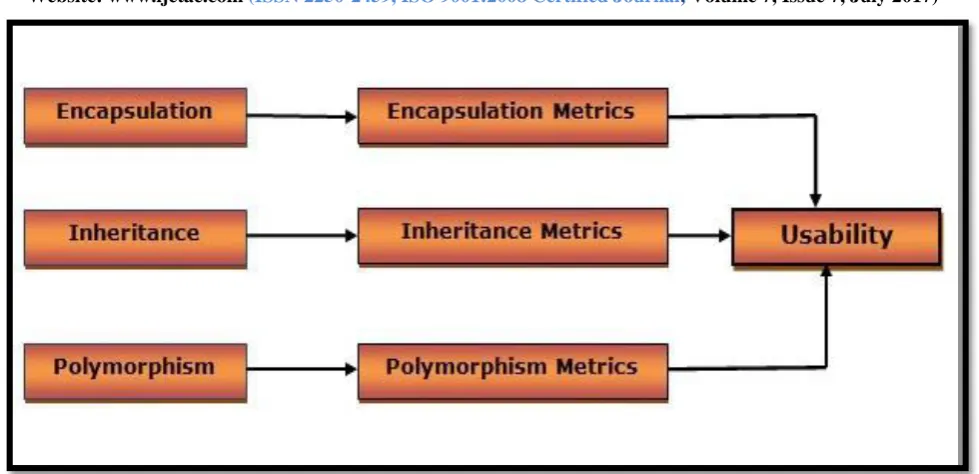
Fig1 :- Proposed Model For Software Usability Estimation Model
X. RESEARCH MODEL OF SOFTWARE USABILITY
We have developed a usability estimation model that demonstrates the quantification process of software usability. The proposed model is shown in Figure 1. The model establishes a contextual impact relationship between software usability and object oriented design constructs and the related metrics. The values of these metrics can be easily identified with the help of class diagram. The quantifiable evaluation of usability is very supportive to get usability index of software design.
XI.DESIGN PROPERTIES INFLUENCING THE SOFTWARE USABILITY WITH HYPOTHESIS (H)
[image:5.595.56.546.127.364.2]It is mandatory to check the validity of proposed model for acceptance. A 2-sample t test has been introduced to test the Significant Correlation between Usability and Encapsulation, Inheritance, Polymorphism. A hypothesis test based on 2-sample t test is being performed and confidence interval is being observed
Table 1:
Correlations Table for Usability Estimation Model
Usability Effectiveness Efficiency Satisfaction
Usability 1 .924 .828 .919
Effectiveness .924 1 1.000** .813**
Efficiency .928 .792 1 .901
Satisfaction .919 .772 1.000* 1
**. Correlation is significant at the 0.01 level (2-tailed).
International Journal of Emerging Technology and Advanced Engineering
Website: www.ijetae.com (ISSN 2250-2459, ISO 9001:2008 Certified Journal, Volume 7, Issue 7, July 2017)
270
Ho:(Null hypothesis):There is no Significant Correlation between Usability and EESH1:(Alternate hypothesis): There is Significant Correlation between Usability and EES .
Given Correlation in Table 1 are trusted by 95% confidence with final remarks that Correlation is significant. at the 0.05 rank. There is major Correlation between the Usability and Encapsulation, Inheritance, Polymorphism. As a result the null hypothesis is rejected and alternate hypothesis is accepted. The obtained equation through using design parameters for usability calculation is highly accepted.
XII. RESEARCH DESIGN AND METHOD
A survey research design was applied in this research paper. A survey attempts to collect data and factors that affect the Effectiveness of E- Procurement in Business Organization with respect to one or more variables. A survey research design was suitable and correct for this work for the reason that it allowed collection of large amounts of related facts from the area. By using the survey design there was generalization of information related to the related study the
XIII. DATA COLLECTIONS
The data is taken for proposed usability model from 20 different commercial software projects and number of classes in each project is approx 12 to 15. Name of the commercial software projects and actual source data is being concealed as per the requests of company's management. A group of software developers was assigned to analyze the quality of the all projects. All the developers had 9 to 13 years of experience in the area of commercial software development, had knowledge of the object oriented design and development paradigm, and had developed commercial software using C++.
The study was done over duration of two month. All the participants analyzed each project's design metrics to assign the usability index to these software systems.
XIV. USABILITY ESTIMATION MODEL
In order to set up a model for usability, multiple linear regression method has been used. Multivariate linear model is given as follows.
Y=a0+ a1 x1+ a2 x2+ a3x3……an xn Eq. (1)
Where
Y is dependent variable, x1, x2, x3……xn are independent variables related to Y and are expected to explain the variance in Y. a1, a2, a3,………an are the coefficients of the respective independent variables and a0 is the intercept.
XV. MODEL DEVELOPMENT
In order to proposed a model for usability, multiple linear regression method has been used, which is as follows.
Usability = ß + A1 × Encapsulation + A2 × Inheritance + A3 × Polymorphism Eq. (2)
We used SPSS tools to calculate the coefficients and the final Usability model that we arrived at is
Usability = 10.274 -.977 × Encapsulation -.419× Inheritance-.726 × Polymorphism Eq. (3)
XVI. DATA ANALYSIS AND RESULTS
Statistics is a mathematical tool used for gathering, organizing, analyzing and interpreting numerical data.
[image:6.595.101.495.599.725.2]For the reason of showing statistical importance or validation of the proposed Usability Estimation Model.
Table 2:
Coefficients table for Usability model
Coefficient
Model
Unstandardized Coefficients Standardized Coefficients
B Std. Error Beta
1 (Constant) 10.274 1.237
Effectiveness -.977 .258 -.774
Efficiency -.419 .258 -.341
Satisfaction -.726 .275 -.558
a. Dependent Variable: Usability
International Journal of Emerging Technology and Advanced Engineering
Website: www.ijetae.com (ISSN 2250-2459, ISO 9001:2008 Certified Journal, Volume 7, Issue 7, July 2017)
[image:7.595.101.494.163.244.2]271
Table 3:
Model Summary for Usability model
The Model Summary table of the output is most valuable when performing multiple regression. Capital R is the multiple correlation coefficients that tell us how powerfully the multiple independent variables are related to the dependent variable. R square is very encouraging as it gives us the coefficient of determination. The Model Summary is shown in Table 2.
XVII. EMPIRICAL VALIDATION
This part of work paying attention how the above designed model is competent to conclude the usability of object oriented design & development. Empirical confirmation is the approved approach and practice to say the model acceptance. Keeping view of this reality, practical validation of the usability estimation model has been performed using sample tryouts data. In order to validate proposed usability estimation model the value of metrics is available.
Table 4 :- Usability Known Value
C1 C2 C3 C4 C5 C6 C7 C8 C9 C10
4.6 3.9 3..4 5.1 4.1 5.8 6.4 4.8 3.6 4.2
Table 5 :-
Usability Known Value Rating
C1 C2 C3 C4 C5 C6 C7 C8 C9 C10
6 3 1 8 4 9 10 7 2 5
Table 6 :-
Usability Value via Proposed Model
C1 C2 C3 C4 C5 C6 C7 C8 C9 C10
4.51 3.899 3.123 4.949 4.692 5.178 5.156 4.999 4.34 4.337
Table 7 :-
Usability Rating via Proposed Model
C1 C2 C3 C4 C5 C6 C7 C8 C9 C10
5 2 1 7 6 10 9 8 3 4
Model Summary
Model R R Square Adjusted R Square Std. Error of the Estimate
1 .882a .778 .667 .37180
[image:7.595.109.488.403.721.2]International Journal of Emerging Technology and Advanced Engineering
Website: www.ijetae.com (ISSN 2250-2459, ISO 9001:2008 Certified Journal, Volume 7, Issue 7, July 2017)
[image:8.595.113.484.155.318.2]272
Table 8:
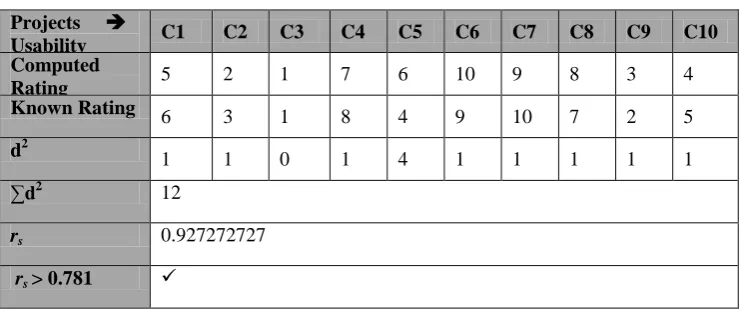
Computed Rating, known Rating and their Correlation
Projects Usability Rating
C1 C2 C3 C4 C5 C6 C7 C8 C9 C10
Computed
Rating 5 2 1 7 6 10 9 8 3 4
Known Rating 6 3 1 8 4 9 10 7 2 5
d2 1 1 0 1 4 1 1 1 1 1
∑d2 12
rs 0.927272727
rs> 0.781
As mentioned above, Speraman‟s Coefficient for Correlation rs was used to verify the significance of correlation between calculated values of usability using model and it‟s „Known Values‟. Rank corelation is the process of determining the extent of correlation amid two variables. The „rs‟ was calculated using the method
given as under the under Speraman coefficient of correlation.
„n‟ = difference between “Calculated values” and “Known values” of Usability. n = number of projects (n=10) used in the experiment. The correlation values among usability through model and known ranking are shown in Table 8. Pairs of these values with correlation values rs above [±.781] are verified in Table 8.The correlations are standard with high degree of confidence, i.e. up to 99%. As a result we can conclude without any loss of generality that usability measurement model measures are really consistent and significant.
XVIII. CONCLUSIONS
Software usability is one of the most significant factors for estimating effectiveness of E- Procurement. Proposed study developed a software usability estimation model that establishes the correlation among usability, object oriented design properties and object oriented metrics.
This paper shows the significant of software usability as key factor of estimating effectiveness of E-Procurement which is developed and validated theoretically as well as empirically using experimental try out data .
For experimental validation several large commercial projects has been used. The applied validation on the proposed usability estimation model is highly reliable up to standard and significant.
XIX. FUTURE WORK
The model developed to measure pre software usability of object oriented design is highly significant and correlated with object oriented design properties. Subsequently, the model has been validated using commercial software applications. Conversely, there is still some scope for future work that is the proposed model may be analyzed for post software usability.
REFERENCES
[1] Eunice Waruguru, Sophia Nduta Kiruri. Factors Affecting Effectiveness of E-Procurement in Business Organizations, a Survey of Safaricom Dealers in Nakuru CBD-Kenya. International Journal of Economics, Finance and Management Sciences.Vol.3,No.3,2015,pp.303-310.doi:
10.11648/j.ijefm.20150303.27
[2] Arnold, U. and Essig, M. (2002) Digital Bidding in Public Procurement: Economic Effects of theElectronic Sourcing in the Public Sector, in 11th Annual International Purchasing and Supply Education and Research Association Conference.Twente University, Netherlands.
[3] Andrea, J.C., and Margaret, T. (2009): “Critical success factors for B2B ecommerce use within the UK NHS pharmaceutical supply chain” International Journal of Operations and production Management, vol. 29 No. 11 pp 1156- 1185. [4] Wanyama, W. (2012). Contribution of E-procurement in
Enhancing Procurement Process, Unpublished Research Project, Kenya Institute of Management, Nakuru.
[5] Bhattacherjee, A., & Hikmet, N. (2008). Reconceptualizing Organizational Support and Its effects on Information Technology Usage: Evidence from The Health Care Sector. The Journal of Computer Information Systems, 69-76.
[6] Laudon, K. C., Laudon, J. P., & Dass, R. (2011). Management Information Systems: Managing the Digital Firms (11th ed.). New Delhi: Pearson Education.
[7] Andrea, J.C., and Margaret, T. (2009): “Critical success factors for B2B ecommerce use within the UK NHS pharmaceutical supply chain” International Journal of Operations and production Management, vol. 29 No. 11 pp 1156- 1185.
International Journal of Emerging Technology and Advanced Engineering
Website: www.ijetae.com (ISSN 2250-2459, ISO 9001:2008 Certified Journal, Volume 7, Issue 7, July 2017)
273
[9] Hamisi, S. (2010).Challenges and opportunities of Tanzania‟s SMEs in adapting supply chain management. African Journal of Business Management, 5(4), pp. 1266- 1276
[10] Hellen, W., and Christine, H. (2008) “E- procurement in the United Nations; influences, issues and impact” International Journal of Operations and Production Management, Vol. 28, No. 9 pp831- 857.
[11] Anyango, P. (2005). Factors Affecting Effectiveness of IT on Procurement Function, Unpublished Research Project, Kenya Institute of Management, Nakuru.
[12] Atieno, J. (2013). An Evaluation of Challenges Faced by SafaricomDealers in Enhancing Profitability, Unpublished Research Project, Kenya Institute of Management, Nakuru. [13] Baily, P. J. H. (2008). Procurement principles and management.
Harlow, England: Prentice Hall Financial Times. pp. 394. [14] Lysons, K. and Farrington, B. (2006). Purchasing and Supply
Chain Management, (7th Edition). Tata: McGraw Hill Publishing Company.
[15] K Mustafa, S I Ahson, “Software Quality Concepts and Practices”, Narosa Publishing House Pvt. Ltd., 2006.
[16] R A Khan, K Mustafa, "MQMOOD: Metric Based Model for object oriented Design Quality Assessment", Information Technology Journal 4, 2005.
[17] B. Grady, “Object-Oriented Analysis and Design with Applications”, 2nd edition, Benjamin Cummings, 1994.
[18] J. Rumbaugh, Blaha, M., et. Al., "Object Oriented Modeling and Design", Prentice Hall, 1991.
[19] R. S. Pressman, Software Engineering: A Practitioner's Approach, McGraw-Hill Book Company, 2005.
[20] P. Coad and E. Yourdan, Object-Oriented Analysis and Design, New Jersey, Yourden Press Computing Series, 1991.
[21] P. Jalote, “An Integrated Approach to Software Engineering”, Narosa Publishing House, Third Edition, 2008.
[22] S. Chidamber and C. Kemerer, "A Metrics Suite for Object Oriented Design", IEEE Transaction on Software Engineering, June 1994, pp. 476-492.
[23] R. G. Dromey, "A Model for Software Product Quality", IEEE Transaction on Software Engineering 21(2), Feb. 1995, p. 146-162.
[24] V. Basili, L. Briand, and W. L. Melo, “A Validation of Object Oriented Metrics as Quality Indicators”, IEEE Transaction on Software Engineering, 22(10), October 1996, pp. 751-761. [25] R. Linda, "Software Quality Metrics for Object Oriented System
Environments", A report of SATC's research on metrics" http://ourworld.compuserve.com/homepages/qualazur/$swmesu2. htm
[26] Anyango, P. (2005). Factors Affecting Effectiveness of IT onProcurement Function, Unpublished Research Project, Kenya Institute of Management, Nakuru.
[27] Mathane, R. (2007). Factors Influencing Adoption of E-procurement in the Supply Chain, Unpublished Research Project, Kenya Institute of Management, Nakuru.
[28] Chepkonga, C. (2010). Factors Affecting Order Placement in Procurement Process, Unpublished Research Project, Kenya Institute of Management, Nakuru.
[29] Serem, T. (2005). Effects of Computerization of Kenya Ports Authority, Unpublished Research Project, Kenya Institute of Management, Nakuru.