Learner autonomy in language learning
Al Ghazali, F
Title Learner autonomy in language learning Authors Al Ghazali, F
Type Conference or Workshop Item
URL This version is available at: http://usir.salford.ac.uk/21009/ Published Date 2010
USIR is a digital collection of the research output of the University of Salford. Where copyright permits, full text material held in the repository is made freely available online and can be read, downloaded and copied for noncommercial private study or research purposes. Please check the manuscript for any further copyright restrictions.
Research Title
Learner Autonomy ... How Can it be Aspired by Arab
Learners?
A Study of the Possibility of Empowering the UAE
What Learner autonomy is not
_________________________________________________________________________________________________________
Learner autonomy is not the same as self-instruction or learning without a teacher because the former is a referent of cognitive ability whereas the latter is mostly a resemblance of physical isolation that does not necessarily enhance autonomy.
What Learner autonomy is not
___________________________________________________________________________________________________________
Learner autonomy is not the synonym of ‘unbridled learning’ (Thanasoulas, 2000: 10); it rather flourishes by intrapersonal initiation, interpersonal collaboration, and learner-centred instruction.
What Learner autonomy is not
_________________________________________________________________________________________________________
Autonomy is not only confined to learning in self-access centres, it can be promoted in the classroom through task-based and learner-centred activities.
What Learner autonomy is
_________________________________________________________________________________________________________
Learner autonomy is:
‘a capacity for detachment, critical reflection, decision-making, and independent action’ (Little, 1999: 4).
What is Learner autonomy in the Arab Context?
_________________________________________________________________________________________________________
In the Arab context:
Relevance of the definition to the Arab Setting
_________________________________________________________________________________________________________
Learner autonomy is not a language skill, but an inspiration assumed to enhance ESL skills.
Learner autonomy has a pragmatic function in helping students meet their linguistic needs and external goals.
Relevance of the definition to the Arab Setting
_________________________________________________________________________________________________________
Learner autonomy entails raising students’ awareness of the different learning strategies and how to use them.
Learner autonomy should be legitimised and adopted as an educational goal supported by all participants.
What does it mean to be autonomous?
_________________________________________________________________________________________________________ Autonomous learners have basic characteristics some of
which are:
Curiosity: Being curious means being in constant search for knowledge any where and in any form. Asking questions can be an easy way of assimilation.
What does it mean to be autonomous?
_________________________________________________________________________________________________________
Collaboration: Being collaborative means interacting with others for reinforcing understanding and getting a taken-as-shared knowledge (Cobb, 1991).
Why Learner Autonomy?
_________________________________________________________________________________________________________
Learner autonomy is underpinned by a constructivist epistemology which posits that personal knowledge is the outcome of the individual’s initiative and own interpretation of the external reality.
Why Learner Autonomy?
_________________________________________________________________________________________________________
Knowledge is a personal ownership and students should be free to choose the effective resources for collecting it and the appropriate strategies for keeping it.
Why Learner Autonomy in the UAE Context?
_________________________________________________________________________________________________________
Breadth & Scope: The non-Arab speakers in the UAE represent about 65% who mostly use English in their communication. Hence, there is an encouraging environment for language practice.
Why Learner Autonomy in the UAE Context?
_________________________________________________________________________________________________________
University Requirements: Maintaining an English language competence and passing any of the proficiency tests has become one of the basic credentials for joining a university in the UAE.
Research Questions
_________________________________________________________________________________________________________
What hinders the adoption of learner autonomy in English language learning in the UAE?
What version of learner autonomy is more convenient for the UAE context?
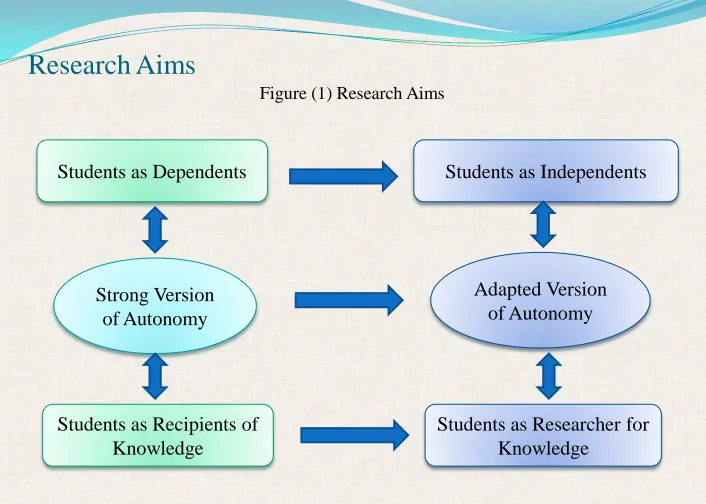
Research Aims
The poured outcomes will provide ample information about how the educational system works.
It will explain the degree of consistency between teaching and assessment techniques.
It will provide a visualisation of how to empower the UAE students to be autonomous in ESL learning.
Research Aims
Figure (1) Research Aims
Students as Dependents Students as Independents
Strong Version of Autonomy
Adapted Version of Autonomy
Students as Recipients of Knowledge
[image:19.720.8.714.12.516.2]Research Methodology
_________________________________________________________________________________________________________ This study applies the mixed-methods Methodology (3M) where a number of quantitative and qualitative methods are used to benefit from both worlds. This (3M):
First provides breadth in terms of investigating the opinions of a large number of participants; thus having a more common and generalisable research findings.
Research Methods
_________________________________________________________________________________________________________
High-achievers’ Focus Group: It will yield abundant information about the non-systematic techniques adopted by such brilliant students to improve their English.
Research Methods
_________________________________________________________________________________________________________
Students’ Questionnaire: This will provide enough data about the attitudes of both male and female students about their learning perceptions, habits, and conventions.
Research Methods
_________________________________________________________________________________________________________
Teachers’ Interviews: They may explain students’ dependence and how their assessment techniques are compatible with the way they teach English.
Research Participants
_________________________________________________________________________________________________________
Age No. Of Participants
Type of Method NO
18+
(6)
H. A. Focus group
1
18+
(6)
L. A. Focus Group
Data Analysis
_________________________________________________________________________________________________________
The questionnaire findings will be analysed in a normal statistical manner to identify the commonality of certain learning traits.
The Fuel of Learner Autonomy in the UAE
____________________________________________________________________________________________________________
Fertility of the Context: The non-Arab population in the
UAE is 65% and they mostly use English in their communication. Hence, there is an encouraging environment for language practice.
Diversity of Resources: The UAE is a wealthy country;
The Fuel of Learner Autonomy in the UAE
____________________________________________________________________________________________________________
University Requirements: This represents an external
stimuli that drives students to improve their English and learner autonomy is presumed key to achieve this.
Employment Requirement: Since almost 80% of the
Thank You For Listening.
_________________________________________________________________________________________________________