7030
MOOC IMPLEMENTATION IN ADDRESSING THE NEEDS
OF GENERATION Z TOWARDS DISCRETE MATHEMATICS
LEARNING
1AMELIA NATASYA ABDUL WAHAB, 2MEI CHOO ANG, 3RUZZAKIAH JENAL,4MURIATI
MUKHTAR, 5NUR FAZIDAH ELIAS, 6HASLINA ARSHAD, 7NORAIDAH
ASHAARI@SAHARI, 8SYAIMAK ABDUL SHUKOR
1,3,4,5,6,7,8Fakulti Teknologi dan Sains Maklumat, Universiti Kebangsaan Malaysia, 43650 Bangi, Selangor,
Malaysia
2Institute of Visual Informatics, Universiti Kebangsaan Malaysia, 43650 Bangi, Selangor, Malaysia
E-mail: 1[email protected], 2[email protected], 3[email protected], 4[email protected],
5[email protected], 6[email protected],7[email protected], 8[email protected]
ABSTRACT
Discrete mathematics is an important subject in the learning of information technology especially for programming and software development. It is a compulsory subject offered to first year students of Undergraduate Degrees in the Faculty of Technology and Information Sciences (FTSM). Discrete mathematics is a subject that is difficult to learn because it involves many theory and concepts. Until recently, Discrete Mathematics modules are mainly taught in a traditional way whereby students are given lectures and tutorials only in the classroom. Students rely on textbooks and lecture notes provided by lecturers. Such approach is not suitable for students in Generation Z. Students in Generation Z will find it hard to learn as learning happens only in the classroom and it leads to boredom. Massive Online Open Course (MOOC) is a web-based learning that can be accessed anywhere and anytime. Integrating the technology into learning process can help improve understanding of the subject matter. Therefore, MOOC implementation is recommended in this study so that generation Z learning preferences are met. In this work, MOOC development for discrete mathematic was implemented based on ADDIE Model. Videos between five and ten minutes were produced using Microsoft Powerpoint, Powtoon and GoAnimate software. Initial survey on the implemented MOOC for Discrete Mathematics showed that it motivated learning and it helped students to understand the subject better.
Keywords: Generation Z, Massive Online Open Course, Discrete Mathematics, e-Learning, Learning
Preferences
1. INTRODUCTION
Discrete mathematics module is offered to students at the Faculty of Technology and Information Sciences (FTSM). It is a subject that is difficult to learn because it involves many theory and concepts [1, 2]. It is taught in a very much traditional way in which students are given lectures and tutorials only in the classroom. Students very much dependent on textbooks and lecture notes provided by lecturers. Effective student learning is always a main concern among lecturers who teach this subject in the faculty. Therefore, there is a need to identify suitable teaching strategies that accommodate student learning in the current generation [2].
There are four generations in this century: veterans, post-war generation, generation X, generation Y and generation Z [3]. Each of the generations exhibits distinct values and views. They differ from one another and they exhibit different behavior in work place and also in education. For example, post-war generation is interested to work hard but generation Y is interested to have balance work life. There are different age boundaries being assigned to generation Z [4]. For example, generation Z is coined for those who born from 1992 [3] and also from 1995 [4, 5] onwards. One thing in common is that they are born in an
environment surrounded by advances of
7031 accustomed to social media to gain popularity, and even self-esteem [6].
The students in our faculty are between 19 to 23 years old. They are in generation Z. Research has shown that the generation Z has specific learning preferences. Generation Z does not like traditional teaching and learning [7]. They love teaching and learning through technology, for example, through online encyclopedia, "How to" video, and from various internet sources [4].
These students will find it hard to master the Discrete Mathematics as the learning happens only in the classroom and this causes students to be bored and lost the interest. Therefore, the current student learning preferences, in particular for generation Z students, should be identified and suitable teaching approach should be matched to meet their learning preferences.
MOOC is a recent development in higher education in Malaysia [16, 17] and not many guidelines are available to support generation Z learning needs in literature. There are authors provided some factors to be considered in developing MOOC content but it is for subjects in social sciences [22]. Thus, there is a need to investigate and identify suitable teaching and learning strategies to support generation Z learning needs, in particular for Discrete Mathematics MOOC. Thus, the research hypothesis of this work is: “The MOOC implementation is able to address the needs of Generation Z in Discrete Mathematics Learning”.
In this research work, generation Z students learning preferences are investigated and identified. Suitable teaching approaches will be matched to their learning preferences based on the existing literature on teaching and learning. The outcome of the investigation has shown that MOOC is a viable approach to assist in teaching for the generation Z students. This paper will report on the research and implementation of MOOC that has been shown to be able to help lecturers in teaching Discrete Mathematics at the FTSM in Universiti Kebangsaan Malaysia.
2. GENERATION Z LEARNING
PREFERENCES
Student characteristics and learning preferences, in particular for generation Z students, should be identified and suitable teaching and learning approaches should be matched to meet their
preferences. Many researchers have shown that generation Z perceives smartphone technology and social media as a natural element. Their habitual usage of WhatsApp and social media hinted the potential effectiveness of using these platforms for mobile learning [6].
From many reported works, generation Z are described to expect teaching environment similar to their virtual world [5]. They expect instant results, answers, and rewards [5, 8, 9] and they exhibit lower attention time [8]. They prefer visual learning [5], usage of technology for interactions [10], fast knowledge acquisition and entertainment [9]. Generation Z students also prefer independent, self-paced and collaborative learning [4]. Figure 1 illustrates the generation Z characteristics and preferences obtained from various sources. Thus, a learning environment that aligns with the Generation Z characteristics must be created to suit the generation Z students. Such learning environment should consist of elements of technology, social media, visual forms, and also entertainment.
3. DISCRETE MATHEMATICS
Discrete Mathematics is one of the fundamental subjects in computer science and information technology. It is among subjects that are difficult to understand because they involve many concepts that need to be understood [1, 11]. Discrete Mathematics is traditionally taught based on lectures and tutorials. Students are expected to listen to the lectures given by lecturers in a class. They are also need to work on the tutorial assignments given by lecturers. Many students were struggling with this one-semester course in the past.
The students who involved in this research were from Year One undergraduates in the Faculty of Information Science and Technology, Universiti Kebangsaan Malaysia. They are between 19 to 23 years old and they are in generation Z. They took
the TTTR1333 Mathematics I (Discrete
Mathematics) as a compulsory subject. These students were from three different academic programs: Multimedia, Industrial Computing and Information Science. The syllabus of TTTR1333 Mathematics I mainly comprises of topics from Discrete Mathematics, which include Logic, Set, Function and Relation, Integer and Cryptography, Pigeon Principles, Graph Theory, and Tree.
7032
their learning. Among many approaches,
incorporating Information and Communication Technology (ICT) in education is found to be able to enhance student learning. Past research works
have shown that conventional teaching
[image:3.612.155.500.182.457.2]complemented with ICT can be a promising approach [12, 13].
Figure 1: Generation Z characteristics [5, 8-10]
4. MASSIVE ONLINE OPEN COURSE
(MOOC)
Incorporating Information and Communication Technology (ICT) in education is not new and it is becoming popular [12-17]. Incorporating ICT in teaching is found to be able to engage and enhance student learning. MOOC is a web-based technology that provides online courses which can be accessed anywhere, anytime and free enrollment. It is also a recent trends in e-learning [18-20]. MOOC can be considered as new form of e-learning that integrates social network, expert facilitation, and online learning resources. Such online learning is expected to give greater flexibility and control over the learning process [21].
A few researchers have demonstrated that MOOC could be used as a teaching and learning platform to enhance students learning [22]. Six
universities were reported successfully
implemented MOOCs and attracted many student participations. These universities include: MIT, Harvard, Standard University, Princeton University and University of Sheffield and UC Berkeley [18].
MOOC is a recent development in Malaysia [18, 19]. Since MOOC is relatively new in Malaysia, not many guidelines are available. In one of the recent MOOC implementations in Malaysia, four factors were being considered in developing MOOC content in Ethnic Relations course. Among the factors were: type of MOOC, type of videos lectures, integration of local culture, and communication approach [23]. However, these factors only provided limited guidelines to support generation Z learning needs. In another recent work, four initial recommendations of MOOC characteristics specifically for science and
Generation
Z
Demandfast
response Used to
social media
Prefer visual form Low
attention time Fast
acquisition of knowledge
Highly connected Want to be
entertained
7033 mathematics subjects were reported [18]. These recommendations were being examined and used as guidelines in this study.
MOOC allows massive participation, online
access, online discussion, self-assessment,
multimedia content videos lectures [20]. A typical MOOC course usually involves large number of participants and this leads to course management issue [20]. The quality of the course delivery and student performance may be affected. Thus, in this initial work, we have only tested our MOOC implementation among our faculty students who were taking Discrete Mathematics. We proposed to implement MOOC gradually for experimentation without major changes in the curriculum.
5. ADDIE MODEL
MOOC implementation for Discrete
Mathematics requires careful planning so that the generation Z learning requirements are met in
parallel with the use of learning materials. MOOC was implemented systematically using the ADDIE model. The ADDIE model is commonly used in the development of teaching and learning materials [24, 25].
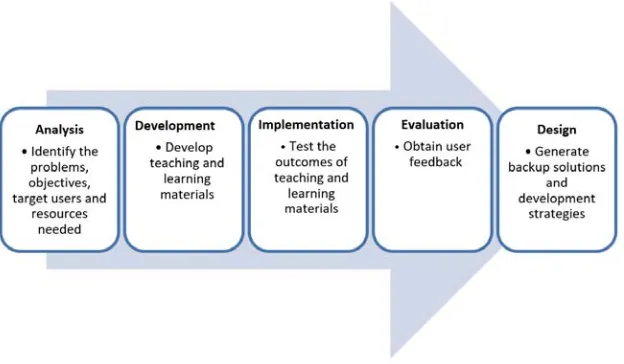
The ADDIE model consists of five phases
namely analysis, design, development,
[image:4.612.157.469.353.535.2]implementation and evaluation. The analysis phase is carried out to identify the problem as a whole by obtaining information about the goals of the study, the target audience and the resources needed. The design phase produces solutions that are in line with the objectives and development strategies. The development phase develops teaching and learning materials. Implementation phase examines learning outcomes and learning. While the evaluation phase was conducted to obtain student feedback on the teaching and learning materials that were built. Figure 2 shows the ADDIE model used in this study.
Figure 2: ADDIE model for MOOC implementation of Discrete Mathematics
5.1 Analysis Phase
The analysis phase is the first step in the study where the problems are identified in meeting the learning needs of generation Z. The objective of the study was to develop the MOOC for Discrete Mathematics that suits generation Z students. As described in Section 2, generation Z students prefer the teaching environment similar to their virtual world. They also prefer independent, self-paced and collaborative learning.
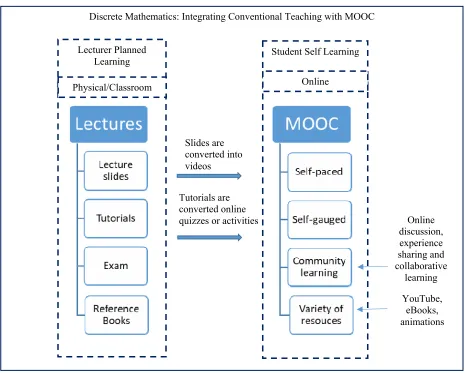
In our plan, the conventional approach of lectures, tutorials and formal assessment via written
7034
Discrete Mathematics: Integrating Conventional Teaching with MOOC
Slides are converted into videos
Tutorials are converted online quizzes or activities
YouTube, eBooks, animations
Online discussion, experience sharing and collaborative
learning Lecturer Planned
Learning
Physical/Classroom
Student Self Learning
[image:5.612.91.296.119.238.2]Online Table 1: Discrete Mathematics syllabus
As illustrated in Figure 4, eight teaching and learning strategies were being proposed to be applied in a MOOC to meet generation Z student
characteristics and learning preferences.
Openlearning has the necessary infrastructure that supports the implementation of the teaching and learning strategies. It is also providing MOOC platform to other universities in Malaysia, namely, University Putra Malaysia, University Technology Mara and University Malaysia Sarawak [18]. Thus, our Discrete Mathematics MOOC was also implemented via Openlearning.com as a platform in this study.
Figure 3: A conceptual framework to integrate conventional teaching of the Discrete Mathematics with MOOC
Topic Name
1 Logics
2 Sets
3 Functions and Relations 4 Integers and Cryptography 5 Pigeonhole Principle 6 Graph Theory
[image:5.612.86.551.289.662.2]7035
Figure 4: Teaching and learning strategies to be incorporated in Discrete Mathematics MOOC
5.2 Design Phase
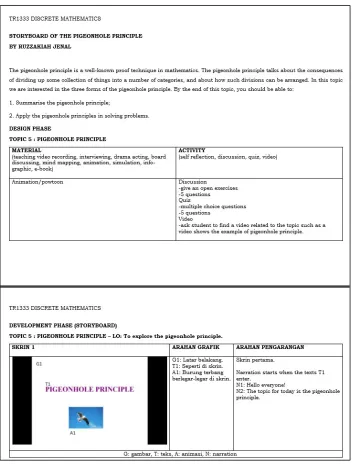
The design phase outlines the development plan and strategies used for Discrete Mathematics MOOC and it has six activities. The activities involved are (1) design MOOC interface using Openlearning, (2) providing content of each topic, (3) designing and compiling storyboards for each topic, (4) producing videos, (5) uploading videos to platforms and (6) preparing activities for each topic for student self-assessment. Figure 5 shows a sample page of a storyboard for the topic on pigeonhole principle.
5.3 Development Phase
In this phase, videos for each topic (listed in Table 1) of Discrete Mathematics were developed. A total of 19 videos had been built and each video was between five to 10 minutes. The videos were built either using Microsoft Powerpoint, Powtoon or GoAnimate. They were edited and perfected several times before uploading to the MOOC platform. Figure 6 shows an example of a video on the topic of the Pigeonhole principle.
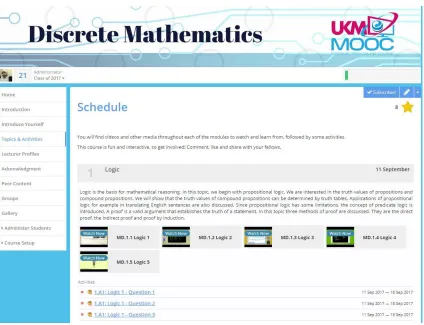
Each topic in Discrete Mathematics is provided with video and followed by activities such as
quizzes, exercises, self-reflection to evaluate students' understanding. Students can perform all the activities on the MOOC platform at their own pace. The MOOC platform also provides discussion space among students and lecturers. This enhance cordial relationship where students and lecturers can interact with each other to discuss the topics they had learned.
5.4 Implementation Phase
[image:6.612.107.489.71.384.2]7036
5.5 Evaluation Phase
The Evaluation phase was implemented to obtain user feedback on the effectiveness of Discrete Mathematics MOOC. Assessments need to be made by the instructors so that the learning outcomes for each topic are met by looking at the involvement of students in participating in the activities provided and their scores. Students evaluated the effectiveness of Discrete Mathematics MOOC by
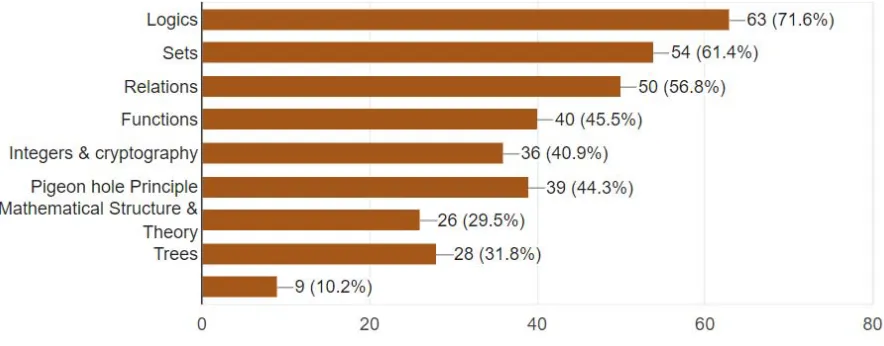
[image:7.612.157.509.223.688.2]responding to a questionnaire. User feedback is important for Discrete Mathematics MOOC future improvements in meeting the needs of generation Z. We have collected a total of 88 responses. As shown in the Figure 8, Students have been using Discrete Mathematics MOOC throughout one semester course. Several topics were able to enhance students learning as shown in Figure 9.
7037
Figure 6: An animation explaining the Pigeonhole Principle
[image:8.612.103.527.374.699.2]7038
Figure 8: Student selected activities in the Discrete Mathematics MOOC
[image:9.612.112.554.381.554.2]7039
6. DISCUSSION AND CONCLUSIONS
MOOC is a recent development in higher education in Malaysia. There is only a few published work on guidelines in developing MOOC contents and are not specifically for generation Z students. Therefore, in this work, we have recommended eight teaching and learning strategies (as shown in Figure 4) to match the eight identified generation Z characteristics (as shown in Figure 1).
The conceptual framework to integrate
conventional teaching of the Discrete Mathematics and MOOC is also developed to give detailed description on our implementation (refer to Figure 3).
Discrete Mathematics MOOC was successfully constructed by producing 19 learning videos and various follow-up activities such as quizzes, training and self-reflection. Students and lecturers were also given a discussion room to create communication between the two parties. A questionnaire was distributed to the students and analysis of the effectiveness of Discrete Mathematics MOOC were conducted.
From the results of the questionnaires, the Discrete Mathematics MOOC was shown to be able to enhance our generation Z student learning especially on topics of: Logics, Set and Relations. We can conclude that the implementation of MOOC in Discrete Mathematics has helped students to understand these subjects better. However, further investigation need to be conducted to revise and improve the remaining subjects that were not very popular.
Upon success of this implementation, we can extend this course to reach out to more students, and even students from other institutions. This will facilitate our university future plan to create dual degree, joint degree, or even double degree programs with other universities.
REFRENCES:
[1] W. Xiuguo, "Discrete Mathematics Teaching
Reformation: Adding Experiments," in 2009
First International Workshop on Education
Technology and Computer Science, 2009, pp.
566-569.
[2] M. E. Little, "Teaching mathematics: issues
and solutions", TEACHING Exceptional
Children Plus, Vol. 6, No. 1, 2009, pp. 2–15.
[3] D. Caganova, A. Starecek, M. Bednarikova,
and N. Hornakova, "Analysis of factors influencing the motivation of generations y and Z to perform in the educational process,"
in ICETA 2017 - 15th IEEE International
Conference on Emerging eLearning
Technologies and Applications, Proceedings,
2017.
[4] K. Moore, C. Jones, and R. S. Frazier, "Engineering Education For Generation Z",
American Journal of Engineering Education,
Vol. 8, No. 2, 2017, pp. 111-126.
[5] E. J. Cilliers, "The challenge of teaching
generation Z", PEOPLE: International
Journal of Social Science, Vol. 3, No. 1,
2017, pp. 188-198.
[6] M. Zhitomirsky-Geffet and M. Blau, "Cross-generational analysis of information seeking
behavior of smartphone users", Aslib Journal
of Information Management, Vol. 69, No. 6,
2017, pp. 721-739.
[7] K. Postolov, M. M. Sopova, and A. J. Iliev, "E-Learning in the Hands of Generation Y and Z," presented at the The 2nd Business & Entrepreneurial Economics – BEE 2017 conference, Brijuni, 2017.
[8] I. Opriş and V. E. Cenuşă, "Subject-Spotting
experimental method for Gen Z", TEM
Journal, Vol. 6, No. 4, 2017, pp. 683-692.
[9] O. Vikhrova, "On some generation Z teaching techniques and methods in higher education",
Information (Japan), Vol. 20, No. 9, 2017, pp.
6313-6324.
[10] N. Kushnir, A. Manzhula, and N. Valko, "New Approaches of Teaching ICT to Meet
Educational Needs of Net Students
Generation " in CEUR Workshop
Proceedings, 2013, pp. 195-208.
[11] S. Duvall, D. Hutchings, and M. Kleckner,
"Changing perceptions of discrete
mathematics through scrum-based course
management practices", J. Comput. Sci. Coll.,
Vol. 33, No. 2, 2017, pp. 182-189.
[12] M. C. Ang, K. W. Ng, H. B. Zaman, A. Ahmad, and A. Jaafar, "Enhancing calculus learning via a student-centred web project," in
AIP Conference Proceedings, 2016.
[13] S. M. J. Azizul and R. Din, "Teaching and
Learning Geometry Using GeoGebra
Software via MOOC", Journal of
Personalized Learning, Vol. 2, No. 1, 2016,
7040 [14] M. M. Yunus and A. Suliman, "Information &
Communication Technology (ICT) Tools in Teaching and Learning Literature Component
in Malaysian Secondary Schools", Asian
Social Science, Vol. 10, No. 7, 2014, pp.
136-152.
[15] A. Rahimi, N. Maimaiti, A. Rahimi, S. M. Aljunid, and S. B. Sulong, "Developing an E-Learning Education Program for Casemix
System; Process and Out Come", Malaysian
Journal of Public Health Medicine, Vol. 16,
No. 1, 2016, pp. 31-39.
[16] H. Haron, J. Hanafi, Z. Ahmad, K. Zainal, M. Mamat, and A. S. Yusof, "The Reasons Concerning Teachers' Attitude Toward Computer in Education at Primary Level",
International Journal of Civil Engineering
and Technology, Vol. 9, No. 5, 2018, pp.
326–335.
[17] A. Shapi’i and S. Ghulam, "Model for Educational Game Using Natural User
Interface", International Journal of Computer
Games Technology, Vol. 2016, 2016, pp. 1-7.
[18] H. M. Salamon, N. M. Ali, S. Miskon, and N.
Ahmad, "Initial Recommendations of
MOOCS Characteristics for Academic
Discipline Clusters", Journal of Theoretical
and Applied Information Technology, Vol. 87,
No. 2, 2016,
[19] R. E. Saputro, S. B. Salam, and M. H. Zakaria, "A Review of Intrinsic Motivation Elements in Gamified Online Learning",
journal of Theoretical and Applied
Information Technology, Vol. 95, No. 19,
2017, pp. 4934-4948.
[20] T. Daradoumis, R. Bassi, F. Xhafa, and S. Caballé, "A review on massive e-learning (MOOC) design, delivery and assessment," presented at the Eighth International Conference on P2P, Parallel, Grid, Cloud and Internet Computing, 2013.
[21] N. M. Nasri and F. M. Kutty, "University Students' View of Self-Directed Learning in
an Online Learning Context", Advances in
Social Sciences Research Journal, Vol. 4, No.
24, 2017, pp. 95-102.
[22] A. M. Santos and P. Ribeiro, "Assessment in
an online mathematics course," in CEUR
Workshop Proceedings, 2017, pp. 22-27.
[23] N. Nordin, H. Norman, M. A. Embi, A. Z. Mansor, and F. Idris, "Factors for Development of Learning Content and Task
for MOOCs in an Asian Context",
International Education Studies, Vol. 9, No.
5, 2016, pp. 48-61.
[24] B. R. Robin and S. G. McNeil, "What educators should know about teaching digital
storytelling", Digital Education Review, Vol.
22, 2012, pp. 37 – 51.
[25] C. Peterson, "Bringing ADDIE to life:
Instructional design at its best", Journal of
Educational Multimedia and Hypermedia,
![Figure 1: Generation Z characteristics [5, 8-10]](https://thumb-us.123doks.com/thumbv2/123dok_us/8901507.955061/3.612.155.500.182.457/figure-generation-z-characteristics.webp)