ISSN: 1992-8645 www.jatit.org E-ISSN: 1817-3195
DIFFERENTIAL SEARCH ALGORITHM IN MULTI
MACHINE POWER SYSTEM STABILIZERS FOR DAMPING
OSCILLATIONS
1NAZ NIAMUL ISLAM, 1,2M A HANNAN,1AZAH MOHAMED, 3HUSSAIN SHAREEF
1
Department of Electrical, Electronic and Systems Engineering, Faculty of Engineering and Built Environment, Universiti Kebangsaan Malaysia, 43600 Bangi, Selangor, Malaysia,
2
College of Engineering, Universiti Tenaga Nasional, Bangi, 43650, Selangor, Malaysia,
3
Electrical Engineering Department, College of Engineering, United Arab Emirates University, F-1 Building, Level 1, P.O. Box 15551, Al Ain, United Arab Emirates
E-mail: [email protected], 1,[email protected], 1,[email protected],
1
[email protected], [email protected]
ABSTRACT
Power system oscillations, a major problem in power system, is suppressed employing power system stabilizers (PSSs). Proper optimization of PSSs is a complex design problem. In this paper, a bio-inspired metaheuristic optimization technique named as differential search algorithm (DSA) is presented to solve the optimization problem of multi machine PSSs. The optimization of PSSs is converted as a cost function then DSA is applied to tune the optimal parameters for PSSs by minimizing the cost function. PSSs are optimized in order to achieve adequate damping for local and inter-area modes of growing oscillations in a multi machine power system. Simulations are conducted in linear and non-linear models of power system to verify the robustness of proposed algorithm. A comprehensive investigation is conducted to compare the performance of DSA based PSSs with the tuned PSSs using bacterial foraging optimization algorithm (BFOA) and particle swarm optimization (PSO) in terms of convergence, improvements of electromechanical modes and system damping over oscillations. The obtained results show that the presented DSA technique is efficient for PSS optimization for the safety of multi machine power system.
Keywords: Differential search algorithm (DSA), Power system stabilizer (PSS), Power system oscillations,
Damping controller, Multi machine power system
1. INTRODUCTION
Power system stability is a serious concern for the power system security and reliability. Large interconnection of power system may cause some severe and complex problem such as power system electromechanical oscillations [1]. The oscillations eventually may keep growing to lead complete system collapse if none damping control is undertaken [2-*]. However, in order to suppress growing oscillations, the damping scheme by means of power system stabilizers (PSSs) have been applied mainly to enhance system dynamic stability [3]. PSS is an auxiliary control device installed on synchronous generators that can manage the stability by providing an additional control signal to excitation system. In general, rotor speed signal is taken as the input to the PSSs control loop. In addition, the fixed lead-lag structure of conventional PSS (CPSS) is
recommended by major power utilities to carry out an extensive overall power system dynamic performance [4]. It was concluded that proper selection of CPSS parameters can dramatically improve system damping and enhance stability. There are several techniques have been used to determine appropriate settings of PSS parameters such as root locus techniques [5], deterministic optimization techniques [6] and heuristic optimization techniques [7]. The tuning of PSS parameters is generally very difficult to solve using traditional techniques. Conversely, eigenvalue based heuristic optimization techniques are easy to implement and solve complex power system problem for PSS design procedures. Therefore, finding the optimal parameters for PSSs is one of the optimization problems of stability studies.
ISSN: 1992-8645 www.jatit.org E-ISSN: 1817-3195 utilized to simplify the difficulties of multi machine
PSSs design. The meta-heuristic algorithm like particle swarm optimization (PSO) has been introduced for multi machine PSSs design [10-11]. Unfortunately, PSO has some control variables which affects convergence if they are not properly selected. In addition, sometimes it gets trapped in local minima easily. Bacterial foraging optimization algorithm (BFOA) was also proposed for coordination control of PSSs with other devices in order to achieve sufficient damping over different modes of oscillations by minimizing single time domain cost function [12-13]. Furthermore, to improve convergence rate and better damping performance, research was suggested using eigenvalue based multi-objective (D-shaped) cost functions to suppress different oscillating modes [14]. In that case, previously used meta-heuristic algorithms may not succeed to obtain optimum design solution of PSS tuning.
Generally, tuning PSS parameters is a multimodal optimization problem. Therefore, most of the existing algorithms get easily trapped and failed to obtain the reasonably accurate solution especially in large system. In addition, the boundary conditions of optimizing parameters make it harder to find optimal solution. To overcome all the issues above, a new meta-heuristic technique named differential search algorithm (DSA) can be applied in PSS design [15]. The uniqueness of the DSA concept is that it is simpler and easy to implement.
In this paper, DSA algorithm is presented for efficient optimization of PSSs in a multi machine power system. PSS parameters are effectively tuned with DSA so that sufficient damping is ensured over different modes of oscillations. The optimization problem of PSSs is converted into a multimodal search problem (cost function). Later on, the formulated cost function was minimized using the proposed DSA technique for optimum design of PSSs that concurrently improving damping over oscillations. Thus, a system safety is ensured from unwanted incidents [16-18]. Although, the test system taken in this research is a medium sized test power system. The sufficient damping by the damping controllers is the main objective of this research using an efficient optimization technique.
2. MULTI MACHINE POWER SYSTEM
In this research, 2 areas 4 machines system is considered as the multi machine test power system
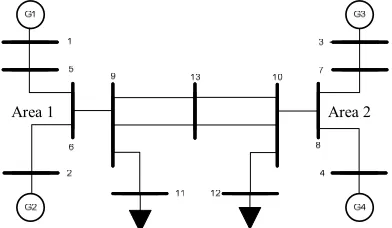
[image:2.612.320.516.451.565.2]to optimize PSSs using DSA. The test system is displayed as a single line diagram in the Figure 1. This is a benchmark multi machine power system to study multimode oscillations inherited in interconnected system [19]. The system consists of two generation area and two load area interconnected between bus 9 and bus 10 through double circuit tie lines. There are two synchronous generators in each area rated at 900 MVA, 20 kV. Each generator is linked via transformer to the 230 kV power line. The entire system is quite heavily loaded (at Bus 11, 976MW and 100MVAr; at Bus 12, 1765MW and 100MVAr) and area 1 is transferring 400MW to area 2. The turbines, governor and excitation systems are identical in all generators. Excitation system contains static exciter equipped with generic PSS. Detailed dynamic properties and data about bus, line, exciter, turbine, governors, loads, and machines are adopted from [20]. Each generator of multi machine system is modeled by six first-order nonlinear ordinary differential equations. This test system shows the basic electromechanical oscillations inherent in multi machine interconnected power system. In this system, generators are tempted to oscillate against other generators for local and inter-area modes of oscillations after subjected to disturbances [21]. Local mode and inter-area mode of oscillations are due to the generators of same area (G1-G2 and G3-G4) and the generators for other areas (G1-G4 and G2-G3) respectively.
Figure 1: 2 areas 4 machines power system.
3. POWER SYSTEM STABILIZER
A PSS is an additional control devices installed at excitation system of a synchronous generator. The main purpose of PSS is to maintain power system stability by damping electromechanical oscillations providing additional control signal to the input of excitation system. Local stabilizing signal such as generator terminal frequency, rotor angle deviation, rotor speed can be taken as input
ISSN: 1992-8645 www.jatit.org E-ISSN: 1817-3195 signal to PSS. In this case, the rotor speed of the
synchronous machine is taken as PSS input.
The well-known generic structure of the PSS taken in this research is shown in the Figure 2. It is composed of a gain block; a washout block and two stages lead-lag blocks. Gain block estimate the amount of damping, washout block acts as a high pass filter and the lead lag block determine the phase lead or lag required to compensate between exciter input and the generator electrical torque.
Figure 2: Lead-Lag Structure of Power System Stabilizer.
4. POWER SYSTEM MODEL
The dynamics of a power system can be represented by a set of non-linear ordinary differential equations (ODE).
)
,
(
)
,
(
u
x
g
y
u
x
f
x
=
=
&
(1)where x is the state vector, and u is the input vector.
For system simplification, linear time invariant (LTI) system theory can be applied to streamline non-linear equations into state space (SS) model forming a set of coupled first order linear differential equations.
Du
Cx
y
Bu
Ax
x
+
=
+
=
&
(2)where, A, B, C and D are the state matrix, input matrix, output matrix, and feed-forward matrix. Later, LTI state space model is characterized in frequency domain which simplify to analyses of the dynamic behavior of power system around an operating point. In the analysis, the stability is determined by observing eigenvalues (
i
i
i
i
σ
ω
λ
=
±
) of matrix A. The system dampingfactors and damping ratios are determined from the real (
σ
i
) and imaginary part (ω
i
) of eigenvaluesas follow-
Damping factor,
σ
i
=
real
(
λ
i
)
(3)Damping ratio,
2
2
i
i
i
i
ω
σ
σ
ζ
+
−
=
(4)where i = 1, 2, 3. . . i and i is the total number of eigenvalues of the system.
5. COST FUNCTION
To achieve fast and sufficient damping over growing oscillation due to disturbance in the power system, the eigenvalue based multi-objective cost function (shown in Equation 5) involving damping factors and damping ratios of poorly and unstable electromechanical modes is preferred [14].
∑ ∑
∑ ∑
= ≤ − + = ≥ − = np j ij a np j ij f ij ij 1 2 ) 0 ( 1 2 ) 0 ( 00 ζ ζ
ζ ζ
σ σ
σ
σ (5)
where,
a
is the weight factor and j = 1, 2, 3… npand np is the number of operating points considered during PSS design. This multi-objective cost function ensure system stability by forcing electromechanical modes to be placed into a D-shaped region due to multiple system operating points. If the expected damping factor and damping ratio are
σ
0 andζ
0 respectively then theD-shaped region for stability is formed imposing the condition
σ
i,j≤
σ
0andζ
i,j≥
ζ
0 as displayed inthe Figure 3.
0 σ 0 ζ 0 ζ ζ ≥ij
0
σ
σij≤
σ
ω
[image:3.612.326.522.245.284.2]}
Figure 3: System stability criteria defined by D-shaped region in S-plane.
In that case, the requirements σi,j ≤σ0and 0
, ζ
ζij ≥ represent the damping factor and damping ratio for i-th eigenvalue of j-th operating condition respectively. Therefore, the design problem of PSSs can be formulated to minimize the cost function, f
subject to: ω ∆ w w sT sT + 1 2 1 1 1 sT sT + + 4 3 1 1 sT sT +
+ Vs
ISSN: 1992-8645 www.jatit.org E-ISSN: 1817-3195
max , 4 4 min , 4
max , 3 3 min , 3
max , 2 2 min , 2
max , 1 1 min , 1
max min
T T T
T T T
T T T
T T T
K K K
≤ ≤
≤ ≤
≤ ≤
≤ ≤
≤ ≤
The final value of cost function will become zero [14] if all electromechanical modes move into the D-shaped stability zone.
6. DIFFERENTIAL SEARCH ALGORITHM
AND IMPLEMENTATION
DSA is a nature inspired meta-heuristic optimization algorithm developed by Civicioglu [15], and it is described as an effective technique for multimodal optimization solution. The concept behind its development is the seasonal migration of different species of nature for the search of fruitful living. This means discovering better stopover sites during the movement of organisms. In this algorithm, the individual search organisms together form a bigger population known as superorganism. The superorganism move towards the target of donors in order to discover stopover sites. The donors are assumed to be in fertile area. During their movement for discovery, superorganism checks whether some randomly chosen locations meet their transitory criteria or not. If any location is appropriate for their lays over temporarily during the journey, the individuals of the superorganism (xsuperorganism) that revealed the stopover, right away
settle in that location and carry on their journey from that location. The discovery of stopover sites (xstopover) is determined using the Equation 6.
)
(
donor superorganism ismsuperorgan
stopover
x
Scale
x
x
x
=
+
⋅
−
(6)The successful migration of the superorganism depends on the mechanism of stopover site discovery. The Scale factor is estimated using gamma random function (randg) for each generation as shown in Equation 7. Donors are made up of reshuffling individuals of superorganism as shown in Equation 8.
) (
] 2
[ rand rand rand randg
Scale= ⋅ ⋅ − (7)
reshuffle random
x
x
donor=
(
superorganism)
_ (8)It is worth to mention that some randomly selected participants involve in the search of
stopoversite discovery and they are considered to discover global minima point of the problem.
In DSA, exploration and exploitation concept are used simultaneously to escape local minima stagnation and to narrow down the search space for actual optimal solution, respectively. This algorithm has only two control parameters and both of them are stochastic variables. Both parameters are used to randomize the selection process of search participants. As they don’t have any direct influence over organism’s movement, the initial selection of them does not affect the solution at all. Moreover, the convergence rate is very swift due to minimal factors to be considered during migration. In addition, DSA has no inclination to global best, personal best solution. Therefore, noisy-stagnation for over-acceleration or under acceleration is easily avoided. All these unique specialties are recommended to solve complex multimodal optimization problems. Interested reader are referred to the original research paper of this algorithm in [15].
In this paper, DSA is applied to optimize parameters of PSSs for its robust performance over different modes of power system oscillations. The flowchart of DSA based PSS design in multi machine power system is portrayed in the Figure 4.
ISSN: 1992-8645 www.jatit.org E-ISSN: 1817-3195 Start
DSA Specification
Search space declaration for PSS Parameters
Initial Population (Superorganism)
generation, xsuperorganism
g <= G
Donor target generation, xdonorusing Eq. 8
Selection of search participants
Scale factor determination using Eq. 7
Stopoversite determination for selected
organis, xstopoverusing Eq. 6
Search boundary check for Stopover sites population
Calculate objective function, fnewusing Eq. 5
Any fruitful discovery?
Update main Superorganism and cost values
Display results
End
N Y
Y N
Calculate objective function, f using Eq.5
[image:5.612.89.289.65.515.2]g = g + 1
Figure 4: Flowchart for DSA based PSS design.
7. RESULTS AND DISCUSSIONS
In order to validate the applicability and effectiveness of proposed DSA to design PSSs in multi machine power system, a comprehensive analysis that includes simulations in linear model as well as non-linear model is conducted. The purpose of eigenvalue based linear model optimization is to minimize the formulated cost function that concurrently improves system inferior electromechanical modes. Finally obtained optimized parameters are justified in nonlinear time domain simulation. For both type of simulations,
obtained results are compared against BFOA and PSO based design performance. The
weight factor,
a
(in the Equation 5) was set to 10[14]. The expected damping factor and damping ratios were selected to -1.5 and 0.2 respectively. The settings for optimization algorithms are given in Appendix section. In majority of preceding literatures, T1 and T3 were typically considered variables to be optimized [8, 13]. For this research,
[image:5.612.92.500.66.519.2]T2 and T4 were included in the optimization to extend complexity of optimization problem. There are four PSSs in 2 areas 4 machines power system and for each generator, the number of optimizing parameters are five (K, T1, T2, T3, and T4). The time constant Tw was set to 10s. Therefore, total 20 parameters were optimized in search problem using proposed DSA technique. The search boundary limits are listed in Table 1.
Table 1: Boundaries of search space
Parameters K T1 T2 T3 T4
Minimum 0.01 0.01 0.01 0.01 0.01
Maximum 100 2 2 2 2
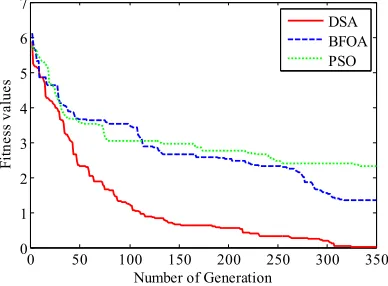
Simulations were continued in the linear model of power system 20 times for each optimization technique. The Figure 5 is the comparison of convergence curves obtained from best optimization results of DSA, BFOA and PSO techniques. From the Figure 5, the convergence of DSA is faster as compared to both BFOA and PSO techniques. Thus, DSA shows rapid convergence for PSS optimization in complex power system.
0 50 100 150 200 250 300 350
0 1 2 3 4 5 6 7
Number of Generation
F
it
n
e
ss
v
a
lu
e
s
[image:5.612.315.509.447.590.2]DSA BFOA PSO
Figure 5: Comparative convergence curve for DSA, BFOA and PSO achieved during best solution
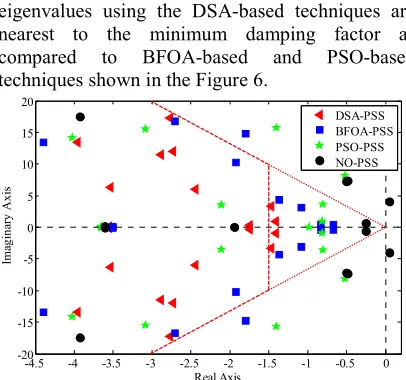
ISSN: 1992-8645 www.jatit.org E-ISSN: 1817-3195 eigenvalues using the DSA-based techniques are
nearest to the minimum damping factor as compared to BFOA-based and PSO-based techniques shown in the Figure 6.
-4.5 -4 -3.5 -3 -2.5 -2 -1.5 -1 -0.5 0
-20 -15 -10 -5 0 5 10 15 20
Real Axis
Im
ag
in
ar
y
A
x
is
DSA-PSS BFOA-PSS PSO-PSS NO-PSS
Figure 6: Comparative progress of electromechanical modes in D-shaped region for best optimization solution
The non-linear model of test system were executed using the optimized parameters. A three-phase fault was created to one tie circuit between bus 9 and 13 near at bus 9 of 2-area power system shown in the Figure 1. The fault was applied at 100ms of simulation time (9s) for 150ms. After that the system was operating with one tie line only and oscillations were grown in the system. Figure 7 and Figure 8 are the damping responses over local as well as inter-area modes of oscillations, respectively. From the figures, the system is totally unstable without PSSs because of the three-phase faults. However, the installation of PSSs after optimization bring back the stability for all optimization techniques as shown in figures 7-8. From both figures, as compared to BFOA-based and PSO-based designed PSSs, DSA-based designed PSSs have significantly reduced overshoots and settling times for both type of oscillating modes. Thus, system stability is improved notably in a disturbed system using DSA-based designed PSSs.
0 1 2 3 4 5 6 7 8 9
-1 -0.5 0 0.5 1 1.5x 10
-3
Time (sec)
W
1
-W
2
(
ra
d
/s
e
c
)
DSA-PSS BFOA-PSS PSO-PSS NO-PSS
Figure 7: Local mode between G1 and G2 (W1-W2) for three phase fault at bus 9
0 1 2 3 4 5 6 7 8 9
-3 -2 -1 0 1 2 3x 10
-3
Time (sec)
W
2
-W
3
(
ra
d
/s
e
c
)
[image:6.612.312.519.80.262.2]DSA-PSS BFOA-PSS PSO-PSS NO-PSS
Figure 8: Inter-area mode between G2 and G3 (W2-W3) for three phase fault at bus 9.
8. CONCLUSION
This paper proposes DSA for optimization of PSSs controller in order to provide adequate damping restraining power system oscillation. The optimization of PSSs is formulated as an optimization problem. After that, DSA is applied to find for the best optimized parameter values. To verify the performance of the proposed optimization algorithm, simulation is conducted in linear model as well as non-linear model and then compared with other popular meta-heuristic optimization algorithms such as BFOA, PSO. The comprehensive analyses are based on the convergence rate, improvement of electromechanical modes in a visual D-shaped s-plane, and the non-linear time domain simulation. In order to design PSSs efficiently, the efficiency of DSA designed PSSs is remarkable than that of BFOA and PSO techniques in multi machine power system. The eigenvalues are more stable in the proposed design, which indicates efficient search techniques of the proposed optimization algorithm. In the time domain simulation, enough damping is achieved to stabilize system from disturbances and its consequence incidents. Therefore, the presented DSA optimization technique has great potential to solve complex design problem of coordinated PSSs for the safety of multi machine power system.
APPENDIX:
Optimization algorithm settings:
(a) DSA Settings: dimension size, D = 20;
[image:6.612.91.294.94.284.2]ISSN: 1992-8645 www.jatit.org E-ISSN: 1817-3195 350; control parameters, P1 = P2 =
0.3×rand.
(b) BFOA Settings: dimension size, D = 20; population size, N = 50; chemotactic steps,
Nc = 70; reproduction steps, Nre = 5; elimination-dispersal steps, Ned = 5; ped = 0.25; C=0.05; mar= 0.1; wat = 0.2; wre= 10. (c) PSO Settings: dimension size, D = 20;
population size, N = 50; generation, G = 350; cognitive constant, C1 = 2; social constant, C2 = 2; wmin=0.4; wmax=0.9.
REFRENCES:
[1] Kundur P. Power system stability and control. Balu NJ, Lauby MG, editors. New York: McGraw-hill; 1994.
[2] Sauer PW, Pai MA, Power system dynamics and stability. Prentice Hall Upper Saddle River; 1998.
[3] Larsen EV, Swann DA. Applying power system stabilizers Part III: Practical considerations. IEEE Transactions on Power Apparatus and Systems 1981; PAS-100(6):3034-3046.
[4] Kundur P, Klein M, Rogers GJ, Zywno MS. Application of power system stabilizers for enhancement of overall system stability. Power Systems, IEEE Transactions on. 1989 May;4(2):614-26.
[5] Trudnowski DJ, Smith JR, Short TA, Pierre DA. An application of Prony methods in PSS design for multimachine systems. Power Systems, IEEE Transactions on. 1991 Feb;6(1):118-26.
[6] Cai LJ, Erlich I. Simultaneous coordinated tuning of PSS and FACTS damping controllers in large power systems. Power Systems, IEEE Transactions on. 2005 Feb;20(1):294-300. [7] Abido MA. An efficient heuristic optimization
technique for robust power system stabilizer design. Electric Power Systems Research. 2001 Jun 21;58(2):53-62.
[8] Islam NN, Hannan MA, Shareef H, Mohamed A. Power system stabilizer design using BAT optimization algorithm in multimachine power system. InResearch and Development (SCOReD), 2013 IEEE Student Conference on 2013 Dec 16 (pp. 540-544). IEEE.
[9] Abdel-Magid YL, Abido MA, Al-Baiyat S, Mantawy AH. Simultaneous stabilization of multimachine power systems via genetic algorithms. Power Systems, IEEE Transactions on. 1999 Nov;14(4):1428-39.
[10] Abido MA. Particle swarm optimization for multimachine power system stabilizer design. InPower Engineering Society Summer Meeting, 2001 2001 Jul 15 (Vol. 3, pp. 1346-1351). IEEE.
[11] Shayeghi H, Shayanfar HA, Safari A, Aghmasheh R. A robust PSSs design using PSO in a multi-machine environment. Energy Conversion and Management. 2010 Apr 30;51(4):696-702.
[12] Panda S. Robust coordinated design of multiple and multi-type damping controller using differential evolution algorithm. International Journal of Electrical Power & Energy Systems. 2011 May 31;33(4):1018-30.
[13] Ali ES, Abd-Elazim SM. Coordinated design of PSSs and TCSC via bacterial swarm optimization algorithm in a multimachine power system. International journal of electrical power & energy systems. 2012 Mar 31;36(1):84-92. [14] Niamul Islam N, Hannan MA, Shareef H,
Mohamed A, Salam MA. Comparative study of popular objective functions for damping power system oscillations in multimachine system. The Scientific World Journal. 2014 Apr 6;2014. [15] Civicioglu P. Transforming geocentric cartesian
coordinates to geodetic coordinates by using differential search algorithm. Computers & Geosciences. 2012 Sep 30;46:229-47.
[16] Hannan MA, Chan KW. Transient analysis of FACTS and custom power devices using phasor dynamics. Journal of Applied Sciences. 2006;6:1074-81.
[17] Hussain A, Hannan MA, Mohamed A, Sanusi H, Ariffin AK. Vehicle crash analysis for airbag deployment decision. Int. J. Automotive Technology. 2006 Apr 1;7(2):179-85.
[18] Hannan MA, Hussain A, Mohamed A, Samad SA. Development of an embedded vehicle safety system for frontal crash detection. International Journal of Crashworthiness. 2008 Sep 11;13(5):579-87.
[19] Rogers G. Power system oscillations. Springer Science & Business Media; 2012 Dec 6. [20] Chow J. Power system toolbox: A set of
coordinated m-files for use with MATLAB. Cherry Tree scientific software; 1996