http://dx.doi.org/10.4236/ojs.2014.41005
Automatic Variable Selection for High-Dimensional Linear
Models with Longitudinal Data
Ruiqin Tian, Liugen Xue
College of Applied Sciences, Beijing University of Technology, Beijing, China Email: [email protected]
Received November 6, 2013; revised December 6, 2013; accepted December 13,2013
Copyright © 2014 Ruiqin Tian, Liugen Xue. This is an open access article distributed under the Creative Commons Attribution Li- cense, which permits unrestricted use, distribution, and reproduction in any medium, provided the original work is properly cited. In accordance of the Creative Commons Attribution License all Copyrights © 2014 are reserved for SCIRP and the owner of the intel- lectual property Ruiqin Tian, Liugen Xue. All Copyright © 2014 are guarded by law and by SCIRP as a guardian.
ABSTRACT
High-dimensional longitudinal data arise frequently in biomedical and genomic research. It is important to select relevant covariates when the dimension of the parameters diverges as the sample size increases. We consider the problem of variable selection in high-dimensional linear models with longitudinal data. A new variable selection procedure is proposed using the smooth-threshold generalized estimating equation and quadratic inference functions (SGEE-QIF) to incorporate correlation information. The proposed procedure automatically eliminates inactive predictors by setting the corresponding parameters to be zero, and simultaneously estimates the nonzero regression coefficients by solving the SGEE-QIF. The proposed procedure avoids the convex optimization prob- lem and is flexible and easy to implement. We establish the asymptotic properties in a high-dimensional frame- work where the number of covariates p increases as the number of cluster n n increases. Extensive Monte
Carlo simulation studies are conducted to examine the finite sample performance of the proposed variable selec- tion procedure.
KEYWORDS
Variable Selection; Diverging Number of Parameters; Longitudinal Data; Quadratic Inference Functions; Generalized Estimating Equation
1. Introduction
Longitudinal data arise frequently in biomedical and health studies in which repeated measurements form the same subject are correlated. A major aspect of longitudinal data is the within subject correlation among the re- peated measurements. Ignoring this within subject correlation causes a loss of efficiency in general problems. One of the commonly used regression methods for analyzing longitudinal data is generalized estimating equa-tions (Liang and Zeger, [1]). Generalized estimating equaequa-tions (GEE) using a working correlation matrix with nuisance parameters estimate regression parameters consistently even when the correlation structure is misspe-cified. However, under such misspecification, the estimator can be inefficient. For this reason, Qu et al. [2] pro-posed a method of quadratic inference functions (QIF). It avoids estimating the nuisance correlation structure parameters by assuming that the inverse of working correlation matrix can be approximated by a linear combi-nation of several known basis matrices. The QIF can efficiently take the within subject correlation into account and is more efficient than the GEE approach when the working correlation is misspecified. The QIF estimator is also more robust against contamination when there are outlying observations (Qu and Song, [3]).
lized estimation using penalty functions. Such as, Lq penalty (Frank and Friedman, [4]), LASSO penalty
(Tibshirani, [5]), SCAD penalty (Fan and Li, [6]), and so on. In the longitudinal data framework, Pan [7] pro- posed an extension of the Akaike information criterion (Akaike, [8]) by applying the quasi-likelihood to the GEE, assuming independent working correlation. Wang and Qu [9] developed a Bayesian information type of criterion (Schwarz, [10]) based on the quadratic inference functions. Fu [11] applied the bridge penalty model to the GEE and Xu et al. [12] introduced the adaptive lasso for the GEE setting, and references therein. These me- thods are able to perform variable selection and parameter estimation simultaneously. However, most of the theory and implementation is restricted to a fixed dimension of parameters.
Despite the importance of variable selection in high-dimensional settings (Fan and Li, [13]; Fan and Lv, [14]), variable selection for longitudinal data that take into consideration the correlation information is not well studied when the dimension of parameters diverges. In this paper we use the smooth-threshold generalized estimating equation based on quadratic inference functions (SGEE-QIF) to the high-dimensional longitudinal data. The proposed procedure automatically eliminates the irrelevant parameters by setting them as zero, and simulta- neously estimates the nonzero regression coefficients by solving the SGEE-QIF. Compared to the shrinkage methods and the existing research findings reviewed above, our method offers the following improvements: 1) the proposed procedure avoids the convex optimization problem; 2) the proposed SGEE-QIF approach is flexi- ble and easy to implement; 3) the proposed method is easy to deal with the longitudinal correlation structure and extend the estimating equations approach to high-dimensional longitudinal data.
The rest of this paper is organized as follows. In Section 2 we first propose variable selection procedures for high-dimensional linear models with longitudinal data, and asymptotic properties of the resulting estimators. In Section 3 we give the computation of the estimators as well as the choice of the tuning parameters. In Section 4 we carry out simulation studies to assess the finite sample performance of the method. Some assumptions and the technical proofs of all asymptotic results are provided in the Appendix.
2. Automatic Variable Selection Procedure
2.1. Model and Notation
We consider a longitudinal study with n subjects and mi observations over time for the ith subject
(
i=1,,n)
for a total of 1n i i
N m
=
=
∑
observation. Each observation consists of a response variable Yij and acovariate vector pn
ij
X ∈R taken from the ith subject at time tij. We assume that the full data set
(
)
{
X Yij, ij ,i=1,, ,n j=1,,mi}
is observed and can be modelled asT , 1, , , 1, , ,
ij ij ij i
Y = X β ε+ i= n j= m (2.1)
where β is a pn×1 vector of unknown regression coefficients, and pn diverging as the sample size in-
creases. εij is random error with E
(
εij Xij)
=0. In addition, we give assumptions on the first two moments ofthe observations
{ }
Yij , that is,( )
Tij ij
E Y = X β and
( )
(
T)
Var Yij =v Xijβ , where v
( )
⋅ is a known variance function.2.2. Quadratic Inference Functions
Denote Yi=
(
Yi1,,Yimi)
T,and write Xi in a similar fashion. Following Liang and Zeger [1], a GEE can beused to estimate the regression parameters, β,
(
)
T 1
1
0,
n
i i i i i
X V− Y Xβ =
− =
∑
(2.2)where Vi is the covariance matrix of Yi. The matrix Vi is often modelled as
( )
1 2 1 2
i i
A R α A , where Ai is a
diagonal matrix representing the variance of Yij, that is, Ai=diag Var
(
( )
Yi1 ,, Var( )
Yimi)
, R( )
α is a com-consistent estimators of α do not always exist (Crowder [15]). To avoid this drawback, Qu et al. [2] suggested that the inverse of the working correlation matrix, R−1
( )
αis approximated by a linear combination of basis matrices, M ii, =1,,s, such as
( )
1
1 ,
s k k k
R− α a M
=
≈
∑
(2.3)where M1,,Ms are known matrices, and a1,,as are unknown constants. This is a sufficiently rich class
that accommodates, or at least approximates, the correlation structures most commonly used. Details of utilizing a linear combination of some basic matrices to model the inverse of working correlation can be found in Qu et al. [2].
Substituting (2.3) to (2.2), we get the following class of estimating functions:
(
)
(
)
T 1 2 1 2
1 1
1
0.
n
i i s s i i i
i
X A− a M a M A− Y Xβ
=
+ + − =
∑
(2.4)Instead of estimating parameters a=
(
a1,,as)
T directly, they recognized that a GEE (2.4) is equivalent to solving the linear combination of a vector of estimating equations:( )
( )
1 1 n
n i
i
g g
n
β β
=
=
∑
, (2.5)where
( )
(
)
(
)
T 1 2 1 2 1
T 1 2 1 2
i i i i i
i
i i s i i i
X A M A Y X
g
X A M A Y X
β β
β
− −
− −
−
=
−
However, (2.5) does not work because the dimension of gn
( )
β is obviously greater than the number of un-known parameters. Using the idea of generalized method of moments (Hansen, [16]), Qu et al. [2] defined the quadratic inference functions (QIF),
( )
T( )
1( ) ( )
n n n n
Q β =g β Ω− β g β (2.6)
where
( )
( ) ( )
T 21
1 n
n i i
i
g g
n
β β β
=
Ω =
∑
Note that Ωn depends on β. The QIF estimate βˆn is then given by
( )
ˆ arg min
n β Qn
β = β .
Then, based on (2.6), according to Qu et al. [2], the corresponding estimating equation for β is
( )
T 1n n n n
U β =ng Ω− g , (2.7)
where gn is the spn×pn matrix
{
}
T
n
g β
∂ ∂ .
2.3. Smooth-Threshold Generalized Estimating Equations Based on QIF
Variable selection is an important topic in high dimensional regression analysis and most of the variable selec- tion procedures are based on penalized estimation using penalty functions. Because of these variable selection procedures using penalty function have a singularity at zero. So, these procedure require convex optimization, which incurs a computational burden. To overcome this problem, Ueki [17] developed a automatic variable se- lection procedure that can automatically eliminate irrelevant parameters by setting them as zero. The method is easily implemented without solving any convex optimization problems. Motivated by this idea we propose the following smooth-threshold generalized estimating equations based on quadratic inference functions (SGEE- QIF)
(
)
( )
0n
p n
where ∆ is the diagonal matrix whose diagonal elements are
( )
1, , n
j j p δ = δ =
, and Ipn is the pn dimen-
sional identity matrix. Note that the jth SGEE-QIF with δj =1 reduces to βj =0. Therefore, SGEE-QIF (2.8) can yield a sparse solution. Unfortunately, we cannot directly obtain the estimator of β by solving (2.8). This is because the SGEE-QIF involves δj, which need to be chosen using some data-driven criteria. For the
choice of
( )
1, , n
j j p
δ δ
=
=
, Ueki [17] suggested that δj may be determined by the data, and can be chosen by
( )1 0
ˆ min 1, ˆ
j j
γ δ = λ β +
with an initial estimator
( )0
ˆ
j
β . The initial estimator βˆ( )j0 can be obtained by solving
the QIF (2.6) for the full model. Note that this choice involves two tuning parameters
(
λ γ,)
. In Section 4, fol- lowing the idea of Ueki [17], we use the BIC-type criterion to select the tuning parameters.Replacing ∆ in (2.8) by ˆ∆ with diagonal elements
( )
1, ,ˆ ˆ
n j
j p
δ δ
= =
. The SGEE-QIF becomes
(
ˆ)
( )
ˆ 0n
p n
I − ∆ U β + ∆ =β . (2.9) The solution of (2.9) denoted by βˆλ γ, is called the SGEE-QIF estimator.
2.4. Asymptotic Properties
We next study the asymptotic properties of the smooth-threshold estimator. Let β0 be the fixed true value of
β. Denote Α =0
{
j:β0j ≠0}
and 0{
: 0 0}
c
j j β
Α = = . Denote by s= Α0 the number of true nonzero para-
meters. s may be fixed or grow with n. We assume, under the regularity conditions, the initial QIF estimator
0
ˆ
β obtained by solving the QIF (2.6) satisfies ˆ0 0
n p
p O
n β −β =
when pn→ ∞ and
( )
2 1
1
n
p n− =o , where β0 is the true value of β. Following Fan and Peng [18] and Wang [19], it is possible to prove the oracle properties for the SGEE-QIF estimators, including n pn consistency, variable selection consistency and asymptotic normality.
To obtain the asymptotic properties in the paper, we require the following regularity conditions: (C1). The parameter space S is compact, and β0 is an interior point of S.
(C2). 4
i
Eε < ∞, EXij r( ) < ∞, i=1,,n, j=1,,mi, r=1,,pn, where EXij r( ) is the rth component
of Xij.
(C3).
0 0
0 0
T 1 2 1 2
, 1 ,
0
1 T 1 2 1 2
, ,
1 lim
i i i i
n
n i
i i s i i
X A M A X
E J
n
X A M A X
− −
Α Α
→∞ =
− −
Α Α
≡
∑
.(C4). The weighting matrix Ωn
( )
β converges almost surely to a constant matrix Ω0, where Ω0 is in- vertible. Furthermore, the first and second partial derivatives of Ωn in β are all Op( )
1 .(C5). Qn
( )
β is a twice differentiable function of β. Furthermore the third derivatives of Qn( )
β are( )
p O n .
(C6). All the variance matrixesAi ≥0, and supi Ai < ∞.
(C7). supi j, Xij =O
( )
pn .(C8).
( ) ( ) ( )
0 0 0( )
2
T 1 2
0 .
n A n A p n
E M β g β Ω− βΑ =O p
We define the active set Α =
{
j:δˆj ≠1}
which is the set of indices of nonzero parameters, where( )1 0
ˆ min 1, ˆ , 1, , .
j j j pn
γ δ = λ β + =
The following theorem gives the consistency of the SGEE-QIF estimators.
Theorem 1. Under conditions C1-C8, for any positive λ and γ , such that 2 1
( )
1
n
p n− =o , 1 2 0
n λ → and
(
)
(1 )2n
0
ˆ n
p
p O
n β β− =
.
Furthermore, we show that such consistent estimators must possess the sparsity property and the estimators for nonzero coefficients have the same asymptotic distribution as that based on the correct submodel.
Theorem 2. Suppose that the conditions of Theorem 1 hold, if 1 3
( )
1
n
n p− =o , as n→ ∞, we have 1) Variable selection consistency, i.e.
(
0)
1P A=A →
2) Asymptotic normality, i.e.
( )
0(
0 0)
(
)
1 2
0 ˆ 0,
L
n n A A A
n A M− β J β −β →N G
where An is a q s× matrix such that
T
n n
A A →G , G is a q q× non-negative symmetric matrix,
( )
0( )
0T 1
0 0 0
n A
M β =J Ω− βΑ J , and “
L
→” represents the convergence in distribution.
Remark: Theorems 1 and 2 imply that the proposed SGEE-QIF procedure is consistent in variable selection, it can identify the zero coefficients with probability tending to 1. By choosing appropriate tuning parameters, the SGEE-QIF estimators have the oracle property; that is, the asymptotic variances for the SGEE-QIF estimators are the same as what we would have if we knew in advance the correct submodel.
3. Computation
3.1. Algorithm
Next, we propose the iterative algorithm to implement the procedures as follows:
Step 1, Calculate the initial estimates βˆ( )0 of β by solving the initial QIF (2.5) estimator. Let k=0.
Step 2, By using the current estimate βˆ( )k , we choose the tuning parameters
(
λ γ,)
by the BIC criterion.Step 3, Update the estimator of β as follows:
( ) ( )
{
( )
( )( )
( )( )
( )}
1{
( )
( )( )
( )( )
( ) ( )}
1 T 1 T 1
, , , ,
ˆk ˆk ˆk ˆk ˆk ˆ ˆk ˆk ˆk ˆ ˆk ,
A A ngn A A n A gn A A GA gn A A n A gn A A GA A
β + =β − β Ω− β β + − × β Ω− β β + β
ˆ ,
ˆ 0
c A
β ∆=
where
( )
(
)
(
)
T 1 2 1 2
, 1 ,
,
1 T 1 2 1 2
, ,
1 n i A i i i i A A
n A A i
i A i s i i i A A
X A M A Y X
g
n
X A M A Y X
β β
β
− −
= − −
−
=
−
∑
and
(
)
1
ˆ ˆ ˆ
A A A A
G = I − ∆ − ∆ .
Step 4, Iterate Steps 2-3 until convergence, and denote the final estimators of β as the SGEE-QIF estimator.
3.2. Choosing the Tuning Parameters
To implement the procedures described above, we need to choose the tuning parameters
(
λ γ,)
. Following Ueki [17], we use BIC-type criterion to choose these two parameters. That is, we choose(
λ γ,)
as the minimizer of( )
( )
, n ˆ, , log ,
BICλ γ =Q βλ γ +dfλ γ n
where βˆλ γ, is the SGEE-QIF estimator for given
(
λ γ,)
, dfλ γ, is simply the number of nonzero coefficientˆ
β. The selected
(
λ γ,)
minimizes the BICλ γ, .3.3. Choosing the Basis Matrices
The choice of basis matrices Mk in (2.2) is not difficult, especially for those special correlation structures
which are frequently used. If we assume R
( )
α is the first-order autoregressive correlation matrix. The exact inversion R−1( )
αwhere M1 is the identity matrix, M2 has 1 on two main off-diagonals and 0 elsewhere, and M3 has 1 on the corners (1, 1) and (m, m), and 0 elsewhere. Suppose R
( )
α is an exchangeable working correlation matrix, it has 1 on the diagonal, and α everywhere off the diagonal. Then R−1( )
αcan be written as a linear combina- tion of two basis matrices, M1 is the identity matrix and M2 is a matrix with 0 on the diagonal and 1 off the diagonal. More details about choosing the basis matrices can be seen in Zhou and Qu [20].
4. Simulation Studies
In this section we conduct a simulation study to assess the finite sample performance of the proposed procedures. In the simulation study, the performance of estimator βˆ will be assessed by using the average the mean square
error (AMSE), defined as
2 0 ˆ
β β− averaged over 500 times simulated data sets.
We simulate data from the model (1.1), where β0=
(
β1,,βpn)
T with β =1 2.8, β = −2 1.8 and β =3 3.8. While the remaining coefficients, corresponding to the irrelevant variables, are given by zeros. In addition, let1 3
4
n
p = n , where u denotes the largest integer not greater than u. To perform this simulation, we take the covariates Xij
(
j=1,, 5)
from a multivariate normal distribution with mean zero, marginal variance 1 and correlation 0.5. The response variable Yij is generated according to the model. And error vector(
)
T(
2(
)
)
1, , 5 ~ 0, Corr ,
i i i N i
ε = ε ε σ ε α , where σ =2 1 and Corr
(
ε αi,)
is a known correlation matrix withparameter α used to determine the strength of with-subject dependence. Here we consider εij has the first-
order autoregressive (AR-1) or compound symmetry (CS) correlation (i.e. exchangeable correlation) structure with α =0.7. In the following simulations, we make 500 simulation runs and take n=60 and 120.
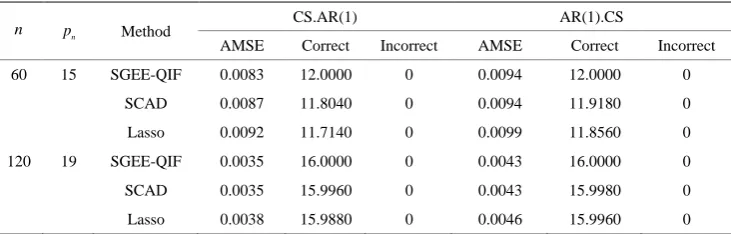
[image:6.595.112.485.446.560.2]In the simulation study, for each simulated data set, we compare the estimation accuracy and model selection properties of the SGEE-QIF method, the SCAD-penalized QIF and the Lasso-penalized QIF for two different working correlations. For each of these methods, the average of zero coefficients over the 500 simulated data sets is reported in Tables 1 and 2. Note that “Correct” in tables means the average number of zero regression
Table 1. Variable selections for the parametric components under different methods when the correlation structure is correctly specified.
n pn Method
CS AR(1)
AMSE Correct Incorrect AMSE Correct Incorrect 60 15 SGEE-QIF 0.0062 12.0000 0 0.0066 12.0000 0
SCAD 0.0064 11.9020 0 0.0070 11.9280 0 Lasso 0.0067 11.8520 0 0.0074 11.9080 0 120 19 SGEE-QIF 0.0028 16.0000 0 0.0029 16.0000 0 SCAD 0.0028 16.0000 0 0.0030 16.0000 0 Lasso 0.0031 16.0000 0 0.0033 15.9980 0
Table 2. Variable selections for the parametric components under different methods when the correlation structure is incorrectly specified. The term “CS.AR(1)” means estimation with the fitted misspecified AR(1) correlation structure, while “AR(1).CS” means estimation with the fitted misspecified CS correlation structure.
n pn Method CS.AR(1) AR(1).CS
AMSE Correct Incorrect AMSE Correct Incorrect 60 15 SGEE-QIF 0.0083 12.0000 0 0.0094 12.0000 0
[image:6.595.116.482.618.735.2]coefficients that are correctly estimated as zero, and “Incorrect” depicts the average number of non-zero regres- sion coefficients that are erroneously set to zero. At the same time, we also examine the effect of using a miss- pecified correlation structure in the model, which are also reported in Tables 1 and 2. From Tables 1 and 2, we can make the following observations.
1) For the parametric component, the performances of variable selection procedures become better and better as n increases. For example, the values in the column labeled “Correct” become more and more closer to the true number of zero regression coefficients in the models.
2) Compared with the penalized QIF based on Lasso and SCAD, SGEE-QIF performs satisfactory in terms of variable selection.
3) It is not surprised that the performances of variable selection procedures based on the correct correlation structure work better than based on the incorrect correlation structure. However, we also note that the perfor- mance does not significantly depend on working covariance structure.
5. Discussion
In this paper, we have proposed the smooth-threshold generalized estimating equation based on quadratic infe- rence function (SGEE-QIF) to the high-dimensional longitudinal data. Our method incorporates the within sub- ject correlation structure of the longitudinal to automatically eliminate the irrelevant parameters by setting them as zero, and simultaneously estimates the nonzero regression coefficients. As a future research topic, it is inter-esting to consider the variable selection for the high/ultra-high dimension varying coefficient models with lon-gitudinal data.
Acknowledgements
This research was supported by the National Natural Science Foundation of China (11171012, 11331011), the Science and technology project of the faculty adviser of excellent PHD degree thesis of Beijing (20111000503), the Beijing Municipal Education Commission Foundation (KM201110005029), and the Beijing municipal key disciplines (No.006000541213009).
REFERENCES
[1] K. L. Liang and S. L. Zeger, “Longitudinal Data Analysis Using Generalised Estimating Equations,” Biometrika, Vol. 73, No. 1, 1986, pp. 13-22. http://dx.doi.org/10.1093/biomet/73.1.13
[2] A. Qu, B. G. Lindsay and B. Li, “Improving Generalized Estimating Equations Using Quadratic Inference Functions,” Biome-trika, Vol. 87, No. 4, 2000, pp. 823-836. http://dx.doi.org/10.1093/biomet/87.4.823
[3] A. Qu and P. X. K. Song, “Assessing Robustness of Generalized Estimating Equations and Quadratic Inference Functions,” Biometrika, Vol. 91, No. 2, 2004, pp. 447-459. http://dx.doi.org/10.1093/biomet/91.2.447
[4] I. E. Frank and J. H. Friedman, “A Statistical View of Some Chemometrics Regression Tools (with Discussion),” Technome-trics, Vol. 35, No. 2, 1993, pp. 109-148. http://dx.doi.org/10.1080/00401706.1993.10485033
[5] R. Tibshirani, “Regression Shrinkage and Selection via the LASSO,” Journal of Royal Statistical Society, Series B, Vol. 58, No. 1, 1996, pp. 267-288.
[6] J. Q. Fan and R. Li, “Variable Selection via Nonconcave Penalized Likelihood and Its Oracle Properties,” Journal of American Statistical Association, Vol. 96, No. 456, 2001, pp. 1348-1360. http://dx.doi.org/10.1198/016214501753382273
[7] W. Pan, “Akaike’s Information Criterion in Generalized Estimating Equations,” Biometrics, Vol. 57, No. 1, 2001, pp. 120-125. http://dx.doi.org/10.1111/j.0006-341X.2001.00120.x
[8] H. Akaike, “Information Theory and an Extension of the Maximum Likelihood Principle,” Proceedings of the 2nd Internation-al Symposium on Information Theory, Budapest, 1973, pp. 267-281.
[9] L. Wang and A. Qu, “Consistent Model Selection and Data-Driven Smooth Tests for Longitudinal Data in the Estimating Equ-ations Approach,” Journal of the Royal Statistical Society: Series B, Vol. 71, No. 1, 2009, pp. 177-190.
http://dx.doi.org/10.1111/j.1467-9868.2008.00679.x
[10] G. Schwarz, “Estimating the Dimension of a Model,” The Annals of Statistics, Vol. 6, No. 2, 1978, pp. 461-464. http://dx.doi.org/10.1214/aos/1176344136
[11] W. J. Fu, “Penalized Estimating Equation,” Biometrics, Vol. 59, No. 1, 2003, pp. 126-132. http://dx.doi.org/10.1111/1541-0420.00015
Para-meters,” Science China Mathematics, Vol. 56, No. 2, 2013, pp. 359-377. http://dx.doi.org/10.1007/s11425-012-4564-y
[13] J. Fan and R. Li, “Statistical Challenges with High Dimensionality: Feature Selection in Knowledge Discovery,” Proceedings of the International Congress of Mathematicians, Vol. 3, European Mathematical Society, 2006, pp. 595-622.
[14] J. Fan and J. Lv, “A Selective Overview of Variable Selection in High-Dimensional Feature Space,” Statistica Sinica, Vol. 20, No. 1, 2009, pp. 101-148.
[15] M. Crowder, “On the Use of a Working Correlation Matrix in Using Generalised Linear Models for Repeated Measures,” Bio-metrika, Vol. 82, No. 2, 1995, pp. 407-410. http://dx.doi.org/10.1093/biomet/82.2.407
[16] L. Hansen, “Large Sample Properties of Generalized Method of Moments Estimators,” Econometrica, Vol. 50, No. 4, 1982, pp. 1029-1054. http://dx.doi.org/10.2307/1912775
[17] M. Ueki, “A Note on Automatic Variable Selection Using Smooth-Threshold Estimating Equations,” Biometrika, Vol. 96, No. 4, 2009, pp. 1005-1011. http://dx.doi.org/10.1093/biomet/asp060
[18] J. Fan and H. Peng, “Nonconcave Penalized Likelihood with a Diverging Number of Parameters,” The Annals of Statistics, Vol. 32, No. 3, 2004, pp. 928-961. http://dx.doi.org/10.1214/009053604000000256
[19] L. Wang, “GEE Analysis of Clustered Binary Data with Diverging Number of Covariates,” The Annals of Statistics, Vol. 39, No. 1, 2011, pp. 389-417. http://dx.doi.org/10.1214/10-AOS846
[20] J. Zhou and A. Qu, “Informative Estimation and Selection of Correlation Structure for Longitudinal Data,” Journal of the American Statistical Association, Vol. 107, No. 498, 2012, pp. 701-710. http://dx.doi.org/10.1080/01621459.2012.682534
Appendix. Proof of Theorems
Proof of Theorem 1
Let Sn
( )
β =(
Ipn − ∆ˆ)
Un( )
β + ∆ˆβ. It suffices to prove for any ε>0, there is a constant c>0, such that(
)
T 0
sup n n n 0 1
u c
P p nu S β p nu ε
=
+ > ≥ −
(A.1)
for n enough. This will imply that there exists a local solution to the equation Sn
( )
β =0. Such that(
)
0
ˆ
p n
O p n
β β− = with probability at least 1−ε. The proof follows that of Theorem 3.6 in Wang [19],
we will evaluate the sign of T
(
)
0
n n n
p nu S β + p nu in the ball of
{
β0+ pn nu: u =c}
. Note that(
)
( )
( )
T T
0 0 1 2,
T
n n n n n n n n n
p nu S β p nu p nu S β p n u S β u I I
β ∂
+ = + ≡ +
∂ (A.2)
where β lies between β0 and β0+ pn nu. Next we will consider In1 and In2 respectively. For In1, by Cauchy-Schwarz inequality, we can derive that
(
)
( )
(
(
)
)
( )
T
1 n ˆ 0 min ˆ 0 .
n n p n n j n
j A
I p n u I U β p n δ λ γ u U β
∈
≤ − ∆ ≤ 1− ,
According to condition (C7), consider the kth
(
k=1,,m)
block of gn( )
β ,(
)
T 1 2 1 2
1
1 n
k i i k i i i
i
B X A M A Y X
n β
− −
=
=
∑
− , let Bk s, denote the sth components Bk, by some elementary calcu-lation, we obtain
( )
,(
)
2
2 2
, 2
1 1 1 1 1
1
,
i i i
k s
m m m
n n
jv
ij s i ij n i j i j v
E B X E O p n
n = = = = = σ ε
= =
∑∑ ∑∑∑
where jv
i
σ is the
( )
j v, th element of 1 2 1 2i k i
A− M A− , hence, we have gn
( )
β =Op(
pn n)
. By C3 and C4,we obtain,
( )
( )
1( ) ( )
(
)
0 .
n n n n p n
U β = g β Ω− β g β =O p n (A.3)
Since
( )
( )
0 ˆ ˆ min min j A j j j A
δ λ γ δ λ γ
∈ ∈
≤
, , , we only need to obtain the convergence rate of
( )
0
ˆ min
j A j
δ λ γ
∈
, . Assume
that βˆ0 is the initial estimator, and is n pn-consistent. By using the condition
1 2 0
n λ → for any ε>0 and j∈A0, we have
( )
(
)
( )(
(
)
( ) ( ))
(
)
( )(
)
(
0)
1 1 1
0 0
1 2 1 2 1 2
1 1 1 2
ˆ ˆ ˆ
min 0,
j j j
oj p n j A
P n P n P n
P n O p n
γ γ
γ
δ λ γ ε λ β ε λ ε β
λ ε β
+ +
− −
+
∈
> = > = >
≤ > − →
,
which implies that ˆ
(
)
( )
1 2j op n
δ λ γ, = −
for each j∈A0. Therefore, we have that
( )
( )
1 2 ˆ
min
j A j p
o n δ λ γ
∈
− =
, .
Hence, by (A.3), we obtain that
(
)
(
3 2)
1
n p n p n
I =O p n u −o p n− u . (A.4)
Now, we consider In2, we can derive that
( )
(
)
T T 1 T
2 n ˆ ˆ 21 22.
n n n
n n p n n n n n
p p p
I u S u u I g g u u u I I
n β β n n
− ∂
= = − ∆ Ω + ∆ = +
∂
By above result, we get In22 =Op
(
pn n u)
2. Thus, it is easy to show that for sufficiently large n,(
)
T 0
n n n
by In21, which is positive for the sufficiently large c. The proof of Theorem 1 is completed.
Proof of Theorem 2
According to Dziak [21], it is known that the initial estimator βˆ( )0 obtained by solving the QIF is n pn -
consistent. For any given 0
c
j∈A , by
(
n pn)
(1 )2γ λ +
→ ∞, then,
( ) ( ) ( ) ( ) ( ) ( ) ( )
( )
( )
(
)
1 2 2 2
0 2 1 0 2 1 0 2 1 0
2 1
ˆ 1 ˆ max ˆ ˆ
1 0,
j j j j
n
P p P P
P n p O
γ γ γ γ
γ
λ β λ β λ β λ β
λ
+ + + +
+
< = < = < ≤ <
= < →
(A.5)
which implies that
(
ˆ 1 for all 0)
1 c jP δ = j∈A → (A.6)
On the other hand, by the condition 1 2 0
n λ → , for any ε >0, and j∈A0, we have
(
)
( )(
(
)
( ) ( ))
(
)
( )(
)
(
0)
1 1 1
0 0
1 2 1 2 1 2
1 1 1 2
0
ˆ ˆ ˆ
min 0,
j j j
j p n
j A
P n P n P n
P n O p n
γ γ
γ
δ ε λ β ε λ ε β
λ ε β
+ +
− −
+
∈
> = > = >
≤ > − →
which implies that ˆ
( )
1 2j op n
δ = − for each
0
j∈A . Therefore, we prove that P
(
δˆj<1 for all j∈A0)
→1.Thus, we complete the proof of 1).
Next, we will prove 2). As shown in 1), βˆj =0 for j∈A0 with probability tending to 1. At the same time, with probability tending to 1,
0
ˆ
A
β satisfies the smooth threshold generalized estimating equations based on quadratic inference functions (SGEE-QIF)
(
0 0)
( )
0 0 0ˆ ˆ
ˆ ˆ 0.
A n A A A
A
I − ∆ U β + ∆ β = (A.7)
Applying a Taylor expansion to (A.7) at
0 A
β , it easy to show that
( )
( )
0( )
0(
0 0)
0 00
1 1 ˆ 1 ˆ ˆ
1
p n A n A A A A A
A
o U U G
n β n β β β β n β
∂
= + − +
∂
where 0
(
0)
00
1
ˆ ˆ ˆ
A A A A
G = I − ∆ − ∆ . Since, we have
( )
{
}
( )
( ) ( )( )
{
}
( )( )(
( ))
( )( )(
)
( )(
( ))
( )( )(
)
( ) ( ) 0 0 0 0 0 0 0 0 0 0 0 2 2 20 0 0 1
2 0 2 1 2
2
2 2
0 0 0 1 0
1 2 1 2
2 2 2
0
1 ˆ ˆ 1 ˆ ˆ ˆ
ˆ
ˆ ˆ
1 max 1 max
ˆ ˆ ˆ ˆ
2 2 2 min
ˆ ˆ
2 min
j
A A j j j j
j A j j A
j j
j A j A
p j j j j p j
j A j A
j A A p
j A
G n
n n
O n O n s
O n
γ γ
γ
γ γ γ
γ
λβ λ
β β β β β
β
δ λ γ δ λ γ
λ β β β β λ β
β β β
− − − + ∈ ∈ ∈ ∈ − − − − − − ∈ ∈ − − ∈ ≤ = + − − − = + − ≤ + − =
∑
∑
∑
, ,( )
2(
(
)
)
( )
2 2 2 1 2
1 p n p ,
n γs O p n o n
λ −τ− τ− − −
+ =
where ( )
0 0 ˆ min j j A τ β ∈
= . Then, if 1 2 1 2
( ) ( )
0 0(
0,)
L
n n A n A
n− A M− β U β →N G holds, by the Slutsky theorem, we can
prove Theorem 2 (2). We write 1 2 1 2
( ) ( )
0 01
n
n n A n A ni
i
n− A M− β U β Z
= =
∑
,where
( ) ( ) ( ) ( )
0 0 0 01 2 T 1
0 1
.
ni n n A n A A n A
Z A M g g
n β β β β
− −
Since Mn
( )
βA0 Cov(
gnT( ) ( ) ( )
βA0 01 βA0 gn βA0)
−= Ω , we have
( ) ( ) ( ) ( )
0 0 0 01 2 T 1
0 1
1
Cov ov
n
ni n n A n A A n A
i
Z C A M g g G
n β β β β
− −
=
= Ω →
∑
To establish the asymptotic normality, it suffices to check the Lindeberg condition, i.e., for any ε,
{
}
2
1
0.
n
ni ni i
E Z I Z ε
=
> →
∑
(A.8)Using the Cauchy-Schwarz inequality, we have
{
}
{
}
{
}
1 2{
(
)
}
1 22 2 4
1
.
n
ni ni ni ni ni ni
i
E Z I Z ε nE Z I Z ε n E Z P Z ε
=
> = > ≤ >
∑
By Bhebyshev’s inequality,
(
)
( ) ( ) ( ) ( )
0 0 0 02 2
2
2 2 T 1
1 1 0 2
1
,
n
n n n n A n A A n A
p
P Z E Z E A M g g O
n n
ε ε− ε− β β − β β
> ≤ = Ω =
and
( ) ( ) ( ) ( )
(
)
(
( ) ( ) ( )
)
(
( ) ( )
)
0 0 0 0
0 0 0 0 0
4
4 T 1
1 2 0
2 2
T T 1 T
max max 0
2 2
1
1
n n n A n A A n A
n
n n n A n A A n A n A
E Z E A M g g
n
p
A A M g E g g O
n n
β β β β
λ λ β β β β β
−
−
= Ω
≤ Ω =
Thus, we have
{
}
2( )
2
2 1
1 .
n
n n
ni ni
i
p p
E Z I Z O n o
n n ε
=
> = =
∑
Therefore, Zni satisfies the conditions of the Lindeberg-Feller central limit theorem. Hence, the proof of