Munich Personal RePEc Archive
A Simple Model of Service Trade with
Time Zone Differences
Kikuchi, Toru and Iwasa, Kazumichi
2008
Online at
https://mpra.ub.uni-muenchen.de/9574/
A Simple Model of Service Trade
with Time Zone Di erences
January 31, 2008
Abstract
This note proposes a two-country monopolistic competition model of
service trade that captures the role of time zone di erences as a
deter-minant of trade patterns. It is shown that the utilization of time zone
di erences induces drastic change in trade patterns: Due to taking
ad-vantage of time zone di erences, service rms learve larger countries
for smaller countries.
Key Words: time zone di erences; service trade; delivery cost
1
Introduction
A tremendous change is taking place in the world economy: globalization,
caused by the communications revolution and by the deterioration of barriers
to international trade. It is now well recognized that there are many kinds of
trade, particularly in service sectors such as banking, engineering, retailing,
software development and so forth, which do not require physical shipments
of products.1 The rise of the Indian software industry provides a prime
ex-ample. The programming problems of some U.S. corporations are e-mailed
to India at the end of the U.S. workday. Indian software engineers work on
them during their regular o ce hours and provide solutions. By the time
the o ces reopen in the U.S., the solutions have already arrived, mainly as
e-mail attachments.2 Ireland, pitching to host Europe's main international
call centers, o ers another example. Cairncross (1997, p. 219) emphasized
the rise of the call-center service industry in Ireland, which is taking
geo-1
Freund and Weinhold (2002) found that Internet penetration, which is measured by
the number of Internet hosts in a country, has a positive and signi cant e ect on service
trade.
2
In his recent bestselling book, The World Is Flat, Friedman (2006, pp. 31{32) also
introduced \remote executive assistant service" in India: because of the time di erences
between India and the U.S., assistants in India can work on their assignments while U.S.
graphical advantage of being in between the U.S. and Europe. These types
of service trade require two basic conditions. First, there must be a di
er-ence in time zones between the trading partners. Second, there must be good
connections via communications networks (e.g., the Internet) which enable
the services to be \transported" quickly with little cost. In other words,
thanks to the communications revolution, time zone di erences can become
a primary driving force behind service trade. This seems to suggest that the
focus on \market proximity" as an advantage in service provision should be
accompanied by focus on a time zone (or remoteness) advantage.
In the existing literature on trade theory, however, relatively few attempts
have been made to address the role of time zones. In a seminal
contribu-tion, Marjit (2007) examined the role of international time zone di erences
in a vertically integrated Ricardian framework. He showed that time di
er-ence emerges as an independent driving force of international trade besides
taste, technology and endowment.3 According to this line, we propose a
two-country monopolistic competition model of service trade that captures the
role of time zone di erences.4 Following Marjit (2007), we assume that two
3
Jones et al. (2005, p. 309) also emphasized the role of time zone di erences as a
determinant of trade patterns.
4
Kikuchi (2006) presented a di erent type of monopolistic competition trade model
countries are located in di erent time zones. Marjit studied the role of time
zones in perfectly competitive markets with constant returns technology. In
contrast, in this study we examine their role in monopolistically
competi-tive markets with increasing returns technology, which enables us to include
service rms' location decisions explicitly.
The key assumption is that domestic service production requires one
workday and that products are ready for sale after one workday:
domes-tic delivery bears signi cant costs. In contrast to this, the utilization of
communications networks allows production in a foreign country where
no-overlapping work hours and service trade via networks enable a quick delivery
and low shipping costs. In other words, imported services whose production
bene ts from time zone di erences realize higher value than domestically
produced services. Although this assumption is at odds with that of the
standard monopolistic competition model with trade costs (e.g., Krugman
1980),5 it captures the idea that consumers would like to have services sooner
than later. On the basis of the model outlined above, we will show that the
utilization of communications networks induces drastic change in industrial
structure due to rm relocation to take advantage of time zone di erences.
In Section 2 we present basic model. In Section 3 we deal with the
5
See, also, Evans and Harrigan (2005) in which transport time increases with the
question of trade patterns, which is followed by concluding remarks presented
in Section 4.
2
The Model
Suppose there are two countries, Home and Foreign, and that they are
identi-cal in regard to tastes and technology.6 There is only one factor of production,
namely labor, and relative country size is measured by labor force size. Let
L denote the size of the world's total labor force, and L (0 < < 1)
de-note Home's size. The two countries are located in di erent time zones and
there is no overlap in working hours: when Home's workday ends, Foreign's
workday begins (aee Figure 1). There are two sectors: a monopolistically
competitive sector producing a large variety of di erentiated services and
a perfectly competitive sector producing a homogeneous good. The latter
serves as the numeraire, and units are chosen such that one unit of labor
produces one unit of output. The production of the numeraire is
instan-taneous in the sense that one unit of output can be produced within one
workday.7
The central assumption is that there are positive costs for the delivery
6
In this way, we rule out Ricardian comparative advantage.
7
of di erentiated services. We assume that the production of each service
requires one workday. Then, one unit of service which is produced in Home
is ready for sale after one workday. In order to capture this point, we assume
that domestic shipments of di erentiated services incur the \iceberg" e ect of
delivery costs: for everyt (t >1) units shipped, only one unit arrives. Thus,
the price of a Home service to Home consumers will be tp, where p is the
producer's price for the service. In other words, we can interpret (t 1)=t
as a rate of discount. Although we do not explicitly model consumption
behavior, this seems to be a reasonable assumption.
Another important assumption is that, if the utilization of
communica-tions networks becomes possible, a country can import di erentiated services
more quickly. For every t0 units shipped, one unit arrives. The key
assump-tion is the following condiassump-tion:
t > t0 >1: (1)
Note that this e ect comes not from lower production costs in Foreign, but
from the quick delivery. This assumption intends to capture the idea that
production taking advantage of time zone di erences increases the value of
each service.
We assume constant expenditure shares between the di erentiated
Dixit-Stiglitz (1977) form: D= 2 4 n X i
(di)( 1)= + n
X
j
(dj)( 1)=
3
5
=( 1)
;
where di (dj) is the consumption level of the Home (Foreign) services, is
the elasticity of substitution between di erentiated services, and n (n ) is
the number of products available from Home (Foreign). The price index for
the di erentiated services that is dual to the subutility D is represented by
P = 2 4 n X i
(tpi)1 + n
X
j
(t0p
j)
1
3
5
1=(1 )
: (2)
The Home consumers' derived demand for a Home service is8
c=t(tp) P 1 L; (3)
where is the share of spending devoted to di erentiated services. Similarly,
the derived demand for a Foreign service from Home consumers is
c0 =t0(t0p ) P 1 L: (4)
A producer of a di erentiated service has to commit units of labor as
a xed cost and has constant marginal input . With the total number of
services available to consumers being very large, each producer chooses its
constant markup price as
p= ( )=( 1): (5)
8
Free entry ensures that the equilibrium output per service, x, is constant,
common across countries, and independent of the level of delivery costs:
x= [ ( 1)]= : (6)
Before turning to the trading equilibrium, we must draw attention to
the autarky equilibrium (i.e., t0 is prohibitively high due to the lack of
com-munications networks). In autarky, the number of di erentiated services in
each country is given by nA = ( L)= , nA = [ (1 )L)]= where A
refers to the value in the autarky equilibrium. Units are chosen so that one
country's autarky number of varieties equals its relative size, i.e., by setting
( L= ) = 1, we obtain
nA = ; n A= 1 : (7)
3
Service Trade via Communications Networks
Let us turn to the case of service trade via communications networks.9 In this
case, the service market equilibrium requires that supply equal demand for
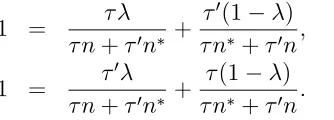
each Home service: x =c+c0. Substituting (3), the Foreign counterpart of
9
It is natural to assume that there is an additional cost of the introduction of
commu-nications networks. However, to keep matters simple, assume that there are no additional
costs. Kikuchi (2005) discusses implication of the xed investment costs of
(4), and (6) into this equation and denoting t1 and 0 t01 ( 0 > )
yields the following equilibrium condition for a Home product and its foreign
counterpart:
1 =
n+ 0n +
0(1 )
n + 0n; (8)
1 = 0
n+ 0n +
(1 )
n + 0n: (9)
Using (8) and (9), the equilibrium number of varieties can be obtained:
n= (1 )
0
0 ; n =
0 (1 )
0 : (10)
Using (7) and (10), the changes in Foreign production structure brought
about by utilizing time zone di erences can be shown as
n n A= 0
0 (2 1): (11)
If Foreign is the smaller country (i.e., >1=2), it will attract more service
rms by utilizing communications networks. This outcome implies that
pro-ducers prefer producing in the countrynext to the larger country, in order to
take advantage of time zone di erences.10 This e ect can be interpreted as a
[image:10.612.229.396.217.277.2]variant ofthe home market e ect, which is emphasized in the trade literature.
Figure 2 helps to illustrate this e ect. The 45 degree line and the
down-ward sloping curve show the relationship between relative country size and
10
Note that, due to product di erentiation, some Home rms remain to provide its
the relative number of products in autarky and in trading equilibrium,
re-spectively. The latter indicates that a relatively small country will have a
more-than-proportional number of service rms in the trading equilibrium
(see the upward arrow in the gure).11 Although this result depends
criti-cally on the assumption on delivery costs [see, (1)], it demonstrates the idea
that the utilization of communications networks induces dramatic change in
service trade as rms take advantage of time zone di erences, which has not
appeared in the existing literature.
Before closing this section, it is worthwhile to note the Home's welfare
gains from service trade liberalization, which can be measured by a change in
the e ective number of service varieties. Before trade, the e ective number
of Home varieties is , while it becomes ( 0+ ) by opening trade. Thus,
the welfare gains due to opening trade is 0 , which becomes larger as a
reduction in the delivery costs becomes larger (i.e., a larger 0).
4
Concluding Remarks
Both deeper market integration and advances in digital technology have
driven a particularly large decrease in the costs of service provision. In this
11
Note that both countries will produce di erentiated services only if lies in the range
note, we propose a two-country monopolistic competition model of service
trade that captures the role of time zone di erences. We have shown that
the utilization of communications networks induces drastic changes in
in-dustrial structure caused by rms taking advantage of time zone di erences:
service rms move away from larger countries in favor of smaller countries.
Although these results are derived under the speci c assumption that the
delivery costs of imported services are lower than for domestically provided
services, it appears that something similar to this will occur for the more
general setting we consider here.
The present analysis must be regarded as tentative. Hopefully it provides
a useful paradigm for considering how time zone di erences a ect both the
structure of service provision and trade patterns. The model could be
en-riched with the inclusion of both FDI and outsourcing aspects in order to
analyze the organization of rms.12
12
References
[1] Cairncross, F. (1997) The Death of Distance, Boston, Mass.: Harvard
Business School Press.
[2] Dixit, A. K., and J. Stiglitz (1977) \Monopolistic Competition and
Op-timum Product Diversity," American Economic Review, Vol. 67, pp.
297{308.
[3] Evans, C. L., and J. Harrigan (2005) \Distance, Time, and
Special-ization: Lean Retailing in General Equilibrium," American Economic
Review, Vol. 95, pp. 292{313.
[4] Freund, C., and D. Weinhold (2002) \The Internet and International
Trade in Services," American Economic Review, Vol. 92, pp. 236-240.
[5] Friedman, J. (2006) The World Is Flat,New York: Penguin Books.
[6] Helpman, E. (2006) \Trade, FDI, and the Organization of Firms,"
Jour-nal of Economic Literature, Vol. 44, pp. 589{630.
[7] Jones, R. W., H. Kierzkowski, and C. Lurong (2005) \What Does
Ev-idence Tell Us about Fragmentation and Outsourcing?" International
[8] Kikuchi, T. (2005) \Interconnection of Communications Networks and
Home Market E ects," Canadian Journal of Economics, Vol. 38, pp.
870{882.
[9] Kikuchi, T. (2006) \Time Zones, Outsourcing and Patterns of
Interna-tional Trade," Economics Bulletin, Vol. 6 (15), pp. 1{10.
[10] Krugman, P. (1980) \Scale Economies, Product Di erentiation, and the
Patterns of Trade," American Economic Review, Vol. 70, pp. 950{959.
[11] Marjit, S. (2007) \Trade Theory and the Role of Time Zones,"